Tuesday, January 31, 2012

TOWN APPLIES FOR DETROIT HARBOR CHANNEL DREDGING GRANT

Detroit Harbor aerial photo, several years ago.
(Ed Graf photo)

Washington Island, Wisconsin -

Recently, on Friday, January 20th, the Town of Washington Board approved an application for grant funds from the Wisconsin Department of Transportation (WisDOT) and its Harbor Assistance Program (HAP).  This is the first official step taken by the Town toward dredging the West Channel entrance to Detroit Harbor, a vital year-around navigational link for commercial water transportation to and from the island.

Although the case had been made for dredging several years ago by the Town to Senator Russ Feingold, Rep. Steve Kagen, representatives of the U.S. Army Corps of Engineers, and Wisconsin's Governor Doyle, the reality is that federal funding allocations take years to work their way through Congress,  even when all political cylinders are "clicking."  It would be a very long shot, indeed.

However, this harbor project fits well within the scope of typical state HAP projects.  In fact, there are several Wisconsin commercial harbors, also with federal channels, that receive assistance on a regular basis in order to improve or expand port facilities and to keep them open through dredging.

When looking at Detroit Harbor's channel and the last time it was dredged (by the federal government in 1937) this may be the appropriate time to improve depths and widen the channel.  It is absolutely essential that Detroit Harbor be kept open and safe for vessel navigation, in particular for the commercial ferries that provide year around service.   It was noted by state officials who reviewed channel dimensions during preliminary discussions that lake levels are low now, but they may drop even lower.  Given the Island's dependency on this navigational channel.  The Town's proposed Detroit Harbor project could be considered urgent in nature.

The grant request amount is for $7.6 million dollars, which represents the State's portion, or 80% of project cost.  This is money that would be paid from the HAP Fund, tax dollars that have been set aside by the Wisconsin Legislature for the Harbor Assistance Program Fund.  This Fund is designed to maintain and improve Wisconsin's commercial ports.  The Town of Washington's contribution of $1.9 million, the remaining 20%, would then be contributed through "tippage," a term that refers to the disposal of spoils at an approved Town site, or sites, with grading and seeding afterward as necessary.

The behind-the-scenes work to put such a project together is considerable, and it balances the local needs for safe harbor navigation with the Town's ability to participate, given the large figures involved.  Obviously, if an actual cash payment from taxes were required, this project could not even be considered.

Chairman Joel Gunnlaugsson and the Town of Washington Supervisors should be commended for their ability to see this project's benefits through the rather daunting amount of engineering and paperwork the application requires.  Included is an engineering study based on recent soundings, and the expertise to complete the application.  The Town was assisted by Foth & Van Dyke Engineering of Green Bay, a company familiar with marine construction projects and also the State of Wisconsin HAP grant process.

Included in the Town's HAP Grant Application were elements of the Engineering Feasibility study and the Environmental Feasibility study. These components ensure that the quantities of proposed dredging spoils are accurately tabulated, and that mud, clay and rock material removed will be disposed of in a manner that will not harm the environment.

The project's scope includes, in general terms, channel widening from 150 to 170 feet, and channel depth from -14 ft. LWD (low water datum) to - 17 ft. LWD.   Since there was little to no silting in the channel in the years after it was dredged in 1937, it is anticipated that given the somewhat predictable lake levels over time, these new dimensions will be adequate for the near future.

It was further noted in the Grant Application that commercial traffic, namely ferry vessels, have increased in draft and beam, and also in the number of annual round trips made.  It may be said that the island community has become ever more dependent for economic and lifeline existence on water transportation, and less self-sufficient than in 1937 when commercial fishing and farming were primary economic contributors and people and goods moved with lesser frequency over water.

Winter harbor photo taken prior to 1995. 

Note:  I was asked a few years ago by a friend who considered purchasing land on Washington Island, "What would happen if the water dropped even more, and the ferry couldn't get into port?"  I somewhat casually replied, "We would all be in trouble then."  
   In fact, as remote a scenario as this seemed, we ultimately have little control over weather patterns and the precipitation and evaporation rates that control the Great Lakes levels.  We could, therefore, just as easily see a drop of several more feet in lake level as maintain or gain lake depth.  If such a drop occurred, we and other shoreline communities would be scrambling to deepen our ports and waterways in order to survive.  This recent Town application for a WisDOT-HAP Grant addresses my friend's question more directly than I did, and it is a fundamental question  anyone who wishes to live here or to own property here might rightly ask.            

-  Dick Purinton

Friday, January 27, 2012

JANUARY'S MILD WEATHER

Old barge slowly reduced to pieces with
work aided by warm weather.
Detroit Harbor, Washington Island -

This month must be going down on the books as one of the mildest Januarys on record.

We've had a few light snow falls, hardly enough to shovel or plow.  I've picked up a snow shovel once - no, twice, if I count dragging it from the tool shed in mid-December.   Ice finally covered Detroit Harbor, after fits and starts, and early last week with water temperature on the verge of making ice, several nights and days in lower teens and then a dose of single digits, froze the channel entrance.

It was at that point, January 17, the Arni J. Richter began making the regularly scheduled trips and the Washington was sidelined.  Ice formed overnight along the route to Northrop, three to four inches at most, but it was soon layered by wind and current, with some stretches that slowed down the ferry's forward progress.  There are many large openings of open water, however, and it looks questionable now whether or not the Bay itself will freeze over into one solid sheet.  More likely, the ice patches will continue to shift with the wind.  This coming weekend we expect to have colder temperatures, low 20s, perhaps, then back into the mid 30s for nearly all of next week.   This has not been a good January for skiers, snowmobilers, or ice fishermen.

The old barge shown above has been reduced by more than half original size within a week or so to scrap. One large dumpster bin is filled with foam, and an empty stands by to receive more.  And, there is a stack of hull plating awaiting pickup by a semi.   The old barge had been foamed quite a few years ago in bow and stern sections, in an effort to maintain flotation, and there is mud inside every bottom frame section.  Surprising, that much of the hull is made of quarter-inch steel plate, considering the beating its taken over time.

With the Packers having tossed in the season's towel several weekends back, attention locally now turns to life in general, how to stay warm, how to make a dollar, how not to lose the dollars you have any more slowly than is possible.  For towns and municipalities, such as the Town of Washington, the lack of snow could mean a nice savings on the monies normally allocated for snow plowing.  Some years, cities and towns have blown through those budgets within the first 45 days of winter.  Not this year!

And yet, plans for the future need to be made, with details and execution starting on schedule.   There are several public dredging projects in the works for Washington Island, and we expect to hear more about those shortly.  The ferry Arni J. Richter, as soon as its winter duties are over, will go to the shipyard for a five year Coast Guard hull inspection, and for some maintenance to the underbody in the vicinity of the skegs.

For the present, the going by ferry is good, but we do hope for more ice to satisfy participants in the Lions Club Annual Ice Fishing Derby.   This is considered a great mid-winter mark, a week that encourages a variety of shore-side and on-ice activity, bringing visitors here and occupying the pent-up energies of islanders.
  - Dick Purinton

Tuesday, January 17, 2012

WIRED FOR THE FUTURE

Yours truly, just off study cycle:  glazed, but not fazed.
Washington Island, Wisconsin -

Wired for the future.  Wired for success.  Wired to see if I could stay awake.

Today the wind picked up velocity as snow began to fall.  It's not quite a snowstorm, but it could be if the frontal line were just a few miles different.  Today's snowfall reminded me of my activities last week, during the first snowstorm of the season, when I went to a Green Bay hospital sleep lab for a wakefulness test.

Due to heavy snoring, and worse, stopping breathing for a time during sleep, some years back I became a candidate for a sleep device known as a CPAP (positive air pressure delivered through a mask).   I would probably not be here to write this, had I not had this machine to back up my normal reflexes during sleep by keeping my airway open.

Its a great life, and even a better night's sleep, with such a device.  I knew it worked for me, but the problem was the United States Coast Guard, which administers maritime licensing, has the responsibility  to ensure the license holder is medically fit for service (recently, increased emphasis has been placed on a candidate's medical history, brought to the forefront in transportation accidents where health issues were a proven cause).   My machines - I use one for home, another smaller one for travel - because of their age, would not produce a computer readout that would prove regular and appropriate usage.  Therefore, I had to do a wakefulness test.

I only had a small inkling of what this test would consist of, and so fearing long hours with little to do, I brought along my computer, iPad, and a batch of paperwork.  As it turned out, these were useful and helped the time fly by...but only between the "studies."

After many wires were glued or taped to my head, face, main neck arteries and legs, so that my movements (or lack thereof if I fell asleep) could be recorded, I was ready for Test #1.

My instructions had been to report to the sleep lab that morning within an hour of waking up.  I did that. By 8:20 I was wired and ready to be tested.  However, rather than comfortably working, reading or listening to music while I was tested, I found myself in a room that was purposely quiet, darkened but for one small light  (drapes that allowed subdued light from the snowstorm outside remained open, but I wasn't to gaze outside).  I was directed to sit in a very comfortable chair and instructed to make as few movements as possible in each 40-minute test period.

Forty minutes seems like a snap, and to stay fully alert during this time would be no problem, or so I thought.  I had slept a good night's sleep, but I soon found that staring at a blank wall or the light switch, with occasional diversions to door hinges or door handle, brought on a degree of difficulty I had not anticipated.   My efforts to review chronologically my first 64 years of life, the great movies, music playing in my head, and acquaintances near and far, soon mushed together.   Maybe I tried too hard, at first, but the first test session could only have been made more difficult had a spinning pinwheel been placed on the wall, with a distant, monotone voice repeating, "You are getting sleepy..."

It was, in the end, efforts to keep my mind in the present and the fear of failure of this test, that kept me awake.  And, later on, having read emails during my down time also raised adrenaline levels and helped me to focus on my immediate task:  staying awake.

What would constitute failure?

Falling asleep would do it, in particular falling into the deep levels of one who was sleep deprived, as recorded and measured by the data collected.  Forgot to mention that I was on camera the entire time, too, observed by the sleep lab attendant who monitored me somewhere down the hall, in a room where the data was received.

I said to her after the first study, my eyes still getting used to looking around in bright light, "This is more difficult than I had anticipated. It seems unfair to have the room darkened and lights turned down, without any stimulation whatsoever.  You've designed this for me to fail!"

"I have to admit, it seems like a cruel test," the attendant said.  "But this is a DOT test, designed by them, and we don't have a choice in how we do it.  It's supposed to simulate driving a truck, being on the road for hours at a time."

OK, I thought.  I can relate to that, driving, or standing at the helm, being on watch at night while gazing at a red light on the horizon for minutes, hours, with only the glow of compass and instruments from the ferry binnacle to cast light.  But, I reminded her, truck drivers chewed gum or tobacco, listened to country tunes on the radio, or cranked a window wide open for a jolt of fresh air.

But, after the first sleep study session was completed, I had approximately 75 minutes to read and check emails.   My disposition toward the study improved, to my surprise.  When the lights were dimmed once again for the second, the third and fourth 40-minute study periods, I thought often of being that 18-wheeler driver, and how falling asleep might mean crossing into the opposing lane.  That thought, and others like it, helped shock my system, helped me to focus my eyes on the light switch or the door handle.   And, as is human nature, I occasionally scratched my nose, ear, or chin, and those motion, too, helped to break up the 40 minutes of otherwise silent boredom.

So at this juncture, I am wide awake (of course!) and await word back from the National Maritime Center in Falling Waters, WV (that blessed spot of earth proclaimed a mecca for Coast Guard record keeping by the ranking former Senator, patron Robert Byrd).

I fully expect to receive my captain's license renewal, unless there is some glitch.  That reminds me:  I had to leave a urine sample in a cup next to the wash basin before I left the study room, and I was never asked to sign a custody slip.  That sample is to prove I had not doctored myself with caffeinated beverages or pills during the day in an attempt to cheat on my test.  I hope the janitor didn't pour the remains of his coffee into my cup.

My future as a ferry captain is still unknown!

    -  Dick Purinton

OLD BARGE TO KNACKERS

Scrapping an old barge with hope of making a profit.
Washington Island, Wisconsin -

Old barges and old ships can find homes only for so long, when they become more liability than asset. Then, demolition becomes the final answer.

I've read articles about the Bangladeshi knackers, worker who cut up super tankers, one piece at a time while wearing sandals, no hard hats or other basic safety equipment, and few mechanized pieces of equipment, taking the problem of old vessels off the hands of industrialized nations.   There is a business in it, but only if you can discount labor and materials used in demolition, and if you can make enough on the scrap or salvaged fixtures, pumps, etc.  

Nevertheless, ship breakers perform a public service for the globe.  Closer to home, we've read about old domestic ships (car ferries, ore boats and barges), sometimes too long forgotten to trace ownership.  These vessels accumulate dockage fees, pumping and watchmen expenses, and they tend to clog waterfronts once their useful lives are over.  Occasionally, an irresponsible owner of barges will sink them, rather than forgo the expense of maintenance or demolition.


One old construction barge, once used by Mike Kahr of Death's Door Marine Construction, has been moored for some time near Kap's Marina due to hull leaks.  Its useful life ended when Mike built a new construction barge that was placed into service in 2007.  The old barge's steel does have scrap value, but in addition to steel there is foam to remove from the voids.  The cutting of rusty plate, although quite straight forward because the barge is of simple design, can be slow going.   

View looking east from Coast Guard pier toward
Detroit Harbor channel, showing general area
to be dredged this spring by USCG.


The barge needed to be scrapped at this point because of a planned dredging project to increase the width and depth of access to the marina.  The Washington Island Coast Guard Search and Rescue station is slated to receive a new aluminum 45-footer in spring with a draft that exceeds the previous patrol craft, a rigid-inflatable with outboards for power.   This new vessel is expected to have improved seakeeping  potential in rough seas.   Dredging and pier renovations to accommodate the new craft are expected to begin soon with project completion scheduled before the new craft enters port here some time in May.  Where the old barge was situated, it had protruded into the proposed dredged thoroughfare, a roughly 200 x 600 ft. channel.  

The Ferry Line has taken on the breakers project, and we'll see how efficiently it can be reduced to scrap and demolition material, and how costs balance with scrap values.  But if it works out?   Maybe island knackers will become a new occupation descriptor, adding to the economic base.  

Gains in experience are guaranteed with this project, even if profitability might be yet in question.   
  - Dick Purinton

Saturday, January 14, 2012

WEST HARBOR PHOENIX

Marianna and Herb Gibson in the West Harbor Resort living room.
Washington Island, Wisconsin -

If there had been doubts as to the course of action the Gibsons would take following the early November fire that nearly destroyed the entire main lodge, including their living quarters, that doubt didn't show itself to others.  The Gibson family began work immediately.  Some of the Gibson children not on the island returned from afar to a sight that shocked their emotions:  Frank had been visiting Anita and husband Bob in Pennsylvania;  Art later managed to fly home for a short time from Saudi Arabia, where he currently lives with his family while working for an oil company.  

Removal of damaged material began the day after the fire and continued at a steady pace as the Gibsons dedicated themselves to the enormous challenge ahead.  Several large dumpster bins were soon filled with lath, plaster, and charred wood and trashed contents.   Once the tearing-out was completed, just before the holidays, Jim Jorgenson and crew arrived to start reconstruction.  

One consolation in this process, Herb and Marianna noted, is that they've been permitted to rebuild close to "as was" regarding the dimensions of the original structure and room divisions, including keeping intact the main stairway in the front hall.  Hard-wired smoke detectors are a new requirement, and the secondary set of exit stairs will be rebuilt on the building's exterior, Herb noted.  

Jim Jorgenson carried boards up the
stairway (Monday, Jan. 9th) 


Approximately 20 feet of roof on the eastern end had to be replaced, and work had begun on reframing several damaged window openings when I stopped earlier in the week.  By this afternoon Herb and Marianna were pleased to point out new windows that had already been installed, and the start of new wiring, by electrician Tony Young.  Both of these were positive signs of renewal.   Within the next week they anticipate insulation will go in, with drywall to follow.  

Several sections of hardwood flooring on the building's second floor, adjacent to the chimney, had to be replaced with plywood, but much of the original hardwood flooring beneath those areas on the first floor is in good shape.

Slight slopes noticeable in the upstairs floors, caused by settling of the wood frame building over time, are unique wrinkles that give the building character.  They will remain, as will many of the original guest room doors that will be stripped of many coats of paint and rehung.

Herb noted he had refinished one of the guest room floors several years ago, the ones that were burned and have been replaced.  With an older building there are many such memories, time and energy spent in renewing, ongoing repairs now negated by the fire.  

Original hardwood flooring will be refinished.  Roof trusses that
run side-to-side are nearly
30-ft pieces, milled by the company that built this
as a boarding house for workers in the 1870s.

 
The original dining room tables are good, Marianna commented. 
 
"I think the oil cloths saved the tops of the tables, and where maybe there's a little charred wood, well, that adds character, too."   

Furniture that had a wood finish and was not upholstered was taken to Sturgeon Bay.
These pieces will be placed in an "ionization chamber," a process where smoke particles are removed.  In the meantime, in addition to construction work, the Gibsons have begun searching for new beds and furniture for the upstairs, looking for the right products - in multiples. 


The community of friends and former guests has supported the Gibsons, surely bolstering their energy levels and faith when the going hasn't been easy.  One who always appeared optimistic about life, Herb showed a twinge of the discomfort they've experienced in recent months.  


"Here I was supposed to become the groundskeeper, the social director, the gardener," Herb said, sweeping his hand toward the building, "But now this..."


Visual progress will be steady as new materials, windows, new lighting and paint bring about a more dramatic transformation.  The Gibsons have set Memorial Weekend as a goal.  Marianna qualified that by saying, "We're not taking reservations just yet, just in case we can't meet that date."  But given the present pace, if not by the end of May, a completion date and reopening of Gibson's West Harbor Resort ought to follow shortly thereafter.
-Dick Purinton

Monday, January 9, 2012

TOWER ON ROCK ISLAND

Rock Island - an old survey tower

Washington Island, Wisconsin -

Last Friday I published information on this site about a Rock Island photo album  given as a gift by C.H. Thordarson to a friend, H.R. Holand.

One photo showed a tower on Rock Island that appeared to be located on a high bluff of the island's interior.  When was it built, why was it built, and how was it used, and what happened to it?  These were questions that arose from that photo, and the only information I was able to obtain was from retired Rock Island State Park manager Kirby Foss.  He said it was a survey tower, and that the location had never been found.

Eric Bonow responded with what appear to be answers to most of those questions.  Eric sails as Mate for the Interlake fleet, has a degree in "industrial archeology," and worked for a time with a survey company in the Superior, WI area.  His research and emailed response offered the following information, which I'm reprinting word-for-word rather than attempting to summarize.

    "Thank you for the blog entry on Rock Island.  Every so often you throw down the gauntlet, so to speak, and I have to pick it up.  Here goes.  What you say regarding the original land survey of the Door County area being done very early is true.  For the most part, those guys hacked their way through the woods, setting section corners and the like.  However, the U.S. Lake Survey did their work by triangulation, and they had a series of stations covering the midwest, and they tied these stations in to other networks which covered the country.  There were orders of stations.  A First Order Station would be used in the triangulation through from one point to another.  First Order surveys were of very high accuracy, and had fairly long legs.  There were also Secondary and Tertiary Surveys (and monuments) to map out local areas.  The legs of these triangles were shorter, and consequently more stations were established.  These surveys led to the production of the charts we still use today.


Contour map of Rock Island


"It so happens that a First Order Station was established on Rock Island in 1864.  In the Annual Report of the Chief of Engineers for 1902 the U.S. Lake Survey positions for all of these stations are given.  From the Rock Island station azimuths are given to the stations at Door Bluff, Bark River and Peninsula Point.  That meant that towers had to be visible at these points as well.  Unfortunately the map which accompanied the report was torn off in my copy  and the part showing these stations is missing.  These stations were used more that once.  For example, in the report that I have (which lists all these stations), there was, in 1901 a resurvey of the Apostle Islands.  In this report the writer enumerates the methods used, types of stations established, etc.  Consequently, if a person had the time (I don't) or the inclination (I do) to look through other reports, the last probable use of the tower on Rock Island could be determined.

The monument has been in use since its establishment in 1864, and a current datasheet on it is attached.  I've plotted the position on a map and included that as well.  With this information, it would be a simple matter to enter the coordinates into a hand-held GPS and take a metal detector along and find the monument.  According to the info, it is buried 3' below the ground, mostly in an effort to protect it.  Once the monument is found, it would be another simple matter to search in a radius around it to see if any remains of the base of the tower exist.  I would guess that the tower was removed so that the material could be used elsewhere.  However, these towers had to be very stable so some sort of base must have been constructed. As an aside in this, First Order monuments are still established, but it is done with a GPS unit.  The unit sits on a station for a given period of time (usually pretty long), and then the electronic record is taken into the office and a computer post-processes the info an comes up with an accurate position. 


Pages from original Rock Island survey notes, c. 1835


"To digress a little, since section 23 of T34N, R30E lies entirely on Rock Island, I looked up the original survey notes and plat which were done in March - April of 1835.  According to the notes, this line was run north from the SW corner, and posts were set at the W 1/4 of section 23, and then again at the NW corner.  The south line of the section was run, and points along it were noted, such as where they encountered a swamp, and when it was left.  I've included those notes as well.

"Since the US Lake Survey used triangulation to set their monuments, and the reports tell of the towers and equipment used, I feel pretty confident in saying that the tower shown in the pictures was used by them.  This is substantiated further by the continuation of the monument up to present time.  It would be a lot of fun to scout out this area and see what's there.  Also, since the Public Land Survey ran the lines I doubt that this would have had anything to do with the establishment of the monuments used in that survey.  That was an interesting exercise for a Sunday morning and early afternoon (before and after church, and lunch too).  Thanks for throwing that out there.  I'll have to look over these photos the next time I visit the Archives."


And in a follow-up email, Eric wrote:


"Since those stations were so far apart, I think that they did a lot of that surveying at night.  A more clear atmosphere, and then they would have some sort of "something" up there that burned.  Of course in 1864 background lights wouldn't be the problem they are today."


Thanks for the information.  Perhaps we'll be taking a trip to Rock Island one day to find that location.   -  Dick Purinton

Friday, January 6, 2012

KODAK MOMENTS?

 Rock Island scenes given as gift by C.H. Thordarson, March 30, 1920
Washington Island, Wisconsin -

A recent Wall Street Journal article Jan. 5, 2012 described the imminent demise of the world-famous Kodak company:
  "Eastman Kodak Co. is preparing to seek bankruptcy protection in the coming weeks, people familiar with the matter said, a move that would cap a stunning comedown for a company that once ranked among America's corporate titans."

What does this news item have to do with Rock Island and the album shown above?  Likely, nothing, except for the film emulsion or paper, most probably a Kodak Company product.  However, there has been for some time an accreditation to George Eastman for photos taken on Rock Island in the early years of C.H. Thordarson's ownership.   The connection has persisted, but so far, no hard evidence has come to light to connect Rock Island with the famous creator of every day photo products.

The album came to the Island Archives in November this way:   Ingert Johnson, wife of the late Al Johnson, called to say she had a book of photos of Rock Island that had been passed to her by the late Liberty Grove resident Bill Beckstrom.  Bill (we surmise) had been given it by the family of noted Door County Historian, H.R. Holand.   Holand's daughter was either given the album, or it was passed to her in his estate.  H.R. Holand, in his wide-ranging historical interests, had become acquainted with Chester Hjortur Thordarson, who owned Rock Island.  The inside cover of the album has a nice contour map of Rock Island, and the opposing fly leaf has the inscription:
                                         
To My Friend                        March 30, 1920 
        Mr. H. R. Holand
        who first told the 
       story of Rock Island to the
       people of Wisconsin
      I give this book.
            C.H. Thordarson


Thordarson purchased land on Rock Island in 1909 and 1910, and so we can estimate that the photos in the album were taken some time in the ensuing decade.  An interesting pair of photos shows a wooden tower (that I estimate to be in the 50-ft. range) in the high-ground interior of Rock Island.  An old fire tower?  Not so, says Kirby Foss, recently retired Rock Island Park Superintendent who worked on Rock Island for all but nine of his 33 years of state park service.

 "Phil Peterson referred to it as a survey tower used in the early survey of Rock and Washington Islands.  But he never found the tower or the exact location.  Neither did Tom Jessen, Phil's successor, or did I.  People who've hunted on Rock year after year, who have pretty well walked every spot of ground, they've never seen evidence of the tower.  Tom always thought it might have been made of hardwood, the fact there are no remains left."

If this was a survey tower, and it was used when the original surveyors were here, could it have possibly lasted some 80 years, when Thordarson came along?  Would anyone have dared climb an old tower, much less a newer one, to take a photo?  Or was it built at a later time, for a related purpose?  But climb the tower a photographer did, obtaining a panoramic shot from the tower's top, overlooking over what Kirby says is the SW notch on Rock Island, with Jackson Harbor in the distance.  (Original surveying was done as early as March 1835, according to notes in his book, Rock Island, p. 25, by Conan Eaton.)

The balance of album photos are of nature, woods, shoreline shots with rugged beaches littered with all types of logs, driftwood, and even identifiable pieces of shipwrecks.  The album also has photos showing old Rock Island's pioneer structures, some of them with repairs-in-progress as directed by Thordarson.  Dewey, Thordarson's oldest son, is shown feeding a young deer from his hand as others in the group looked on.  Early gardens and the beginning of a fountain were also featured in several photos.  These photos pre-dated when Thordarson shifted his development emphasis from the east side fishing village to the SW cove on Rock Island.  However, an old wood-framed boat house used by the Light House Service, NW of the present day Thordarson boat house, is shown in one photo.

Wooden tower on one of Rock Island's high points.
The photos are of very high quality, fine grain, and are backed with linen for durability.  It is possible Thordarson himself took the photos, or a friend who had photographic equipment and skills.

Could they really have been taken by George Eastman?   It's hard to say one way or the other with absolute certainty, however Rock Island from Rochester, NY would be a very long trip for Eastman. He would have had to make the trip several times in order to capture the multiple seasons shown in these photos.  And while the photos are of fine quality, they aren't necessarily outstanding in composition.  A few are blurry on the edges, due to wind movement of trees, etc.  Rather, these photos more closely depict, I think, what we might want to show others through photos if we owned Rock Island.

Tower view, looking toward Jackson Harbor.
When I presented this album from Ingert, our Archivist Janet Berggren showed me another album, this one with even more photo pages, that was already in the Archives vault.  It would seem that Thordarson, as proud landowner, gave these books to friends, and maybe kept one for his own family's use. Had these been Eastman's photos, Thordarson might have given credit to him as photographer, because he would have also been a friend, and an already famous figure in photography and American business.   That wasn't done, nor has the file of archived correspondence indicated exchanges between the two men.

Now, finally, there is an interesting Swedish connection pointed out by Ingert Johnson.  Eastland, she said, was actually Ostland (imagine an umlaut over the "O"), and that Eastland's family was noted in Sweden for starting a school of dentistry.    Having George Eastland as the photographer makes a much more interesting story, but other than for the fun of speculation, I don't think he belongs there.

Yet, thanks to Thordarson's efforts, we do have a great photo history of the island.

Old Rock Island contour map.  Highest point (210) is just above the "N".
One final note:  In some of the Thordarson correspondence he indicates a personal interest in trying to officially change the name from 'Rock Island' to 'Pottawatomie Island,' a name he believed was more historically fitting for the island. Certainly the naming of the lighthouse on Rock, Pottawatomie Light, had followed this path.

Holand, whose writings seemed to often honor early natives, might also have favored the name Pottawatomie.   In any case, Thordarson's photo album cover shows his preferred name in large letters, with top-billing.

Thanks to Ingert Johnson for passing this piece of history along to the Washington Island Archives.
        -  Dick Purinton

Thursday, January 5, 2012

METALWORK AT THE FERRY DOCK

Nine ferry captains participated in a week long training course
in welding and cutting.  NWTC instructor Scott Massey (L) observes progress.
Washington Island, Wisconsin -

With acknowledged difficulty in getting students from Washington Island to the technical college campus in Sturgeon Bay, NWTC has partnered with Washington Island Ferry Line to offer several employee classes here.

Rich Ellefson and Hoyt Purinton arranged with NWTC for instruction in welding, hydraulics and basic diesel mechanics. Nine ferry captains were signed up for the unit on welding.  This week-long course began shortly after welding instructor Scott Massey stepped off the ferry Monday morning.  Various styles of welding and cutting equipment, steel plate and gas bottles, had been transported to the island in advance, augmenting equipment already available at the ferry work shop.

Instructor Massey demonstrating technique.
Students began by learning safety equipment, cutting and grinding equipment, then using those methods to create small steel blanks, or coupons.  These would later serve as materials for a variety of welding exercises.  Course work moved quickly from cutting to welding, where both stick and wire methods were employed.

Like many skills, almost anyone can call themselves a welder, but an objective is to create a strong, flawless weld, consistently.  It helps to know what  good weld production looks like.  For several students, this was their first time handling welding equipment, but even for those with hours of welding experience behind them, they said the course had greatly improved their skills.

Although it wasn't the intent in offering basic welding to enable a crew member to repair critical vessel components (we preferring to leave that to real welding professionals).  But for a variety of lesser-scale repairs such as on shore ramps, platforms or bollards, basic welding skills can be applied.  Gaining appreciation for the many stresses placed upon properly welded plates, and efforts required to remedy failed welds, gives an operator greater appreciation for the well-built vessel with thousands of feet of welds.

Pete Nikolai gets advice from Rich Ellefson.
Nearing the end of the course students used the various skills learned to complete steps required for welding certification, with a sample cut of their weld bent in a "U" shape in a press, then examined. This would be the requirement if an individual was seeking official certification.

Aside from the challenge to pass the grade, students commented that the processes of cutting, grinding, welding and assembling steel pieces is just plain fun, a good thing to know.

-  Dick Purinton  

Monday, December 26, 2011

LOVE IN A BOX

Richard and Emma Kalms with grandchildren
Richard and Helen Purinton. Photo taken around October, 1948


Washington Island, Wisconsin 


Today, we'll dip into some family history...


RICHARD PAUL KALMS
Richard Paul Kalms, born Feb. 16, 1885 in Leutmansdorf, Silesia, Germany (now Poland) and came to this country in 1902, sponsored by a brother, Gustavus Adolph Kalms.   He died January 27, 1967.   He married Emma Hoefert Staver  who was born Feb. 10, 1889 in Pomerania, Germany. She came to the U.S. at age of three.  Emma had two daughters with Albert Staver from a previous marriage (he died of pneumonia), Esther and Viola, and together Richard and Emma had six more children:  Martha; Frieda; Walter; Mabel; Hilda; and Leona.


KALMS LEGACY

Grampa Kalms was what I might call a Door County peasant farmer, a first generation immigrant who, along with his wife, Emma, raised their family of eight on an Old Stage Road farm.   This was a part of Liberty Grove Township referred to as “the German Settlement.”

Here, stone fences ran in long rows at the edges of the fields, waist high to me when as a kid our family visited my grandparents’ farm.  We went “up north” when we left home in Sturgeon Bay, the county seat and largest town.  The drive was about 35 miles, but it took just under an hour because many of the side roads were graveled, and my father loved side roads. 

Each trip was a major event, through Sevastopol, Valmy, Jacksonport, past the cemetery next to where two bachelor brothers lived in a ramshackle, two-story, clapboard farmhouse with no paint set in a sandy field.  

A most memorable day was in early spring when we spied grayish union suits hanging from the wash line, arms, legs and tail flapping in the breeze.   My sister Helen and I shouted and laughed from the back seat.  This was one of the most unusual experiences on a drive that otherwise seemed long and boring (“When will we ever get there?”).
 
Grampa’s face featured a thick, dark moustache.  Sometimes in winter he grew a full beard.  Otherwise, he shaved only once a week, as was his habit.  He used no disposable blades, plastic throwaways or electric razor.  Instead, his facial stubble grew from Sunday to Saturday, until it was again time to shave his cheeks and dimpled chin smooth using a straight-edge, stropped generously on a leather.  His shaving routine followed a standard morning breakfast of oatmeal topped with cornflakes and applesauce, eaten after he finished the chores of feeding the pigs and chickens or milking and feeding the few cows.

A round mirror on a heavy nickel stand was placed on the kitchen table oilcloth before him.  Gramma dipped hot water from the wood stove reservoir into an enamel metal bowl and set it down in front of Grampa.  He wetted a towel and patted his face before covering his beard in foamy shaving soap mixed in a ceramic mug made for that purpose.  He applied the cream with a short bristled brush.  When he started to shave, his thin razor made a surprisingly loud scratching, a scrape of sharp metal edge against the stubble whiskers of his face. Residue of soap and whiskers were washed from the razor's edge in periodic dunking before being swiped against the towel.
  
When only a few soap specks remained and his skin was smooth, he dipped the end of the towel in the hot water once again and wiped his face clean.  Putting his razor away in a slim box, stowed high over a mirrored cabinet, he’d then pull up his two suspender straps that hung down around his hips with his two thumbs, and guide them over his shoulders and over the long-sleeved, cotton underwear he wore.  This was a one-piece suit, top and bottom combined.

Richard, as his friends and his respectful sons-in-law called him, seldom spoke, but  when he did it was with a heavy German accent.  Even with Emma, his wife, there was little conversation between them.

Their kitchen was formerly a shed-roof addition to a pioneer log home, and it had been first used for animals.  At some point it became a living space, a kitchen complete with a nickel-plated wood stove that dominated the southeast corner, a hot water reservoir to one side, warming ovens on top, and circular lids for access to the wood fire Gramma relied on for cooking.  She kept a bed of coals glowing over cold winter nights, for easy restarting in the morning.   

In later years they had a Jungers oil stove in their living room, thanks to installation by only son Walter, who worked installing and servicing heating units as a part of his job with Jungwirth Hardware of Sister Bay.   But the Jungers heater was lit only when it got really cold, and I can’t recall ever seeing my grandparents using the living room, except as a path to the bedroom.  They were always in the kitchen, near the stove, pantry and kitchen table.   You dressed for cold, wearing many layers, and if you sat nearer to the stove, you took off one or more layers.   Gramma wore a grey wool sweater buttoned over her flower print dress.  She also wore flesh-colored stockings that were pulled to the knees over heavy, thick-veined legs.  

One of the few times I can recall my grandfather speaking to her was to admonish her for scratching her legs, a habit she had, something about “starch and eating too many potatoes.”  In her prime, Gramma’s weight was estimated to have exceeded 300 pounds.  Obesity, fairly common in members of our family,  although Grandpa was of average height and weight, was always associated with Gramma.  Late in their years, both of them struggled with diabetes.

In the corner of the kitchen that opposed the stove, between the entry where wood was stored a window with small panes of wavy glass, was Grampa’s rocking chair.  This corner of the kitchen was his den, library, office and smoking room.  When he wasn’t outdoors working or seated at the kitchen table for a meal, nearly all of his indoor time was otherwise spent in his rocking chair relaxing, sometimes snoozing, feet propped on a foot stool.

After meals, he rocked alongside the single-pane glass chewing Plow Boy, or a pipe of Prince Albert.  He preferred his chew with a gumdrop to sweeten the tobacco.  His favorite reading materials were limited:  the Door County Advocate; The Farm Journal; or a western novel.  Richard could read and write, both in English and German, but not Emma, not in either language.  She remained illiterate all of her life, and as far as I know, there was never discussion about teaching her, nor can I recall her having expressed the interest, either.  How did she manage cooking?   She was a great cook, and maybe an even better baker, and she did so without written instructions.  

Richard spent more and more time in his rocking chair as he grew older and arthritis bothered his joints.  This would have started while he was in his mid-60s.  By then, there were no more cows or pigs, and a few years later, no more chickens.  The reasons to leave his chair were minimal: to fetch a bucket of water from the well in the pump house morning and evening;  or shuffle to the outhouse, about one hundred feet from the farmhouse doorway.  The more Richard sat, however, the more debilitating his arthritis seemed to be, until finally, the act of getting up from his chair became a major effort.  He’d need his two canes to hobble wherever it was he needed to be.

But while gazing out of his window on Old Stage Road, chewing tobacco and spitting into a can, or eating chocolate covered cherries, his favorite, neighbors' cars and trucks would drive past, clouds of dust swirling behind them.  You first heard the roar of gravel as a distant whisper, quickly building as the tires rolled closer, throwing stones aside and underneath the floorboards.  Then, just a suddenly it was gone, sometimes with a toot of the car horn.  Left behind was a whitish cloud, fine limestone dust that coated plants and trees along the roadside. 

Occasionally, Grampa tuned in WDOR, the local station,  on his radio.  He listened to news and polka music that followed the noon news.  But he listened sparingly, because his home and farm had no electricity, conserving his radio's battery power.

The older he became, the more padding his rocking chair required, eventually piled with several pillows. The arcs of the rockers and the shifting of his feet wore white spots through the linoleum pattern beneath the chair.  Rarely would he read in the evening.   Kerosene lamps were lit briefly during and after supper, or when there was company.  Most evenings, he and his wife were in bed shortly after the sun went down.

A young Richard Paul Kalms


I can’t remember hearing the question asked of him, either critically or out of curiosity, why he had never electrified his home and farm?  He used a one cylinder gasoline motor to help pump well water for cattle, but he and Emma preferred using the pump handle otherwise.  Simplicity, with modest living.  That was their life as they chose to live it.
 
By 1965 they had ended farming, and they were physically unable to fend for themselves in winter. Grampa Richard, whose arthritis and lack of daily activity curtailed his mobility, used two canes to support stiff legs when he stood.    

“Ma and Pa,” as their children called them, lived in a farmhouse without insulation, without storm windows, with a wood cooking stove for primary heat, no telephone, and a mailbox out by the road for their only daily, outside communication.  Grampa at one time drove his old truck to the feed mill in Sister Bay, but in later years, he never drove.

Because winters had become too harsh on the farm, they were “passed around” to their daughters’ homes, first Leona and husband Arno, who raised five children of their own but generously shared their farmhouse near Watertown, and then to Sturgeon Bay, at daughters Martha and Frieda.  Two homes were needed, since each of those homes were small. One parent stayed at each home.   Under this arrangement, Gramma stayed at our home, and Grampa at Martha’s.  

In order to be together several days each week, one or the other would be driven across the bay, over the bridge to the other’s home.  Most often, visiting meant just being in the same room together, watching TV together, or sharing meals together. On occasion, they might be given a leisurely ride around town or over nearby country roads.   Once evening came and supper was over, it was time for one or the other to leave, returning to their respective home on the other side of the bay until next visit.

In 1967 they died two days apart, Grampa Richard in the Door County hospital from pneumonia and kidney failure.   

Gramma died two days later, after she had been driven to the Casperson Funeral Home in Sister Bay.  There, family members had gathered to prepare a funeral that would take place one day later.  After Gramma entered the viewing room, she touched Grampa in his casket and fell over, dead.  

Richard’s funeral service was delayed two more days, until Emma was readied for the double event.  

As one of several grandsons who served as a pallbearer on that wintry February, I rode in the front seat of the hearse alongside Clyde Casperson to the Sister Bay cemetery.  Clyde remarked how unusual this circumstance had been, a first in his many years as undertaker.    

The novelty of such circumstance aside, their funeral was a beautiful and fitting occasion, an event that could be observed as tribute to a couple who lived their lives together simply and honestly, and who, in death, had expressed love in a way that words had not.
  - Dick Purinton 

Monday, December 19, 2011

ISLAND BUSINESS INCUBATOR PROJECT HALTED


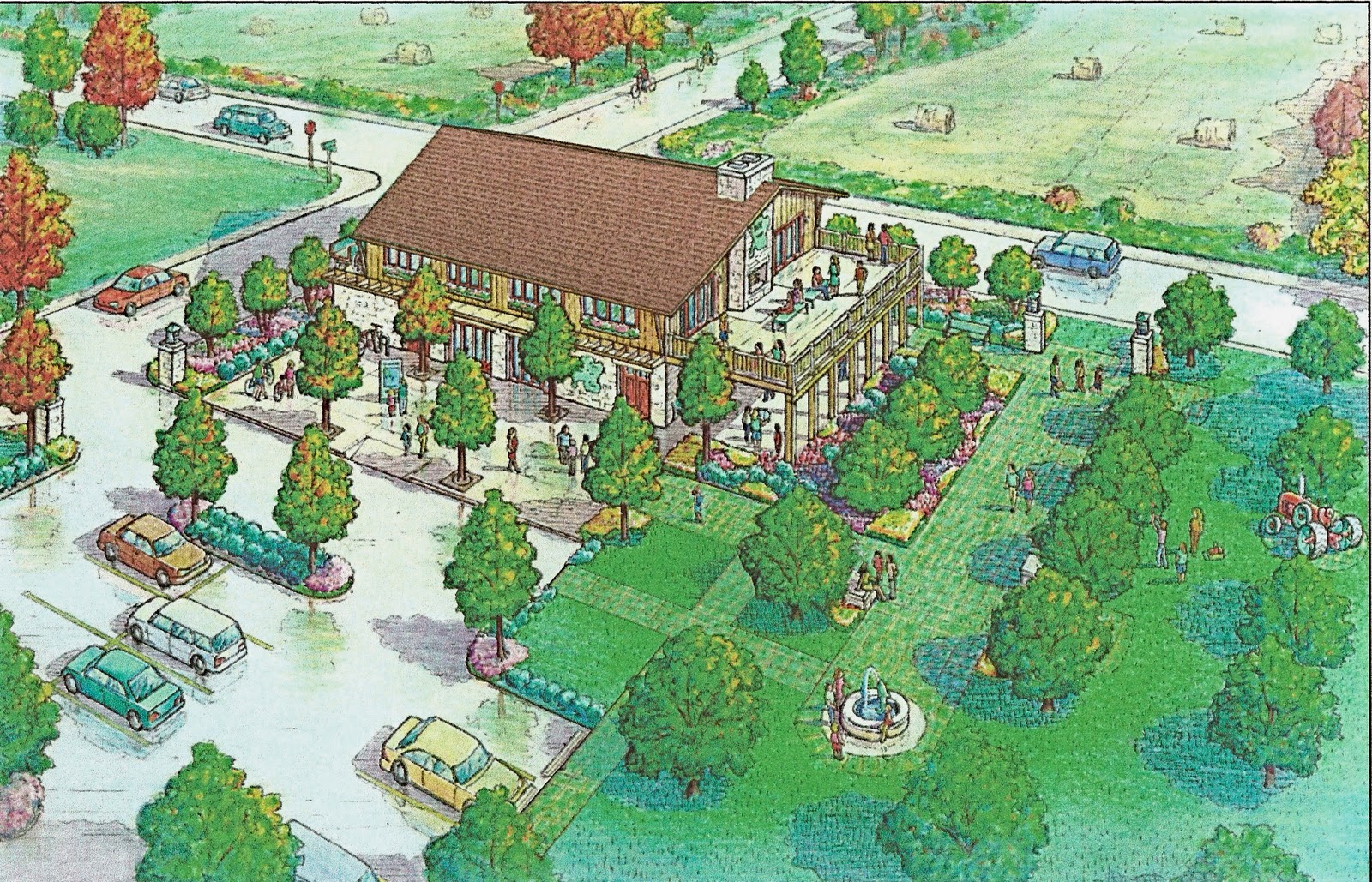
Proposed Island Business Incubator in
architect's rendering, looking north.   Remodeled
cheese factory / chalet is in foreground.
Washington Island, Wisconsin -

Consider this scenario for Washington Island:

Your township’s population hasn’t changed by more than 25 residents, up or down, in over 40 years.   The main township industry is tourism, with a very small amount of fishing and farming.   Citizens and property owners have scratched their collective head to come up with business ideas that might infuse their community with jobs and help the local economy.  

Along comes a rather unique proposal made not by government, but by an island property owner, a seasonal resident with an architectural business in Chicago who would like to build an incubator for small business. 

Problems occur when this individual applies to get the required zoning permits, and even when he attempts to obtain straightforward, timely answers to his questions.  His proposal would cost the town citizens nothing, and as owner he hopes only that his model business incubator becomes self sufficient in order to pay property taxes and insurance, and sustain itself over time.

What community, especially an island community with maybe an even narrower set of economic opportunities than a similar mainland community, would not like to see such an effort, at no risk to its citizens?

What governmental zoning or planning code, through its respective administrators, would not accommodate such an idea by making every effort to assist in bringing it about?

Not a fictional proposal!

Scott Sonoc, along with his wife Marsha Williams, recently announced by letter to those who had shown support for their ideas, that they would be “…cancelling the Incubator Project for Washington Island…”   
In his letter, Scott cited reasons for cancelling their project that he says point to an ineffective county process for filing and obtaining necessary permits.

In August, Washington Island Ferry Line Board of Directors invited Scott and Marsha as guests in order learn more details about their project.  At that time, preliminary plans for an Island Business Incubator had been drawn to compliment a newly remodeled, former island cheese factory (also referred to as the Chalet after remodeling in the 70s by former owner Thorsten Williamson).  The project location is the property at the NW corner of Range Line and Town Line Roads, which is the physical center of Washington Island.  

The Ferry Line's Board expressed support for Sonoc's Business Incubator idea, believing it to be the best and most practical for island economic development heard to date.

The cheese factory/chalet had stood vacant and on the market for some 30 years prior to Sonoc's purchase.  It had several broken windows and the shake roof needed replacement.  Sonoc, who enjoys the challenges and satisfaction of remodeling and improving usefulness of old structures, making changes that reflect local culture, had remodeled the building to comply with Wisconsin commercial codes.  


Compliance includes elevator to second
floor of chalet, Washington Island's first lift.


While purpose and tenants for the remodeled building have not yet been fully determined, the cheese factory building can serve multiple purposes including small conferences and catered events such as weddings.   Office and display space will also be provided.  

Sonoc then examined the possibility of providing further space, small workspaces that might encourage new businesses, to be made available to artisans, to producers of locally grown/made products that could then be marketed regionally, nationally, or internationally.   He used as a model the excess space in the building his architectural firm owns in Chicago. There, artisans are tenants, and their synergy has further led to individual success stories with expanded business in new locations.

Sonoc’s vision was to build a second structure adjacent to the cheese factory and divide it into suites for multiple occupants, thus providing a variety of businesses with reasonably priced space, a place for island artisans to work.   Advantages with such a building can be found in the access to shared equipment and space.   Examples:  a conference room for business meetings;  an approved commercial kitchen for food processing; common restroom facilities; common mechanicals along with building maintenance supervision.   Such an incubator could bring projected activities, including those who may be artists, from private kitchen, garage or basement into a public space where they might share ideas and grow as businesses.


Rendering of remodeled chalet as viewed SE toward Town Line
and Range Line Road intersection.  As island property owners
for fifteen years, "We are willing to risk our own money to try out
this (incubator) idea," Sonoc stated.


Sonoc's plan comes from a sincere desire to see people succeed and improve their lives.  In its details were many positives. 

From the onset, however, Sonoc said he ran into roadblocks at Door County zoning and planning, and in the end, his frustration ultimately ended pursuit of the project, citing Door County’s negligence and incompetence, where the Planning Department works as "enforcers" rather than "encouragers."  


The following are some of the problems Sonoc ran up against, condensed, as outlined in his letter to interested supporters:

1.          *   Letters were sent, Planning Department personnel were contacted, but responses to questions were slow in coming and when they were received, answers were simply not forthcoming, “…even after six months from our first meeting.”

2.          *   Construction drawings were prepared by Sonoc by the end of June 2011, but due to the need to rezone, issues of parking could not be addressed.  The parking issues were never resolved.
3.     Sonoc could not obtain answers as to “…what is permitted and what is not in an MC zoning district and what the requirements will be.”

4.        *    The Zoning Administrator stated that “…we must obtain multiple zoning permits, one for each ‘use’ in the building, instead of a single zoning permit for one ‘Principal Use,’ as stated in the Zoning Ordinance.”  

This last point was appealed by County Board Supervisor Joel Gunnlaugsson on behalf of the project.  The decision was then reversed by the Zoning Dept.   Following this reversal, Door County wrote Sonoc to advise him that in the future he ought not to have anyone, including County Supervisors, intervene on his behalf.

Other points were made:

·      The County Manager informed Sonoc that “…we cannot submit our site/building drawings for a zoning permit, until our property is rezoned from Gen. Ag. to Mixed Commercial, for the Incubator.  This is contrary to common development practices, because it is necessary to determine the governmental requirements for a proposed building project, especially those requirements that affect the project costs.  In some cases, projects do not go forward once specific government requirements for the project are identified." 

·      A personal fitness-exercise training and dance instruction studio would require “Conditional Use Permits” because these have been decided to be “Fitness Center” uses, not ‘”Personal Service” uses.

·      Parking spaces, according to the Planning Director, for both the Incubator and the adjoining Chalet, may not be shared to reduce the overall size of the shared parking lot.  The Planning Director, according to Sonoc, used his/her discretion to make this decision.  

·      An intended Incubator business that would promote ‘Internet art/poster/book sales’ use needs a “Conditional Use Permit” because this use has been decided to be a “Wholesale” use, rather than “Retail” use. 

·      Sonoc said he was cautioned that “…the Zoning permit expires for any and every use in the building that is not established within the first year or any single use that is discontinued for more than 18 months, in which case a new zoning permit application must be re-submitted for each use that is not operating in the building. “     Supposedly, this determination is because the Zoning Ordinance does not specifically cover a single building with multiple uses, and the Planning Director has discretion to make this decision. 

·      Sonoc was informed that the Planning Director and the Zoning Administrator stated they would not correspond with him via email, but only by regular mail.  This, Sonoc noted, causes “…extended time delays between questions and answers…”    He added that normal response time he experienced from the Planning Department back to him was “…2.5 to 3 weeks…”

·      Sonoc outlined actual costs incurred for Planning Department permits related to the proposed Business Incubator for Washington Island, and the possible fees totaled $2,850.   These were aside from any legal, survey, architectural fees that he incurred along the way.

·      To appeal the “…at least 8 unresolved issues…” would require fees of $3,600, according to Sonoc, and that he might also be required to pay for additional island on-site visits by the Zoning Administrator, at a possible $134.30 per visit, based on mileage and ferry fee.   
     [As a personal note, I inquired about this fee in November with the Planning Department and was assured that although the ability to assess the fee exists, there is no intention ever to assess such a fee, nor has the Department ever relied on this fee.  Nevertheless, it exists.]
 
Will Door County provide clarification?   

It is hard to read such a letter as Sonoc's and not become upset, confused, and to want to ask further questions of our County government and its processes.   

We have no reason to doubt Scott Sonoc’s intentions or his sincerity.  He has shown himself in his dealings to be a man of his word, to be forthright.

As an owner of multiple properties, he is not a “developer” in the traditional sense, but instead he’s one who revitalizes old structures, seeking to improve what already exists.   He’s shown a deep understanding and respect for Washington Island’s past, as well as its future.   Through his remodeling and construction projects over a ten-year period of time - including fencing for pastureland - Sonoc has employed islanders and provided them with opportunity at a time when work has been scarce.

What happened to cause such a breakdown in County customer services?   Has this Island Business Incubator stalled through administrative entrenchment, the defense of institutional turf over public good?   Are there other, reasonable explanations for why this project cannot get approvals?

In follow-up correspondence, Sonoc wrote:
 
   “We believe that the County needs to revamp the way it … conducts its business with the citizens of Door County…We are fearful that with any project we undertake, including the Incubator, the County will come back and say something that will cause us to have to spend more time and more money whenever they choose to do so, simply because they can… We sincerely believe the County is an unsafe place to operate a business! …It is the sum of the bad experiences with Door County Government that has created our lack of trust in the County.”

Can common sense prevail for community advancement?   Will the sum of poor experiences cause others to shy away from progressive ideas?

We hope Sonoc’s project isn't dead and done.  But underlying his specific problems is the more confounding obstacle: the manner in which project planning is conducted within Door County.

Door County’s Zoning and Planning institutions, which citizens depend upon to be fair and consistent and lead to a positive future, require close examination by both its citizens and its elected officials.   Worthy projects, some greater, some lesser in scope than the Island Business Incubator will face a similar uphill climb if changes in process aren't considered.
    
Chalet exterior, remodeling in progress.  12/19/11


-  Dick Purinton    

Upper floor banquet / conference area indicates quality of chalet remodel.  12/19/11