|
| Eyrarbakki waterfront in 1900 with sailing ship and small fishing boats, and a long, sloping stony beach. |
Washington Island, Wisconsin -
When reading Njal's Saga, several times it is mentioned that a ship came ashore at Eyrar (Eyrarbakki). For a long time, this was the only port on the southern shore of Iceland. From there, the main character described in the saga rode his horse to his farm, or north across the level plain to the Althing at Thingvellir to seek redress for wrongs to him or his family members.
This is the scene as we drove south to Eyrarbakki for our visit with folks at the museum: flat, green fields with sheep or horses scattered here and there, the mountains visible behind us, the open sea ahead. Eyrarbakki never had what one would describe as a well-protected harbor, but instead, as the historic photo above shows, it took skill and knowledge to navigate the entrance and slip behind the outer reefs, to find moderate protection at this small coastal village. The Atlantic is open to the south, the next points of land being Scotland and Ireland. And yet, this was Iceland's main shipping port for centuries for exporting woolen products, fish, and for bringing foreign goods to Iceland's people. Only much later did Reykjavik (which does have natural harbor protections here and there) become a major port and the leading city of Iceland.
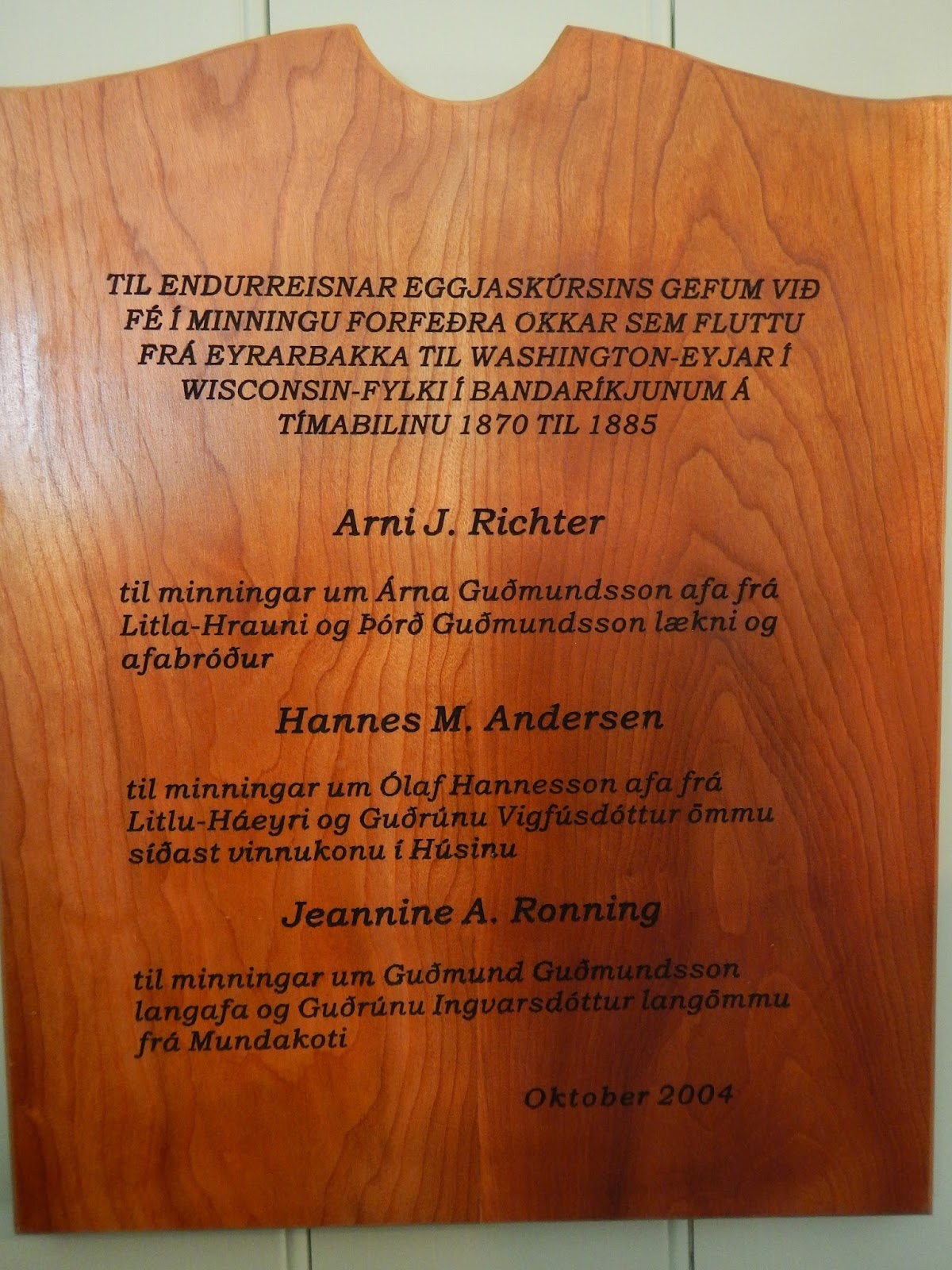
We learned from Audur Hildur Hakonarsdottir's explanations that there were many reasons for why the first Icelanders emigrated to North America. Those four men who left in 1870 (Jon Gislason, Gudmunder Gudmundson, Jon Einarson and Arni Gudmundson - who later took the name Arni LeGrove to avoid confusion with the Arni Gudmundson who came afterward to Washington Island in 1873) did so with purpose and intent. William Wickman during his time as an employee in the Danish trading center in Eyrarbakki, came to know young men of the area, and when Wickman was later established in Milwaukee, Wisconsin a number of years later, he encouraged his friends to join him there. Letters and documents indicate that these men then tried to find jobs such as fishing from Milwaukee, but that the method of fishing with nets and the language barrier proved too much. Wickman, feeling an obligation to help them, persuaded them to cut wood on his property, recently purchased on Washington Island. This island location and the opportunity to work and earn a living appealed to them, and their letters home spoke positively of their Washington Island experiences. This led to more young people - men and women - to consider emigrating to North America. Washington Island became their destination, at least initially, with its known benefits and a group of countrymen to greet them. And so, in 1872, another group departed Eyrarbakki which included Arni Gudmundson (the second of the two Arnis by that name).
 |
| Eyrarbakki in 1885. The main street in Eyrarbakki was said to be the first in Iceland. Here the buildingsare of turf, stone, board and batten. Later, around the time of WWI, lightweight and durable corrugated steel sheets replaced wooden and turf exterior materials. |
Economic times in Iceland were not flourishing in the 1870s, and opportunities may have been limited to earn a living or even to own land. But according to Hildur, these were for the most part men with an education who could have made it had they stayed in Iceland. It was equally the adventure that drew them to try something new, she believes.
In other parts of Iceland, especially the north and eastern fjords, increasingly cold weather prevented the grazing of animals that depended upon natural grasses that grew in higher elevations. Arctic drift ice then blocked harbors in summer, an unusual occurrence that made fishing and vessel transportation more difficult. The situation of a few who owned land leasing sections to tenant farmers discouraged the desperate who could see no future. Women, despite sometimes being very well educated, could not obtain permission to marry unless their future husband owned land. Society was structured so that landowners had the privileges, and yet even some of them found the 1870s and 80s so difficult that they seized on the advice of steamship company agents and purchased tickets to sail west. Many of these Icelandic immigrants found their way to Canada (the Winnipeg area especially) and northeastern North Dakota, where land was readily available.
Hildur's display follows the first four young men, and then also the life of Arni Gudmundson of the 1872 emigration. Arni's father, we learned, was a man with a recognized status in the area, which may have led to Arni's later being fondly referred to on Washington Island as "the Squire." He served for many years as Washington Island's Town Treasurer and Justice of the Peace, similar to a position his own father would have held in the Eyrarbakki area.
 |
| Audur Hildur Hakonardottir explained the events depicted in her museum display at the Eyrarbakki House. Museum Director Lydur Palsson is at left. |
The history of Eyrarbakki, then, strikes close to home, with Arni Richter being a grandson of Arni Gudmundson (also spelled Gudmundsen). But old Icelandic history as told through the sagas brings interesting connections as well, even though many of these sagas were written around 1200 and describe early Iceland settlement of a century or two before that. They tell about the way of life in old Iceland, the turf dwellings, the difficulty of raising animals for sustenance, the jealousies and differences with neighbors (and even relatives) that often resulted in severe penalties or bodily harm to one another. A tough time in which to live, for sure, but yet there was a common support for a system that recognized the importance of independent living, on the one hand, and allegiance to the law of the land.
 |
| This photo of the Danish merchant's home that is now the museum appears in the book, "Husid A Eyrarbakki" by Lydur Palsson in 2014, and also on a postcard sold at the museum. Man standing third from left has been identified as Thordur Gudmundson, father of Arni Gudmundson. (Year is 1884.) |
Our modern day visit to Thingvellir brought shivers from historic drafts: the dramatic cleft in the earth where the continental plates come together; the "Law Rock" where Iceland's laws were recited aloud and court was held by chieftain judges to resolve the differences brought forward in law suits by its citizens; the fast-flowing Oxara (Axe) River that empties into Thingvillevatn (Lake Thingvellir); and the broad plain below the rocks where horses were pastured, children would have played, and commoners would have set up their tents during the two-week annual event.
 |
| Hoyt stands on walkway that leads through dramatic rift at Thingvellir. |
At a location of great prominence, within several hundred feet of the Law Rock itself, we viewed the foundation remains of the booth (as they were called) of Snorri Sturluson, the noted poet and writer and perhaps the most powerful of all Icelandic Chieftans in his day. Such booths, of which several foundations can still be seen, were small dwellings made of rock and turf (which over the centuries have settled to low mounds) and wooden poles for rafters, over which cloth or skin tops were spread as a roof. Such a temporary summer abode would have been reclaimed year after year by its owner who attended this special event.
In the year 1,000 the Althing convention voted become Christian, a remarkable transformation. Those who did not follow (according to the saga) could be killed, but in fact paganism continued to thrive alongside Christianity for a time, and even today, superstitions and beliefs in trolls and elves still is a part of the Icelandic culture.
Many Icelandic converts of means made pilgrimages to Rome in the centuries that followed the island's conversion, and a few volunteered in the Crusades. Today a Lutheran Church stands in the valley below the rocks, and I believe that the minister assigned there is, more or less, caretaker and manager for this historical setting. (We received a rather lengthy and detailed historical explanation from the then minister there on our visit in 1987.)
On the descriptive information for Snorri's booth we read the text that included the explanation of "… translation by Dick Ringler." Ringler is a Professor Emeritus of the UW-Madison Scandinavian Department, and he frequently visits Washington Island with his wife, Karin (Erickson) staying at their family's cabin in West Harbor. Together, the Ringlers spent a number of years in their younger days on an Icelandic farm learning the language and culture, and Icelandic history and literature became Dick Ringler's specialty.
 |
| Hoyt and foundation remains of Snorri's booth. In 2012, when working on the Thordarson and Rock Island book, I was given assistance and advice by Dick Ringler, along with a copy of his book: Bard of Iceland, Jonas Halgrimsson, Poet and Scientist. |

Saga Center
In preparation for our trip to Iceland I began reading Njal's Saga, to help me gain an understanding of life in early Iceland, and more importantly because we would stay in the general area where much of that Saga took place. Our lodging for two nights was in Hellisholar, under the shadows, so to speak, of the volcano Eyafjallajokul. The eruptions of 2008 that spewed ash into the air and shut down flights across much of northern Europe for weeks have been quiet, and what we saw against a deep blue sky was a white dome of ice and snow. (Tee shirts and mugs sold in area souvenir shops proudly state that Iceland got the best of Europe…in rather graphic language.)
 |
| Example of a "High Seat," or place of honor often accorded special visitors to a farm home, displayed in the Saga Center. |
Just a few miles away in the town of Hvollarshollar is the Saga Center, and displayed are early artifacts along with modern day landscape photos and descriptive artworks that relate to pertinent paragraphs from Njal's Saga. This museum experience brings this particular saga to life, especially the realization that there are many geographic and farm name references still existing today, and that a significant portion of the fictional saga accounts were based on real people, places and events.
- Dick Purinton
 |
| Another view from Snorri's booth. According to the sagas, disputes would sometimes be settled by sword duel on the grassy island in the Oxara River. Lutheran church is in background. |
 |
| Sword and shield on display at the Saga Center. |