Showing posts with label Dan Petersilka. Show all posts

Wednesday, July 15, 2020

MADONNA CONSTRUCTI0N - 37.0


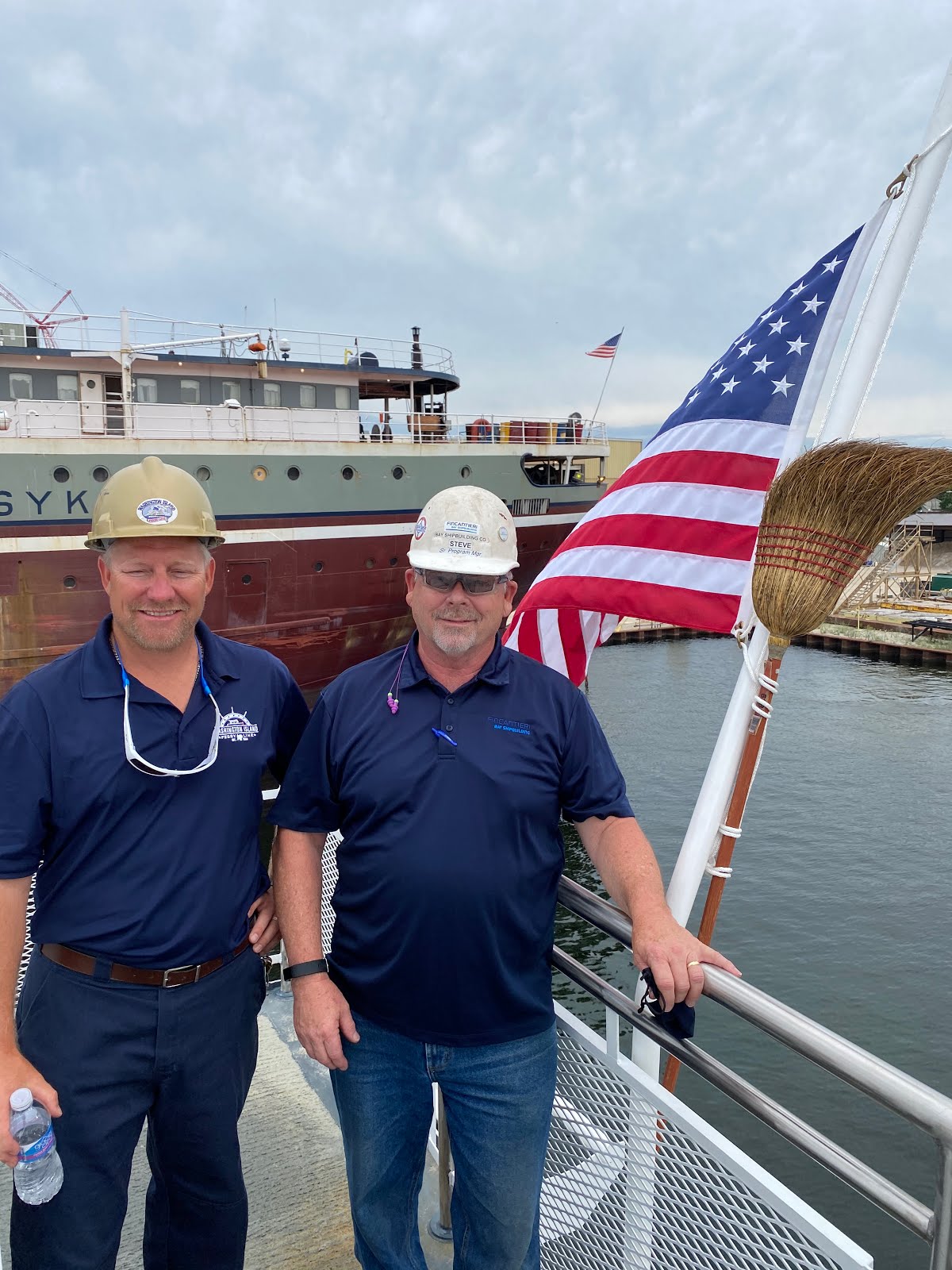
Capt. Joel Gunnlaugsson with Fincantieri
Senior Project Supervisor Steve Propsom, upon
return to port after sea trials.  Broom signifies
a "clean sweep", the satisfaction of
requirements for U. S. Coast Guard Certificate
of Inspection.  (Purinton photos in all cases)


Detroit Harbor, Washington Island -

Having been absent here for a few weeks in reporting on construction, during which time the christening took place at Fincantieri Bay Shipbuilding, we're now back to continue the story, with particulars of where the new ferry Madonna stands in terms of finishing and delivery.

First, we need to update statements regarding the steering system, because the first assessment for remedy didn't prove out.

One of many details added in the past weeks:
a step for crew to reach and tie mooring lines.
During Builder's Trials, a test run of the vessel's systems, its engines, electronics, etc., it was discovered that steering responsiveness seemed to lessen over time.  Greater revolution of the pilot house helm was required to move the rudder just a few degrees. The cause was determined to be hydraulic oil heating and thinning with longer running time time.  The probable fix appeared to be reduction of heating by means of installing a lower volume output hydraulic pump, and by enlarging the diameter of the piping from pump/reservoir to pilot house and to the steering rams back aft, a rather long run with many angles and turns in the piping.

Fincantieri pipe fitters began work right away and installed larger inside diameter piping.  But as for a lower output, CAT engine-compatible hydraulic pump, none was found in the marketplace.  Instead, a flow valve was installed, along with an oil cooler (fed by the same pump that flushes stern tubes). During a second Builder's Trial, performed two days ago on Monday, July 13, the steering seemed to perform well.

As can often happen with more time spent underway, a few more items also came to light, and they were highlighted on the punch list.

After Monday's successful underway trial, a second sea trial was then scheduled for Tuesday, July 14, this time with a U. S. Coast Guard Marine Safety Detachment observer on board.   This sea trial fell almost exactly 1-1/2 months beyond the original estimated Madonna delivery date, a point of secondary importance to getting steering, as well as other vessel functions, to where they needed to be.

In this photo, you're looking up the ladder
that leads from engine room to main deck.
Madonna engine room has come a long way:
a complex space of piping, wiring and machinery,
but with room to move about.  A Bay Ship
mechanic can just be seen between generators,
monitoring fluids and temperatures.
Clean bilge; CAT engine control boxes;
bilge piping manifold beneath.  One example of
well-laid out, yet separate, systems.


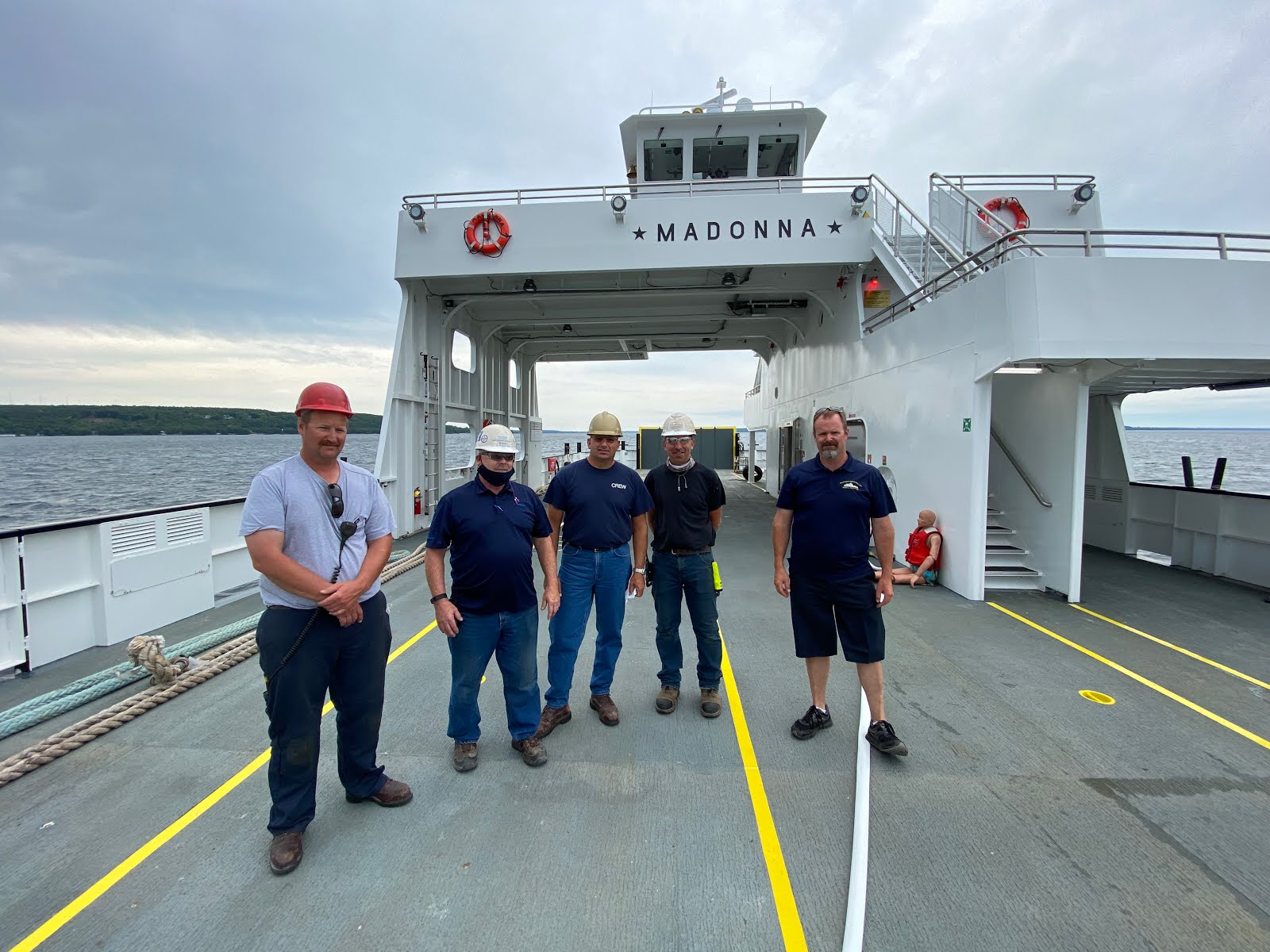
We departed the Bay Shipbuilding slip at 10:00 a.m. and proceeded to the outer bay, with approximately a dozen yard personnel plus five Ferry Line representatives on board.

Enroute to sea trials, Madonna passed
Cason J. Calloway, inbound to Bay
Shipbuilding for repairs.


At the conclusion of several drills and with Joel Gunnlaugsson
at the wheel in the pilot house:
Rich Ellefson, Steve Propsom, Jeff Cornell, Dan Petersilka and
Hoyt Purinton.
By the time we reached Sherwood Point light, having passed port-to-port in the entrance channel the Cason J. Calloway, inbound to the shipyard for repairs, the Madonna's engines and fluids were warmed to anticipated operational temperatures.  Steering maneuvers, the shifting of generator loads, "crash stops" (full back while carrying typical forward momentum), a man overboard drill, and demonstration of good water pressure on main deck fire hydrants, were among items checked off during the several hours underway.  The sea trial was termed a success, and the number of items on the "to-do list" were trimmed even further.

A man overboard drill was conducted using a dummy
designed for such an evolution (approx. 150# with water
weight).  Shown:  Coast Guard observer Tom Hunninger,
Jeff Cornell, and Hoyt Purinton on bow ramp.

Another day or so will be used to tie up remaining loose ends, and to reconcile our standing with the Fincantieri yard regarding "who pays for what."  Those discussions may continue for some time, but a general understanding must be met in order to transfer ownership, and satisfy builder and owner product expectations, contractual items met, and with an appropriate USCG Certificate of Inspection forthcoming (like having a motor vehicle license plate, only with particulars of operation spelled out in detail).

A view of mezzanine cabin passenger seating.


When can we expect Madonna to be underway for Detroit Harbor?  Perhaps Friday.  We'll have to see.

  -  Dick Purinton

Upper deck passenger seating and pilot house.

Wednesday, January 8, 2020

FERRY MADONNA UPDATE - 12.0


Tuesday evening, Jan. 7:  the two Madonna hull sections positioned
on blocks in upright position.  Bay Shipbuilding graving dock and bulk carrier
Edgar B. Speer are in background.  (Rich Ellefson photo)

Detroit Harbor, Washington Island -

We'll begin with a photo showing the two hull sections now in their upright position, abutting one another, and following fine adjustment, ready for several days of welding that will tie the sections together as one hull, one vessel.

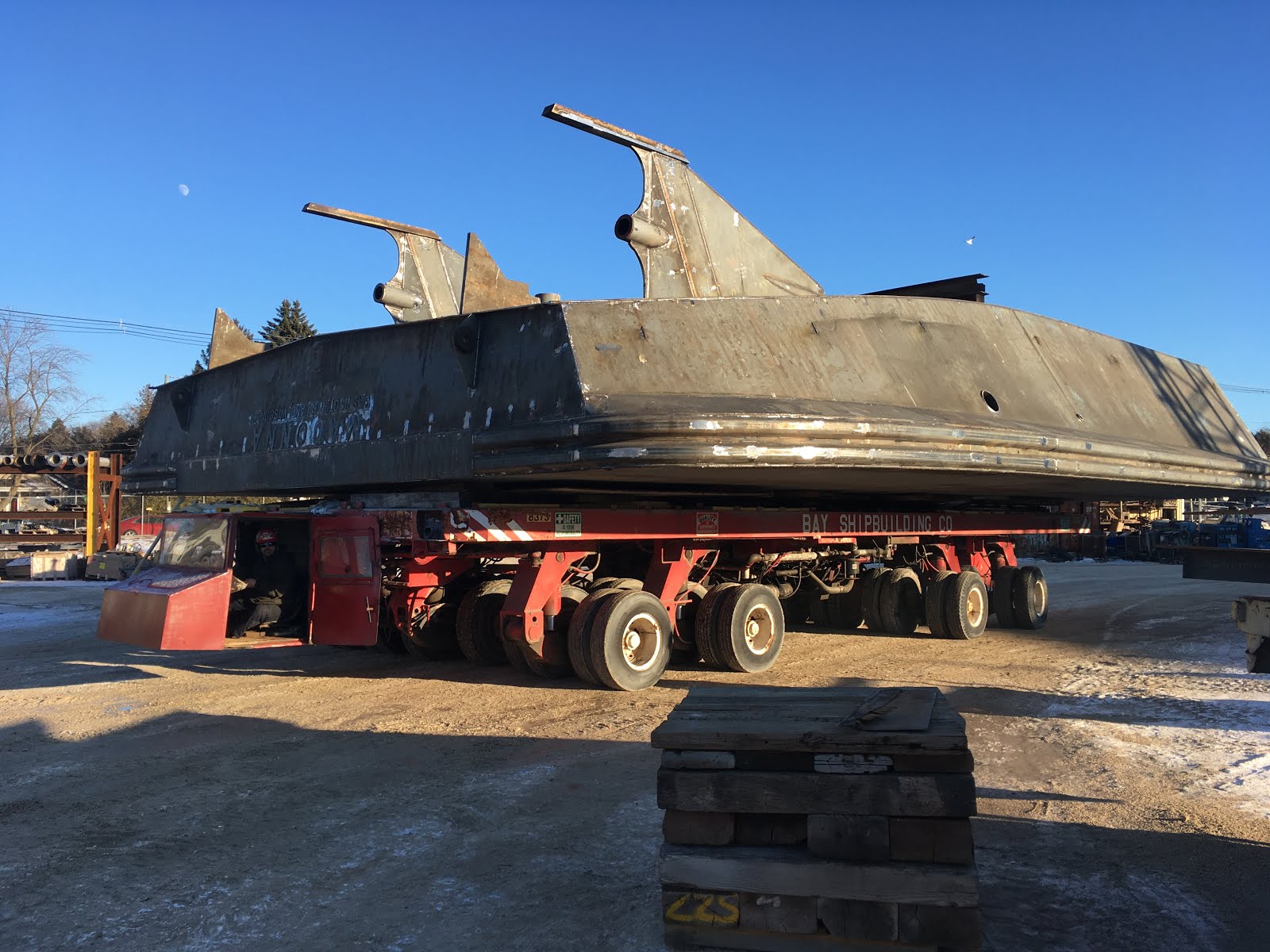
I took the opportunity to visit Fincantieri Bay Shipbuilding facility this week, my first such visit since the first cutting of steel began in August.  The turnover of hull sections that had been scheduled for January 6th took place pretty much on track.  When I arrived at the yard Monday morning, greeted by Rich Ellefson (WIFL) and Steve Propsom (Fincantieri Sr. Project Manager), preparations were underway to get the transporter to Bldg. 311, where the stern section was still being worked on.  A large module for the Interlake company's new freighter had to be moved first, to allow access to the Washington Island stern section.  The move of our ferry section from Building 311 to a site near the graving dock would take place later in the afternoon.

In the meantime, I was shown the hull progress, with explanations for various challenges met and overcome in design and construction, and in Coast Guard certification of welds.  One thing learned:  besides a water pressure test for the hull, or an air pressure test, there was also use of a UT device, like an ultrasound sensor, that was utilized in areas where there were heavy structural members and multiple welding passes.  The UT scan, with skilled use by a technician, can determine if porosity exists within an area of heavy weld.  An example of this was use in the area of the two skegs, where heavy plate intersected the hull, and where the stern tube pipe was fastened into the skeg.  There was also a thick (6 x 4 ") bar that will become the support piece (or "shoe") for each rudder.

Fincantieri Senior Project Manager Steve Propsom
and the port skeg, an enclosure that provides solid
support to the stern tube and propeller shaft.  On many
vessels such a skeg is omitted and bearing struts are used
instead.
  Our experience has shown the added structure 
protects the shaft and bearing, and it also aides tracking
in a sea. (Purinton photo)   
Nearby was the pedestal structure with a number of steel workers engaged in welding, fitting, and preparing this piece for move-out from Bldg. 311, either later this week or early next week, to be set upon the deck of the upright hull.

In the nearby former Palmer Johnson shed, a large facility at the south end of the Fincantieri yard, we saw the CAT engines with gears attached, and the forward section of the ferry (approximately an 80-foot section resting on supports) awaiting transport. We toured through the pipe and machine shops, viewing engine coolant expansion tanks and the lube oil tank, and mooring bitts and the pair of rudders. The rudders, owing to deep, concentrated welds, required special care with preheating of the rudder stock to 350 degrees, welders working opposing sides of the stock to eliminate heat distortion.


It was 3:00 pm when the stern section was rolled outdoors and positioned for lifting Tuesday morning, after blocks had been set and measured for appropriate height.  We returned that next morning, and after lifting cables were attached to pick points welded to the hull section, lifting began. The large overhead gantry crane assumed the primary weight, assisted by a large Manitowoc crane on tracks.

Stern section rolled into position on the transporter Monday afternoon
for lift and turnover Tuesday morning. (Purinton)


Sequence shows stern section being lifted clear;  then in vertical position
just above ground (lower right) and, finally, lowered in upright position onto preset blocks.


Once clear of the transporter, a slow and steady lift was coordinated from rigging observers, and in a matter of 20 minutes or so, the hull section was stern to the sun, with engine room facing earth.  The hull was then rotated 180 in the air to facilitate a change of pick points for the Manitowoc crane, and a gradual lowering to a new, upright, horizontal attitude was achieved.  By 10:00 am, the stern section was inches above the blocks, as workers leveled supports to later accommodate the bow section, a separate move that would occur that afternoon.   Unable to remain in town longer for that evolution, I headed north for the ferry, but here is the report from Rich Ellefson received later:

   The setting of the bow half to the stern went very well last night, and by the time Steve and I left at
10:30, the two halves were lined up pretty close.  At 5:30 this morning, when I got back to the yard, they had it completely tight and the bow was supported still from the gantry.  There were no carpenters to set blocks last night so it was decided too pull it together tight and just use the gantry to support the forward portion of the bow until morning.  In talks with Dan Petersilka this morning, he felt that it may take a (work) shift to get the hull regulated and aligned.  Once that is complete, they will tack the whole erection joint, girders and stiffeners.  The hope is to have it locked together by the end of the first shift today.  Once that is accomplished, they will have the second and third shift concentrate on putting in the root pass on the whole erection joint.  Once that joint has a root pass, the plan would be to install the main engines and gears, which is planned for midday tomorrow (Thursday), with the superstructure to be installed and assembled on Friday.  -  Rich


With the target dates for these tasks soon to be met, the project remains on track, if not slightly ahead, and a delivery date for the end of May remains an achievable goal.

 -  DIck Purinton