Showing posts with label Evy Purinton Beneda. Show all posts

Friday, March 1, 2019

Icelandic Celebration 2020

Husid, the Danish trading center's home for its manager 
in years gone by, when Iceland was a Danish protectorate.
 Museum Director Lydur Palsson and staff members greeted
 us as their guests during our 2015 visit.  The IcelandicCelebration2020
 will make this Eyrarbakki visit a trip highlight.
Photo was taken in early June, similar to the time period
contemplated for the Sesquicentennial Tour.


Detroit Harbor -

The year 2020 will be the 150th anniversary of four young Icelanders arriving on Washington Island.

The area encircled in green refers to the region in Iceland in which
we concentrated our travels during a 2015 trip.  Both Reykjavik and
Eyrarbakki lie within this circle, an approx. 2 hour drive apart.


Already established here were residents - farmers, fishermen laborers and merchants - who were of German, Irish, Norwegian, Danish, English, and other national origins.  But, the fact that this was the first settlement of Icelanders in North America made it significant for those who followed.

During the ensuing four decades, 1870 to 1913, approximately 20% of the Icelandic population emigrated to North America.  Some came to Washington Island, as we know, but many more settled in western Minnesota, northeastern North Dakota, and the Red River Valley area near Winnipeg, "little Iceland" in Gimli, Manitoba, and so forth.

Yet, the establishment of homes, farms and businesses here on this island by Icelandic pioneers was significant, and it continues to be recognized as such by today's Icelandic historians who are eager to trace their family tree to descendants in North America.

Historical photo of Eyrarbakki at the turn of the last century when
stone and turf dwellings were commonplace. Eyrarbakki then was a leading
seaport for southern Iceland, and besides exporting wool and codfish
this seaport is where first emigrants departed by sailing vessel for Denmark,
then on to North America, in the early 1870s.   


The 100th Anniversary of that Icelandic immigration event was ably observed here in 1970.  There were Icelandic officials in attendance, and descendants of Icelandic immigrants.  Gertrude Andersen, first-born child to Icelandic immigrants in 1874, was 96 when she struck a bottle of wellwater against the steel of the brand new ferry, Eyrarbakki.   That water was drawn from a well in Eyrarbakki, then flown from Reykjavik to America by Iceland Air for the occasion.  A fish boil brought also people together for (we imagine) a few toasts and speeches.
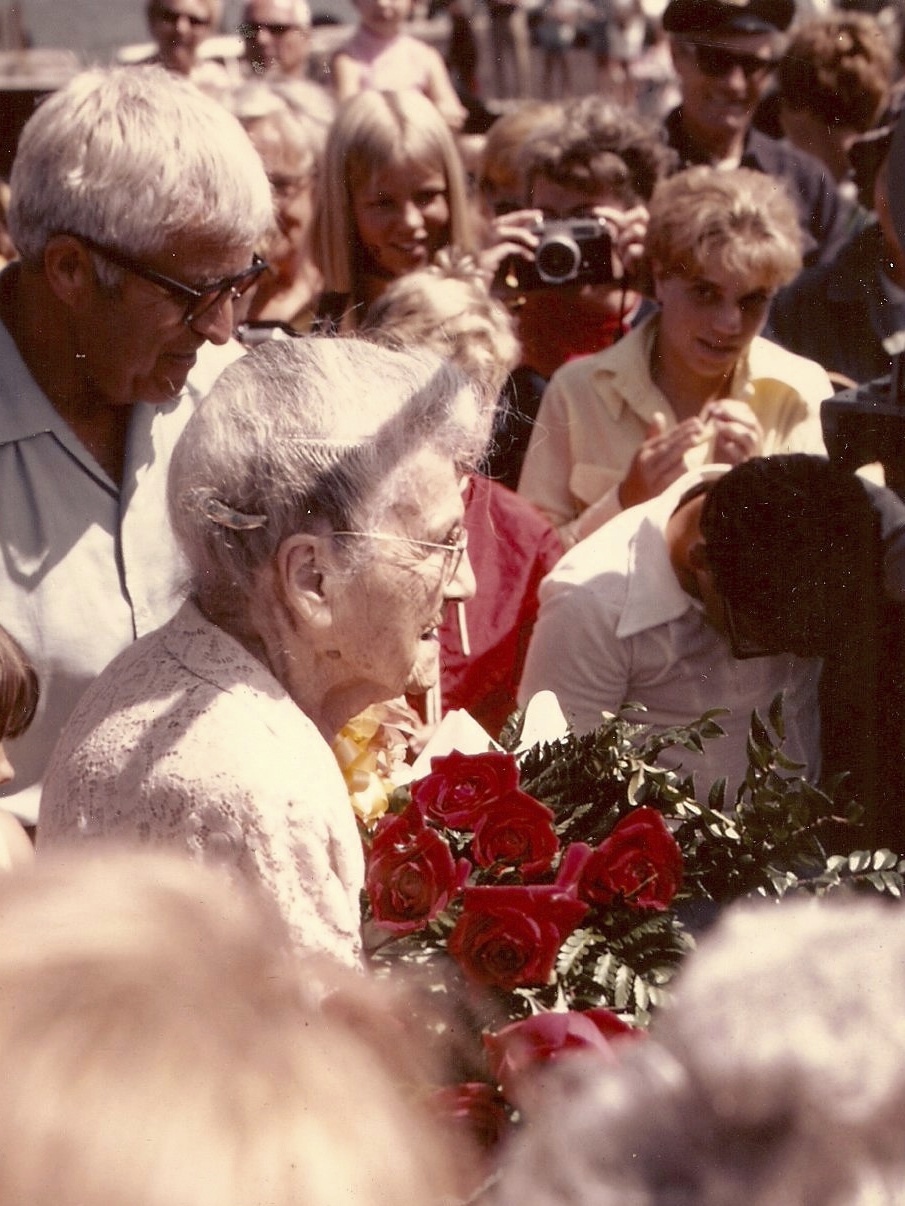
Gertrude Andersen christened the new ferry Eyrarbakki
 in 1970.  Grandmother of Christine Andersen, she was
born in 1874, first child of Icelandic immigrants born
on Washington Island.


A sperm whale tooth, carved with the likenesses of early Icelandic settler Gudmander Gudmundson, and his wife, Gudrun Ingvarsdottir, was presented to the "People of Washington Island" from the Icelandic Association of Chicago.  Haldor Einarsson, best known for his furniture carvings for C. H. Thordarson, carved the likenesses of the Island's early Icelandic settlers.  Einarsson had by then returned to his homeland of Iceland after a career based in Chicago as a wood carver.  (photo of this commemorative gift is attached; you may see the actual item on display in summer at the Jacobsen Museum at Little Lake.)

Water drawn from a well in Eyrarbakki was flown by
Iceland Air to New York, then to Chicago, and driven to
Washington Island for the christening of the
ferry Eyrarbakki.


All of the above is background for why a 150th Anniversary Celebration ought to be seriously considered by the Island Community, and by anyone connected by heritage or simply
personal interest in strengthening our ties with Iceland.

In order to begin planning, a small number of us have met as volunteers of an unofficial steering committee to determine the best ways in which this event might be honorably celebrated.  We've come up with a broad outline, knowing that more details will need to be filled in as we proceed, and believing that more individuals will express interest and ideas as participants.  Today's blog, then, becomes just the first of many communications. We encourage others to digest the information and the possibilities, while considering their inclusion in 2020 planning...to whatever extent possible.

Fortunately, we've had direct (email) communication with several Icelandic individuals, friends and relatives, with whom we are well acquainted.  We also respect their passion regarding the 1870 emigration that began from Eyrarbakki.  They've also traveled to Washington Island and know us.   Through them I've been able to pin down timing for key events.

In addition (and here lies perhaps the most exciting and potentially significant part of the plan), we believe there will be interest from a group of Islanders to travel to Iceland in early June of 2020.  Likewise, from indications we've received from our Icelandic counterparts, a group of Icelanders may then travel to Washington Island in early October of 2020, rounding out the 2020 celebration experience.

Such an exchange would symbolize our mutual interest in a 2020 celebration.  It would further help to establish - or reestablish - ties with the Icelandic nation that might further ongoing, future relationships.

Gudmunder Gudmundson and his wife,
Gudrun (Ingvarsdottir)
Carved sperm whale tooth, gift to the Island
people in 1970.
Carved by Haldor Einarsson, Iceland.


Following, then, in Q & A format, are some of the particulars to consider.  I will anticipate there will be chat discussions, questions being asked, and ideas to aid in this celebration.  We - members of the initial steering committee - will try our best to keep up with your questions and comments, and to help organize various ideas.

1.  When would the exchanges take place?

By initial agreement with our Icelandic counterparts, we anticipate a contingent of Washington Island folks traveling to Iceland June 9 & 10, 2020.   That is when actual travel to Eyrarbakki, and perhaps a gathering of sorts with Icelandic relatives, might take place.  Of course, travelers will want to see sights and do things, either on their own, or as a group.

We would be hosts to a group from Iceland in early October, with planned activities to be held in the mid-week, Oct. 6 & 7.  A variety of events can be planned for their visit, including local points of interest, and opportunities for formal and informal exchange.

A walk along the seawall in Eyrarbakki, which was Iceland's
leading port for export of wool and fish in 1800s.  Later, this emigration
movement included citizens from other regions and
other Icelandic seaports.


2.  Where do I sign up to go to Iceland?

You will travel as an individual, or as a family, or group of friends, by making your own flight and lodging arrangements.

One possible scenario:  Fly to Iceland on Sunday (arriving early Monday morning in Iceland).  Take a day to acclimate, catch up on jet lag, visit points of interest in Reykjavik.  Gather and meet up with others at an appointed location, then travel as a group to Eyrarbakki on either June 9 or 10.  (TBD) Participate in a group dinner one evening.  Visit with Icelandic relations, either on your own or as a group, when such is organized.   Sightseeing should also be high on your list, and there are many tour opportunities,. both in Reykjavik and for the outlying countryside, to points of historical and cultural interest, to museums and the like.   But, we wish to emphasize that being a Washington Island representative to Iceland remains the key purpose for this trip.  We expect to further guidance from our hosts as more plans are developed.

Note:  Not to be discounted are the services of a professional travel agent.  However, for many, this becomes an extra step.  We as a committee of volunteers are not capable of providing travel booking services as would such a professional, or one's self!

At a certain point, by early July, we'd like to know:    Who wishes to travel to Iceland as part of the 2020 Celebration Group?    Who wishes to help host Icelandic guests on Washington Island?
Who is interested in both, but not likely to participate in either event?   We'd like to get an idea of what our planning and obligations might entail as we move ahead.   But, there's plenty of time, still.

Gulfoss, largest waterfall in Europe, discharges tons of
glacier meltwater each hour.


3.  Can I then also be an Island hosts to receive Icelandic guests in October?

Yes, this is an equally integral part of this celebration exchange.

Aside from visiting points of interest such as Rock Island, museums, Stavkirke, the Wickman home, etc., we anticipate hosting our Icelandic guests to at least one, if not more, social events, where personal exchanges of "Welcome" can be made, official proclamations or gifts presented, and perhaps enjoyment of local entertainment based around the Icelandic immigration theme.

Our Icelandic guests will likewise need to determine their travel dates, their places of lodging, and so forth.  We can assist them with suggestions.  We have no ideas as to numbers of visitors expected at this date because planning is still in its earliest stages.

4.  How can I determine my Icelandic lineage?

In Iceland there is great emphasis placed on genealogy, and they have a number of available websites that may prove very helpful (www.icelandicroots.com is one example).  Our Island Archives is about to embark on updating our genealogy records.   An informational meeting to get this effort started will be held in early summer, and not only for families with Icelandic ties, but all Island families, in order to extend the base of knowledge in our Archives.  

Above all, anyone of Icelandic heritage ought to update their family information soon.  This, in turn, will help tie you to your ancestral roots in Iceland.  Who knows?  You may find a new cousin living  here in America, or in Iceland.

5.  What about funding for this whole thing?

At this point, the planning and execution is by individuals, out-of-pocket.  We think this is the way to go because today people can easily access travel information by the internet and create their own plans.   The variations in personal plans, credit card incentives, travel and lodging wishes, is more than a volunteer is willing to undertake.  You will likely find help and advice via internet, however, as you begin this process.

As for presentations to acknowledge and thank our Icelandic hosts, and later, to present our meaningful expressions of thanks to our Icelandic visitors, we perceive offering gifts that are meaningful but that do not necessarily require major expense:   framed photographs;  a momento of an immigrant family;  a dinner for all that could be pot-luck, or out-of-pocket, these ideas are to be encouraged.

Entertainment ideas have already been proposed, to include local talent and participants (perhaps members of the Island Players), slide photos from the Island Archives, etc.    If specific opportunities are identified for sponsorship, we would not hesitate to solicit financial aid from local businesses or service organizations.

As with travel to Iceland by members of the Washington Island contingent, we would encourage  personal visits with Icelandic relatives and friends.

We'd like the involvement of our Island school children as an educational and cultural opportunity.  Ideas are also welcomed to further this goal.

Dramatic walk in Thingvellir, between rifts in the Atlantic and
Europeantectonic plates.  Ruins of "booths," or shelters, at site of
oldest republic in the world lie in foreground.


6.  So, I'm interested in going to Iceland.  How do I start my planning?

There's no single way to go about this, but if you're thinking of joining in the Iceland travel portion of this celebration, you might begin by blocking out that second week of June, 2020.  Check out air travel, the options and approximate pricing. We think Chicago may be the easiest airport for departure, with Iceland Air being a major carrier, but Minneapolis is another option.  There are also frequent flights out of Boston  (only 3+ hours flight to Iceland.)  Cheaper seating may be available on "second tier" airlines, but beware of smaller planes, tighter seating, and extras for luggage, plus more commonly delayed departure times, etc.

As for lodging, there are many hotels in Reykjavik, also Air BnB's.  By checking back and forth with friends and relations who are interested in this trip, you may open up new ideas.   You might want to join in the same lodging location... or not.

All of this planning begins some 15 months in advance of the proposed June travel date, which ought to be time enough to consider your options carefully, and to correspond with others for advice.

        *       *      *     *

In the meantime, let us recommend introductory experiences through film, books and internet that might help you in making choices (and to familiarize yourself with Icelandic culture for when you become the host).

Two films we highly recommend that give you a good flavor of Iceland:
      Rams                          ....  on Netflix   
      Of Horses and Men ...   Amazon Prime

A book that captures the struggles, and the spirit, of Iceland's farmers in the years leading up to WWI, by Nobel Prize winning author Haldor Laxness:   Independent People
                                        Hannah Kent:      Burial Rites
                                        Nancy Brown:      A good horse has no color

Many Icelandic sagas exist, tougher reading for sure, but interesting in cultural and historical background, from the perspective of 8-900 years in the past, as Iceland developed identity as an island nation.

Evy Beneda has several Icelandic blog sites that she follows and recommends, including the following:

     Icelandwithaview.com
     iheartreykjavik.net

Finally, stay tuned to this blog.  Give your email information to (Bill Schott & me) at this email address:     IcelandicCelebration2020@gmail.com    This will put you on the mailing/notification listing for pertinent information.

In mid-May (date to be determined) we'll plan another public function to discuss plan developments, and to view slides of Iceland, or other information that will educate and invigorate your planning.  All are welcome, and you need not be an Icelandic descendent to enjoy and participate in these events!

-  Dick Purinton.        [NOTE ONE:   I was recently notified that the email address I provided in the next-to-last paragraph for celebration notifications did not work.   I made the correction 3/7/19.   Thanks for the several comments that pointed out my error.       SECOND NOTE:  I should not be quick to discount the aid and services of travel agents, for we used a great source, the Icelandic Farm Holidays Association, when we planned for our family trip in 2015.  In my next posting, I'll give some particulars based on our very positive experience working with an Icelandic agent of this tourism cooperative.]
   

Wednesday, November 26, 2014

ISLAND ICELANDIC HORSES

Young riders on their Icelandic mounts at a Field Wood
Farm show.  From L to R:
Erika Johnson, Heather Young, Evy Purinton and
Alex Trueblood.  Year unknown.
Washington Island, Wisconsin -

Note:   Last week we received in our mail the Winter 2014/2015 issue of Door County Living.  If you live in Door County and read your copy, I hope your reaction was as positive as mine.  (Copies are available - at no charge - at several county travel information outlets.)

Four separate pieces featured Washington Island.  The first three ran back-to-back for impact.  The four stories were:  “The Icelanders – A Settlement of Singular Significance,” by Stephen R. Grutzmacher;  “A Marvelous Legacy to Wisconsin – Thordarson’s Boathouse,” by Patty Williamson, PH. D.;  “Island Icelandics – 50 Years of Icelandic Horses,” by Richard Purinton; and featured separately, “How Washington Island Got Its Name,” by Jim Lundstrom.  

These features effectively connected Washington Island and its Icelandic heritage in a straightforward presentation of local history and cultural ties.  It was a refreshing change from the promotional journalism that most often appears in such magazines.  Graphics were also well done, using the distinctive Icelandic flag design overlaying Rock, Washington and Detroit Islands, the red, white and blue in constrast against the black and white historical photos shown.

Because of magazine space limitations, my story about Icelandic horses used only a portion of the text and photos I assembled.  For that reason, I’m devoting several blogs on this topic. 

Although I worked from a file of clippings, notes and letters gathered by Mary and Arni Richter, I relied heavily on Laurie Veness to help verify fine points and to fill in gaps.  Laurie, in addition to being a devoted lover of Icelandic horses, also keeps files – both written and in memory - of the Icelandic horses introduced here and their offspring.  

Laurie answered my questions, occasionally with long and detailed answers.   I also needed to take photos, and for this activity she directed me so that I stood in an optimum spot to capture her horses, one of them as it bolted across the pasture.

The Icelandic Horse and Washington Island

Icelandic horses are on Washington Island today, in part, due to a winter’s party held nearly 50 years ago at the home of Arni and Mary Richter.   Whether attendees at this party had previously discussed the notion of owning Icelandic horses isn’t known – there was advanced footwork done to determine source and price – but it appears that agreement on that occasion launched the venture in obtaining Icelandic horses.

Earlier, perhaps in the fall as her college courses got underway, Estelle Richter,  one of the Richter twins, discussed Icelandic horses with a girl in her school dorm.  By chance, this young woman’s father owned Icelandic horses in Maryland.   Samuel Ashelman, Jr. of Ashton, Maryland, had imported 13 non-related mares and one stallion from Iceland in 1960, for the purpose of breeding them and for trail rides.

Pedigree paper believed to be for one of the
original Island Icelandic horses.


Ashelman wrote to Richter on January 3, 1965 –
“Dear Mr. Richter:  My daughter Siri tells me that your daughter wrote asking information about our Icelandic ponies, saying you might be interested in 10 or so. 
“We have about 45 in our herd.  In 1960 I brought in twelve mares and a stallion but we lost three mares.  Out of the original group we have a stallion not related to the original stud and are now just expecting our first foals sired by him.  To date, we have, as a policy, not sold any foals (except for two who got hurt and were not as good as the rest) as I have wanted to build up the herd.   Icelandic ponies have gotten some publicity in the Eastern Sunday newspapers, and I felt they would be a drawing attraction at a summer recreation place we are developing in the mountains of W. Va.  This next summer I plan to run pack camping trips and got a very positive response from some of the outdoor writers who have promised to do feature stories in the major newspapers.
 “I think we are in a position that we could sell some of the foals this Spring.  I would prefer to sell some of last Spring’s foals or some from the year before.  As to prices, I have no idea what would be fair and would like to know what you would expect to pay.  To import would cost about $350 plus $100 quarantine etc. charges, and a lot of trouble and some danger of losing some in shipment.
“We found the ponies a lot of fun, very good disposition, excellent for teen agers and strong enough to carry a full grown adult.  Enclosed is a folder about them.  I can send you some pictures, if you like.  They are easy to train.  Most of our older ones have been ridden but the younger ones would need some working.  Let us know what you are planning to do and what your project is.  I hope we can meet.  Looking forward to hearing from you.” – Sam Ashelman

Richter responded Jan. 14, 1965:
“Dear Mr. Ashelman – Received your letter of Jan. 3rd and was happy to learn about your Icelandic ponies.  A small group on the Island became interested in these ponies last year and we have had considerable correspondence with the Icelandic Pony Club and Registry in Greeley, Colo.
“We are thinking seriously of purchasing ten ponies and build a small herd.  Eventually we would have a riding stable. Washington Island is becoming a very popular tourist center and we feel there would be a good demand for this service.  Washington Island had the first Icelandic settlement in the United States.  Therefore we feel it would be most fitting and interesting to have these ponies.  My grandfather was one of the first Icelanders to migrate to Washington Island.  His name was Arni Gudmundsen.
“My daughter Estelle was quite excited when she learned from your daughter that you were raising these ponies. She has always loved horses and is looking forward to the time when we may raise them too.
“Mrs. Richter and I are planning a trip East some time in Feb. and would like very much to stop by and meet your and see your herd.”
The Island group voted to move ahead, and a deal was made with Ashelman.   On June 23, 1965, Richter sent a check for $2560.00 “for the eight mares (all with foal, I hope). I am sure that the truck driver will find the island O.K. if he has a Wisconsin road map.  Tell him to call me from Sturgeon Bay (my phone number is 40-2).  Does he have insurance covering the horses in route?”

Arni Richter feeding horses.
(about 1966)


After their arrival - the trucking bill was $400.00 - The Door County Advocate Island Correspondent, Sarah Magnusson, wrote a story titled, “Hardy Icelandic Ponies are Thriving on Washington Island”:

“On a zero degree moonlight night in January I glanced out my kitchen window to see a dark blot against the white snow.  On closer inspection it proved to be an Icelandic pony.  I switched on the yard light and discovered that it was red with white in its face.  It was pawing down through the deep snow to get the dead grass. Wandering around day or night seems to be a characteristic of the Icelandic ponies.  Also, they are extremely hardy, and will go into a warm barn to eat, then sleep outdoors in the snow.” 
Sarah described the horses: 
“All were pedigreed, and the original pedigrees passed on to each individual buyer. Most of the ponies have Icelandic names, such as:  Elding (which is red and means flame in Icelandic), Hrefna (black), Naela (star in forhead, red with white feet), Thordur (called Sam), Kari, Bjorn, Groa, Loki (one of the Gods), Trygve, LIff and Ula.  The latter two are Arni’s colts.
“There are now 24 ponies on the Island, and there are several new owners.  Out of seven originals, each mare has had three colts, and all are expecting.  Most of the male ponies are geldings, Sam being the only stallion, and he is not related to any of the mares.  He is owned by Kathy Anderson.
“Icelandic ponies are docile, love people and attention, and are easy to train, say their owners.  Some of the children who now own them have taught them tricks like shaking hands, rolling over, and getting down on their knees.  The ponies become so attached to their young owners that they will stand by the beach while the children go swimming, or will stand by a frozen pond while the children go sliding or skating.”

Children’s book:   Bylur

Evy (Purinton) with Bylur, about 1985.


It was just such friendly and docile characteristics exhibited by her Icelandic horse, Bylur, that our daughter, Evy, described in her book, “Bylur, the Icelandic Horse.”  In the years she grew up with her horse, there were few outdoor activities in which her horse was not a part, including ice cream at the Albatross Drive-In.

Now, many years after losing Bylur to old age, Evy is excited to have Blitzen, another Icelandic, also pure white in color.

Recently, Connie Essig passed along to us at the Island Bayou Press unsold copies of Evy’s book, which was published in 1996.   The illustrations by Shea Ryan capture an idyllic island childhood, with horse and owner engaged in a variety of Island activities.  This book is now listed on my website, alongside books I’ve written. ( See  RichardPurinton.com ) 


Learning about Icelandic horses

In order to learn more about Icelandic horses I contacted Laurie Veness of Field Wood Farm, near West Harbor.  Laurie is a knowledgeable horsewoman who first came upon Icelandics when visiting Washington Island as a teenager, and she admits she was drawn to them.  An absence from them made her realize how great a ride Icelandics were in contrast to quarter horses and other breeds she’d worked with.  From 1971 to the present, then, Veness has owned, trained and bred Icelandics.   Her command of the various Icelandics’ names, lineages, and traits is impressive.

At one time she had as many as 44 Icelandic horses, offering trail rides and lessons.  Our daughter Evy was one of those young Island girls who became infatuated with horses at Field Wood Farm, learning all facets of care, including feeding and the cleaning of stalls, in exchange for the opportunity to ride.  

Star (Stjarna), a 38 year old mare at Field Wood Farm.


Today, Laurie's farm has 14 horses, and the facilities are rather run down and in need of repair.  

A first time visitor who might bring with them a child for the purpose of taking a trail ride, Laurie’s lane, home and barn emit a Ma-and-Pa-Kettle, helter-skelter ambience.  But I found myself attracted to the disarray, anxious see what lay around the next corner.  

The present state of her farm isn’t a reflection on Laurie’s inattentiveness, but rather her physical inability to do the work necessary following two debilitating auto accidents several years ago.  There are days she finds it difficult just getting from house to stable, much less performing the daunting chores necessary to maintain fences, gates and buildings.  I was pleased for that reason to be invited to spend some time with Laurie learning about her horses and Icelandics in general, to see her horses and photograph them.   

Laurie Veness with her companion.


Laurie is a smart, well educated woman, and she knows her subject matter.   She is also bold to tell anyone – including me – her ideas based on her storehouse of knowledge.  But when it comes to horses, at least her Icelandics and their offspring, her knowledge is considerable and quite complete.  

Her interest goes back to her childhood.

“I can never remember not being interested in horses,” Laurie said. “I rode my first Icelandic, Freya, owned by Cathy Newman, who was Pearl Haglund’s granddaughter.”  

But it was absence from the island and from riding Icelandics - including several years at SUNY, where she earned an associate degree in Animal Science, majoring in Horse Science - that deepened Laurie's respect for this breed.

One of the more interesting features I learned from Laurie about Icelandics - besides the fact they have several gaits unique to the breed that provide a smooth, even ride – has to do with their thick, warm coats.  I remembered how thick Bylur’s coat had been, even in summer, and his distinctive flowing mane and tail. 

Laurie described three different coat hairs that grow in to protect the horse from Icelandic weather that often includes wet, blowing snow.  “They have a 4-6 inch winter coat with down underlying it, which is the last to shed.  And there are guard hairs, up to 12 inches long, stiffer and shinier, that shed water.  If you put one of my guys in the barn right now [this was August], you would overheat them.”  
Snow and ice build up on the longer hairs and provide a protective shell for the horse, preserving body heat.  This can be seen most dramatically in the tail, a growth of longer hairs which Laurie described as a “caudal disk.”  With their backs against the freezing wind, their long tail hairs fan out in the breeze, collecting snow and ice and forming a windbreak of sorts.

Although there wasn't wind or snow on
this day, the caudal, or tail, fans out and
encrusts with ice and snow,
protecting the horse from cold winds.


The Icelandic horse - and not a pony, according to Laurie - is considered a purebred developed over centuries in the fields and mountains of Iceland.  At least in modern times, no other horses are permitted to be imported.  And once an Icelandic horse is exported, it may not reenter the island.  This is to keep the breed pure, but also to protect the native horses from disease.  Even riding boots and gear worn outside of Iceland is prohibited, unless such items are brand new and haven’t been used.

Rose, galloping across the field at Field Wood Farm in August.

  
These Icelandic horses are exceedingly sure footed, bred for rocky, volcanic ground that is commonplace in Iceland, and they carry more weight than a typical horse of their size.   An Icelandic can carry the weight of a horse half again as large, and they require less in return, living off sparse Icelandic pastureland and preferring the outdoors. 

Other Current Island owners

Besides Field Wood Farm, Jerry and Mary Ann Meiers own several Icelandic horses – one is a gelding and one a mare, half-brother and sister - as well as other horses of related Scandinavian breeds.  

Mary Ann Meiers of Norse Horse Farm with their Icelandic mare.


The Meiers bought their Icelandics from a farm in Iowa (prices start at around $8,000 each, Jerry said).
From his research, Meiers said that centuries ago, perhaps as early as 900, the Icelandics derived from the Dole horse and the Fjord horse (both are light Norwegian draft horses), and also the Russ or Gotland horse (from the Swedish island of Gotland.)
 
Norwegian horses have the same easy temperament as the Icelandics, Jerry said, although in his stable's pecking order it is the small Icelandic mare that dictates who comes in the barn, and who eats first.

The Meiers keep other animals, too, such as Icelandic sheep, Finnish sheep, and Swedish chickens.  Their intent is to show visitors the variety of Scandinavian livestock available, hence their farm’s name:  Norse Horse Park.   They do not breed their horses, and they do not offer trail rides.  Their farm is meant to be an educational experience.  This year their farm was closed, but they hope to reopen to the public again in 2015. 

-  Dick Purinton