Showing posts with label Jim and Janet Wilson. Show all posts

Monday, March 3, 2014

HELO UNDERWAY VIA FERRY, HIGHWAY


Washington Island, Wisconsin -

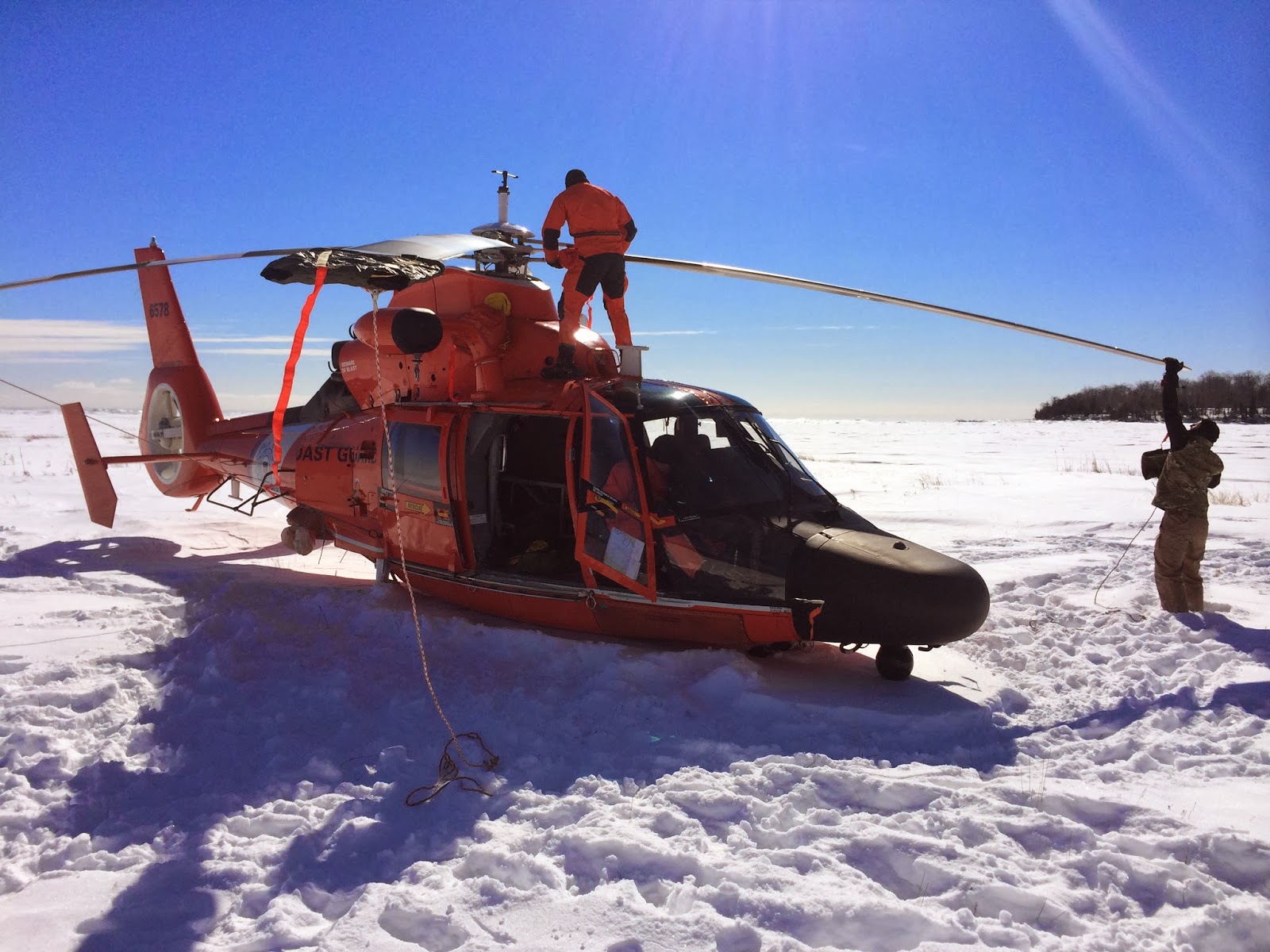
The photos above and left make it seem as though the task to remove the U. S. Coast Guard Air Rescue Helicopter from its position on an east side beach was rather easy.

In fact, it took Maintenance Chief John Lee and his crew of five men most of the day, working in temperatures that never went above 12 degrees, to remove rotor blades, dig out the aircraft, slide it to an open area, winch it aboard their trailer, and secure the load for the highway.  A second trailer from Yacht Works in Sister Bay was also on hand, as was Tom Jordan's excavator to lift the aircraft, but the final decision was made to use the Coast Guard trailer brought from Traverse City, at least for the first leg of the trip to a yacht storage shed in Sister Bay.

By 3:45 p.m., the trucks, trailers and crew started down the temporary road plowed parallel to the beach, from in front of the home of Jim and Janet Wilson to the end of Lake View Road, a distance of just over 1/2 mile.  

Dismantling blades, securing the aircraft prior to removal from beach.
The location where the helo set down early Sunday morning happens to be a wide, flat stretch of beach, features not always found along the island's shoreline.  And, as providence would have it, this  location was also in close proximation to the only beach access road along the entire eastern shore of Washington Island, easing substantially one major obstacle to removing the aircraft by trailer from the beach.

Chief John Lee (second from left) and his salvage crew, ready to depart the
beach with helicopter secured to trailer.


Chief Lee isn't new to this particular routine.  He extricated this same aircraft just six weeks earlier from a farmer's field in lower Michigan.  Then, too, the pilot and crew had experienced "flight control problems," according to a news report, similar to the crew's experience in yesterday's cross-lake flight from the Traverse City Air Station.

This helicopter model (Eurocraft AS365 Dauphin) has been utilized by the Coast Guard since the early 1980s, and has been a serviceable workhorse during this time.  But, as Chief Lee noted, there are parts no longer stocked on the shelf or easily procured.

Such flight control problems, manifested now on several occasions, surely weigh on the minds of the Coast Guard command, and may serve to hasten the effort to renew the fleet.  In 2010, according to one news release, the Traverse City Air Station Commander requested replacement Jayhawk helicopters, newer aircraft with more power and longer range.  But, apparently, the cost, time of procurement, training, parts…all were a part of the challenge to effect change.

Meanwhile, the Coast Guard's air and ground crews, not to mention the occasional citizen whose life may one day depend on such machinery, would certainly prefer the use of the safest and most robust aircraft available.  Days for aging "Dolphin" helos like #6578 may be numbered, with safety compromised if deployment of this aircraft continues to be extended.

Time in the air for the "Dolphin" is something like 2 1/2 hours on a full tank, after which the aircraft requires refueling.  A flight to Washington Island from Traverse City, as an example, would take approximately one hour.  With one hour for the return flight, that leaves only 30 minutes on station, unless the aircraft is refueled.

View from the Wilson home toward the open lake.

Welcoming hosts:  the Wilsons

 When the crew of #6578 landed in front of their home around 7:50 Sunday morning, Janet was already up, and after the helicopter landed she soon saw one of the men coming toward their house.  Jim, still sleeping, had incorporated the whirr of the blades into his dream, believing he was again aboard Eagle III, the medivac helicopter that took him on an emergency flight to a Green Bay hospital in July of 2012.  It took him time to determine where he was and what the activity was all about.  It wasn't long before Jim joined Janet and the four men in their living room, sensing their relief for a safe landing.  It was at least an hour, Jim said, before he realized he wasn't yet dressed.

Janet and Jim Wilson gaze out their living room
deck window toward the helicopter.  
The activities of the past 30 hours in front of the Wilson home are now over.   The safe emergency landing - a precautionary landing - becomes a good story that might add push for the Coast Guard to renew this aging aircraft.

-  Dick Purinton

Sunday, March 2, 2014

COAST GUARD HELO MAKES PRECAUTIONARY LANDING, EAST SHORE OF WASHINGTON ISLAND


Flight crew with Air Rescue Helo 6578 on beach in front of Wilson home.
Hog Island is visible in background, above tail section.

Washington Island, Wisconsin -

U. S. Coast Guard Rescue Helicopter 6578 landed safely on the snow along the eastern shore of Washington Island this morning, in what was termed a "precautionary emergency landing" by aircraft commander LT. Chris Breuer.

The MH-65C "Dolphin" helicopter with four crew aboard had taken off from the U. S. Coast Guard Air Station Traverse City around 7:50 a.m. EST.   As their aircraft flew over Lake Michigan and approached within approximately ten miles of Wisconsin's shoreline, intending to fly over Washington Island enroute to a search and rescue assignment (SAR) near Ashland, Wisconsin, a "flight control issue" arose.   A decision was then made to land along the flat, broad portion of beach just south of Hog Island and the Percy Johnson County Park, an area separated from the trees along shore and the open lake waters by ice banks and snow covered rocks.

According to LT. Breuer, flying further inland wasn't a prudent risk.  It would have been a flight path over trees for another several miles, extending their air time in an effort to reach open fields, or perhaps the Island Airport.   While he couldn't speculate on the nature of the mechanical issues encountered, other than to verify that it was not a fuel related problem, such landings, while not routine, are occasionally made, always with safety of both crew and aircraft foremost in mind.

With landing wheels now deep in snow and the aircraft unable to be flown, the most likely resolution to repairing the helo will be to lift it by crane to a flatbed truck, and transport it back to their air station, rather than perform on-the-spot repairs.  Engineering tech support at the Traverse City airbase will determine just when and how the helo extrication might be accomplished.   When this is sorted out, likely by early afternoon today (Sunday), Breuer's crew will be airlifted back to their base.  A "salvage" detail will then likely take over to ready the plane for lifting and transport, first by ferry, and then via highway back to a facility where it can be properly repaired.

Air crew secured rotors in preparation for their anticipated departure later today.


The helo crew includes:  Aircraft Commander LT Chris Breuer;  Co-pilot Jim Okorn;  Flight Mechanic Matt Lussier; and Rescue Swimmer Tom McArthur.   The crew had responded to a call around 5 a.m., an "uncorrelated Mayday" reported from the Ashland area, which, according to Breuer, could be almost anything, including an ice fisherman or snowmobiler needing assistance.  It was unlikely, he said, due to the heavy ice conditions in that area, that this call would have come from a vessel in distress.

According to Breuer, his aircraft had been used earlier last evening by a nighttime crew, before his crew responded to the Ashland call.  They were in the air some 50 minutes, he said, before putting down in front of the Jim and Janet Wilson home around 7:45 a.m. CST.

"Did you head for the widest stretch of flat beach, or the nearest home with smoke curling from the chimney?" I joked, noting the warm, comfortable surroundings of the Wilson home.  Safe landing was foremost on their minds, I was assured, with the nearby hospitality of the Wilsons an added bonus.

By the time I arrived to interview the crew, around 9:45 a. m., the Wilsons had just departed for Sunday morning worship service, leaving their lakeshore home in the hands of the air crew, plus the Island's two policemen, Gary Schulz and Tyler McGrane.   The morning was fresh, with bright sunshine, temperatures slightly below zero, with very little wind.  Circumstances could certainly have been more extenuating, the crew noted, than along this shoreline, a location where a century or more ago crews of sail schooners sometimes found themselves wrecked.


Aircraft Commander LT Chris Breuer
While LT Breuer was occupied with phone and email traffic, coordinating plans going forward, he also kindly answered my questions.  Crew members' families had been provided notice of their status, each man noted.  After a quick couple of photos taken in front of the fireplace, scenes that might depict their situation as just a bit too comfortable, considering the circumstances behind the forced landing, the crew donned their boots and winter gear and waded through the snow to secure the helo in preparation for their anticipated departure for home base.
L to R:  Pilot LT Chris Breuer, Rescue Swimmer Tom McArthur,
Co-pilot Jim Okorn, (and seated) Flight Mechanic Matt Lussier. 

The Coast Guard regularly assigns helicopter crews to assess ice conditions for commercial shipping, operations called "ice reconnaissance." This is one reason why, periodically through the winter, Islanders can see or hear helicopters flying overhead.  Great Lakes shipping has been slowed greatly by this winter's ice conditions, but vessels that still operate - or that will begin their 2014 season soon - rely on both satellite reports and the Coast Guard's eyes to assess navigation conditions.   And, there are also the several Coast Guard ice breakers and the administrative commands at the various Coast Guard Sectors of Operation that use such ice updates to advantage.

Islanders, ferry operators and commercial fishermen, or any citizen with extraordinary medical need, may also find comfort in the fact that four such helicopters are assigned to the Traverse City Air Station. These aircraft generally have much quicker response time than a vessel, weather permitting, should there be a need for flight rescue assistance.

-  Dick Purinton