Showing posts with label North Shore. Show all posts

Monday, April 20, 2015

ISLAND WATERFRONT - Then and Now - Arni and Carl Richter Years - Part XVII

Carl Richter, on board the ferry C. G. Richter
Washington Island, Wisconsin -

When Carl and Arni made their decision to purchase Jepson's ferries, after nearly nine years freighting and carrying mail, with the occasional passenger, aboard the little tug Welcome, Carl was 69 years of age.   Hardly a time to jump into a new venture with both feet.

But, his son Arni, who would have just turned 29 in 1940, was in the prime of his life, married to the former Mary Cornell, and he had experience gained in both the navigation and the administrative side of a freight transportation business. In addition to his duties with the Welcome he was a fish wholesaler, buying and then shipping Island fish to markets in Chicago and New York.  To Arni, an expanded ferry business made economic sense, although there were challenges with a war effort coming on, and two older, wooden ferries to maintain.

 He helped deliver ice with horse and buggy for the Gislason store, in Jensenville.  As a youngster he had always loved horses, and Arni's first desire was to become a farmer.
Arni Richter, as a toddler.

The opportunity to operate a ferry business meant the chance to live on the Island and to continue working with his father.  It could be said by those who came to know him that he seemed to have a head for business and the decision-making that went along with serving customers and keeping boats running.   One of their great challenges, and one that seemed out of reach for several years just as it had for William Jepson, was to solve the winter transportation issue.

Crossing on ice was a risky business, but often it was the only way to get the mail and goods back and forth.  The wooden ferries they inherited were getting softer around the shaft logs. (Arni had privately wondered if the Steamboat Inspector Erikson hadn't been considerate by overlooking some aspects of the ferries' ages, knowing that it would be a few years before a new ferry could be built?)

Due to the absolute necessity of Island ferry transportation, Arni did not join the military service when the war was on.  Those years were a struggle for the business, however.

When the war ended, he redoubled efforts to design and build a new ferry with a steel hull and sufficient power for ice work.   He enlisted the services of Naval Architect Walter Haertel, Sturgeon Bay, with rough proposals from several builders.  Obtaining financing proved most difficult, without a local bank, or any bank along the Lake Michigan shoreline for that matter, willing to take on the risk of financing a new ferry.   Arni believed that their small revenue stream and the fact they hadn't been in business for long made the venture seem risky.  Only as a last-ditch idea, on his return from points as far south as Kenosha and Waukegan (where he had worked in his twenties in fish stores) did he try Henry Schuette of the Manitowoc Bank.

A long-ago connection the Manitowoc Bank had with a schooner named White Swan was a long shot, but in this case, it worked.  Mr. Schuette's father had been with the bank years before, and the bank had part ownership in the vessel that called at Jackson Harbor occasionally for a load of grain.   Arni, as a youngster in his early teens, once had the opportunity to sail on the White Swan for a trip down the lake, from the Island to Manitowoc, where its load would be deposited at the mill that produced flour of the same name as the ship.

Later, Mr. Schuette's pleasure in seeing the difference his loan made in Island ferry transportation was repeated on many Sunday afternoons, when he and a granddaughter would drive to Gills Rock and ride round-trip on the Griffin.

The only Richter ferry not built by a Sturgeon Bay shipyard, as it turned out, was the Griffin, which was constructed by Krause Kraft of Kewaunee, Wisconsin.  It was 65-ft. x 20-ft. beam, 7-ft. draft, with capacity for approximately 9 autos and 100 passengers.  She was powered by a 180 HP Kahlenberg engine.  The access to the passenger deck above the vehicles was located at centerline, a trunk that made loading somewhat awkward (as compared with the C. G. Richter of 1950 that had its engine room access and cabin stairway access along the port rail.)  Nevertheless, the improvements in operations with this new ferry in the 1946 season were immediate.  It's steel hull brought even greater benefit for the winter ferry service, when one trip each winter day was scheduled (but none on Sunday).  The Griffin became a most useful and relied upon Island ferry.

The wooden ferry Welcome was the first of the old ferries to be traded, and then in 1950 the North Shore was sold to make room for the twin-engine C. G. Richter was constructed at Sturgeon Bay's Shipbuilding and Dry Dock Company, and it was also a Haertel design.  There was a section on the car deck, all the way aft, where the tail-ends of vehicles overhung a steel beam.  This, in theory, shortened the useful overall vessel length, which kept her in the classification known as "Small Passenger Vessel," according to the federal Subchapter T Regulations, an advantage in both outfitting and manning.

From a 1990 interview with Arni Richter, from Over and Back (WIFL - 1990):

It was evident from the last dry-docking of the Welcome in the late forties that she was getting old and was going to need a major overhaul soon.

We found a buyer for her down in the Lake Erie islands.  Having a buyer was a deciding factor in going ahead with a new ferry for the 1950 season.  Walter Haertel designed the C. G. also.  She was twin screw and built for winter service.  Twin screws did not prove to be a good arrangement for ice work. We bent both stats the first winter we tried using her in ice and went back to using the Griffin for winter crossings.

After the Eyrarbakki was added to the fleet in 1970, we sold the Griffin to the Anderson brothers [Cecil and Jackie] soon afterward.  Then we converted the Richter to a single screw, single engine boat, and it has been the winter ferry ever since.

Preparing for launch, Griffin in 1946 in Kewaunee.  A stoutly-built ferry,
Arni noted she had very little dishing to show for over 20 years of ice work.


The C. G. Richter had softer chines and easier lines all around than did the Griffin, and she carried nine autos and 100 passengers quite easily.  Power was furnished, not by Kahlenbergs this time, but by twin Murphy 150-HP diesels, for good speed and for maneuverability at the pier.  But, as noted by Arni, it wasn't good for ice work in winter.  Carl's name went on this ferry, and family members were present to see it launched in Sturgeon Bay in the early summer of 1950.   Those two ferries, Griffin and C. G. Richter, kept people, vehicles and freight moving back and forth to the Island throughout the next several decades, to be joined in 1960 by the first open-deck ferry, Voyageur.

Launch day at the Shipbuilding and Dry Dock yard.  Maggie and Carl Richter stand with
granddaughters Carol (Richter) and Jeannie (Leasum).  Arni and Mary Richter,
Margaret Leasum, Emma and Paul Richter stand at bottom of steps.


When the Voyageur was designed (again, by Walter Haertel) it's purpose was to move more and larger vehicles.   Almost immediately it's attributes were put to work in Sturgeon Bay, following her first season of Door crossings, when the highway bridge was struck by the Swedish freighter Carlsholm, Oct. 21, 1960.  The northern portion of the county's peninsula was instantly separated by water, and it would be weeks before the single Michigan Street Highway Bridge would be repaired.  For the first several weeks, until a barge-bridge was put in place across the narrows of the ship canal within a mile or so of Lake Michigan, ferries from Washington Island provided 'round the clock service for people and vehicles.   This was at a time when the apple harvest was still in full swing, with the Fruit Growers Co-operative located on the north side of the bay, adjacent to what is now the Great Lakes Marina. (Then the Palmer Johnson Boatyard.)  Arni sent the C. G. Richter almost immediately to Sturgeon Bay, and by 7 p.m. that same day, the Voyageur had joined her, with their crews shuttling equipment, freight and people across the bay, leaving the Griffin to handle the off-season Island traffic.  Tourism, not yet what it would become a decade or so later, slowed greatly after Labor Day weekend, and with the bridge out, traffic headed into northern Door County slowed to a trickle.  If anything, the novelty of having a damaged bridge and two of the Island ferries in town increased the traffic of bystanders and vehicles locally, at least for the first several days.

Jerry Potter enjoyed this photo of his Cadillac coming
off the C. G. Richter so much he asked for a special print.
Side loading became a slow-down factor as newer ferries
loaded more quickly, easily and safely.

Griffin, loaded with sacks of potatoes from
the Anderson farm for Sturgeon Bay. (1950s)
Arni Richter, when asked in 1990 about the impact new ferries had on the ferry business and the Island as a whole, said:

Of all the ferries, I think the Griffin and the Voyageur made the greatest economic impact on the Island.

Fish and freight were a big part of the operation in the 50s.  one year, we hauled over 1 1/2 million pounds of fish!  In the In the fall, after labor Day, one boat hauled just herring to Menominee.   Later in the fall, we hauled potatoes for Ed Anderson to Sturgeon bay.  Tourism was picking up then, too.  

In Florida I saw an open deck ferry which ran to Sanibel Island, and it gave me the idea of building a boat to handle large trucks.  Walter Haertel and I worked out a design which became the Voyageur, built by Bay Shipbuilding & Dry Dock for the 1960 season.  That was a real change after the Voyageur came out.  We hauled lots of heavy loads in the 60s with her…semis, log trucks, highway equipment, road oil in semis for Island blacktopping…I think it encouraged Island development.

Island traffic, thanks to increased tourism in the late years of the 1960s, seemed to have outgrown ferry capacities in the peak days of summer.   More motorists towed trailers and boats and hauled goods for their cabins.   More freight arrived in bulk, delivered by truck.  Island roads were slowly becoming paved, and in order to mix asphalt, tankers of heavy road oil and specialized equipment like stone crushers came back and forth.  At 65-feet in length, the Voyageur had become a workhorse, but her deck barely held the ever-longer semi-trucks.  The Voyageur investment showed that an open-deck ferry with unlimited overhead dimensions was the wave of the future.   The Eyrarbakki was built in 1970, and the C. G. Richter would then undergo a conversion to single-screw, replacing the Griffin in 1971 as the Island winter ferry.

Arni often enjoyed a cigar, as did his
father, Carl.  Shown here in his 60s, he
also enjoyed taking the helm of one of his
ferries - in this case the Voyageur. 

By 1969, Arni had begun to consider another, longer ferry, one with greater capacity for autos and large trucks, and for passengers.  The year 1970 would be a special year, and as one who served as a director, and then president, on the Door County Chamber Board, and who was in tune with Door County's emerging tourism economy, it seemed natural to Arni (and to Mary Richter) that a celebration of Icelandic immigration be combined with a christening ceremony.

In 1970, the Eyrarbakki would become the newest ferry, one of the earliest of hulls constructed by Bay Shipbuilding, the Manitowoc shipbuilder that had recently moved its operation to Sturgeon Bay, taking over the Christy and Shipbuilding and Dry Dock and Roen Salvage yard properties.

Nathan Gunnlaugsson, long-time ferry captain, on one of the early trips
aboard the Eyrarbakki in 1970.
 -  Dick Purinton

Monday, April 13, 2015

ISLAND WATERFRONT - Then and Now - Richter Years Begin - Part XVI

Loading fish boxes aboard the little Welcome, in 1930s.  Believed
to be in the East Channel, with Detroit Island in background,
where the Welcome, along with other boats,
often anchored to the ice in winter.

Washington Island, Wisconsin -

Saturday, April 11th, marked the 75th year of Richter ferry service, a business owned and operated by Carl and Arni Richter, father and son, since 1940.   Not to be forgotten in this endeavor were Maggie (Gudmundsen) Richter, and Mary (Cornell), who were also willing to support this new family venture in its early days, before it could support them.

Why did Capt. William Jepson choose to sell to the Richters when he did?  We know he had considered a new and longer ferry route, the 20-mile run between Sturgeon Bay and Marinette-Menominee.  And, according to Arni, he and Carl had a preliminary design for a new ferry and planned to compete with Jepson.  Arni believed that word of their plan was a factor in Jepson's decision to sell.  We don't know how or if the build-up of U. S. industry to help European allies in their war effort came into play, but if timing was ever right to sell his Island ferry business and move on, for Jepson this may have seemed his best opportunity.

For the Richters, starting up a competing ferry operation from scratch would be difficult:  raising the capital for a new ferry; modifying Island and mainland piers for landing purposes;  and providing a schedule of service with a single vessel that would gain public support.  All this when it was questionable there be enough business volume to support two competing ferry operations.

Buying Jepson's ferry operation made more sense to the Richters.  For one thing, they would take over an established and progressive business.  Besides having the right boats, equipment and docks, there was also the recently dredged West Channel into Detroit Harbor (thanks, in large part, to Bill Jepson's urging) that made navigation to and from the Island safer than ever before.

Photo taken in Kenosha or Waukegan, when Arni was a young man
of perhaps 19 or 20.  He called this photo, "The three Arnis."  Shown are
Arni Paulson, with the Icelandic consulate
in Chicago;  his grandfather, Arni Gudmundsen, and Arni Richter.
The April 30, 1930 Advocate reported:  "Arni Richter arrived home
Monday and wil fish with his father, C. G. Richter, this summer."


The Richters weren't without experience when they decided to go fully into the ferry business, although Carl was really the one with past water experience.

In Arni's words, from Over and Back (WIFL - 1990):

Dad had sailed as a young boy on several schooners, the Walhalla, Iris, Madonna and the Flotilla among them. He was sixteen when he got his first job as a cook's helper aboard one of the sailboats which called frequently in Detroit Harbor. His mother instructed him how to make bread in the one hour he had before the boat departed, while he packed his "turkey," as he called his sea bag.  He also spent several seasons sailing the lakes on ore boats of the day, and later fished commercially, mostly from the St. Ignace area.  …The Shine On was getting sort of old, and Dad was looking for a different boat around 1930.  I was buying fish at the time but also doing some fishing.  We bought the little Welcome from the Hansen brothers, Art and Hans.  She was 40 feet long, and ironed off.

This series of photos from the Richter album shows the little Welcome, sawed free
from the ice,  then towed by truck on bobsled runners to the East Channel, the beginning
of freighting operations for Carl and Arni Richter in 1931.


During the season, the fishermen could ship their fish with Mr. Jepson's ferries, the Welcome, built in 1929, or the North Shore, built in 1931.  But in the winter, they had to take a day from fishing to transport their fish to the mainland as there was no winter ferry.

They asked me if we would haul the fish with the little Welcome.  At the time, it was frozen in the west channel in Detroit Harbor, not far from what is now the Island Outpost dock, the Cornell dock back then.  I talked to George Hanson, and asked what he thought about skidding it over the ice to the east channel, where there was open water.  Thinking it would not be too difficult, we sawed her out, pulled her up onto the ice with trucks, and got sections of a bobsled under her.  We towed her across the ice to the east channel (off what is now the Shipyard Marina), and waited until the fish boats came in for the day.  They broke the ice around her and she floated right up.  From there, we made the winter trips, hauling fish and whatever else needed to be hauled, mostly fresh produce, as the stores stocked up in the late fall with canned goods.  There wasn't a lot of fresh produce in those days, either.  Besides fish, there was a lot of cheese being shipped from the Island cheese factory, sometimes as much as a ton a and a half, in ten or fifteen pound horns,.  It was a very good cheddar cheese, and many places in Green Bay and the area used to give them as holiday gifts.

In 1931, we got our first mail contract. In those days it was a four-year contract.  That was a year around contract.  At times, when we couldn't take the Welcome because of ice, we could go over the ice, which was actually a faster trip most days.

In the thirties, we didn't have a good dock on the other side for winter.  Gills Rock was our landing spot in summer, but we'd go into Europe Bay and anchor the Welcome in winter, and take our rowboat ashore, tying up to the ice banks.  I remember as many as 112 boxes of fish on the Welcome (about 115 pounds apiece with ice, plus fish, over six tons!).  On some occasions, boxes were put on the upper deck. But quite commonly, there would be 50 or 75 boxes.  I was handling thirty-five accounts in those days, there were so many making a living fishing.  It was a real trick sometimes to row ashore, twelve fish boxes or so in the rowboat, and throw the boxes up on to the ice banks where a truck was waiting to pick them up.


Ted Jessen once described Carl Richter (1871-1962) as
"snappy," in terms of his wit and personality.
In this photo taken in Oct. 1941, he's snappy
in appearance, too, posing in the wheelhouse
of the ferry Welcome.


Carl Richter, with Ford pulling bobsled, alongside
rough ice.  When they bought the Ferry Line
from Wm. Jepson in 1940, Carl was 68 and Arni was 29.   


If Arni seemed short on actual water experience when he started freighting with his dad on the little Welcome (he would have been 20 in 1931), he soon learned how to handle a boat and adjust to different situations.  He seemed to possess, however, a good business sense, along with an optimism for the future.

Carl and Arni continued using the little Welcome when the conditions allowed to carry freight and mail.  If an occasional passenger wanted to ride along, they were invited to sit on a fish box.  By 1939, they looked at making a substantial change.  

Early Ferry Line experiences were remembered in this interview with Arni Richter, published in Over and Back:


CROSSING THE DOOR ON ICE WITH SNOWMOBILE…early forties…as related by Arni Richter…

We bought the Ferry Line from Mr. William Jepson in 1940.  We had operated the little Welcome continuously since 1931, carrying mail, freight and passengers until April 11, 1940, at which time we bought the Line.  I sold Mary's (wife Mary Richter) new Ford V-8 automobile which she had just bought with her earnings as a teacher, to come up with some of the cash needed in the purchase.

Arni recalled when he and his dad first applied for a Coast Guard license
in 1940 in Milwaukee, soon after they purchased Jepson's passenger ferries.
 Carl was nervous and not used to taking exams, but he and
Steamboat Inspector Henry Erickson got along quite well after they
discovered they both had a background in sailing vessels.
Carl happily came away with his license to operate.
Shown here is the Feb. 1956 issue.
The deal included the ferries WELCOME, NORTH SHORE, and two snowmobiles, a model A and a Model T with tracks, the present Island dock property, and one half-ownership of the Northport property.  Roy Voight owned the other half.

When I think of some of the things we used to do as a matter of necessity…and no one ever thought anything of it, because that was the only way.

One time, in winter, we couldn't land at Northport.  Europe Bay was out (impossible to land), and Gills Rock was full of ice, near Ellstrom's bluff.  Dad stayed aboard, and I went ashore with the sleigh and the mail. On the way back, we had some passengers for Plum Island.  Among them were a young Coast guardsman and his wife with their newborn little baby.  In those days families lived on Plum Island, and the station was open year around.  On the way back to the WELCOME, I had the young mother by the arm.  Her husband was following with the baby in his arms.  As we were nearing the boat, I heard a crash and turned around to see him go down through the ice with the baby.  I got the mother aboard the WELCOME, then ran back and grabbed the baby from the father.  It was just luck he came back up in the same spot he went down.  I ran the baby to the mother, while someone else helped the young man out of the water.  When the baby's wet blankets were unwrapped, luckily the water hadn't penetrated through.        

[At the Ferry Line's 50th celebration, Rudy Bahlert came forward and told Arni that he was that baby rescued years ago.  His father served in the Plum Island Coast Guard at the time, and his family later lived in a home just south of Gills Rock.]

Walking over the ice wasn't too uncommon, and many times it had to be done to get ashore.  I recall a mainland basketball team leaving the Island.  We tied a rope from one boy to another, in case one boy went through.   Sure enough, one boy did break through the ice, but I wonder if he hadn't been fooling around and not paying attention.

Carl Richter and Lucien Boshka (who had also worked for Bill
Jepson's Ferry Line) exchange freight, including fish boxes.
Location appears to be near a low bluff on the Peninsula.


If we couldn't go by ferry, we'd take to the ice, using the snowmobile and a big bobsled we had built to haul freight.  One trip Dad and Lucien (Boshka) drove in the snowmobile, and I took my car, a 1941 two-door Chev, because of the passengers we had along.  We went into the mainland at Door Bluff, where we were usually met by a truck with mail and freight, saving us time.  On this occasion, with a strong southwest wind blowing, the trip to the mainland went fine.  But on the way back, with about a ton of feed on the bobsled, we noticed the whole field of ice was breaking loose from Door Bluff all the way to Lehman's on the west side of the Island.   A large crack had opened up with the strong southwest wind.  I scouted ahead with the car and found a spot where the two fields of ice were together, and I backed up, with my door open, just in case, to jump the crack.  I made it across that crack, all right, but I came down so hard on the other side that the ice broke under the weight of the car.  I made it up onto solid ice, but the back rims of the car were flattened, and the door was bent on its hinges.  I kept going toward the Island, near Denny's Bluff, and could see big ice shoves with cakes piled up in the air, but the field was starting to slow down, pressed against Washington Island.  I went back to where Dad and Lucien were.  We found a crack which wasn't too wide and built a bridge of logs and planks.  We had to disassemble the bobsled, and carry it and the feed, and whatever other freight we had that day, across the crack, then reassemble and reload the sleigh.  The snowmobile was the last thing to go across.  We wound up near Denny's Bluff as it was getting dark, and I don't think anyone had an idea where we were.


Those early Ferry Line times were often days with long hours, filled with uncertainties over whether the business would provide enough revenue to eventually plan for a new ferry.  The war years also delayed this venture by restricting travel for motorists, through gasoline and tire rationing, and by making ship materials scarce.   Building a new ferry of steel was still a goal, however, to replace the aging ferry Welcome and improve the safety of the winter operation.

This goal would not be met until 1946 with the building of the Griffin, but even then, obtaining the financial support for such a project proved difficult.

-  Dick Purinton

Wednesday, April 8, 2015

ISLAND WATERFRONT - Then and Now - Anderson Freighting - Part XIV


Ervin Anderson, shown aboard the
Lawrie Transportation Co. passenger / freight vessel
Lois Pearl, home ported in Milwaukee, Wisconsin
(possibly 1929)

Washington Island, Wisconsin -

Over the years, freighting supported a number of Island families.  This post is about Captain John Anderson (called Jack by his close friends), his sons and their vessels.

The Andersons were very much involved in freighting through several generations, starting in the early1920s, owning and operating a number of vessels:   Agnes H.;  Diana;  American Girl; and Griffin.  Each was used for hauling a variety of commodities.  Like many Island families who made a living working on the water, whether freighting or fishing, tragedy and near-tragedy visited the Andersons several times, in several different ways.

On Sep. 26, 1930, the 25-year old Ervin Anderson, son of Capt. John Anderson, Washington Island, operated the Lawrie Transit Company's new, welded, steel-hulled North Shore from St. Joseph, Michigan, heading for Milwaukee.  (The photo at top shows Ervin posing in the door of the wheel house of the Lois Pearl, another of the Lawrie Company's boats, in an earlier time.)  Joining Ervin on that trip across the lake was Harriet, his new bride of several weeks, engineer Joseph Tekus from Cudahy, deckhand Arthur Peters from Milwaukee, and two unidentified passengers.  Before leaving the Michigan harbor, they loaded of 3,000 baskets of grapes aboard the North Shore.

According to an account by Lois Lawrie Rehberg, a daughter of William Lawrie who owned and operated the Lawrie Transit Co. of Milwaukee, and who was a young girl at the time, "A sudden Lake Michigan gale struck when the boat was about thirty miles out of St. Joseph."  The North Shore and the six on board were lost in the storm.  Approximately two weeks later, the body of Arthur Peters was recovered, wearing a life jacket.  None of the others were found.

As we noted in the last blog post, within a year William Lawrie built a new, wooden-hulled North Shore as a replacement, and this North Shore would be the same vessel in five years that would find its way to the Island ownership of William Jepson, where it joined the Welcome for auto/passenger and freight service.  (In the way of making further connections, William Jepson's sister, Annie, was the wife of Capt. Jack Anderson.)

With permission from Jim Anderson, grandson of Jack Anderson, we publish a letter written July 8, 1929 on Lawrie Transit Company stationery by oldest Anderson boy, Ervin, in which he addresses his younger brother, Cecil (whom he fondly calls "Duke").   Ervin's letter reveals an eagerness to return home and work in the family's freight business after a year or two spent sailing in Milwaukee, if his services should be required on the Diana.   Beatrice is the cook, and she's a sister to Ervin and Cecil.

According to Advocate entries, Lawrie's South Shore put in at Washington Island fairly regularly for off-season freight, and she also was hauled for work one time at the Island's shipyard, connections through which Ervin quite possibly came to his employment at the Milwaukee boat company.

Dear Brother,

Just a few lines to find out how things are going on "The Diana."  How did she pass Inspection?  And is Freighting any good?  Do you think it would be better if I came home?  I'm sending you a bill I want you to mail to Dormer Fish. Co.  That is if they haven't already mailed the check.  If they sent it, mail it to me as I sure need it.  Write and let me know if you think I should come home so I can give Bill [Lawrie] a couple weeks' notice.

I seen Tom Williamson the other day and he said he seen you in Green Bay and he also said the Boat looked good but the cook looked better - be sure to tell Beatrice that.  

Well Duke Sir got to take her in to the dock now write we all need the News   tell Ma to write.  You may not be able to read this but the boat shakes so darn much I can't do better.  From Ervin
  (my regards to Alvin)

PS  Do we get half the oil or does Christ [Andersen] get most of it yet?  -  EA

Jack Anderson, as far as records show, began hauling freight with the hooker Agnes H. in the early 1920s.  Agnes H. (42 x 13.4 x 5.8, with a 40 h.p. gas engine) was built in 1914 by Rasmus Hanson in Jackson Harbor and was named for his daughter, Agnes.  The 1920s were an active period for freighting, with frequent news reports of loads taken by various vessels and their owners, both to and from Washington Island, with an occasional load for a non-island destination.

A sample report:  the Oct. 2, 1925 Door County Advocate reported that,  "Capt. Al Shellswick, Diana, has gone south in quest of freight.   Capt. Wm Jepson, Wisconsin, has gone in to the fruit trade.  Capt. John Anderson, Agnes H., is making irregular trips."

In the fall of 1926, Agnes H. lost power and went ashore on the rocky beach near Bowyer Bluff.   The Advocate reported, "The Agnes H. went on the beach Oct. 30 and is laid up for repairs. It's difficult for "hookers" to handle freight."  

[The term "hooker" was described by Jim Anderson in the following way:   "…the type of freighter which mainly carried their cargo in "the hold" of the boat and was lifted out by means of a boom, winch and hooks - so came the name hooker."]

Jack and his son, Ervin, were aboard the Agnes H.,  but no one was harmed and the vessel slid from the rocks with the aid of timbers placed under the keel and two vessels straining on tow lines.  It's rudder in one of the photos appears bent at an angle.  But the hull, all things considered, was only slightly worse for the experience.  The following series of photos of the incident shows the efforts made to remove the Agnes H. from shore, observed by many bystanders.

Agnes H. on the beach with salvage efforts, observed
by a crowd on shore, 1926.  John and oldest son Ervin
Anderson were on board at the time.
(all of the above photos including Ervin Anderson on
the Lois Pearl are courtesy of Jim Anderson)


A few years later, March 30, 1928, the DCA reported:

 Capt. Chris Andersen made the first spring trip to Sturgeon Bay on the hooker Diana, leaving Friday A.M. and returning Sunday A. M.  He carried about 4 tons of fish.  John Anderson arrived with another boat Saturday. The new boat will replace the Agnes H., which was wrecked at Whitefish Bay late last fall.  The new boat, South Shore, of Milwaukee will tow a new fish boat from Sturgeon Bay Boat Works to Two Rivers where a crude oil Kahlenberg diesel will be installed.

Cecil Anderson was about ten years of age when the
Agnes H. foundered near Sturgeon Bay.  He and his father were rescued by members of the U. S. Coast Guard from the Sturgeon Bay Canal Station.  The vessel broke up in the following days.  Cecil, now seasoned with experience, continued in what would become a long and successful career in freighting.

Two vessels in an early photo (year unknown).  The Arrow, Abe Jessen's boat, is moored at left,
and the Andersons'  
Diana is at the Cornell dock, with the tip of Detroit Island in background.  (Jim Anderson photo)


The Anderson's operation of the Lawrie Company boat South Shore was temporary.   The loss of the Agnes H. soon led to purchase of the Diana from Alfred Shellswick, who had used it for freighting since approximately 1919.  It was launched at Burger Boat in Manitowoc in 1906, and originally it was a yacht, measuring 60.5 x 12.4 x 6 ft.   Diana's name frequently appeared among the small freighters listed in the shipping news published by the Advocate, hauling fish and assorted freight from the Island.  For a time, Shellswick leased Diana to Chris Andersen, but with it's somewhat limited carrying capacity, Chris Andersen was in the market for a larger vessel, and he found it in the Wisconsin when Bill Jepson (who had operated the Wisconsin in freighting and ferrying for years, ever since he built it at the Sturgeon Bay Shipbuilding and Dry Dock) brought out the brand-new Welcome in 1929.

The following DCA news item recorded the changes in vessel ownership that year:

March 29, 1929 - Chris Andersen and two twin boys, Ray and Roy, bought the motorboat freighter Wisconsin from Wm. Jepson who had it built several years ago and used it as a freighter in several places, but ferried autos and passenger across the Door for the last three years.   Chris had been renting Alfred Shellswick's Diana, originally a twin screwed yacht which Al had converted to a single screwed "hooker".  Chris carried Island fish to Green Bay and returned with whatever back freight he could get.  Many times the Diana was too small for the freight volume.  Sometimes as high as 100 fifty-five gallon barrels of gas needed to be brought to the Island and this weighed over 50 tons, but the Diana's capacity was 40 tons so Chris could not handle all of it.

The Diana served the Andersons well from approximately 1929 until the spring of 1947.   Photos of the Diana show that it continued as a hard-working freighter, already into its third decade of service when Capt. Anderson bought her.  By the time WWII came to a close, with some 40 years under her bottom, this vessel's serviceable life was used up, and Jack and Cecil purchased the American Girl.

Scrap iron loaded on Diana's deck was a frequent commodity.  Here, in 1942, 
at least some of the bits and parts appear to be from old ships.  (Jim Anderson photo)


The Islander, Washington Island's newspaper of the day, the editor reported the new vessel in it's February 11, 1947 issue:

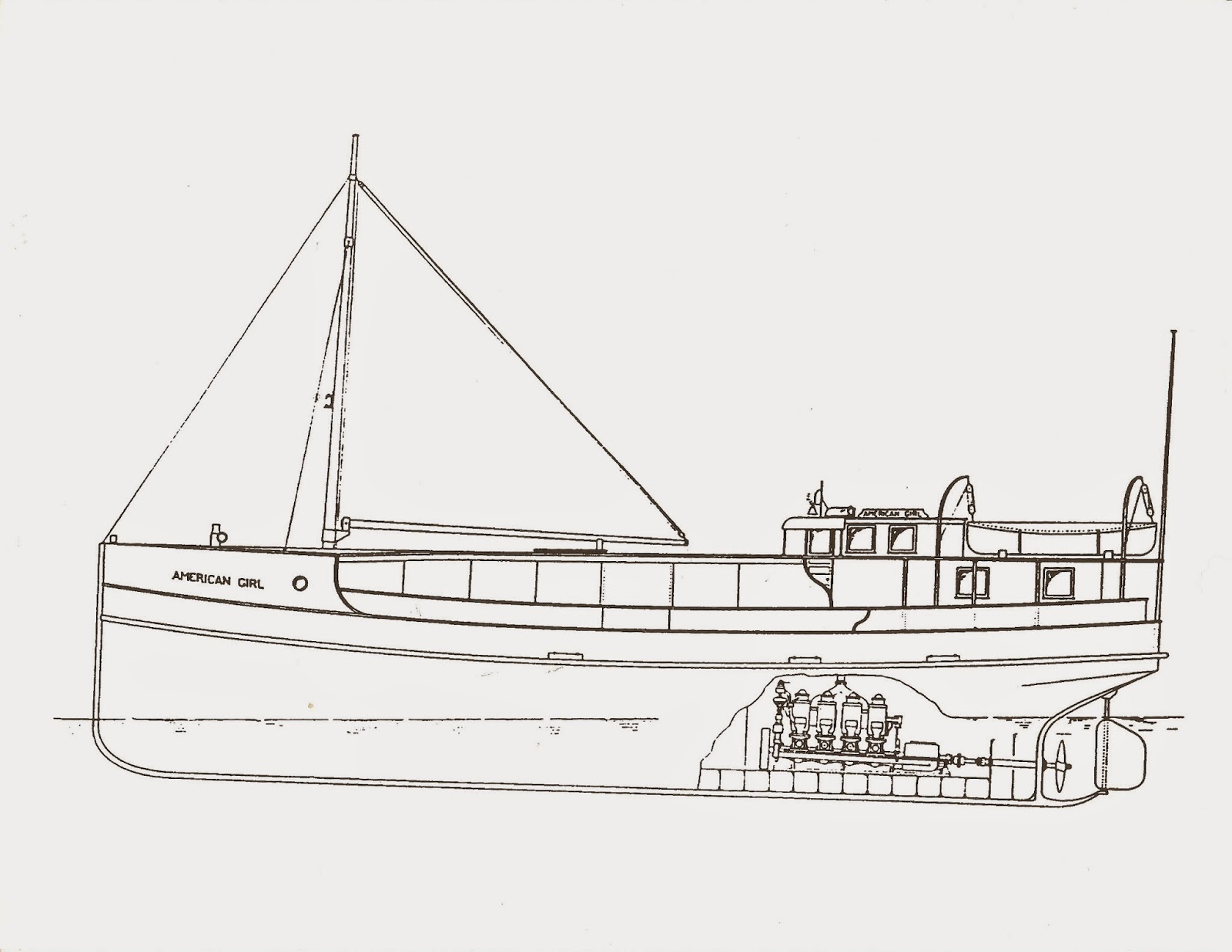
American Girl coming here - The American Girl is the name of the 65 foot steel freighter, recently purchased by Jack Anderson and Sons for the freight run between Washington Island and Green Bay.  The transaction will be completed in ten days, but the boat will not be brought here until weather permits.  
The American Girl come from Sheboygan(sic), Michigan, where it had been used for hauling fish from Canada before the war.  Mr. Anderson plans to make a tow-barge out of his present boat, the Diana.


Side profile of American Girl as originally built.  Slight changes
were made over the years, but the vessel's name stayed the same.
The American Girl was a substantial addition to Island freighting, coming along at a time when nearly all of the older, wooden hulled vessels were nearing the end.

By 1949, Chris Andersen's Wisconsin would be finished.  None of the other familiar names from the past continued to sail - at least not locally.  Instead of serving out its final couple of years as a barge, as the news article indicated, Diana's usefulness may have been relegated to that of a "floating warehouse."

By the early 1950s, she, too, was no longer useful or fit for sailing.  Moored to the Chamber's dock and leaking, the Andersons pumped her out and towed the hull away. (With the assistance of crew members from the nearby Plum Island station, Jim Anderson noted)  Then, she was intentionally sunk off the south shore of Detroit Island.   A series of photos shows the Diana, with Coast Guard's pump on the pier, ready to depart alongside the American Girl.  A list to the hull is visible in the second photo as she is towed, and in the third photo she is adrift.  A series of several forceful bumps from the American Girl's bow finally caused her to sink, which brought tears to the eyes of its owner, Capt. Anderson.

Diana in preparation to be scuttled off Detroit Island's shore.  A young Walt Jorgenson
(wearing cap) can be seen in the bow.  The Coast Guard's gasoline pump used to float
the hull is on the pier, with the American Girl tied alongside.
(series of photos courtesy of Jim Anderson)
The story of the Anderson freighting business will continue in the next post.

Thanks to Jim Anderson for the many great photos and information.

-  Dick Purinton

Saturday, March 21, 2015

ISLAND WATERFRONT - Captain William Jepson - Part XII

Capt. William Jepson, from wheel house window.
Photo taken June, 1932 by A. H. Fensholt of Chicago and
made available for publication in book Over and Back
by Millie Jacobsen.


Washington Island, Wisconsin -

When perusing the Island waterfront, then and now, it is impossible not to bestow a great deal of credit upon William Jepson, who not only was an early ferry operator, but also dock builder, and to an extent, a visionary of for transportation services and how they could be ably fulfilled.

I've seen only a couple of photos of Jepson, somewhat strange, since so many of the older, glass plate photos were credited to him.  The photo above appeared in my book, Over and Back (1990) and it was passed to me by the late Millie Jacobsen.  Captain Jepson looks back toward the photographer from the window of the wheel house.

The other photo of Jepson I happened on is in the Wisconsin State Historical Society archives, (and which I published with permission for a fee) in the book, Thordarson and Rock Island.   In that photo, Jepson stands in front of his Ford snow machine, which is hooked to a bobsled used for hauling freight and mail.  He stands in front of the Island post office (across the street from what is now the Red Cup), smoking a cigarette while in apparent conversation with C. H. Thordarson.  I supposed that Jepson could have been discussing ice conditions that morning, or perhaps he was being propositioned for a ride to the mainland by Thordarson.

The point I made in that winter photo was to show that in the ice months, Jepson and helper made regular trips to the mainland to exchange mail and freight.  His Ford conversion snow rig and bobsled appear to be the same used by his successors, Carl and Arni Richter, who likely purchased those assets in 1940 when they bought the Welcome and North Shore, when they took over ferry operations from Jepson.

Anyone who ventures out regularly across the Door on ice will, sooner or later, encounter conditions he may wish he didn't have to face.  Underscored in my March 10 blog entry was the danger encountered when crossing ice that shifted quickly or deteriorated from currents and wave action.  If anything, it's a wonder more fatalities didn't occur during those years.

This news clipping from March 24, 1936 (newspaper source unknown) recounts one example of a close shave by Jepson in his efforts to deliver the mail:

THREE ESCAPE AS TRUCK BREAKS ICE - Death's Door Gives Warning to Capt. Jepson -

Captain William A. Jepson and two other persons narrowly escaped death yesterday when the Washington Island mail truck, with the island's mail on board went through the ice on the trip froth mainland to the island over honeycombed ice.

The mishap occurred over the passageway known as Death's Door where several persons died last winter and where many lives have been lost.

The truck was about a quarter mile from shore at Loebel point (sp) when the back end of the vehicle sank.  Besides the captain those on board were his son, Gordon, and Charles Hagen.  By putting on all the motor's power and turning the wheel the captain managed to reach firmer ice.

Three passenger cars following saw their peril and avoided the danger.  All reached the mainland safely, but there will be no more passages over the ice this spring.

For about two months the mail route to the island led over the ice.  Tonight Captain Jepson had launched his ferry and was attempting to clear the Detroit Island passageway so mail might be delivered by ferry boat. 

It was Jepson who worked out a mainland docking spot with Gills Rock property owners, Voight and Johnson family members, a landing that while far from being a perfect location was still a decided improvement over the more distant Ellison Bay.   It was Jepson who, after operating from the Gislason dock at the far eastern shore of Detroit Harbor for a number of years, shortened up the ferry's run considerably by improving the shore land he purchased from Ole Christiansen on Lobdell Point.  The development of this location for future auto and passenger services was a natural, given the shorter distance to the mainland and the elimination of crossing a somewhat shallow harbor.  But this shift entailed a considerable amount of fill to be placed in a lowland, plus construction of a pier and landing suitable his two ferries.

In this postcard photo Jepson's Welcome moors at an
Ellison Bay pier, likely near where Cedar Grove is
located today.


Prior to the 1930s, according to bits of information passed down from J. W. Cornell to Arni and Mary Richter, there had been at first only a walking path out to the Point from the Main Road area, then a two-track buggy route through the swamp.  By 1930, we assume, a stone and gravel road led through woods and wetlands connecting Jepson's ferry dock with the rest of the Island.

One aspect of operating passenger vessels that Jepson faced that might easily be taken for granted were the requirements to meet government certification for operation under the regulations of the day.

A letter from the Wm. Jepson file in the Island Archives, dated December 7, 1938, from U. S. Local Inspector Henry Ericksen of the Milwaukee office, Department of Commerce, Bureau of Marine Inspection and Navigation, addressed a fire safety issue:

Dear Sir:    The matter of protecting your two vessels, the NORTH SHORE and the WELCOME with sprinkler systems was referred to the Supervising Inspector of the Sixth District and it is his opinion that both vessels should be equipped with an approved type of manually operated sprinkler system as follows:

NORTH SHORE -  The sprinkler system should be installed overhead on the main deck, extending from the forward side of the upper deck to the stern on port and starboard sides.

WELCOME - Should be equipped with an overhead sprinkler system on the main deck the entire length.

It will be necessary for you to furnish this office with blue prints in triplicate fully descriptive of the type of sprinkler system that you intend to install, showing plan and profile, also power pump location, size of pump.  We believe that the open head system would be advisable for those two vessels.  It will be necessary to have this installed, approved, and tested by this Board before the issuing of a Certificate next spring.

We are herewith enclosing Supplement 51, and calling attention to the requirements on Page 79, as marked, relating to the requirements to manually operated sprinkler systems to be installed on ferry boats;  also Page 82-83, which will give your the information regarding such types of systems as have been approved.       Respectfully,   Henry Ericksen

Satisfaction of this requirement would have necessitated, we imagine, a trip off the island to visit a naval architect or a shipbuilder in Sturgeon Bay, and the production of a satisfactory plan outlined on blueprint - in triplicate for approvals - and then the purchase and installation of pump and piping.  These were likely unforeseen cost in material and labor that fell into the cost of vessel operations.

Pennants signal a special occasion -
North Shore at the Burger Boat yard prior to launch in 1931.
Vessel was built for a Milwaukee owner, used in service there
for two years before Jepson purchased and placed it into
Island service.  This vessel remained in service until the Griffin
was built in 1946.


It could be that the mounting expenses faced in operating, the winter challenges, and wooden vessels that grew more problematic with age, caused Jepson to look toward a new design.   He had a basic plan in place by 1939, and whether or not he came close to acting on that blueprint is unknown.  By early February of 1940 he had reached an agreement with Carl and Arni Richter to sell his operation, and when the season more or less began, April 11th 1940, that transaction officially took place.

North Shore on the ways, after conversion
to auto/passenger service.


Even as late as 1951, Jepson was very much involved with commercial vessels.  According to the Dec. 27, 1951 Door County Advocate, Jepson initiated a double trade of vessels, the Velox for the Lester H. Smith with Murray Cornell, and then the Velox was traded to Glenn and Alvin Sorenson for the fish tug Sorenson Bros., an all-steel boat.   According to the story, Jepson used the fish boat Lester H. Smith the previous four years to "carry mail."     [A sign of brisk commercial fishing enjoyed during that era, in a related note below the Jepson reference it was reported that for the winter, "There are now 17 tugs moored at the ferry, Standard Oil and Cornell's docks at Lobel's (sp) Point.]

Jepson was a true entrepreneur, starting up a number of businesses, and planning others that may never have gotten off the dock, such as vessel service from Sturgeon Bay to Marinette.  He operated at least one supper club, the Mill, an establishment still operating today near the "Y" north of Sturgeon Bay.

He was married three times (Karen Sorensen, Esther Orman and Dorothy Young) to wives who preceded him in death.  His daughters were Jane Jirtle (who was married to attorney Don Jirtle of Kewaunee) and Hazel Flaherty.   His sons were Gordon and Earl.

Jepson was born March 25, 1881 and he died May 23, 1978.   Pall bearers at his service were:  Cecil Anderson, Jim Anderson, John Hanlin, Ed Marsik, Lloyd Orman and Arni Richter.  His funeral service program read:

Captain Bill was a man who was at home upon the water. He was a member and served in the U. S. Life Saving Service.  He sailed on the Great Lakes, owned and pilot dthe Lucile, Minnie S., Wisconsin, Welcome and the North Shore.  Captgain Bill owned and operated the Washington Island Ferry Line, the Ship Yard, two night clubs and the Hotel Washington.       He will be remembered for his stories of the sea, his longevity, his generosity and his love of our island.

-  Dick Purinton