Showing posts with label South Georgia. Show all posts

Wednesday, November 30, 2016

ABUNDANT LIFE IN THE SOUTH ATLANTIC


Arrival at South Georgia after approximately three
days sailing from the Falklands. Whales, dolphins and
seabirds are seen in increasing numbers as the
convergence zone is entered.


Washington Island, Wisconsin -

Note:   Keep in mind Saturday, Dec. 17, 4:00 pm, when I'll present slides and a short video of the trip Thor and I took to the Falklands and South Georgia.  I think you'll be both entertained and educated about life in the Southern Latitudes as we briefly experienced it on our recent Lindblad voyage.  Donations at the door will be accepted in support of the Trueblood Performing Art Center.

Studying atlas pages of the southern ocean in the southern hemisphere, it might be assumed there is nothing but ocean, a vast emptiness.

A sign in the waterfront park in Ushuaia, Argentina, reinforces that belief.  It reads, in Spanish, "fin del mundo."  End of the world.  But that belief might be a hold-over from several centuries ago when little was known about what existed in the Southern Ocean, and Cape Horn was the end of civilization as was then known.   It's true that from the Falkland Islands latitude of 54 degrees south there are few land forms, but a good deal of ice and cold ocean, and that human habitation is sparse for reasons of climate.  But during those centuries, discoveries were made of new lands, of islands, and the Antarctic Continent.  We can say today that although it is a very remote, and often hostile, place for humans, there is an abundance of bird and sea life.  And this is due, in large part, to the cold ocean waters flowing northward in the Antarctic, creating rich food sources for these animals.

Elephant seals (above), fur seals and penguins
provide a great source of color and entertainment
ashore.  


Man quickly adapted and endured harsh conditions found in the southern ocean for reasons of profit.  Sealing and whaling soon became major activities that drew men and ships to this area in the 19th and 20th centuries So did the quest for science.  Science - the study of the earth's magnetism, meteorology, biology, geography, geology, oceanography and mapping - was often the stated reason that aided in securing expedition funding from government and private sources.  And even today, science remains the higher calling,  often an underlying reason for planting flags and expanding the empire.  Antarctica, the continent, is a vast area with outposts of national influence, rights respected by a treaty that has thus far encouraged participating nations with interests there to coexist while learning more about this least populated land.

Industrial scrap in the form of old barrels and oil tanks clutter
the small beach area in Godthul Harbor.  We hiked beyond this,
to the hilltops, for great harbor views.


Our voyage led us "below the convergence zone," where the cold waters of the continent meet warmer ocean waters, where there is found increased ocean habitat, and unique island climates.  Thor and I traveled, therefore, to the Antarctic, but not to Antarctica, the continent itself.  (Maybe another time!)

While the southern oceans may appear desolate, they are an extremely rich source of food for bird and sea mammals, and this in itself becomes an attractive magnet for today's so-called "expedition cruising," whereby paying shipboard guests are invited to observe, photograph and learn about the ecosystem of the cold Antarctic waters.  (And I would add, to learn about the human history of this area.)

Convergence zone where cold Antarctic ocean
waters meet warmer currents indicated by green 

line.  South Georgia falls within that zone; Falkland
Islands lie just outside the zone, a water
temperature difference of 5-10 degrees F.


The ocean waters of the convergence sustain remarkable bird and mammal numbers.  Some of these species are still bouncing back from sealing and whaling days, when industrial processing sites were  constructed in South Georgia's protected harbors.  Whales were found swimming in adjacent waters, and something like 175,000 whales were killed over a 60-year period, at the height of South Georgia's whaling days.  I was surprised to learn that this existed into the 1960s, and ended only when the practice of shore processing proved unprofitable, and whales were further than the immediate South Georgia waters.  Whaling continued, but with self-contained factory ships.

Penguin colonies found in the bays of South Georgia range from several hundred to the thousands.  The fur seal, once thought nearing extinction (300-500 were estimated) when sealers took pelts, are now believed to be 3-5 million in number and growing.  In fact, we were told that bird nesting grounds on cliffs and hillsides that surround South Georgia's harbors may now be threatened by the fur seals who use the same areas when they come ashore to mate and raise their young.   No one seems to know what the right balance ought to be, in terms of fur seal numbers.

Our ship, the National Geographic Explorer, dropped anchor fifteen times or so in different harbors during our five days in South Georgia waters.  Three times we anchored and and went ashore near rusting, abandoned equipment or buildings remnants of an industry that was fairly booming just a little over 50 years ago.   Except for Grytviken, which was perhaps the largest whale processing site on South Georgia, now cleaned up of dangerous debris and open as a museum, the other whaling or sealing historical sites must be observed by visitors (who first register with the local authorities) from a distance of 200 meters or greater, for safety reasons.  Grytviken and the other whaling or sealing processing sites were licensed from the British by Norwegian companies, from approximately the early 1900s into the mid-1960s.

King Penguins and seals coexist on this section of beach in St. Andrews Bay.   


When stepping ashore in a harbor to visit, one of the ship's naturalists' first tasks is to find a beachhead occupied by only a few seals.   The sheer numbers of elephant seals and fur seals found along the shore are such that this isn't always easily done, especially where a beach narrows or is hemmed by hills on either side.   Cones are sometimes set down to indicate a safe walking route inland, up the beach and away from the waterfront frequented and claimed by seals.  But, of course, orange cones mean nothing if the seals have a notion to move to a new spot.

From a vantage point a few hundred feet removed from the water's edge, passengers can observe in relative safety.  Nevertheless, fur seals are still found even hundreds of yards back from the beach, lying amongst tall humps of tussac grass, and they must be respected for both their speed and their teeth should they become aggressive.

It's hard not to find fascination with the sounds and motions of the male elephant seals as they posture, belch and grunt, challenging one another, and with the females and their pups.  Just the bulk of such huge animals that simply flop down on the beach after months of continuous activity in the ocean is impressive.

Amongst the seals can be seen a scattering of penguins of various types, with more penguins found in hillside colonies or further upland where they might inhabit the sometimes relatively flat, expansive beach areas.   Here, fresh water glacial streams may empty into bays.  In St. Andrews Bay, the largest single colony of King Penguins may easily exceed half a million penguins, scattered about within a half-mile or so radius of the beach.  These numbers are made up of parents and their chicks, molting penguins, and birds that may not yet be ready for mating.

Grytviken, a former whale processing port, is now a museum village with post office and
museum display buildings, staffed by approximately 24 residents who represent
the U. K. Territory of South Georgia and the South Sandwich Islands.  The 

Territory derives income from commercial fishing licensing and tourism.
(Elephant seal, upper left, found a spot to his liking between sections of pipes.)

You may wonder, as I did:  Is there a smell associated with so many krill and fish-eating birds and seals in one place?   Yes, somewhat, but it's very slight as compared with, say, a midwestern hog farm or a dairy barn where cows have been kept indoors.  Comparatively, this odor is nothing at all.  Wearing rubber boots for coming ashore in a Zodiac, you may expect to step into, onto, or over greenish puddles of poop and feathers, residue from the birds, and I would estimate the Ecoli count in the waters adjacent to the beach is high.   But then, we weren't there for the swimming.

During our days spent at sea, and every evening before dinner whether at sea or not, presentations were given by several of the ten naturalists on board.  This was an excellent way to learn about what we might encounter in the coming days, and it also served as great reinforcement of what we experienced earlier that same day.  Slides, short videos, and summations highlighted things we might otherwise have missed, or misunderstood.

I would add that each day from about 6 to 7pm, the wrap-up session coincided with "cocktail hour." Afterward, each naturalist, the ship's doctor, and even the ship's captain, made the rounds of the lounge seating area with trays to pick up our empty glasses and plates as we headed off to dinner.  This practice, led by the captain, is designed not to impress passengers, but rather to instill a sense equality in duty and a willingness to serve.  But I was impressed, nonetheless, by the camaraderie that existed among these professionals, many of whom would soon join the paying guests as evening table mates for  dinner and conversation.  These examples, and the standing Lindblad "open bridge" policy, add a welcoming closeness in shipboard experience, unexpected and unique compared with cruises we've taken on much larger ships of larger name brand companies.

Sale of stamps, commemorative coins, books and other
souvenir items is a source of South Georgia revenue, helping
to maintain government staffing and management there.


There remains much to tell about, so I hope to see you at the TPAC on the 17th!

-  Dick Purinton

Wednesday, November 23, 2016

SOUTH ATLANTIC


Leaving the Island, Sunday, October 23, 2016

Washington Island, Wisconsin -

Our recent trip to Tierra del Fuego, the Falklands and South Georgia is well behind us, but I admit to still getting acclimated, as well as excited when I think back on the many fine moments.

Part of returning home is to get back into whatever routine existed before we left.   The rest has to do with travel memories, putting them into perspective as to what was most important, and given all that we did, what was most meaningful?

Our time away was 18 days, with 13 days spent onboard the National Geographic Explorer.  Motivation for such a trip stemmed from reading about exploration and adventures of Shackleton and many others, for their exploits in the southern latitudes.  But we were open to a good adventure ourselves, learning about places completely new to us, and the birds, mammals and people we might encounter along the way.

Because this was billed by Lindblad as a special expedition - it was the company's 50th year offering Antarctic travel expeditions - that coincidentally was also the100th year of Sir Ernest Shackelton's heroic efforts in finding help at South Georgia.   He and 27 others spent nearly 18 months on the ice after their ship, the Endurance, was crushed in the ice pack, then sailed a small boat in treacherous seas from Elephant Island to South Georgia.  That feat is still considered one of the finest examples of fortitude and navigational success, given the sea conditions they were up against, but in determination it was equalled by the climb of Shackleton and two of his crew, up and over steep mountains and treacherous glaciers to at last reach the Stromness whaling station on the NE side of South Georgia. 

That was the background theme to our trip, one that I hoped would connect us in a meaningful way, including the possibility of retracing the route of Shackleton's final steps on his return to civilization.

Ushuaia, Tierra del Fuego

Groggy from the airports and plane rides from Green Bay to Miami, and then to Buenos Aires, we spent a very comfortable overnight in a fine hotel in the old section of this Argentine city.  Several tours were offered, where we met others who would soon be our shipmates, and we learned about the people and the capital of Argentina.  The following morning, by 7:30, our contingency of approximately 70 was bussed to the domestic flight airport, where we boarded a LAN flight to Argentina's southernmost city near the tip of South America.  This is the port where our ship would get underway later that same afternoon.  In order to give a comparison of the N/S distance covered that day in Argentina, the jet flight from Buenos Aires to Ushuaia took 3 1/2 hours, the same approximate time it took to fly from OHare to Miami.

End of the transcontinental highway in the
Tierra Del Fuego national park. Dandelions reflect
the spring day's temperatures of over 50 F.   


Ushuaia is a city that's seen tremendous growth in recent years, in part due to incentives by the Argentine government to settle the area.  Not that many years ago the population was under 10,000.  And years before that, Ushuaia was the sparsely settled home of Argentina's federal penal colony, believed then to be far enough away from civilization so as to be a perfect place for a prison.  

The surrounding forests and its natural habitat, and the nearby harbors, have much to recommend Ushuaia for hiking and observing wildlife.  One animal found there today in abundance has turned out to be a major pest without natural predator, is the beaver.  It was introduced to the area as a few mating pairs, but today the numbers are so great and the range so extensive that they can't be controlled.

On a catamaran tour we were treated to observing our first groups of penguins and seals sunning on a rocky outcropping in the Beagle Channel.  The birdlife observed that afternoon was just a foretaste of what we were to see in the weeks to follow.  Thor's beard took a set in the breeze as the catamaran sped toward a colony of penguins, shags and elephant seals positioned on rocks near a harbor navigational light that serves as an icon for the area's tourism.  Today, tourism - ecotourism - is the key to the Ushuaia economy.


We disembarked from the catamaran at Ushuaia's main commercial pier.  A containership from Buenos Aires that shuttles products back and forth to this remote city was busy loading empty containers.  A supply ship resembling an oil patch service vessel was moored across the pier and astern of the Lindblad National Geographic Explorer.  Pier activity was so intense in the late afternoon, with trucks, lifts and other equipment moving about, that we were bussed the hundred yards or so from our landing to the Explorer's gangway, for our personal safety. Within minutes, we were shown our cabin and found our winter expedition gear on our beds.

If I held any concerns leading up to this trip for my own health and mobility - considering our isolation from medical care during our trip - I dismissed those thoughts rather quickly when I observed a number of fellow passengers finding a way to manage, many who appeared to be of an even greater age, and many who exhibited mobility difficulties.  I would soon learn that every one of them would get along just fine, given their personal initiative and confidence, and the kind assistance given by the ship's staff at every point along the way.
  
There were many dedicated Lindblad travelers, I also learned, who embarked with us, proud to be on their second, third, fourth - and even one couple on their fifth - trip to the Falklands and South Georgia.   They well knew the routine and what was to be anticipated along the way.  

I asked, somewhat incredulously, "What is it about this trip that brings you back so many times?"   Their answer: "Penguins!"  That, and the fact that even though they've managed to visit just about every place on earth, no place for them compared to South Georgia.

With that high recommendation imprinted in my mind, lines were cast off, the dining room was open for a buffet dinner, and we headed down the channel for the Southern Ocean and the Antarctic!


Our ship waited several hours for luggage that was late in arriving.  Then shortly
after sunset, we got underway for the Falkland Islands.  The first several days on the open
sea, once clear of the Beagle Channel, would take their toll among the
passengers, evidenced by empty seats in the dining room as
the ship moved about in the seas.


Note:  I won't attempt to do a day-by-day recap by blog.  However, I've scheduled a future date at the TPAC to show more photos, a few short videos, and to discuss in greater detail our trip to the Antarctic,   titled:  "People and penguins:  the southern latitudes."

Time of presentation:   4:00 pm, Saturday, December 17, 2016.   (Free will donations for the TPAC will be accepted at the door.)


 -  Dick Purinton

Monday, September 5, 2016

THINKING AHEAD; THINKING BACK


Washington Island, Wisconsin -

Our most illustrious Karfi passenger this summer was a tree frog nicknamed "Chester,"  who rode back and forth many days to Rock Island.

This was back in June, and we were at first puzzled by the occasional, loud sound made by this frog.  I looked about on the shore, never imagining a frog might take up residence aboard this passenger ferry.

Then, one day, Jeff Cornell and his crew spotted the frog near the bow of the Karfi.  They took it ashore, and it returned.

On one of my days with Tony Woodruff, the frog was spotted clinging comfortably to the vertical wall above the door frame to the storage locker.  Like Jeff, Tony removed the frog from the boat and placed him (her?) in the woodsy strip adjacent to the parking lot.  And like the other previous occasions, it was found back on board the boat the next morning.  

I guess it was this persistent personality, with a penchant for traveling back and forth to Rock Island, that earned it the name "Chester" (Thordarson) from Jeff.    

Then, on one of my days in late June taking a turn as operator aboard the Karfi, I spotted the frog sitting on the starboard rail, just outside the screening.  (The starboard rail seemed to be its preferred perch.)   After several trips to Rock Island and back that day it disappeared, slipping, maybe, into a pile of camping gear for a ride to a new, more exotic location.

We haven't seen it since.

   *        *        *

View of decimated Pilot Island during height of cormorant nesting,
with ore boat entering Death's Door Passage, enroute to Escanaba.


During an Island visit in early June, boatbuilder and youngest son, Thor, and I took a leisurely trip around Detroit Island on the Moby Dick.   This short cruise turned out to be a practice run for our upcoming journey to the Falkland Islands and South Georgia, where bird life is concentrated in the various harbors.  Thousands upon thousands of seabirds and penguins rest, mate and raise their young on the relatively small patches of land sprinkled across waters of the vast Southern Latitudes.

Thor at the helm of Moby Dick as we round Detroit Island.


The bird activity - in this case,  Pilot Island, and of seagulls and cormorants - and the smells that emanate from this nesting island favored by fish eaters - proved to be a practice run for what we expect we might encounter on our trip south.

But, first I should back up a bit to say that I've always been interested in reading about early exploration and man testing his limits, especially in those days when sailing vessels were the only means of going to the ends of the earth, and when discovery of new lands and the planting of a flag brought national prominence.

The risks of finding uncharted lands often meant lasting recognition for the vessel captain, ship sponsors (with the subsequent naming of islands, bays and sections of coastline) and occasionally, crew members.  More often, sailing in the high latitudes, whether the Arctic or the Antarctic, also brought on severe bouts of illness, months of deprivation and hardship, and not infrequently, loss of life.

Such has been my interest since reading a paperback book in seventh grade titled, Shackelton's Incredible Journey.  It was pure luck when I blindly chose this title from among several recommended in the flimsy, monthly paper called The Scholastic Reader.   (There was a faint image of a sailing ship on the cover.)  I ordered a copy, knowing nothing about Shackleton and his efforts to cross the southernmost continent.  

Such interest in books about men and expeditions picked up once again in recent years, and when I finished reading Alan Gurney's book in March, Below the Convergence, I wondered aloud, "Wouldn't it be fun to visit some of those places?"

Mary Jo firmly declined, having listened to my recounting of the literary descriptions of frequent storms, steep seas, ice, fog and generally harsh conditions experienced in the high southern latitudes.  But, she suggested, our son Thor might be interested.  And he was.

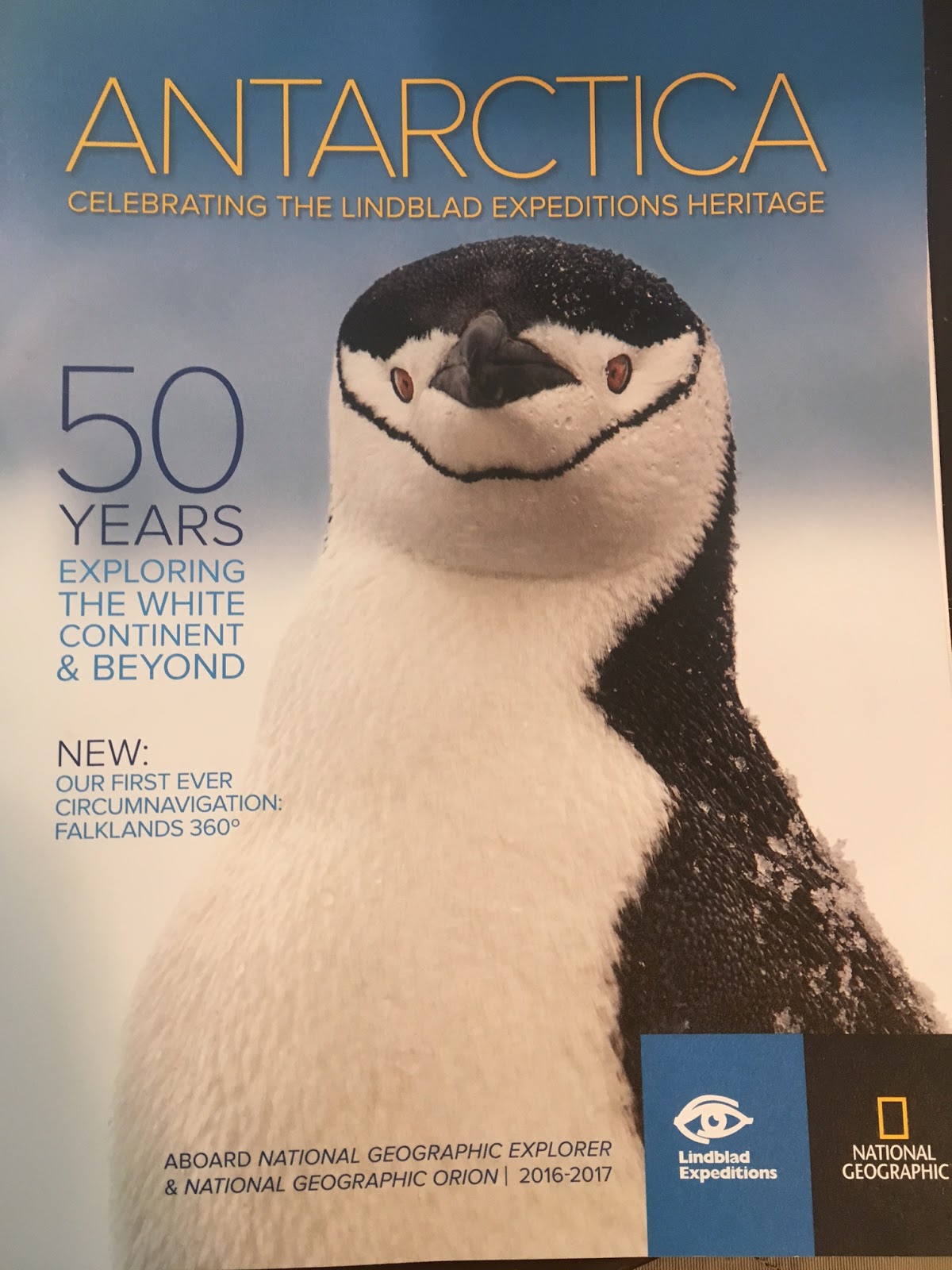
So, on October 24 we'll embark on a trip with Lindblad / National Geographic to the port Ushuaia,  Argentina, board the National Geographic Explorer, spend a night in the Falklands, and then steam onward, and southward, to South Georgia.   This island is rugged, with many fjords and indentations, along with grassy slopes in the southern spring (not to forget the interior glaciers).  This rarity of landmass in the midst of vast ocean reaches is what the population of Antarctic birds find to their liking for nesting.  One particular variety of penguin, in its favored cove, may number upward of a quarter-million, making Pilot Island's bird population, in comparison, a paltry warm-up.  

But it is the human history of this region, and the history of exploration of these remote, scattered lands that has most captured my interest.   I only realized, after first suggesting this trip, that May 2016 was the 100th anniversary of the noted crossing by Shackleton and five other men in the 22-ft. lifeboat James Caird, sailing from Elephant Island to South Georgia.  That desperate, heroic voyage of 15 days was equalled - topped in some ways - by the exhausting, life or death climb up and over the interior of South Georgia by Shackleton and two crewmen.  This climb brought them to the Norwegian whaling station on the far, eastern side of the island.  There, he found assistance, and he eventually succeeded in saving the lives of all of his men, including those men left behind without knowing if they would survive, on Elephant Island.

I've read almost nothing about this 100th milestone year of Shackleton's expedition and survival except in the marketing literarure of the Lindblad / National Geographic cruises.  The cruise ship company has planned this voyage in commemoration.  Their two ships will moor at South Georgia at the same time, to witness a recreation of the climb up and over the island.  Sons of noted explorers will do the climbing:   Peter Hillary (son of Sir Edmund Hillary);  Jamling Norgay (son of Sherpa Tenzing Norgay), and Sven Lindblad, son of Lars-Eric Lindblad, founder of Lindblad Expeditions. Lindblad was the first company to provide public cruises to Antarctica and adjacent southern waters, and 2016 also happens to be the 50th year of Lindblad Expeditions operating in Antarctic waters.  

Passengers will have the opportunity to meet this small group as they descend from the island's interior toward Grytviken, where the remains of the old Norwegian whaling station (now a small museum) can be found today.

In all, a most exciting time lies ahead!    

-  Dick Purinton