News and Opinion - From Washington Island, Wisconsin - The Surrounding Islands and the Island Community - From a Ferry Operator's Point of View
Monday, June 6, 2011
National Geographic Piques Interest
Detroit Harbor, Washington Island -
A few readers may have mistakingly assumed that the title of this entry containing the words "National Geographic" is a follow-up to my previous entry about turtle peeping, but it is not.
Recently, I perused the April issue of National Geographic on my iPad, and the photography as always was terrific, and, I would even say the photos were superior to the printed magazine format.
Miracle Above Manhattan was the story that caught my attention. It's about how an abandoned railroad spur, the mile and a half High Line in the Chelsea neighborhood, once overgrown with trees and weeds, an unused strip of railroad trestle and right-of-way that runs smack through the heart of Manhattan's residential and business neighborhoods. This section of track 25 feet above ground now offers a safe and sought-after elevation with spectacular panorama of river, sky and surrounding city lights.
Mayor Giuliani had wanted to tear it down, but a group of passionate New Yorkers persisted. They were responsible for transforming this section of abandoned commercial track into useful, artful public space. They weren't different in their passion from the local, Sturgeon Bay group who went by the moniker "Save Our Bridge," who organized to help popularize, memorialize through registry, and save Sturgeon Bay's aging but surplus downtown bridge. But that New York group envisioned transforming the unused structure into a linear combination of parks, gardens, rest spots and social venues. This feature has become a regular destination for thousands of New Yorkers and city visitors. The Geographic photos showing people enjoying this strip of elevated green are stunning and convincing. A quote from the article: "From the day the first section of the High Line opened in June 2009, it has been one of the city's major tourist attractions..."
Why couldn't a similar plan have worked for the Michigan Street bridge in Sturgeon Bay by utilizing the outdated, and for a time condemned, bridge structure not as an actual bridge, but as a focal point for recreational activities? This transformation would have been unique - I've never heard of this being done elsewhere - and it would have saved state taxpayers millions in rehabilitation dollars, dollar already spent to beef up the structural supports, to reconstruct the draw equipment, and to paint the bridge from one end to the other. There will undoubtedly be future expenditures to maintain an 80-year old bridge structure as a certifiably safe highway bridge.
An essay in my book "Bridges Are Still News," (Island Bayou Press, December 2010 - $16.50) suggested an option similar to the Manhattan railroad project by keeping only the "stubs" or piers, one on each side of the bay. To my knowledge, such an idea was never considered. Had the bridge been abandoned, the center spans could have been removed to improve shipping navigation. The piers or bridge stubs would have provided significant public space for music, food courts, sidewalk art, sightseeing, fishing, attractive plantings and benches...a waterfront vantage point that would have made them a noteworthy destination.
The uniqueness of the rusted, riveted rail trestles shown in the Miracle Above Manhattan article is not unlike that of the riveted girders of the Michigan Street Bridge. Both were built during times when steel design and construction were vital to industry and commerce.
When the current restoration work is completed on the Michigan Street bridge, the structure may be serviceable for several decades with minimal work, so for readers this blog might seem like whistling in the wind. But there ought to be consideration by a future generation when the subject of maintaining a National Historic monument vs. cost to maintain comes around once again.
In the meantime, the old bridge is still closed to traffic (going on for what seems like several years, now) and until it is reopened to vehicular traffic, nearby businesses will continue to suffer the side effects of sandblasting and painting, the Christo-like canvas curtains, the rows of orange construction barrels, and the resulting lack of consumer traffic to their businesses.
For all of the dollars spent on this bridge to date during reconstruction, the City of Sturgeon Bay could have entered a period of bustling economic activity. The "bridge-stubs" could have become a grand provider of foot traffic for those same business that have folded or are suffering for lack of access to their doors.
- Dick Purinton
Monday, May 30, 2011
VISITOR CENTER AT NORTHPORT PIER
Northport Pier, 215 State Hwy. 42, Tip of Door Peninsula -
A Visitor Center has opened within the terminal building at Northport, a space that had operated the previous 25 years as Northport Pier Restaurant.
The dining room tables and chairs have been replaced with display kiosks for photographs, information and literature related to Washington and Rock Islands and the islands of Death's Door. This shift in direction may surprise some visitors, especially those who recall memorable meals served at the Northport Pier Restaurant over that time period, but according to Hoyt Purinton, Ferry Line President, the new direction in the face of ever-declining restaurant activity is meant to support island tourism as a whole.
"This building had been designed and zoned for use as a seasonal restaurant, and over the 25 year span of operation it had a base of loyal customers," Purinton said. "But, because it was not economically successful, and because we believe we can do a better job marketing Washington Island, we've decided to be creative, and a visitor center, rather than some other venture, seems the best fit. This has come after considerable discussion within our company, and with the Washington Island Chamber of Commerce, with whom we work very closely."
The Ferry Line began the transformation process last winter with new paint and new carpet, the addition of display pedestals, new signage, and footpaths for easier access. The transformation became reality on opening day, Friday May 27. Marge Frank, representing the Island Chamber, and Christy Davidson of the Ferry Line were hosts, and they answered questions from dozens of curious visitors, some who simply wound up at the northern end of Highway 42 looking about for more information, and those vacationers with weekend travel plans already in hand. While dining is no longer available, coffee, tea and snack items are, and the atmosphere is intended to invite travelers to stay awhile, to absorb this northern Door County experience, to view the Death's Door Islands and ferry activities with guest binoculars, and to contemplate an island visit at a future date and time.
| Island Chamber Hostess Marge Frank |
The Visitor Center intent is to market the island experience in both a direct way such as passing on literature for motels, restaurants and attractions, but also to pique the interests of travelers who might be birders, photographers, or people who are simply curious about natural history found in these islands. It has been the aim of the Island Chamber of Commerce and the Ferry Line to ensure all information hosts will have earned the Door County Visitor Bureau's Certified Tourism Ambassador qualification, and as such, informed assistance will be offered with any visitor's question, not only those related to Washington Island, but questions relating to our neighboring communities and Door County as a whole.
Northport Visitor Center hours of operation will be daily until mid-October, 9:30 am to 3:00 pm. A large, self-help display with literature will always be available after-hours in the ferry terminal lobby, open during daytime hours of ferry operation. Short-term Visitor Center parking is available near the entrance, and there are more than two-hundred spaces available for general parking for both ferry riders and those who wish to walk out on the pier to observe ferry activity and the Death's Door scene close at hand.
- Dick Purinton
Saturday, May 28, 2011
Turtle Frenzy Surveillance
Detroit Harbor, Washington Island -
It is springtime. It is near sunset, and we've had one of those precious few days in mid-May with the sun bright overhead, unblemished by clouds. The air temperature warmed to 60 degrees by the early afternoon, and what breeze there was settled to a whisper toward twilight.
We walked in silence so as to not scare the wildlife, my wife and I, to the docks of the bayou, a small estuary of Detroit Harbor that is filled with a variety of bird, reptile, and other animal life. We carried a pair of binoculars to better observe these creatures: a large muskrat chomping on the roots of rushes along the bank; eagles, both soaring and perching on trees on Suzie's Island; a great blue heron stalking the reeds for supper; an egret; a swimming water snake (makes my wife shudder) breaking the calm surface with its wriggling; carp rolling about; and fornicating snapping turtles.
It is the mating turtles we've really come to see!
Picture snappers the size of your largest inverted kitchen turkey pan - or maybe the microwave (some appear to be 30 inches across the shell). Two turkey pans bumping and grinding, changing partners, chasing away suitors or competition. It has to be an enjoyable moment for them, the turtles, doing what they are meant to do in the springtime. I am not easily relating to the subtleties of mating in smelly muck and ooze, but I have an idea of how the strength of procreation may overwhelm a pea-sized brain. For these several weeks, this is all they seem to care to do, with activity levels peaking when it is sunny and warm and calm.
This is the estuary primeval, the Bayou as we call it. And it is these snapping turtles we've come to appreciate, huge snappers recently emerged from the muck and ooze of this backwater, at first carrying scads of mud and moss on their backs. For at least the past five months, if not six, they've lain dormant, hibernating beneath the mud, immobile until water temperature warmed enough to stir them. And then, instead of searching out food for their first activity, they expend energy mating.
If you've seen photos of the Sydney, Australia, Opera House, imagine how it would look down-scaled and brownish-green in color, with perhaps a turtle head or tail stretching outward. This is the sort of repeated scene we observe in the bayou during the first several warm weeks of spring. Mating boulders, is how it appears from a distance. Moving rocks, shell on shell.
Action is everywhere, in the shallows of the muddy bottom and in the warmth of sunny humps of grass. This activity piques our human curiosity. We humans have rituals of our own, but turtle mating is far removed from the familiar white sheets covering man-made, cushioned platforms. How do they know, these creatures submerged in mud, when it is time to emerge, which other turtles are accepting, when enough is enough? Normally slow-moving creatures, they now roil the waters in their passion, showing quickness and bursts of energy either in pursuit of or escape from one another. The disturbance of the peace at times resembles carp rolling in the shallows, their backs above water, another activity that will also take place here but at a slightly later time when the water is even warmer.
Finally, after a few weeks have gone by, on another sunny day when I am watching from shore, first one turtle, then two, swim from the estuary, large dark shadows just beneath the surface, heads the size of my shoe occasionally breaking the surface for air and a look-see. Maybe these turtles are out to find food, but more than likely they are females dispersing to find a place on shore to lay their eggs, where they dig deep pockets in gravel or sand, preferably a "nest" that will benefit from the warmth of sunshine. Often times, chosen locations are in the middle of graveled drives or roads, where the females (and I would presume their hatched offspring) may be in peril from the tires of passing vehicles.
How to observe this better!
We have a pretty fair pair of binoculars, and we often have them with us when we take our "nature" walk, but then we've had to share the one pair. So, in advance of Father's Day (always helps to have an excuse) I ordered another, more powerful pair, easy to focus and waterproof. There are several internet sites that recommend brands and types with user ratings specific to certain activities. Although I didn't find binoculars specifically manufactured for the purpose of turtle peeping, I thought I would double-up with birding recommendations, and so the type and pair I selected, for $159, are really for birding. They arrived one day after my order was placed, with free shipping!
From our kitchen table we can now see effortlessly across the harbor. Watching bird and turtle activity will be much improved with this pair of field glasses. I attached the neck strap (it also comes with a harness strap to keep them from swinging when running away from snakes or aggressive turtles.) They are from a company based in Omaha, Nebraska, a state known for its sensible, down-home folks who are not usually known for kidding around. (Think of Warren Buffett, financial tycoon with a dry sense of humor and stoic bridge player.)
Here are the unabbreviated Warnings listed on page one of the five-page pamphlet:
(reprinted here verbatim)
* Viewing the sun can cause permanent eye damage. Never look at the sun through your binoculars.
* Never use your binoculars while walking amongst obstacles (i.e., rocky fields, wooded areas,
children's playrooms).
* Inappropriate use due to a lack of common sense may result in product damage or personal injury.
* Objects in binoculars may be farther away than they appear.
* Not intended for human consumption.
* Running with scissors is dangerous. Never run with scissors while using binoculars.
Perhaps the binocular company was concerned about persons with severe sight impairment using their product, mistaking the eye caps for Oreo cookies, etc., etc., or maybe this is just good Nebraska humor to test if we've read the fine print. (We have!)
Positives for this product include: they seem to work very well, and their magnification should provide many pleasurable hours of viewing turtle intimacy; and, my new pair comes with an almost unheard of 25-year warranty. If they perform as well as I think they will, I might suggest they consider Turtle Observation as a new marketing niche.
- Dick Purinton
Thursday, May 26, 2011
TRUEBLOOD PERFORMING ARTS CENTER ALMOST READY
Main Road, Washington Island, Wisconsin -
Remediation work on the Wilson and Carol Trueblood Performing Arts Center, referred to locally as the TPAC, is nearing completion. The above photo shows installation of the metal water barrier on the west and south sides of the building. As of this entry, only the topmost portion of the curved wall awaits metal siding.
This week marked a significant juncture for the TPAC facility and for those persons directly involved with remediation work being done: during a site visit Monday, State of Wisconsin Building Inspector Jane Drager approved all work done thus far. Red tags that denied occupation of the building since November 2009 were lifted, allowing limited access to the building's interior spaces.
The TPAC building is now deemed not only safe and sound, but also much improved, owing to the extensive renovations. (See March 15 and March 24 blogs for additional detail.)
Once structural supports had been improved, the obvious changes took place on the building's exterior, first four-inch thick vertical foam panels, then the painted, corrugated steel, exterior wrap. It is anticipated the project engineer and the State Building Inspector will meet in approximately two weeks to conduct a final inspection of remediation items, and with that a formal close to construction and a welcoming for public use once again.
This past Wednesday evening, May 25th, TPAC Building Committee Chairman Bill Norris and committee member John Chapman addressed an audience of twenty or so specially invited guests that included members of the Town Board, the TPAC Board, and the TPAC Building Committee.
Basic remediation highlights were described for the interior and exterior. Thorough cleaning - wire brushing and vacuuming - preceded the recent painting of all interior block surfaces by Mike Remke, Tom Jordan and crews. (These surfaces were previously unpainted.) Not only has the painting improved appearances both in the audience chamber and backstage, the process helped to further eliminate lingering prospects for mold or mildew.
Building manager Emmet Woods pointed out the two new sets of interior doors with special elongated hinge plates. These new doors have fire ratings that are fully compliant, and the extra hinge dimensions now permit folding the doors back 180 degrees, against the walls, for easier ingress/egress.
| Bill Norris points out new TPAC support columns. |
The difficulty of covering a curved outer wall with linear "super-rib econolap" was described by Chapman, and we were shown the patented, seamless corner pieces supplied by the manufacturer to ensure a total waterproofing characteristic. This special metal siding comes with guarantees for both paint and for waterproofing.
The tour of construction highlights moved outdoors to observe details of the completed east, north and south walls, where numerous supportive comments were overheard regarding the job well done by the Building Committee and the contractors involved.
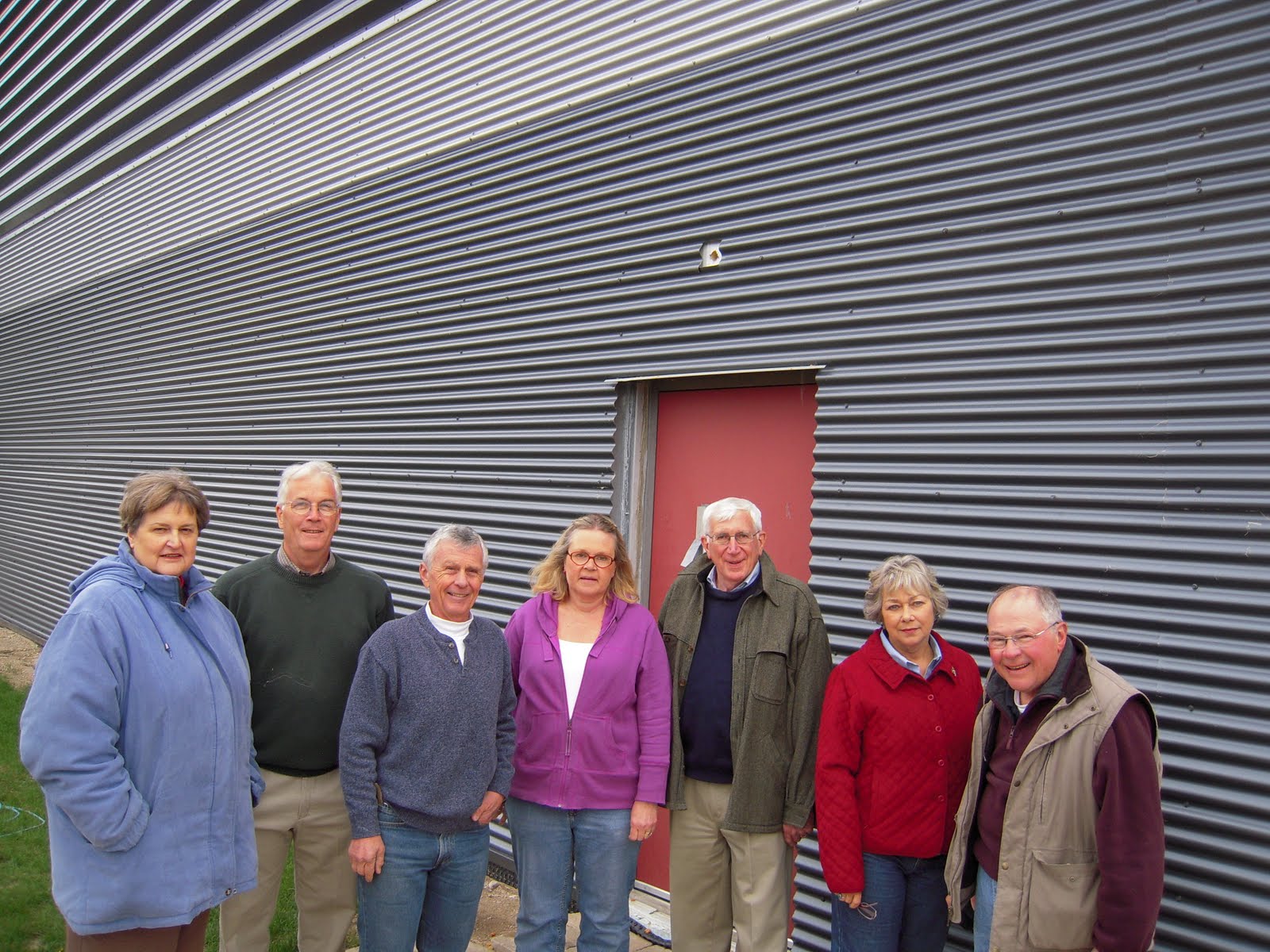
| TPAC Board Members present were, L to R: Joan Kuhn; John Chapman; Bill Norris; Mary Andersen; Doug Straus, President; Jackie Rader; Jim Morris |
| TPAC Building Committee Members present were (L to R): Dick Clancy; Terry Foster; John Chapman;Bill Norris; Doug Straus; Julian Hagen; Mike Berger. - Photos and article by Dick Purinton |
Wednesday, May 18, 2011
ISLAND WEATHER OBSERVERS
Washington Island, Wisconsin -
Several times this winter a sheet summarizing Washington Island weather data appeared at our Ferry Line office front desk, delivered, I later learned, by John Delwiche.
Interested in following up on what constitutes an official weather observer, I later learned that both John and his wife Anne have the title Weather Cooperative Observers, meaning they have officially been recognized and given responsibilities in observations by the National Weather Bureau office in Green Bay. Their data is captured by computer at the Green Bay office, which then feeds in to a much larger national data bank of weather observations.
Becoming a National Weather Service Cooperative observer volunteer requires the following, according to the Cooperative Observer Program website:
* Dedication to public service
* Attention to detail
* Ability to learn and perform daily duties
* Willingness to allow NWS to place measuring instruments on your property
* Willingness to allow at least one visit per year from a NWS representative
I had briefly met Anne and John once or twice in the past several years, but I took this opportunity to learn more about them and their role as volunteer weather observers.
John is a retired mechanical engineer who began with Larson Canning in Green Bay, but spent much of his career at one of the paper mills. He and Anne live in a very comfortable, recently constructed home along the island's East Side Road. Through ample window openings in all rooms they're able to pursue their hobby of birding (and many birds were about while I was there) while enjoying the fantastic views of surrounding fields and sky. A number of bird feeders were on poles a short distance from their home, and near the top of the rise at the far end of the field was a metal tower.
Birding and weather observations are related pursuits, and the Delwiches had in the past participated in recording weather observations using a basic home weather set as volunteers for Project Feeder Watch, in which their bird count and type and weather data contributed to a larger collection of data.
But it was the new and different environment with its temperature swings and winds that captured John's interest, combined with the chance opportunity in late 2008 to take over duties from retiring Observer, Don Cunningham.
A significant nudge toward observing weather an official capacity was the fact that Anne's father, Herbert H. Bomalaski, was a meteorologist for the National Weather Bureau for 41 years and head of the Green Bay Weather Bureau office for many of those years. Fifty years ago this March, according to the Green Bay Press Gazette, Mr. Bomalaski received the Meritorious Service Award from the Secretary of Commerce for his studies in "Growing Degree Days." His contribution codified temperatures during the growing period for vegetables, providing a system of predictability for both canners and growers, and his work was credited with saving the industry here and abroad thousands of dollars.
It is fair to say, then, that both Anne and John take great pride in their role as official Weather Cooperative Observers.
Viewing web postings for National Weather Cooperative Observers across the nation (some are institutions, but many are generational family members) I found that the appointment of a local weather observer often leads to decades of volunteer reporting. While this may not always be the case, the record speaks to the general class of people who become observers for reasons of occupational interest, hobby, or curiosity about the environment, and then dedicate time and effort toward capturing numbers for our federal weather agency.
John's tower was originally intended as a future base for his amateur radio station antenna, but it currently supports several weather instruments.
"I wanted a much higher tower for my radio station," John said, pointing to several tower sections lying in the field near the house, "but the government standards for recording wind are very specific. Instruments must be 33 feet above ground for the anemometer, no more, no less."
Other recording instruments such as rain gauge and temperature gauge are mounted on pedestals nearer the ground, within one hundred feet or so of the back door. The siting of these instruments had to meet approval by the Green Bay field office for the National Weather Bureau.
Neat, hand entries into a log of weather data, and the installation of two indoor analog gauges for wind direction and speed in a vintage upright radio cabinet, further revealed the meticulous nature of these two weather observers.
An exception to "meticulous" might be the wire Anne pointed out, laughing, that John strung from the the rear of the radio cabinet gauges to a bedroom loft above one end of the room.
"I wanted wind instruments badly, and I pestered the hell out of them," John said. "The National Weather Service has gone digital with gauges at their offices, so these analog gauges became a surplus set. They were formerly at the Rapid City, SD weather station."
As far as John was aware, few Co-op Observers are issued wind instruments, but in this case, the U.S. Coast Guard had first chance for such equipment and they expressed interest in capturing additional wind speed data in this part of the lake. Had those gauges been digital, according to John, both high and low speeds could then be automatically recorded. However, since they are analog (with dial indicators similar to an old auto speedometer) John ran that wire from the radio cabinet to a second gauge set in their bedroom loft, one way to monitor peak wind gusts at night during a storm while lying in bed.
John showed me a stack of old Washington Island weather logs passed along to him, noting the names of several island observers who preceded him: Don Cunningham; Gabrielle Daniels; Marvin Andersen. There may have been others.
How did he and Anne happen to find their way to Washington Island for retirement?
John pointed across the field toward Island Camping, the privately owned campground on the adjacent 40 acres.
"We came to the island one weekend in July for a HAM radio round-up, and I was so impressed with the capabilities of my small radio from this location. I could get a signal out to just about anywhere."
It may have been as important that Anne had been enrolled in classes at Sievers School, creating another strong island connection.
Is it the limestone bedrock, or the fact we are located in a large body of water with little outside interference, that makes it such a good place for transmitting radio signals, I wondered?
"It could be," he replied. "I'm not sure what it is, but with this little set, it's amazing the reach it has. I suppose relative isolation may also have something to do with our choosing this location."
He pointed to the radio set on his living room table, a deceptively small package not much larger than a thick book, maybe 10 x 6 x 3 inches, with a retractable antenna.
John said that he became a licensed radio operator at age 11, but because his voice had not yet changed, when he spoke over the airwaves listeners thought they were talking to a girl. That caused John to learn code so he could communicate without speaking, and he claims to have used code for his radio communications ever since. His call sign is K9IY.
John heads to Dayton, OH, this week for a radio operator conference, the largest in the nation, at which both commercial and amateur operators will be present. While he is absent, Anne will take over weather reporting duties.
- Dick Purinton
Saturday, May 14, 2011
NEW ISLAND FIRE TRUCK ARRIVES
Detroit Harbor, Washington Island, Wisconsin -
If one didn't know the anticipation for a new fire truck was the cause of all the cars out at the ferry dock Wednesday morning, May 12, the audience might have been credited for watching the ferry land amid a squall of wind and rain. But recently, including several days this mid-week, heavy rains with wind squalls that spring on eastern winds have been too commonplace to catch islander attention - although I found it hard not to sympathize with ferry captain Ken Berggren as he brought the Eyrarbakki to position despite channel currents and gusts at the end of our island ferry pier during the moment of peak winds.
[Note: Not having my camera at hand, I grabbed a small video camera to capture the event, then had to learn how to download and process the video and place it in blog format. For the past two days Google's Blogger site has been interrupted for repairs, this being my first opportunity to try the video posting.]
The Eyrarbakki landed safely, and with several lines secured to shore and diesels thrumming at elevated power to hold the bow in place, the 1985 Pierce fire truck was driven ashore. This truck is a new acquisition for the Washington Island Volunteer Fire Department, coming from the neighboring Sister Bay-Liberty Grove Fire Department on the peninsula to our south, purchased with $45,000 in donated funds.
A campaign that began in early October drummed up both political and financial support for a truck that will boost the island's potential to fight fires. Since funds were not budgeted by the Town for that purchase, and given a limited window of availability - a "special neighbor" offer from the Sister Bay-Liberty Grove Fire Department - willing donors met the challenge in a few month's time.
Specifically, this truck's ladder and snorkel will help to fight fires in structures having metal roofs, structures situated on properties dotted with adjacent trees, sometimes accessed by snaking, narrow drives, and it will offer increased reach above the newer, multi-level seasonal homes that have eclipsed the old time, single-bedroom cottage-by-the-lake.
This fire truck, designated Engine No. 21 by its previous owner, will retain the same unit number out of superstition and tradition as it enters service on Washington Island.
- Dick Purinton
Saturday, April 30, 2011
GETTING ON WITH LIFE
Washington Island, Wisconsin -
The widespread and often complete destruction of homes and businesses in cities and rural areas throughout the south this past week by tornadoes is difficult to comprehend.
Television footage has shown us what it looks like, but the smells, sounds (or lack of sound) and emotion experienced by those persons most affected can only be imagined. In so many cases, it appears, homes and personal possessions vanished into the stew of rubble and trash.
Quite frequently, here on Washington Island, we remind ourselves of the safe environment we enjoy, generally free from threats of floods, hurricanes, tornadoes, or forest fires. We tend to crab about the tourist season, the economy, the level of Lake Michigan, things that do impact our lives but that we can often adjust to until the pendulum swings another direction.
Reality TV and the show "Hoarders" has taught us how debilitating it can be to collect things, and to hang on to them for years, tied not by their usefulness but by the emotional bond we have with them. Most items, it would seem, have not seen the light of day in those houses jammed with stuff, and the owners would be hard-put to say when they last used or saw a particular item. But it's there, somewhere, and they know that, and the parting seems too painful, so the item stays, joined and buried by more of the same as days, weeks and years go by. The accumulation eventually becomes a hazard to physical and emotional health.
This morning, I lightened my own load of stuff, saying good-bye to a teddy bear that had been in a closet in one house after another for some 62 years. I think I got it as a Christmas present on my first birthday, because it was captured on an 8mm home movie taken by my father. My mother, bless her, made some clothes for him (it), and I suppose those ties of my early birthday and the clothing Mom added to the teddy bear made it too hard to part with. So, here I am at 63 years of age, and my bond with this toy...which has not been often viewed during the past 60 years because it was either in an attic or a trunk, is an object I still found hard to part with. But this morning, the bear is on its way to the compactor at the Island Exchange, then from there to a landfill close to Green Bay, WI following a bouncing ride on the ferry and over highway by trash truck.
Imagine: it is harder in some ways to ditch an emotional piece of the past like that teddy bear, than old friends and acquaintances. That's a screwy view of the world.
Good riddance! I feel better already! Did I think tossing that toy stuffed bear out with the garbage would hurt my mother's feelings? (I won't tell her. She is 94 and hard of hearing anyway.)
And another set of items also left my sight this morning, via UPS package: two mementos from sailing days 40 years ago. They had collected dust and got an occasional review from me when I stumbled upon them, but they will be much better appreciated by members of the Bonneville Sailing School in Utah, where the boat I sailed on now resides and is being restored.
A home run: Get rid of more stuff, along with the emotional baggage, and that stuff being received by others who may actually use and appreciate it!
A friend who lives in Seattle is going through a similar experience of moving from one home to another and having to sort out, sell, or throw things collected or purchased over decades. He said, "The ideal situation would be to go through a natural disaster that lets me escape with only my health and the clothes on my back."
There is wisdom in that thought, the elimination of the emotional process that goes along with paring down our lives. Although none of us would actually choose to go through the trauma experienced by folks who have lost everything but their lives and loved ones, there is a perverse envy in the fact we see they now have a clean slate, that is, assuming their emotional state will allow them to get on with their lives.
If we believe in prayer, in the transfer of positive spiritual energy, and the wise use of our wealth to help others, it is our wish that in the future we can live without debris and avoid the sometimes painful tripping over our past. We can replace collected objects and their weight with great hope and prospect for what the future might hold.
- Dick Purinton
Thursday, April 7, 2011
MAIN ROAD PROGRESS
Main Road, Washington Island, Wisconsin -
A four-man crew from Nation Roofers, Milwaukee, have made rapid progress with installation of the first stage of the new wrapper system on the Wilson and Carol Trueblood Performing Arts Center (TPAC).
Metal channel of a "hat-shaped" cross section has been screwed to the block walls half-way around the building, and a crew of three men using a second lift device followed up, screwing metal-clad foam panels to that channel framework.
A metal base channel that will accept the bottom of the long, vertical panels was fastened around the foot of the walls the entire perimeter of the building. Doorways received special treatment, including foam to fill air gaps that might allow heat to escape easily and water shields over the openings.
This project, part of a larger effort to rectify shortcomings found in the original design and construction of the 2003 building, has progressed quickly thus far. The final wrap of horizontal metal siding will follow the foam panel installation. The end result will be a wind and water proof exterior, and a gain in insulation value from approximately R-4 to R-24.
Photos were taken today, April 7th.
- Dick Purinton
Sunday, April 3, 2011
SPIRITUAL ENCOUNTER?
Washington Island, Wisconsin -
What can be made of a personal encounter with a bald eagle, an encounter in which that eagle seemed to lead me down the road?
I’ve been wondering what that experience might mean since posting Saturday’s blog.
Was the bald eagle fascinated with the green 2002 Dodge pickup I drove?
Or had that eagle decided at that precise moment I drove past to dive from a nearby tree, swooping low over the cab where I sat at the wheel, to teach me a lesson? If so, what lesson?
Within seconds of overtaking me the eagle took the point position, never more than 200 feet ahead and never more than 30 feet above the pavement as I followed south toward the ferry dock.
Was it coincidence that the eagle maintained a course over the centerline of the road, rather than vigorously flapping its wings to gain altitude and escape confinement from between the tree lines? Why hadn’t it peeled off to the right when it came to the opening that was Green Bay Road and flown westward and upward?
My first thought upon seeing a bird overtake me from above and behind had been that an owl had descended, a bird type I’ve often seen sitting or flying along that road. But this eagle’s white head and leg feathers were soon unmistakable, as was its beaked profile when it turned its neck to look back at me. The eagle alternately glided, then flapped its wings, then it glided some more, casual in its flight, never appearing hurried.
Ego would like me to say that this was my experience, just for me, a special treat because I must be special. (And, I haven’t yet ruled this out!) At the very least, Saturday morning I had a curious encounter with a bird. I also recognize it as having been a singular moment, yet not unlike other special moments I’ve experienced in nature, events that have brought me greater appreciation for the continuum that is life on earth.
I am mindful of the extraordinary experiences people report to have had with pets and with wild animals, sometimes claiming to gaze into eyes filled with wisdom and inspiration, and also with inanimate objects or natural events where truth is imparted related in a way that can be intimate, personal and spiritual.
I shouldn’t rule out the chance this eagle was in its own way communicating directly with me, and not simply reacting to my chromed pickup truck. Could it see into the pupils of my eyes, or into my soul, even through the windshield safety glass and my bifocals, as it briefly but repeatedly glanced behind?
I followed its movements closely, and I had all I could do to stay on the road, using my peripheral vision while taking the Point Road curves at 35 mph. My eyes were glued on the eagle, and I was reminded of the X-wing fighter scene in a Star Wars movie as the gunships jockeyed back and forth between canyon walls. If I was being toyed with, it was by a bird that seemed to enjoy its leadership role.
Then, after a half-mile of easy flight the bald eagle pulled up its wings in a stall and settled easily onto a large maple tree limb. It was a high perch, and from there it sat and observed for the next hour or more, moving nothing but its head as vehicle traffic passed below and through the wooded corridor.
At home, later, I read a passage from a book by Steven D. Farmer, Ph.D., titled Animal Spirit Guides (Hay House, 2006). The passage for eagles included these observations -
If an eagle shows up, it means:
* There’s an opportunity for you that you’re considering, and it would be best if you take advantage of it soon.
* There will be a new beginning in a positive direction following a recent period of strife, one in which you’ve gained a great deal of stamina and resilience.
* Detach and rise above the mundane so that you’re able to see your life and circumstances with a broader perspective and greater vision.
* It’s a time for a great spiritual awakening, one where you experience a greater connection to the divine.
* This is an important time to get creative inspiration from the divine, so heed any guidance you receive.
* Whatever you put out, positive or negative, will now return to you in some form, more quickly than ever.
If it is a bald eagle:
* You have an increasing ability to walk between the material world and that of spirit.
* Dive into inner depths, paying close attention to any visions or inspirations that arise.
You are to call on EAGLE when:
* You’re caught up in the little details of life and have lost sight of the big picture.
* You’ve recently had some spiritual insights or revelations and want to integrate them into your daily life.
* You have to face some major challenge as a result of massive life change.
* You’re in a period of struggle or difficulty, one where you get completely caught up in the mundane aspects of your life’s drama. When an opportunity presents itself and you’re not sure whether to act on it or not.
…and finally…
If EAGLE is your POWER ANIMAL:
You’re a very spiritually evolved individual and a born leader, and people gravitate quite naturally to you.
You’re willing to endure challenges and struggles because you’re confident that you can meet them, and you trust that they’re necessary for your spiritual development.
Even though you’re an old soul, you must still go through various initiations throughout your life that will ultimately lead you to living a completely spiritually directed life.
You’re passionate, and have a bit of a temper that you have to watch.
One of your main life lessons is learning to conserve your energy and apply your focus to what’s truly important.
You take advantage of opportunities without hesitation and with a strong faith that there will be lessons or gifts that you’ll discover in doing so.
Pay attention to the sensations in your backbone as an instinctual trigger to be more alert to what’s going on around you.
These lines above used "for identifying and understanding your power animals and spirit helpers" tend to read something like fortune cookies in that many conclusions can be taken from them, but they also contain elements that are truthful and positive about our lives and our relationship with one another and our world.
So, what do I believe happened yesterday? Was I a participant viewing a display by an agile eagle, and that was all?
The bald eagle is a wonderful creature, one small piece of an even more wonderful creation. My bald eagle encounter caused me to ask questions: what had I done that morning that was different? Was this a special message for me? Why did I deserve this experience (instead of the driver in the white Chevy pickup who came along ten minutes later)?
I believe my encounter was special because this eagle had my attention then, and it still does.
My experience was not a result of driving a green Dodge truck at 10:15 am on a Saturday. For some reason (whether considered a force, circumstance, coincidence, or miracle) I was connected with this bird. It floated and glided easily, and it controlled its movement within the narrow confines of the forested roadway, maintaining a comfortable and consistent distance between us. This bird was having fun.
Was there an eagle spirit in that fun? I rely on my reflection of events to get a sense of message. I admit, my experience was far more special than if I had seen a snake or turtle in the road and had swerved to avoid it, or if I had spotted an eagle from afar. This was intimate and meant for me.
I believe that the universe is the work of a Creator, and that the bald eagle is one of the more beautiful and cherished of wild life creations. This particular bird and its timing on an otherwise gray morning has made an impact by its presence.
What do you think?
- Dick Purinton
Saturday, April 2, 2011
ICY TREATS
Detroit Harbor, Washington Island -
Days this past week were marked by cold nighttime temperatures, frosty mornings, and then milder, sunny afternoons.
As snow melted from the roofs, steam arose, water dripped and then froze.
Sparkling patterns of icesicles were too tempting for Aidan and Magnus to resist, trumping for the moment Oreos in the Ziploc bag.
Toward week's end it warmed enough by noon to create respectable sap runs, this being the second major week - and likely the last - for local sap producers.
Detroit Harbor is still frozen over, and although ice shanties have been removed, a few fishermen still try their luck, making the trip out on snowmobile or four-wheeler. Except for the soft edge where the ice sheet meets shore, this harbor still has a two-foot thick covering of hard ice. But very little ice is seen along the ferry route these days, and a good thing, since the ferry schedule increased Friday to six daily round trips from the two trips of Jan-Feb-Mar.
There's more and more bird activity, now that spring is on its way. Geese have moved in, staking out their claim along the marshy shoreline. Swans can also be seen, dozens of them swimming in open water near the ferry dock. Sandhill cranes are around now, too, squawking as they take off across the harbor. We've had a hawk in the neighborhood that likes to bring its lunch of a small bird or rodent to the edge of the beach where Main Road ends. Early one morning it gave chase to a gliding pheasant along the waterfront. We think we've also spotted the first great blue heron of the season.
Eagles are seen near the islands year around, often sitting out in the open on protruding ridges of ice when the ferry passes by. No longer a strange sight, eagles are still wonderful to spot, for their size, color, and commanding presence.
That is why I was taken by surprise this morning as I rounded the major curve on Lobdell Point Road and a mature bald eagle swooped down from a tree behind me, then led me for at least half a mile along the twisting Point road. This eagle stayed over the centerline of the road, about 30 feet above the pavement, as occasionally it turned its head to one side or the other to see if I was still following.
When it had banked around the sharp corner at Gordon Court and passed the graveled Henning Road cut-off, the eagle coasted up to a perch in a large maple tree on a branch that overhung the roadside.
That was pretty amazing, I thought, following close behind a low-gliding eagle, with the bird leading me toward the ferry dock, so-to-speak. I was just as surprised 45 minutes later when I drove the mail van from the ferry to the U.S. Post Office. This same eagle was still on the same branch and was now posing for a couple who had spotted it as they drove along. They were thrilled and amazed by their find. After unloading the mail, I drove home to get my camera, then took a few photos of the eagle on my return to the dock. (Unfortunately, my digital camera's telephoto feature no longer works.)
Unsure of my photographic results, I drove on to the Ferry Office, picked up a small hand-held video camera, and then drove back to film the eagle. He (it) was still in its perch.
Could this be the same eagle we've seen in summer each day sitting atop one of the two poles near the Plum Island fog signal building, the one the ferry crew calls "Walt," because he appears to routinely track ferry activities? This eagle from its Lobdell Road vantage point, whether it was Walt or another, had observed the string of cars discharged by the mid-morning ferry, as well as other vehicles passing to or from the ferry dock.
Attentive. Interested. Patient. That is how this bird could be described.
This brings me to my last paragraph, a pitch for the Island Birding Festival, scheduled for the weekend of June 4-5-6. For a listing of activities and a registration form, please go to this site:
doorislandsbirdfest.org
Its a great way to enjoy the outdoors and to share information with other birders, and an opportunity to see parts of these Door islands not otherwise accessible to individuals. And, this year there happens to be a guest speaker for Saturday evening's gathering who is an expert on bald eagles!
- Dick Purinton
Thursday, March 24, 2011
AN EXTRA NIGHT ON THE MAINLAND
Northport Pier, Door County, Wisconsin -
The best part about Wednesday's snowstorm was the sunrise that came afterward, as we drove north at dawn to meet the ferry at Northport, and later, as we crossed the Door waters.
When we headed south to Sturgeon Bay on Tuesday, the sky had been gray and heavily overcast, then by early afternoon, light sleet began and the NE winds picked up speed. (By this time, it was a white-out in Green Bay, we were told.)
I attended a workshop Tuesday afternoon along with three other co-workers from the Ferry Line. Later, we walked across the street to dinner from our motel through slush. That evening, as cars pulled in from the highway for the night, islanders were among them, and there was speculation if they might get home the next day. (My answer? "I don't know!")
Familiar faces circulated through the lobby of Sturgeon Bay's Maritime Inn like snowflakes under a street light.
By morning, a wide blue band that represented heavy snowfall on the TV Precision Weather Forecast ran west-to-east, South Dakota through Green Bay, Wisconsin, and on toward Detroit. It was clear there would be little chance for a ferry home Wednesday. 40 MPH winds were whipping the snow, and that was the ultimate factor for not running the ferry that day.
We greeted a dozen or so island neighbors at breakfast and a few more as the day wore on. City streets were plowed by noon, sort of, but the main highways up and down the peninsula weren't good, although a few did try driving north anyway, on the chance that winds would drop and the ferry might run. But, it never happened, not on Wednesday.
So, through our cell phones we planned for an early departure from the motel to catch the extra-early ferry that was specially scheduled to absorb the backlog of traffic, mail and freight. We met a couple more islanders we hadn't known about as we exited the Maritime Inn to our snow-covered car. After a quick stop at McDonald's (windows were frozen shut so we went to the counter instead of the drive-thru), we were on our way to catch the extra-early ferry.
As we passed through Gills Rock and wound through the woods toward Northport and the ferry, the sunrise was worth the drive. Orange light over white snow and light ice. A small raft of black ducks huddled in the crook of the breakwall. With wind down to a mere draft, the half-full ferry backed away and took the short-route home, around Plum Island's north side, with not even enough sea to toss spray on deck.
By 8 o'clock, our familiar snow shovel was in hand, as we tackled a drift wrapping around the back door to our home. Then, we unpacked from two nights with a snowstorm on the mainland.
- Dick Purinton
| Underway, Captain Erik Foss was one of ARNI J Richter's several crew, who also got his quota of shoveling for the day when decks were cleared. |
Monday, March 21, 2011
TPAC - PART II
![]() |
| Steel tubes for TPAC support columns were unloaded from a Boldt Construction truck March 10, and have since been installed. (Chapman photo) |
- Main Road, Washington Island, Wisconsin
Washington Island’s Wilson and Carol Trueblood Performing Arts Center, referred to as the “TPAC,” is undergoing repairs at the present time, with a projected completion date of late May, in time for a Memorial Weekend event.
Remediation is perhaps a much better word than repair to describe the work being done, because collectively this work will remedy, or stop, deterioration of the building from elements over time. It will also make it a safe and sound structure after the work is completed.
If you imagine a “repair” as removing a faulty part and replacing it with a new part, as you would with an auto repair, that is not exactly what is being accomplished. Here at the TPAC the same, essential components will remain more or less in place, but they will be modified, supported, wrapped, better-drained, or in other ways treated so that the final, long term result will guarantee public safety, with a building that will not only be physically sound, but efficient to manage. This remediation may also serve to greatly improve the outer appearance of the facility.
What are these remediation efforts, then, and why were they deemed necessary in the first place? How will they be accomplished? Answers to these question will be the topic of this piece.
How we got here
The legal mediation process involving the TPAC, the original architect and original contractors, ended in an agreed upon settlement in October 2010. Settlement funds were then transferred to an escrow account to be used for structure remediation. The challenge before the TPAC Board moved quickly from the legalities of the mediation process to the remediation/repair process, examining details for solutions that would lead to approvals from the State Department of Commerce, the agency responsible for Wisconsin's public building safety standards.
A new architect of record, Jendusa Engineering Associates, Inc. of Milwaukee, and a new Owner’s Representative, Terry Patrick of Professional Project Services, also of Milwaukee, were hired. Patrick had been extremely helpful when hired as a forensic engineer to represent the TPAC during mediation.
Referring to TPAC safety, Straus said, “This will be one of the more thoroughly inspected structures in Door County. The State is very interested in this project.”
Clarifications
There have been misconceptions about the TPAC going back to a time period that preceded the actual closing. Some of these misconceptions grew from the void of hard information. Not keeping the public fully informed wasn’t necessarily of the TPAC Board’s choosing, it turns out, but instead a result of the several years of ongoing legal embroilment that required confidentiality. It can also be said that from the onset, no one knew for certain what the causes or solutions were until experts were called upon, tests were conducted, and problem sources could be evaluated. For a time, this list of apparent problems continued to grow, a period of great darkness for both the community and the TPAC Board as pressure increased to resolve the mess. During this time, and even since, public misconceptions flourished.
As a way of introducing the problems and their remedial solutions, here are some of those misconceptions:
Misconception #1 - The TPAC walls were about to crumble due to faulty mortar or lack of re-rod.
Faulty mortar or lack of steel reinforcement rods are not the case, although it took a while to eliminate elements of this claim.
According to TPAC Building Committee member John Chapman, at one point the walls were x-rayed to determine placement of steel re-rod in the single-block walls. The results were positive: the rebar was where it was supposed to be.
Then, “prism” samples of intact block and mortar from each wall were cut, bundled, and shipped to an independent lab using state certified methods for testing.
Conclusion: The mortar between blocks is strong; it met lab strength tests.
The ability of the mortar to resist water penetration, however, was a slightly different problem.
Moisture during heavy rains had been observed running down inside TPAC walls, more than could be attributed to condensation. This mortar deficiency was a problem of a different nature, caused by the lack of a waterproofing additive used in the mortar mix. Only after attempts to reseal the roof cap joint at the top of the wall proved unnecessary, was leakage determined to occur by means of capillary action, through the mortar joints and not through gaps at the roof line or from other locations. This elimination process took time to fully determine.
Knowing then that moisture was finding its way through mortar joints brought suggested solutions such as the application of waterproofing products to the exterior. But, this type of fix was rejected by the TPAC Board because the product life was relatively short, and it would require re-application every few years.
The “wrapper system” currently planned for installation was then selected because it was a more permanent solution for waterproofing, and it will boost the R-factor from R-4 to R-24.
The wrapper system will consist of steel “hat-channels” fastened to the building, which creates a ¾” air space. Then 3” thick, metal-skinned foam panels the height of the building will be stood upright, joined by a tongue-and-groove sealed joint, and clipped and screwed to the hat-channel, a process that Chapman says ought to go as quickly as a crane can set them up. Chapman also noted that these panels alone are so substantial that some manufacturing structures have used just the composite panels for exterior walls.
This huge step forward resulted from the close examination of walls which were then found to be sound, but admitted moisture through capillary action. In the end, a major gain in function and appearance will be achieved.
Misconception #2 - But, isn’t the building sinking into the ground? Can it withstand snow loads and high winds?
There was great concern for the stability of the TPAC structure, especially the potential for heavy winter snow loads. That’s why, given the uncertainty, the TPAC Board elected to close the building in the fall of 2009 and cancel future events until the issue could be properly resolved. This is also why, several weeks later, the State Building Inspector placed the red-tags on the entry doors, forbidding access to persons other than specifically authorized contractor or TPAC representatives.
It should also be stated that during the investigation of water through the walls, a second major problem that was a major design flaw was discovered as each responsible party reexamined structural design and engineering.
This design flaw concerned undersized bearing plates that supported the two, deep-webbed steel trusses that divide the chamber roof roughly into thirds. When these trusses were installed, their ends were set into the block walls and then secured with steel plates that carried the roof loads to footings. It was the undersized steel plates that were determined to have potential for failure. These would require remedy prior to State approval for reopening the building to the public.
For a structure that ought to last a lifetime without need for drastic engineering changes – perhaps 100 years and more - this finding was a major setback. But, to the credit of the responsible engineering firm, the error was reported as soon as it was discovered, and costs associated with repairs are being picked up by that firm.
![]() |
| Boldt worker at bottom of excavated foundation, measuring for installation of tubular steel column. (Chapman) |
In order to remedy the undersized bearing plates, Oscar J. Boldt workers cut through the thick interior concrete walkways adjacent to the seating area and stage to reach the foundation below. Piers of high-density concrete were poured, tied by heavy steel bars to the foundation, upon which 8” x 8” tubular steel columns were erected. Those tubular columns were set by Boldt ironworkers during the week ending 3/18 and welded to the trusses, prior to the transfer of partial roof load from walls to foundation.
This shifting of load from walls to steel columns was actually accomplished on this date, March 21, and was witnessed by the State Building Inspector. With the steel columns in position, jacking screws raised the columns ever-so-slightly, just enough to take pressure from the sidewall fastenings, then shims were placed under the supports. Later, a non-shrink grout will be poured under each column base to complete that phase of the project.
![]() |
| Detail showing one of four steel tubes in place prior to being secured. Below, the support at north side of stage has been welded to the truss. (Chapman) |
Chapman has been duly impressed with the work done by Boldt, their rapid progress as well as their attention to detail. Stage curtains were removed prior to the start of foundation work (the curtains will be cleaned, then treated with a fire retardant product); the tall, red wing curtains were not removed, but were instead wrapped in plastic to keep them from dust; all cement saw cuts inside the chamber were done using a concrete wet-saw and a vacuum; seats were wrapped in protective plastic, and before welding and cutting took place, that material was replaced by another spark-retardant covering. Soil excavated from beneath the floors, piled on tarps, was later backfilled. Nearby floors were swept and mopped afterwards. In many respects, according to Chapman, it was a cleaner building than when Boldt had arrived on scene.
Misconception #3 – The TPAC sits atop a swamp, or at least, active springs.
While this area might indeed be mushy, especially in the spring, no evidence of springs are to be found.
When the Boldt crew excavated inside the TPAC foundation in four different locations, soils underneath the building were found to be completely dry. There was no indication of moisture emanating from beneath the building floors or seeping under the foundation walls. This was very good news, given the fact that public opinion had the TPAC sitting over active springs, or in a swampland.
Said Chapman, “In springtime and in late fall there is definitely a rivulet of moisture that can be seen on the parking lot pavement, running from north to south, coming from the direction of school. So there is runoff of some kind going on there. But springs on the TPAC property aren’t the cause, and none of that moisture appears to be found under the building. There, it was perfectly dry.”
| John Chapman checks for water in the inspection pipe on the TPAC north side as Dick Clancy looks on. (Purinton) |
[I might add that when the school was built in 1986, it was determined that a thin layer of clay-like material, post-glacial deposit, lay several feet under the surface. This acts like an impervious membrane which surface water seems unable to penetrate, and because of this the grounds have a very soggy feel following spring thaw or after very rainy periods.]
A further proof that the soil beneath or near the TPAC structure is not a source of water can be found at the inspection tube on the building’s north side. Chapman noted that this six-foot deep culvert pipe, in which a sump pump is located, was installed in November 2010 when water diversion from the saddlebag roof and along the foundation wall perimeter was being addressed. Until this recent March thaw, the tube hadn’t exhibited signs of significant water at its bottom, and then still not enough to reach the level of drain ducts, or enough to activate the sump pump.
This shows both the effectiveness of the drainage measures taken around the building foundation, as well as the lack of moisture from underground sources.
In addition to the installation of foundation insulation (4" of blue foam board), the 26” diameter supply and return ducts that run underground from the HVAC units to the building were retroactively insulated with foam board, too, providing an R-20 value. Chapman also noted that the air supply and return tubes directly below the HVAC units need further insulation, which will be added later this spring.
| Building Committee members Dick Clancy (L) and John Chapman examine one of two HVAC units that supply heat and ventilation to the TPAC facility. (Purinton) |
The excavation work to install the plastic drain pipe and foam board insulation around the foundation and over air ducts was relatively inexpensive, and those costs were assumed by the TPAC apart from state requirements and the settlement agreement.
Misconception #4 – Frozen walls?
It has been said that if the TPAC walls were soaked through during heavy rain, surely the pockets inside the blocks had filled with water, and if they’ve been frozen, they will begin to deteriorate.
This one may be a bit harder to disprove, because visually we can’t see into each pocket, but the observations of two people regularly on the scene, Emmet Woods and John Chapman, help to dispute this viewpoint.
Had the walls actually been “filled” with water, and had the heat been turned off, this could indeed lead to a disastrous consequence. However, painstaking measures were taken to ensure this would not be the case. Heat was kept at a sufficient level within the TPAC at all times, so that any moisture absorbed by the blocks and mortar would be drawn out.
In a measure of economy, the building heat had been turned down in past winters to save on the LP and electrical bills. However, meters were installed by Emmet Woods that measured and recorded temperature and humidity hourly, and readings were observed regularly to better monitor the building. The winter building temperature has been maintained between 40 and 45 degrees F, and recently a bit higher with Boldt people working inside.
What about mildew and molds? Will they be a problem?
Here is a response from John Chapman:
“Mold is an ongoing concern, and it is being dealt with. Last summer, the building had been closed for ten months. Mold was visible on the bottom of some backstage curtains and on bathroom and furniture surfaces. An environmental company was hired to evaluate the TPAC for mold. Interestingly, the first stage of the evaluation was a survey of moisture levels through the building. The levels were high, likely because of water passing through the walls. Mold needs moisture to grow. The mold test was straightforward. A known volume of air is drawn through a filter, which is then evaluated for the type and quantity of mold present. The types of mold found are common to the island. They are the same inside as outside the building. However, the level inside the building was elevated. The building was opened and aired out for several days in July. The bathrooms and furniture surfaces were cleaned. The AC units continued to run through the summer. To date, no further mold deposits have been observed, possibly due in part to the low humidity of the winter months.
“So, the first step is to reduce moisture levels in the building. The wrapper system will do this. Heat and dehumidifiers will accelerate the drying-out process. The second step is to clean the building for a fresh start. Funds from the settlement have been designated for building clean-up, which will begin shortly after the interior structural work is completed. Air quality will be reevaluated before reopening.”
Also, as a part of their contract, Boldt will clean the entire building interior surfaces (likely to be subbed out to another party), for both construction dust and debris. It is believed this thorough cleaning process will further aid in the restoration of the interior spaces to that of a highly functioning public space.
Misconception #5 – The TPAC is broke. It can no longer function, given the cost of these many remedial items.
Well, this is false, too, although Doug Straus admitted that this facility, like all similar facilities, must and will perpetuate itself through significant financial support from its community. Receipts from the various performances are a part of balancing operating costs, but they don’t begin to offset long-term capital expenses of building management and upkeep.
The TPAC funds remain, more or less, intact. They are sufficient, according to Straus, for this non-profit organization to move ahead with what the TPAC Board believes is resuming an important role in the community, including activities with the Schools. A sum from the TPAC endowment was used to help defray professional legal and engineering costs. The TPAC Board is anxious to put this phase behind them and again emphasize programming and use of their space.
There will likely be more to add to this ongoing story. But for now, public knowledge of the fact that there is quality work being done, and public confidence that there are skilled and dedicated people working in the best long-term interest of the TPAC, should go a long way toward restoration of the facility and its importance to the community.
Although the dollar figures can only be guessed at, it is difficult to deny the economic impact this facility makes to the island’s economy when it is fully functioning, much less the cultural contribution it is capable of making through its offerings.
- Dick Purinton
Subscribe to:
Posts (Atom)