Showing posts with label Dave Heath. Show all posts

Friday, February 14, 2020

MADONNA CONSTRUCTION PROGRESS 16.0


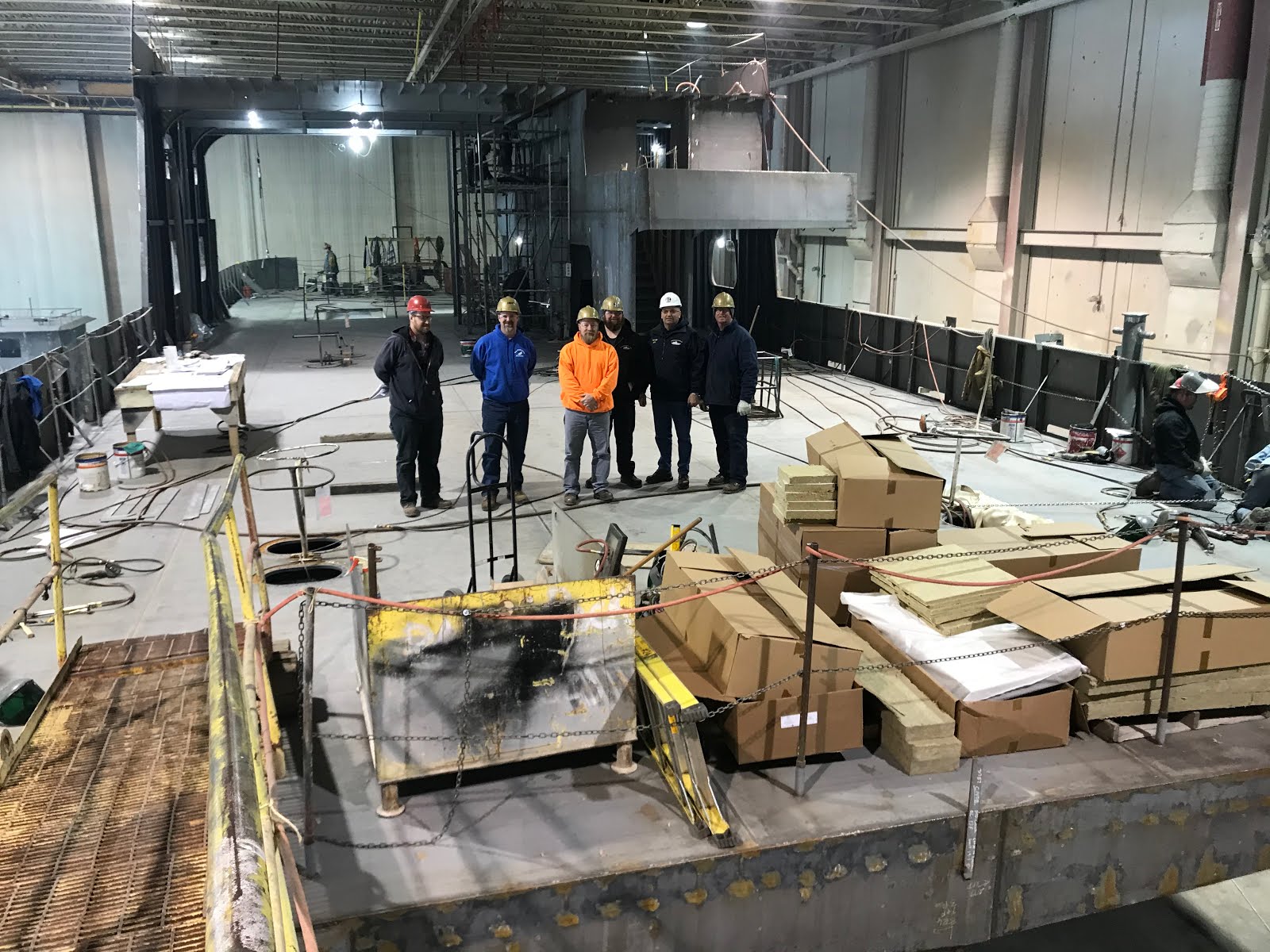
Washington Island ferry captains visit shipyard Feb. 12. 
With Madonna as backdrop:  Con McDonald, Kraig Krueger,
Erik Foss, Pete Nilolai, Rich Ellefson, Hoyt Purinton
and Dave Heath.  (WIFL photo)
Detroit Harbor, Washington Island -

Construction of the new Washington Island ferry Madonna continues within the large shed #411, a former Palmer Johnson Yachts building now owned by Fincantieri Bay Shipbuilding, located at the south end of the shipyard facility.

Hoyt and Rich were away last week, attending a meeting, and with their absence my photo source was lacking.  However, the work product moved ahead, although it may not show the obvious visual changes seen during the steel erection process, where frames, plating and hull shape shifted dramatically week-to-week.  But progress is there, and in ways that may be obvious only upon closer examination.

Several days ago, a portion of the ferry crew visited the shipyard for a close-up look at the new ferry for the first time (topmost photo).  When they left the Island, a skeletal crew remained to operate the Arni J. Richter, and yesterday the remaining men went to the shipyard, touring both the hull inside and out.  They were guided by Rich Ellefson, Hoyt Purinton and Fincantieri Senior Project Supervisor Steve Propsom, who have been with the project closely from the start.
Madonna main deck, looking aft, on Feb. 13 - Rich Ellefson,
Hoyt Purinton, Joel Gunnlaugsson, Jake Dahlke,
 Jeff Cornell and Tully Ellefson. Insulation materials
are stacked on deck.  (WIFL photo)
A fair amount of time has been spent assembling and adjusting the sundeck, in order to achieve the proper rake and smoothness.  The rather light steel plating that becomes the upper passenger deck can dish and warp, through the welding and fitting process, if steps are not made to eliminate such rippling.  The second of two photos (below) was taken from the upper deck looking aft over the main deck.  Carpenters, electricians, and painters now work daily in various sections of the vessel, staying out of one another's way as much as possible. The soft patch, a steel cover for one of the engine room openings, rests in the center of the deck.
U. S. Coast Guard inspector, shipyard personnel and Ferry Line
representative Rich Ellefson discuss plan details.

In this photo taken from the sundeck, main deck bulwarks, 
the solid ship's rails, are in place. (WIFL photo)


Two workers fit aft bulwarks to match curvature of the deck's shape.
Surface of the sundeck, made of lighter steel, reveals
effort to get smooth surface.  Disk welded to the deck
will help absorb welding heat when passenger
benches are installed, later on.
Although nearly all of today's photos were of work above-deck,
here is a shot of the starboard main engine, through the
main deck access opening. Piping is well along, and the engines
have been mounted in close-to-final position on rails, awaiting
boring of stern tube and  final alignment. 
Compressed air hoses, oxygen and acetylene
hoses, and electrical lines run to various work
stations on the ferry. (WIFL photos)

- Dick Purinton

Saturday, February 1, 2020

HIGH WATER COMPLICATES FERRY OPERATIONS


Magnus and Hoyt Purinton at the new steel foundation box
formed for the Island's north ramp, adjacent to the Standard
Oil pier.  (R. Purinton)


Detroit Harbor, Washington Island -

When we had extremely low lake levels - January 2013 was the record low - we dredged to allow for ferry maneuvering.  Then the level of Lake Michigan began to rise, so that on numerous occasions by 2019 we were at near-record highs.

At least a dozen times water overtopped the Island docks - which are lower in elevation than the pier at Northport - and that created ankle-deep ponding for pedestrians trying to access the ferries.  Most of the time such extremes were brief, driven by winds or created by low pressure cells.  But the forecast for the coming year indicates a likely return to high, dock flooding levels, perhaps even a few inches higher than in 2019.

"Indications are we could easily see eight inches more in lake level this summer," Hoyt Purinton said, "and of course, more than that if its a wind-driven event."

What can be done about it, from a ferry operator's point of view?

Several feet of water currently flow beneath the
Island's south ramp. A steel ice barrier was
created using stacked H-beams that can be
removed when water levels drop.

A new, longer approach for the adjustable, south loading ramp at north port was completed last summer.  This winter, work began in December on several loading sites.  In December 2019, the ramp at the end of the Island pier, used most frequently for landing since it was installed in 2001, had footings driven.  This December, two long pipes, approximately 30-ft. each, were driven inside the steel sheeting, and the gap beneath the ramp was filled with stacked H-beams.  This was done to prevent ice from sliding beneath the ramp, possibly damaging hydraulic lines or cylinders.  (Similar work was accomplished at the pier end-ramp at Northport, where the ramp structure is exposed to lake swells and sloshing winter ice.

Following those two preventative measures, a major job of improving the north ramp began.

This adjustable ramp was originally installed in 1975.  Several minor improvements have been made from time to time,  but high water dictates more work be done now.  High water, gradually sinking dock fill and concrete, slight misalignments between dock face and ramp centerline, and the need for a quality, dependable landing for the new, 124-ft. Madonna dictated more extreme measures be taken.   

Thirty or more years ago, sheeting and pipes were driven 8-10 feet into the bottom, less if a large boulder was struck first.  Now, Mike Kahr has driven new, 30-ft. pipes to bedrock where mooring tires will be hung.   Interlocking sheets 25-ft. in length were driven along the face of the pier to square it up with the Standard Oil pier.  Along the face of that pier, where the side of the ferries moor, additional, heavier steel pipes were driven to provide mooring tire supports and absorb side-forces as ferries come up against them in stiff southerly winds.   The new Madonna has a 40'-7" beam, and that will require a slightly wider berthing area, another reason for the southerly shift in orientation of the north ramp.

Ferry Line crew welded (Con McDonald, top) cut and
bolted steel sheeting for the Island's north ramp.
(Jake Dahlke and Dave Heath, foreground)
Taken several weeks ago.
All of this takes a great deal of work, along with a long range plan for what might still work should the water level continue to rise.  Right now, according to Hoyt, winter's precipitation has been less than anticipated, so that by April we might find the level down a few more inches.  But, with lots of liquid still ready to flow downstream in the Upper Great Lakes, that may not be long-lasting, and no quick remedy is foreseen to combat every circumstance.

Changes to ferry landings are one thing: concrete, steel and lots of labor can make them serviceable for the coming summer.  But, what about dock surfaces?  They could be at or below water level, and that's not a good thing for pedestrian traffic heading to or from the ferries.  Fill of some sort can be helpful - it would have to be stone or gravel to avoid washouts - but too much fill can trap dock overflow, becoming isolated ponds.

Such remedies have their limitations in engineering solutions, cost and practicality.  No single solution seems to meet all foreseen challenges. Only a gradual drop in Lake Michigan water levels brings a certain solution to this problem.

-  Dick Purinton