Showing posts with label Eric Greenfeldt. Show all posts

Thursday, September 24, 2015

Archivist Janet Berggren's page, ADVENTURES IN THE ARCHIVES,
became my favorite page in the Island Observer.


Washington Island -

I attended a meeting of the Washington Island Archives last Tuesday afternoon (which by coincidence also happened to be my birthday).

Everything went smoothly and routinely initially, my first meeting as committee chair since Eric Greenfeldt resigned as our long-term chairman in May, due to personal obligations that take him away from the Island. (Eric stayed on as a committee member, however.)

But, as Janet Berggren concluded her Archivist's report, she looked quietly first at the table top, then at the ceiling lights, and drew a deep breath before announcing that she would retire at year's end.  

This was quite a shocker to those around the table, let me say!  (I have to admit it was "right up there" with the time I was elected American Legion Post Commander when attending my second meeting in 1975 (the other four or five men in attendance already had their turn and were waiting for new blood)... or the time I consented to take the role of Church Council President, only to have the minister resign a few months later, followed by the church furnace giving up a few months after that.   Unforgettable times, all.)  

We'll miss Janet when she leaves in late December.  She said she's looking "to carve out some 'retirement' time.  One can never stop learning, and I've learned that when it comes to Island history, the road is a seemingly endless path leading from one treasure to another."  I can't help but agree with her inclinations, and wish her nothing but the best.

Janet has great skills, including the talent to put together an outstanding, polished Archives page in the Observer, drawing us in with her humor and light mystery.  She'll be with us a few more months, and during that time we hope to select her replacement, someone who can benefit by working alongside Janet before she goes skiing, or whatever she has in mind!

On another note, the Island Archives lost a friend and a great volunteer in David Raup this summer, a man with tremendous career accomplishments in paleontology, yet someone most of us hardly knew because he was quiet and unassuming.  He kept the Archives computers humming by updating software and looking for suitable machines that still ran on his favored XP software.   Janet's remarks, delivered at Dave's Memorial Gathering on Saturday, Sep. 19, titled "Remembering Dave Raup," will be published in the next Island Observer issue.

Never static

Organizations are dynamic, always changing, and the Island Archives is no different.  It would be a mistake to believe Island events and committees run on auto pilot, seldom deviating from course, with little effort expended to keep the ship moving forward.

Established routines, understood job descriptions, and a history built around successful events helps, but in the end it is the plain, hard work of many members and participants that makes a success of Island events.   These highlights make a significant contribution to our "tourism summer":   the Birding Festival; Paddlefest; the Lions Club Fly-In Fishboil, and the Fair;  the Women's Club International Food Festival; Art In The Park at the ANC;   Scandinavian Dance Festival;  the Music Festival;  the Rec Run and Walk;  the American Legion Memorial Day Program and Fish Boils;  Death's Door BBQ;  the Friends of Rock Island picnic;  and the recently held Literary Festival.  I know I've forgotten many others, for which I apologize.

These are but the tip of the iceberg.  Lots of work goes into putting on these events, and I believe each one of those named above is sponsored by a non-profit organization and staffed by volunteers.  The cumulative effect is an Island that bustles with energy, ideas, creativity and promise.  It's captivating and contagious, and not just for first time visitors.   Residents often make up the bulk of the patronage at these events, both pitching in to help and enjoying the activity.

There's good reason we choose living here, beyond the beauty and awe of this natural world.   The closeness of a working community is a strong part of that reason.  There's nothing better than to be invested in your community, knowing that your work, using your hands and head, contributes to the overall economic and social well-being of the Island.

-  Dick Purinton    


Tuesday, February 17, 2015

ISLAND WATERFRONT - Then and Now - Part VI

It's sometimes easy to think romantically of the past, and this photo showing
passengers aboard the Wisconsin at their leisure, a few with sun (?) umbrellas
 may feed such an urge.  However, it is doubtful these passengers could have
found shelter if a rainstorm came on suddenly.  And, the chill of the lake was
theirs to deal with until they made land on either side of the passage, for there
was little protection to be had.
Not so much different than aboard the Karfi today, I am reminded!
(photo from Bell Collection, Wm. Jepson the likely
photographer.)
Washington Island, Wisconsin -

When I wrote in the last blog in this series about the Washington Island waterfront over the years, describing early ferry boat efforts, I mistakenly omitted the wooden ferry H. J. Davis that competed, for a very brief time it appears, with the Wisconsin.  I say only the vessel Wisconsin, because I'm not certain for how many years the Marion and Navarre operated as ferries.   One mention in The Door County Advocate, in July 1928, mentioned the Marion had delivered cedar posts to Sheboygan from Cedar River, and in the paragraph that followed, that the H. J. Davis delivered cement to Sturgeon Bay.  It would seem that in the height of the season, the transportation of freight was the main source of income and purpose for those two vessels.  I'm uncertain how the Navarre fared as a ferry once placed in service.

I was advised by none other than Eric Bonow to "hold the presses" (but the blog had already taken flight into the ethernet) and so I'll provide a correction, an addition, actually, here.  With the previous blog I had been using clippings provided me by Eric Greenfeldt, all of which came from The Door County News, one of two newspapers that flourished for a time in Door County.  When I reached the final clipping, I ended my blog.

We have Ann (Herschberger) Young and daughter Carolyn Foss
to thank for this great shot of the Wisconsin departing Gislason's
dock, sometime prior to 1928, the year when Capt. Jepson
began using the new Welcome.  This is from a Herschberger
photo album.


From Eric Bonow, then, I received the following pertinent excerpts on the H. J. Davis mentioned in columns of The Door County Advocate (DCA).  She was referred to in a 1915 report as "the little auxiliary schooner" carrying pulpwood, and in another mention in 1918 as "the gasoline hooker".  In 1920, she was credited as the "auxiliary schooner…bringing a cargo of potatoes…Walter Goodlet is master." By 1923, Mike Anderson was listed as captain of the Davis, and hay was the cargo loaded in Sturgeon Bay for Menominee, Michigan.

So it may be with some surprise that in August 31, 1928, it was announced the J. H. (sic) Davis was purchased by Art Weber from Mike Anderson for the purpose of serving Washington Island as a ferry boat.  The dimensions of the H. J. Davis were given:  20-ft. beam; 75 ft. length; capacity of five autos besides passengers and "considerable freight," and would, through alterations, be capable of carrying seven autos the following year.  Capt. James Sorenson, owner of the West Harbor Hotel, would be "handling the craft," while Milton Hansen, also of the Island, would act as shore captain.   A daily schedule was also announced.

We have no idea how many days the Davis operated to and from the Island, but in the DCA of Sept. 24, 1928 its stint as a ferry appears to have ended:  "The new ferry Davis, which operated a short while as a ferry boat carrying cars and passengers across the Door, has gone into general freighting
for the rest of the fall.  Since the resort season is practically over, the ferry Wisconsin will be able to handle all of the traffic during the rest of the season."

Another wonderful photo from the Herschberger album shows an early,
unidentifiable vessel under sail.   This gaff rig was apparently used for saving
on fuel, and as the means of salvation if the motor quit.  

Hard to say what vessel this is for certain, since these small freighters 
tended to look very much like one another from a distance.   
Does anyone venture a guess?  


The Davis appears to have returned to freighting and "special ops," more or less on a permanent basis.  In November of that year, the Davis retrieved a damaged Cherryland Airways airplane (the first plane in Sturgeon Bay) from Green Island, located six miles or so from Menominee, Michigan.   And in the fall of 1929, the Davis was reported to have taken a load of coal to Sister Bay.  Art Weber of the Weber Dredging Co. was listed as owner, and the newspaper reported that the H. J. Davis was up for sale, "a good carrier and a staunch craft for coastwise trade."

A photo Eric Bonow emailed (but which I don't have permission to reprint here) shows the Davis having similar lines as the vessel Marion, except for being in a very 'tired' looking condition.  My conjecture is that this vessel worked hard over the years as a small freighter, and that its life as a ferry boat amounted to a very brief period before it returned to its familiar role as freighter or small hooker.   Art Weber, listed as owner at least for a period of time, and who also owned a dredge company, was employed by C. H. Thordarson for excavation of the shoreline on the southwest shore of Rock Island late in 1925, where the foundation for Thordarson's Rock Island boathouse began.

In this photo Gordon Jepson appears in the window of the pilot house.
The passenger second from left below him is Gene Gislason, and
it is very likely Gene's brother alongside him.  Others have not been
identified.  Capt. William Jepson operated the North Shore 

beginning in 1933.(the photographer is unknown, but one copy 
is in the Herschberger family album, and it may be the original.)


One more mention came in my book Over and Back (1990) in which Gordy Jepson, son of William P. Jepson, recalled the name H. J. Davis:   "...a 70-75 foot boat, running from Teskies in Gills Rock to Nor Shellswick's on the Island."  Gordon also said in the 1990 interview that, "After Gills Rock replaced the farther port of Ellison Bay, most of the other boats which had made similar runs quit operating.  Dad landed at Gislason's dock, in Jensenville, near the present Shipyard Marina.  He sold the Wisconsin in the spring of '29 to Chris Andersen, who used her as a freighter once again to Green Bay.  Dad had built the Welcome for use as a ferry, and she could carry ten cars.  The Welcome was also built of wood, by Sturgeon Bay Shipbuilding and Dry Dock.  Dad pulled me out of school to become a deckhand.  Other deckhands working for Dad during these years were:  Ralph Wade, my brother-in-law;  Ray Andersen;  Walt Hansen;  and Ernie Lockhart."

Two photos of the Wisconsin moored at the Ida Bo dock (now Findlay's Holiday Inn) appear in Over and Back (pages 29 and 38) , and these could have been taken when the boat was employed as a freighter, possibly before or after the regular tourism season.  The Ida Bo dock, however, didn't have the width necessary for loading autos.

 -  Dick Purinton


Tuesday, September 16, 2014

AMONG SPIRITS


Three groups of 30+ each listened raptly to eight 
Island voices at Sunday's Cemetery Walk.
Washington Harbor, Island Cemetery -

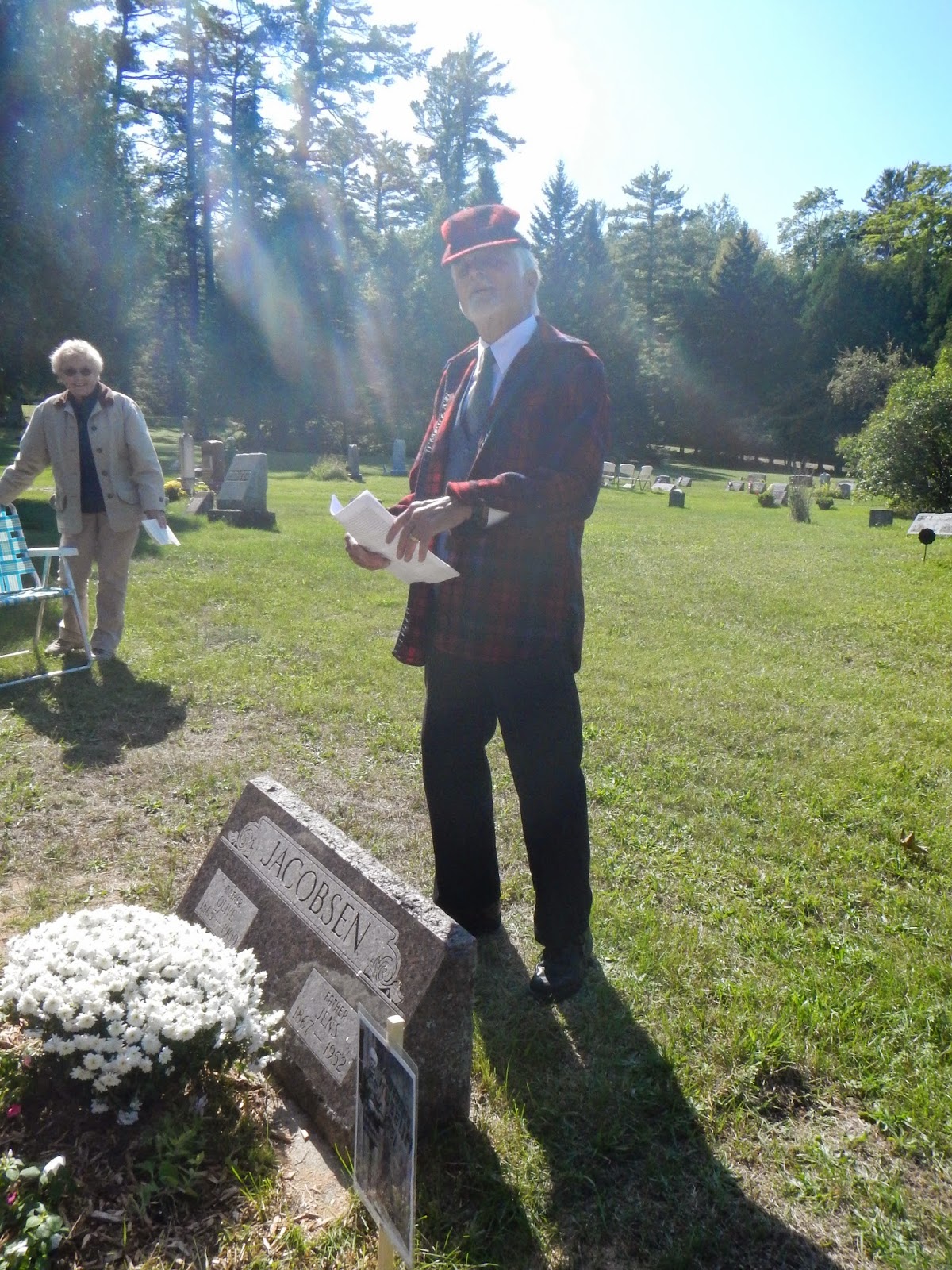
The third Washington Island Archives Cemetery Walk held Sunday, Sep. 14, brought eight Island personalities from the past back to life before an audience of more than 100.

The Green Bay Packer organization held off Sunday's start time at 3:25 out of respect for this Island resurrection, making it possible for fans to participate in both events.   The September weather was pleasant, the monologue scripts summarizing each life were excellent, and the actors who delivered the messages did so in convincing, entertaining fashion.

The eight Islander profiles chosen, along with their respective actors, are shown in photos below.   In many instances, the likeness of the presenter to the person they portrayed was uncanny.  The many accomplishments of the persons chosen, and their contributions to Island life, absorbed within a two-hour program, was overwhelming.  These were tireless organizers, heads of families, champions of causes, successful in ways that lasted far beyond the grave.  

According to Island Archivist Janet Berggren and her staff of volunteers, over 100 programs were given out to a crowd divided into three groups.  Each circulated the short distance between headstone locations, spending approximately 15 minutes with each spirited actor.  The entire event was completed by 3:00 pm, in time to watch the Green Bay Packers get buried, then miraculously come to life again against the New York Jets.  

Julian Hagen sang his new song, written
especially for the occasion:
"From A Spirit's Point of View"


Archives President Eric Greenfeldt portrayed
his great-grandfather J. W. Cornell (1865-1952).
Research/Script by Eric Greenfeldt.


Jens Hansen portrayed
Christ A. Hansen (1856-1936).  Research/
Script by Charlotte Hansen.
Chuck Sena portrayed Nels Friis (1850-1923).
Research/Script by Connie Sena.
Neil Shadle portrayed Will Jess (1869-1938).
Research/Script by Merrill Lundberg.
Lillie May Shadle portrayed Janet Burgoon (1900-1989).
Research/Script by Kirby Foss.

Terry Henkel portrayed Jens
Jacobsen (1867-1952).   Research/Script
by Jewel Lee Grandy.
Joyce Morehouse portrayed Martha
Stelter (1914-2009).  Research/Script by
Jeanie Young.
Tony Woodruff portrayed Tom Nelsen (1871-1960).
Research/Script by Dave Raup and Grace Woodruff.

Friday, July 26, 2013

EARLY DETROIT HARBOR PASSENGER VESSEL SERVICE


Detroit Harbor, Washington Island -

A light rain is falling, and there is a temporary lull in tourism this afternoon, a good time to consider a new blog.  I've had some of these images on my computer screen for months, waiting for that opportunity to string them together with observations.

What got me started on this was the topic of dredging and dock work, and how one thing builds on another over the years and decades.  The present island ferry dock was formerly the property of Ole Christianson who had a boatyard and marine railway there.  If you're interested in more details on that yard, a letter from Ole to Thordarson is included in the about-to-be-published Thordarson and Rock Island.  Thordarson, it turns out, was interested enough in Ole's boatyard to exchange letters with him and get a price.  Ole, it is assumed, was what we call today a "motivated seller" because when Thordarson didn't bite, William Jepson who operated the ferries from the shipyard location at the far end of the harbor did.  Jepson moved his ferry landing and began to make dock improvements.  (This move would also have entailed the improvement of a road for motorized vehicles to and from the Lobdell Point area.  John W. Cornell recalled walking to work along a footpath when he first expanded his dock, where the current Island Outpost dock is now situated.)

North Shore moored inside the slip.
Barrels are lined up along the Standard Oil
dock to the north.  Chambers house is
in background (right).


In the first photo I think we can safely say the North Shore is backing from the location that is also the current ferry landing, backing "into the channel" so-to-speak.  Since the exact year isn't known, there might not yet have been a dredged channel, only a naturally deep waterway. (It was first dredged in 1937.)  Jepson wasn't the only operator to carry autos.  But he appears to be the first to do so, and the first to operate a regularly scheduled service using two ferries, the Welcome and the North Shore, built expressly for passenger and auto service from the Island to the Door Peninsula.


Earlier passenger service?

Eric Bonow provided the 1909 timetable below that outlines early passenger service options to upper Green Bay ports, including Detroit Harbor.   The larger Bon Ami or Sailor Boy made the main run between Sturgeon Bay and Marinette-Menominee, and then north to Escanaba.  A smaller vessel, Thistle, was used to call on smaller harbors along the Door Peninsula.  If someone from Washington Island wished to go to Escanaba, for instance, they could board the Thistle from Gislason's dock (near present day Shipyard Marina), and then transfer near the harbor's entrance to the northbound Bon Ami, which then continued on its way to Escanaba.  When southbound, the Bon Ami or Sailor Boy would stop in Washington Harbor, but apparently only when there was demand.

The fact that trains could be met at Sturgeon Bay or Marinette/Menominee (also at Escanaba, although it is not stated on the Time Card) made it a convenient means of scheduling travel.   It was with such possibilities that C. H. Thordarson often arrived in Escanaba, Michigan, from Chicago by train in later years.  A smaller boat trip completed his last leg to his Rock Island estate.

 Although it is hard to read the fine print, Eric highlighted the Thistle's name in yellow.  Passengers who wished to disembark in Detroit Harbor would also transfer from the larger Hart Line boat to the smaller Thistle near the harbor's entrance.  Then Thistle and her crew were optimized with an offer of "cheap excursion rates outside of Detroit Harbor every pleasant afternoon" to help fill time before she began her run south.

A promotion ran in the Time Card:  if passengers continued to Escanaba, they would arrive in the evening, "Giving all our passengers a chance to approach the city by night and view the immense ore docks lighted by electricity, which is a beautiful sight."

Other early Detroit Harbor vessel activity

Another Eric, Eric Greenfeldt, sent me a volume of great information in the form of early newspaper article reprints.  These clippings tell of the very first beginnings of  ferry transportation on Washington Island.  Here is a sampling:

The Door County News (DCN) of 22 May 1919 reported Capt. Carl Hanson of Washington Island, owner and master of the gasoline freighter Marion, stated his intention to make twice daily round trips from Detroit Harbor to Garret Bay (west of Gills Rock).

In the next few weeks, Hanson apparently sold (or leased) the Marion to William Jepson.  The June 26, 1919 issue reported the first trip carrying an automobile, the ferry Marion under Jepson's authority.  Success of the undertaking, it was noted, depended upon the "patronage of the public." But a "large increase in the number of autos during the past and first of the present season" was optimistically noted.  Also described was "a dock being built at Gills Rock for the ferry to discharge the autos conveniently and expeditiously, and the work will be completed by the end of the week."

Highways and automobiles led to a decline, then the end, of around-the-bay services such as the Hart Line offered.

The Marion's schedule and rates as advertised in the July 10 DCN:  Trips were twice daily.  Round trip rates were $5.00 for small cars, $7.00 for touring cars.  Passengers were 75 cents each, one way.  An accompanying column noted that "The line promises to become a popular mode of travel when brought to the attention of the outside world."

[We're still working on that...]

Competition was in the wings.  The following account appeared in the April 21, 1920 issue of the DCN:

Pete Anderson, the Mail Carrier, Will Carry Cars Across the Door In His New Boat

Washington Island is to have a ferry service again during the coming summer for the accommodation of the inhabitants of that part of the county as well as the tourists trade.

Pete Anderson, the hustling mail carrier, is the man behind the proposition and he will combine it with his regular business of handling Uncle Sam's mail and carrying passenger s back and forth.

During the past winter Pete purchased the big gasoline yacht Navarre which formerly belonged to Judge Turner, now deceased, and during the past couple of weeks, he with Thos. Johnson and George Jorgenson have been busily engaged at Two Rivers in converting the craft into a business boat.   She was thoroughly overhauled below the waterline and is now as good as new.

On Monday, Mr. Anderson, accompanied by Messr. Johnson and Jorgenson, arrived in the city with the boat on their way to Washington Island, stopping only long enough at the yards of the Fuller Goodman company on the west side to take on a load of material with which to finish the craft.  It is the intention to put in exceptionally heavy beams and decks for carrying automobiles.  The upperworks and decks will be put in at Detroit Harbor during the ensuing month, it being the intention to have her ready for commission along about the first of June.  The Navarre is 56 feet long and 15 feet wide and will be capable of carrying three cars handily.  She is an exceptionably fine boat.  The owners will also have accommodations for passengers as well.

Mr. Anderson has not as yet figured out just what schedule he will run on , but this will be announced at a later date.

There are a large number of autos owned on the Island, which together with those of people who wish to visit the place should provide a good business for the ferry.  
(Note:  In this early newspaper article the word "autos" appears with an "e," similar to "potatoes," a new word then for editors and readers alike.)

Well, enough for one rainy day.

Eric Greenfeldt sent me quite a few column inches reporting discussions leading to that first official auto being carried by Jepson on the ferry Marion in 1919.  When it rains again, and tourism doesn't require my services, we'll continue with this subject.

-  Dick Purinton