 |
| This photo would have been taken during the first years that Capt. Jepson operated from Lobdell's Point, instead of across the harbor at the shipyard location. On the postcard reverse, in Mary Richter's hand, is written: Welcome 1933-34. |
Washington Island, Wisconsin -
Ours is a small corner of Lake Michigan, a tiny bit of Great Lakes waterfront, and hardly a spit in the ocean when compared to the national maritime picture, and yet there is a relationship. Maybe we puff our chest over this, but it's good to look at the national picture once in awhile and think how we might, or might not, be contributing to the overall picture.
What happens at home is always most important: Washington Island's port activity, revenues, tourism volume and overall business health. A prospering business dependent upon good waterfront access will reflect in projects undertaken along that waterfront, efforts made to either improve operational facilities in a forward-looking manner, and sometimes acts in desperation, trying to stay ahead of mother nature, the weather-related events of storms, lake level fluctuations, as well as deterioration of docks and piers that happens over time. Even concrete, as we often see, has its limitations when the element of time comes into play.
 |
| This date (again, according to Mary Richter's hand) is 1943. |
So here are a few photos of the waterfront in different years, showing vessels of the day loading from the facilities available then. In some cases the loading was made under duress, using the best available means that day. Often the measures taken were bare minimum, but the best that could be hoped for. Over time, the materials used (such as steel and concrete and asphalt) brought crispness to the edges and greater durability to the landings. Machinery that could dig, pound and lift meant that time and money became the greatest hurdles. Electrification made possible the use of portable hoists to raise and swing plates, plug in vessels to shore power (and heat the machinery spaces in cold weather). Modern times brought larger and heavier vehicles that required larger and more substantial vessels, a few with year around capabilities.
 |
| Dora Engelson is shown in this photo (perhaps family members will know who the children are) taken some time in the early 40s, we think. To be noted are the buildings on Detroit Island, and the old, natural channel marker of timber and piled stone. |
Seventy five years have brought these changes, often established following lots of work just to maintain at the same level of service, sometimes small improvements, but with occasional, larger leaps into new and more modern, safer and more efficient service.
Partly for my amusement, and partly to find out what's happening in the maritime trade beyond Detroit Harbor, I regularly read three or four industry related magazines. It helps me in keeping our Ferry Line role in perspective.
One such magazine, The Waterways Journal Weekly, has been around since 1887. Although it reports mostly on "brown water" events and activities, meaning the inland rivers, there is always an eye to the national picture. In the January 19 issue, I found these amazing statistics that indicate not only the health of our maritime economy, but also our continuing national dependence on shipping, ports, shipyards and the many thousands of workers and families who derive their livelihood from these and associated industries.
 |
| This postcard shows the dock around 1950, when the new C. G. Richter still had its hull painted white. |
I consider the case of my own family, having grown up in Sturgeon Bay, and its dependence not only on the local shipyards, but the Great Lakes bulk shipping industry as a whole, for my father's work involved engineering details for conversions and repairs of lakers and other vessels (including several of the Washington Island ferries). Ship construction was cyclical, dependent on the economy and surges in Great Lakes shipping, but also to a great degree on government contracts. There were research vessels, transports, and naval vessel contracts, if not at the Christy, Ship Building and Dry Dock or Peterson Builders yards, then somewhere else on the Lakes, when R. A. Stearn Naval Architects looked further afield than the adjacent waterfront for work. Workers at Bay Shipbuilding (now under Italian ownership) today build oil industry vessels with ice classification approvals, perhaps for work in the near future in Arctic waters, where competing international maritime interests have recently beenfocussed.
One point I always found exciting and also satisfying was that from the front of our home, which was situated along Memorial Drive where we saw many of these vessels pass, including the cross-lake car ferries when they were still in service, was that I could some day take a vessel from that point and sail to any point in the world's oceans. That thought allowed me to dream, an activity I still enjoy!
 |
| You might think this photo was taken at time of record high water, in the fall of 1987, but in Arni Richter's handwriting on the reverse, the date is January 11, 1975. This early winter storm raised the water level, and tore up the wooden cribbing along the waterfront, the area now immediately in front of the present day ferry terminal. |
Life in Sturgeon Bay, and for the last 40 years on Washington Island, has impressed on me the importance of a having a vibrant maritime industry, not only for our local economy, but for the nation. I wouldn't think this concept would be a hard sell, but every so often members of Congress bring up amendments to abolish the Jones Act. Most recently, Senator John McCain proposed this as an amendment to the Keystone Pipeline project. I suppose we should forgive a senator from a dry state like Arizona that has no shipyards, but for an ex-naval officer, and son of a navy admiral, to turn his back on American-built vessels in favor of opening up ship construction, design and supply to foreign-built vessels for our domestic trade, seems ludicrous. Normally, I'm not for specific industry-protective legislation, but the Jones Act means that our American vessels will not be built in China, or Korea or some other nation, but by a U. S. shipyard, by U. S. workers, and that's important for our economy, but its also also critical for national security.
Well, that's only one of the items in the larger picture that caught my attention while reading. Here are a few others found in the Jan. 19 Waterways Journal:
* The Seamen's Church Institute continues to promote seafaring through training of mariners, and with their chaplains who visit vessels along the coasts and inland. Training facilities in Houston and Paducah train nearly 1600 mariners each year. The organization was founded in 1834 by the Episcopal Church, and the non-denominational institution has always had the welfare of mariners at heart. ** It was members of this organization, I believe, who helped construct Bethel Church in Washington Harbor in 1865.
* Burns Harbor, a destination for many of the ore carriers we see passing by our island's shores, experienced the best year ever, with total tonnage delivered up by 30% over 2013, including steel, grain and salt. These figures were also boosted by a 35% increase in ocean-going vessels, and a 25% increase in river barges moving through Illinois/Mississippi river systems. Over 500 barges were handled in 2014, linking the port to more than 20 states and 12,000 miles of rivers. This is a statistic that makes one doubt the wisdom of those who wish to close off the Illinois barge canal, rather than find other solutions to stopping the advance of Asian carp.
* Our dependence on ocean shipping is as great, if not greater, than it ever was, with the container industry bringing us all sorts of goods from foreign shores. Measurements are in TEUs (twenty-foot equivalent units) rather than tons of cargo carried. On the West Coast, ports have been locked up due to striking longshoreman, with incoming ships queued at anchor, and this brought delays of goods to stores near us, especially around holiday time. Despite this, in 2014 the number of TEUs was up in November, and for the year. 2014 brought an estimated total of 17.2 TEUs to U. S. shores, according to Global Port Tracking, a 6% increase over 2013.
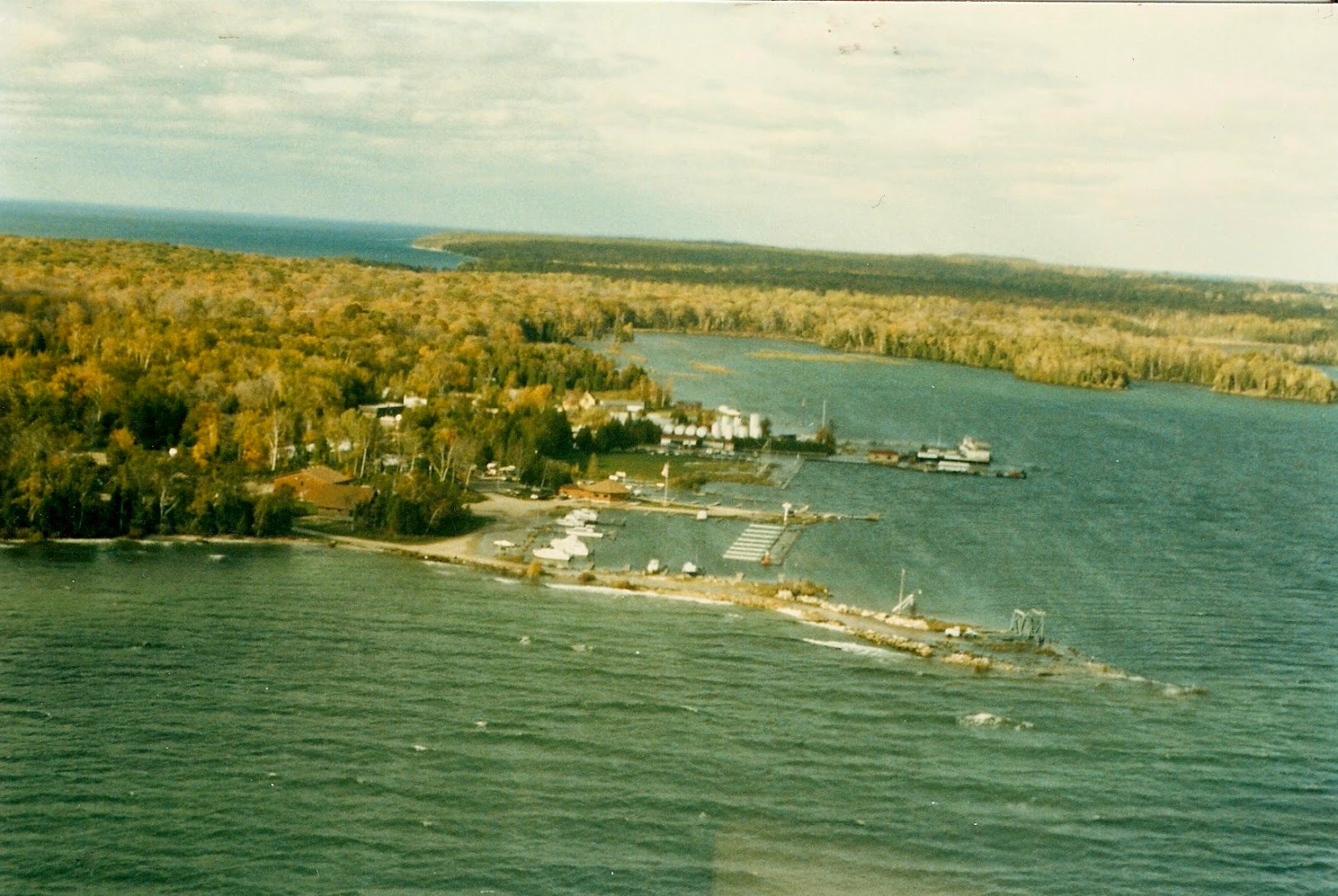 |
| I'm not sure who to thank for this photo, but obviously a pilot. This one was taken in the fall of 1987, when the all-time high water level for Lake Michigan was recorded. |
We often enjoy looking back on yesteryear, thinking they were "golden" years, if only because we're removed from them by time and further filtered by our romantic imaginations. In this pursuit, I'm adding a few paragraphs written by Christopher Morley, a writer and editor well known in his day who was especially good at, among other things, writing about his home town which happened to be New York City. He was especially knowledgeable when it came to waterfronts and vessel activities, aided by first-hand experiences when he and his friends (loosely formed into what he liked to call the "Three Hour Lunch Club") took excursions on one of the Moran Towing tugs. It was shortly after the First World War, and there were all sorts of freighters and wayward vessels still visiting the harbor.
Here are a few samples from a compilation of his essays entitled, Christopher Morley's New York (published by Fordham University Press, 1988). I didn't just happen to find this in the library. A copy was loaned to me by Tony Woodruff, who besides being a deck companion on the Karfi in summer, is a grandson of Christopher Morley!
From an entry titled, "Alice and the Aquitania":
Shipping business is bad; it is grievous to see so many good vessels laid up in the Erie Basin and in the alcoves of the Gowanus Canal. But Alice M. Moran, "of 29 net tons measurement," says her certificate, still puts in a lively twelve-hour day.
We are not the first to raise a small chantey of praise in honor of Alice, for her skipper, Anton Huseby, proudly showed us an admirable article written about her…Alice had already done a good five hours' work when we boarded her. We were hardly in the roomy pilot house before sturdy Alice was again about her affairs. The first thing one noticed was that tugboats, by old tradition, steer backward: unlike social craft the wheel preserved the old theory of the tiller. When the wheel is turned to starboard, the tugboat turns to port. So the ordinary merchant seaman or yachtsman is a dangerous fellow at a tugboat helm until he has learned this difference by instinct.
And after a most entertaining account of a shift aboard the Alice M. Moran during which time they assisted numerous ships to and from the New York harbor, Morely closed with:
While do people build or buy big steam yachts, we wondered. Surely a tugboat is the perfect craft. They build them on the Great Lakes - Green Bay, I think they said, was where Alice came from. You can get one like her for something like $100,000. A maiden voyage in a tugboat from Green Bay to New York would be a good trip to take.
Aquitania lay there, a blaze of lights, stewards busy carrying off baggage. Alice backed off with a curtseying motion, and vanished into the dark. She sleeps in Brooklyn.
- Dick Purinton


