Showing posts with label LT Chris Breuer. Show all posts

Sunday, June 8, 2014

RESPONSE TO COAST GUARD HELO QUESTIONS

LT C. A. Breuer and Coast Guard helo 6578,
Sunday morning, March 2, 2014 shortly after a
precautionary landing.  
Washington Island, Wisconsin -

Early on a clear Sunday morning, shortly before 8 a.m., March 2, 2014, a precautionary, emergency helicopter landing was made on the east shore of Washington Island by the crew of the search and rescue helicopter 6578, then in transit from the Traverse City Air Station to northern Wisconsin.

Local interest in this incident, which ended safely for crew and aircraft, and the subsequent removal of the helicopter within 48 hours by a maintenance crew via trailer, sparked questions.   Questioned was the soundness of this particular aircraft, given a similar incident that occurred about one month prior to this event, when the same unit was forced to land in a cornfield in lower Michigan.  (See blogs March 2 and March 3)  

Other questions that were raised:  How does crew training prepare for such an event"  What are maintenance procedures for this aircraft?  Will this helicopter model, relied upon and in service for many years, continue to serve not only Traverse City Air Station but Coast Guard-wide, as a dependable search and rescue tool?

I directed such questions to the the aircraft's commander on that March morning, LT Chris Breuer, who carefully responded in a detailed letter of 8 May 2014.  His letter was posted on June 5th, and I received it in yesterday's mail (following what I presume was a review by his Traverse City Air Station command, prior to the letter being released to the general public).

According his attached note, Breuer will soon leave the Traverse City Air Station and join Coast Guard Air Station Kodiak, in Alaska.

LT Breuer

We are pleased to reprint his letter of response, and for accuracy his entire response is given rather than selected portions of answers:

Dear Mr. Purinton,

I appreciate your interest and time documenting the 6578's beach landing.  Enclosed are answers to your questions.

1)  Unfortunately, most of the ice along our route of flight was smaller "pancake ice" or small sheets that wouldn't have held the weight of the helicopter.  Our crew train annually for water entries and the aircraft is equipped with floats, so if the malfunction had been severe enough we could had landed in the water.  Each aircraft is equipped with a raft and survival gear, also each member is dressed in a dry suit and multiple layers of insulation, depending on the water temperature.  If we had been forced to land in the water, we would have been both prepared and equipped to handle the environment.

2)  The malfunction on both the Washington Island landing and the previous cornfield landing started out with a Flight Director (auto pilot) error.  The flight director was commanding the aircraft to roll one direction and the aircraft wasn't following the command.  With the pilot's hand flying, there was excessive force in the controls and we isolated the malfunction to a hydraulic issue. After retrieving the aircraft back here to Traverse City, our maintenance crews expended 180 labor hours working to find the cause.  They were able to locate a broken check valve which allowed hydraulic pressure to flow the wrong way.  Our helicopters have multiple systems with a backup secondary system, and the flight control hydraulic is one of those.  This casualty essentially allowed the two hydraulic systems to fight each other for control of the helicopter.

3)  Our crews go through constant training and assessments to ensure they react appropriately to in-flight emergencies.  Annually pilots go through a week long simulator course at Aviation Training Center Mobile, Alabama, that tests their knowledge of emergency procedures.   Also, each year a team from Aviation Training Center Mobile will visit each unit and test flight crews on their systems and emergency procedure knowledge and in aircraft skills.  Approximately 40% of our flight hours are used of retraining, and most of those flights include some discussion or practice of emergencies.

4)  The 6578 has flown on 17 flights since our maintenance crews completed the repairs and will continue to be a fully functional part of our flight schedule.  The Air Station Engineering Officer recommends to the Commanding Officer whether to clear an aircraft for flight after any major maintenance.  For unusual situations like this one, Coast Guard Headquarters may be part of the discussion.  Because our maintenance crews are so highly trained and also fly on the aircraft, crews are confident in the work performed on all of our aircraft.

5)  The H-65 Dolphin helicopter has been in service with the Coast Guard since 1985 and will continue for the foreseeable future. The Coast Guard's H-65 fleet has completed more than 1.3 million flight hours and continues to hold a Mishap rate well below both commercial and other military branches' Mishap rates.   The H-65 Dolphin is a very well maintained and capable aircraft that crews have confidence in flying.

I hope that these answers expand your understanding of Coast Guard operations and answer your questions.  Thank you again for the detailed article and interest in our emergency landing.

Sincerely,   C. A. Breuer   (Chris Breuer)

With appreciation for his response, and with renewed appreciation for the Coast Guard's Great Lakes Air Search and Rescue program going forward...

 -  Dick Purinton

Sunday, March 2, 2014

COAST GUARD HELO MAKES PRECAUTIONARY LANDING, EAST SHORE OF WASHINGTON ISLAND


Flight crew with Air Rescue Helo 6578 on beach in front of Wilson home.
Hog Island is visible in background, above tail section.

Washington Island, Wisconsin -

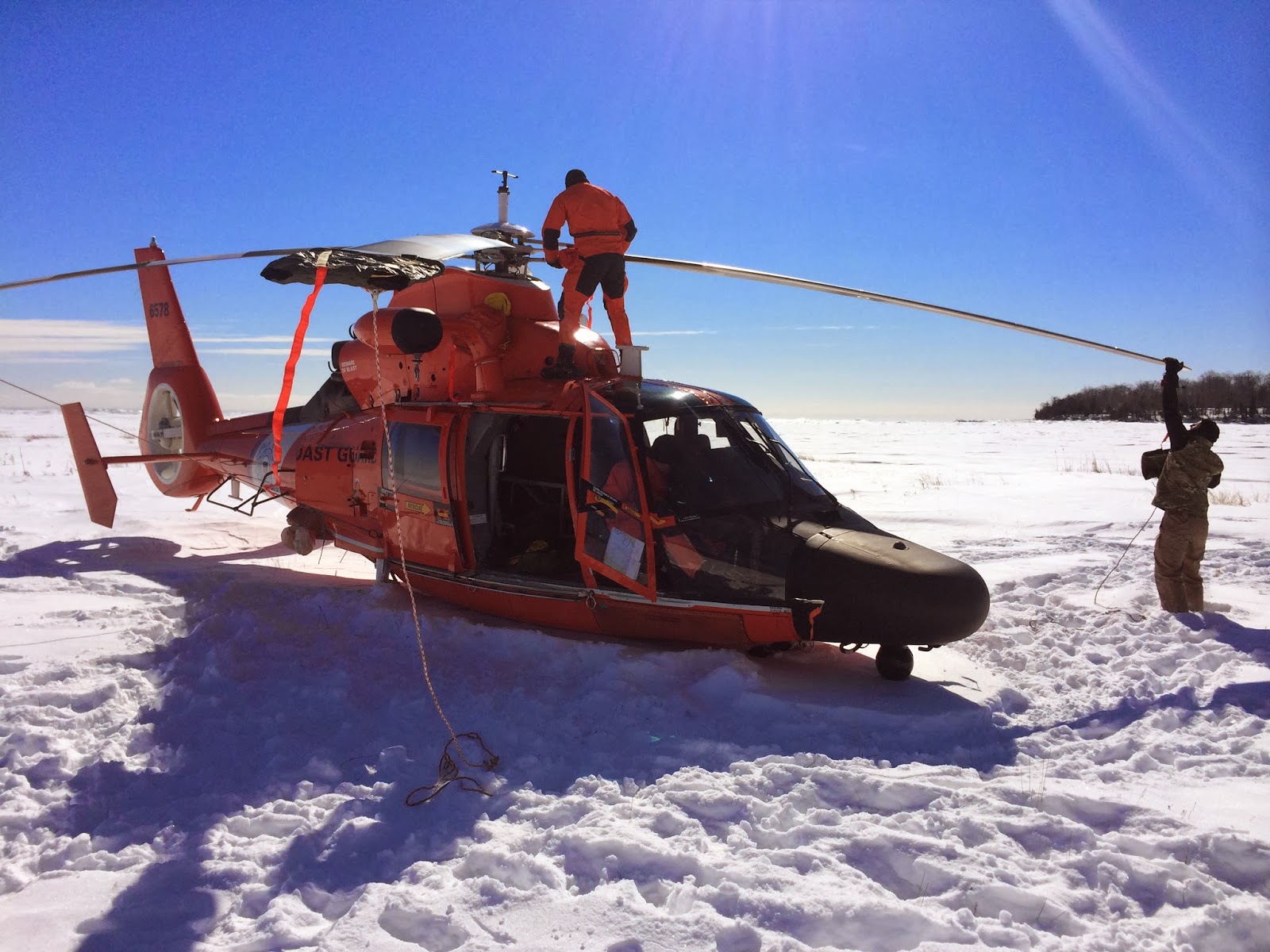
U. S. Coast Guard Rescue Helicopter 6578 landed safely on the snow along the eastern shore of Washington Island this morning, in what was termed a "precautionary emergency landing" by aircraft commander LT. Chris Breuer.

The MH-65C "Dolphin" helicopter with four crew aboard had taken off from the U. S. Coast Guard Air Station Traverse City around 7:50 a.m. EST.   As their aircraft flew over Lake Michigan and approached within approximately ten miles of Wisconsin's shoreline, intending to fly over Washington Island enroute to a search and rescue assignment (SAR) near Ashland, Wisconsin, a "flight control issue" arose.   A decision was then made to land along the flat, broad portion of beach just south of Hog Island and the Percy Johnson County Park, an area separated from the trees along shore and the open lake waters by ice banks and snow covered rocks.

According to LT. Breuer, flying further inland wasn't a prudent risk.  It would have been a flight path over trees for another several miles, extending their air time in an effort to reach open fields, or perhaps the Island Airport.   While he couldn't speculate on the nature of the mechanical issues encountered, other than to verify that it was not a fuel related problem, such landings, while not routine, are occasionally made, always with safety of both crew and aircraft foremost in mind.

With landing wheels now deep in snow and the aircraft unable to be flown, the most likely resolution to repairing the helo will be to lift it by crane to a flatbed truck, and transport it back to their air station, rather than perform on-the-spot repairs.  Engineering tech support at the Traverse City airbase will determine just when and how the helo extrication might be accomplished.   When this is sorted out, likely by early afternoon today (Sunday), Breuer's crew will be airlifted back to their base.  A "salvage" detail will then likely take over to ready the plane for lifting and transport, first by ferry, and then via highway back to a facility where it can be properly repaired.

Air crew secured rotors in preparation for their anticipated departure later today.


The helo crew includes:  Aircraft Commander LT Chris Breuer;  Co-pilot Jim Okorn;  Flight Mechanic Matt Lussier; and Rescue Swimmer Tom McArthur.   The crew had responded to a call around 5 a.m., an "uncorrelated Mayday" reported from the Ashland area, which, according to Breuer, could be almost anything, including an ice fisherman or snowmobiler needing assistance.  It was unlikely, he said, due to the heavy ice conditions in that area, that this call would have come from a vessel in distress.

According to Breuer, his aircraft had been used earlier last evening by a nighttime crew, before his crew responded to the Ashland call.  They were in the air some 50 minutes, he said, before putting down in front of the Jim and Janet Wilson home around 7:45 a.m. CST.

"Did you head for the widest stretch of flat beach, or the nearest home with smoke curling from the chimney?" I joked, noting the warm, comfortable surroundings of the Wilson home.  Safe landing was foremost on their minds, I was assured, with the nearby hospitality of the Wilsons an added bonus.

By the time I arrived to interview the crew, around 9:45 a. m., the Wilsons had just departed for Sunday morning worship service, leaving their lakeshore home in the hands of the air crew, plus the Island's two policemen, Gary Schulz and Tyler McGrane.   The morning was fresh, with bright sunshine, temperatures slightly below zero, with very little wind.  Circumstances could certainly have been more extenuating, the crew noted, than along this shoreline, a location where a century or more ago crews of sail schooners sometimes found themselves wrecked.


Aircraft Commander LT Chris Breuer
While LT Breuer was occupied with phone and email traffic, coordinating plans going forward, he also kindly answered my questions.  Crew members' families had been provided notice of their status, each man noted.  After a quick couple of photos taken in front of the fireplace, scenes that might depict their situation as just a bit too comfortable, considering the circumstances behind the forced landing, the crew donned their boots and winter gear and waded through the snow to secure the helo in preparation for their anticipated departure for home base.
L to R:  Pilot LT Chris Breuer, Rescue Swimmer Tom McArthur,
Co-pilot Jim Okorn, (and seated) Flight Mechanic Matt Lussier. 

The Coast Guard regularly assigns helicopter crews to assess ice conditions for commercial shipping, operations called "ice reconnaissance." This is one reason why, periodically through the winter, Islanders can see or hear helicopters flying overhead.  Great Lakes shipping has been slowed greatly by this winter's ice conditions, but vessels that still operate - or that will begin their 2014 season soon - rely on both satellite reports and the Coast Guard's eyes to assess navigation conditions.   And, there are also the several Coast Guard ice breakers and the administrative commands at the various Coast Guard Sectors of Operation that use such ice updates to advantage.

Islanders, ferry operators and commercial fishermen, or any citizen with extraordinary medical need, may also find comfort in the fact that four such helicopters are assigned to the Traverse City Air Station. These aircraft generally have much quicker response time than a vessel, weather permitting, should there be a need for flight rescue assistance.

-  Dick Purinton