Friday, June 17, 2011

ISLAND BREAD COMPANY - NEW NEIGHBOR

Warm slices of birdseed bread.
Detroit Harbor, Washington Island, Wisconsin -

From the kitchen of the former Moonpennies Cafe, located just beyond the island ferry dock and next to the Washington Island Visitor Center, wonderful aromas are wafting from oven-fresh bread baked by Heidi Gilbertson.

Heidi learned brick oven baking in Red Lodge, Montana, at her small coffee shop where she built a brick baking oven.  She is now in her seventh year of baking specialty breads using the brick oven method.  She had been baker for the Washington Hotel here for several years, and when it closed in early 2010, she then leased the hotel's brick oven and began her own business, Island Bread Company.  This spring Heidi set up her baking equipment in the kitchen of the former Moonpennies Cafe, where this noon I picked up several loaves of warm birdseed bread to take home.

Because Heidi has no access to a brick baking oven at the present time, she uses an LP-fired pizza oven to continue production.  Bread is her main product line, but there are other items, too.  One day earlier this week, a cooling rack was filled with pizza crusts for a Madison customer.  Using a prep table, Maya Woods, Heidi's assistant, made pastries.  On an entry shelf, a small electric mill ground out island red winter wheat, and while she kept tabs on the flour mill, Heidi began to mix a new batch dough.  This former restaurant kitchen is small compared with her former work space, but according to Heidi it is very efficient.  The baked results bear proof of both efficiency and quality.

Heidi's background is in wildlife ecology.  Employed with the Wisconsin Department of Natural Resources, she worked at various times, for example, with amphibians, wolves and the endangered Karner blue butterfly. While baking may seem distant from that career path, in a way it stimulated Heidi's interest in natural food products and the processes that she uses in baking.   She's learned the chemical actions that create natural starter, or levain, and temperature control that lead to baking excellence.

Brick vs. pizza oven

What differences are there between the wood-fired brick oven and the pizza oven?

"There's a huge difference in the bread," Heidi replied.  "The brick oven is hotter than the pizza oven. It stays hotter and gives better crust, because the brick is hot all around the bread.  It creates what is commonly called 'oven spring,' or liveliness.  The crust and dough spring to life in a brick oven."

A down side of a wood-fired brick oven is that a fire must be built eight to ten hours before baking.  The brick oven is a retained-heat oven, so once the oven reaches desired temperature, coals and ash are swept clear.  Then it is mopped and allowed to dry while the heat distributes evenly, taking about an hour, before its ready at last for baking.

"I bake smaller items first, like baguettes, then the larger bread loaves, and then as the oven cools, cakes and pastries.  The thermocouple which has six different sensors tells me what temperatures are all around the oven.  Ideally, they are within 50 degrees of one another."

Heidi bakes most weekdays, but bread is baked on Thursdays and Fridays.

"I have two days of prep time for bread," Heidi continued.  "Day one, I mix a portion of water and flour.
Day two, I mix the remainder of the dough and refrigerate overnight.  Day three, I bake.   The slow development of the dough allows the flavor of the wheat to come through, and the baked bread will have no spoiling due to the process and the natural preservatives found in the levain.

"I learn how the dough feels after it sits for four to five hours.  Every 1/2 hour I fold the dough, rather than the traditional machine mixing - all by feel.  Room temperature and humidity can also make a difference."

Is there a better time of year for baking?

"Winter is better time of year for bread making in terms of the dough, mostly due to temperature and humidity.  You adjust to whatever the conditions are at any time, in order to compensate."

Heidi prefers working with locally grown island wheat, as well as other local ingredients.  "Once the wheat is cracked, it begins to break down.  It's sweeter when it's freshly ground. "

While Heidi uses island-grown wheat, she noted that sometimes island wheat isn't always the best for bread making.

"Island wheat has 10% protein, with a lower gluten amount than the 12-15% protein that is best for whole wheat bread.  So I occasionally have to mix other flours with ground island wheat.   I was told by a farmer that rainfall and heat at critical stages of growth are necessary to produce the best bread wheat."

Heidi measures freshly ground
wheat flour.
Levain is a natural starter made
of wheat flour and water, and key ingredient
for creating new batch of dough.

A brief pause from baking duties:   Maya and Heidi.
Heidi uses other natural products to the extent possible, and not always in baked goods.

"I collected spring ramps (leeks) and made a great pesto that I sold in a farmer's market.  People really loved that stuff.  I also use island grown flax seed, berries, and asparagus. "

Maya works this summer as Heidi's assistant.  She gained baking experience the previous summer working at Sweetie Pie in Fish Creek.  So far, Island Bread Company has supported Heidi and a half-time summer position.

On Thursdays and Fridays, bread baking days, customers can pick up the freshest Island Bread Company products at Mann's Store, Fiddler's Green, Red Cup, and also at the door of her bakery that opens to Lobdell Point Road.

Several customers were in line at the bakery door to pick up fresh bread when I arrived at noon to take a few more photos.   One recommendation:  Don't wait until Monday to buy one of these special loaves.  Get one while it is fresh, before the batch is sold out.

  -  Dick Purinton

Tuesday, June 14, 2011

GOLD CROWN REUNION TOUR

Tom Wilson powers the cable barge across Kitchi-Ti-Kipi Springs
(Big Springs) at Palms Book State Park, near Manistique, MI

Around Michigan With Our Island Dentist, Friend -

The weather forecast for the weekend was to be rainy and cool.  At the Wilson home in Sister Bay Saturday a baby shower was planned for expecting daughter, Erika.  Tom's wife, Gunilla, had invited  lady friends and relations for the party.  It was a weekend made for getting out of town, or off the island, and that is what island dentist and friend Tom Wilson and I did.

Its a current trend among aging rockers to dust off their amps, tune their guitars, and polish their acts before hitting the road with a "reunion tour," in an attempt to ignite yesterday's memories.  In a manner consequential only to us and those we know, Tom and I hoped retracing old tracks and making a few new ones across the Upper Peninsula of Michigan might rekindle memories from our 1976 road trip to the Iron Mountain Veteran's Administration Hospital.

Tom and I became good friends during island winters starting in 1975, days when our winter ferry made only a single round trip. Tom joined Mary Jo and me, and our kids, for supper, TV and an overnight on our couch Tuesday evenings following island dental appointments.  Once the new and more powerful icebreaker ferry Arni J. Richter began its twice-a-day scheduled service in the winter of 2003-04, those overnight visits ended.   Tom for the first time was able to work a short day on the island and then return to his Sister Bay home in the afternoon.  

Our excursion came in late October, 1976, approximately one year after my discharge from the U.S. Navy. During that year Tom completed extensive dental work approved through the VA.  He drilled away brittle amalgam, one tooth after another, then capped my molars with gold crowns.  Before reimbursement could be made, the work had to be verified by a VA dentist in Iron Mountain, MI.

I suggested we make my dental appointment into a two-day trip.  We would drive to Escanaba, stay with Emma Richter for the night, then drive on to Iron Mountain the next morning by way of Paul Richter's hunting camp near Gwinn.  That was Tom's first foray into the heart of the UP.

Kate's Lake


Paul Richter's Camp 55 was named for the distance from his Escanaba driveway to the middle branch of the Escanaba River where his cabin was located.  The way to camp took us on a series of roads that decreased in size from the 4-lane US-2, down to paved, then dirt county roads, and finally, the last stretch was a seven-mile long, straight-as-an-arrow pot-holed grade road.  You had to know where you were headed and have good directions to find it, because you would never stumble upon it by accident, and there would be no one to ask for directions.  This log cabin was well out of normal traffic patterns, seventeen miles from the nearest black-topped road, built in the 1860s as a surveyors cabin at a time when there were no roads.  A set of railroad tracks not far away that served to transport timber to the sawmills ran along a level bed.  That former rail bed is known as Kate's Grade, a 16-ft. wide strip straight through woodland, wetland and thick bush.

When we arrived at Camp 55 on that 1976 trip, it was around 10:30 a.m. of a late October morning.  Wood smoke curled from the cabin chimney as light snowflakes fell.  Uncle Paul was inside, pumping the treadles of his player piano, singing and entertaining himself.  We heard the honkey-tonk notes through the log cabin's walls.  Not only did it feel like we were home, we felt incredibly lucky to have found this oasis amidst the hundreds of square miles of woods, logged-over swaths and swamp.  We visited with Paul for about an hour before we set off again, this time to the west, following a two-track logging trail he guaranteed us would intersect with a black topped road some 15 miles to the west.  ("Take a left on the blacktop road and it'll take you right in to Iron Mountain.")

Paul spent nearly all his spare time at camp, right up until his death, tending a garden, feeding the animals, observing nature, and playing his piano, either alone or as he entertained camp neighbors and friends.

I'd returned a few times in the intervening years, including last September, 2010, when Mary Jo and I rode over that unforgettable, unpaved approach on my motorcycle.  We found the place successfully, after doubting many times if we were on the right track.  When we got there, Porkey and Marlene Prudhomme, who now own the property, weren't home.  So, we left them a note with a ferry schedule at their locked gate, and I followed up three months later with a Christmas card.  This couple had been best friends with Paul, and now they were the caretakers/owners of this forested camp property.

Porkey and Marlene first lived in an original log cabin neighboring Paul's camp, dating to the 1800s.  Their log cabin was used as a school for children of lumber camp supervisors.  It was about a half mile from Paul's camp, and right on the shore of a small lake.  The first teacher had been Kate, and that was how the nearby small lake was named.  In recent years, with an aging cabin and their own age begging for less maintenance, Porkey and Marlene decided to put up a new home where the cabin had stood.

Prior to this current trip, I had mailed a post card to Porkey and Marlene, hoping they would receive it in time to know of our travels.  As it happened, Porkey drove into town the day before we arrived and picked up his mail, so in anticipation of our arrival, he left the gate unlocked at the end of the long lane.  We were met warmly, first by their two little house dogs, then with refreshments, then supper.  We exchanged stories about the two Richter brothers, Paul and Arni, inquired of the Prudhomme's life in the woods, and related Washington Island events.  Porkey and Marlene had visited Washington Island only once, with Paul Richter.   It also happened to be Porkey's first time beyond Green Bay and into Door County.

"What about mosquitos? Doesn't it get pretty bad out here?" Tom asked Marlene.

Marlene shrugged.  "Nah.  We have them, sure," she replied.  "When I slowly paddle the canoe on the creek while Porkey fishes, that's when you get mosquitos.  But I don't let them bother me."

"Any black bears?"  Tom eyed several framed close-ups of bears hanging on the sitting room wall.

"Those bears were at our other camp, before we moved here," Marlene said. "A couple of miles to the west. We haven't seen many here.  But I've seen a moose several times from my four-wheeler.  I didn't know what I was looking at, at first.  Now, moose, they are big!"


A Richter family air-loom is discreetly passed.
"Wait a minute," Porkey said.  "I've got something for Thor from Paul's camp that Thor said he enjoyed."

Porkey went into a bedroom off the kitchen and rummaged a bit before returning with a box.

"Paul's Pet Fart. Thor will enjoy that, Porkey,"  I said.

Tom was already unscrewing the lid, curious to see what was inside the white plastic jar.

This well-used curiosity had brought many laughs in its day, and it brought back memories of other, less-repeatable gags and plaques that made up the major part of Paul Richter's cabin decor.

I took a few photos of the formal presentation before we departed at dusk.  We dodged young snowshoes that had come out to enjoy green shoots of spring grass as we bounced along the seven mile stretch of grade road.  We hoped returning in daylight would help us to make the right choice at each dirt road intersection on the way to the asphalt county road, then U.S. 2, and onward toward the Straits of Mackinaw.  

Mackinac Straits Bridge
Mackinac Straits and Boyne City


The road to the Straits was new territory for Tom.  As it had on Friday's drive, the time and the towns flew by without our notice as the conversation logjam of the past several years loosened bit by bit.   We discussed families, work, politics, the direction our home towns and county were headed, the status of the state and the nation.   When politics ebbed, it was sports and the NBA finals.

Saturday morning was overcast, lower 50s, wet and windy.  The Mackinac Bridge was barely visible in the fog and rain.  At Mackinaw City, on the tip of the Michigan mitt, tourists jammed shops and restaurants to get out of the weather, and the boat docks appeared sparsely dotted with tourists.  The same, slow boat traffic was undoubtedly being witnessed by ferries at home.

One hour after we crossed the long suspension bridge we were at son Thor's home in Boyne City, a small town on the inland bight of Boyne Lake.  Petosky, Walloon Lake, and Horton's Bay are a few of the place names on the route to Thor's home.  These places were an important influence on Ernest Hemingway's youth, later playing a role in his Nick Adams Stories and other works.

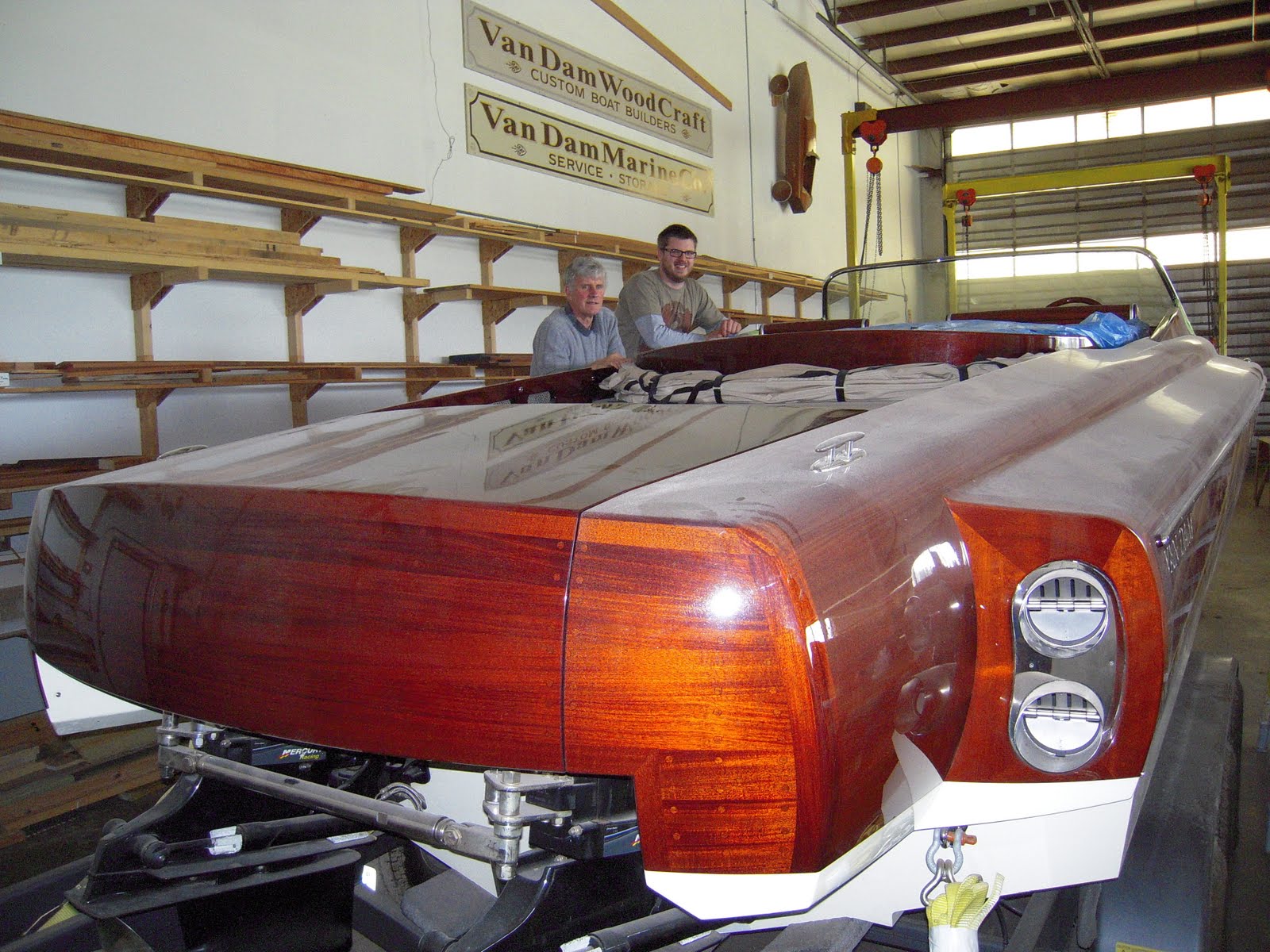
Thor led us on a quick tour of the Van Dam Wood Craft shop where top-end, classic boats are built for clients all around the country.  At this time, many boats were in the completed stages and were ready to be delivered.   One classic runabout restoration project was in progress, and a new hull would be started in the coming week.   These products are breathtakingly fine in line and workmanship, gleaming even under the light coat of shop dust.  From the Van Dam shop, we rounded Boyne Lake and Lake Charlevoix by way of the Ironton cable barge (four car capacity, four hundred yards distance), through the town of Charlevoix, rounding the north side of Boyne Lake into Horton Bay, where we stopped at the Red Fox Inn.

Thor and Tom feign enthusiasm
as I eagerly await encounter with
a Hemingway relative in
Horton Bay.


Typical top quality Van Dam custom craft


The lights in this old hotel turned museum/book store/shrine-to-Ernest Hemingway were burning brightly, and we heard footsteps as upstairs someone got to their feet and clomped down the steps to the former hotel dining room.

I had met James Hartwell before, the present day owner and descendent of the first hotel owner  (it is said by James Hartwell, among others, that Ernest Hemingway was taught to fish by this man.)   Books, magazines and mementos mostly honoring Hemingway were on display or for sale.   James remembered me - or remembered having talked about Washington Island, anyway - from my visit several years earlier.

You need a fair amount of time to catch up on all the news with James.  The new tidbit divulged this time was that it had recently been established, beyond a doubt, that James was actually fifth cousin to Ernest Hemingway.   As my two traveling companions excused themselves from the store, I carried on as polite listener, eventually purchasing two Hemingway books.   There is something about the old hotel and the former general store next door with its doors still open, and the enthusiasm of James Hartwell, that easily takes one back to an earlier time, the early 1900s, when families like the Hemingways spent summers in the north of Michigan, after taking steamers and trains to those rustic retreats far removed from Chicago.  Too, there is the literary connection that is fascinating.

We had a great dinner at an Italian restaurant, newly opened by acquaintances of Thor's, then packed some rhubarb from Thor's garden plot, and we headed back toward the Straits.

Big U.P. - Not nearly enough time

We did our best to cover as many points of interest as possible, and yet we hadn't scratched the surface as we headed back toward Escanaba on U.S. 2 Sunday morning.  We had an early start from St. Ignace which allowed us a quick stop at Big Springs, along the west shore of Indian Lake near Manistique.  The barge on cable, powered by its passengers turning the wheel, floats over the heart of the natural springs, clear waters 25 or more feet deep.  It is an out-of-the-way place, as nearly all U.P. places seem to be, but reward is found again in these locations with beauty, history, and an element of pleasant surprise.   Tom and I were half the tourism compliment floating across the springs that morning.

I couldn't pass up this opportunity to detour southward, toward point Detour, down the Garden Peninsula through Garden, with a quick stop at Fayette State Park and its beautiful Snail Shell Harbor.   It had been 40 years since I'd last seen the old company town buildings there, and the Michigan Parks people have done a great job of restoring and providing interpretive signage.   Fayette is another unexpected gem, and it takes a few hours of time to see it properly.  We did it in 30 minutes, but as I told Tom, "We're stopping, because you never know if you'll get back here again."

As it was, the next five hours included just two stops, for gas and food.   Otherwise, it was continuous driving from the peninsula that resembles Door County - minus people and tourism development - and I just made the 4 o'clock ferry at Northport with minutes to spare.  The car Trip Odometer showed 1000.1 miles at the top of the Sister Bay hill.  When we arrived in his driveway, Tom and Gunilla's home was quiet. All guests had left, and Tom planned to go for a late afternoon run while Gunilla would walk on a favorite  Liberty Grove back road.

This 2011 U.P. Reunion Tour had been nothing really special, but yet everything was special about it, including the memories we added to our first trip.  There would be no follow-up commemorative CD, no final Madison Square Garden bash.  Only this blog.

The gold crowns?   They're in great shape, still protecting the tooth under each crown.  Only one crown came off in thirty-five years, and Tom replaced it with modern epoxy.  I estimate that each crown is responsible for successfully aiding the ingestion of tons of food during those years.  I have Tom to thank for that handiwork.

  -  Dick Purinton


Tuesday, June 7, 2011

DENTAL OFFICE IMPROVED; ISLAND EYE CARE BLURRED

Dr. Tom Wilson, island dentist, monitors progress as Jesse Messersmith (L)
and Paul Sefcik (background) of Patterson Dental completed
installation of new equipment Monday afternoon.


Washington Island, Wisconsin -

The island dental office has undergone a facelift, and despite the disarray of tools and equipment Monday afternoon, technicians completed the installation before the 5 p.m. ferry.  As a result, Dr. Tom Wilson arrived by ferry from Sister Bay this Tuesday morning to open his office for patient appointments.

Thanks to the many island organizations and individuals who donated toward this project, new equipment and cabinets were installed from Patterson Dental.  These items included a left/right delivery system (water, air, suction), an operatory patient chair, doctor's stool, a pivoting light post, tubing and valves.   Just prior to the arrival of the new equipment, during a routine examination, Dr. Wilson noted that the X-ray head had failed.   Timing being what it is, that, too, will be replaced within a week's time by a new unit.   Total cost, once the entire project is completed, will approach $23,000, which is the sum accumulated through donations and memorials.

Immediately following Memorial Day Monday, the dental office was closed while Town of Washington crew painted, installed new carpeting, and assisted with relocating plumbing.  Tony Young of Tony Young Electric, Inc., modified wiring to accommodate the new equipment.

Tony Young (L) and Steve Beekman
assisted with modifications early Monday
morning to receive
 new dental office equipment.
This dental office upgrade is the first major improvement in some 38 years, dating back to when Dr. Wilson began his practice on the island.  The Island Medical Memorial Fund, Inc. hopes this remodel will serve Dr. Wilson's needs in the near future, and that of his successor at such time as Dr. Wilson retires.

Island Optical Care Currently Not Available

In February, Optometrist Dr. Paul Filar of Sturgeon Bay informed the Island Memorial Medical Fund Inc. and his island patients by letter that he would not be traveling to Washington Island this summer for appointments.  His letter cited the commitment of time, travel and expense for his weekly visits here, and the need to balance his time between career and family.

It was not clear whether this was intended as a temporary break in island service, or if this would mark the end of a long, approximately 35-year, relationship begun by Dr. Filar's predecessor and former partner, Dr. Richard Weisner.

Dr. Filar wrote that "...it is very hard for me to take a break from this service - I do not like to disappoint people."   He also stated "...at this point, this decision only extends to this summer; we will see what the future holds.  Thank you very much for all of your support over the years, and I hope to continue to maintain a positive working relationship with you."

In lieu of traveling to the island to see patients, Dr. Filar has offered several benefits for island patients who wish to have eye care appointments through his Sturgeon Bay clinic.

Following discussion regarding Dr. Filar's letter, and noting the many years of providing consistent, supportive eye care for the island, and while not wishing to close the door on the possibility that his service might be reinstated, the Island Memorial Medical Fund committee did opt to find a replacement for continuation of service as being the best possible outcome for island patients.

Finding a new provider for island eye care would be challenging, it was acknowledged, but the Committee wishes nevertheless to open the door to possibilities.   If there should be knowledge of a professional who might fill this need, please contact any of the following members of the Island Memorial Medical Fund:   Marlene Mann;  Joan Blair;  Charlotte Hansen; Leon Shellswick;  Dick Purinton, as well as the Town of Washington.

 -  Dick Purinton

Monday, June 6, 2011

INDULGE ME, PLEASE

Legion Color guard and bagpipers lead procession from
Bethel Church
to the Island Cemetery and School House Beach.

Washington Island, Wisconsin -

Memorial Day came and went, and how the past week has flown by.   I'd like to offer a few photos to show what's been happening, beginning with the procession to the cemetery following the program in Bethel Church.   Lt. Col. (U.S. Army, Ret.) Bill Nauta, an island resident and soon to be Legion Post Commander, addressed the audience of several hundred people, focusing on his Army career, especially his years spent on staff at the Pentagon.  Before Bill spoke, selected Student Essays were read by contest winners Sophia Hagen, Patricia Hansen, and Maren Schutz (shown below), each of whom provided excellent examples of thinking through the various probable answers to the question, "Is it the proper role of the United States to provide military support to emerging governments around the globe?"  


Enough With the Painting, Already!


Spring and getting ready at the Ferry Line are synonymous with painting and inspections.   (Two ferries will undergo U.S. Coast Guard annual inspections tomorrow, June 7th.)
We completely stripped the outer decks of the ferry Robert Noble this winter and primed them, then waited for several months for warm, dry weather to lay down the Sherwin-Williams non-skid. This product goes on nicely when temperatures are 60 and up, the likes of which we did not see until very late May, just a few days prior to Memorial Day Weekend, in fact.   Here Pete Nikolai goes ashore for more paint.  A huge job for five or six men over a two-day time period.  We hope this paint job will last 20 or more years, with occasional touch-ups here and there.


Nature Calls


Finer weather has brought out the finery of the woods, in this case a carpet featuring trillium in abundance. (They are now actually in the decline, as other plants and flowers vie for our attention.)   We've had several asparagus pickings, some rhubarb, but with the crunch of spring duties we've not yet prepared for or planted a garden.  May not get to it this year at the rate things are going, which would be a shame when late August and September come around, and we start to miss home-grown tomatoes and cucumbers and squash.

We did play a bit this weekend by taking a slow canoe paddle into the bayou.  Mary Jo thinks she saw several snapping turtles, just their heads poking out from under root masses in the back waters.  Minnows and bass nests everywhere, and carp in the deeper water just outside the bayou.  It was a fine time to look up close at nature.


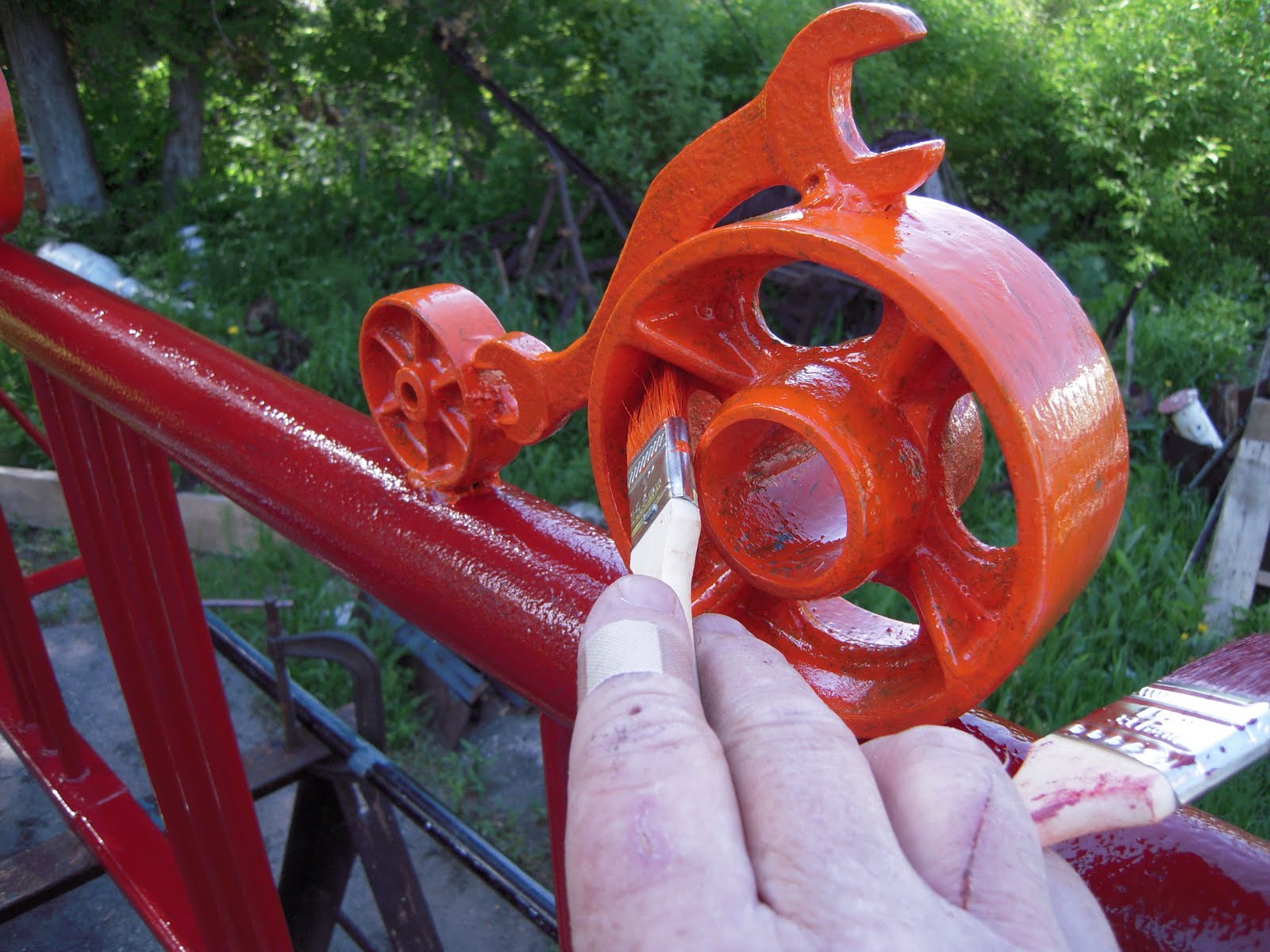
And speaking of work that doubles as play, I spent most of Thursday and part of Friday (the part that wasn't raining) building a bike rack for the Northport Ferry Terminal.   To date, bicyclists have just leaned their bikes against the large stones, which I guess is alright if it isn't a $2000 model Trek.   Well, I'm pleased to have completed, along with special welded do-dad sculpture on top and a paint job to match, a bike rack that is nothing if not an original.   I copied basic dimensions from a commercial rack we have on the island, using iron, steel and galvanized pipe found in our metal pile behind the shed.  I'm proud to say, not one piece was purchased.  Most pieces were destined for the scrapper's pile, anyway.  A few nicks on the fingers later (I had lost my gloves temporarily and did the cutting, welding and grinding without any) and a few splotches of bright paint show as the final touches of paint are applied.


With that, my backlog of photos too good not to use, but not useful enough for a stand-alone story, is back to square one.

 - Dick Purinton

National Geographic Piques Interest

When it was the only highway bridge across Sturgeon Bay, the Michigan Street
Bridge was struck by the freighter Carlsholm in October of 1960.  Now, with
two other bridges across the bay built in recent decades, this bridge
is a commercial navigational obstacle with debatable highway value.


Detroit Harbor, Washington Island -


A few readers may have mistakingly assumed that the title of this entry containing the words "National Geographic" is a follow-up to my previous entry about turtle peeping, but it is not.

Recently, I perused the April issue of National Geographic on my iPad, and the photography as always was terrific, and, I would even say the photos were superior to the printed magazine format.

Miracle Above Manhattan was the story that caught my attention.  It's about how an abandoned railroad spur, the mile and a half High Line in the Chelsea neighborhood, once overgrown with trees and weeds, an unused strip of railroad trestle and right-of-way that runs smack through the heart of Manhattan's residential and business neighborhoods.  This section of track 25 feet above ground now offers a safe and sought-after elevation with spectacular panorama of river, sky and surrounding city lights.

Mayor Giuliani had wanted to tear it down, but a group of passionate New Yorkers persisted.  They were responsible for transforming this section of abandoned commercial track into useful, artful public space.  They weren't different in their passion from the local, Sturgeon Bay group who went by the moniker "Save Our Bridge," who organized to help popularize, memorialize through registry, and save Sturgeon Bay's aging but surplus downtown bridge.  But that New York group envisioned transforming the unused structure into a linear combination of parks, gardens, rest spots and social venues.  This feature has become a regular destination for thousands of New Yorkers and city visitors.  The Geographic photos showing people enjoying this strip of elevated green are stunning and convincing.  A quote from the article: "From the day the first section of the High Line opened in June 2009, it has been one of the city's major tourist attractions..."

Why couldn't a similar plan have worked for the Michigan Street bridge in Sturgeon Bay by utilizing the outdated, and for a time condemned, bridge structure not as an actual bridge, but as a focal point for recreational activities?   This transformation would have been unique - I've never heard of this being done elsewhere - and it would have saved state taxpayers millions in rehabilitation dollars,  dollar already spent to beef up the structural supports, to reconstruct the draw equipment, and to paint the bridge from one end to the other.   There will undoubtedly be future expenditures to maintain an 80-year old bridge structure as a certifiably safe highway bridge.

An essay in my book "Bridges Are Still News," (Island Bayou Press, December 2010 - $16.50) suggested an option similar to the Manhattan railroad project by keeping only the "stubs" or piers, one on  each side of the bay.  To my knowledge, such an idea was never considered.   Had the bridge been abandoned, the center spans could have been removed to improve shipping navigation.   The piers or bridge stubs would have provided significant public space for music, food courts, sidewalk art, sightseeing, fishing, attractive plantings and benches...a waterfront vantage point that would have made them a noteworthy destination.

The uniqueness of the rusted, riveted rail trestles shown in the Miracle Above Manhattan article is not unlike that of the riveted girders of the Michigan Street Bridge.   Both were built during times when  steel design and construction were vital to industry and commerce.

When the current restoration work is completed on the Michigan Street bridge, the structure may be serviceable for several decades with minimal work, so for readers this blog might seem like whistling in the wind.  But there ought to be consideration by a future generation when the subject of maintaining a National Historic monument vs. cost to maintain comes around once again.

In the meantime, the old bridge is still closed to traffic (going on for what seems like several years, now) and until it is reopened to vehicular traffic, nearby businesses will continue to suffer the side effects of sandblasting and painting, the Christo-like canvas curtains, the rows of orange construction barrels, and the resulting lack of consumer traffic to their businesses.

For all of the dollars spent on this bridge to date during reconstruction, the City of Sturgeon Bay could have entered a period of bustling economic activity.  The "bridge-stubs" could have become a grand provider of foot traffic for those same business that have folded or are suffering for lack of access to their doors.

  -  Dick Purinton

Monday, May 30, 2011

VISITOR CENTER AT NORTHPORT PIER


Northport Pier, 215 State Hwy. 42, Tip of Door Peninsula -

A Visitor Center has opened within the terminal building at Northport, a space that had operated the previous 25 years as Northport Pier Restaurant.

The dining room tables and chairs have been replaced with display kiosks for photographs, information and literature related to Washington and Rock Islands and the islands of Death's Door.  This shift in direction may surprise some visitors, especially those who recall memorable meals served at the Northport Pier Restaurant over that time period, but according to Hoyt Purinton, Ferry Line President, the new direction in the face of ever-declining restaurant activity is meant to support island tourism as a whole.

"This building had been designed and zoned for use as a seasonal restaurant, and over the 25 year span of operation it had a base of loyal customers," Purinton said.  "But, because it was not economically successful, and because we believe we can do a better job marketing Washington Island, we've decided to be creative, and a visitor center, rather than some other venture, seems the best fit.   This has come after considerable discussion within our company, and with the Washington Island Chamber of Commerce, with whom we work very closely."

The Ferry Line began the transformation process last winter with new paint and new carpet, the addition of display pedestals, new signage, and footpaths for easier access.   The transformation became reality on opening day, Friday May 27.   Marge Frank, representing the Island Chamber, and Christy Davidson of the Ferry Line were hosts, and they answered questions from dozens of curious visitors, some who simply wound up at the northern end of Highway 42 looking about for more information, and those vacationers with weekend travel plans already in hand.  While dining is no longer available, coffee, tea and snack items are, and the atmosphere is intended to invite travelers to stay awhile, to absorb this northern Door County experience, to view the Death's Door Islands and ferry activities with guest binoculars, and to contemplate an island visit at a future date and time.

Island Chamber Hostess Marge Frank 
Several gallery-worthy displays will be featured.  Outstanding island landscape photography by Lucas and Heather Frykman will be the centerpiece.   A 4 x 6 oil painting by Eric Brodersen depicting an island nature scene will occupy the east wall.  And Sievers School of Fiber Arts, Friends of Rock Island, and Friends of Plum and Pilot Islands will each feature their unusual, out-of-the-way experiences.

The Visitor Center intent is to market the island experience in both a direct way such as passing on literature for motels, restaurants and attractions, but also to pique the interests of travelers who might be birders, photographers, or people who are simply curious about natural history found in these islands.  It has been the aim of the Island Chamber of Commerce and the Ferry Line to ensure all information hosts will have earned the Door County Visitor Bureau's Certified Tourism Ambassador qualification, and as such, informed assistance will be offered with any visitor's question, not only those related to Washington Island, but questions relating to our neighboring communities and Door County as a whole.  

Northport Visitor Center hours of operation will be daily until mid-October, 9:30 am to 3:00 pm.  A large, self-help display with literature will always be available after-hours in the ferry terminal lobby, open during daytime hours of ferry operation.  Short-term Visitor Center parking is available near the entrance, and there are more than two-hundred spaces available for general parking for both ferry riders and those who wish to walk out on the pier to observe ferry activity and the Death's Door scene close at hand.

   -  Dick Purinton
Saturday, May 28, 2011

Turtle Frenzy Surveillance


Detroit Harbor, Washington Island -

It is springtime.   It is near sunset, and we've had one of those precious few days in mid-May with the sun bright overhead, unblemished by clouds.  The air temperature warmed to 60 degrees by the early afternoon, and what breeze there was settled to a whisper toward twilight.

We walked in silence so as to not scare the wildlife, my wife and I, to the docks of the bayou, a small estuary of Detroit Harbor that is filled with a variety of bird, reptile, and other animal life.   We carried a pair of binoculars to better observe these creatures:  a large muskrat chomping on the roots of rushes along the bank;  eagles, both soaring and perching on trees on Suzie's Island;  a great blue heron stalking the reeds for supper; an egret; a swimming water snake (makes my wife shudder) breaking the calm surface with its wriggling; carp rolling about; and fornicating snapping turtles.

It is the mating turtles we've really come to see!

Picture snappers the size of your largest inverted kitchen turkey pan - or maybe the microwave (some appear to be 30 inches across the shell).  Two turkey pans bumping and grinding, changing partners, chasing away suitors or competition.  It has to be an enjoyable moment for them, the turtles, doing what they are meant to do in the springtime.  I am not easily relating to the subtleties of mating in smelly muck and ooze, but I have an idea of how the strength of procreation may overwhelm a pea-sized brain.  For these several weeks, this is all they seem to care to do, with activity levels peaking when it is sunny and warm and calm.

This is the estuary primeval, the Bayou as we call it.  And it is these snapping turtles we've come to appreciate, huge snappers recently emerged from the muck and ooze of this backwater, at first carrying scads of mud and moss on their backs.  For at least the past five months, if not six, they've lain dormant, hibernating beneath the mud, immobile until water temperature warmed enough to stir them.   And then, instead of searching out food for their first activity, they expend energy mating.

If you've seen photos of the Sydney, Australia, Opera House, imagine how it would look down-scaled and brownish-green in color, with perhaps a turtle head or tail stretching outward.  This is the sort of repeated scene we observe in the bayou during the first several warm weeks of spring.  Mating boulders, is how it appears from a distance.  Moving rocks, shell on shell.

Action is everywhere, in the shallows of the muddy bottom and in the warmth of sunny humps of grass.  This activity piques our human curiosity.  We humans have rituals of our own, but turtle mating is far removed from the familiar white sheets covering man-made, cushioned platforms.  How do they know, these creatures submerged in mud, when it is time to emerge, which other turtles are accepting, when enough is enough?  Normally slow-moving creatures, they now roil the waters in their passion, showing quickness and bursts of energy either in pursuit of or escape from one another.  The disturbance of the peace at times resembles carp rolling in the shallows, their backs above water, another activity that will also take place here but at a slightly later time when the water is even warmer.

Finally, after a few weeks have gone by, on another sunny day when I am watching from shore, first one turtle, then two, swim from the estuary, large dark shadows just beneath the surface, heads the size of my shoe occasionally breaking the surface for air and a look-see.  Maybe these turtles are out to find food, but more than likely they are females dispersing to find a place on shore to lay their eggs, where they dig deep pockets in gravel or sand, preferably a "nest" that will benefit from the warmth of sunshine.  Often times, chosen locations are in the middle of graveled drives or roads, where the females (and I would presume their hatched offspring) may be in peril from the tires of passing vehicles.


How to observe this better!


We have a pretty fair pair of binoculars, and we often have them with us when we take our "nature" walk, but then we've had to share the one pair.  So, in advance of Father's Day (always helps to have an excuse) I ordered another, more powerful pair, easy to focus and waterproof.  There are several internet sites that recommend brands and types with user ratings specific to certain activities.    Although I didn't find binoculars specifically manufactured for the purpose of turtle peeping, I thought I would double-up with birding recommendations, and so the type and pair I selected, for $159, are really for birding.  They arrived one day after my order was placed, with free shipping!

From our kitchen table we can now see effortlessly across the harbor.   Watching bird and turtle activity will be much improved with this pair of field glasses.  I attached the neck strap (it also comes with a harness strap to keep them from swinging when running away from snakes or aggressive turtles.)   They are from a company based in Omaha, Nebraska, a state known for its sensible, down-home folks who are not usually known for kidding around.  (Think of Warren Buffett, financial tycoon with a dry sense of humor and stoic bridge player.)

Here are the unabbreviated Warnings listed on page one of the five-page pamphlet:
(reprinted here verbatim) 


   *  Viewing the sun can cause permanent eye damage.  Never look at the sun through your binoculars.
   *  Never use your binoculars while walking amongst obstacles (i.e., rocky fields, wooded areas,  
        children's playrooms).
   *   Inappropriate use due to a lack of common sense may result in product damage or personal injury.
   *   Objects in binoculars may be farther away than they appear.
   *   Not intended for human consumption.
   *   Running with scissors is dangerous.  Never run with scissors while using binoculars.

Perhaps the binocular company was concerned about persons with severe sight impairment using their product, mistaking the eye caps for Oreo cookies, etc., etc., or maybe this is just good Nebraska humor to test if we've read the fine print.   (We have!)

Positives for this product include:  they seem to work very well, and their magnification should provide many pleasurable hours of viewing turtle intimacy;  and, my new pair comes with an almost unheard of 25-year warranty.   If they perform as well as I think they will, I might suggest they consider Turtle Observation as a new marketing niche.

 -  Dick Purinton

Thursday, May 26, 2011

TRUEBLOOD PERFORMING ARTS CENTER ALMOST READY


Main Road, Washington Island, Wisconsin -

Remediation work on the Wilson and Carol Trueblood Performing Arts Center, referred to locally as the TPAC, is nearing completion.   The above photo shows installation of the metal water barrier on the west and south sides of the building.  As of this entry, only the topmost portion of the curved wall awaits metal siding.

This week marked a significant juncture for the TPAC facility and for those persons directly involved with remediation work being done:  during a site visit Monday, State of Wisconsin Building Inspector Jane Drager approved all work done thus far.  Red tags that denied occupation of the building since November 2009 were lifted, allowing limited access to the building's interior spaces.  

The TPAC building is now deemed not only safe and sound, but also much improved, owing to the extensive renovations. (See March 15 and March 24 blogs for additional detail.)

Once structural supports had been improved, the obvious changes took place on the building's exterior, first four-inch thick vertical foam panels, then the painted, corrugated steel, exterior wrap.  It is anticipated the project engineer and the State Building Inspector will meet in approximately two weeks to conduct a final inspection of remediation items, and with that a formal close to construction and a welcoming for public use once again.

This past Wednesday evening, May 25th, TPAC Building Committee Chairman Bill Norris and committee member John Chapman addressed an audience of twenty or so specially invited guests that included members of the Town Board, the TPAC Board, and the TPAC Building Committee.

Basic remediation highlights were described for the interior and exterior.  Thorough cleaning - wire brushing and vacuuming - preceded the recent painting of all interior block surfaces by Mike Remke, Tom Jordan and crews.  (These surfaces were previously unpainted.)  Not only has the painting improved appearances both in the audience chamber and backstage, the process helped to further eliminate lingering prospects for mold or mildew.

Building manager Emmet Woods pointed out the two new sets of interior doors with special elongated hinge plates.  These new doors have fire ratings that are fully compliant, and the extra hinge dimensions now permit folding the doors back 180 degrees, against the walls, for easier ingress/egress.

Bill Norris points out new TPAC support columns.
Back stage, a question was asked about the stage floor plywood having been warped and needing repair or replacement.  But the plywood flats that had previously shown a signature waviness had improved, according to John Chapman.  He noted that since water runoff at the building's perimeter had been addressed, seepage into underground ventilation ducts had been eliminated.  The result is that the atmosphere inside the TPAC has greatly reduced in humidity, and the stage floor has gradually leveled on its own.

The difficulty of covering a curved outer wall with linear "super-rib econolap" was described by Chapman, and we were shown the patented, seamless corner pieces supplied by the manufacturer to ensure a total waterproofing characteristic.   This special metal siding comes with guarantees for both paint and for waterproofing.

The tour of construction highlights moved outdoors to observe details of the completed east, north and south walls, where numerous supportive comments were overheard regarding the job well done by the Building Committee and the contractors involved.

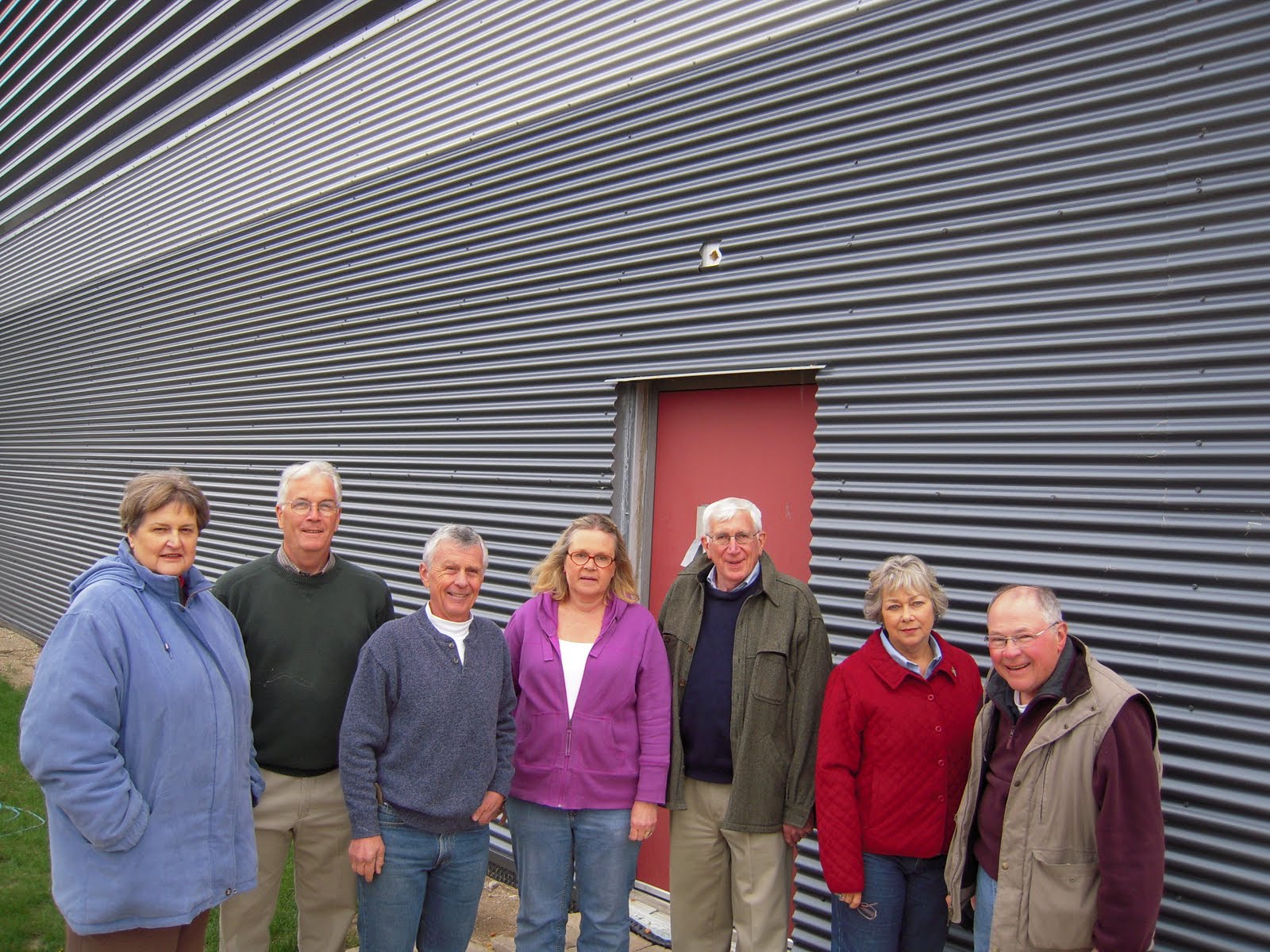
TPAC Board Members present were, L to R:  Joan Kuhn; John Chapman; Bill Norris; Mary Andersen;
Doug Straus, President; Jackie Rader; Jim Morris


TPAC Building Committee Members present were (L to R):  Dick Clancy;
Terry Foster; John Chapman;Bill Norris; Doug Straus;
Julian Hagen; Mike Berger.    

-  Photos and article by Dick Purinton

Wednesday, May 18, 2011

ISLAND WEATHER OBSERVERS


Washington Island, Wisconsin -

Several times this winter a sheet summarizing Washington Island weather data appeared at our Ferry Line office front desk, delivered, I later learned, by John Delwiche.

Interested in following up on what constitutes an official weather observer, I later learned that both John and his wife Anne have the title Weather Cooperative Observers, meaning they have officially been recognized and given responsibilities in observations by the National Weather Bureau office in Green Bay. Their data is captured by computer at the Green Bay office, which then feeds in to a much larger national data bank of weather observations.

Becoming a National Weather Service Cooperative observer volunteer requires the following, according to the Cooperative Observer Program website:
  * Dedication to public service
  * Attention to detail
  * Ability to learn and perform daily duties
  * Willingness to allow NWS to place measuring instruments on your property
  *  Willingness to allow at least one visit per year from a NWS representative

I had briefly met Anne and John once or twice in the past several years, but I took this opportunity to learn more about them and their role as volunteer weather observers.

John is a retired mechanical engineer who began with Larson Canning in Green Bay, but spent much of his career at one of the paper mills.  He and Anne live in a very comfortable, recently constructed home along the island's East Side Road.  Through ample window openings in all rooms they're able to pursue their hobby of birding (and many birds were about while I was there) while enjoying the fantastic views of surrounding fields and sky.  A number of bird feeders were on poles a short distance from their home, and near the top of the rise at the far end of the field was a metal tower.

Birding and weather observations are related pursuits, and the Delwiches had in the past participated in recording weather observations using a basic home weather set as volunteers for Project Feeder Watch, in which their bird count and type and weather data contributed to a larger collection of data.

But it was the new and different environment with its temperature swings and winds that captured John's interest, combined with the chance opportunity in late 2008 to take over duties from retiring Observer, Don Cunningham.

A significant nudge toward observing weather an official capacity was the fact that Anne's father, Herbert H. Bomalaski, was a meteorologist for the National Weather Bureau for 41 years and head of the Green Bay Weather Bureau office for many of those years.  Fifty years ago this March, according to the Green Bay Press Gazette, Mr. Bomalaski received the Meritorious Service Award from the Secretary of Commerce for his studies in "Growing Degree Days."  His contribution codified temperatures during the growing period for vegetables, providing a system of predictability for both canners and growers, and his work was credited with saving the industry here and abroad thousands of dollars.

It is fair to say, then, that both Anne and John take great pride in their role as official Weather Cooperative Observers.

Viewing web postings for National Weather Cooperative Observers across the nation (some are institutions, but many are generational family members) I found that the appointment of a local weather observer often leads to decades of volunteer reporting.  While this may not always be the case, the record speaks to the general class of people who become observers for reasons of occupational interest, hobby, or curiosity about the environment, and then dedicate time and effort toward capturing numbers for our federal weather agency.  

John's tower was originally intended as a future base for his amateur radio station antenna, but it currently supports several weather instruments.

"I wanted a much higher tower for my radio station," John said, pointing to several tower sections lying in the field near the house, "but the government standards for recording wind are very specific.  Instruments must be 33 feet above ground for the anemometer, no more, no less."

Other recording instruments such as rain gauge and temperature gauge are mounted on pedestals nearer the ground, within one hundred feet or so of the back door.  The siting of these instruments had to meet approval by the Green Bay field office for the National Weather Bureau.

Neat, hand entries into a log of weather data, and the installation of two indoor analog gauges for wind direction and speed in a vintage upright radio cabinet, further revealed the meticulous nature of these two weather observers.

An exception to "meticulous" might be the wire Anne pointed out, laughing, that John strung from the the rear of the radio cabinet gauges to a bedroom loft above one end of the room.

"I wanted wind instruments badly, and I pestered the hell out of them," John said.  "The National Weather Service has gone digital with gauges at their offices, so these analog gauges became a surplus set. They were formerly at the Rapid City, SD weather station."

As far as John was aware, few Co-op Observers are issued wind instruments, but in this case, the U.S. Coast Guard had first chance for such equipment and they expressed interest in capturing additional wind speed data in this part of the lake.  Had those gauges been digital, according to John, both high and low speeds could then be automatically recorded.  However, since they are analog (with dial indicators similar to an old auto speedometer) John ran that wire from the radio cabinet to a second gauge set in their bedroom loft, one way to monitor peak wind gusts at night during a storm while lying in bed.

 John showed me a stack of old Washington Island weather logs passed along to him, noting the names of several island observers who preceded him:  Don Cunningham;  Gabrielle Daniels;  Marvin Andersen.  There may have been others.

How did he and Anne happen to find their way to Washington Island for retirement?

John pointed across the field toward Island Camping, the privately owned campground on the adjacent 40 acres.

"We came to the island one weekend in July for a HAM radio round-up, and I was so impressed with the capabilities of my small radio from this location.  I could get a signal out to just about anywhere."

It may have been as important that Anne had been enrolled in classes at Sievers School, creating another strong island connection.

Is it the limestone bedrock, or the fact we are located in a large body of water with little outside interference, that makes it such a good place for transmitting radio signals, I wondered?  

"It could be," he replied.  "I'm not sure what it is, but with this little set, it's amazing the reach it has.  I suppose relative isolation may also have something to do with our choosing this location."   

He pointed to the radio set on his living room table, a deceptively small package not much larger than a thick book, maybe 10 x 6 x 3 inches, with a retractable antenna.

John said that he became a licensed radio operator at age 11, but because his voice had not yet changed, when he spoke over the airwaves listeners thought they were talking to a girl.  That caused John to learn code so he could communicate without speaking, and he claims to have used code for his radio communications ever since.  His call sign is K9IY.

John heads to Dayton, OH, this week for a radio operator conference, the largest in the nation, at which both commercial and amateur operators will be present.   While he is absent, Anne will take over weather reporting duties.

 - Dick Purinton

Saturday, May 14, 2011

NEW ISLAND FIRE TRUCK ARRIVES


Detroit Harbor, Washington Island, Wisconsin -

If one didn't know the anticipation for a new fire truck was the cause of all the cars out at the ferry dock Wednesday morning, May 12, the audience might have been credited for watching the ferry land amid a squall of wind and rain.   But recently, including several days this mid-week, heavy rains with wind squalls that spring on eastern winds have been too commonplace to catch islander attention - although I found it hard not to sympathize with ferry captain Ken Berggren as he brought the Eyrarbakki to position despite channel currents and gusts at the end of our island ferry pier during the moment of peak winds.

[Note:  Not having my camera at hand, I grabbed a small video camera to capture the event, then had to learn how to download and process the video and place it in blog format.  For the past two days Google's Blogger site has been interrupted for repairs, this being my first opportunity to try the video posting.]

The Eyrarbakki landed safely, and with several lines secured to shore and diesels thrumming at elevated power to hold the bow in place, the 1985 Pierce fire truck was driven ashore.  This truck is a new acquisition for the Washington Island Volunteer Fire Department, coming from the neighboring Sister Bay-Liberty Grove Fire Department on the peninsula to our south, purchased with $45,000 in donated funds.  

A campaign that began in early October drummed up both political and financial support for a truck that will boost the island's potential to fight fires. Since funds were not budgeted by the Town for that purchase, and given a limited window of availability - a "special neighbor" offer from the Sister Bay-Liberty Grove Fire Department - willing donors met the challenge in a few month's time.   

Specifically, this truck's ladder and snorkel will help to fight fires in structures having metal roofs, structures situated on properties dotted with adjacent trees, sometimes accessed by snaking, narrow drives, and it will offer increased reach above the newer, multi-level seasonal homes that have eclipsed the old time, single-bedroom cottage-by-the-lake.      

This fire truck, designated Engine No. 21 by its previous owner, will retain the same unit number out of superstition and tradition as it enters service on Washington Island.

  -  Dick Purinton


Saturday, April 30, 2011

GETTING ON WITH LIFE


Washington Island, Wisconsin -


The widespread and often complete destruction of homes and businesses in cities and rural areas throughout the south this past week by tornadoes is difficult to comprehend.  

Television footage has shown us what it looks like, but the smells, sounds (or lack of sound) and emotion experienced by those persons most affected can only be imagined.  In so many cases, it appears, homes and personal possessions vanished into the stew of rubble and trash.

Quite frequently, here on Washington Island, we remind ourselves of the safe environment we enjoy, generally free from threats of floods, hurricanes, tornadoes, or forest fires.  We tend to crab about the tourist season, the economy, the level of Lake Michigan, things that do impact our lives but that we can often adjust to until the pendulum swings another direction.

Reality TV and the show "Hoarders" has taught us how debilitating it can be to collect things, and to hang on to them for years, tied not by their usefulness but by the emotional bond we have with them.  Most items, it would seem, have not seen the light of day in those houses jammed with stuff, and the owners would be hard-put to say when they last used or saw a particular item.  But it's there, somewhere, and they know that, and the parting seems too painful, so the item stays, joined and buried by more of the same as days, weeks and years go by.   The accumulation eventually becomes a hazard to physical and emotional health.

This morning, I lightened my own load of stuff, saying good-bye to a teddy bear that had been in a closet in one house after another for some 62 years.   I think I got it as a Christmas present on my first birthday, because it was captured on an 8mm home movie taken by my father.  My mother, bless her, made some clothes for him (it), and I suppose those ties of my early birthday and the clothing Mom added to the teddy bear made it too hard to part with.  So, here I am at 63 years of age, and my bond with this toy...which has not been often viewed during the past 60 years because it was either in an attic or a trunk, is an object I still found hard to part with.   But this morning, the bear is on its way to the compactor at the Island Exchange, then from there to a landfill close to Green Bay, WI following a bouncing ride on the ferry and over highway by trash truck.  

Imagine:  it is harder in some ways to ditch an emotional piece of the past like that teddy bear, than old friends and acquaintances.  That's a screwy view of the world.

Good riddance!  I feel better already!  Did I think tossing that toy stuffed bear out with the garbage would hurt my mother's feelings?   (I won't tell her.  She is 94 and hard of hearing anyway.)

And another set of items also left my sight this morning, via UPS package:   two mementos from sailing days 40 years ago.  They had collected dust and got an occasional review from me when I stumbled upon them, but they will be much better appreciated by members of the Bonneville Sailing School in Utah, where the boat I sailed on now resides and is being restored.

A home run:  Get rid of more stuff, along with the emotional baggage, and that stuff being received by others who may actually use and appreciate it!

A friend who lives in Seattle is going through a similar experience of moving from one home to another and having to sort out, sell, or throw things collected or purchased over decades.   He said, "The ideal situation would be to go through a natural disaster that lets me escape with only my health and the clothes on my back."  

There is wisdom in that thought, the elimination of the emotional process that goes along with paring down our lives.   Although none of us would actually choose to go through the trauma experienced by folks who have lost everything but their lives and loved ones, there is a perverse envy in the fact we see they now have a clean slate, that is, assuming their emotional state will allow them to get on with their lives.

If we believe in prayer, in the transfer of positive spiritual energy, and the wise use of our wealth to help others, it is our wish that in the future we can live without debris and avoid the sometimes painful tripping over our past.  We can replace collected objects and their weight with great hope and prospect for what the future might hold.  

-  Dick Purinton

Thursday, April 7, 2011

MAIN ROAD PROGRESS

Main Road, Washington Island, Wisconsin -

A four-man crew from Nation Roofers, Milwaukee, have made rapid progress with installation of the first stage of the new wrapper system on the Wilson and Carol Trueblood Performing Arts Center (TPAC).

Metal channel of a "hat-shaped" cross section has been screwed to the block walls half-way around the building, and a crew of three men using a second lift device followed up, screwing metal-clad foam panels to that channel framework.

A metal base channel that will accept the bottom of the long, vertical panels was fastened around the foot of the walls the entire perimeter of the building.  Doorways received special treatment, including foam to fill air gaps that might allow heat to escape easily and water shields over the openings.

This project, part of a larger effort to rectify shortcomings found in the original design and construction of the 2003 building, has progressed quickly thus far.   The final wrap of horizontal metal siding will follow the foam panel installation.  The end result will be a wind and water proof exterior, and a gain in insulation value from approximately R-4 to R-24.  

Photos were taken today, April 7th.
              - Dick Purinton


Sunday, April 3, 2011

SPIRITUAL ENCOUNTER?


Washington Island, Wisconsin -

What can be made of a personal encounter with a bald eagle, an encounter in which that eagle seemed to lead me down the road?  

I’ve been wondering what that experience might mean since posting Saturday’s blog. 

Was the bald eagle fascinated with the green 2002 Dodge pickup I drove? 
 
Or had that eagle decided at that precise moment I drove past to dive from a nearby tree, swooping low over the cab where I sat at the wheel, to teach me a lesson?  If so, what lesson?  

Within seconds of overtaking me the eagle took the point position, never more than 200 feet ahead and  never more than 30 feet above the pavement as I followed south toward the ferry dock.

Was it coincidence that the eagle maintained a course over the centerline of the road, rather than vigorously flapping its wings to gain altitude and escape confinement from between the tree lines?  Why hadn’t it peeled off to the right when it came to the opening that was Green Bay Road and flown westward and upward?

My first thought upon seeing a bird overtake me from above and behind had been that an owl had descended, a bird type I’ve often seen sitting or flying along that road.  But this eagle’s white head and leg feathers were soon unmistakable, as was its beaked profile when it turned its neck to look back at me. The eagle alternately glided, then flapped its wings, then it glided some more, casual in its flight, never appearing hurried.

Ego would like me to say that this was my experience, just for me, a special treat because I must be special.   (And, I haven’t yet ruled this out!)   At the very least, Saturday morning I had a curious encounter with a bird.   I also recognize it as having been a singular moment, yet not unlike other special moments I’ve experienced in nature, events that have brought me greater appreciation for the continuum that is life on earth.

I am mindful of the extraordinary experiences people report to have had with pets and with wild animals, sometimes claiming to gaze into eyes filled with wisdom and inspiration, and also with inanimate objects or natural events where truth is imparted related in a way that can be intimate, personal and spiritual. 

I shouldn’t rule out the chance this eagle was in its own way communicating directly with me, and not simply reacting to my chromed pickup truck.  Could it see into the pupils of my eyes, or into my soul, even through the windshield safety glass and my bifocals, as it briefly but repeatedly glanced behind?   
I followed its movements closely, and I had all I could do to stay on the road, using my peripheral vision while taking the Point Road curves at 35 mph.   My eyes were glued on the eagle, and I was reminded of the X-wing fighter scene in a Star Wars movie as the gunships jockeyed back and forth between canyon walls.   If I was being toyed with, it was by a bird that seemed to enjoy its leadership role.
 
Then, after a half-mile of easy flight the bald eagle pulled up its wings in a stall and settled easily onto a large maple tree limb.  It was a high perch, and from there it sat and observed for the next hour or more, moving nothing but its head as vehicle traffic passed below and through the wooded corridor.

At home, later, I read a passage from a book by Steven D. Farmer, Ph.D., titled Animal Spirit Guides (Hay House, 2006).  The passage for eagles included these observations -
      
      If an eagle shows up, it means:
  *  There’s an opportunity for you that you’re considering, and it would be best if you take advantage of it soon.
  * There will be a new beginning in a positive direction following a recent period of strife, one in which you’ve gained a great deal of stamina and resilience.
   * Detach and rise above the mundane so that you’re able to see your life and circumstances with a broader perspective and greater vision.
   *  It’s a time for a great spiritual awakening, one where you experience a greater connection to the divine.
   *  This is an important time to get creative inspiration from the divine, so heed any guidance you receive.
   * Whatever you put out, positive or negative, will now return to you in some form, more quickly than ever.

   If it is a bald eagle:
    * You have an increasing ability to walk between the material world and that of spirit.
    * Dive into inner depths, paying close attention to any visions or inspirations that arise.
You are to call on EAGLE when:
     * You’re caught up in the little details of life and have lost sight of the big picture.
     * You’ve recently had some spiritual insights or revelations and want to integrate them into your daily life.
     * You have to face some major challenge as a result of massive life change.
    *  You’re in a period of struggle or difficulty, one where you get completely caught up in the mundane aspects of your life’s drama.  When an opportunity presents itself and you’re not sure whether to act on it or not.

…and finally…

  If EAGLE is your POWER ANIMAL:
   You’re a very spiritually evolved individual and a born leader, and people gravitate quite naturally to you.
   You’re willing to endure challenges and struggles because you’re confident that you can meet them, and you trust that they’re necessary for your spiritual development.
  Even though you’re an old soul, you must still go through various initiations throughout your life that will ultimately lead you to living a completely spiritually directed life.
  You’re passionate, and have a bit of a temper that you have to watch.
   One of your main life lessons is learning to conserve your energy and apply your focus to what’s truly important.
   You take advantage of opportunities without hesitation and with a strong faith that there will be lessons or gifts that you’ll discover in doing so.
   Pay attention to the sensations in your backbone as an instinctual trigger to be more alert to what’s going on around you.

These lines above used "for identifying and understanding your power animals and spirit helpers" tend to read something like fortune cookies in that many conclusions can be taken from them, but they also contain elements that are truthful and positive about our lives and our relationship with one another and our world.   

So, what do I believe happened yesterday?   Was I a participant viewing a display by an agile eagle, and that was all?  

The bald eagle is a wonderful creature, one small piece of an even more wonderful creation.   My bald eagle encounter caused me to ask questions:  what had I done that morning that was different? Was this a special message for me?  Why did I deserve this experience (instead of the driver in the white Chevy pickup who came along ten minutes later)?  

I believe my encounter was special because this eagle had my attention then, and it still does.

My experience was not a result of driving a green Dodge truck at 10:15 am on a Saturday.  For some reason (whether considered a force, circumstance, coincidence, or miracle) I was connected with this bird.  It floated and glided easily, and it controlled its movement within the narrow confines of the forested roadway, maintaining a comfortable and consistent distance between us.  This bird was having fun.

Was there an eagle spirit in that fun?  I rely on my reflection of events to get a sense of message.   I admit, my experience was far more special than if I had seen a snake or turtle in the road and had swerved to avoid it, or if I had spotted an eagle from afar.  This was intimate and meant for me. 

I believe that the universe is the work of a Creator, and that the bald eagle is one of the more beautiful and cherished of wild life creations.   This particular bird and its timing on an otherwise gray morning has made an impact by its presence.       

What do you think?

   -  Dick Purinton