Showing posts with label Tom Wilson. Show all posts

Thursday, June 27, 2013

ACROSS THE LAKE and OVER THE TOP

Worker on Badger fantail assists 
truck's driver by manipulating
rear unit with remot
e to 
guide turbine tower section.
Manitowoc to Ludington, Boyne City, Petosky and  home...

This past weekend, Island dentist Tom Wilson and I took what is becoming our annual weekend jaunt to Michigan.  We decided rather than touring the Upper Peninsula, this might be a good time to ride the mighty SS Badger across the lake.

Having written about the Badger in this blog column earlier this spring, and knowing her days could be numbered regarding its coal-fired steam engine propulsion, this would be one of those "do it now before it's too late" experiences.

We were not disappointed, in part because of the company we met along the way, and also the treatment while on board that allowed us to see normally off-limits areas of the vessel, courtesy of Captain Jeffery Curtis.

A new direction to engineer the Badger's management of coal ash by-product while underway came as a complete surprise to me when I asked Captain Curtis about the Badger's future.

With its current two-year EPA permit to continue operations using traditional coal-fired boilers, the practice of sluicing coal ash by-product overboard as the ship is underway must be remedied.  Dumping anything "foreign" into lake waters goes against most parameters (although major cities are exempted from dumping millions of gallons of sewage annually).  Ash dumping has been a major contention of Badger detractors, even though the coal ash analysis results have proven them to be largely inert and quite harmless to the environment.  Nevertheless, ship management practices, in order to continue operations into the future, will require a new and different solution acceptable to EPA discharge mandates within that 2-year time frame.  Like others, I had assumed the Badger's new direction might be toward the use of natural gas, rather than coal.  Natural gas, I had believed, would allow the continued use the existing steam plant machinery with small modifications.

Mixed traffic on the Badger's main vehicle deck ranged
from Harley Davidsons to 100-ft.+ tractor trailer unite.
This revelation came, however, when we were told by the Badger's captain that onboard containment of the coal ash was the route currently being explored.  This would mean storage of perhaps several tons of ash from a day's running time, until the vessel moored in the evening and the ash could be off-loaded to waiting trucks or tankers.  The ashes are hot when discharged from the fire box and need to be cooled, stored, and then removed by pumps or an enclosed conveyor from the ship.

We began to see the sense in doing it this way because a minimum of re-engineering would need to be done to the power plant itself.  Coast Guard approvals for such a solution are another matter, but those approvals might more easily be obtained than pursuit of new and more flammable natural gas fuel.  Natural gas has great benefits as a clean and relatively cheap fuel, but regulatory approval still seems a distance in the future.  (See attached footnote regarding natural gas future aboard U. S. domestic shipping.)

Away we go

We were excited to board the Badger, along with Ed Graf of Washington Island whom we coincidentally met in the ticket office lobby after we drove up to the Manitowoc queue.   Besides autos and motorcycles, tower sections for wind turbines that were mounted on long, extended semi trailers waited to be backed on.   These units had an extra set of independently operated steering axles to support and guide the over-sized turbine loads.

Capt. Jeffery Curtis and Ed Graf,
 with Tom Wilson, in engine room.
Of course, that is the beauty of using the Badger service as a short-cut across the lake.  Those turbine tower pieces were manufactured just a few blocks up the street, at the old Mirro Aluminum plant, and they're so big they are nearly impossible to maneuver through or around Chicago.  The Badger, however, loads them effortlessly.  We read where approximately 300 towers are being shipped to a lower Michigan wind farm via the Badger.  It makes a great deal of sense to keep such a ship operating when there is such a variety of vehicles and customer demand for midwest cross-lake shipping.  Loading those trucks took a few extra minutes, but when unloading at Ludington, drivers pulled their rigs off the vessel with ease along with other traffic.

Our ferry trip went smoothly and quickly, and half-way across, rain clouds were replaced by sunshine.   We then drove north to Boyne City to my youngest son Thor's home where we spent two evenings.  Saturday morning we attended the Bay Harbor auto and boat show.  I'm not an expert in such events, but the cars and boats displayed were magnificent, high-end examples of manufacturing and restoration.

Thor inspects Morgan trunk detail at Bay Harbor auto show.


One main reason for attending, other than the anticipated pleasure it would bring to our eyes, was the trunk Thor built through the Van Dam Woodcraft boat shop, then fitted into the rear lid by an area custom auto shop.  After Thor finished the woodworking part of this trunk, Louis Vuitton fabric was added for contrast.  We didn't stay long enough to observe the awarding of prizes, but it appeared the judges were going to have a difficult time choosing a top model when each and every entry was so beautifully maintained, restored and polished to the extreme.

Slot in center of trunk has red LED connected to brakes.
That was the essence of our weekend getaway.  Our return took us over the Mackinac bridge into the U. P.   Despite the sometimes gloomy weather pattern that had hung like a blanket at times over upper Lake Michigan, we're now energized for what the rest of our summer may bring.

Notes on Natural Gas as a commercial vessel fuel:

Almost every maritime magazine today has an article or a news item related to impending vessel conversions to natural gas as a propulsion fuel.

For years, as we understand it, Liquid Natural Gas (LNG) carriers have used the boil-off natural gas from their storage tanks to help fuel their engines as they cross the oceans.  European vessels seem to be somewhat ahead of U. S. domestic vessels in the application of natural gas as ship fuel, but one definite advantage that may help U. S. shippers over time is the increasing supply and distribution of relatively cheap, clean natural gas that is now coming on line.

The Pacific Maritime magazine recently ran a column by Louis Lemos ( June 2013):  Using LNG as Fuel.  Lemos wrote about both the positives and the limitations of LNG.  Lemos, now retired, has extensive credentials, including the British Merchant Navy and the U. S. Merchant Marine as a Chief Engineer, U. S. Navy certified Ship Superintendent, and as a Commissioned Inspector of Boilers and Pressure Vessels.

The tanks that hold the liquid gas, Lemos states, must be heavily insulated to maintain a constant temperature of minus 165 Celsius.  This is to "not only preserve the ultra-low temperature of the LNG tanks, but also to protect the ship structures from the effects of cryogenic temperatures of the LNG."  He then estimates that required ship storage space for such tanks could be as much as 250 percent greater than that required for tanks of corresponding diesel fuel capacity.

Such shipboard tanks are designed and regulated as pressure vessels, with construction rules similar to those of steam boilers and compressed air storage tanks.   Codes are being rewritten today to address such storage and safe shipboard practice by Class Societies, quasi-government bodies that help administer and regulate vessel standards, with guidelines often based on international agreements.  The Class Societies have been expending time and resources for research and technical solutions, and for cost effective methods to improve the safety and efficiency of LNG-powered main propulsion machinery, according to Lemos.

This article contains much more information on LNG applications aboard vessels, and it shows that the possibilities are within reach, but that we're not yet there.  The lack of a ready LNG solution today, along with perhaps staggering refit costs, may have convinced the Badger's management to look to a more expeditious and realistic solution.  -  Dick Purinton

Thursday, June 14, 2012

PIECES

Essar steel mill in Canadian Soo.
Here 'n there -

Tom Wilson, Island dentist, and I went on our second annual U.P. road trip this past weekend, which took us to Sault Ste. Marie, among other places.   Friday evening's rain, much needed in the eastern Upper Peninsula where there have been many wooded acres burned in the past month, gave way to sunshine as we cruised on the upper St. Mary's river in Le Voyageur, a craft operated by Soo Locks Tours that closely resembled our old C. G. Richter.  Not surprising, the Naval Architect was the same Walter Haertel, and the builder for each vessel was Sturgeon Bay Shipbuilding and Dry Dock.

Laker Cason J. Calloway approaches
lock loaded with ore.  Great Lakes Maritime
Academy training vessel follows.


Our weekend tour continued with a drive to the maritime museum at Whitefish Point, then Tequamenon Falls, with time to scoot to Boyne City on the mitten (yes, Michigan has a real mitten shape down-state) and dinner with our youngest son, Thor, at a fantastic Italian restaurant.  This is in the same neighborhood as Hemingway's old haunt of Horton's Bay.

After a night in St. Ignace, we hit the road again for home Sunday morning and stopped briefly in the early afternoon at the Peshtigo Fire Museum.  Over 1200 lives were lost in an evening firestorm, we learned.  I've always wanted to stop at this museum (and did once on my motorcycle, but it had closed) and compare notes with southern Door County's Williamsonville fire of the same date in October 1871.
Williamsonville was a settlement within the Town of Brussels, actually a shingle mill owned by the Williamson brothers.  A much more broad area than the Town of Brussels and parts of southern Door County that were burned on the east side of the Bay, but even more lives and acres were burned in the country surrounding Peshtigo.

We covered a lot of ground in three days, surpassing, by my estimate, the 1200 driving miles we put on during last year's excursion.  Among the memorable sights was Canada's Essar mill.  Somehow, the billowing smoke and piles of raw materials gave me a warm and friendly feeling:  the essence of production with the piles of taconite, coal and limestone, and even more impressive were the enormous piles of slag.  A truck dumped a load of orange, molten slag as we cruised, and exposure to oxygen brought on an eruption of smoke, causing a youngster to point and exclaim to his parents, "Look, a volcano!"  He was right, it had that appearance.

And while that industrial setting may no longer be observed in the U.S. - due to environmental laws and the times, as well as imported steel - there was an endearing quality about this example of heavy industry (with its 4000+ jobs, according to our narrator), and the tangible, finished coils of rolled steel at the end of the pier, waiting to be shipped to customers.

There's a lot to be seen and learned by visiting our Great Lakes waterway neighbors.

May's weather -


Island weather observer John Delwiche dropped off his monthly synopsis for May the other day, and here are a few of the highlights:  
   A record high was recorded of 78 on 05/16, which also happened to be the first 70 degree day in 2012.  I'm not sure if we hit 70 again since then - just kidding - but it has been on the cool side of late.   Our May precipitation total was 1.80".  That figure is less than half the average precipitation of 2.87".   We remain nearly two inches off the precipitation average for the year.

Lake levels, as had been predicted by the Army Corps, fell off slightly rather than continuing to rise, as would be expected up to July, given normal snowmelt and spring rains.

Wisconsin said "No" to Town's application -


We heard via Town Chairman Joel Gunnlaugsson late last Thursday that the Town of Washington's Harbor Assistance Program grant application was NOT selected for approval.   There were other applicants, and we understand that Washington Island did not receive a funding recommendation.  In fact, we were at the bottom of the list.   Where does that leave us, given continued low water and the prospect for perhaps even lower future lake levels?    

We're bound to learn more details during the next week.  A renewed application effort is one possibility.

Eagles eat, too -

Eagles are seen more frequently along these shores, from Rock Island to Washington, Plum and along the peninsula, to the point where sightings are no longer considered unusual.  However, they're still fun to watch and exciting to see, flying or sitting, and part of this has to do with their size and their habits.

We watched six immature eagles, in varying degrees of white and brownish-black feathers, roosting in one tree last Sunday afternoon.  Below them, at water's edge, were three egrets.  And just beyond the egrets was a pair of white (black-tipped wings) pelicans. Nearby, geese swam with their young.

The resident great blue heron had taken the afternoon off, and he was absent from the scene, but neighbor Connie sees him - or her - often, sometimes with a snake wrapped in its bill.

A rather incredible Detroit Harbor sight, all of these birds seen together.

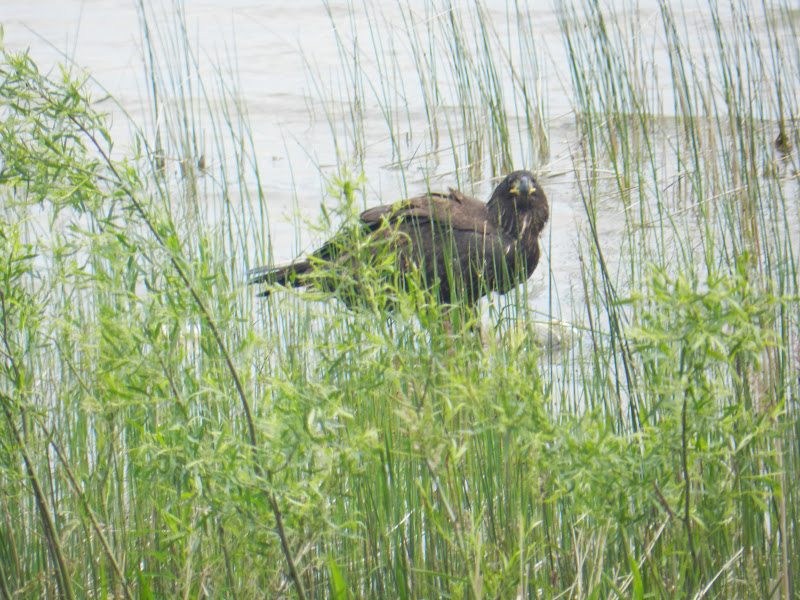
This noon, while eating lunch at our kitchen table, I looked out the window and watched an eagle doing the same, only with a dead fish, among the grasses near shore.  A seagull and a second eagle waited above to claim the leftovers.

It's never too late to get a good pair of binoculars and enjoy spotting these impressive birds.

-  Dick Purinton


Tuesday, June 14, 2011

GOLD CROWN REUNION TOUR

Tom Wilson powers the cable barge across Kitchi-Ti-Kipi Springs
(Big Springs) at Palms Book State Park, near Manistique, MI

Around Michigan With Our Island Dentist, Friend -

The weather forecast for the weekend was to be rainy and cool.  At the Wilson home in Sister Bay Saturday a baby shower was planned for expecting daughter, Erika.  Tom's wife, Gunilla, had invited  lady friends and relations for the party.  It was a weekend made for getting out of town, or off the island, and that is what island dentist and friend Tom Wilson and I did.

Its a current trend among aging rockers to dust off their amps, tune their guitars, and polish their acts before hitting the road with a "reunion tour," in an attempt to ignite yesterday's memories.  In a manner consequential only to us and those we know, Tom and I hoped retracing old tracks and making a few new ones across the Upper Peninsula of Michigan might rekindle memories from our 1976 road trip to the Iron Mountain Veteran's Administration Hospital.

Tom and I became good friends during island winters starting in 1975, days when our winter ferry made only a single round trip. Tom joined Mary Jo and me, and our kids, for supper, TV and an overnight on our couch Tuesday evenings following island dental appointments.  Once the new and more powerful icebreaker ferry Arni J. Richter began its twice-a-day scheduled service in the winter of 2003-04, those overnight visits ended.   Tom for the first time was able to work a short day on the island and then return to his Sister Bay home in the afternoon.  

Our excursion came in late October, 1976, approximately one year after my discharge from the U.S. Navy. During that year Tom completed extensive dental work approved through the VA.  He drilled away brittle amalgam, one tooth after another, then capped my molars with gold crowns.  Before reimbursement could be made, the work had to be verified by a VA dentist in Iron Mountain, MI.

I suggested we make my dental appointment into a two-day trip.  We would drive to Escanaba, stay with Emma Richter for the night, then drive on to Iron Mountain the next morning by way of Paul Richter's hunting camp near Gwinn.  That was Tom's first foray into the heart of the UP.

Kate's Lake


Paul Richter's Camp 55 was named for the distance from his Escanaba driveway to the middle branch of the Escanaba River where his cabin was located.  The way to camp took us on a series of roads that decreased in size from the 4-lane US-2, down to paved, then dirt county roads, and finally, the last stretch was a seven-mile long, straight-as-an-arrow pot-holed grade road.  You had to know where you were headed and have good directions to find it, because you would never stumble upon it by accident, and there would be no one to ask for directions.  This log cabin was well out of normal traffic patterns, seventeen miles from the nearest black-topped road, built in the 1860s as a surveyors cabin at a time when there were no roads.  A set of railroad tracks not far away that served to transport timber to the sawmills ran along a level bed.  That former rail bed is known as Kate's Grade, a 16-ft. wide strip straight through woodland, wetland and thick bush.

When we arrived at Camp 55 on that 1976 trip, it was around 10:30 a.m. of a late October morning.  Wood smoke curled from the cabin chimney as light snowflakes fell.  Uncle Paul was inside, pumping the treadles of his player piano, singing and entertaining himself.  We heard the honkey-tonk notes through the log cabin's walls.  Not only did it feel like we were home, we felt incredibly lucky to have found this oasis amidst the hundreds of square miles of woods, logged-over swaths and swamp.  We visited with Paul for about an hour before we set off again, this time to the west, following a two-track logging trail he guaranteed us would intersect with a black topped road some 15 miles to the west.  ("Take a left on the blacktop road and it'll take you right in to Iron Mountain.")

Paul spent nearly all his spare time at camp, right up until his death, tending a garden, feeding the animals, observing nature, and playing his piano, either alone or as he entertained camp neighbors and friends.

I'd returned a few times in the intervening years, including last September, 2010, when Mary Jo and I rode over that unforgettable, unpaved approach on my motorcycle.  We found the place successfully, after doubting many times if we were on the right track.  When we got there, Porkey and Marlene Prudhomme, who now own the property, weren't home.  So, we left them a note with a ferry schedule at their locked gate, and I followed up three months later with a Christmas card.  This couple had been best friends with Paul, and now they were the caretakers/owners of this forested camp property.

Porkey and Marlene first lived in an original log cabin neighboring Paul's camp, dating to the 1800s.  Their log cabin was used as a school for children of lumber camp supervisors.  It was about a half mile from Paul's camp, and right on the shore of a small lake.  The first teacher had been Kate, and that was how the nearby small lake was named.  In recent years, with an aging cabin and their own age begging for less maintenance, Porkey and Marlene decided to put up a new home where the cabin had stood.

Prior to this current trip, I had mailed a post card to Porkey and Marlene, hoping they would receive it in time to know of our travels.  As it happened, Porkey drove into town the day before we arrived and picked up his mail, so in anticipation of our arrival, he left the gate unlocked at the end of the long lane.  We were met warmly, first by their two little house dogs, then with refreshments, then supper.  We exchanged stories about the two Richter brothers, Paul and Arni, inquired of the Prudhomme's life in the woods, and related Washington Island events.  Porkey and Marlene had visited Washington Island only once, with Paul Richter.   It also happened to be Porkey's first time beyond Green Bay and into Door County.

"What about mosquitos? Doesn't it get pretty bad out here?" Tom asked Marlene.

Marlene shrugged.  "Nah.  We have them, sure," she replied.  "When I slowly paddle the canoe on the creek while Porkey fishes, that's when you get mosquitos.  But I don't let them bother me."

"Any black bears?"  Tom eyed several framed close-ups of bears hanging on the sitting room wall.

"Those bears were at our other camp, before we moved here," Marlene said. "A couple of miles to the west. We haven't seen many here.  But I've seen a moose several times from my four-wheeler.  I didn't know what I was looking at, at first.  Now, moose, they are big!"


A Richter family air-loom is discreetly passed.
"Wait a minute," Porkey said.  "I've got something for Thor from Paul's camp that Thor said he enjoyed."

Porkey went into a bedroom off the kitchen and rummaged a bit before returning with a box.

"Paul's Pet Fart. Thor will enjoy that, Porkey,"  I said.

Tom was already unscrewing the lid, curious to see what was inside the white plastic jar.

This well-used curiosity had brought many laughs in its day, and it brought back memories of other, less-repeatable gags and plaques that made up the major part of Paul Richter's cabin decor.

I took a few photos of the formal presentation before we departed at dusk.  We dodged young snowshoes that had come out to enjoy green shoots of spring grass as we bounced along the seven mile stretch of grade road.  We hoped returning in daylight would help us to make the right choice at each dirt road intersection on the way to the asphalt county road, then U.S. 2, and onward toward the Straits of Mackinaw.  

Mackinac Straits Bridge
Mackinac Straits and Boyne City


The road to the Straits was new territory for Tom.  As it had on Friday's drive, the time and the towns flew by without our notice as the conversation logjam of the past several years loosened bit by bit.   We discussed families, work, politics, the direction our home towns and county were headed, the status of the state and the nation.   When politics ebbed, it was sports and the NBA finals.

Saturday morning was overcast, lower 50s, wet and windy.  The Mackinac Bridge was barely visible in the fog and rain.  At Mackinaw City, on the tip of the Michigan mitt, tourists jammed shops and restaurants to get out of the weather, and the boat docks appeared sparsely dotted with tourists.  The same, slow boat traffic was undoubtedly being witnessed by ferries at home.

One hour after we crossed the long suspension bridge we were at son Thor's home in Boyne City, a small town on the inland bight of Boyne Lake.  Petosky, Walloon Lake, and Horton's Bay are a few of the place names on the route to Thor's home.  These places were an important influence on Ernest Hemingway's youth, later playing a role in his Nick Adams Stories and other works.

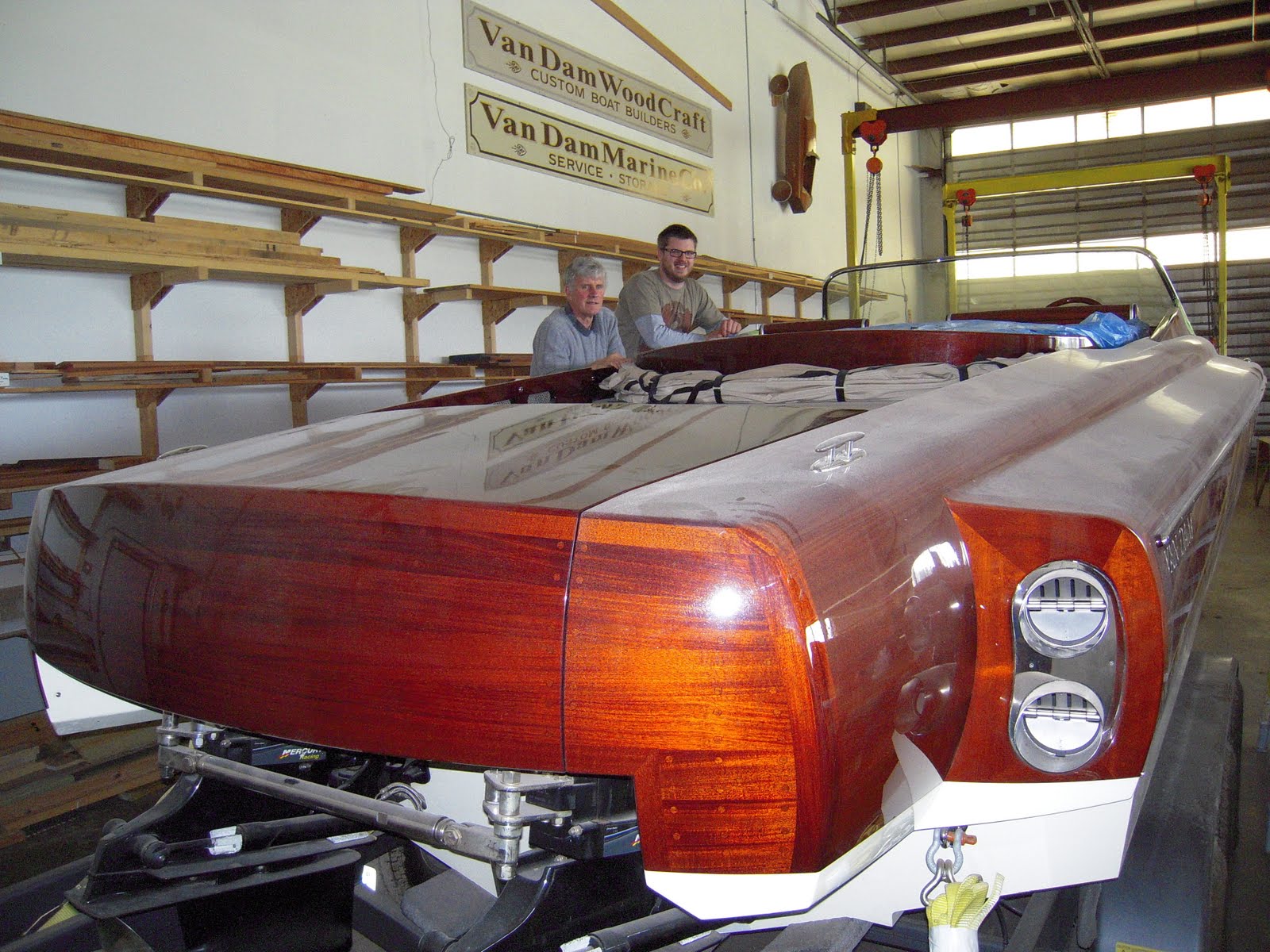
Thor led us on a quick tour of the Van Dam Wood Craft shop where top-end, classic boats are built for clients all around the country.  At this time, many boats were in the completed stages and were ready to be delivered.   One classic runabout restoration project was in progress, and a new hull would be started in the coming week.   These products are breathtakingly fine in line and workmanship, gleaming even under the light coat of shop dust.  From the Van Dam shop, we rounded Boyne Lake and Lake Charlevoix by way of the Ironton cable barge (four car capacity, four hundred yards distance), through the town of Charlevoix, rounding the north side of Boyne Lake into Horton Bay, where we stopped at the Red Fox Inn.

Thor and Tom feign enthusiasm
as I eagerly await encounter with
a Hemingway relative in
Horton Bay.


Typical top quality Van Dam custom craft


The lights in this old hotel turned museum/book store/shrine-to-Ernest Hemingway were burning brightly, and we heard footsteps as upstairs someone got to their feet and clomped down the steps to the former hotel dining room.

I had met James Hartwell before, the present day owner and descendent of the first hotel owner  (it is said by James Hartwell, among others, that Ernest Hemingway was taught to fish by this man.)   Books, magazines and mementos mostly honoring Hemingway were on display or for sale.   James remembered me - or remembered having talked about Washington Island, anyway - from my visit several years earlier.

You need a fair amount of time to catch up on all the news with James.  The new tidbit divulged this time was that it had recently been established, beyond a doubt, that James was actually fifth cousin to Ernest Hemingway.   As my two traveling companions excused themselves from the store, I carried on as polite listener, eventually purchasing two Hemingway books.   There is something about the old hotel and the former general store next door with its doors still open, and the enthusiasm of James Hartwell, that easily takes one back to an earlier time, the early 1900s, when families like the Hemingways spent summers in the north of Michigan, after taking steamers and trains to those rustic retreats far removed from Chicago.  Too, there is the literary connection that is fascinating.

We had a great dinner at an Italian restaurant, newly opened by acquaintances of Thor's, then packed some rhubarb from Thor's garden plot, and we headed back toward the Straits.

Big U.P. - Not nearly enough time

We did our best to cover as many points of interest as possible, and yet we hadn't scratched the surface as we headed back toward Escanaba on U.S. 2 Sunday morning.  We had an early start from St. Ignace which allowed us a quick stop at Big Springs, along the west shore of Indian Lake near Manistique.  The barge on cable, powered by its passengers turning the wheel, floats over the heart of the natural springs, clear waters 25 or more feet deep.  It is an out-of-the-way place, as nearly all U.P. places seem to be, but reward is found again in these locations with beauty, history, and an element of pleasant surprise.   Tom and I were half the tourism compliment floating across the springs that morning.

I couldn't pass up this opportunity to detour southward, toward point Detour, down the Garden Peninsula through Garden, with a quick stop at Fayette State Park and its beautiful Snail Shell Harbor.   It had been 40 years since I'd last seen the old company town buildings there, and the Michigan Parks people have done a great job of restoring and providing interpretive signage.   Fayette is another unexpected gem, and it takes a few hours of time to see it properly.  We did it in 30 minutes, but as I told Tom, "We're stopping, because you never know if you'll get back here again."

As it was, the next five hours included just two stops, for gas and food.   Otherwise, it was continuous driving from the peninsula that resembles Door County - minus people and tourism development - and I just made the 4 o'clock ferry at Northport with minutes to spare.  The car Trip Odometer showed 1000.1 miles at the top of the Sister Bay hill.  When we arrived in his driveway, Tom and Gunilla's home was quiet. All guests had left, and Tom planned to go for a late afternoon run while Gunilla would walk on a favorite  Liberty Grove back road.

This 2011 U.P. Reunion Tour had been nothing really special, but yet everything was special about it, including the memories we added to our first trip.  There would be no follow-up commemorative CD, no final Madison Square Garden bash.  Only this blog.

The gold crowns?   They're in great shape, still protecting the tooth under each crown.  Only one crown came off in thirty-five years, and Tom replaced it with modern epoxy.  I estimate that each crown is responsible for successfully aiding the ingestion of tons of food during those years.  I have Tom to thank for that handiwork.

  -  Dick Purinton