Tuesday, December 13, 2011

Hunt In Iowa - Part II


South Central Iowa -

The second morning, Sunday, began with a clear sky.  Rain had stopped a few hours after the Badgers had beaten Michigan State for the Big Ten Championship, which we watched with a hunting group from Kewaskum, WI.

Overnight temperatures were in the lower 20s, so that the ground began to firm up.  More importantly, the return of cold temperatures helped to get the deer moving about.  Because of the wet 24 hours leading up to Sunday morning, deer seemed anxious to move, returning to more normal activity.

Here are sample entries from Sunday, December 4, 2011:

   By the time the Badgers had clinched the Big Ten Championship vs. Michigan State, the stars had come out and the wind had shifted northerly.  We were more than ready for a night's sleep.  Hoyt had already turned in by 9 pm.   A shower and dry clothing felt like heaven to those who were soaked by the rains.  Earlier that evening while the boys showered and changed to dry clothes, I grilled cheese sandwiches at the stove.  It was pretty basic: hot buttered bread and melted cheese, with beer to wash it down.


 In the morning, I was the last to wake up, a few minutes after six.  My ear plugs had done their job! Hoyt and Thor were dressed and ready to go.   The Kewaskum group had left for their hunting grounds, and so had the pair of hunters from New York, in order to walk to their stands before daylight.  For some, there was a mile or more of hiking in the dark from their truck, by flashlight, to the spot they had picked out within the state forest.  


Hoyt had in mind for us a short drive to start the day, with himself walking in a N/S direction, and Thor and I would post east and west on a ridge above a creek in a small patch of hardwoods.  It was 28 degrees with the slightest northerly wind, and the ground had thankfully hardened after the mushiness following Saturday's saturating rain. Still, the pickup truck made deep ruts in the mud near the access gate, and when Thor and I set out to take our positions, we had to high-step through a creek that was swiftly flowing, deep enough to overtop our boots.  


This same drive produced two does for us last year, also on a Sunday morning by coincidence.  We didn't get a single shot today on this drive, but we did see deer on our way to the stand, and Hoyt spotted several deer, one a smaller 8-pt. buck, while walking toward our position. 


Hoyt and Thor changed to dry socks and boots (which they had the foresight to bring along in the truck), while I followed instructions to walk west, staying downwind of a tree break, paralleling  yet another creek bottom.   I would find a suitable location and stay there for quite an indefinite time. I began looking for a good spot to observe activity, and to have an open shot if the opportunity arose.   


As I approached the margin of the creek, an area thick with brambles and downed walnut trees, I saw a buck with two other deer ahead of me, beyond a ravine covered in dense growth.  I assumed all of these deer were bucks.  The lead buck's antlers were high, wide and white in the bright sun, and the size of the buck indicated its maturity.  It took off at a full run and was followed by the others. They crossed the densely covered creek bottom and in no time at all were high on the grassy slope of the far side, following a fence line that divided the land we hunted from private pastureland of a neighbor's farm.  All deer were at a full run, and they hesitated only once, at the top of the ridge.


With the morning sun low and bright behind me, I walked into the thick brambles to a downed tree that would be my seat and my hunting stand.  After the string of deer led by the large buck trotted along the far fence line, more deer soon trailed them.  Two diverted their direction of movement to a finger of trees that headed back toward the creek I overlooked, east of my position, and too far for me to identify antlers, or for me to shoot, had I been able to determine what they were.  There was also too much brush in between for a clean shot.   


Hoyt and I had Iowa antlerless permits only.  Thor was the only one to hold a buck tag.  


Within minutes, another deer, this time a doe, walked into view on the far bank, also traveling east.  It stood long enough for me to sight the cross hairs of my muzzleloader scope, and for the first time this hunt (and the first time in the field with this new .50 cal. gun) I shot.   The deer stood still, looked around for a few seconds, then it trotted slowly to the east.   As I followed its movement, trying to determine if it had been hit, yet another deer came into sight in the creek bottom, not more than fifteen yards away, its head poking above the steep bank on my side of the creek.   I crouched slightly as I began the process of reloading the muzzleloader, a somewhat clumsy evolution, and I glanced at the deer as it fixed eyes on me.  


Then, it disappeared below the bank, reappearing on the opposite bank where it climbed to level ground and open field, looking back toward me.  I saw two spikes between its ears through my scope.   I watched as it loped in the same direction as the doe I had just shot at.   The spike buck sniffed where the doe had stood, then began trotting off with its nose to the ground.


About 45 minutes later I left my stand, having seen at least eight deer in rapid succession, and I crossed the steep creek ravine to examine the grasses on the far side for signs of blood.  None were to be found, not a sign of having hit my target.  The cross hairs had been right on, but my shot was not.  The distance, looking back to the fallen walnut tree where I had shot, was around 80 yards, and within my range.


I recrossed the ravine, snagging gloves and sleeves in the thorns and bramble, only to see four more deer to my south, running across the grassy slope, alerted by my thrashing efforts.   


   BLIND CHICKEN GETS A KERNEL 
Nearly at my feet where I took my shot, half buried in grass and leaf debris, was half an antler, a shed possibly from the previous winter, with some of the tines showing signs of rodents nibbling them.  This would be my prize for the day, that and the blast of a 12-gauge from over the hill and through the woods, coming from the direction of Thor and Hoyt. 


Thor, changing to dry socks and boots.

[And this from memory...]

The sun went behind clouds around noon, and with that the air chilled. My damp boots and socks required me to stamp about to keep warm.   After a great start to the morning, for several hours I had seen only the neighborhood fox squirrel as it went from tree to tree, chirping down at the orange intruder.  Perhaps he saw his antler snack in my possession on the log.

Around 1 pm, I called Mary Jo to let her know how the day had been going.   While we talked on the phone, I heard a deep shotgun blast from over the hill and through the woods, a 12-gauge sound.

Thor with his buck.
Ten minutes later Hoyt called me to say that Thor had shot an 8-pointer, and he was tracking it to be sure it was down.   While I offered congratulations, another blast sounded.  "Now he's down," Hoyt said.  "Get the truck and drive over our way."

The rest of the afternoon was spent field dressing Thor's deer, and also the antlerless deer Hoyt had shot, not long after Thor got his deer.   We returned to the bunkhouse late that afternoon, pleased with our efforts.  One other hunter staying there had also been successful, shooting a 10-pointer.  As a trio, we had been lucky, and Thor had made a good shot at a deer that was moving away from him.  But Hoyt had carefully guided him in to that spot, so it wasn't all chance.

During our stay at the bunkhouse our host Terry Mothershead, who also guides during the various game seasons and is himself a terrific hunter (as is his wife and son), showed us the fine buck he took in November during bow season.  It's an example of what may be possible, given the right circumstances and patience in the field.

Iowan Terry Mothershead with
antlers that rough-score in the 180 range.


Although we hunted for four hours again Monday morning to fill our two remaining antlerless tags, we didn't get any shooting in, and we went home with Thor's buck and Hoyt's antlerless deer, and my half-set of chewed on horns.  During our stay, we had met other hunters at the camp, swapped stories, and we had watched two terrific football games on TV (Packers beating the NY Giants Sunday evening).

That's why we hunt in Iowa!

Hoyt and Thor, packed up and ready
to head home to Wisconsin.
-  Dick Purinton

Monday, December 12, 2011

WHY HUNT IN IOWA?


Southern Iowa -

I've asked myself, and I've often been asked by others, "Why go to Iowa to hunt?"

Why would anyone want to pay for a permit to hunt deer- and receive a doe only permit - then travel 700+ miles in a truck loaded with gear, then spend the first day in a tent-blind in pouring rain, with virtually no opportunity to see or shoot a deer?

If you are from Wisconsin, it sounds like a good idea.   And if you have two sons eager to hunt, one who lives in Michigan, the other from Washington Island, steeped in hunting knowledge, and who gets excited just spotting deer from the Interstate - and if you'll spend 16 hours in the truck visiting, plus hours  hunting with them - that's time and money well spent!

But, I wasn't quite so sure of myself Saturday, opening morning December 3.

Rain had only begun to fall that evening, and it picked up speed and volume as the day flowed on.  I was assigned to a blind, a kind and gentle effort that distanced mea from the activities of the real hunters, Hoyt and Thor, who would sit in tree stands.  Eight hours later, I was grateful to have had that tent, despite its leaks and drips.  Each hour, I imagined those two boys in huddled on their tree stands, soaked to their long johns, getting soggier by the hour, shivering, suffering out in the open, waiting for the big buck that would never appear because it was too rainy.  Thankfully, the temperature had been a balmy 41 degrees that morning, a saving grace as opposed to 38 or 36 degrees.   I managed quite well, thanks to heavy hunting parka, coveralls and the blessed pop-up blind.

As an afterthought that morning, I placed a small notebook and pen in my hunting jacket pocket, along with shells, gloves, knife and a bag of trail mix.  What started out as a long day went rather quickly, I found out.  Here are sample entries, with approximate time of day:

   Our bunkhouse is situated in hilly, south central Iowa, an area noted for outstanding whitetail deer. Not only are the deer themselves larger than typical Wisconsin deer, the antlers of bucks are larger in spread and thicker in beam.  It's a fifteen minute drive from the bunkhouse where we slept to the private land where we hunt, rolling land which abuts a large, several-thousand acre state forest.  Oaks, deep ravines and adjacent grasslands with small creeks provide good habitat, along with nearby croplands of corn and soybeans.  


Unfortunately, this year's opening morning we awoke to steady rain on the tin roof of the Bar-M.  None of the hunters we stayed with were anxious to get started in the pitch black wetness, but the call to duty, the short 5-day season, and cost of out-of-state permits made staying indoors not an option.


I was dropped off first at the edge of a field, next to a thicket, while Thor and Hoyt drove further to a low field where they would park and hike to tree stands set up Friday afternoon.  Their stands would be somewhere on a wooded hillside overlooking both woods and field.  I considered their situation often those first hours as the rain intensified.


From roughly 10 am to 11 am, the heavy rain subsided to a moderate drizzle.  I began to hear the water flowing nearby, a 3-ft. wide rivulet that bubbled over stones, once the pounding rain had lessened.  Yesterday when we set up my hunting blind the ditch had been dry.  This ditch flows into a larger ditch, and joins several other small creeks on the property.  The dark, almost rockless Iowa soil is deep, and where creeks become swollen and flow fast, they cut deep, creating steep-sided gullies.


Hoyt told us on our drive here of a hunter on this same property a few years ago who drove his car across the dry creek bed. When he returned near dark after a day hunting in the rain, the water had deepened to 3 feet.   He had no choice but to try crossing with his car in order to get back to his lodging.  The car stalled.  With no one nearby to help, and without cell coverage, he walked to the top of the next rise along the road from where he could place a call for assistance.  Eventually, a tow truck came to pull him out, for a fee of several hundred dollars.   


It might be this way later today, the rising creek, if the rain continues apace.


12:45 and its raining hard as it has all morning.  Haven't heard from the boys since around 9:30 (by phone).  I've seen 7 deer so far, all at a distance, all does as far as I can tell.    My permit is "antlerless only" so I must avoid shooting any deer with horns...that are hard to see if hidden between large ears.   Almost impossible to differentiate small antler points on a moving, distant target.  


I called home and spoke with Mary Jo, a tech marvel in itself that, despite my being far removed physically, I am still tied in to home life.    At our home, in front of our house and near the water's edge, a wounded doe stood for over a day.  Its injury was apparent to Mary Jo, and it seemed unable to eat and was losing strength.   I had contacted friend Bill Crance on Friday, and Saturday morning he performed a favor for us and the doe by mercifully dispatching it.  He had also contacted the DNR to get their approval and to dispose of the carcass.   


This was an example of unintended consequence, not a welcomed sight, this victim of a poorly aimed shot during the gun season that ended the Sunday before.    


2 pm -   It's been spattering into the shooting openings of the blind, pouring continuously for the past several hours.  The little stream before me is now six inches deep and about 4 ft. wide.  The two deer I observed a short while ago ran swiftly through the corn stubble, perhaps moved from their cover by other hunters in adjacent property.  I am in no hurry to leave this tent, not until the sun goes down or the rain stops, not even to answer the call of nature.


Almost 3 pm -  It's rained steadily, hard that is, since noon.  I learned that Hoyt and Thor left the woods, returned to the bunkhouse for a dry change of clothes, then headed back to their tree stands.  By now, they are again soaked, I should think, and more soggy than at midday.    I've seen no deer since 12:30.   


The skies are slowly darkening as the afternoon fades, as if someone is slowly twisting the dimmer rheostat.  My tent, under downpour, now drips inside everywhere, but I'm still thankful my shift will end at dark and I'll not be required to spend the night here outdoors.  Even the ground inside the tent is soggy now.


I observed several small stones and one large flat rock, all in view earlier.  Now, they've been fully submerged and the current is swift, carrying with it sticks and leaves, sometimes leaves in clumps, and they temporarily dam up the shallow crossing in front of me.  It's still a jumpable creek, but it's rising.    


Hoyt told me during his last call that he has the stamina to last the afternoon, but he wondered if Thor may have to head to the truck and a warm heater.   Or, he may elect to walk my way - but I would doubt that, given the constant downpour.


Its been a day maybe best forgotten, memorable only for its miserable, relentless rain and stolen hunting opportunity.     


End of day, Hoyt and Thor return to the truck where I await
in relative comfort.  No shots were fired this day
.
 As it turned out, both boys stayed in their tree stands until dark, soaking up rain.  I photographed them as they slid down the muddy creek bank and waded across to the truck.   -    To be continued...
 -   Dick Purinton

Friday, December 9, 2011

CO-WORKER, FRIEND KIM HANSEN

Photo taken at last year's Christmas party:
 Kim, Frank, and her close friend, Janet Hanlin

Washington Island, Wisconsin -

We lost a great friend and ferry crew member this week, Kim Hansen.  Kim had fought illness over the past several years.  Her great spirit undoubtedly extended her stay with us, and she made others around her happy and comfortable, something we had hoped we might bring to her during our visits.

Kim was joyful and loved to have fun, often nuttiness.   She was the first person I've heard refer to the long sleep as a "dirt nap," while pointing out to her friend Janet her future spot of repose at School House Beach Cemetery during one of their drives together.  Her Christian faith produced such optimistic and forward-looking observations.

Prior to the opening of our current ferry terminal building, we had room in our tiny, old office for only one person at the front desk.  That same person also handled all phone calls, freight, and the considerable book work.  But with this current building, new in 1996, we had need for an additional person to share the work load.  After a stint selling tickets, Kim stepped into the role of customer relations (everything to do with freight, answering the phone, and people in general).  She soon became the dominant presence and our "Ferry Line voice," a job Kim seemed born to do given her pleasant, enthusiastic interaction with both customers and employees.

When former VP Al Gore came to town for the island parade
two years ago to promote windy ventures,
it took no persuasion for Kim to stand in
for the absent Tipper, towing Al's parade
float in this stylish Bobcat.
We'd gone to visit Kim in the past year not knowing if she would be up for visitors. Each time, though, she soon got out of bed or sat up, and within minutes was telling jokes and stories, laughing as much as we did.  

We're pleased to have been counted as friends and associates while she was here with us.

Our thoughts and prayers extend to her husband Frank, her children, granddaughter Caitlin, and family members.  Kim will be laid to rest for her "dirt nap" Saturday morning at School House Beach Cemetery following a service at Bethel Church.  
    -  Dick Purinton

Wednesday, November 30, 2011

NOBLE ENGINES NEARING STARTUP


Bay Shipbuilding, Sturgeon Bay, Wisconsin -

A visit to the yard Tuesday morning found the Noble's repowering project closing in on the startup date.

Piping and hoses for engine cooling and for hydraulics have been flushed (metal filings, dirt) and pressure tested using a piece of equipment set up for that purpose on the main deck.    Fluids fills were to have begun today.  Engine room overhead insulation was well on its way to being installed, and pipe fitters had maybe half of a day left.  Electricians will need a few more days, and that will including the re-installation of new battery supply wiring.  At the last minute, this wire which is commonly approved by American Bureau of Shipping on commercial work vessels, was cited as not meeting code by U.S. Coast Guard plan review in Washington D.C.   Given the late notification, an appeal based on amperage and application was made, but in the end, the technical manual won out, as this wire type does not meet specifications for use in this installation.  Wire type with approved spec numbers will be installed as soon as the shipment arrives at the yard.

Port engine, showing yellow-coated battery supply
wires in ready-to-connect status.
Will be replaced with new wire
assured to meet USCG approval.

Device used to pressure test
hydraulic systems.


In the background of the top photo is the Spirit of Chicago, a dinner cruise and excursion vessel that homeports at Navy Pier.  This vessel began main engine changeout at about the same time as the Robert Noble, with new John Deere marine engines.  Its owner hopes to set sail soon from Sturgeon Bay to Chicago, but this vessel has the same battery supply wiring issue to contend with, prior to receiving Coast Guard approvals.

Maritime Museum 


Last evening I was invited to speak at the Door County Maritime Museum in Sturgeon Bay, the first of the coming winter's speaker series.   My chosen topic was "Island Transportation in Winter," and I was quite pleased with the audience turnout, perhaps 75 or so persons.  Using slides and historical examples to illustrate how winter transportation here has evolved, I'm hopeful a few might have been enticed to try a winter's journey to Door County's northernmost township.  Unless you live here, work here, or have friends or relatives here, it is not the direction most people think of traveling in winter.    

Jon Gast, Dick Purinton, Bob Desh (Museum Director

The Maritime Museum's spaces have been decorated for the holidays, and so was the tug John Purves, moored along the waterfront.  I would recommend a museum visit as a great winter family outing.  There are exhibits of interest for all ages, both entertaining and educational,  and its all within a comfortable indoor setting.  Single-day individual passes may be purchased, along with tours of the tug tickets, or if repeat visits or museum membership activities are in your future, then family or corporate memberships can be purchased.  

Let the Holidays begin!       -  Dick Purinton

Thursday, November 17, 2011

INFORMATION TOUR

Island Northport Visitor Center staff at Ellison Bay
Bluff County Park.  L to R - Maggie Swanson, Patty Cornell,
Doc Westring, Mary Andersen, Janet Hanlin,
Ann Rose and Marge Frank.

Door Peninsula, Wisconsin -

Staff from the Northport Visitor Information Center, representing both the Ferry Line and the Island Chamber, spent several hours on the Door Peninsula Wednesday learning more about area businesses and tourism opportunities.

Persons who hold a Certified Tourism Ambassador (CTA) rating are members of a program designed to provide excellent customer information.  They are encouraged to expand their local knowledge of businesses and attractions to better serve tourism customers.  Points toward ongoing certification may be accumulated in several ways, including reading articles about area activities and events.

Personal visits are also encouraged.  With this goal in mind, eight of us drove to several peninsula parks:  Liberty Grove Death's Door Town Park; Garett Bay Town Park;  Ellison Bay Bluff County Park; Murphy Park in Horseshoe Bay;  and the Egg Harbor Village Marina.  Along the way, a number of well-known area businesses and non-profit  locations were pointed out. (Birch Creek Music School and Peninsula Players among them.)

At two destinations tours had been arranged ahead of time.

One of the tours was at The Clearing, a folk school situated along wooded shore bluff property near Ellison Bay, founded in 1935 by Danish landscape architect Jens Jensen.  We received information about the school's mission, class offerings, and the type of experience a student or a day visitor might anticipate.  The second tour was of the Door County Coffee and Tea production facility, where prior to lunch in the retail store, we observed coffee beans, imported from all over the world, as they were roasted, blended and packaged for retail and wholesale markets.

The apparent community contribution these two very different entities exhibited created positive impressions with our group's members.

Steps to the Clearing lodge, where students
 may find relaxation, entertaining themselves
in a non-internet environment,
and enjoy meals as a group.
Quite typically, islanders traveling to the mainland are guided by a very specific list of stops for supplies and services, with a limited amount of time for "nonessential" sightseeing stops.  Seldom does the opportunity present itself to include off-the-highway stops.  But, that was Wednesday's goal, and for most members of our group, these stops were first-time encounters ... despite being near our back Door, so to speak.

Warm beans recently dropped from one of two roasters
add to the already pervasive coffee aroma at Door County
Coffee and Tea, Carlsville.
The first year of operation for Northport Visitor Center ended on the last day of October. It will reopen prior to Memorial Weekend of 2012.  Although exact numbers of visitors were impossible to record, we estimate thousands of people were aided with information answers to their questions.
 -  Dick Purinton

FERRY ROBERT NOBLE - ANOTHER LOOK

Robert Noble, port engine, exhaust line with insulation
blanket being installed, foreground.
Bay Shipbuilding, Sturgeon Bay, Wisconsin -

Work progress continues on board the Robert Noble at Bay Shipbuilding.   Piping is now nearing completion, and within a few more work days fluids will be added to cooling and hydraulic systems, prior to system testing.

Rich Ellefson reported this noon that the dry dock in which the Noble rests was flooded (filled) this morning, and barring unforeseen problems, the gates will be opened and the ferry will be escorted to a berth by tugs this afternoon for the remaining work.   As the water reaches the point where the ferry is nearly once again afloat, inspection is made of all below-deck spaces to ensure no weeping of through-hull fittings or of new welds.  This inspection is visual, and so far, the hull has proven to be dry except for the point at which propeller shafts enter the engine room.  There, slight leakage can be controlled by means of the stuffing box, which has fiber packing rings between flanges.   Dripping at the stuffing gland will continue to be monitored.   The packing will be loosened prior to initial start-up of the new CAT engines to avoid heating through excessive friction with shaft rotation.

Insulation blankets were in the process of being installed on exhaust lines when I visited the shipyard Tuesday.   Other panels will be mounted on the overhead, where work had been done to the exposed underside of the main vehicle deck.   Room to move about the engine room, once generous when this was a nearly empty space, is already reduced as the space fills with piping, new equipment, and soon wiring, as gauges and controls are connected.

Hydraulic pump made in Belgium mounted
to aft face of port transmission
will drive fire pump and
Auragen generator.
One new operational feature will be a hydraulically driven fire pump, and a hydraulically driven generator, known by brand name Auragen.   This compact generator will produce 8.5 kw and should eliminate, at least with typical operating loads, the necessity of a running the diesel genset, thus improving vessel fuel economy and lowering overall air emissions.  These main engines have sufficient reserve power to drive a sizable hydraulic pump without reducing ability to turn the propeller shaft.  Previously on the Noble,  a belt-driven pump was relied upon for fire system water pressure, and this occasionally led to alignment problems, worn belts, and the need to rev the main engine at high rpms to get the required water pressure to the hydrant (60 lbs. psi).   Shipboard electrical needs in the future should allow for a choice in power source, rather than mandatory operation of a diesel-driven generator set that ran, more-or-less, from startup to shutdown each day.  Significant dollar savings are also anticipated on generator moving parts through fewer operating hours on this piece of equipment.

Within several more working days, piping runs for coolant and hydraulic oil will be ready to be flushed, filled, and tested.

Space between forward bulkhead and port
engine shows addition of new piping.  These systems
are designed to be isolated by valves,
with removable sections for servicing.
Crawling through or standing in
this space has become prohibitive.
Then, as piping needs gradually reduce, engine room wiring and electrical installation activity will increase.  During the past several weeks, electricians have avoided competing with engine room working space with the other tradesmen, but their time has been well spent in the pilot house. New wiring harnesses connecting engine room with the operating stations on the upper deck were run earlier.  Gauge panels with associated lights, sensors and gauges will be wired in soon.

Given continued progress, the new engines should be ready for startup the week after Thanksgiving.  We are looking realistically for operational testing, pier side and then underway, to be completed for Coast Guard and owner approval, in the early days of December.

  -  Dick Purinton

Sunday, November 13, 2011

VETERAN DAY PROGRAM AT TPAC 2011

American Legion Post 402 Commander, Bill Nauta, led the program that
featured speaker Tim Raymond, Island Schools Administrator,
and island elementary children.

Washington Island, Wisconsin -

Veterans Day, previously known as Armistice Day, was observed by community members at the Trueblood Performing Arts Center this past Friday morning.

This day of national observance has also had island traditions that, with the exception of a different speaker each year, few changes from one year to the next.  The program format over time came to include a certain predictability, beginning with the clanking of metal folding chairs as they were set up by Legion members in the Community Center, and the same annual list of audience sing-along numbers that included dusty relics from the WWI.  (Who among us identify with WWI era songs that have lyrics such as:  "Pack up your troubles in your old kit bag and smile, smile, smile; while you've a lucifer to light your fag, smile boys, that's the style; What's the use of worrying? It never was worthwhile, So pack up your troubles etc. etc."?)  It was time for change!

The 2011 program shifted to the newly remodeled TPAC, a comfortable setting that permitted easy audience access and easy presentation of program elements from the stage.  This shift from the traditional program at the Community Center could be said to have actually started with completion of a walkway installation one week earlier.  A crew poured a new concrete sidewalk between school and the auditorium, removing the old chain link fence at the same time along the school's southern boundary. This installation is a welcoming feature both from a practical and symbolic viewpoint, as it opens up the north-to-south contiguous properties of Community Center, Rec Center, School and TPAC, now one "campus."

This year's program injected fresh elements.  Speaker was School Administrator Tim Raymond, new to Washington Island in August.  Elementary school children followed, whose voices led the audience in "My County 'Tis of Thee."  The large, rear-projection screen behind the speaker and the school children ran a slide show of military images, old and new.

Comments afterwards indicated that the setting and the active participation by schoolchildren were well received.  The program was short and to the point, starting at 10:30, ending by 11:15.

  - Dick Purinton

Friday, November 11, 2011

PUMP DESIGNED FOR THE AGES


Washington Island, Wisconsin -

Back on September 17, I had posted information about a piece of old machinery, thought to be associated with a steam vessel that might have repowered at Richter's Point on Detroit Island.

That location is where it was uncovered in sandy soil by Dr. Rod Johnson, property owner, who then offered it to the Jackson Harbor Maritime Museum.   It would be, judging from old photos, at least 100 years old, as that was when this tip of Detroit Island directly across from the present island ferry docks was active with fishermen and their craft.

We could only guess at how the heavy cast iron piece was used, and so I asked if readers had any ideas.

Responses came from several people, each with experience and background in marine matters (well, one is a lawyer with an avid interest in all things maritime, old and new).

David Foss, engineer for the Interlake fleet and retired Senior Chief Engineer, U.S. Navy, identified it as a steam pump, and went further to guess it might have been removed from the L.P. Hill.   I suspect David might have had a photo that identified the Hill moored at the Detroit Island dock.  There are several old Detroit Island photos (copy machine copies, actually) I have that show many fishing craft moored to the Richter Point fishing docks, and in one, a very large steam tug.  Other, much larger, cast iron parts are half-buried beneath the existing dock, too heavy and awkward to move.


Lew Clarke, retired attorney with a great deal of time on the water as a kid riding along with Chris Anderson on the Wisconsin, did recognize it as a pump, and he recited some working pressures that passed me by.  Lew did not think such a piece was ever used as a boiler feed water pump, however, and for that we will give him only a B+.

Eric Bonow, also a Great Lakes sailor and mate on Interlake ships, looked up some helpful information and sent along copies from that literature describing the type of pump found on Detroit Island.  Most surprising is that this design is apparently so timeless in marine applications (and elsewhere, too) that nearly the identical pump to the one now at the Jackson Harbor museum can be ordered from the internet.  According to a Gardner Denver site, this Duplex Steam Pump can be air, steam or gas driven, and has application for boiler feed, oil service, water service, or general service, with pistons and valves of different materials depending upon specific intended use.

The topmost illustration was copied by Eric from the Audel Power Plant Engineers Guide c. 1945, 1948.

From pages of a book titled Practical Marine Engineering, c. 1918, also sent by Eric, we learn more about this type of pump and why it was versatile in steam application:

   "DIRECT ACTING PUMPS

In early marine practice the flywheel pump was a favorite type, and was used for all ordinary purposes where an independent pump was required, as for boiler feed, fire purposes, or for general purposes on shipboard.  This pump consisted essentially of horizontal steam and water cylinders with the piston and plunger on a common rod and moving together.  Attached to the rod was a crosshead with connecting rod leading to a crank and shaft carrying a fly wheel.  The fly wheel served to carry the pump past the dead points, and the shaft served to carry an eccentric which actuated a simple slide valve on the steam cylinder.
  This type of pump, however, has almost entirely disappeared from modern practice, its place being taken by the direct acting pump with its greater compactness of form and better adaptation to the conditions of service.
  Now consider briefly the essential features of this type of pump, with a few examples drawn from modern practice.
  As illustrated in Fig. 325, the pump is horizontal and consists of two cylinders, one for steam and one for water, carried on a common piston rod.  The steam end is operated by means of a suitable valve gear as a simple reciprocating engine, and this communicates the same movement to the pump plunger or piston.  Each end of the water cylinder is provided with both inflow and outflow valves, as shown, and thus the pump becomes double acting --- that is delivering on each stroke alternately from one end and then the other.
  For operating the steam ends of pumps of this type, a great variety of ingenious valve gears have been devised.
  The need of especial devices arises from the fact that there is no rotating part and no chance to use an eccentric, and that the valve cannot be operated directly from the main piston rod.  Where it is thus required that a single set of principal moving parts be self operating, the valve gear usually consists of the following features:   (listed) ..."

Complete copies of the literature provided by Eric were passed along to Kathleen Morris, Director for the Jackson Harbor museum.

There you have it:  more than you ever cared to know about this steam pump, a design for the ages!
  -  Dick Purinton

Wednesday, November 9, 2011

ROBERT NOBLE - WORK PROGRESS

Second of two CAT C-18 engines with Twin Disc
marine gear, ready to
be lowered through a main deck opening
.
Bay Ship Building, Sturgeon Bay, Wisconsin -

Catching up with some of the photos I took last week of the Robert Noble repowering project, I've posted several of them here.  Since that date, much has been accomplished.

Both engines have been set on engine bed framing and aligned, and by now a hard resin known as Chock-Fast has likely been poured beneath the mounting plates.  Piping of cooling lines has begun.   Keel coolers have been installed, from the underside of the hull.   The new props were mounted on reinstalled shafts and secured with large brass nuts.  Rudders that were slightly enlarged were reattached.  The hull exterior was spot-blasted where needed, and painting over those areas was completed.

As of today, nearly all work has been completed outside the hull.   In the near future, the ferry will be floated from the dry dock.  Then, remaining interior work will be done while moored to the pier.  A solid two-to-three weeks of piping, wiring (including gauge panels in the PH), insulating, painting and dockside testing are necessary before the ferry will be ready for a sea trial.

Rich Ellefson has monitored work there since the ferry went into dry dock, Monday October 17, and has spent long hours on board each day following up on details.  Results, though far from complete, already indicate wise choices in use of the limited engine room space.   Equipment placement, wiring run locations, and essential piping that can avoid traffic areas is considered carefully for later ease of service and maintenance.   Regulation governing small passenger vessel design adds to the volume of valves and wiring, for example, but the engines themselves are more compact than the engines they replaced.

Starting battery banks, separate and distinct for each engine, were shifted to a seldom-used alcove, one example of how sensible redesign can save space in the more frequented walkways.  Main engine exhaust lines, essential to carrying away hot emissions, grew from 6" diameter pipe to 8" pipe, are another challenge because they will hang directly above the shaft alleys, limiting side-to-side movement for service in the engine room.   However, on the port side which is near the engine room entrance, round pipe will be replaced by a flattened, rectangular tube, so that crew members can more easily duck  beneath.  

As more equipment is piped and wired, remaining open spaces will gradually close in, but the intended result is to maintain sufficient room to move and to service the equipment that may be superior to the original layout.

Following are more photos that show progress as of 11/1/11, which was the approximate starting point for putting the engine room back together.    -  Dick Purinton

Rich Ellefson and Bay Ship machinist discuss
cooling water connections.
Engine room, starboard side looking aft:  new waste holding tank
is outboard, at left; bulkhead plating with round access hatch 

to steering room was cut, then flipped 180 degrees and reinstalled to 
avoid new exhaust run.  Exhaust pipe will penetrate 
bulkhead to left of stanchion shown in foreground.
Starboard rudder, foreground, with additional surface 
added to trailing edge, hangs from chain fall, ready
to be reinstalled.  New starboard prop is
already mounted and secured to shaft.

Saturday, November 5, 2011

WEST HARBOR SAWMILL, HOTEL

West Harbor Hotel - date unknown, but thought to
be 1900 or shortly thereafter.
Washington Island, Wisconsin -

So many memories accumulate around a piece of property and the people who own, manage and offer hospitality, that it is hard to accept sudden interruption in that flow of history.  We think ... and this is only conjecture, knowing the resilience and resolve of the Gibson family and their close association with their home, property, business and community...that there is more than even chance it will be rebuilt.

But that is a decision that will come after close examination of future plans, including what is possible and practical given today's design and structural codes.  We do know there are a good many people pulling for the Gibsons who still have vivid memories of vacations spent there, playing in the water, tasting the most wonderful chicken dinners, shooting pool or horseshoes (free lessons from the "master"), and visiting with Marianna and the Gibson children, (and before that, with Pearl and Frank.)

My own memories include such arcane blasts from the past as:   our own honeymoon night in room #8 (where else could you get away from wedding revelers?);  playing bunco during the holidays with the American Legion and Auxilary members, and observing a near-fight between hostess Pearl Gibson and other senior bunco fanatics as to which table was the "head" and which one was the "foot;" escorting a frail Florence Bell out the back door to her car one evening during an early December snowfall wearing my leather-soled shoes, departing from a party hosted by Arni and Mary, then slipping and nearly crushing Florence as I fell on top of her;  numerous Ferry Line Christmas parties, most always centered around those delicious meals with games afterward;  knocking on Marianna's kitchen door after driving through West Harbor ice in a pickup truck with Tom Wilson;  and a family Fourth of July in one of the Gibson cabins in 1955, when swimming and flipping over in inner tubes was just about the coolest thing I could imagine.

I understand one or more dining room tables remain relatively untouched from the fire, and maybe even those old dining room chairs, save for smears of watery char, because the intense heat during the balze concentrated upward in the ceiling and attic cavities, not the main floor below.

Our memories are only a very small slice of the nonstop family and community activity that took place for over a century at West Harbor.  I was reminded in checking back that it was in June 2007 when the 60th anniversary of Gibson family presence at the resort was celebrated, an event attended by over 500 people.  And before the Gibsons were the Sorensons, and before them, the Paulsens.


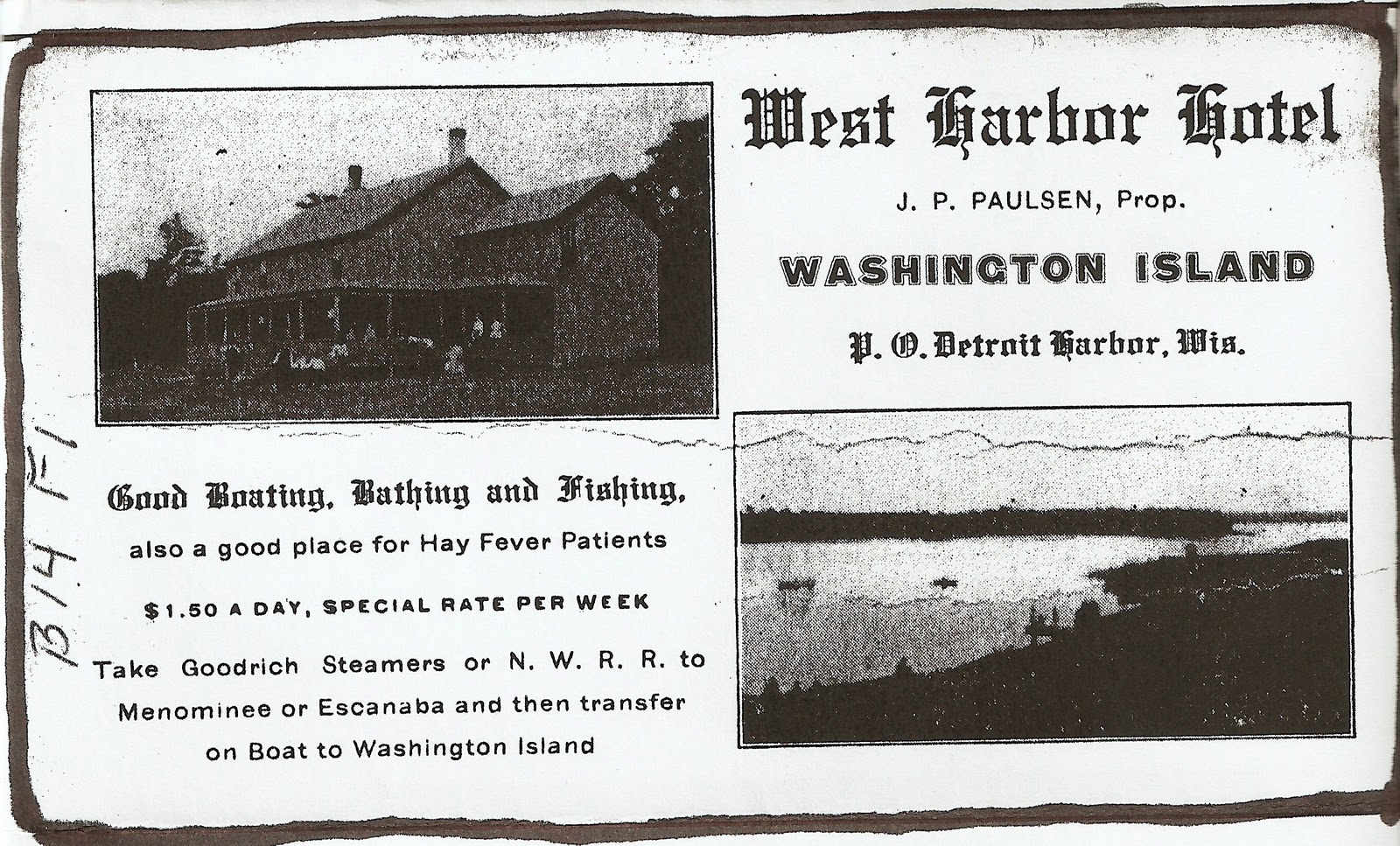
The West Harbor Hotel image (top) is from an Archives post card and we think it was from the Paulsen era, given the squareness and trim of the porch, the look of the windows.   A Paulsen calling card noting special instructions for getting there was also in the archives file for West Harbor.

At some point the Door County Advocate featured an article written by Herb Gibson (date unknown but the HS indicates it may have been Herb's high school history project) about West Harbor Resort.  It was very well done, and given yesterday's events, I'll reprint it here as a refresher on the progression of ownership that took place on that property.

[I would also recommend looking at a video interview with Herb who recounts this history on the Island Chamber web page in story-teller fashion.  With pride, Herb talks conversationally about his family's roots there and those who preceded the Gibsons.]

From the Door County Advocate, by Herbert Gibson, Washington Island HS:


 "My home, West Harbor Resort, has a very interesting history.  It is one of the oldest buildings still standing on the Island.  The main building and the property started out as the headquarters for a lumber camp. After that it was converted into a general store, and then in to a summer resort, which it still is today.
  "About 1860 Frieburg's Lumber Company, one of Wisconsin's leading wood companies of the time, bought a timber contract for removing all the virgin pine from the island.  At that time the island was very sparsely populated, and nearby all  the island was covered by huge virgin pine.
  "The so-called "big pine" of the island which was cut down several years ago was estimated to be about 500 years old and was about five feet in diameter and illustrates the immense size the trees must have been.
  "That particular pine was one of the few survivors of that great lumber boom 100 years ago.  That sawmill was set up at the point of land north of the entrance to West Harbor. 
 "A boarding house for the lumberjacks was constructed from some of the first products of the sawmill, and that building is still standing today although several additions have been added.  A large dock, built out into Green Bay next to the mill, served the ships hauling lumber to all the large cities on the Great Lakes.
  "Traces of that dock can still be found.  The lumber jacks used oxen mostly to haul the logs to the mill.  From dawn until dusk all that could be heard was the ringing of axes and the buzzing of saws. The whole point on which the mill was located became a mass of slabs and sawdust. Even today if you walk on this point the ground is spongy from that sawdust, and if you ever fish in West Harbor, there is seldom a day goes by without hooking into one of the thousands of waterlogged slabs or deadheads that abound in the water.
  "Most of the activity of the mill ceased in the winter.  The lake froze over early and no shipping could get through, also the heavy snows that used to prevail made work in the woods almost impossible in spring.
  "Eventually it became unprofitable to keep the mill running.  All the pine had been cleared off and there was no profit shipping other types of lumber.  Frieburg, still owning the small piece of property on which the mill and boarding house were located, decided to convert the boarding house into a general store.  The upstairs was used for storing 100 pound sacks of flour and feed.  With all this weight continually being stored there, dips in the floor developed, and even today as you walk down the upstairs hall it is like walking over a series of hills.
  "In the store's early days people came from all corners of the island to trade at Frieburg's general store.  They would come for a weekly and sometimes monthly trip in their horse and buggy or horse an sleigh depending on the time of year, and stock up.  But as the population increased, other stores sprang up nearer the centers of population, and began taking the business away from Frieburg's, and it became unprofitable to keep the store running.
 "The store was boarded up and stood empty and deserted for a number of years.  Then, about the year 1900, a fellow by the name of Paulson with the idea of turning the store into a resort bought it from Frieburg. Since that time, it has never shut its door to summer tourists. The only other owners of the resort beside Paulson are Jens Sorenson and Frank Gibson.  Many additions and improvements have been added to make the resort what it is today.  It isn't a fancy or expensive resort, but the people who come there enjoy themselves and a large percent come back every year.  Its purpose is, and has been, to serve the tourist and hopes to go on doing so for many years."


   -  Dick Purinton

Friday, November 4, 2011

UPDATE: WEST HARBOR RESORT FIRE

Island Fire Chief Pete Nehlsen confers with resort owner Herb Gibson
on plan of action following return of equipment to
fire station.  Nehlsen and several men stayed on scene with one
truck as fire watch.
Washington Island, Wisconsin -

By 9 a.m. this Friday morning, nearly all equipment and volunteer fire fighters had been released from the scene.  Fire Chief Peter Nehlsen, one truck, and a few men as fire watch remained.

"It was the smoke alarm that saved us," Herb said.  "Without the alarms, who knows?"    Herb, his wife Marianna, and one daughter, Sara, were sleeping when the smoke alarms sounded, around 4:30 a.m., and he immediately placed the fire call.  With soot on his lips and face, still very much absorbing the impact of events of the early morning, Herb expressed relief that his family was safe.

The building appears to have extensive damage, in particular the easternmost  portion of the building.  This section contained a dining room, game room, large living room area and a staircase leading to upstairs guest rooms.  These spaces were used primarily by resort guests, although the Gibson family welcomed many island visitors who made themselves at home for various club and private functions over the years.  The building's west end, also two stories, had been remodeled within the past ten years and was living quarters for the Gibson family.   From the exterior, it appears to have been spared from direct flame, but it will undoubtedly have smoke and water damage.

How important a role did the Island Fire Department's new ladder truck play in battling the blaze?

"The aerial pumper saved what is left of the building," according to Fire Chief Nehlsen.  "Unequivocally, without it, the rest of the building would be gone."  Heat had blown out window glass in the older section of the resort building.

Perry Jorgenson and Herb
examine damage.
And, from the accounts of several firemen I spoke with, each agreed that the timely arrival of island men and equipment, in particular the aerial truck, were key in knocking down the fire, keeping it from spreading and consuming the entire building.   Nehlsen, who was in the attic pulling down smoldering insulation when I arrived, said the entire attic the length of the building had been on fire at one point, but water directed downward from the aerial pumper stopped the advance in short order.

Nehlsen credited Liberty Grove's firefighters who, wearing Scott air packs, spelled Island firemen when it came to working inside the structure, assisting in extinguishing remaining hot spots, in particular the overhauling, tearing down of interior walls and ceilings.   "That's the dirty work," he said, "the real physical work."  Each LG fireman cycled twice through the structure's interior, he noted, before heading back to the mainland.

Nehsen had already contacted the State Fire Marshall to conduct  a post-fire investigation, routine procedure for such events, he said, and he expected an investigator would arrive later today.

New sheets of OSB were already stacked on the lawn, along with 2 x 4s and tarps, in preparation for closing the building's openings once the fire is out with certainty.   While the early morning  had been calm and frost was everywhere before sunup, southerly winds are anticipated this afternoon.  Island firemen will return around 3 pm to assist in buttoning up the remains of the structure.


-  Dick Purinton  - 11 a.m.

FIRE AT GIBSON'S WEST HARBOR RESORT!

Washington Island Fire Department volunteers responded to fire
at West Harbor Resort, called in at approx. 4:30 this morning.
Washington Island, Wisconsin -
  Gibson's West Harbor Resort, an island landmark wood frame building and one of the oldest commercial structures on the island, experienced a major fire early this morning.   Volunteer firefighters responded quickly, using the newly acquired aerial pumper truck (purchased from neighboring Liberty Grove Fire Dept.) to knock down flames.  Members of the Gibson family, including owners Herb and Marianna, were reported to have safely exited the building shortly after the fire was discovered.

No details of how or where the fire began are yet available, but it appeared as though damage was greatest next to the chimney, the east end of the building.   There are rental rooms on the second floor, and family living quarters in the western end of the building.

By 6 a.m. exterior flames appeared to have been checked, and firemen were about to attack the internal parts of the building to further extinguish burning material.   All units of the Island Fire Department were on scene, including pumper units at the Ferry Dock, where the tankers were being refilled.

Offering to assist, Liberty Grove Fire Chief Chris Hecht sent approximately eight volunteers, led by Liberty Grove Fire Captain, Lee Telfer, across the Door.  They arrived at the Island dock on Jeff Weborg's trap net boat from Gills Rock around 5:45 a.m. and joined Island firefighters at the West Harbor scene.   (Note:  By 7:40 a.m. they were on their way back to Gills Rock via Weborg's trap net boat.)

By the time the 7 a.m. ferry Washington began loading for the first trip leaving the island, water demand had slowed.

The hope is that damage will be confined to the eastern end of the structure, but that may be better determined in the next hour or two with daylight and a better assessment of damage from the interior.

This building, before it became a resort, had at one time housed men working in a West Harbor sawmill operation, prior to 1900.   The property, situated on a beautiful site along the island's western shoreline and also on the small inlet known as West Harbor, has provided rooms, meals, and hospitality to generations of guests for decades.  For over 50 of those most recent years, it has been operated by members of the Gibson family.


  -  Dick Purinton  -  7:40 am

Tuesday, October 25, 2011

SLACK WATER

Algae and scale shading on steel sheets, indicating
annual lake level variations, with highest point
resulting from the 1986-87 modern high. 
Washington Island, Wisconsin -

tide |tÄ«d|nounthe alternate rising and falling of the sea, usually twice in each lunar day at a particular place, due to the attraction of the moon and sun: the changing patterns of the tides | they were driven on by wind and tide.• the water as affected by this: the rising tide covered the wharf.• a powerful surge of feeling or trend of events: he drifted into sleep on a tide of euphoria | we must reverse the growing tide of racism sweeping the country.


Ticket seller Maggie Swanson fielded a challenging question yesterday from a visitor.  His question was:  "Is it high tide right now, or low tide?"

If there are tides on Lake Michigan, they are imperceptible.  However, with mud flats and protruding rocks now beginning to show a bit more each week, our harbors and shorelines do take on an appearance of lake water having ebbed with the tide.   This phenomena is typically observed here in the fall of the year.  Lake Michigan levels have remained below-average since approximately 2001, and for some of those years the levels have been mere inches above the record-lows of 1963-64.  

According to a report received from the International Lake Superior Board of Control, under authority of the International Joint Commission (IJC), the Lake Superior outflow has once again been adjusted, one means of tweaking water levels in lakes Huron and Michigan which, by the Mackinac Straits connection, are at the same levels.  Lake Superior by the end of September was about 11 inches below long-term average, but 2 inches higher than a year ago.  Lakes Michigan-Huron at that same time were about 14 inches below long-term average, 1-inch lower than a year ago, and about 7 inches above chart datum level.

Low water observed on Lakes Michigan-Huron has drawn critics for past engineering and the processes by which water levels are adjusted and maintained.   Yet, from all we've read and heard, including a presentation by the IJC Chairman several summers back, there is nothing as dramatic for impact on lake levels as plentiful precipitation, or on the other hand, evaporation, and absorption into land mass.

We were told that despite the controls at the few man-made valves from these Great Lakes, mother nature is still very much in control, and she will continue to dictate what is normal despite our wishes to the contrary.  Would an "empathy table"and free hugs, such as that employed by Wall Street protestors at New York City's Zuccotti Park, be useful activism for citizens who refuse to believe Army Corps of Engineers (ACE) data and reasoning?   An empathy table would provide temporary mental relief, at least, from what may seem to be overwhelmingly difficult and unfair conditions.

U.S. ACE Great Lakes Update


Monthly our office receives a free report on Great Lakes water levels, which includes a very informative bulletin titled "Great Lakes Update."

According to October's bulletin, the Coordinating Committee on Basic Hydraulic and Hydrology Data was formed in 1953, following extremely high lake levels in 1952.   At that time, agencies in both the U.S. and Canada "recognized that continued independent development of basic data would be illogical...and that early agreement on the hydraulic and hydrologic characteristics of the system was of paramount importance..."    As a result they "...opened negotiations early in 1953 for the purposes of establishing a basis for development and acceptance of identical data by both countries."

The Coordinating Committee, which meets twice a year, is made up of six members  (a chairperson, member and secretary from each country) and represents these agencies:
  *  U.S. Army Corps of Engineers
  *  National Oceanic and Atmospheric Administration
  *   U.S. Geologic Survey
  *   Environment Canada
  *   Natural Resources Canada
  *  Fisheries and Oceans Canada
  *  Canadian Hydrographic Service

There are several important subcommittees (pardon me if your eyes begin to glaze slightly as we review them):

    **   The Vertical Control-Water Levels Subcommittee which established the International Great Lakes Datum (IGLD) in 1955, a base line for all future measurements.   Noted are the "continued effects of crustal movements," new surveying methods, and the deterioration of the "zero reference point gauge location."

   **  The Hydraulics Subcommittee, which documents methods for conducting hydraulic field measurements, reports them, makes maps, comments on measurement techniques and computation methods, water level readings and tables of actual discharges.

   **  The Hydrology Subcommittee "spends a great deal of effort in coordinating forecasted wear levels for the Great Lakes and official water level statistics," which includes discussion of "Monthly mean water levels, outflows, precipitation and net basin supplies..."

The above is but a summary of the activities of the IJC and its subcommittees, a rather impressive range of activities for which the average citizen has little appreciation.  It is something to think about when gazing at the mud flats and wondering, and complaining, "Where has all the water gone?"

We can take comfort in the fact that these impressive-sounding agencies, staffed and supported by many technical experts in their field, put their best effort forward in monitoring and managing our Great Lakes water.  While their activities are tax-payer funded, and they work from a framework of legislation approved by Canada and the U.S., there would seem to me to be little room in such settings for renegades or persons with self-serving motives.  And still, these agencies have come under increasing pressure in recent years from those who aim for the good old days of higher lake levels, and who desire to change the status quo (to what?).

Bring on the "Empathy Table" and free hugs.  We can all use some!
 -  Dick Purinton

Sunday, October 23, 2011

ROBERT NOBLE IN SHIPYARD


Sturgeon Bay, Wisconsin -

The ferry Robert Noble sailed to Bay Shipbuilding in Sturgeon Bay early Sunday morning, October 16, and shortly after arrival crew members began dismantling piping, wiring, and exhaust lines from the engines as they cooled.   The following morning a tug assisted the ferry, "cold iron," into the oldest dry dock in the yard.

This box is made from a ship's hull surrounded by fill on all sides except the seaward end, where the gates are located.  Pumps run 24 hours a day to dewater the box due to a slightly leaky gate system.  It's old, but efficiently sized, and our ferries have used this dry dock almost exclusively during the many yard visits over approximately 70 years.

The reasons for dry docking Robert Noble now are several:  the five-year required Coast Guard hull inspection;  removal of propellers and shafts, check of stern bearings, pintles and pintle bearings;  modification of external cooling loops; paint touch-up as needed.   Of course, there can always be other items, sometimes planned maintenance, other times surprises, which are also expected when there are so many pieces to fit.  Even in freshwater, a hull exterior unseen for five years, can require unforeseen attention while it is on the blocks.

The plans to re-power this ferry by replacing original Cummins K-1150 engines with CAT-18 engines, and new gears, actually starts with the underbody where welded, steel channel loops would no longer provide sufficient cooling capacity, or configuration for the new engines.   Requirements for different water jacket ranges for after-cooler and engine cooling, with separate loops for each transmission, the old channel coolers no longer sufficed.  And, as it turned out, they had accumulated scale from the past 32 years.   It would be simpler and cheaper, for these reasons, to cut them off and install in their place new Fernstrum grid coolers, approximately 4' x 3' copper/nickel grids that readily exchange engine heat with cool lake water.   With the possibility of receiving the new coolers within ten days of order placement, the project both without and within the hull, would proceed apace.

Rich Ellefson had trailered the shafts to Green Bay's Badger Roll machine shop, along with two, new 4-blade propellers, for a close taper fit, and also the transmission tail shafts that would mate against propeller couplings.  These items would be ready within a week to install in the dry dock.

Above the dry dock

If you've ever been fascinated by the pouring of cement into foundation forms at a construction site, or the erection of steel on a multi-story building, or the quick and efficient setting of roof trusses on a home, as bystander you can appreciate the progress made before your eyes, even if you're incapable of personally doing any of it.

I felt that similar sensation at the shipyard Friday morning, the fourth day since work had formally begun, while staring down into rectangular openings in the main deck.   Hoses and wires ran this way and that.  Pieces of jagged, cut steel - now scrap - were jumbled in skip boxes on deck.   Fans, lights, ladders, barrels and other equipment were found in a seeming unorganized fashion.

This is a fairly typical shipyard snapshot, where a dozen or so men would cut, grind, weld, pipe, run new wire, insulate, and finally, paint, over the course of the project.   Each day's activities are coordinated for maximum, consistent progress until the day the new engines are restarted, a sea trial is run with Coast Guard observers on board, and the ferry is given approval for running back to the island.

During these first four yard days, the old engines and gears had been removed.  The engine foundations, boxes of half-an-inch thick steel, were undergoing slight modification to receive the new motors.  Deeper oil pans required cutting down transverse stiffeners inside the engine beds to accept them.  Racor fuel filters would be modified, one set of filters for each new engine.  The same for independent, isolated starting battery banks.  New, engine-driven hydraulic pumps with separate oil reservoirs for each system, will be installed.  A brand-new steel waste tank in gleaming white paint, had been lowered through the convenient deck opening and was resting on frames outboard of the starboard engine location, ready to be secured and connected to piping.

The aft, starboard bulkhead had been cut away, and a new bulkhead would be installed further aft, satisfying a Coast Guard design requirement for stability and balance in event of down-flooding.   

Peering through deck opening at
port engine location


What had seemed like a fairly straight-forward and routine engine replacement, old for new, had become a significant project.  Such projects often grow in like manner.   And yet, given the consistent, daily progress by skilled yard personnel, and the timely arrival of key equipment components from suppliers, this project may stay on or slightly ahead of schedule.

Our goal is to have the ferry home by Thanksgiving, more or less, with additional testing, cleaning, painting, and then winter lay-up, to follow.

 -  Dick Purinton