Showing posts with label Robert Noble. Show all posts

Thursday, April 23, 2015

ISLAND WATERFRONT - Then and Now - Richter Ferry Line - Part XVIII

Ferry dock aerial 1978 -  Jon Gunnlaugson's  tanker Griffin is docked at
Hansen's Standard Oil (the concrete surface looks new in this photo) and the
 crew of the Eyrarbakki, largest of the three remaining ferries then, and in
its eighth year of service, prepares to discharge a Coke truck and other vehicles.  
Adjustable, hydraulic ramp in foreground is in its 4th season of use, the only
spot on the dock then set up for bow loading/unloading.  Voyageur (top) and
C. G. Richter are idled on this day.  Bob Bell's orange International Scout is
parked next to the ferry office, foreground.  A telephone booth is
handy, alongside the building for patrons coming off  the ferry.


Washington Island, Wisconsin -

We continue with the story of the Richter ownership and operation of the Ferry Line, now in its 75th year in this year, 2015.

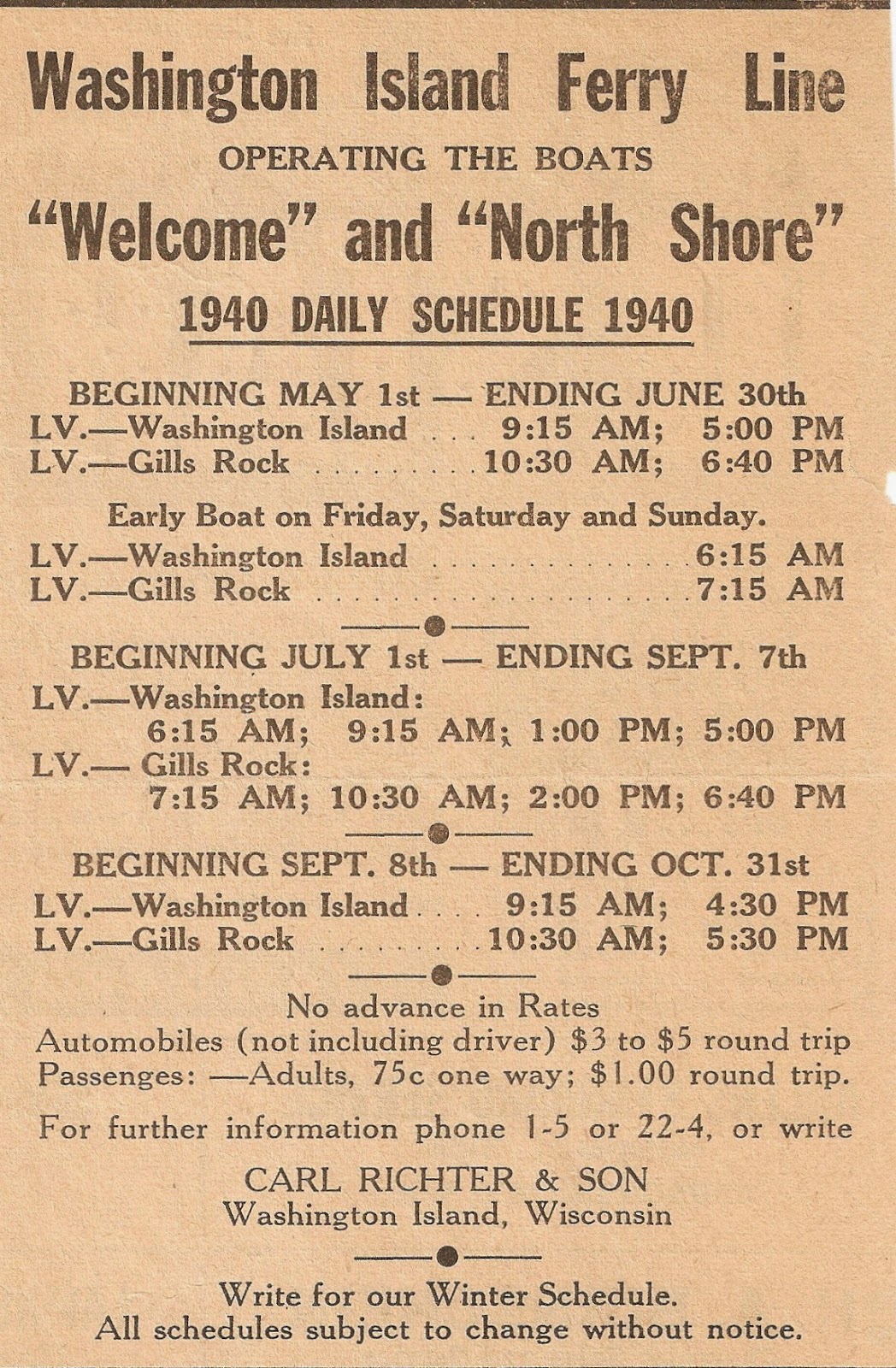
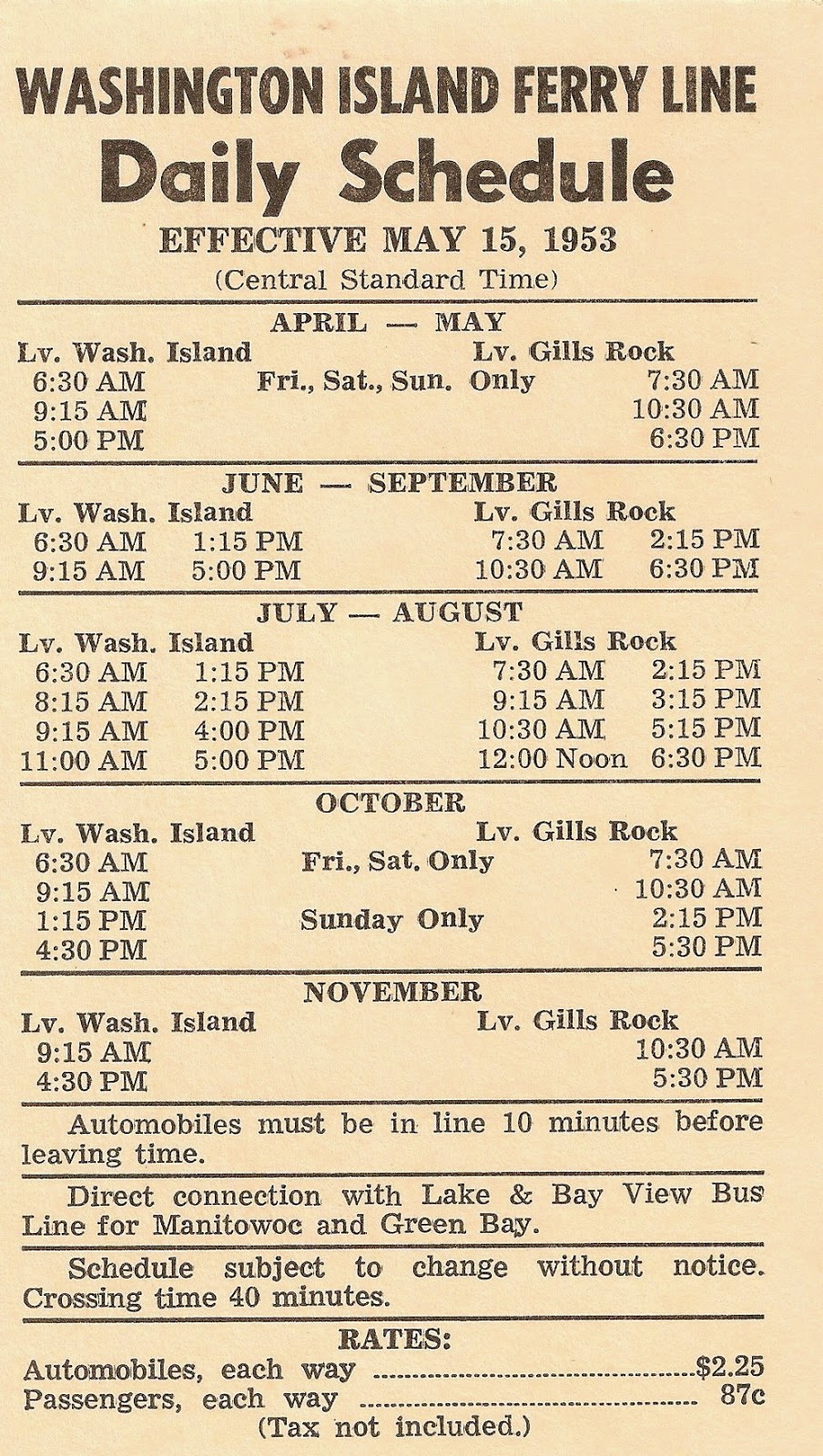
The schedule comparison shown above is interesting for a couple of reasons.  For one, there was deference paid to Carl in 1940, with credit paid to "Carl Richter & Son."  This would soon change, and maybe it was more practicality than anything, acquiring a business name that would be readily associated with Washington Island.  But over time it was still the Richter name, Arni Richter's name, that would be closely associated with Island ferry service, and in a general sense, with Washington Island as a whole.  Arni's involvement in the Door County Chamber of Commerce, his role as a director for the Bank of Sturgeon Bay, and his staunch support of the Republican Party (that brought him in contact with several Republican governors, state legislators, and Congressional representatives) held both social and business implications for the Richters and the Ferry company. 

Another interesting comparison is found in examining the rates, where one-way passenger fares ($1.00 in 1940 vs. 87 cents in 1953) and auto rates were actually less in 1953 than in 1940.   Perhaps increased volume had something to do with those rates, but in 1953 there were two, relatively new ferries, Griffin (1946) and C. G. Richter (1950), still working off construction debt.   Farming and fishing were then two booming Island industries, with dairy and potato farming continuing apace, and commercial fishing was the king industry in terms of incomes and steady employment.  Those industries translated to a great deal of freight hauled, meaningful in terms of revenue for both the Anderson Transit Co. and the Ferry Line.  Perhaps the freight revenues helped to meaningfully support the business overall. 

The construction of the Voyageur in 1960 departed from the side-loading ferries that required wooden planks (later replaced by a steel plate) to span the gap between vessel and shore.  Although the Voyageur had only a single ramp, located in the bow, loading could be accomplished quickly by directing drivers and backing autos on board.  A creative crew with the right mix of traffic could load a dozen vehicles in a short time.  Oftentimes, the load was a mix of autos, trucks and trailers, and occasionally large equipment that earlier ferries simply were unable to carry.   

Hauling a semi by ferry was novel, unheard of until the Voyageur.  That was
why this first-time photo was taken of a J. W. Cartage truck aboard early in the
1960 season.   The design of a larger, open-deck ferry today seems a no-brainer,
but Percy Johnson spoke often of Arni's agonizing the day before he had to
sign a contract to build the Voyageur at Sturgeon Bay Shipbuilding and
Dry Dock. Financing was always a challenge, and Arni's business style was
to first have the major percentage of new construction costs in hand before laying
a keel, a pattern that has been followed to this day in keeping debt
to a minimum.


By 1970 traffic justified a second open-deck ferry, an even longer vessel named Eyrarbakki.  If the Voyageur had been a grand improvement for carrying vehicles of all sizes, the Eyrarbakki went one better.  She had both a bow and stern ramp, and rather than the restrictive open deck of 50 feet of the Voyageur,  at 87 feet LOA the Eyrarbakki had approximately a 70-foot opening, making possible the loading of just about any combination of truck and trailer that could be brought over the bow.  (Eyrarbakki still has the largest unrestricted height, open deck space of all of the ferries.)   Standard vehicles (if they required less than a 9-foot overhead clearance) could be easily loaded in a drive-on, drive-off arrangement, and overall capacity came to 18-20 autos.  There were still large "Detroit boats" being driven for comfort rather than concern for fuel prices in those days, but new, smaller Japanese models had joined the highway mix, plus Detroit's "compacts" that provided options for crews to load an extra car here and there, maximizing usable deck space on a busy day.  

A major drawback in loading the C. G. Richter- especially in low water,
and especially with a heavy load - dealt with regularly throughout winter,
was to drive loaded trucks over the side ramp, timing the roll of the boat so that
the rebound in buoyancy would support the rear axle's wheels as the major
weight came into play.


On a cold winter's day, the Noble's hull was moved
from a construction shed to an opening and turned upright.
using two cranes.  Shown with the upright hull at PBI
are Arni Richter, Dick Purinton and Harry Purinton, who
represented R. A. Stearn, Inc. Naval
Architects.  Harry did much of the structural design and
engineering on this ferry, and the Washington in 1989 when
working for Tim Graul Marine Design.
At the time the Robert Noble was constructed, Tim Graul
headed up the PBI commercial design division,
completing Robert Noble design details. 


With a new ferry C. G. Richter in 1950, another in 1960 (Voyageur) and a third in 1970 (Eyrarbakki), there came a public tendency to believe that a new ferry would be built "about every ten years."  Pushing this theory along (and based solely on the coincidental rise in tourism and the need to keep pace with summer traffic, not a pre-ordained circumstance) was yet another ferry designed and built for launch in early 1979.  

Robert Noble launch, April 30, 1979 at PBI.  90' x 36', with
two, 365 hp Cummins engines, with 175 passengers, and 10'6" overhead
on the aft vehicle deck, made this ferry quite versatile,
the best in the fleet at the time.


The Robert Noble's design would enlarge, slightly, upon the dimensions and capacity of the Eyrarbakki, and in so doing it would render the C. G. Richter less useful - almost obsolete - as a summertime vehicular ferry. 

The answer, in order to get use from an aging vessel that still had many nautical miles left under her keel, was to convert the C. G. to summer passenger-only use.  

By 1984, an extension of 70 feet had been made to the Northport Pier, and as a result Gills Rock became a "passenger excursion" port, with the C. G. competing in summer, first with the Yankee Clipper, owned by Charles Voight, then after 1987, with Voight's new, aluminum Island Clipper.   

One fact of business Arni liked to recite was that each new ferry exceeded in cost the sum total of dollars spent on all previous ferries.  This reflected not only the nature of new construction, with increased complexity in safety equipment and design features intended to meet U. S. Coast Guard regulation, but also the tendency to improve each new ferry in size and utility.  With increased size came increased horsepower, and larger transmissions, all with added cost.   Each new construction contract was supported with the optimism that it would prove to be the right decision, and that a new ferry would help to sustain, if not increase, business for the Ferry Line and the Island.

Adding to the "ten year cycle" myth circulating in Door waters would be yet another ferry, Washington, also built by Peterson Builders, Inc., this one designed start-to-finish by Tim Graul Marine Design (TGMD).  It should be noted that during this period, Peterson Builders was attempting to transition from a heavy dependency on U. S. Naval contracts, which were becoming harder to obtain, while at Bay Shipbuilding nearly all shipbuilding efforts were going into the large commercial ship construction or repairs for the laker fleet.  Bay Ship didn't seek new, small vessel construction at this time, although that approach would change again in time.  

The Washington's design was a departure from previous ferries, most notably for the use of a center pedestal, or trunk, that supported a substantial superstructure.   The Washington had greater length and beam (100-ft. x 37-ft.) than previous ferries, but the increased overall dimensions, as it turned out, were somewhat offset by cramped lane conditions alongside the trunk, which incorporated public heads, engine room and passenger deck access stairs, piping and wiring runs, and light cargo storage.

Every vessel results in compromises, however, and overall, this ferry became a summertime savior by taking on long lines of vehicles and passengers, loading them with ease.   In certain instances, she's also been used in the freeze-up stages of December, having good sea keeping abilities, with less propensity to toss spray over the deck.  But, summertime use was its main purpose, to meet with the still-increasing patterns in traffic.   The 1990s, with dot.com financial bubbles not yet ready to burst, also brought increasing tourism, very much on the rise in Door County as a whole. This ferry, Washington, coupled with a new break wall built in 1994 that surrounded the Northport dock and made landings much less subject to wind and waves, became a very useful piece of equipment.  

Washington set to depart.   Crew: (L to R)  Jeff Cornell, Laura (Shellswick)
Lerner and Erik Foss.


The age of the C. G. Richter, having design qualities unacceptable to owners of longer and higher vehicles, and with increased bulk freight demand in the dead of winter (fewer Island goods were being stockpiled in advance, with less small package freight), and without the mass and horsepower to bull through frequently encountered ice conditions, and with its less-than-adequate passenger accommodations  (both heads and cabin space) her days were numbered.

But, it would take substantially more capital, plus the right design - whatever that might be - before a contract would be signed for a new winter ferry.  That timing proved to be 2002, a decision that followed much internal discussion and regular, annual deposits into a construction fund.  By that time, Arni Richter had retired (after making an official retirement statement, but one not always heeded!), and the new ferry to bear his name would have greater size, horsepower, and capacity than any of the other ferries.  And as before, it would result in greater expense than all previous ferry vessels combined!   

This card appeared anonymously one day at the Ferry Line office.
Its creator was quite perceptive of the divergence of opinion as
construction of the Arni J. Richter took shape in Nov. 2002.
(Taken on day of keel-laying at Bay Shipbuilding.)

The Arni J., as this ferry quickly became known, at 104-ft. LOA could carry 18 vehicles with ease, having broad vehicle lanes nearly 10 feet wide, with passenger cabins and passenger deck access, heads and engine room access offset in a structure along the starboard rail, giving it capability to carry several semi trucks by driving them straight through - this ferry came to be a considerable improvement for  winter and summer ferry service.  

Capt. Bill Jorgenson at wheel of Arni J., in ice.  Hull speed is
a consistent several knots, even in solid ice 10' thick.
Best of all, as it turned out the Arni J.  exhibited wonderful icebreaking capabilities.   This was due, in no small part, through copying the lines of the successful design of the most recent Drummond Islander ferry at Point DeTour, Michigan, also designed by TGMD.  A flight to Drummond Island in a small plane piloted by Graul convinced Arni there just might be a new and better design possible, rather than repeating or enlarging the C. G. Richter design.  (At one point, several years earlier, Arni had stroked his chin while he mused, "I don't think you'll ever find another design as good as the C. G. Richter for winter work!")

If Arni hadn't entirely agreed with the general design and parameters for the new ferry as they were developed with Tim Graul's expertise, he did go so far as to agree to put his name to it, and then to strike the bottle of champagne against a gangway upright when the moment for public approval was ripe.  His oft-repeated statement at age 92, and later, and not without intended humor, was:  "If my name's on it, it better be good!"  

-  Dick Purinton

Arni joked, after his first swing produced only a thud, that
he "might be getting a bit weak."  The occasion was
witnessed and enjoyed by several hundred people, and
accompanied by music, stories and adulations.

Saturday, September 13, 2014

SHIFTS IN THE WEATHER

Dark clouds, distinctive rays and backlit vegetation
made for an interesting sunset at the Bayou the
day before our weather became stormy.
Detroit Harbor, Washington Island -

Maybe I've waited too long to publish these photos, because the weather has been in continual flux since they were taken.

First, we experienced warm and humid weather in the high 70 degrees (high 80s in much of the midwest) leading to violent storms and great rainfall amounts. Then starting with Thursday, Sep. 3rd, flooding occurred in areas where flooding is rarely seen, towns such as Baileys Harbor.   Trees were downed, and creeks, rivers and swamps were filled with runoff.  

Dramatic squall line between powerful rain cells
as the stormy mass moved across Detroit
Harbor in the early afternoon. The low pressure
remained to our west and moisture then circulated
from east to west over northern Lake Michigan.   
At our home we experienced power interruptions, frequent during the height of the storm, but never for more than about 20 minutes.   The REA crew stayed on top of downed trees to keep power supplied locally, but the Peninsula experienced wider and longer outages, some for close to 24 hours.

We were in Karly's for a hamburger before the first wave of the storm hit, taking in with us a slicker just in case, because the radar showed a massive storm cell was headed our way.   I had begun working on my french fries when the power went out. The deluge intensified outside, with heavy, tropical-like rains at times.

This pattern continued throughout the night of Sep 3, on and off.  As one large cell passed over, or split and went north and south, another just as large and intense formed inland to the west, taking its place in the sequence.  Around 8:30 pm, with island power temporarily out and an intense squall in progress, Hoyt and Rich were called on to make a special medical emergency trip.  

The Packer game in Seattle that same night wasn't impacted by Wisconsin's weather, but our TV viewing was.  Frequent, but brief, outages had us listening to part of the game on a battery operated radio.  It was a good diversion from a game that in many ways echoed the night's weather:  a relentless pounding.

Patrons supped contentedly at Karly's, unfazed by the
power outage, as heavy rain fell outdoors. Tim stated
the power would be back in 20 minutes - and it was.
This moist air mass began well to the southwest, Oklahoma and Nebraska, through Iowa into Minnesota, Wisconsin and Michigan.  Rather than this large humid air mass being pushed briskly to the east by a cold, high pressure air mass, which is often the case, the winds remained southerly, and we enjoyed a few more days of pleasant, warm summer weather before the pattern seemed to repeat itself.

One week later, Sep. 10, stormy skies reappeared, this time with less rain but more wind - gusts in the 40+ mph range for ten hours or so.  When the cloud cover finally eased a day or two later, we found ourselves in a high pressure system with fall-like temperatures: mid-40s by night, daytime highs in the lower to mid-50s.  

This change provided a good reason to get the pellet stove going and shut down basement humidifiers.  The drying warmth felt good, both the real heat and the psychological warmth a fall fire can bring.

Photo taken by wimpy photographer aboard the Robert Noble.
 I rolled down the window for this one as we headed through the break wall
and into the NW gale.  Temperatures dropped 10 degrees in one hour,
and winds picked up dramatically in late afternoon,
Wednesday, Sep. 10, but all ferry trips were completed.

Yes, fall is firmly in place.  The bow hunt for deer season begins today, and I believe we heard blasts from a goose (or turkey) hunter early this morning.  Several maples now show signs of bright colors, and our fields suddenly seem to have lost their summer green.  Plants are in the latter stages of production.  High bush cranberries are turning a bright red.  

Many great days lie ahead, however, and it's a time of year that many of us prefer to any other: sweater weather.   Still pleasant enough for just about any outdoor activity of your choice, at least during the middle part of the day.

Time to get out and enjoy it!  -  Dick Purinton

Tuesday, May 6, 2014

MAY IS LOOKING UP

Treasure Seeker,  former C. G. Richter, recently
photographed moored in St. Marten harbor.
Detroit Harbor, Washington Island -

Our foreign correspondent and his wife were recently vacationing on St. Marten Island, where he took this picture of the Treasure Seeker.   Other than her hull still floating, there wasn't much to indicate she ever left the mooring in Philipsburg Harbor.   Locals said the Treasure Seeker had been stationed there since some time in November.  "Maybe awaiting a gold shipment from South America to Europe" was how our correspondent interpreted the situation.

We can imagine the salt air and salt water are by now taking their toll on the old girl.  Keeping up with pockets of rust had become a standard spring activity during the last years here, in fresh water, even long after the last trips as a ferry.  Time and the elements are not kind to vessels, despite lack of daily service.

Water levels continue to rise

Our Lake Michigan water levels are up nicely over last spring, and a rather wet week with strong easterly winds knocked out the last of the bay and harbor ice in addition to contributing moisture to the lake.

According to the Army Corps, Lakes Michigan and Huron are now about 11 inches above last year's level, with another expected rise of at least five inches over the next month.

With the harbor ice gone and danger of ice en route being eliminated, the ferry Robert Noble made its first trip of the season May 1.  The Arni J. Richter, which began winter service back on December 10, 2013, was sidelined for cleaning and routine maintenance, some of it deferred during that period due to the daily need for availability during the period of ice.   With so much ice in the bay this winter, and the potential for problems during breakup, this year's process nevertheless went quite smoothly, with only one day's interference during a heavy snowstorm three weeks back when a large field came against Plum Island.  From then it was smooth sailing, and the bay ice melted, more or less, in place.

Saturday, May 3, the ferry schedule bumped up to 11 daily round trips, one per hour through the heart of each day.   We hope adequate traffic will soon follow.

Dredging progress

Since resuming the Detroit Harbor channel dredging project in April, the Roen crew has made good progress, edging the 80% mark by last week's end.  The rig with backhoe and crane moved into the middle section of the channel, as the WDNR requires with three designated "fish windows."  Foth Project Manager Ken Aukerman now believes they are on track to complete this project by the middle of June.  This is good news for everyone, in that the trucking and the resulting mess on the roads will settle down in time for the start of the heaviest tourism season.

Dredging in fog April 30.


The Town's gravel pit, the receptacle for the dredge spoils, is fast filling up.  Much of the material in the past weeks has been exceptionally sloppy and mucky - easy to dig and transfer, but not particularly easy to truck, or to contain on site.   This, too, should change as the rig works its way further out the channel, where higher stone content has in the past been found.

This has been a big project, and while it stirred up commotion in terms of truck traffic, road damage and so forth, none of that comes as unexpected.  One positive is that, perhaps in late August, brand new asphalt paving is expected for those trucking roads, in addition to other roads the Town of Washington and Door County designate for paving.   Six months from now, we should see many, excellent miles of newly paved roads.

Currently, with temperatures pushing to edge above the 50 degree mark (it was 33 degrees yesterday morning), it's hard to believe that Cherry Train tours begin in two weeks, and that we'll entertain Memorial Day guests with an Island that is now only partially awake from a long winter.

-   Dick Purinton


Monday, December 16, 2013

ICE SEASON BEGINS

Arni J. Richter passing Roen dredge, 8:05 a.m., Dec. 16.  
Washington Island, Wisconsin -

Earlier than anticipated, deep cold temperatures halted the Detroit Harbor dredging project today, and it also marks the beginning of the Arni J. Richter as the ferry of choice for the next several months.

Single-digit temperatures around Wisconsin Sunday, plus ice in the Door passage, means we're not far from seeing the bay tighten up with ice.   Before Sunday noon, when bay ice from the western shore filled in the Door passage, the Eyrarbakki was used for most ferry runs.  We may reach 32 degrees by Christmas Day, but otherwise, its been consistently cold, and snowy.

When this photo was taken last week, several
nights' ice had formed in the channel.  It was later
cleared with a ferry stern wake and northerly wind.
Here, the Eyrarbakki is
pictured underway.    The Washington
and Robert Noble (hidden behind the Washington, to the right)
were drained and winterized prior to the previous,
deep cold snap.


Colder temperatures of teens and single-digits, coupled with strong westerly winds, hampered dredging operations during the past week.   The scow shown being loaded in the photo above was receiving the last of the dredged spoils for this season.  Roen crewmen will begin to lay up their equipment later today, mooring the construction and material barges near the island ferry terminal.  The tug Stephen M. Asher will moor at the south side of the Ferry Line property, where shore power can be obtained.

With ever-decreasing production this past week, and already down to one shift, it was a matter of time before the call was made by Roen and Foth to stand down.

When it was still possible to do so last week, the Roen crew dragged the channel to assure uniform depths, and to determine if any large, upturned stones were missed by the excavator operator.  Errant stones lying above project depth could be struck inadvertently by ferry propellers this winter when transiting the channel.   However, none were found.  In the accompanying photo are stones recently dug from the channel depths.   They will be added to the upland pile of stones previously separated from the more easily trucked spoils.

Blocks of stone three-by-four feet in dimension, like the one above, have been encountered all too frequently. 
Exactly when this project might resume is anyone's guess.  This will be determined in part by the WDNR's allowance for dredging after March 15th -  a date when, the claim is made, fish may begin to spawn.  When the heaviest ice disappears is another factor.   If ice remains well into April, and permit approval is not forthcoming from WDNR to continue in April and May, then the project may stall until late summer or fall.  This, in turn, will have impact in delaying repair of island roads.  Road repairs won't be made until the trucking ends.

An update on the dredging project progress will appear in the next issue of the Island Observer.

Note:   In the most recent Island Observer I carelessly wrote that Foth Construction Manager Ken Aukerman patrolled the trucking route and tossed spilled stones from the pavement into the grassy roadside.  That was incorrect.  Aukerman brings them to the dumping site where he hands them over to Tom Jordan, making the point that truckers should pick up after themselves, or be more careful. 

-  Dick Purinton

Thursday, November 14, 2013

WINDS OF NOVEMBER REMEMBERED


Jim Rose took this photo this morning, with Roen work and material
barges moored adjacent to the main ferry pier's
south side.


Washington Island, Wisconsin -

The Roen barge alongside our regular ferry pier tells the story today, the second straight day with no dredging activity due to strong SW winds and seas that make maneuvering barges difficult and dangerous.  We've been able to make our ferry trips in the southerly winds, all right, but the work of unloading spoils has been temporarily halted because of high SW winds.  There is a roll that comes into Detroit Harbor, even sweeping around the end of the Potato Dock

On Monday, this most recent Veterans Day, our ferries made only several of the scheduled trips.  Two boats carried cars and passengers at 2:00 p.m., and that was the day's last run.  After the early trip, the other morning trips were cancelled.

Monday's cancellations were, I believe, the first such scheduled runs cancelled in 2013.  That day, because the winds were from NW, sea conditions in the Detroit Harbor channel remained smooth, despite gusts, and the Roen crews continued dredging.  In fact, we had several days of quite tolerable weather early this week - though cold - during which dredging operations went full-bore.  But then, when a warming trend brought swings in temperatures of twenty or more degrees, the southerly air flow increased to the point dredging operations were halted. 

Hazards of trucking typically don't
include deer, butduring his last run of the evening
several days ago a deer tried clearing Dave Hanlin's truck
hood.    This photo by Jim Rose shows Hanlin's truck
at Northport, awaiting a replacement windshield.
In the marine construction business there is always something to fix on a weather day, and the Roen crew busied themselves with a generator project yesterday.  But as the clock ticks and the season advances, production must continue or else we'll surely be looking at a prolonged dredging project well  into 2014.  That's not in anyone's best interest.  

Following discussions with Roen and Foth, we will likely permit the offloading of spoils at our regular dock until working conditions improve.  With the swinging of mud and stone in buckets, and the movement of trucks, there is an associated mess and mayhem, which we prefer to take place at the Potato Dock, out of the way of ferry traffic.  But we also realize the necessity of keeping this project moving along, so our main ferry pier may become the temporary offload site until winds abate. 

Gordon Lightfoot's lyrics that paid homage to the men of the Edmund Fitzgerald, lost in a Lake Superior storm November 10, 1975, and to Great Lakes sailors in general, brings to mind storms of historical proportions.  There was the Armistice Day blow of Nov. 11, 1940, to which Arni Richter often referred, etched into his memory.  The November 1913 "White Hurricane" was another, which carried vessels into dire straits in local waters over a period of several days:  the Louisiana, Halsted, and Plymouth.   Winds were recorded exceeding 70 mph during that storm.

Joan Hansen reminded me last week that this year was the 100th anniversary of the Louisiana coming ashore in Washington Harbor, its crew managing to safely reach shore in a lifeboat after a night on board, while the hull burned, eventually to the water line.  The Louisiana was light after unloading cargo in Milwaukee, enroute to Apena, Michigan, and had dropped into Washington Harbor for protection from the wind and seas.  When the wind direction shifted, it dragged anchor with seas bringing it progressively closer to the beach.  That was November 8th.

On the 10th of November, with the storm still raging, it was the lumber barge Halsted's turn, and it landed after many hours broadside on a ledge near shore.  Later, in calmer weather, it would be pulled to safety with the help of a dredge and steam tug, to continue its service.  No lives were lost on either the Louisiana or Halstead.  

One account reported the boiler of the Louisiana salvaged in 1920 by the Leathem Smith Company of Sturgeon Bay.  The compound steam engine was also removed later that year, it is believed.  

North of Washington Island, however, the barge Plymouth had been towed into the bay, possibly seeking the lee of St. Martin Island, towed by the tug Martin.   The tug's Capt. McKinnon indicated later that he was towing toward Washington Harbor when he determined the strain of the tow cables was too much. The tug had itself already taken on much water through leaks in its hull and was in danger.  McKinnon feared that both tug and barge might go down together, and so a decision was made to let the barge go.  Shortly after the tow cables were cut, according to an account, the barge sank with seven men still onboard.  Another account had the Plymouth anchored for a time near Gull Island, with the tug, helpless, a distance away.  

McKinnon had apparently tried to turn his tug around in order to save the men in the water, but he was blown away from the site of the wreck.  It is unclear why so many men were onboard the Plymouth, an unpowered vessel, while it was under tow in heavy weather.  The helplessness of the men aboard the unpowered barge was compounded when the cables were cut. Their loss of life was reported November 12th, 1913.

This photo of the Robert Noble taken by Peggy Olson several years ago serves
as a reminder that when one of our ferries behaves like a rowboat or small
runabout, it isn't a good time to be underway.  In this instance, winds
were westerly and crossing the Door itself was the greatest, though brief, challenge.

 Each day's conditions - wind direction, sea state,
air temperature, ice  (if any)  - can impact the decision to operate

or not.


LOUISIANA - Nov. 8, 1913

The other day at the Archives, Kirby Foss asked, had I ever read the accounts of the Louisiana and Halsted in the Wreck Log from the Plum Island Life Saving Station?  He promptly found them for me, and here are the main portion of neat entries, official accounts for the Louisiana, followed two days later by the Halsted, made by Williamson Robinson, Keeper:

Nor Shellswick with team to haul Beach Apparatus to scene of wreck.

At 6:30 a.m. I received a telephone message from Washington Harbor saying that the steam barge Louisiana had dragged her anchor and was on the shore with the crew on board and that they needed our assistance.  The wind was then blowing a gale form the N.W. with blinding snow storms and it was not practicable to take the life boat to Washington Harbor as it would take hours to reach there.  We loaded the gear of the Beach Apparatus into the life boat and took the boat to Detroit Harbor where I had engaged a team to carry us to Washington Harbor.  We left the station at 7:50 a.m.  It took us some time to load the gear and to launch the life boat in the heavy sea.  We arrived at Detroit Harbor at 8:40 a.m. where I learned that the crew was on shore, that the vessel was on fire and that no assistance was needed.  I was informed that three other vessels in Washington Harbor were in danger of dragging ashore.  We continued our trip overland to the scene of the wreck.  The crew of the Louisiana was ashore and nothing could be done to assist the burning vessel but three other vessels were in danger.  We spent the day & night patrolling the shore. 

 From the Wreck Report entry a few days later, Nov. 10th, 1913, of the Halsted, also entered by Williamson Robinson, Keeper:

Nor Shellswick with team to carry gear of beach apparatus.

We arrived at Detroit Harbor at 9:30 a.m. on our way to wreck of Louisiana.  We learned that the Louisiana needed no assistance but that several other vessels were in danger in Washington Harbor.  We continued our trip overland loading gear of Beach Apparatus on a rig I had previous engaged for that purpose.  On arriving at scene of wreck we found that the Sch. Halsted anchored about 3/4 mile from head of Harbor was dragging ashore.  We patrolled the beach all day and night, building fires for signals to the vessel.  We expected the Halsted to come ashore at any time as at times she would drag a considerable distance and then would hold for an hour or more.  At 5 o'clock Monday morning the Halsted dragged within 60 feet of shore.  We shot a line over her and got the whip aboard.  The water is very bold at that point and the Halsted was hard against a shelf of rock.  We were ready to use the breeches buoy when a heavy seas lifted the Halsted upon the shelf.  It was then so close to shore that the men on  board hung a ladder over her port bow and we assisted them to shore.  When daylight broke we used the whip to bring their clothing ashore.  We could render the Halsted no further assistance but we remained at scene of wreck as a small vessel was in danger of dragging in.  At 3 p.m. the wind went down slightly and as the vessel was in no further danger we came to Detroit Harbor intending to return to Station.  As our boat was covered with ice we remained there overnight, removing ice form boat & returning to station at 11 a.m. Tuesday morning.

-  Dick Purinton


Tuesday, January 8, 2013

Harbor scene early Saturday morning,
Mike Kahr's barge being positioned
for drilling final core samples. (Purinton)
 
Detroit Harbor, Washington Island -

This is being written Tuesday morning, on what we hope will be the final day of major dredging at the Potato Dock.  There will be more dredging over the next few weeks, but in smaller volumes, as areas around the main ferry landings are brought to useable depths.

A reminder of the Potato Dock dredging project goal:  safe navigation and maneuverability at one island landing for our winter ferry, Arni J. Richter (draft of slightly over 11-ft.,loaded.)  The Detroit Harbor channel is now too shallow to chance regular passage with that ferry, the Ferry Line's only ice breaking vessel.   Other ferries draw less water, and because we've not had ice to contend with yet this winter, we've made daily trips much as before, loading at our regular docks using the ferry Washington. (Eyrarbakki and Robert Noble are currently in winter lay-up.)

Roen's project supervisor and crew chief Don Sarter said, "It's time.  We're ready to head home.  It's been a long season."  Ice hasn't yet set in near Sturgeon Bay heavy enough to cause them difficulties in navigating home, a good thing, and winter maintenance and a return to more normal working hours and home life lies ahead.  The crews work in the outdoors, 10-12 hour days, with two crews alternating shift time since Jan. 2nd in order to gain on the production of dredge spoils.

Mike Kahr arrived in port with his barge Wednesday from Fish Creek, and he provided a work platform for Subsurface Exploration Services, LLC, of Green Bay, with its drill rig and operators, along with a Foth Environmental Engineering representative as observer.  Their objective was to obtain representative core samples along the channel bottom that will reveal what type of material a contractor  might encounter after the channel dredging project is bid.  (We're saying "when,"not "if," with optimism that project funding will be approved, in this case by the State of Wisconsin.)

Core sampling resumed Saturday morning for the final holes (and that's when the above photo was taken) as the Kahr barge with drill rig and workers headed out the channel.   Early morning conditions were perfect for stable drilling outside the harbor entrance light.  The photo below was taken by Jim Rose earlier, on Friday, when the rig worked near lighted aid #5.

Kahr work barge with drill rig.  (Jim Rose photo)
 Regular traffic and logging trucks  continued to be ferried aboard the Washington.  Saturday, with Captain Bill Jorgenson down with the flu and Joel Gunnlaugsson driving dump truck, I had a chance to try the helm on three round trips.

Saturday morning log trucks. (Purinton)
Aside from light ice surrounding island landings, no ice is in sight on the route, getting on in January for such a condition to be observed.  It makes me wonder what ice cover we'll ultimately see over upper Green Bay this winter.

While the lack of ice and extreme cold aided greatly to complete the recent weeks' dredging and trucking tasks, ice cover can supposedly slow evaporation of surface water, at least from that small percentage of the lake typically ice covered each winter.  Aside from the rain, sleet and snowfall of several weeks ago, we've since had a dry spell for precipitation.

Monday brought very strong SW winds (30+ mph), but both the Kahr and Roen crews kept dredging, two excavators digging from neighboring barges, tucked in the lee of  the Potato Dock to find calm water.  Sunday's production marked what may have been the highest 12-hour volume so far.  It took more than 66 truckloads to empty the barge, given a good daytime production.  The pile of spoils on the barge was being replenished every few hours with the added stones and hardpan from Mike Kahr's barge.

-  Dick Purinton


Friday, August 31, 2012

LOW WATER TODAY

Detroit Harbor, north end - 2:30 pm, August 31, 2012
Washington Island, Wisconsin -

The low water today marked a low for the year, as far as we're able to determine, and it raises serious concerns regarding loading and unloading of ferries at the island and at Northport.

If memory serves us well, the lake levels generally go even lower on a gradual basis, from this point to approximately the end of the year.   How much lower is anyone's guess.  Recreational boaters, and I am one, have already noticed the drop in lake level.  The sailboat that I thought would easily get in or out of the harbor scraped mud Wednesday when I motored toward open water.  Today, I would not be able to depart or return.  I'd run aground trying.  The key for my sailing will be to wait for a strong, very strong southerly wind that will push along enough water into Detroit Harbor, so that "the next time" will lead to haul-out for the season.  But that is a problem that doesn't impact others, except for fellow boaters.

Algae line shows unofficial drop of around ten inches since season high.


What we'll do with the ferries when water drops even lower may mean special loading considerations, until we're able to adjust ramps further.  Doing so may mean knocking out concrete, cutting steel, and looking ahead to a new low level several months from now.   Better yet may be to consider a much longer-term solution, but that will require permits and some expensive, time consuming construction to provide greater flexibility in loading.  Were these requirements for passengers only, it could be done using a floating stage.  Even with autos, the requirements aren't overwhelming.   But when heavy semis are considered, the ramp situation becomes both an engineering and financing challenge.  And, none of the shore ramp modifications address what could ultimately become shallow maneuvering area.

Stern ramp of the ferry Robert Noble is lower than the other ferry ramps, and the air gap shown
here between underside of ramp and the concrete of the pier 
would 
reduce to zero clearance with a full vehicle load and associated passengers standing aft.
Our ability to load ferries, one right after the other or simultaneously, speeds up the movement of traffic on busy days.   This feature of service may be lost until ramp improvements have been addressed, or water levels rise.

Fortunately the successful passing of this weekend will mark the start of fall, a period of operation with a slower pace and a lesser ferry schedule, a breather in which to better assess our options.

-  Dick Purinton

Tuesday, May 15, 2012

WITH SUMMER COMING ON

Framed by the lightening holes in the main fore and aft structural bulkhead,
Con McDonald and Hoyt Purinton install foam blocks
in the aftermost compartment of the ferry
Robert Noble.


Washington Island, Wisconsin -

Spring at the Detroit Harbor ferry dock typically means painting, cleaning, assembling systems drained over winter, and minor modifications in readiness for daily operations.  This spring has been different in that there were several, major projects to complete.   By mid-May, we're nearly there.

Pete Nikolai and Eric Brodersen
open a mold containing newly
expanded, closed-cell foam block.

Hoyt Purinton with pile of blocks
in workshop.


Robert Noble


This ferry was at Bay Ship for all of November in late 2011 for new engines and gears and new cooling, hydraulic and fire systems. This was extensive work resulting from the replacement of original (1979) Cummins diesels with CAT engines.  The major emphasis was to reduce emissions levels and lower the gallons of fuel consumed per hour of running time.  (So far, fuel consumption is under 7 gallons per hour, per engine, at running speed of 1100 to 1200 rpms.)

Once back in her Detroit Harbor berth, our crew cleaned and repainted the entire Noble engine room.    In late February, as a result of the Coast Guard recalculating vessel stability for the Robert Noble, it was determined that due to a newer formula than that under which it was designed in 1979, additional measures would be needed to conform with required stability.

While there were several options, the one least invasive and least costly involved adding inert, light foam material to the aftermost compartment.  That is what we chose to do, and in the accompanying photos, block production and installation are shown.  The objective is to displace water that might, in an extreme flooding situation, fill the after compartment.

We were fortunate in this project to have new soft patches, removable covers over each main engine. These were installed as a part of the re-power project.  With the starboard hatch removed, eight-foot long blocks could be maneuvered into the after compartment.  Steel flatbars, 1/4" x 3", will be bolted to frames, securing the foam blocks between the frames.  

Starboard, aft void with foam blocks installed.


Robert Noble deck, with hatch over starboard
engine removed.
Washington


The Robert Noble had been used during the first week of May under a provisional Coast Guard certificate, while a warranty repair was in progress on the Washington.  The Washington's starboard engine had a bad rear crankshaft oil seal, the second time this seal had failed in two years, for a two-year old engine. The flywheel housing was determined to be the cause, ever-so-slightly out of round, and a new one was located to replace the original.  (The casting was slightly off from the factory, unusual, but not unheard of, and a new one was located in Germany with identical bolt hole characteristics. It was air-freighted to Green Bay where our engine awaited at the CAT/FABCO shop.)  The repaired engine was then delivered to the island last Thursday morning and lowered in place through the soft patch opening.  It was in running order by late afternoon, and the Washington was immediately placed back on the line.  Crossing our fingers, we believe this ferry is now in top mechanical order for the upcoming season!

Arni J. Richter


During the latter part of February 2009 while routinely inspecting the Arni J. Richter's aft below deck compartment, crew members discovered what proved to be a slight trickle of water.  (This was determined over a period of several weeks, as there can also be tiny leaks under gaskets surrounding deck hatch covers, as well as condensation collected on the shell plating.)  Closer inspection, monitoring of the suspected area, and conference with the Coast Guard Marine Safety Office in Sturgeon Bay led to a determination that several small weld fractures had occurred above the starboard skeg.  The two skegs on the Arni J. are fin-like structures attached to the underside of the hull, through which the propeller shaft protrudes.

Worker prepares skeg for new shell plate, an area of
convergence of multiple planes, and which requires extra care
to avoid shaft log movement during heating, cooling
of welded members.
A crew from Bay Shipbuilding came to the island on an afternoon ferry, bringing with them grinding and welding gear and steel plate, and they spent the next fifteen hours, until early dawn, welding the fractures and installing framing stiffeners.   These repairs were intended to be temporary, only.  In two years, the plate in the area of concern would need to be cropped and repaired to Coast Guard satisfaction.  That is when the next scheduled dry docking exam for the Arni J. came due.  That required hull inspection and repair period took place this spring, during which time the affected areas surrounding both port and starboard skegs were addressed.   Substantial  5 ft. x 5 ft.  x  1" inch plates were inserted above each skeg to better carry the weight and absorb stresses.  New interior framing running both fore and aft and thwartships (side-to-side) was also added.

Because of this work, the Arni J. Richter was in the yard from early April to early May while subject areas were prepared for new plating and framing.  Examination of the existing areas led to various discussions regarding proposals to fix problem areas, and this, too, added to overall time at the yard.

In the end, it can be said that the fractures found in welds were likely a result of several different factors, not just one.   Vibration, plate movement and stresses at various points can be expected in a vessel that runs through ice.  Ice encountered in the Door can be heavy and hard, and there are times underway when it passes continuously between the two skegs, funneled into the blender-like mix as it passes through the propellers.   Had this ferry never operated in winter, it is likely the problems seen would not have developed.

The framing structure in surrounding areas over the skegs, in retrospect, appeared relatively light, given this vessel's mission on a year-in, year-out basis.  There were also signs that a closer fit of plating and higher quality welds may have forestalled or prevented failure.

Interior shell in areas over skegs received extensive,
deep framing to carry stress and reduce plate movement.
During the entire time the Arni J. Richter  was operated, following the  initial recognition of the problem in March 2009, the intermediate measures we adopted under Coast Guard and naval architect direction proved to be prudent and satisfactory.

Now, each of our ferries, upon completion of the foam block project, will be in excellent shape for summer operations.  By mid-June, a ferry may operate 10-12 hours each day, for the next three to four months, before the schedule begins to wind down.

- Dick Purinton

Machinists (man at right) took hourly readings to
determine change in shaft log
alignment. Welders and fitters tailored
their work to minimize movement.


Wednesday, November 30, 2011

NOBLE ENGINES NEARING STARTUP


Bay Shipbuilding, Sturgeon Bay, Wisconsin -

A visit to the yard Tuesday morning found the Noble's repowering project closing in on the startup date.

Piping and hoses for engine cooling and for hydraulics have been flushed (metal filings, dirt) and pressure tested using a piece of equipment set up for that purpose on the main deck.    Fluids fills were to have begun today.  Engine room overhead insulation was well on its way to being installed, and pipe fitters had maybe half of a day left.  Electricians will need a few more days, and that will including the re-installation of new battery supply wiring.  At the last minute, this wire which is commonly approved by American Bureau of Shipping on commercial work vessels, was cited as not meeting code by U.S. Coast Guard plan review in Washington D.C.   Given the late notification, an appeal based on amperage and application was made, but in the end, the technical manual won out, as this wire type does not meet specifications for use in this installation.  Wire type with approved spec numbers will be installed as soon as the shipment arrives at the yard.

Port engine, showing yellow-coated battery supply
wires in ready-to-connect status.
Will be replaced with new wire
assured to meet USCG approval.

Device used to pressure test
hydraulic systems.


In the background of the top photo is the Spirit of Chicago, a dinner cruise and excursion vessel that homeports at Navy Pier.  This vessel began main engine changeout at about the same time as the Robert Noble, with new John Deere marine engines.  Its owner hopes to set sail soon from Sturgeon Bay to Chicago, but this vessel has the same battery supply wiring issue to contend with, prior to receiving Coast Guard approvals.

Maritime Museum 


Last evening I was invited to speak at the Door County Maritime Museum in Sturgeon Bay, the first of the coming winter's speaker series.   My chosen topic was "Island Transportation in Winter," and I was quite pleased with the audience turnout, perhaps 75 or so persons.  Using slides and historical examples to illustrate how winter transportation here has evolved, I'm hopeful a few might have been enticed to try a winter's journey to Door County's northernmost township.  Unless you live here, work here, or have friends or relatives here, it is not the direction most people think of traveling in winter.    

Jon Gast, Dick Purinton, Bob Desh (Museum Director

The Maritime Museum's spaces have been decorated for the holidays, and so was the tug John Purves, moored along the waterfront.  I would recommend a museum visit as a great winter family outing.  There are exhibits of interest for all ages, both entertaining and educational,  and its all within a comfortable indoor setting.  Single-day individual passes may be purchased, along with tours of the tug tickets, or if repeat visits or museum membership activities are in your future, then family or corporate memberships can be purchased.  

Let the Holidays begin!       -  Dick Purinton

Thursday, November 17, 2011

FERRY ROBERT NOBLE - ANOTHER LOOK

Robert Noble, port engine, exhaust line with insulation
blanket being installed, foreground.
Bay Shipbuilding, Sturgeon Bay, Wisconsin -

Work progress continues on board the Robert Noble at Bay Shipbuilding.   Piping is now nearing completion, and within a few more work days fluids will be added to cooling and hydraulic systems, prior to system testing.

Rich Ellefson reported this noon that the dry dock in which the Noble rests was flooded (filled) this morning, and barring unforeseen problems, the gates will be opened and the ferry will be escorted to a berth by tugs this afternoon for the remaining work.   As the water reaches the point where the ferry is nearly once again afloat, inspection is made of all below-deck spaces to ensure no weeping of through-hull fittings or of new welds.  This inspection is visual, and so far, the hull has proven to be dry except for the point at which propeller shafts enter the engine room.  There, slight leakage can be controlled by means of the stuffing box, which has fiber packing rings between flanges.   Dripping at the stuffing gland will continue to be monitored.   The packing will be loosened prior to initial start-up of the new CAT engines to avoid heating through excessive friction with shaft rotation.

Insulation blankets were in the process of being installed on exhaust lines when I visited the shipyard Tuesday.   Other panels will be mounted on the overhead, where work had been done to the exposed underside of the main vehicle deck.   Room to move about the engine room, once generous when this was a nearly empty space, is already reduced as the space fills with piping, new equipment, and soon wiring, as gauges and controls are connected.

Hydraulic pump made in Belgium mounted
to aft face of port transmission
will drive fire pump and
Auragen generator.
One new operational feature will be a hydraulically driven fire pump, and a hydraulically driven generator, known by brand name Auragen.   This compact generator will produce 8.5 kw and should eliminate, at least with typical operating loads, the necessity of a running the diesel genset, thus improving vessel fuel economy and lowering overall air emissions.  These main engines have sufficient reserve power to drive a sizable hydraulic pump without reducing ability to turn the propeller shaft.  Previously on the Noble,  a belt-driven pump was relied upon for fire system water pressure, and this occasionally led to alignment problems, worn belts, and the need to rev the main engine at high rpms to get the required water pressure to the hydrant (60 lbs. psi).   Shipboard electrical needs in the future should allow for a choice in power source, rather than mandatory operation of a diesel-driven generator set that ran, more-or-less, from startup to shutdown each day.  Significant dollar savings are also anticipated on generator moving parts through fewer operating hours on this piece of equipment.

Within several more working days, piping runs for coolant and hydraulic oil will be ready to be flushed, filled, and tested.

Space between forward bulkhead and port
engine shows addition of new piping.  These systems
are designed to be isolated by valves,
with removable sections for servicing.
Crawling through or standing in
this space has become prohibitive.
Then, as piping needs gradually reduce, engine room wiring and electrical installation activity will increase.  During the past several weeks, electricians have avoided competing with engine room working space with the other tradesmen, but their time has been well spent in the pilot house. New wiring harnesses connecting engine room with the operating stations on the upper deck were run earlier.  Gauge panels with associated lights, sensors and gauges will be wired in soon.

Given continued progress, the new engines should be ready for startup the week after Thanksgiving.  We are looking realistically for operational testing, pier side and then underway, to be completed for Coast Guard and owner approval, in the early days of December.

  -  Dick Purinton

Sunday, October 23, 2011

ROBERT NOBLE IN SHIPYARD


Sturgeon Bay, Wisconsin -

The ferry Robert Noble sailed to Bay Shipbuilding in Sturgeon Bay early Sunday morning, October 16, and shortly after arrival crew members began dismantling piping, wiring, and exhaust lines from the engines as they cooled.   The following morning a tug assisted the ferry, "cold iron," into the oldest dry dock in the yard.

This box is made from a ship's hull surrounded by fill on all sides except the seaward end, where the gates are located.  Pumps run 24 hours a day to dewater the box due to a slightly leaky gate system.  It's old, but efficiently sized, and our ferries have used this dry dock almost exclusively during the many yard visits over approximately 70 years.

The reasons for dry docking Robert Noble now are several:  the five-year required Coast Guard hull inspection;  removal of propellers and shafts, check of stern bearings, pintles and pintle bearings;  modification of external cooling loops; paint touch-up as needed.   Of course, there can always be other items, sometimes planned maintenance, other times surprises, which are also expected when there are so many pieces to fit.  Even in freshwater, a hull exterior unseen for five years, can require unforeseen attention while it is on the blocks.

The plans to re-power this ferry by replacing original Cummins K-1150 engines with CAT-18 engines, and new gears, actually starts with the underbody where welded, steel channel loops would no longer provide sufficient cooling capacity, or configuration for the new engines.   Requirements for different water jacket ranges for after-cooler and engine cooling, with separate loops for each transmission, the old channel coolers no longer sufficed.  And, as it turned out, they had accumulated scale from the past 32 years.   It would be simpler and cheaper, for these reasons, to cut them off and install in their place new Fernstrum grid coolers, approximately 4' x 3' copper/nickel grids that readily exchange engine heat with cool lake water.   With the possibility of receiving the new coolers within ten days of order placement, the project both without and within the hull, would proceed apace.

Rich Ellefson had trailered the shafts to Green Bay's Badger Roll machine shop, along with two, new 4-blade propellers, for a close taper fit, and also the transmission tail shafts that would mate against propeller couplings.  These items would be ready within a week to install in the dry dock.

Above the dry dock

If you've ever been fascinated by the pouring of cement into foundation forms at a construction site, or the erection of steel on a multi-story building, or the quick and efficient setting of roof trusses on a home, as bystander you can appreciate the progress made before your eyes, even if you're incapable of personally doing any of it.

I felt that similar sensation at the shipyard Friday morning, the fourth day since work had formally begun, while staring down into rectangular openings in the main deck.   Hoses and wires ran this way and that.  Pieces of jagged, cut steel - now scrap - were jumbled in skip boxes on deck.   Fans, lights, ladders, barrels and other equipment were found in a seeming unorganized fashion.

This is a fairly typical shipyard snapshot, where a dozen or so men would cut, grind, weld, pipe, run new wire, insulate, and finally, paint, over the course of the project.   Each day's activities are coordinated for maximum, consistent progress until the day the new engines are restarted, a sea trial is run with Coast Guard observers on board, and the ferry is given approval for running back to the island.

During these first four yard days, the old engines and gears had been removed.  The engine foundations, boxes of half-an-inch thick steel, were undergoing slight modification to receive the new motors.  Deeper oil pans required cutting down transverse stiffeners inside the engine beds to accept them.  Racor fuel filters would be modified, one set of filters for each new engine.  The same for independent, isolated starting battery banks.  New, engine-driven hydraulic pumps with separate oil reservoirs for each system, will be installed.  A brand-new steel waste tank in gleaming white paint, had been lowered through the convenient deck opening and was resting on frames outboard of the starboard engine location, ready to be secured and connected to piping.

The aft, starboard bulkhead had been cut away, and a new bulkhead would be installed further aft, satisfying a Coast Guard design requirement for stability and balance in event of down-flooding.   

Peering through deck opening at
port engine location


What had seemed like a fairly straight-forward and routine engine replacement, old for new, had become a significant project.  Such projects often grow in like manner.   And yet, given the consistent, daily progress by skilled yard personnel, and the timely arrival of key equipment components from suppliers, this project may stay on or slightly ahead of schedule.

Our goal is to have the ferry home by Thanksgiving, more or less, with additional testing, cleaning, painting, and then winter lay-up, to follow.

 -  Dick Purinton