Showing posts with label Roen. Show all posts

Monday, April 14, 2014

A RIGHT, THEN A LEFT, THEN A RIGHT...

Wind-driven, heavy Green Bay ice piled on the western side of Plum Island
during the early morning.
Washington Island, Wisconsin -

A gray, bleary Sunday turned out to be our best day of the weekend in what could otherwise be termed a stretch of poopy weather. (Is that an approved meteorological term?)

We got comfy and spent several hours yesterday watching those folks in short sleeves and shorts as they watched the Masters in Augusta, Georgia.  And, we don't golf.  We just wanted to be transported to someplace for a few hours, to see what green grass and bright spring flowers look like.  After Bubba Watson put on his new green blazer, I went outdoors to put away sleds and shovels, and raked in a few small sections of lawn where it had dried.

I had no sense, believing the TV weather picture that had the snow north of our location.  By daybreak Monday morning, rain having turned to snow during the night, winds from the NW picked up and temperatures dropped, and we looked out the window to a fresh blanket of heavy snow.  This latest snow storm, by my official boot top measurement and estimated shovel weight, put another five or so inches on the ground.

With the high winds and poor visibility, and the likelihood of ice coming out the Door passage, the morning ferries were canceled.  Although Islanders were headed down the line (to hear the Governor speak at the Door County Economic Development Corporation's Annual Banquet, among other things), the poor roads and difficult conditions reined in such impulses. School was first delayed, then canceled.   Students may have been happy to be home, indoors looking out, but that was before the other shoe dropped.  The power went out, and it remained out for three to four hours.

Tree limbs were down over power lines and roads in many locations. The Town crew tackled limbs as  the REA crew worked to restore power.  According to Mary Lynn at REA Phone Central, what was first a local problem grew as a phase was dropped from the Mainland, and one of the Island generators had a problem that caused "an imbalanced load."  Power was restored in time for a hot lunch.

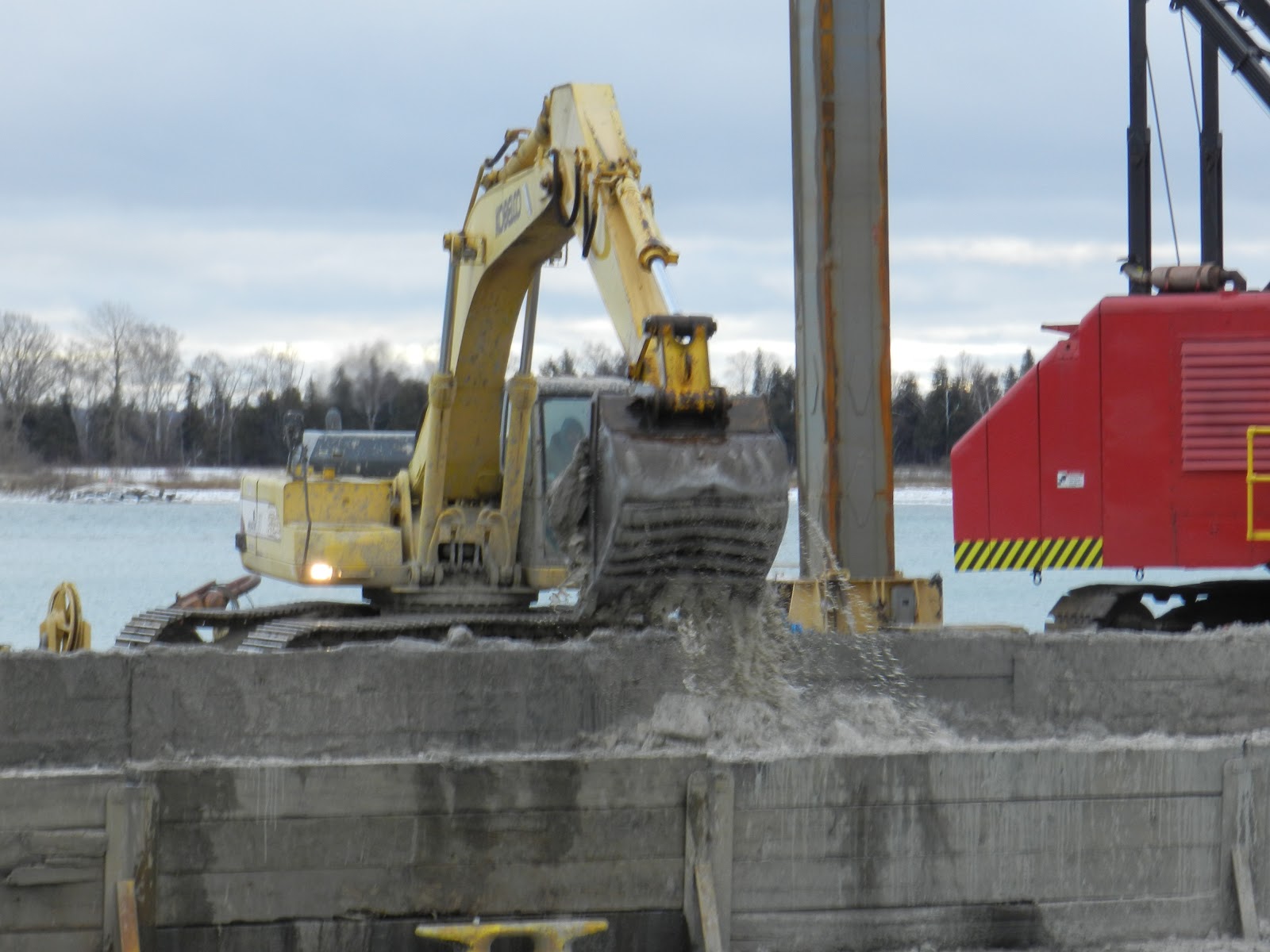
Beyond these several setbacks there was good news.  The Roen crew dug today throughout the blizzard-like conditions, and as of 4 pm the tug Stephan M. Asher was pushing the third loaded scow of the day to the Potato Dock, with the possibility of a fourth scow being filled in the early evening.  Although roads were plenty sloppy in places, the main trucking routes that were plowed by the Town early in the morning seemed exceptionally dry and snow-free, thanks to melting from pavement heat.

Dredging days have been few and far between this spring.
First, ice and cold weather, then broken ice in
the channel blocked operations.   


This day marked only the second full 24 hours of dredging so far in 2014.

Tuesday, April 7th, the Detroit Harbor project resumed, only to have progress quickly curtailed by a damaged silt curtain.  Several days passed while repairs were made, during what were ideal weather and ice-free conditions.  But, by the time the crews and equipment were ready to dig once again, ice chunks filled the channel, floated in on a southerly breeze.

With no prospect for the wind to shift and the ice to leave, crews departed for a couple of days off. They reported in again Sunday morning, just as the shifting northerly breeze blew ice toward the open lake.  With April now already half over, and only two days of dredging accomplished,  in order to gain on the schedule imposed by the WDNR permit for digging, the contractor will need assistance in the form of favorable winds - meaning more northerly than any other direction.


According to Hoyt Purinton, the bay ice that blew down this morning against Plum Island was a single, large field, with nary a visible crack running through it.  Plum Island became an effective Door stop, but not before the edge of the field piled some 30 feet into the air.  (That's an estimate, as there is little but the nearby tree line for a gauge.)  The Bay of Green Bay has yet to break up into small fields.

A friend earlier this winter indicated to me that he read my blogs, but he just about had his fill of dredging photos.  Sorry!  I guess the same might be said for snow pictures. When there are few local events to mark these days, we'll keep covering the same-old.   [But really, how exciting, isn't it, to see the dredge dredge for a change?  And fresh snow fall sideways in a breeze, and then the white aftermath…]

Some day soon, summer will come along and then we'll be yawning, waiting for fall colors and another cycle of nature.

-  Dick Purinton

Tuesday, December 24, 2013

CHRISTMAS EVE UPDATE

Tug Stephan M. Asher is laid up for winter along the south side
of the Ferry Line bulkhead.
Washington Island -

Winter weather has been with us for at least a month, even though officially this season began last Saturday.

At home, we've had time to get settled into a routine of shoveling, getting wood into the woodbox, and cutting new wood for next year.

Each day last week, it seemed, we received more snow. Temperatures were often in the mid-20s, with northeasterly winds, conditions that encouraged the production of lake effect snow.  Those fluffy, light flakes accumulated quickly on the ground, a good seven inches last Sunday alone.  In addition, our part of the state received moisture from a more southerly origin that became snow as it met colder, northerly air masses. An easy 10" of snow on the level now covers the landscape.

Dredging operations wrapped up Monday, December 16, and by late Tuesday the equipment had been set for winter by the Roen crew.  The silt curtain, already torn to shreds by the ice, was extracted from the harbor in pieces. The remains were loaded in the Jordan dump truck, destined for a box at the Town's recycling center.  A few Roen crew members may return during early January for maintenance work on their equipment, but otherwise the operation is shut down until warmer weather returns and ice is gone.   The

View from Ferry Line office window as shredded silt curtain
is disposed of from barge to dump truck.

The Detroit Harbor dredging project has had its share of hiccups, but overall I would say that I've been pleased with the progress made, and I'm hopeful that spring-like weather, along with WDNR permit approvals, will allow for the second half of the project to be completed before the Fourth of July.  As of the date when production stopped, 51% of the estimated total yardage had been dredged.

Bill Engelson forwarded a copy of a news clipping taken from the Door County Democrat, found when he was looking for information about his family's history.  (The Engelsons started Sunset Resort, and prior to that Torger Engelson was a commercial fisherman, first on St. Martin Island, then Washington Island, as I recall.  He noted the cost of the current project.)

I'm guessing this dredging project would have been the first such Detroit Harbor project, and it could have created the short-cut, "false channel," that runs east of the present-day channel.  This would have made entry possible, and safer, for the deeper draft sailing and power vessels that entered Detroit Harbor.  For many years - and perhaps until the later 1920s) there were no piers, or reasons to stop at what we now associate as the Ferry Dock area.  Water traffic went to the Shipyard near Jensenville, to the Ida Bo dock near the foot of Main Road, or to Richter's Point on Detroit Island, which had homes and a number of fish boats.

I wonder what sort of bottom material they encountered, and where they placed the spoils.   Chances are, they weren't hauled far from that location before being dumped.


We have a beautiful winter day going, with plenty of sunshine, in advance of another predicted three inches of snow tonight to dress up the landscape.  Why not?  It's winter.

Have a Merry Christmas!

PS - This is posting #201.   Besides those blogs archived with this site, I previously dumped about 80 blogs in 2010.   The spinning globe on this blog now has registered over 85,666 hits since it was installed several years ago.  Thanks for your continued interest.
 -   Dick Purinton

Monday, December 16, 2013

ICE SEASON BEGINS

Arni J. Richter passing Roen dredge, 8:05 a.m., Dec. 16.  
Washington Island, Wisconsin -

Earlier than anticipated, deep cold temperatures halted the Detroit Harbor dredging project today, and it also marks the beginning of the Arni J. Richter as the ferry of choice for the next several months.

Single-digit temperatures around Wisconsin Sunday, plus ice in the Door passage, means we're not far from seeing the bay tighten up with ice.   Before Sunday noon, when bay ice from the western shore filled in the Door passage, the Eyrarbakki was used for most ferry runs.  We may reach 32 degrees by Christmas Day, but otherwise, its been consistently cold, and snowy.

When this photo was taken last week, several
nights' ice had formed in the channel.  It was later
cleared with a ferry stern wake and northerly wind.
Here, the Eyrarbakki is
pictured underway.    The Washington
and Robert Noble (hidden behind the Washington, to the right)
were drained and winterized prior to the previous,
deep cold snap.


Colder temperatures of teens and single-digits, coupled with strong westerly winds, hampered dredging operations during the past week.   The scow shown being loaded in the photo above was receiving the last of the dredged spoils for this season.  Roen crewmen will begin to lay up their equipment later today, mooring the construction and material barges near the island ferry terminal.  The tug Stephen M. Asher will moor at the south side of the Ferry Line property, where shore power can be obtained.

With ever-decreasing production this past week, and already down to one shift, it was a matter of time before the call was made by Roen and Foth to stand down.

When it was still possible to do so last week, the Roen crew dragged the channel to assure uniform depths, and to determine if any large, upturned stones were missed by the excavator operator.  Errant stones lying above project depth could be struck inadvertently by ferry propellers this winter when transiting the channel.   However, none were found.  In the accompanying photo are stones recently dug from the channel depths.   They will be added to the upland pile of stones previously separated from the more easily trucked spoils.

Blocks of stone three-by-four feet in dimension, like the one above, have been encountered all too frequently. 
Exactly when this project might resume is anyone's guess.  This will be determined in part by the WDNR's allowance for dredging after March 15th -  a date when, the claim is made, fish may begin to spawn.  When the heaviest ice disappears is another factor.   If ice remains well into April, and permit approval is not forthcoming from WDNR to continue in April and May, then the project may stall until late summer or fall.  This, in turn, will have impact in delaying repair of island roads.  Road repairs won't be made until the trucking ends.

An update on the dredging project progress will appear in the next issue of the Island Observer.

Note:   In the most recent Island Observer I carelessly wrote that Foth Construction Manager Ken Aukerman patrolled the trucking route and tossed spilled stones from the pavement into the grassy roadside.  That was incorrect.  Aukerman brings them to the dumping site where he hands them over to Tom Jordan, making the point that truckers should pick up after themselves, or be more careful. 

-  Dick Purinton

Thursday, November 14, 2013

WINDS OF NOVEMBER REMEMBERED


Jim Rose took this photo this morning, with Roen work and material
barges moored adjacent to the main ferry pier's
south side.


Washington Island, Wisconsin -

The Roen barge alongside our regular ferry pier tells the story today, the second straight day with no dredging activity due to strong SW winds and seas that make maneuvering barges difficult and dangerous.  We've been able to make our ferry trips in the southerly winds, all right, but the work of unloading spoils has been temporarily halted because of high SW winds.  There is a roll that comes into Detroit Harbor, even sweeping around the end of the Potato Dock

On Monday, this most recent Veterans Day, our ferries made only several of the scheduled trips.  Two boats carried cars and passengers at 2:00 p.m., and that was the day's last run.  After the early trip, the other morning trips were cancelled.

Monday's cancellations were, I believe, the first such scheduled runs cancelled in 2013.  That day, because the winds were from NW, sea conditions in the Detroit Harbor channel remained smooth, despite gusts, and the Roen crews continued dredging.  In fact, we had several days of quite tolerable weather early this week - though cold - during which dredging operations went full-bore.  But then, when a warming trend brought swings in temperatures of twenty or more degrees, the southerly air flow increased to the point dredging operations were halted. 

Hazards of trucking typically don't
include deer, butduring his last run of the evening
several days ago a deer tried clearing Dave Hanlin's truck
hood.    This photo by Jim Rose shows Hanlin's truck
at Northport, awaiting a replacement windshield.
In the marine construction business there is always something to fix on a weather day, and the Roen crew busied themselves with a generator project yesterday.  But as the clock ticks and the season advances, production must continue or else we'll surely be looking at a prolonged dredging project well  into 2014.  That's not in anyone's best interest.  

Following discussions with Roen and Foth, we will likely permit the offloading of spoils at our regular dock until working conditions improve.  With the swinging of mud and stone in buckets, and the movement of trucks, there is an associated mess and mayhem, which we prefer to take place at the Potato Dock, out of the way of ferry traffic.  But we also realize the necessity of keeping this project moving along, so our main ferry pier may become the temporary offload site until winds abate. 

Gordon Lightfoot's lyrics that paid homage to the men of the Edmund Fitzgerald, lost in a Lake Superior storm November 10, 1975, and to Great Lakes sailors in general, brings to mind storms of historical proportions.  There was the Armistice Day blow of Nov. 11, 1940, to which Arni Richter often referred, etched into his memory.  The November 1913 "White Hurricane" was another, which carried vessels into dire straits in local waters over a period of several days:  the Louisiana, Halsted, and Plymouth.   Winds were recorded exceeding 70 mph during that storm.

Joan Hansen reminded me last week that this year was the 100th anniversary of the Louisiana coming ashore in Washington Harbor, its crew managing to safely reach shore in a lifeboat after a night on board, while the hull burned, eventually to the water line.  The Louisiana was light after unloading cargo in Milwaukee, enroute to Apena, Michigan, and had dropped into Washington Harbor for protection from the wind and seas.  When the wind direction shifted, it dragged anchor with seas bringing it progressively closer to the beach.  That was November 8th.

On the 10th of November, with the storm still raging, it was the lumber barge Halsted's turn, and it landed after many hours broadside on a ledge near shore.  Later, in calmer weather, it would be pulled to safety with the help of a dredge and steam tug, to continue its service.  No lives were lost on either the Louisiana or Halstead.  

One account reported the boiler of the Louisiana salvaged in 1920 by the Leathem Smith Company of Sturgeon Bay.  The compound steam engine was also removed later that year, it is believed.  

North of Washington Island, however, the barge Plymouth had been towed into the bay, possibly seeking the lee of St. Martin Island, towed by the tug Martin.   The tug's Capt. McKinnon indicated later that he was towing toward Washington Harbor when he determined the strain of the tow cables was too much. The tug had itself already taken on much water through leaks in its hull and was in danger.  McKinnon feared that both tug and barge might go down together, and so a decision was made to let the barge go.  Shortly after the tow cables were cut, according to an account, the barge sank with seven men still onboard.  Another account had the Plymouth anchored for a time near Gull Island, with the tug, helpless, a distance away.  

McKinnon had apparently tried to turn his tug around in order to save the men in the water, but he was blown away from the site of the wreck.  It is unclear why so many men were onboard the Plymouth, an unpowered vessel, while it was under tow in heavy weather.  The helplessness of the men aboard the unpowered barge was compounded when the cables were cut. Their loss of life was reported November 12th, 1913.

This photo of the Robert Noble taken by Peggy Olson several years ago serves
as a reminder that when one of our ferries behaves like a rowboat or small
runabout, it isn't a good time to be underway.  In this instance, winds
were westerly and crossing the Door itself was the greatest, though brief, challenge.

 Each day's conditions - wind direction, sea state,
air temperature, ice  (if any)  - can impact the decision to operate

or not.


LOUISIANA - Nov. 8, 1913

The other day at the Archives, Kirby Foss asked, had I ever read the accounts of the Louisiana and Halsted in the Wreck Log from the Plum Island Life Saving Station?  He promptly found them for me, and here are the main portion of neat entries, official accounts for the Louisiana, followed two days later by the Halsted, made by Williamson Robinson, Keeper:

Nor Shellswick with team to haul Beach Apparatus to scene of wreck.

At 6:30 a.m. I received a telephone message from Washington Harbor saying that the steam barge Louisiana had dragged her anchor and was on the shore with the crew on board and that they needed our assistance.  The wind was then blowing a gale form the N.W. with blinding snow storms and it was not practicable to take the life boat to Washington Harbor as it would take hours to reach there.  We loaded the gear of the Beach Apparatus into the life boat and took the boat to Detroit Harbor where I had engaged a team to carry us to Washington Harbor.  We left the station at 7:50 a.m.  It took us some time to load the gear and to launch the life boat in the heavy sea.  We arrived at Detroit Harbor at 8:40 a.m. where I learned that the crew was on shore, that the vessel was on fire and that no assistance was needed.  I was informed that three other vessels in Washington Harbor were in danger of dragging ashore.  We continued our trip overland to the scene of the wreck.  The crew of the Louisiana was ashore and nothing could be done to assist the burning vessel but three other vessels were in danger.  We spent the day & night patrolling the shore. 

 From the Wreck Report entry a few days later, Nov. 10th, 1913, of the Halsted, also entered by Williamson Robinson, Keeper:

Nor Shellswick with team to carry gear of beach apparatus.

We arrived at Detroit Harbor at 9:30 a.m. on our way to wreck of Louisiana.  We learned that the Louisiana needed no assistance but that several other vessels were in danger in Washington Harbor.  We continued our trip overland loading gear of Beach Apparatus on a rig I had previous engaged for that purpose.  On arriving at scene of wreck we found that the Sch. Halsted anchored about 3/4 mile from head of Harbor was dragging ashore.  We patrolled the beach all day and night, building fires for signals to the vessel.  We expected the Halsted to come ashore at any time as at times she would drag a considerable distance and then would hold for an hour or more.  At 5 o'clock Monday morning the Halsted dragged within 60 feet of shore.  We shot a line over her and got the whip aboard.  The water is very bold at that point and the Halsted was hard against a shelf of rock.  We were ready to use the breeches buoy when a heavy seas lifted the Halsted upon the shelf.  It was then so close to shore that the men on  board hung a ladder over her port bow and we assisted them to shore.  When daylight broke we used the whip to bring their clothing ashore.  We could render the Halsted no further assistance but we remained at scene of wreck as a small vessel was in danger of dragging in.  At 3 p.m. the wind went down slightly and as the vessel was in no further danger we came to Detroit Harbor intending to return to Station.  As our boat was covered with ice we remained there overnight, removing ice form boat & returning to station at 11 a.m. Tuesday morning.

-  Dick Purinton


Saturday, October 26, 2013

FALL IS IN THE AIR

Spectacular cloud formations and lighting over Hog Island,
coupled with high winds and seas, made for an entertaining
drive during a power outage Saturday morning, Oct. 26.


Washington Island, Wisconsin -

Following is a short excerpt from the NOAA weather forecast for the Near Shore in our area earlier today (written Saturday, Oct. 26th):

FOR WATERS WITHIN FIVE NAUTICAL MILES OF SHORE ON LAKE MICHIGAN

LMZ521-541-262215-
THE BAY OF GREEN BAY SOUTH OF LINE FROM CEDAR RIVER MI TO ROCK
ISLAND PASSAGE AND NORTH OF A LINE FROM OCONTO WI TO LITTLE
STURGEON BAY WI-
LAKE MICHIGAN FROM WASHINGTON ISLAND TO STURGEON BAY-
1152 AM CDT SAT OCT 26 2013

...SMALL CRAFT ADVISORY IN EFFECT UNTIL 10 PM CDT THIS EVENING...

.REST OF TODAY...NW WIND 15 TO 25 KTS WITH GUSTS TO AROUND 30
KTS. LOCALLY HIGHER GUSTS POSSIBLE NEAR DEATHS DOOR. WAVES 3 TO 6
FT. MOSTLY CLOUDY WITH A SLIGHT CHANCE OF SHOWERS OR SPRINKLES.
.TONIGHT...NW WIND 15 TO 25 KTS WITH GUSTS TO AROUND 30 KTS IN THE
EVENING…

Cloud formations layered over the lake
on a calm Saturday, October 19.
Peterson Bay is in the foreground.


Lake freighters held in port or anchored behind land forms late Friday, in response to the evening's forecast for high winds and large waves (the off shore NOAA report predicted possible waves to 28 feet in the open lake.)  Peak winds were brief, but enough to get lake swells rolling, and the Roen dredging crews were able to work through the day Saturday by locating their dredge in the harbor's northern portion of the channel, where better protection was offered.

The type of clouds seen this time of year are unique to fall, laden with moisture and updrafts.  The puffy plumes over Lake Michigan and Green Bay, even on a calm day, can bring enjoyable viewing this time of year in this latitude.  Looking out my window late Saturday afternoon, I was surprised to see sheets of ice pellets moving across the harbor in a wind-whipped squall.  But such conditions were short-lived.  I glanced away for a short time, then back again a few minutes later, and the icy screen had already lifted and winds had moderated.  

Sand Dunes Park proved to be a good vantage point to
observe "Hawaii Five-0" type combers as they ripped
into the East Channel shallows, tops blown back by
westerly winds - Sat. Oct. 26.


We took advantage of a power outage Saturday morning to skip making breakfast and to drive around the island.  Then, I recalled that the Danish Mill had a back-up generator, and so we stopped there first to buy bakery and coffee, making our leisurely wind-leaf-and-cloud drive all the more enjoyable.  Not a single car was encountered on our entire drive around the east side, from the South Shore Drive to Hemlock Drive and then along Lake View Road.  We had the morning - that time of morning, at least - to ourselves.

Within a few weeks leaves will be off the trees almost entirely and deer hunting season will begin. Thanksgiving and Christmas holidays quickly follow, and the build-up of colder days that precede real winter.  Until then, the often spectacular clouds and sky provide us with a backdrop and lighting to energize the changing of the seasons on Washington Island.

 - Dick Purinton


Thursday, January 10, 2013

MOVING ON

Dredging and trucking crews with final spoils barge
to unload,  6 a.m. Tuesday Jan. 9th.    

L to R:
Roen crew Jeff Thoney, Greg Viste, Steve Ross, Jim Warrick; Hoyt Purinton (WIFL)
Roen crew Matt Goetz,; drivers Dave Hanlin, Pete Nehlsen, Tom Jordan,
Joel Gunnlaugsson (WIFL, behind); driver Tim Ervin; Rich Ellefson (WIFL);
Don Sarter, Roen Project Supervisor and tug captain.
Detroit Harbor, Washington Island -

The last Roen barge load of dredge spoils was off-loaded early Tuesday morning to complete several weeks' work near the Potato Dock.  Mike Kahr continued digging Tuesday in several hard-to-get spots, but the bulk of the project is complete as of Jan. 10.


Ferry Arni J. Richter brought around to new mooring,
shortly after Roen's barges moved out.


Mariners were greeted by a perfect Thursday morning today, January 10.  With light wind and temperatures already in the middle 30s by 8:30 am, the Roen crew moved their barges and tug to deeper water in preparation for the tow home to Sturgeon Bay.  Before they departed Washington Island, however, they were joined by a deeper draft tug operated by Selvick Towing.  The Jimmy L came to pick up the McMullen & Pitz construction barge that had been in Kap's Marina since early November, constructing a new dock for the Coast Guard station there.

The heavy work on the dock project had been finished.  Final details were being wrapped up, such as wiring and the grouting of gaps between the pre-cast walkway sections.  Workers launched a small boat from the McMullen barge in order to push it toward deeper water near the channel, where Roen's tug waited to take over.  Then, beyond the entrance light the tow was transferred to the Selvick tug.  The Jimmy L began towing toward Door Bluff and Marinette, where the barge would remain for the rest of the winter.

Using a fuel truck and a backhoe as ballast in the bow to lighten the stern, the Arni J. Richter's crew moved that ferry from the inner harbor to the Potato Dock in preparation for anticipated winter operations.  (Lately, we're beginning to wonder if we'll get winter back again!)

While the water near the dock is deep enough, caution must be used because the room to maneuver, especially to the east, will be limited.  The dock will be useable for landings, however, and that was the whole objective since this project began.

-  Dick Purinton

Tuesday, January 8, 2013

Harbor scene early Saturday morning,
Mike Kahr's barge being positioned
for drilling final core samples. (Purinton)
 
Detroit Harbor, Washington Island -

This is being written Tuesday morning, on what we hope will be the final day of major dredging at the Potato Dock.  There will be more dredging over the next few weeks, but in smaller volumes, as areas around the main ferry landings are brought to useable depths.

A reminder of the Potato Dock dredging project goal:  safe navigation and maneuverability at one island landing for our winter ferry, Arni J. Richter (draft of slightly over 11-ft.,loaded.)  The Detroit Harbor channel is now too shallow to chance regular passage with that ferry, the Ferry Line's only ice breaking vessel.   Other ferries draw less water, and because we've not had ice to contend with yet this winter, we've made daily trips much as before, loading at our regular docks using the ferry Washington. (Eyrarbakki and Robert Noble are currently in winter lay-up.)

Roen's project supervisor and crew chief Don Sarter said, "It's time.  We're ready to head home.  It's been a long season."  Ice hasn't yet set in near Sturgeon Bay heavy enough to cause them difficulties in navigating home, a good thing, and winter maintenance and a return to more normal working hours and home life lies ahead.  The crews work in the outdoors, 10-12 hour days, with two crews alternating shift time since Jan. 2nd in order to gain on the production of dredge spoils.

Mike Kahr arrived in port with his barge Wednesday from Fish Creek, and he provided a work platform for Subsurface Exploration Services, LLC, of Green Bay, with its drill rig and operators, along with a Foth Environmental Engineering representative as observer.  Their objective was to obtain representative core samples along the channel bottom that will reveal what type of material a contractor  might encounter after the channel dredging project is bid.  (We're saying "when,"not "if," with optimism that project funding will be approved, in this case by the State of Wisconsin.)

Core sampling resumed Saturday morning for the final holes (and that's when the above photo was taken) as the Kahr barge with drill rig and workers headed out the channel.   Early morning conditions were perfect for stable drilling outside the harbor entrance light.  The photo below was taken by Jim Rose earlier, on Friday, when the rig worked near lighted aid #5.

Kahr work barge with drill rig.  (Jim Rose photo)
 Regular traffic and logging trucks  continued to be ferried aboard the Washington.  Saturday, with Captain Bill Jorgenson down with the flu and Joel Gunnlaugsson driving dump truck, I had a chance to try the helm on three round trips.

Saturday morning log trucks. (Purinton)
Aside from light ice surrounding island landings, no ice is in sight on the route, getting on in January for such a condition to be observed.  It makes me wonder what ice cover we'll ultimately see over upper Green Bay this winter.

While the lack of ice and extreme cold aided greatly to complete the recent weeks' dredging and trucking tasks, ice cover can supposedly slow evaporation of surface water, at least from that small percentage of the lake typically ice covered each winter.  Aside from the rain, sleet and snowfall of several weeks ago, we've since had a dry spell for precipitation.

Monday brought very strong SW winds (30+ mph), but both the Kahr and Roen crews kept dredging, two excavators digging from neighboring barges, tucked in the lee of  the Potato Dock to find calm water.  Sunday's production marked what may have been the highest 12-hour volume so far.  It took more than 66 truckloads to empty the barge, given a good daytime production.  The pile of spoils on the barge was being replenished every few hours with the added stones and hardpan from Mike Kahr's barge.

-  Dick Purinton


Thursday, January 3, 2013

DREDGING GAINS WIDER AUDIENCE

WBAY news team at the Potato Dock Thursday morning.
Detroit Harbor, Washington Island -

When news here is slow, we report on those who are reporting on the status of ...

News reporter Bao Vang, WBAY-TV, Channel 2, Green Bay, and her cameraman did a short interview this morning with Hoyt at the Potato Dock about dredging.   The Roen crew had just completed offloading the barge and were in the process of pushing the crane and material barges into position to begin again.  The news story should air on the local-2 news this evening.

Two crews are now working on the barges.  Tom Jordan digs the tougher material with the excavator during the day, which is offloaded before the shift ends, then second shift digs softer material with the crane, and that barge load is trucked first thing in the morning.  Progress is being made, but there are still 3 to 4 days of this routine, estimated, to complete the work.  Temperatures have been in the teens by night, low to mid 20s by day, with a forecast for warming toward the weekend.   That's good news.

Early morning runs to Northport are being made to pick up log trucks (empty), which are ferried from the island later in the morning. That return trip is sandwiched between the two regular runs.  This routine is day-by-day, dependent upon the volume of logs to be exported.  With moderate winds and no ice in the route, ferry travel has been good.

Travelers interested in catching an earlier trip need to contact the Ferry Line office to find out if there will be an extra ferry for the following day, and time of departure.

-  Dick Purinton  


Monday, December 31, 2012

AGAIN ??

Seems like the same old story, digging, trucking and muck.  
But each day holds newchallenges.  Current dredge spoil 
totals are now slightly over the half-way mark
objective in terms of volume of spoils, and

not quite half-way in bottom area to be dug.
Detroit Harbor, Washington Island

-  Last Day, 2012  -

By far the largest dredging project yet undertaken by the Ferry Line is the deepening of waters adjacent to the Island Potato Dock.  In the warmer weather of any other season, a successful project conclusion would be assumed as only a matter of time and money.  But with winter coming on, short daylight hours, temperatures sure to drop below the pleasant upper 20s of the past weeks, and equipment and people increasingly under strain, achievement of our goal is still a ways off.

"No, not another blog on dredging," was a comment I received, directed toward the series of reports with similar themes of late.

I can't help myself!  I find the combination of big equipment, the project scale and challenges too intriguing to pass up.  And, that doesn't begin to address the alternatives if the Ferry Line and the Island can't have one, safe ferry landing site come real winter.  Not succeeding is just something none of us can begin to contemplate.  So... its dig and haul, dig and haul, until sufficient material is removed.

"Why is this being done so late in the season?" is one question we've been asked.

The project as it stands on this last day of the year is a culmination of action begun months ago.  First, as water levels were monitored, we hoped the drop would not lead to extremes requiring immediate dredeging.  The cost of such activities was huge enough that we waited until we were sure certain there were no other options besides expenditure for dredging.

The paperwork - the filing of permit applications for state and local approvals that allow a project like this legally go forward began in early October.  That was when falling lake levels sounded serious alarms for the consequences of the coming winter's navigation.  We were fortunate in the permitting process to have had the prompt and full cooperation of regional WDNR administrative and Door County Zoning personnel,  We believe they helped to speed the permitting for this project more than would typically have been the case.  Our permits were received in mid-December, and at that time we had already set a tentative start date for digging.

There was also the verbal lining-up of a marine contractor.  Although we had Mike Kahr on the way, after he completed work at another site in Fish Creek, the scope of this project and the slippage of time brought further concern.  That led to our asking Roen by the middle of December to consider our job once their work in Egg Harbor was completed.  This they agreed to do.   We were fortunate to have the understanding and support from both Roen and Kahr.  Everyone understood that this dredging needed to be done ASAP.   As it happened, we are relying on the equipment of each marine contractor.

Critical in this project, too, is the willingness of Island men who own and drive dump trucks.  They've been willing to operate their trucks, loaded ten yards at a time, for five or six round trips - about 3.5 hours - per material barge load.  They appear at the Potato Dock after an advance phone call from Rich Ellefson.  Rich then works either on shore coordinating the trucking, or he monitors dredging progress and operates a skidster to assist cleaning out corners on the material barge.

Without the help of Pete Nehlsen, Dave Hanlin, David Small, Mike Jorgenson, Tim Ervin, Tom Jordan, Drew Rainsford and Jon Mann, plus one of Mike Kahr's dump trucks driven by Joel Gunnlaugsson (or myself, one day), and Hoyt Purinton supervising the pit dumping activities, the dredged material would soon stockpile on the barge and the entire project would be slowed.  Thanks also to Julian Hagen for consenting to receive spoils at his gravel pit.  Because the Hagen site is close, a truck can make the round trip in 30 minutes or less, when all goes smoothly.

Dave Hanlin, Rich Ellefson, Con McDonald
lent a hand in pulling slack on the hoist cable.


Rigging the cable for the clamshell used for offloading
stopped production Saturday evening for about 30 minutes.
Rich Ellefson, Dave Hanlin and others assisted Roen crew in
refastening the cable.


Tom Jordan drove his dump truck for every off-load, and he's also operated the Kahr excavator.  Saturday, I observed Tom as he climbed down from the excavator following a continuous, five-hour shift of digging.  (The excavator didn't have heat in the cab.)  Cold and stiff-legged, he crossed the barge deck to get behind the wheel of his truck.  Later that evening, while the bucket cable was undergoing repairs,  he laughed and joshed with other drivers, surprisingly fresh and enthusiastic.


View from behind the wheel of a Mack.  I kidded Pete Nehlsen about
"catching up with me," when actually he'd lapped
me earlier on the pit turn-around.   Good drivers can haul, dump, re-do
tailgate "sludge locks" and be positioned for
another load in less than 30 minutes.  It's no space shuttle cabin, with
half-a-dozen buttons and as many procedures for dumping, but I 

barely kept up.   A clutch failure sidelined my truck later, that evening.
Now, with a two-day holiday break coming, Roen's lead man Don Sarter indicated he'll return after New Year's with enough men for two shifts to enable round-the-clock digging.  The Roen crew is just as concerned about finishing the job for the Island as they are to complete their season and get their equipment safely back to homeport in Sturgeon Bay.

So, thanks for indulging me in yet one more report on dredging.  It's critical to the well-being of Washington Island to have this work done.  We could say that the stakes have never been higher.  For that, we're thankful for the willing participation of many hands during the recent days.
  -  Dick Purinton

Friday, December 28, 2012

FRIDAY MORNING DREDGERY

Detroit Harbor, Washington Island -

Dredging at the Potato Dock resumed early Wednesday morning when the Roen crew returned from Christmas holiday.  Tom Jordan operated the excavator of Mike Kahr's, and brought up heaping buckets of sand, clay from the hardpan area 100-140 ft. east of the dock's face.  A loaded barge was offloaded Wednesday, and again late Thursday, and digging began again after 7 p.m., continuing until a hydraulic hose connection broke on the excavator.

While Rich Ellefson went for repair parts, the crane and clamshell are once more in service.  The material barge is full as of 11 a.m. this Friday morning, and trucking has begun.

Island road conditions are good with most icy patches worn down, some slush here and there. Dump trucks have been making good time on each round trip.  A couple of truck owners have dropped out of rotation due to mechanical concerns, so one of Mike Kahr's trucks was ferried over yesterday.  It's being driven by Joel Gunnlaugsson.  Something like one-quarter to one-third of the estimated volume has now been dredged. A substantial area remains.  

Holiday traffic is arriving for New Year celebrations on the Island.  A log truck and a Veolia waste truck with trailer departed from the Island on earlier ferries.  

Conditions are calm, temperatures have hovered around 24-26 degrees, ideal late December weather for this work in many ways.   Light snow may fall this evening.  

-  Dick Purinton

Tuesday, December 25, 2012

CHRISTMAS DAY


Christmas Morning Ferry
Detroit Harbor, Washington Island -

Merry Christmas, everyone!

We receive many gifts, and one of the most extraordinary of any winter's day is the lighting.  Snow clouds dark and hovering over the lake, clear, crisp air.

Trinity Lutheran Church pastor, Frank Maxwell,
quick-changed from vestments to traveling attire
for the 10 a.m. ferry.
A quiet day in many respects. Following Christmas morning church service at Trinity, Frank Maxwell and his wife, Mary, boarded the 10 a.m. ferry to enjoy the remainder of the day with their family in the Milwaukee area.  A number of others traveled, too, and they were greeted by the Ellefson family, Rich, Kerstin, Mack, Jed, Brody, and grandparents from Upper Michigan, Kathy and Morris.

Each year during the days leading up to Christmas, the Ellefsons bake cookies and make other treats, then package them as gifts to holiday ferry travelers.  Rich was also ferry captain on this morning, joined by crew Pete Nikolai and Con McDonald.  This is the one day of the year with only morning ferries, no afternoon trips.

Brody, Jed and Mack with Kirsten and ferry captain, Rich Ellefson,
prior to loading the ferry.
At our home this afternoon we're expecting our grandchildren and children for sledding. This will erase the lethargy of a morning before the fire.  It's a great afternoon to visit, connect by phone - my sister called from Florida - write a blog, or take a nap.  

Tomorrow, with an excavator now at their disposal, the Roen crew's dredging should continue apace.

Time is of the essence, as overnight harbor ice spanned to Detroit Island, and it could be permanent for the next three months. It's one early sign that liquid surfaces may soon transform into hard ice.  When that happens over a broad enough area, our manner of ferry operations will change.

Merry Christmas!   -  Dick Purinton

Outbound ferry nearing entrance light.
Excavator delivered late Monday
afternoon by  Con McDonald (shown) and Hoyt Purinton.
Tires were laid to improve traction of tracks on icy dock
and to protect deck paint.


Saturday, December 22, 2012

LIFE GOES ON!

Offloading routine of dredge spoils  began shortly before sunup.  On its second
round of the morning, this truck receives a 5-cu.yd. deposit.  
Detroit Harbor, Washington Island -

Winds went down, as did the temperature.   Two ferries loaded at the same time for an 8 a.m. Island departure.  Slightly more traffic was scheduled to leave the island than to come in.  Freight carts and a chock-full mail truck were expected with the incoming traffic.

At the Potato Dock, trucks started hauling early.  Roads were heavily sanded by the Town in most slick stretches.  The dock approaches that softened in the rain and slush, set up nicely at 21 degrees.  The material barge had an ice crust, but the volume of muck, although stiffer this morning, was easily scraped and deposited in truck boxes.  A total of 105 truckloads have been hauled so far, which represents approximately 1110 cu. yds., or about 1/8 of the total required to provide sufficient depth for ferry maneuvering.   Yardage per truck increased slightly this morning with thicker material easier to haul, less prone to slopping over the edges of the truck box.

Wednesday morning, we're anticipating an excavator to be ferried to the island. This machine will reduce the hard spots the crane bucket can't get.

Routines continue

Ferry travel got back on track, too, this morning.  Evidently, Islanders were looking forward to the future, to Christmas, visiting with relatives and so forth, as if they never heard of the Mayan Calendar.  And tomorrow, we expect Green Bay will defeat Tennessee at Lambeau Field, keeping their train on track for the NFL playoffs.

Several readers inquired about the location of the Potato Dock in relation to the ferry dock, and so I added an aerial photo from the Washington Island Canoe & Kayak website, where you'll find many more excellent aerials of the Island shoreline.

Have a great weekend!     -  Dick Purinton
Washington unloaded backlogged traffic,
Saturday, 9:35 a.m.
 

Appendage (upper left) is Potato Dock.  The northwest tip of
Detroit Island is in foreground.

Friday, December 21, 2012

Potato Dock - Dredging a second barge load, 4:15 Thursday afternoon.
Detroit Harbor, Washington Island -

Snowfall amounts were hard to measure this morning because of the wetness from rain and sleet.  Snowfall following the rain was compacted.   I estimated a slushy covering of perhaps 4-5 inches deep.  Temperatures this morning were still above 30 degrees, so it was easy to remove the mess from streets and sidewalks.  Washington Island, according to the weather radar, was in a region near northern Lake Michigan that was free from moisture as of 7 pm, and there was little to no accumulation after that. Quite a different story further south in state, we understand.

Several logs came up with the muck, maybe
old pier timbers? 
Dredging continued through Thursday afternoon, the 20th, concentrating in areas where decent production could be achieved.  Trucking commenced at 7 am today.  Roads had been cleared by Town plows by that time.   The material barge was clean by approximately 10:30 am, and then digging resumed.

In order to achieve removal of several high spots within the designated area for dredging, consisting of hardpan (stone, clay) that the crane's bucket can't bite into, a test dig was made with Tom Jordan's small excavator.  Based on Jordan's ability to rip into the hard crust, Roen is attempting to locate a larger excavator.  Weather has to calm considerably, as that heavy excavator will be loaded directly on to the contractor's construction barge from the Northport dock.

Dumping spoils at the Hagen gravel pit.
At the Hagen pit, off Michigan Road, trucks dumped their loads of black, mucky material over the bank, where it was further cleaned up and spread with a small loader.  The off-load was completed in just under three hours.

Today is mostly a day for clean-up of snow and slush, in anticipation of a better day tomorrow.  At the Island Schools, at least in the elementary wing, students are enjoying a pre-Christmas celebration.  School lets out at noon and the Christmas holidays begin for staff and students.


Joel Gunnlaugsson, ferry captain,
operated loader.

-  Dick Purinton  

11:00 am, Friday - test digging over hard spot.

Tuesday, June 5, 2012

DETROIT HARBOR AIDS TO NAVIGATION - contd.

Cylinder base for Detroit Harbor aid #5,  filled with rock to create mass.


Detroit Harbor, Washington Island -  

The second of two steel cylinders was transported to Washington Island Friday afternoon, June 1st, and was lowered over H-piles where buoy #5 had previously been tethered on chain and concrete sinker.  Roen crews began filling each cylinder with stone from their second work barge, and by late Monday, both #4 and #5 cylinders were ready for concrete.

A stationary mixer truck on deck was used to combine gravel, sand and cement, then the product was pumped into the cylinder. (photo below)

Concrete mixer (L) and crew ready to add to cylinder.
Below - Ferry Eyrarbakki shown outbound from the island dock,
alongside Roen's construction barge.


The bulkiness of these new harbor additions will be hard to overlook, even without their 20-foot or so tall light towers, yet to be added.

By Thursday, June 7th, if work on the two cylinder bases is completed, the Roen work barges and crew may depart this location in preparation for their next contract.  The final stage of light pedestal installation will follow later, after shipment of the units is received from the fabricator.

-  Dick Purinton