Showing posts with label Jon Mann. Show all posts

Friday, May 22, 2020

GETTING READY: SUMMER AND HIGH WATER

A concrete pour--the approach to the Island readjusted
north ramp was in progress early Thursday afternoon.
At left, Jon Mann floats thesurface; Rich Ellefson and
Brien Jordan trowel and smooth, at top.   Surface will require
a minimum several days to set before lighter
loads can be driven across.  (Purinton photos)


Detroit Harbor, Washington Island -

We're beginning Memorial Day Weekend, usually the first brush with tourism volume of any significance.  This year, we don't know what this year's holiday weekend might bring.

Today (Thursday, May 21) began an escalation to six round trips (still five less than the standard number of trips this time of year) and so far, the ferry capacity seems to have matched the lineup of traffic at Northport.  Nearly all passengers boarded with vehicles, still---although there were a few "walk-on" passengers.  We think this trend with few walk-on passengers will continue through the holiday weekend, given the continuation coronavirus concerns and fewer travelers in general.

Tonite the first evening trip of the season will begin, a "nite trip" leaving the Island at 7:00 pm, and leaving Northport at 7:45 pm.   As with most holiday weekends during warm weather months, there may be additional trips to accommodate traffic lined up at Northport, should that be the case.


At the Island's north ramp, Rich Ellefson, Brien Jordan, Jon Mann and Jed Ellefson floated and smoothed cement pour.  This will take several days to set up.  Even then, heavy loads will cross the ramp at the end of the pier, giving the new incline time to set and harden.  

This just about completes a major ramp project begun in early January.   Pipe pilings were driven to bedrock (about 30 feet) to establish a solid base for the ramp's foundation.   Steel sheeting was added, and trimmed, to protect the new foundation and shore up the sagging surfaces surrounding the ramp.    In the process, the entire ramp, which was never "square" with the Standard Oil pier, is now more in line.   Longer pipes, from which hang new tires along the south face of that pier, will help in landings, especially during strong southerly winds.

This slip location may be used more than in recent years, given the improvements made to the ramp, and the opportunity it gives the operator to avoid the stream of current and side-winds that can sweep down the channel and challenge docking maneuvers at the pier's outermost end.   It will also provide a secure mooring spot for the new and longer ferry Madonna, when it arrives in mid-June.

   -  Dick Purinton

Wednesday, May 1, 2019

HIGH WINDS, HIGH WATER and RISING ANXIETIES


May 2nd - Lake Michigan's level nearly overtops bulkhead at ferry dock.
Extensions to mooring pipes and raised fenders--work
accomplished in the past year, now prove essential.
essential under such conditions.


Detroit Harbor, Washington Island -

Yet another dirty, windy day.  Winds continue from the ENE, currently spitting moisture in gusts of 30 mph or more.  Not a good day to rake, garden, golf or participate in outdoor activities, including a short dash from house to car, from car to grocery, or from car to post office.

Of course, there are workers who must be outdoors and perform their duties through the day, and they include the ferry crews.

Spring, if it will ever come, has been reluctant to show itself.  Temperatures have consistently been in the low 30s to mid 40s, and we've even seen flakes of snow on occasion.  But we're not alone here on the island.  Snow accumulation occurred in past weeks throughout Wisconsin, south and north.   I stopped one day at Home Depot in Green Bay, and I couldn't help but smile at the line of mowers covered in snow.  Rushing the season, I wondered?

Home Depot in Green Bay in early April


Looking down the waterfront, in particuar at the Island ferry landings, the rise in water level is inescapable.  Nearing the high water marks  recorded in the late 1980s, and with ferry decks considerably above the level of our docks, changes have to be made for ease and safety in loading.

In order to provide means of proper adjustment, steps were recently taken to raise the main ramp located at the end of the Island pier.

Contractor Mike Kahr, in coordination with Ferry Line crewmen, removed that ramp section and installed hinge beams to which the inboard end of the ramp is connected.  Concrete adds (a temporary measure, we hope) slope to meet the new ramp height.  Such changes are time-consuming, add to operational costs, but hopes are that this solution will serve our purpose, and that even more extreme future measures will not be necessary.  Who can predict if this high water mark will be the maximum?

Work will continue to provide the public with greater ease and safety in boarding, with the avoidance of extreme slopes on ferry ramps at Northport.  That plan will call for removal of the short ramp located on the pier's south side, and in its place sections of the ramp formerly located on end of that pier will be installed.  Those two 20 x 20 ramp sections will be joined strengthened for a longer approach on the south side.  New piling foundations will be required to hold this structure in place.   (Previously, for the past 35 years or so, electric screw jacks were used to adjust the south ramp angle.)

All such work, it is anticipated, will be completed prior to the busiest traffic season, when increased passenger and vehicle traffic demands usage of multiple landing points.

Jon Mann, Jed and Rich 
Ellefson and Hoyt Purinton shovel and level
cement from Martin Andersen's truck.


Sunday morning pour - Saturday's 20 x 20 pad was enlarged
with another, sloped section.  Location of pour
was complicated by two ferry ramps in close
 proximity to one another.


Jon Mann clears chute as Martin
Andersen, driver, prepares to reposition
truck.


In addition to such waterfront projects, an upgrade in Island terminal restroom flooring and partitions, a new water cooler with water bottle fill option and new carpeting, have been installed in late March, early April.  Not something one often notes as a highlight when traveling, but the results should make for a more pleasant experience overall.

What else goes on here in spring, you ask?

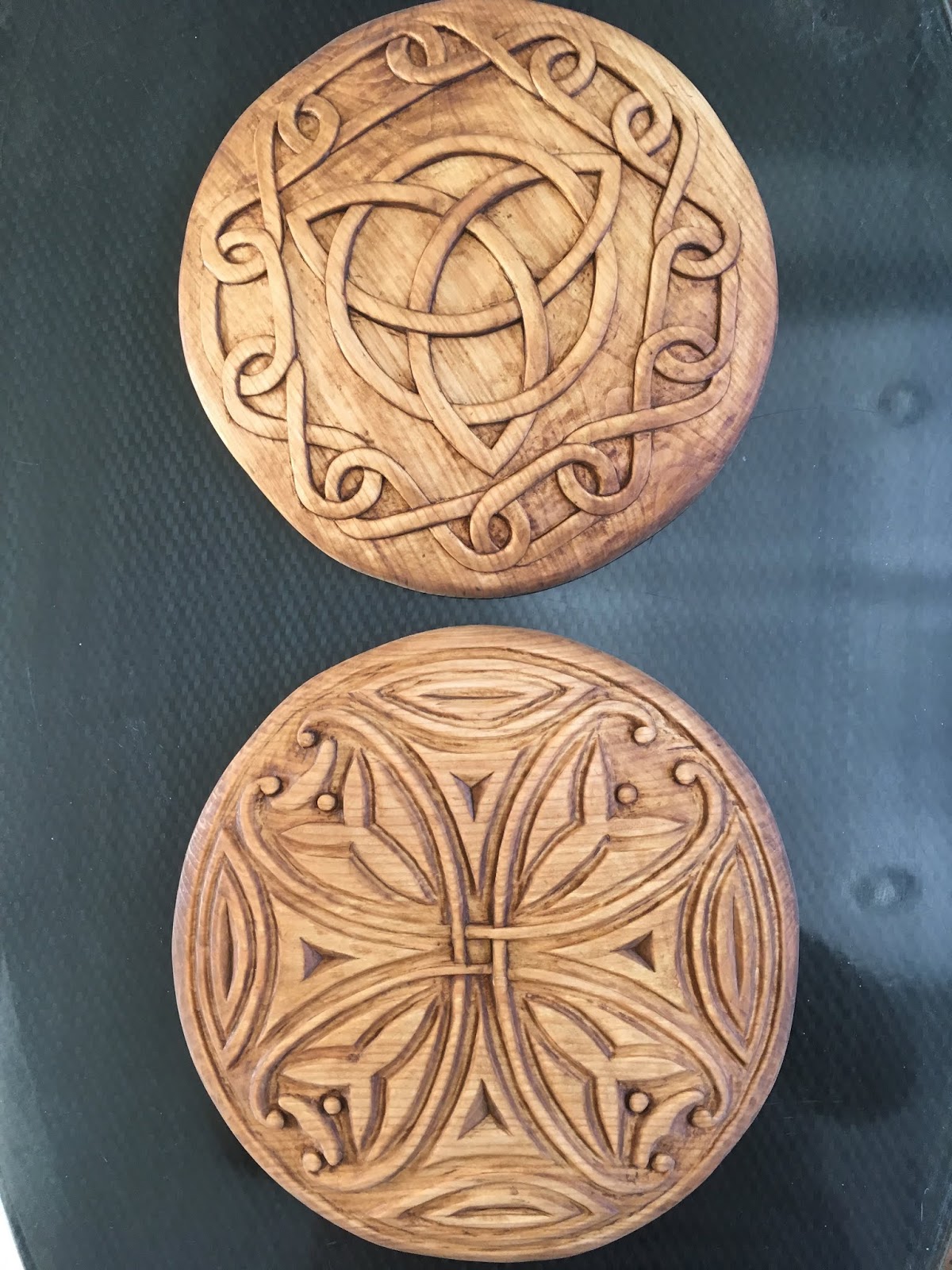
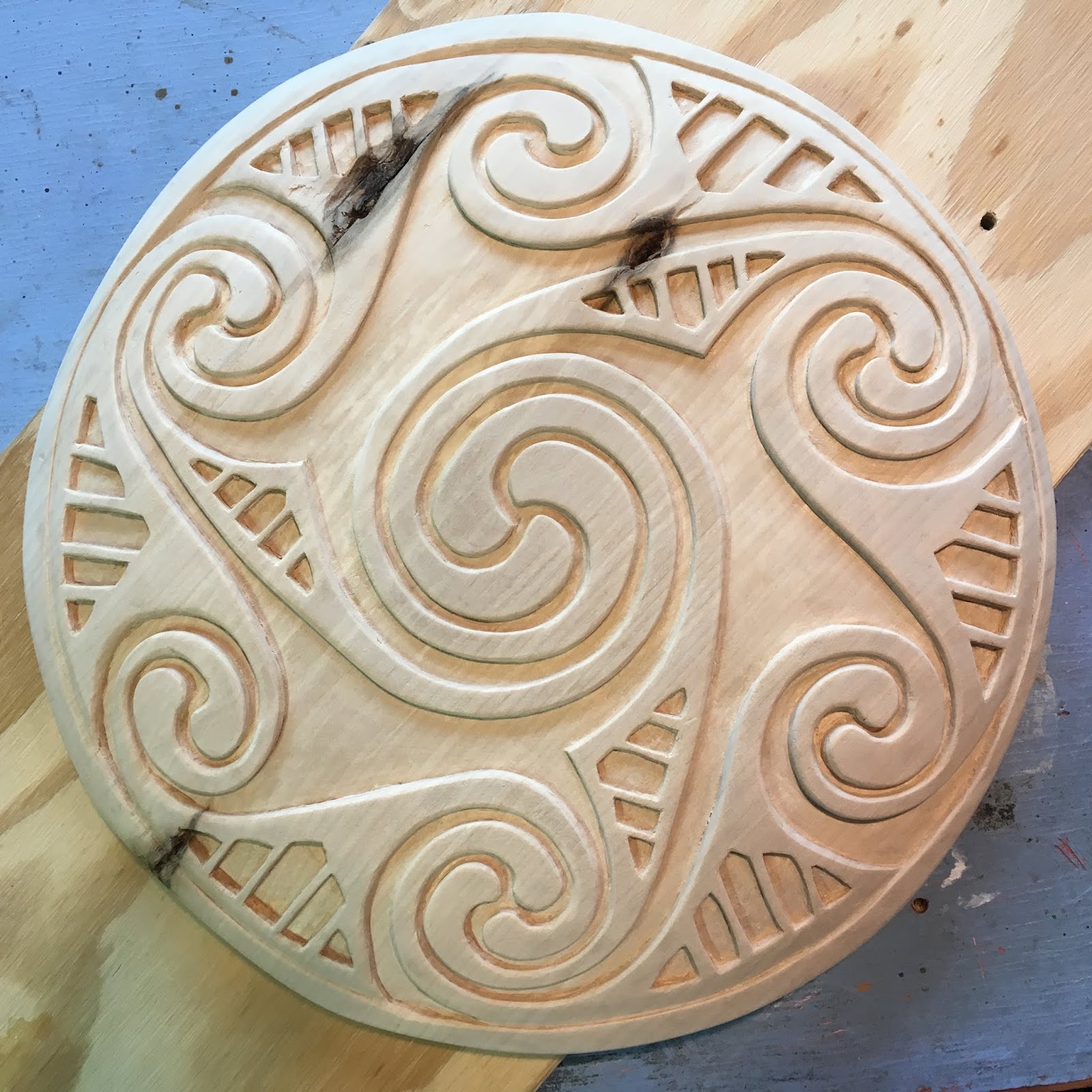
I've recently completed several carvings that I call "medallions," intended for application to the interior of the Stavkirke.   Initially inspired by a Norwegian pendant worn by Connie Sena, I expanded that design to a 12-inch diameter line drawing.  As this carving neared completion in early April, I found other pleasing designs of either Celtic or "Viking" origin.  (Such designs are, for the most part, culturally interchangeable, artistic motifs that were incorporated in ancient jewelry, weaponry, stone and wood.)  Included here are the examples thus far completed, installed in the Stavkirke.

Bottom design taken from Connie Sena's
Norwegian pendant.


With the activity of wood carving plus other repeated physical motions, I developed, temporarily, I hope, signs of bursitis in my right elbow, and later, finger joints. Better now, I can type on this computer, and I've even taken up the carving tools once again.  Summer, sunshine (but probably not raking) lie ahead, and I look forward to working outdoors once again.

-  Dick Purinton

Monday, December 31, 2012

AGAIN ??

Seems like the same old story, digging, trucking and muck.  
But each day holds newchallenges.  Current dredge spoil 
totals are now slightly over the half-way mark
objective in terms of volume of spoils, and

not quite half-way in bottom area to be dug.
Detroit Harbor, Washington Island

-  Last Day, 2012  -

By far the largest dredging project yet undertaken by the Ferry Line is the deepening of waters adjacent to the Island Potato Dock.  In the warmer weather of any other season, a successful project conclusion would be assumed as only a matter of time and money.  But with winter coming on, short daylight hours, temperatures sure to drop below the pleasant upper 20s of the past weeks, and equipment and people increasingly under strain, achievement of our goal is still a ways off.

"No, not another blog on dredging," was a comment I received, directed toward the series of reports with similar themes of late.

I can't help myself!  I find the combination of big equipment, the project scale and challenges too intriguing to pass up.  And, that doesn't begin to address the alternatives if the Ferry Line and the Island can't have one, safe ferry landing site come real winter.  Not succeeding is just something none of us can begin to contemplate.  So... its dig and haul, dig and haul, until sufficient material is removed.

"Why is this being done so late in the season?" is one question we've been asked.

The project as it stands on this last day of the year is a culmination of action begun months ago.  First, as water levels were monitored, we hoped the drop would not lead to extremes requiring immediate dredeging.  The cost of such activities was huge enough that we waited until we were sure certain there were no other options besides expenditure for dredging.

The paperwork - the filing of permit applications for state and local approvals that allow a project like this legally go forward began in early October.  That was when falling lake levels sounded serious alarms for the consequences of the coming winter's navigation.  We were fortunate in the permitting process to have had the prompt and full cooperation of regional WDNR administrative and Door County Zoning personnel,  We believe they helped to speed the permitting for this project more than would typically have been the case.  Our permits were received in mid-December, and at that time we had already set a tentative start date for digging.

There was also the verbal lining-up of a marine contractor.  Although we had Mike Kahr on the way, after he completed work at another site in Fish Creek, the scope of this project and the slippage of time brought further concern.  That led to our asking Roen by the middle of December to consider our job once their work in Egg Harbor was completed.  This they agreed to do.   We were fortunate to have the understanding and support from both Roen and Kahr.  Everyone understood that this dredging needed to be done ASAP.   As it happened, we are relying on the equipment of each marine contractor.

Critical in this project, too, is the willingness of Island men who own and drive dump trucks.  They've been willing to operate their trucks, loaded ten yards at a time, for five or six round trips - about 3.5 hours - per material barge load.  They appear at the Potato Dock after an advance phone call from Rich Ellefson.  Rich then works either on shore coordinating the trucking, or he monitors dredging progress and operates a skidster to assist cleaning out corners on the material barge.

Without the help of Pete Nehlsen, Dave Hanlin, David Small, Mike Jorgenson, Tim Ervin, Tom Jordan, Drew Rainsford and Jon Mann, plus one of Mike Kahr's dump trucks driven by Joel Gunnlaugsson (or myself, one day), and Hoyt Purinton supervising the pit dumping activities, the dredged material would soon stockpile on the barge and the entire project would be slowed.  Thanks also to Julian Hagen for consenting to receive spoils at his gravel pit.  Because the Hagen site is close, a truck can make the round trip in 30 minutes or less, when all goes smoothly.

Dave Hanlin, Rich Ellefson, Con McDonald
lent a hand in pulling slack on the hoist cable.


Rigging the cable for the clamshell used for offloading
stopped production Saturday evening for about 30 minutes.
Rich Ellefson, Dave Hanlin and others assisted Roen crew in
refastening the cable.


Tom Jordan drove his dump truck for every off-load, and he's also operated the Kahr excavator.  Saturday, I observed Tom as he climbed down from the excavator following a continuous, five-hour shift of digging.  (The excavator didn't have heat in the cab.)  Cold and stiff-legged, he crossed the barge deck to get behind the wheel of his truck.  Later that evening, while the bucket cable was undergoing repairs,  he laughed and joshed with other drivers, surprisingly fresh and enthusiastic.


View from behind the wheel of a Mack.  I kidded Pete Nehlsen about
"catching up with me," when actually he'd lapped
me earlier on the pit turn-around.   Good drivers can haul, dump, re-do
tailgate "sludge locks" and be positioned for
another load in less than 30 minutes.  It's no space shuttle cabin, with
half-a-dozen buttons and as many procedures for dumping, but I 

barely kept up.   A clutch failure sidelined my truck later, that evening.
Now, with a two-day holiday break coming, Roen's lead man Don Sarter indicated he'll return after New Year's with enough men for two shifts to enable round-the-clock digging.  The Roen crew is just as concerned about finishing the job for the Island as they are to complete their season and get their equipment safely back to homeport in Sturgeon Bay.

So, thanks for indulging me in yet one more report on dredging.  It's critical to the well-being of Washington Island to have this work done.  We could say that the stakes have never been higher.  For that, we're thankful for the willing participation of many hands during the recent days.
  -  Dick Purinton