Showing posts with label Martin Andersen. Show all posts

Wednesday, May 1, 2019

HIGH WINDS, HIGH WATER and RISING ANXIETIES


May 2nd - Lake Michigan's level nearly overtops bulkhead at ferry dock.
Extensions to mooring pipes and raised fenders--work
accomplished in the past year, now prove essential.
essential under such conditions.


Detroit Harbor, Washington Island -

Yet another dirty, windy day.  Winds continue from the ENE, currently spitting moisture in gusts of 30 mph or more.  Not a good day to rake, garden, golf or participate in outdoor activities, including a short dash from house to car, from car to grocery, or from car to post office.

Of course, there are workers who must be outdoors and perform their duties through the day, and they include the ferry crews.

Spring, if it will ever come, has been reluctant to show itself.  Temperatures have consistently been in the low 30s to mid 40s, and we've even seen flakes of snow on occasion.  But we're not alone here on the island.  Snow accumulation occurred in past weeks throughout Wisconsin, south and north.   I stopped one day at Home Depot in Green Bay, and I couldn't help but smile at the line of mowers covered in snow.  Rushing the season, I wondered?

Home Depot in Green Bay in early April


Looking down the waterfront, in particuar at the Island ferry landings, the rise in water level is inescapable.  Nearing the high water marks  recorded in the late 1980s, and with ferry decks considerably above the level of our docks, changes have to be made for ease and safety in loading.

In order to provide means of proper adjustment, steps were recently taken to raise the main ramp located at the end of the Island pier.

Contractor Mike Kahr, in coordination with Ferry Line crewmen, removed that ramp section and installed hinge beams to which the inboard end of the ramp is connected.  Concrete adds (a temporary measure, we hope) slope to meet the new ramp height.  Such changes are time-consuming, add to operational costs, but hopes are that this solution will serve our purpose, and that even more extreme future measures will not be necessary.  Who can predict if this high water mark will be the maximum?

Work will continue to provide the public with greater ease and safety in boarding, with the avoidance of extreme slopes on ferry ramps at Northport.  That plan will call for removal of the short ramp located on the pier's south side, and in its place sections of the ramp formerly located on end of that pier will be installed.  Those two 20 x 20 ramp sections will be joined strengthened for a longer approach on the south side.  New piling foundations will be required to hold this structure in place.   (Previously, for the past 35 years or so, electric screw jacks were used to adjust the south ramp angle.)

All such work, it is anticipated, will be completed prior to the busiest traffic season, when increased passenger and vehicle traffic demands usage of multiple landing points.

Jon Mann, Jed and Rich 
Ellefson and Hoyt Purinton shovel and level
cement from Martin Andersen's truck.


Sunday morning pour - Saturday's 20 x 20 pad was enlarged
with another, sloped section.  Location of pour
was complicated by two ferry ramps in close
 proximity to one another.


Jon Mann clears chute as Martin
Andersen, driver, prepares to reposition
truck.


In addition to such waterfront projects, an upgrade in Island terminal restroom flooring and partitions, a new water cooler with water bottle fill option and new carpeting, have been installed in late March, early April.  Not something one often notes as a highlight when traveling, but the results should make for a more pleasant experience overall.

What else goes on here in spring, you ask?

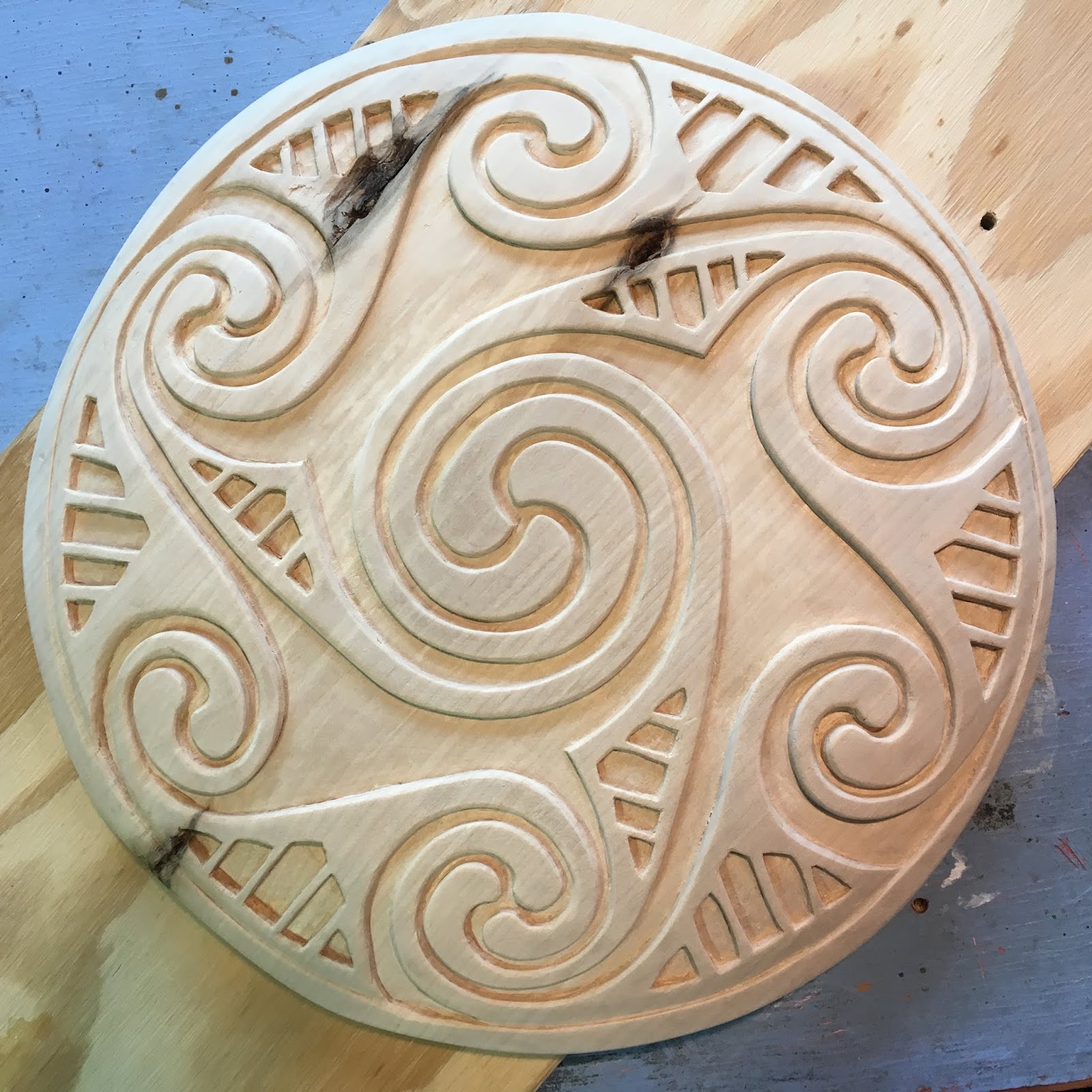
I've recently completed several carvings that I call "medallions," intended for application to the interior of the Stavkirke.   Initially inspired by a Norwegian pendant worn by Connie Sena, I expanded that design to a 12-inch diameter line drawing.  As this carving neared completion in early April, I found other pleasing designs of either Celtic or "Viking" origin.  (Such designs are, for the most part, culturally interchangeable, artistic motifs that were incorporated in ancient jewelry, weaponry, stone and wood.)  Included here are the examples thus far completed, installed in the Stavkirke.
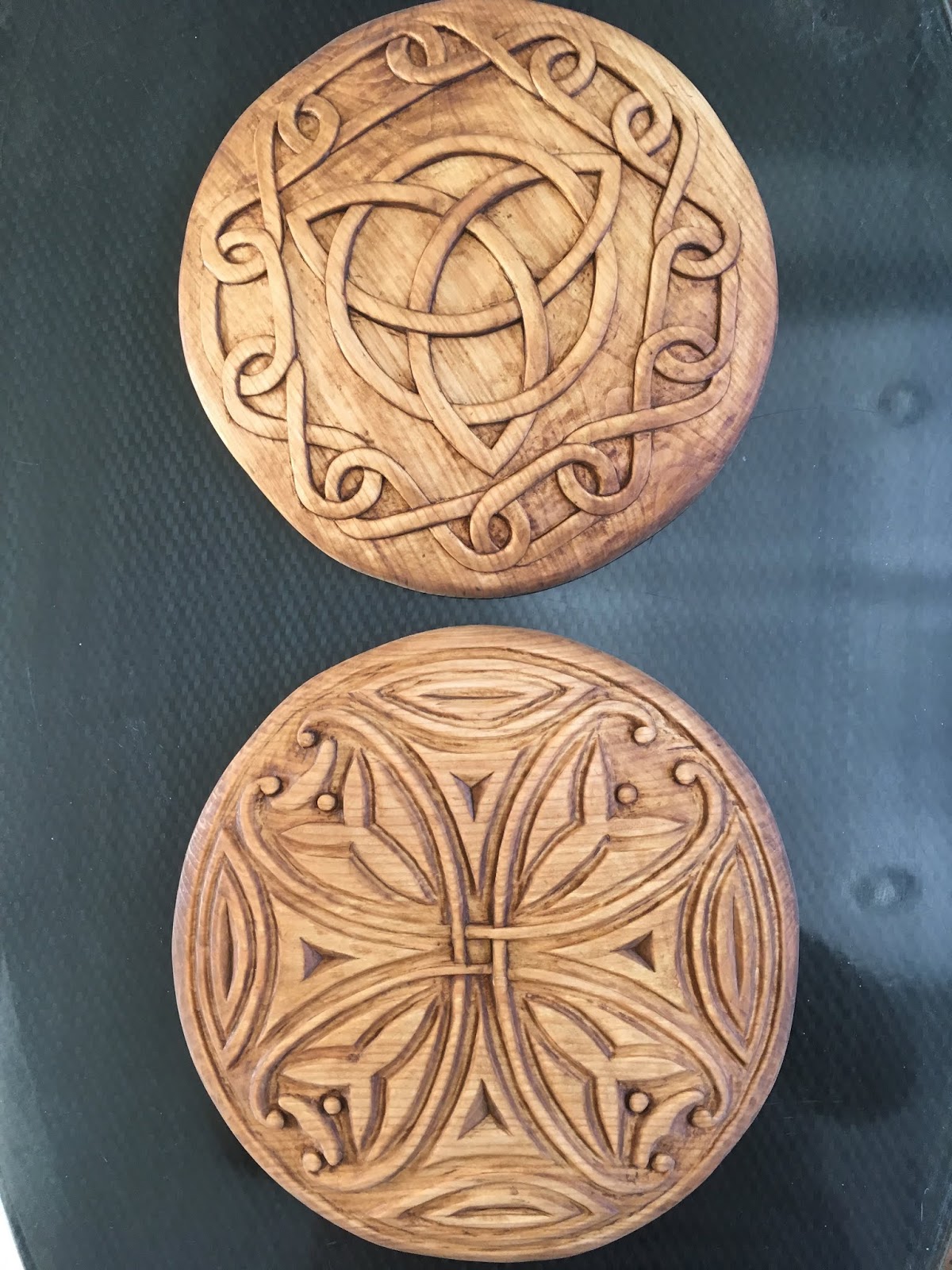
Bottom design taken from Connie Sena's
Norwegian pendant.


With the activity of wood carving plus other repeated physical motions, I developed, temporarily, I hope, signs of bursitis in my right elbow, and later, finger joints. Better now, I can type on this computer, and I've even taken up the carving tools once again.  Summer, sunshine (but probably not raking) lie ahead, and I look forward to working outdoors once again.

-  Dick Purinton

Wednesday, January 30, 2013

POTPOURRI

Weather photo, taken early Tuesday afternoon, Jan 29th.
(Purinton photo)
Washington Island, Wisconsin -

After promoting the picture of a mighty, bustling island in winter I open here with a shot of yesterday's Main Road.
Not a single car passed me in the several minutes I stopped to photograph... but there was activity just across the road!  The second shot of this soupy, unusually warm day (40 degrees F) shows Martin Andersen's pasture and cows.  I couldn't help but remember Alvin Cornell's favored adage, "Winter's fog'll freeze a dog" when I saw those animals laying down in the cold slop of the pasture.  Where's their sense, anyway?

Snow Friday, Jan. 25, again Sunday into Monday,
Jan. 27, then rain Tuesday turned it into mush.
Later today, Wednesday, we're expecting
6 to 8 inches of new snow.


The rain-slicked roads yesterday only added to a rather depressing scene, but just take a look at the two photos that follow.  The first was taken by Tyler McGrane from a vantage point on the Potato Dock as the ferry returned from Northport.  This was the morning of the first day's service out of that docking point.  The second photo is of a bright, cheery morning filed with sunlight and human activity.  It was taken by Tim Sweet who traveled to Washington Island Saturday, Jan. 26 for the meeting of Friends of Plum and Pilot Islands, for which he serves as its president.  Tim also took terrific photos of Rock Island later that day, but I think he'll submit them for the FORI website at some point.

If it wasn't still dark outside this morning, I could provide a weather update for you...instead, you can look in on our Ferry Dock Webcams at www.wisferry.com     Enjoy your weather, and your day, wherever you are.
  -  Dick Purinton

Ferry returning, single-digit morning, Monday Jan. 21.
(Tyler McGrane photo)
Cold, crisp morning as ferry approached Island,
Saturday, Jan. 26.  (Tim Sweet photo)

Thursday, July 7, 2011

LYONS ISLE VINEYARDS

Tim Lyons inspecting grape foliage for insects.
Washington Island, Wisconsin -

Relatively new to Washington Island is the Lyons' vineyard, located on the acreage south of the old Potato Farm, along Airport Road.  I've seen the vines while driving past, but I've not taken the opportunity until July 4th to talk in depth with the Lyons about their vineyard.

Tim and Julie Lyons believe working in their island vineyard is a labor of love.  There is the enjoyment of physical work in the vineyard, the never-ending process of planting, pruning, watering and caring for the vines.  There is also the prospect of marketing and selling their products with profitability on the near horizon.  That their products can be marketed was proven last fall when the entire production line of bottled verjus sold out.


(Verjus:  pronounced vair-zhoo.  An acidic liquid made from green wine grapes, often used in place of vinegar or lemon juice to add acidity to sauces, soups, dressings.  Popular as far back as medieval times, replaced eventually in many cultures by lemons and lemon juice.  In the Middle East verjus is known as hosrum, and it is still a cooking staple.)

In time, the Lyons Isle Vineyard's success may add to the diversity of the current island agricultural base, which has seen recent expansion toward crops such as:  red winter wheat for beer and spirits; island grown potatoes for a specialty potato chip brand; and locally grown table vegetables.  Each of these, through product names, marketing plans and packaging that often features the words Island or Washington Island, also broadens the public's familiarity with Washington Island as a tourism community.

As I approached, Tim was engaged in spraying his plants with a hardware-store-variety insecticide for the rose chafer, a beetle that hatches in June and is especially prevalent in sandy soils where its larvae lay dormant for a period of time.  Unchecked, this insect will devastate green grape leaves, leaving only the lacy stem patterns, and it will lay eggs on the leaves, repeating the cycle.  While Tim continued to spray, Julie and I talked about their vineyard venture.

Examples of rose chafer beetles, male on female,
potential threat to the health of grape vines.
First, their vineyard is more than a venture, although profitability is certainly a goal.

"When Tim came home from working with the vineyard, I had never seen him so happy," Julie said.  "We both recognized this as an additional fulfillment beyond his job as a member of the Chicago Board of Trade, where he specializes in working with South American grain companies."

His academic background includes an undergraduate degree from UC-Berkeley, an MBA from the nation of Colombia where he had also served in the Peace Corps, and a graduate degree from Stanford in futures and options.  He worked for Cargill for a number of years.  His career path has always been in agri-business.

When the opportunity presented itself for the Lyons family to spend more time with their vineyard on Washington Island, where they and their two sons have spent portions of many summers, it seemed the right direction.  Although Tim is not yet retired, he works from his island home during the growing season via internet and phone.  He's able to devote daily attention to the vineyard.

Why, I wondered, had the oldest vines, the ones that are now capable of producing grapes, been planted around the field's perimeter?  The most recently planted vines grew in the field's interior.

"Tim bought this land with the idea of agriculture of some kind in mind," Julie said.  "He just wasn't sure what it would be.  For a summer he partnered in growing buckwheat, and the following summer, winter wheat.  Then, he leased the land to Martin Andersen for grazing cattle.  He considered wild flowers, a seed catalog, and grazing sheep.  But it was when he decided to try grapes, about eleven years ago, that he planted them around the available space at the field's perimeter.   In the past few years, since cattle were no longer grazing, we've planted five acres of new grapes in the interior.  They should begin to produce in another year.   Grape vines take four years before they're ready to produce.  We may consider planting another five acres in the future."

Julie described how much labor and time it has taken to bring the vines to this stage:  preparation of the sandy soil, monitoring for insects and mold, and regular watering.  Last year, a new well and pump house was added, (they previously hauled water in 55-gal. drums in the back of a pickup).  Youngest son, Timmy, helped install the new plastic irrigation system in the evenings,  following his daytime construction job with contractor Jeff McDonald.

Why verjus and not wine?

Julie showed me a 750 ml bottle of their red verjus product.

The answer to "Why not wine?" lies in the Lyons' ability to process, bottle, label, and sell directly to customers - on their own.  Last fall, Julie personally processed grapes, filled and labeled each bottle, and packed each case.  Her professional background in marketing has now proven invaluable in promoting their own product line.

"We sold our entire 2010 production in eleven days," Julie said, "with a few bottles sold locally and the rest distributed to Madison area restaurant kitchens through Elegant Foods of Madison."

With that initial success, there is less incentive to compete in the competitive wine market, which requires transport of picked grapes to a third party vintner, shipments of bottled wine, and hoped for visibility on wine shop shelves.  The Lyons have been able to produce and sell their complete harvest as verjus.

She noted that when a few bottles were given to area restaurant chefs as samples, those chefs were ecstatic.  They had been looking for such a product but were unable to find it anywhere.   Their response to using the product was overwhelmingly positive.

The grape harvest for verjus must occur before ripening, because it is the acidic nature of verjus that makes it so desirable.  A device is used to sample the sugar content of grapes, measured in brix.  8 to 14 brix is considered a good range for verjus.  When the juice content of grapes is high, but the sugars are still low, that is the optimum harvest time. On the island, that is usually in late August.

The brix content and the variety of grape used are noted on each label.  Sugar content varies during ripening and by variety, and sugars can even vary within an individual grape bunch, because outer grapes receive more sun and ripen faster.   But when processed, Julie seeks an overall, or averaged, brix number.  The higher the brix number, the higher the relative sweetness.  The processed liquid remains non-alcoholic because of the low sugar content, and unlike wine, remains unfermented.

Julie noted, "It is a delicious drink over ice with sparkling water, and a splash can also be used to flavor a mixed drink."

Cooks use it with moderation, too, perhaps a few tablespoons at a time, to flavor the entree ingredients.  Chefs also like to pair it with table wines for a more complete, compatible meal.


Grape varieties grown by Lyons Isle Vineyard LLC are considered "Cold Climate Grapes."  These specialty plants were developed at the University of Minnesota, and they are favored in climate locations around the 45th parallel.  The Lyons attend the Cold Climate Grape Conference each winter, where they exchange growing tips and general vineyard information with growers from all over the world.  While their vineyard has seven different varieties of grapes, four red and three white, through experience their preference has settled on the St. Croix grape because it is a good "blending grape," but it can also stand on its own.

Julie held a 750 ml bottle of red verjus to the light, and we decided that bottle  might be best featured in the vineyard beneath a grapevine.

Look for the Lyons Isle Vineyard products on local store shelves toward early fall.  This year's vintage will feature a 375 ml bottle at $15, and a 250 ml bottle at $12.  They hope production doubles this year, if all goes well, but owing to demand, the supply may still be relatively limited on the local market.

 -  Dick Purinton