|
Framed by the lightening holes in the main fore and aft structural bulkhead,
Con McDonald and Hoyt Purinton install foam blocks
in the aftermost compartment of the ferry
Robert Noble. |
Washington Island, Wisconsin -
Spring at the Detroit Harbor ferry dock typically means painting, cleaning, assembling systems drained over winter, and minor modifications in readiness for daily operations. This spring has been different in that there were several, major projects to complete. By mid-May, we're nearly there.
 |
Pete Nikolai and Eric Brodersen
open a mold containing newly
expanded, closed-cell foam block. |
 |
Hoyt Purinton with pile of blocks
in workshop. |
Robert Noble
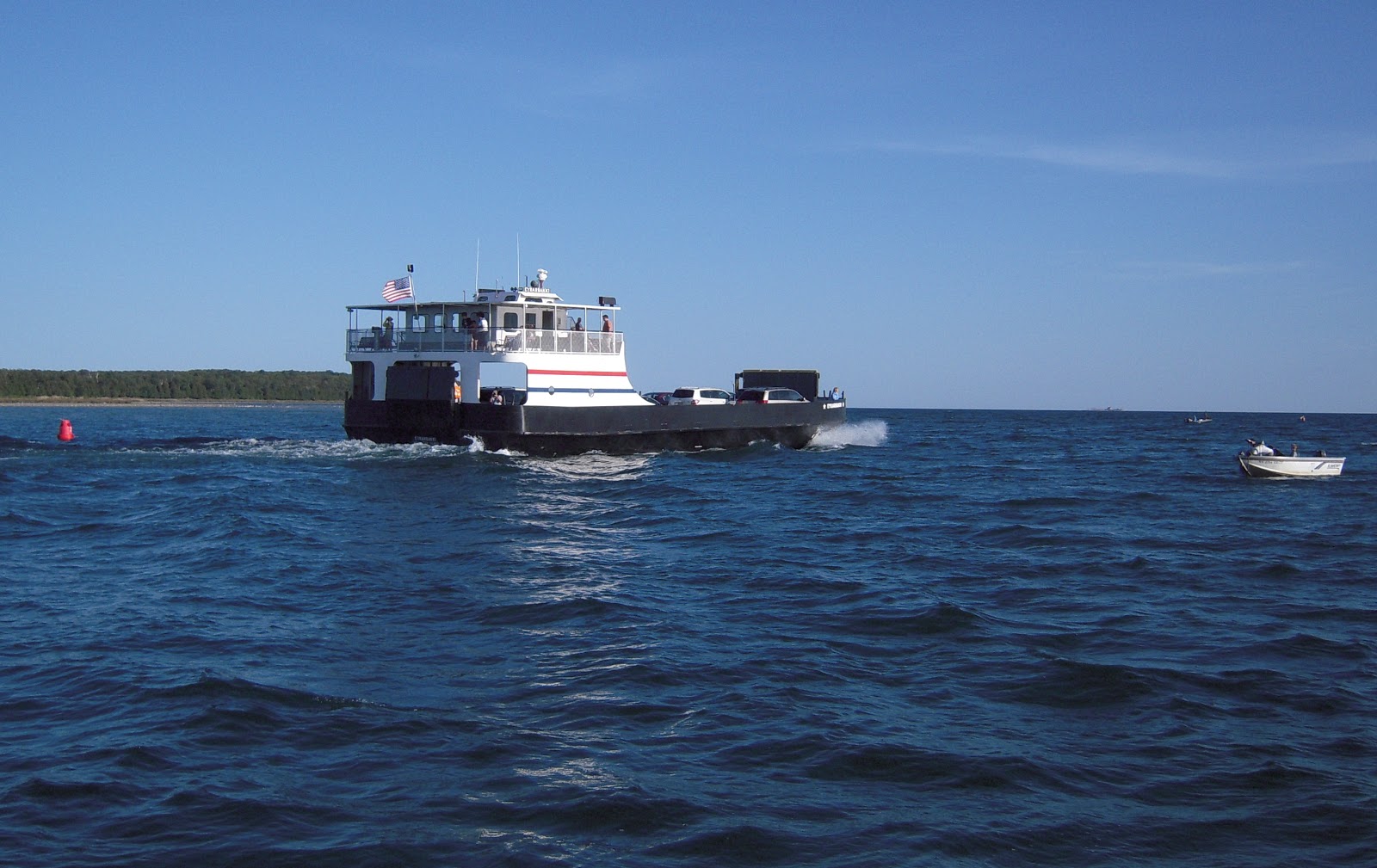
This ferry was at Bay Ship for all of November in late 2011 for new engines and gears and new cooling, hydraulic and fire systems. This was extensive work resulting from the replacement of original (1979) Cummins diesels with CAT engines. The major emphasis was to reduce emissions levels and lower the gallons of fuel consumed per hour of running time. (So far, fuel consumption is under 7 gallons per hour, per engine, at running speed of 1100 to 1200 rpms.)
Once back in her Detroit Harbor berth, our crew cleaned and repainted the entire
Noble engine room. In late February, as a result of the Coast Guard recalculating vessel stability for the
Robert Noble, it was determined that due to a newer formula than that under which it was designed in 1979, additional measures would be needed to conform with required stability.
While there were several options, the one least invasive and least costly involved adding inert, light foam material to the aftermost compartment. That is what we chose to do, and in the accompanying photos, block production and installation are shown. The objective is to displace water that might, in an extreme flooding situation, fill the after compartment.
We were fortunate in this project to have new soft patches, removable covers over each main engine. These were installed as a part of the re-power project. With the starboard hatch removed, eight-foot long blocks could be maneuvered into the after compartment. Steel flatbars, 1/4" x 3", will be bolted to frames, securing the foam blocks between the frames.
 |
| Starboard, aft void with foam blocks installed. |
 |
Robert Noble deck, with hatch over starboard
engine removed. |
Washington
The
Robert Noble had been used during the first week of May under a provisional Coast Guard certificate, while a warranty repair was in progress on the
Washington. The
Washington's starboard engine had a bad rear crankshaft oil seal, the second time this seal had failed in two years, for a two-year old engine. The flywheel housing was determined to be the cause, ever-so-slightly out of round, and a new one was located to replace the original. (The casting was slightly off from the factory, unusual, but not unheard of, and a new one was located in Germany with identical bolt hole characteristics. It was air-freighted to Green Bay where our engine awaited at the CAT/FABCO shop.) The repaired engine was then delivered to the island last Thursday morning and lowered in place through the soft patch opening. It was in running order by late afternoon, and the Washington was immediately placed back on the line. Crossing our fingers, we believe this ferry is now in top mechanical order for the upcoming season!
Arni J. Richter
During the latter part of February 2009 while routinely inspecting the
Arni J. Richter's aft below deck compartment, crew members discovered what proved to be a slight trickle of water. (This was determined over a period of several weeks, as there can also be tiny leaks under gaskets surrounding deck hatch covers, as well as condensation collected on the shell plating.) Closer inspection, monitoring of the suspected area, and conference with the Coast Guard Marine Safety Office in Sturgeon Bay led to a determination that several small weld fractures had occurred above the starboard skeg. The two skegs on the
Arni J. are fin-like structures attached to the underside of the hull, through which the propeller shaft protrudes.
 |
Worker prepares skeg for new shell plate, an area of
convergence of multiple planes, and which requires extra care
to avoid shaft log movement during heating, cooling
of welded members. |
A crew from Bay Shipbuilding came to the island on an afternoon ferry, bringing with them grinding and welding gear and steel plate, and they spent the next fifteen hours, until early dawn, welding the fractures and installing framing stiffeners. These repairs were intended to be temporary, only. In two years, the plate in the area of concern would need to be cropped and repaired to Coast Guard satisfaction. That is when the next scheduled dry docking exam for the
Arni J. came due. That required hull inspection and repair period took place this spring, during which time the affected areas surrounding both port and starboard skegs were addressed. Substantial 5 ft. x 5 ft. x 1" inch plates were inserted above each skeg to better carry the weight and absorb stresses. New interior framing running both fore and aft and thwartships (side-to-side) was also added.
Because of this work, the
Arni J. Richter was in the yard from early April to early May while subject areas were prepared for new plating and framing. Examination of the existing areas led to various discussions regarding proposals to fix problem areas, and this, too, added to overall time at the yard.
In the end, it can be said that the fractures found in welds were likely a result of several different factors, not just one. Vibration, plate movement and stresses at various points can be expected in a vessel that runs through ice. Ice encountered in the Door can be heavy and hard, and there are times underway when it passes continuously between the two skegs, funneled into the blender-like mix as it passes through the propellers. Had this ferry never operated in winter, it is likely the problems seen would not have developed.
The framing structure in surrounding areas over the skegs, in retrospect, appeared relatively light, given this vessel's mission on a year-in, year-out basis. There were also signs that a closer fit of plating and higher quality welds may have forestalled or prevented failure.
 |
Interior shell in areas over skegs received extensive,
deep framing to carry stress and reduce plate movement. |
During the entire time the
Arni J. Richter was operated,
following the initial recognition of the problem in March 2009, the intermediate measures we adopted under Coast Guard and naval architect direction proved to be prudent and satisfactory.
Now, each of our ferries, upon completion of the foam block project, will be in excellent shape for summer operations. By mid-June, a ferry may operate 10-12 hours each day, for the next three to four months, before the schedule begins to wind down.
- Dick Purinton
 |
Machinists (man at right) took hourly readings to
determine change in shaft log
alignment. Welders and fitters tailored
their work to minimize movement. |