Showing posts with label Jim Rose. Show all posts

Saturday, July 18, 2020

MADONNA IS HOME! - 38.0

Madonna shortly after departing Bay Shipbuilding Friday
afternoon, enroute to Detroit Harbor on delivery run.
(Fincantieri Bay Shipbuilding photo)
Detroit Harbor, Washington Island -

When a vessel is designed, constructed, launched, sea trialed, and then sailed home, the hope is always that it will be right: feel right, look right, handle right.  Each step along the way, including the components chosen, contribute to the overall product:  engines, gears, shafts, propellers, electronics, seating, flooring, deck coatings.  If one or two elements miss the mark the whole can seem off and create disappointment.  And until the whole is assembled, sea-trialed and sailed, judgement cannot be properly given.

Madonna shadowed by Washington Island Coast Guard's
SAR vessel as she entered port.  (Tyler McGrane)
That is a part of the mystery of shipbuilding: built upon science, improved from existing examples, and put together by those who know their trade well.  Still, always a bit of a gamble as the whole comes together.

A portion of the small fleet that trailed in the Madonna's
wake.  (Tyler McGrane)
In the case of Madonna, the new ferry designed by Seacraft Design and built by Fincantieri Bay Shipbuilding, both Sturgeon Bay entities, the process and the product thus far speak of great success.

Added to the characteristics listed above is functionality, its acceptance and trust by those who sail her, by those who stand upon her decks as passengers and enjoy her services.

We know some unknowns await to be answered, but many major hurdles have been crossed.  Gauging by initial crowd reactions, for there were several hundred who came out last evening by boat and by car to see the new ferry, it meets the criteria of a winning vessel so far.

Madonna and Coast Guard escort.
(Kim Toro)
Last-minute items had been sorted out during this past week, a press to resolve "head scratchers" such as improvement of the steering system (check!) and the suction for pumps that energize the fire mains and sprinkler systems (check! yet again).   Yard personnel, vessel designer, and WIFL personnel put their heads together to best resolve those issues.

A Certificate of Inspection was granted by the U. S. Coast Guard, required before carrying vehicles and passengers.  A check was exchanged, a signature of ownership given to mark the transfer. and hands were shaken by Todd Thayse, Fincantieri General Manager and Vice President, and Rich Ellefson, WIFL Construction Representative and Company Vice President.  That was late on Friday morning.


A mild breeze blew from the south as Rich
Ellefson made his approach, then swung the
Madonna's stern 180 degrees to nail this first
landing at the Island dock.  (Jim Rose photo)

By 2:00 pm a number of vehicles were run aboard the car deck, mooring lines were cast off, and Madonna headed north for home port.

On board were Hoyt and Rich and their two young sons, Magnus and Brody, observer Terri Moore (who in a "normal summer" would drive the Cherry Train), and a number of key Bay Shipbuilding personnel.

Among the latter was Steve Propsom who was on a "final lap" over the waters of Green Bay aboard his last project assignment as shipbuilder and project manager.  Upon mooring at the Island, lines were made fast to the Island pier and Steve's 46-year career in local shipbuilding came to a close.  Retirement adventures would next deserve his full attention.

Along with approximately 15 other small craft, we on the Moby Dick fell in behind the Washington Island Coast Guard in helping to escort Madonna in her last mile to port.  We were thrilled by the sight, and we absorbed each authoritative air horn blast as Rich Ellefson issued the "long salute".  Such moments in one's life (and career) are rare, especially when they happen on such a beautiful Friday evening, joined by several hundred onlookers. We sensed community pride in product, and not just our own.  We are convinced this vessel will continue to meet expectations.  

Madonna, positioned for backing in to south ramp.
Rich stands at the stern controls, but there's also
great PH 
visibility, should the operator chooses to remain
in the wheel house throughout the landing evolution.

(Jim Rose)
No sooner had Rich swung the Madonna's stern to the pier, pressing the rub rail against the dock tires, and the ramp was lowered and vehicles on board were driven off.  Dozens of folks on the pier, most wearing face masks and mindful of the Covid-19 threat, had by that time lined up to come aboard for closer inspection.  This parade of viewing lasted for the better part of an hour, before the crowd thinned.  The crew then removed pallets of paint, lube oil and spare parts from the deck, stores intended for future maintenance and repair projects, before laying the new ferry port side to the pier for the evening.

First line over, secured by Hoyt Purinton, approximately 6:30 pm.
(Jim Rose)


This morning, as a line of thunderstorms approached, Mary Jo and I got up early, still dreaming about the evening before.  We drove out to the ferry dock to see if the Madonna, a longtime dream, was still moored securely at the Island pier.  She was.

We returned home satisfied, but excited for her future appearance on local waters.  We look forward, as do crew members of the Ferry Line and our many customers, to its first regular service.

Steve Propsom (Bay Shipbuilding), Magnus and Hoyt Purinton,
and Rich Ellefson, upon arrival, relieved and satisfied at successful
delivery, and to be joined by well-wishers.
(Kim Toro photo)
Madonna is about to enter dedicated ferry service, for what we anticipate will be decades of faithful operations--winter and summer--for Washington Island, its residents and visitors.

All off this has happened during the 80th anniversary of Washington Island Ferry Line, Inc., an additional reason to celebrate.

      -  Dick Purinton

PS -  I was busy steering the Moby Dick last evening and wasn't able to take photos.  Thanks to all who sent me a selection from which to choose.
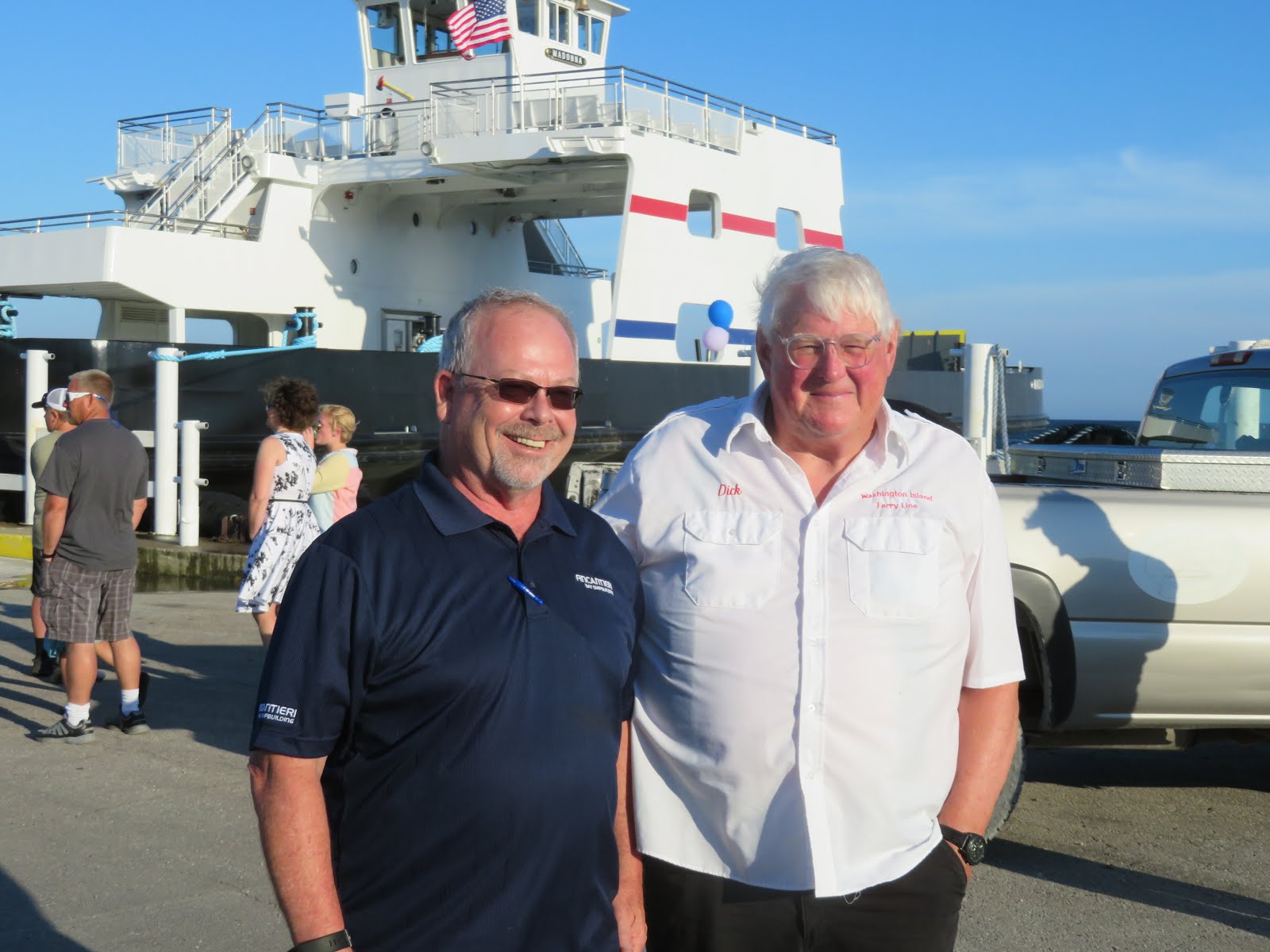
Steve Propsom with author.  Steve retires after
46 years in area shipbuilding.  One note: this writer also
celebrates 46 years with the Ferry Line, in late October.
Jim Rose, WIFL employee (and the photographer here)
reminded us that his first day as a Ferry Line ticket seller
was the
 day of the Robert Noble christening, June of 1979.
Steve began his career as a part of the Peterson Builder's work
force on that ferry project.
We've each had the pleasure of observing the bay freezing
over--and then thawing once again--
many times.    


Friday, November 27, 2015

REMINDERS

Fall weather at its best, with wind gusts topping 40 mph,
Thursday, Nov. 19.     Eric Foss guided the Robert Noble
through 6-8 ft. swells.   A rare cancellation was made
for the last trip of the day, with darkness adding to
operational challenges.  


Washington Island, Wisconsin -

Erik Foss reminded me a week or two ago, as I drove onboard the Washington for a trip down the peninsula, that my last blog was posted in late September, the equivalent of internet eons ago.  Such a deterioration in communications.

So I'd better get with the program.

If you happened to watch Channel 5 weather at the 6:00 pm and 10:00 pm on Nov. 12th, you may have seen the ferry Washington lurching through seas in the Door.  Erik Foss happened to be at the wheel, and he was comfortable enough on camera to crack a joke with the reporter, a reference I was unable to hear.    Nearly all ferry trips are made without television crews along for the ride.  Their film, however, showed a more realistic look at ferry travel to and from Washington Island, at least in the fall.  And, in more recent days the conditions were far windier.

But overall the 2015 Fall season was mild with moderate wind conditions, and the fall colors held on well into October with plenty of unexpected, bonus days that enabled us to accomplish outdoor activities.   In addition to picking up fallen leaves, many of my outdoor hours were spent glazing windows and touching up the paint on old buildings.   Unless it warms up again, I'll move on to brushing and woodcutting for a few weeks, before the snow and consistently colder temperatures stay with us.

This morning, following a light rain most of Thanksgiving day, we awoke to a light cover of snow on the ground.   The thermometer hasn't budged off the 30-degree mark.
  *     *     *     *     *


Jim Rose sent along photos of an improvement for the Percy Johnson County Park (formerly, Eastside Park.)   The transportation of this modern day outhouse to the Island was shipped on two separate semi trucks, along with a large, portable crane to lift and set each section.


This dandy crapper came in ready-to-assemble sections:   the upper structure for above-ground, walk-in patrons, and the vault for below ground waste storage.   Wonder what Percy would think about the improvement, in particular the cost?

In the interest of a more complete story, I need to take a photo of the finished product, learn where it was manufactured, approximate cost, and its success as a public improvement.


      *      *     *     *

Thanksgiving blessings

With Thanksgiving leftovers still on hand, and appreciation for the bounty so many of us enjoy in terms of food, shelter and the essentials of life, I'm also reminded of the different approaches individuals choose to take.

Back in mid-September (while waiting in line for an order at the Albatross) I had a conversation about the seemingly late turn of colors, and of the eventual coming of winter.

"It might be warm now, but just wait," the man said. "If you watch squirrel activity,  they've been quite busy lately, and that's a sign it's going to be a hard winter."

I've heard it said before by old timers (Jack Hagen, among others) that squirrel activity is an indicator of the severity of winter to come.   (It could also have to do with the abundance of acorns produced in a particular year that spurs such activity, not unlike shoppers scurrying after bargains on the day following Thanksgiving.)   The gist of the old adage is,  we can learn from observing squirrels, that they sense things we don't.

Earlier this fall, we observed squirrel-like human activity, too, the storing away of tons of canned food, dry goods, and essentials tools and equipment.

Was this storing of "nuts" the conscious preparation for an impending disaster that regionally and nationally might cripple communications, supply lines, transportation routes and electric grids?  

Almost everything we use depends upon electronics that are susceptible to hacking and interruption, whether by villainous perpetrators or natural causes.  A major disaster would make such private storehouses of goods an essential element for survival of the few who have the foresight, wealth and gumption to see into and prepare for the future, so the logic goes.

This way of thinking - to my mind negative, and almost nutty -  me wonder if the rest of us are just naive to forces beyond our shores?    Those who properly prepare, as I understand it, are people who act on knowledge and a healthy fear of things to come by laying in supplies for the impending disaster.

As I was about to dismiss the notion to follow the lead of squirrels, I read a short piece in an AARP magazine (that's right, my undisputed source of information!) where television journalist Ted Koppel was interviewed regarding his theories of what might happen if the nation's electric grid goes down.  Less than a week later, I listened to Koppel on the CBS Sunday Morning program as he elaborated on his investigations.  As he sees it, a major electrical grid failure is inevitable, just a matter of when, a belief he outlines in his book, Lights Out!   No one in government is prepared, or looking out for our interests in such a scenario, according to Koppel.     

Then, I read a piece in the October 26 issue of The Waterways Journal, a weekly magazine of maritime trade and transportation on North America's inland waterways:

   Navy To Reinstate Celestial Navigation
After an absence of nine years from the curriculum of the Unites States Naval Academy at Annapolis and a 15-year absence from Naval ROTC programs, U.S. naval officers are once again learning to navigate by the stars, the Navy announced.   
The class of 2017 will be the first in many years to graduate with a basic knowledge of celestial navigation.   

This article went on to announce that the U. S. Navy was reintroducing sextant skills to its cadets, due to the increased concerns about the vulnerability to errors and possible hacking of government high-tech instruments and satellites.   It was also possible, it was noted, that during a national emergency our government might elect to shut down the GPS system, because it might be used to advantage by potential enemies.

This information was, again, something I hadn't considered.  I agree there are real benefits for teaching celestial navigation as a back-up to electronics (as was the practice for a number of decades), and I hadn't even realized that celestial navigational had been dropped from the curriculum for future Naval officers.

When adding these various things up, a conscientious squirrel begins to wonder if we're far enough out of the mainstream of life to ignore the signs?   Will our household  in a disaster fail to provide health and happiness?  Should we continue in belief in the American system, as we've known it?

Surely there are thousands of brilliant people who. through their concern for prosperity and survival, have given a great deal of thought to the consequences?   If so, we're in good company continuing along our path of "productive citizenship."   Projects, contracts, planning and financing for the future …  continues apace in all manner of scale, nationally and globally.   Preparing for an eventuality that may never come is a risk analysis of the highest order.   It can seem silly, like the practice of ducking beneath classroom desks in the late 50s to avoid nuclear annihilation.

It's been suggested to me that what others do is none of my business, that one can spend hard-earned income however he or she wishes, even if that wish is to stockpile the goods of this earth to extend our days.  Maybe they're right.   I shouldn't puzzle over the lives and decisions of those I can't understand.

But, another question bothers me:   How will those individuals during a major disaster - the ones with foresight and capital to cache food and supplies:   a) Hold off friends, neighbors and relatives at gunpoint when desperation sets in;  or,  b) Share food and supplies equitably with those same neighbors, friends or relatives, thereby limiting their own longevity?

We might take action from another observation in nature.  Every so often squirrels are observed jumping into the lake and swimming away from shore, perhaps when populations exceed nut supply.

Should we follow one another, like squirrels over the edge of the bluff, or continue to stand on firm ground, building on the foundations laid before us?    Do we allow squirrel observations to rule our lives?


-  Dick Purinton


Thursday, November 14, 2013

WINDS OF NOVEMBER REMEMBERED


Jim Rose took this photo this morning, with Roen work and material
barges moored adjacent to the main ferry pier's
south side.


Washington Island, Wisconsin -

The Roen barge alongside our regular ferry pier tells the story today, the second straight day with no dredging activity due to strong SW winds and seas that make maneuvering barges difficult and dangerous.  We've been able to make our ferry trips in the southerly winds, all right, but the work of unloading spoils has been temporarily halted because of high SW winds.  There is a roll that comes into Detroit Harbor, even sweeping around the end of the Potato Dock

On Monday, this most recent Veterans Day, our ferries made only several of the scheduled trips.  Two boats carried cars and passengers at 2:00 p.m., and that was the day's last run.  After the early trip, the other morning trips were cancelled.

Monday's cancellations were, I believe, the first such scheduled runs cancelled in 2013.  That day, because the winds were from NW, sea conditions in the Detroit Harbor channel remained smooth, despite gusts, and the Roen crews continued dredging.  In fact, we had several days of quite tolerable weather early this week - though cold - during which dredging operations went full-bore.  But then, when a warming trend brought swings in temperatures of twenty or more degrees, the southerly air flow increased to the point dredging operations were halted. 

Hazards of trucking typically don't
include deer, butduring his last run of the evening
several days ago a deer tried clearing Dave Hanlin's truck
hood.    This photo by Jim Rose shows Hanlin's truck
at Northport, awaiting a replacement windshield.
In the marine construction business there is always something to fix on a weather day, and the Roen crew busied themselves with a generator project yesterday.  But as the clock ticks and the season advances, production must continue or else we'll surely be looking at a prolonged dredging project well  into 2014.  That's not in anyone's best interest.  

Following discussions with Roen and Foth, we will likely permit the offloading of spoils at our regular dock until working conditions improve.  With the swinging of mud and stone in buckets, and the movement of trucks, there is an associated mess and mayhem, which we prefer to take place at the Potato Dock, out of the way of ferry traffic.  But we also realize the necessity of keeping this project moving along, so our main ferry pier may become the temporary offload site until winds abate. 

Gordon Lightfoot's lyrics that paid homage to the men of the Edmund Fitzgerald, lost in a Lake Superior storm November 10, 1975, and to Great Lakes sailors in general, brings to mind storms of historical proportions.  There was the Armistice Day blow of Nov. 11, 1940, to which Arni Richter often referred, etched into his memory.  The November 1913 "White Hurricane" was another, which carried vessels into dire straits in local waters over a period of several days:  the Louisiana, Halsted, and Plymouth.   Winds were recorded exceeding 70 mph during that storm.

Joan Hansen reminded me last week that this year was the 100th anniversary of the Louisiana coming ashore in Washington Harbor, its crew managing to safely reach shore in a lifeboat after a night on board, while the hull burned, eventually to the water line.  The Louisiana was light after unloading cargo in Milwaukee, enroute to Apena, Michigan, and had dropped into Washington Harbor for protection from the wind and seas.  When the wind direction shifted, it dragged anchor with seas bringing it progressively closer to the beach.  That was November 8th.

On the 10th of November, with the storm still raging, it was the lumber barge Halsted's turn, and it landed after many hours broadside on a ledge near shore.  Later, in calmer weather, it would be pulled to safety with the help of a dredge and steam tug, to continue its service.  No lives were lost on either the Louisiana or Halstead.  

One account reported the boiler of the Louisiana salvaged in 1920 by the Leathem Smith Company of Sturgeon Bay.  The compound steam engine was also removed later that year, it is believed.  

North of Washington Island, however, the barge Plymouth had been towed into the bay, possibly seeking the lee of St. Martin Island, towed by the tug Martin.   The tug's Capt. McKinnon indicated later that he was towing toward Washington Harbor when he determined the strain of the tow cables was too much. The tug had itself already taken on much water through leaks in its hull and was in danger.  McKinnon feared that both tug and barge might go down together, and so a decision was made to let the barge go.  Shortly after the tow cables were cut, according to an account, the barge sank with seven men still onboard.  Another account had the Plymouth anchored for a time near Gull Island, with the tug, helpless, a distance away.  

McKinnon had apparently tried to turn his tug around in order to save the men in the water, but he was blown away from the site of the wreck.  It is unclear why so many men were onboard the Plymouth, an unpowered vessel, while it was under tow in heavy weather.  The helplessness of the men aboard the unpowered barge was compounded when the cables were cut. Their loss of life was reported November 12th, 1913.

This photo of the Robert Noble taken by Peggy Olson several years ago serves
as a reminder that when one of our ferries behaves like a rowboat or small
runabout, it isn't a good time to be underway.  In this instance, winds
were westerly and crossing the Door itself was the greatest, though brief, challenge.

 Each day's conditions - wind direction, sea state,
air temperature, ice  (if any)  - can impact the decision to operate

or not.


LOUISIANA - Nov. 8, 1913

The other day at the Archives, Kirby Foss asked, had I ever read the accounts of the Louisiana and Halsted in the Wreck Log from the Plum Island Life Saving Station?  He promptly found them for me, and here are the main portion of neat entries, official accounts for the Louisiana, followed two days later by the Halsted, made by Williamson Robinson, Keeper:

Nor Shellswick with team to haul Beach Apparatus to scene of wreck.

At 6:30 a.m. I received a telephone message from Washington Harbor saying that the steam barge Louisiana had dragged her anchor and was on the shore with the crew on board and that they needed our assistance.  The wind was then blowing a gale form the N.W. with blinding snow storms and it was not practicable to take the life boat to Washington Harbor as it would take hours to reach there.  We loaded the gear of the Beach Apparatus into the life boat and took the boat to Detroit Harbor where I had engaged a team to carry us to Washington Harbor.  We left the station at 7:50 a.m.  It took us some time to load the gear and to launch the life boat in the heavy sea.  We arrived at Detroit Harbor at 8:40 a.m. where I learned that the crew was on shore, that the vessel was on fire and that no assistance was needed.  I was informed that three other vessels in Washington Harbor were in danger of dragging ashore.  We continued our trip overland to the scene of the wreck.  The crew of the Louisiana was ashore and nothing could be done to assist the burning vessel but three other vessels were in danger.  We spent the day & night patrolling the shore. 

 From the Wreck Report entry a few days later, Nov. 10th, 1913, of the Halsted, also entered by Williamson Robinson, Keeper:

Nor Shellswick with team to carry gear of beach apparatus.

We arrived at Detroit Harbor at 9:30 a.m. on our way to wreck of Louisiana.  We learned that the Louisiana needed no assistance but that several other vessels were in danger in Washington Harbor.  We continued our trip overland loading gear of Beach Apparatus on a rig I had previous engaged for that purpose.  On arriving at scene of wreck we found that the Sch. Halsted anchored about 3/4 mile from head of Harbor was dragging ashore.  We patrolled the beach all day and night, building fires for signals to the vessel.  We expected the Halsted to come ashore at any time as at times she would drag a considerable distance and then would hold for an hour or more.  At 5 o'clock Monday morning the Halsted dragged within 60 feet of shore.  We shot a line over her and got the whip aboard.  The water is very bold at that point and the Halsted was hard against a shelf of rock.  We were ready to use the breeches buoy when a heavy seas lifted the Halsted upon the shelf.  It was then so close to shore that the men on  board hung a ladder over her port bow and we assisted them to shore.  When daylight broke we used the whip to bring their clothing ashore.  We could render the Halsted no further assistance but we remained at scene of wreck as a small vessel was in danger of dragging in.  At 3 p.m. the wind went down slightly and as the vessel was in no further danger we came to Detroit Harbor intending to return to Station.  As our boat was covered with ice we remained there overnight, removing ice form boat & returning to station at 11 a.m. Tuesday morning.

-  Dick Purinton