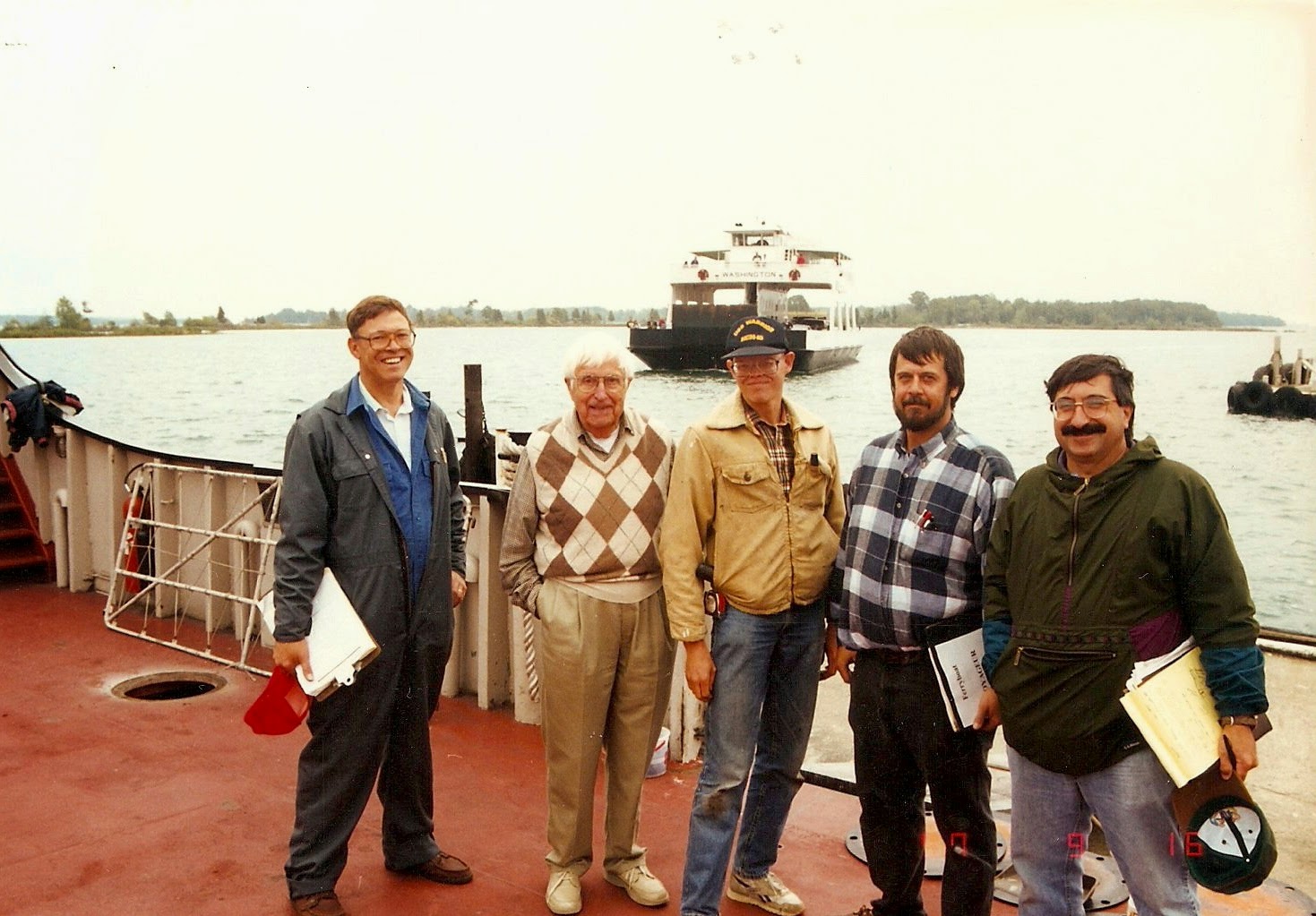
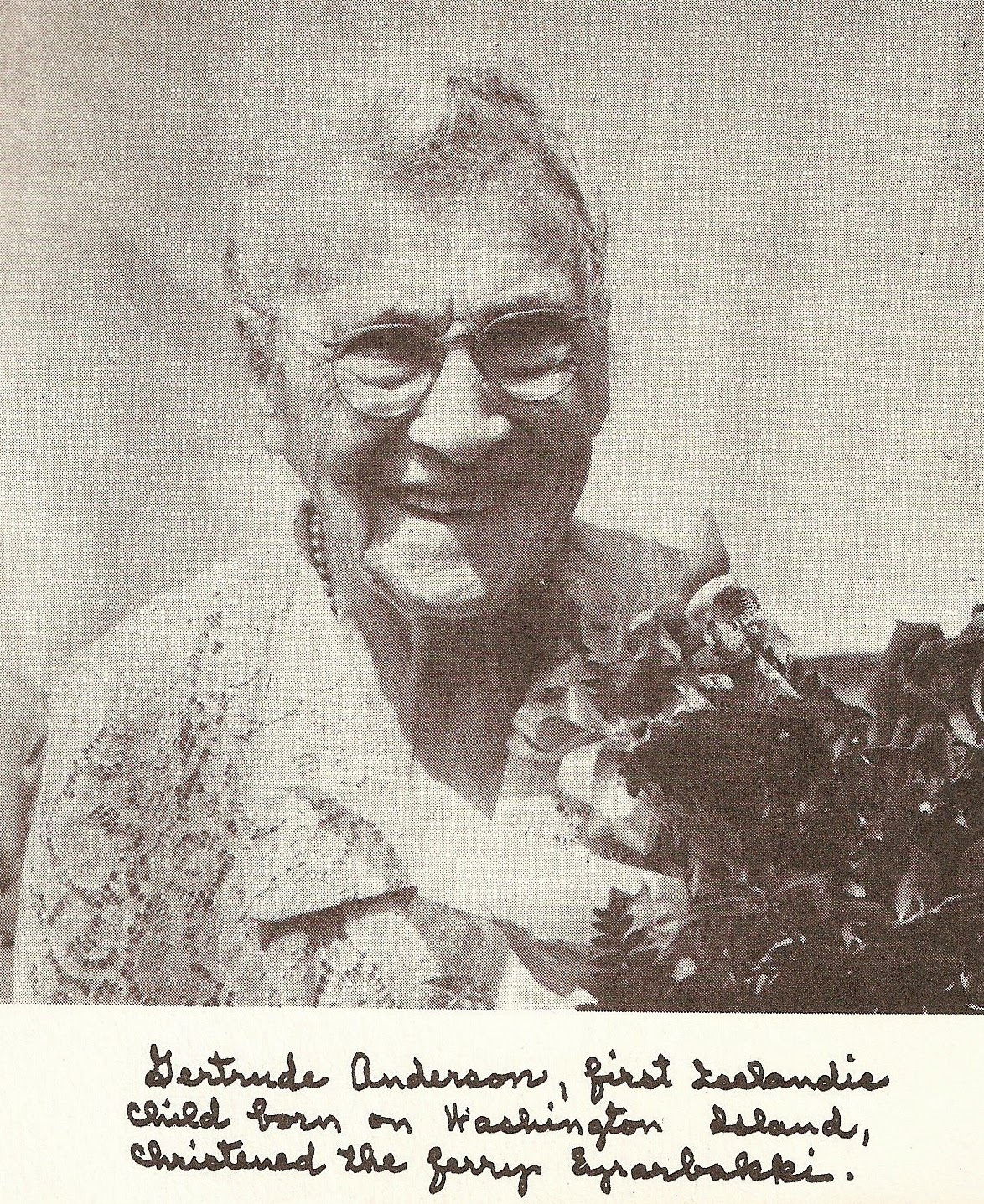
Showing posts with label Arni Richter. Show all posts

Friday, June 26, 2020

WIFL CHRISTENINGS - PART II


Fortunately many good photographers were on hand
when the Arni J. Richter was christened at the Island
dock May23, 2003.  This one was taken by Bruce McKay
and captured the Island Festival Chorus, led by Dan Hansen, 
 and the Festival Orchestra, led by Stephen Colburn.
Detroit Harbor, Washington Island -

We've covered considerable ground reminiscing about Washington Island Ferry Line christenings.  Our previous blog (June 23) brought us to the ferry Washington's christening in June 1989.

The Washington design was much different than any previous WIFL ferries by incorporating a large upper deck, and a "sun deck" above that, supported by both the side curtain structure and the pedestal - or trunk - located at the vessel centerline.  Fore and aft stairways offered access to upper deck spaces, including the pilot house that was elevated several feet above the passenger deck for best pilot visibility.  As with any design, kinks needed to be worked out.  Those that could not, or would not, accept modification became something we've gotten used to over time.

As an example, the 100-ft. auto deck length allows a rather easy five vehicles per lane, with four lanes, for a total of 20 vehicles.  If there are a good number of small cars, that totalcould be increased to 21 autos without too much strain.   However, those lanes squeezed alongside the center trunk tended to be narrow.  When loading large or bulky vehicles, two cannot be parked side-by-side.  Large campers, straight trucks, or semis would automatically reduce vehicle capacity in those lanes.   For semi trucks it is often a tricky maneuver to get the truck's last set of wheels as far outboard as possible, so that rear sets of wheels will track through the ramp opening during the unloading process.  Overhead dimensions were meant to accommodate standard semi trailer heights, but we soon found out that many newer over-the-road trucks pushed 70 feet in length and occasionally exceeded 13'-6" in height.  Sprinkler heads located on the main deck overhead have often been raked by those high trucks, requiring replacement.

But overall, this ferry proved to be a great addition to the fleet.

Ferry Arni J. Richter

After the one-time experiment with a center pedestal design on the Washington, in 2002 we began considering a new ferry design that reverted back to a main deck superstructure, this one tucked as tightly to starboard as possible.   This enclosure included a main deck passenger cabin, a unisex head, fore and aft stairs, an engine room access - all within that starboard structure.  While there would be two car slots forward and to starboard, the remainder of the vehicle deck had ample width for three lanes, 104 ft.  x 10-ft. width, each lane.  Vehicle loads could now consistently reach 18 units, even when a couple of straight trucks, boats on trailers, or campers boarded the ferry.

A most important feature of the new Arni J. Richter was its intended use in winter. Adequate cabin and pilot house heat (also AC), insulation and tight windows, helped support that.  Main propulsion would require ample horsepower, with stout framing, heavy propeller shafts, and stainless, ice-class propellers. Heavy rudders followed behind them.

Naming the 2003 ferry for its owner and president of many years was a foregone conclusion.  Arni Richter and his father, Carl, had purchased two wooden ferries in 1940 from William Jepson.  Over 60 years later, Arni was still intimately involved with the company, and he offered many suggestions in design and detail (some taken, some not!).  We had the extensive background and expertise of the Tim Graul Marine Design team, and that helped in designing a vessel we needed, one we intended to operate for many decades in these waters, for four seasons of the year.  Tim and his staff had already engineered many modifications on each of our existing ferries. This new ice breaker would receive their input of experienced ideas.  (Mark Pudlo, naval architect, would later purchase TGMD when Tim Graul retired, and continue his services under Seacraft Design, in Sturgeon Bay.)

The christening ceremony was held at the Island ferry dock May 24, 2003, after the boat had been delivered to WIFL, and it was attended by a largest crowd of any christening ceremony to date, some especially invited, but most just Island people who "showed up" to witness the event.  The series of photos below capture a good part of that day's crowd.

Someone photographed the crowd during the AJR
May christening.  How many people can you
identify in the photos? (unknown photographer)
The Island Festival Choir, led by Dan Hansen, sang, and members of the Island Music Festival orchestra accompanied them, besides playing several other numbers.  Island school children had been invited earlier to participate in a coloring contest.  An original poem about the new ferry Arni J. Richter was read by Bill and Liz Jorgenson's son, Dale.


After nearly an hour of remarks, music and testimonials on the new ferry's future, Arni stepped to the side gate and smashed the bottle to christen his own vessel.  (A second swing of the bottle was required to do the job!)


Arni J. Richter christens the Arni J. Richter.
(photo by Bruce McKay)
For these past 17 years, the ferries Eyrarbakki, Robert Noble, Washington and Arni J. Richter have been essential in carrying people, vehicles and cargo on a daily basis across the Door.  During the latter years of that time span summer traffic gradually increased, with long lines building at Northport in the mid-day, and the same on the island side in late afternoon.

Our WIFL Board of Directors, after considering several remodeling options, decided to build a new ferry.  Seacraft Design was chosen to provide the engineering and blueprints, and Fincantieri Bay Shipbuilding was selected to build the new ferry.  It would be named Madonna, for delivery in late May, 2020.  That date is now extended into late June, and possibly July, due to parts needed to satisfactorily complete the hydraulic steering system.


The christening ceremony is now scheduled for June 29 at the Fincantieri Bay Shipbuilding yard.  Only a small number of guests will be invited due to COVID-19 pandemic concerns.

More on this event in a few days.

-  Dick Purinton

Wednesday, February 3, 2016

STEERING CLOSER TO THE RIGHT ANSWER

Hull plating replaced, and power steering installed
on C. G. Richter at PBI, May 1980.


Washington Island, Wisconsin -
 
Usually, there's more than one explanation for things being as they are, and in the case of that stainless ship's wheel pictured in my last posting, the answer wasn't as I had first thought.

In the process, I learned I shouldn't rely on memory alone, because dates and facts are blurred with time.

First, former C. G. Richter captain Chuck Sena believed the stainless wheel was part of a then newly installed power steering system on that ferry, and it turns out he was right.

I hadn't remembered that wheel being installed on the C. G., probably because it was replaced only a few months later with the original wheel when several components failed.  Chuck remembers heading to Gills Rock, Doug Foss riding along, Kurt Meyer the operator, when the shaft under the binnacle broke, necessitating their labored actions in order to turn the ferry around and head back home.

A second point that triggered this blog posting was the return to daylight of correspondence found in an old file that originated from Tim Graul, Naval Architect, who was then Peterson Builders Inc. (PBI's) Commercial / Workboat Division Manager.   Concerning the shortcomings we reported, Tim wrote Arni Richter about resolving the C. G. Richter's steering, recommending specific remedies.

The replacement of dished hull plating around the waterline had been the primary reason for the Richter's spring yard visit to PBI, but at some point the installation of the first version of power steering was added to the work list.  The original 1950 steering system was a cable that ran from the helm to the quadrant, bending through a series of sheaves, and when the Richter's large rudder collided against a cake of ice (especially when the ferry moved in reverse) it could spin the wheel from the operator's hands, slamming the quadrant hard against the stops.  This wasn't good for the quadrant, and it wasn't safe for the knuckles of the operator.  A hydraulic assisted wheel, it was hoped, would make steering not only easier, it would prevent an unexpected kick-back.

Arni Richter, Tim Graul and H. F. Purinton (of R. A. Stearn
Naval Architects) at PBI in winter of 1979 during Robert Noble 
construction.   Ferry Robert Noble was launched with cable steering 
but was later refitted with power steering, after the C. G. Richter's
second system proved itself.


As a result of breakdowns, a new and more robust power steering arrangement was then installed at Peterson Builders, Inc. in the fall of 1980, in time for the next winter's ice season.   (I realize all of this detail might be more than our typical reader might wish to know, but if you've an interest in such things, then this follow-up may be entertaining and enlightening - as it was for me!)

Included with Tim's letter (on PBI's letterhead, with Fred Peterson's Utopia under full sail, a light tint in the stationery background) were two sketches showing how the old and the new arrangement would differ.

Captain Arni Richter:                                                               24 September 1980

We have discussed the steering system on the C.G. RICHTER, and Ellsworth Peterson concurs that the only thing for us to do under the circumstances is to install a new steering system as we discussed on 9 September.
Power steering assist, the first version
installed in May 1980.


To reiterate my understanding of that discussion, you will bring the boat back to Sturgeon Bay for the work to be done here.  Peterson Builders will furnish the labor to remove the existing power-boosted steering system and install in its place a cylinder, two hydraulic lines from the pilot house to the stern compartment and a new helm unit. 

Washington Island Ferry Line will pay the cost of the additional materials necessary to install this different system, (which you would have done had we installed this type of system in the first place).   Materials will include the new Char-Lynn helm unit, a steering cylinder, hydraulic tubing, fittings and hoses and all the miscellaneous small parts.

I will place the order for the helm unit and the cylinder immediately, and as soon as we have a date for the receipt of this equipment, we'll advise you so that the boat can be brought to PBI for the necessary work.  I am enclosing a couple of sketches which illustrate schematically the steering system as it was installed in May of this year and the new proposed system which utilizes a Char-Lynn "Orbitrol" helm unit driven by a chain from a new wheel shaft.  This new wheel shaft would duplicate the original installation before we installed the torque generator.  Two new hydraulic lines will be run from the Pilothouse back to the lazarette where a cylinder will be installed to actuate the quadrant. 


Second version of C. G. Richter power steering, with
the wooden wheel back in place.


This system will be a true huyraulic boost at the rudder itself. Turning the wheel will displace the valve in the Orbitrol helm unit, directing the oil to the cylinder and actuating the quadrant directly.  There will be enough slack in the cable and chain so that when the rudder has reached its desired position, the valve can be shut off and hydraulic pressure will hold the rudder in the desired location.
We appreciate your cooperation with us on this project and look foward to working on the boat.

Very truly yours,
Peterson Builders, Inc.
Timothy Graul, N.A.
Commercial / Workboat Division Manager

A good reason for the old wheel being reinstalled was the leverage required to turn the helm when the power steering - for whatever reason - failed.  The ferry could still be steered, but it took a good deal of "armstrong" to turn it against the fluid pressure still in the lines, and to manipulate the large rudder against water forces.

Captain Bill Jorgenson, steering with the C. G. Richter's original wheel.

One question still in the back of my mind:  Did I mistakenly recall a similar stainless wheel installed on the Washington?
Was the wheel recently found in Arni's attic from the C.G., or the Washington,  or were those two wheels the same?

-   Dick Purinton

(Purinton photos; correspondence from WIFL files.)

Saturday, April 25, 2015

ISLAND WATERFRONT - Then and Now - What of 75 years? - Part XX


Washington Island, Wisconsin -

When thinking of the significance of 75 years of service, I keep coming back to the idea that there has been community commitment - a two-way commitment:  the ferry company to the Island and the public it serves, and the base of customers who use and rely on that service.

There is no better visual example I can think of than the christening ceremony for the ferry Arni J. Richter, held on May 24, 2003, just before that ferry was placed into service.   Present were Islanders, guests from off the Island, students and many other well-wishers.

I say well-wishers, because I think everyone wanted this ferry to be a great one, reaching the mark in every sense of the term, for the improvement of service it would offer in summer and winter.  Grade school children participated in a coloring contest, and one of the many entries submitted, with a personal message, is shown above. (Sorry, but I can no longer recall the artist's name.)

A chorus of voices led by Dan Hansen, the Island Music Festival Chamber Orchestra under direction of Stephen Colburn, representatives from the U. S. Coast Guard, and representatives of the design, construction, financing and legal support - each necessary to make such a vessel possible - and the many, many people who stood on the pier made this a community celebration.  It was an event for the community, with the intended purpose of providing future service to the community.  If you knew where you were standing on that day, you might identify yourself in the photos below.

May 24, 2003 - AJR Christening (photos by Arni Orman)

We've been blessed over the years to have talented professionals in our area who have furthered the development of our vessels, docks, piers and shore facilities.   Having excellent shipyard facilities, naval architecture design firms and engine suppliers handy, each a part of our regional economic community, has been an immeasurable positive for this business, and for the Island community, in turn.

Tim Graul Marine Design crew from Sturgeon Bay visited in 1998 to
inspect, measure and offer Voyageur improvements.
From left to right are Tim Graul, Arni,
Bob Thompson, Bill Hitt and Charlie Balestrieri.
We mentioned in the last posting that it would be impossible to name any particular event or achievement as having the greatest impact over the past 75 years, but one event that comes to mind that might be easily overlooked would be the naming of the ferry Eyrarbakki to coincide with the 100th Anniversary of the first Icelanders to come to Washington Island.  (The original four young men led the way for a greater Icelandic immigration that followed, here, in other states and Canada).
Launching of Eyrarbakki at Bay Shipbuilding - 1970
(Estelle Richter photo)


 Having made a trip to Iceland in 1969, perhaps with the idea of creating a special celebration in 1970, Arni and Mary Richter visited Eyrarbakki, home of Arni's grandfather, Arni Gudmundsen, and the port of embarkation for many Icelanders.  Ideas for a vessel name were exchanged with his Icelandic cousin by letter in the months that followed, as community plans were prepared for an Island celebration in the summer of 1970.  Arni and Mary settled on the name of that village, Eyrarbakki.

Other communities at that time had their own ethnic celebrations, and Washington Island had for years featured a summer Scandinavian Festival with folk dancing, smorgasbord and such.  But, in keeping with a genuine respect for Island ancestry, this celebration elevated the importance of the Icelandic settlers, and it still provides today a unique notoriety for Washington Island.

So, back to our original question:  what does 75 years in business mean, if anything?

There was certainly no long-term plan that Arni or Carl Richter had for continuing their ferry business as long as possible, but the combination of doing something they enjoyed, activities that proved profitable but just as importantly, served their community.  These were lasting goals that committed them to a particular approach to service.  And from that commitment, I think, came the need and desire to grow, to improve and modernize and do those things for which the community can hopefully benefit, as well as the business itself.

Hoyt Purinton with his grandfather in 1995.
There was never a master plan, but rather,
 uncertain struggle along
the road to business leadership
succession.
Now with 40 years under my own deck shoes, and from my association with Arni and all of the fine people I've worked with at the Ferry Line, I believe it is the broad range of talent and skills, people with a similar desire to serve the community in which they live, that instills  dedication in today's employees, excellent people, all.

The second thing I learned, in a somewhat unexpected manner, is that the time will come to provide greater opportunity for others, and that opportunity can be furthered by stepping back, with confidence that there are several ways to accomplish goals, and an abundance of good people to accomplish them.


Ferry crew and family members demonstrate the effectiveness
of an IBA (Inflatable, Buoyant Apparatus) - June 2005.

With the passing of the torch, so to speak, there ought to be - and I find that there is - a great deal of pride in observing the accomplishments of others, and in knowing that commitment and tradition continue.

That, I think, is the best - and only legacy of value - for a business that hits the 75th year mark.
       - Dick Purinton


Steve Propsom of Bay Ship with Hoyt during the indoor construction of
the AJR in 2003.  If there is a "face" of the Ferry Line today, it is that of
Hoyt... and Rich Ellefson, and Bill Schutz, and Bill Jorgenson, and Erik Foss,
and… the many others who make daily ferry service possible.


Thursday, April 23, 2015

ISLAND WATERFRONT - Then and Now - Richter Ferry Line - Part XVIII

Ferry dock aerial 1978 -  Jon Gunnlaugson's  tanker Griffin is docked at
Hansen's Standard Oil (the concrete surface looks new in this photo) and the
 crew of the Eyrarbakki, largest of the three remaining ferries then, and in
its eighth year of service, prepares to discharge a Coke truck and other vehicles.  
Adjustable, hydraulic ramp in foreground is in its 4th season of use, the only
spot on the dock then set up for bow loading/unloading.  Voyageur (top) and
C. G. Richter are idled on this day.  Bob Bell's orange International Scout is
parked next to the ferry office, foreground.  A telephone booth is
handy, alongside the building for patrons coming off  the ferry.


Washington Island, Wisconsin -

We continue with the story of the Richter ownership and operation of the Ferry Line, now in its 75th year in this year, 2015.

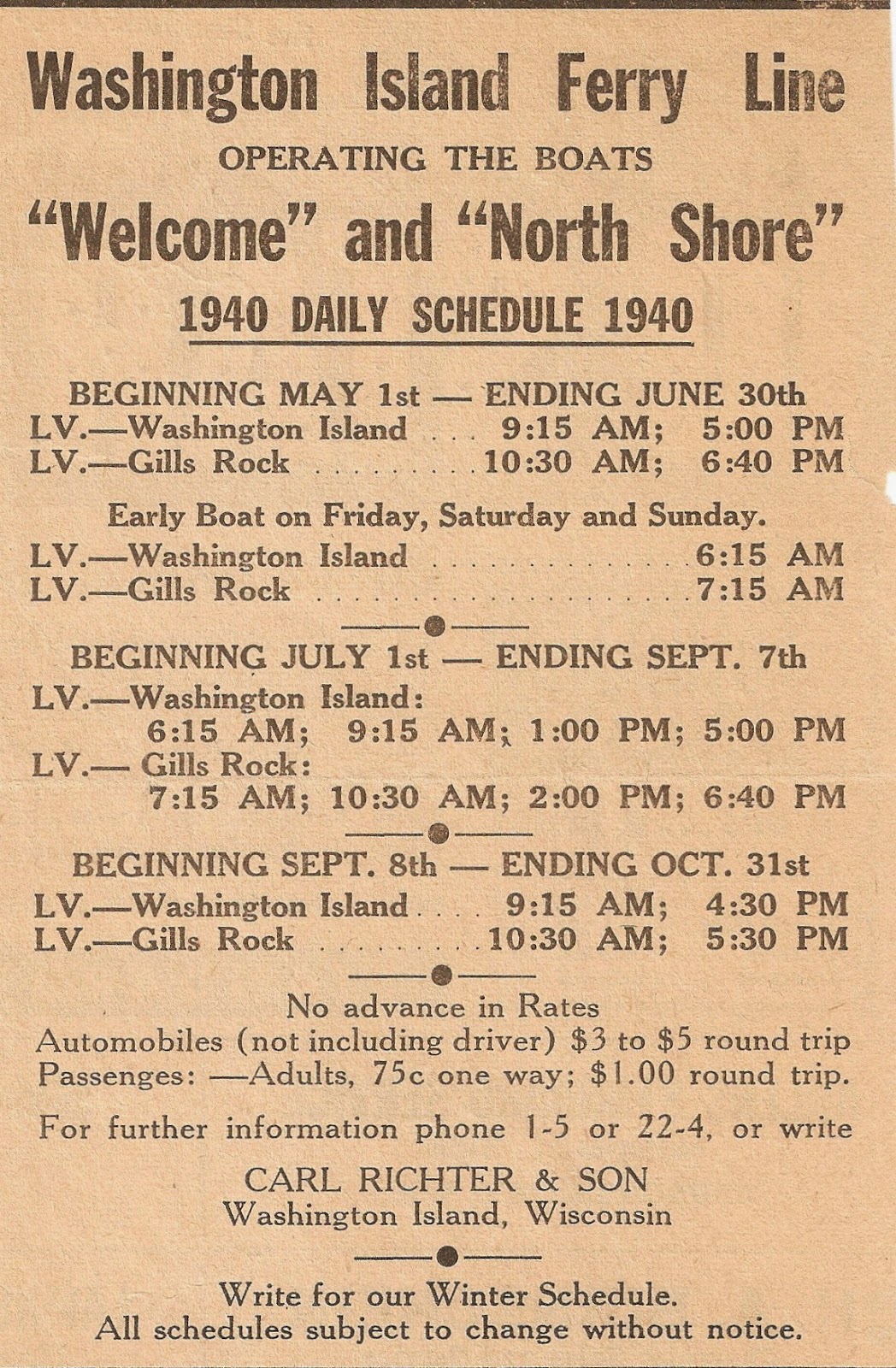
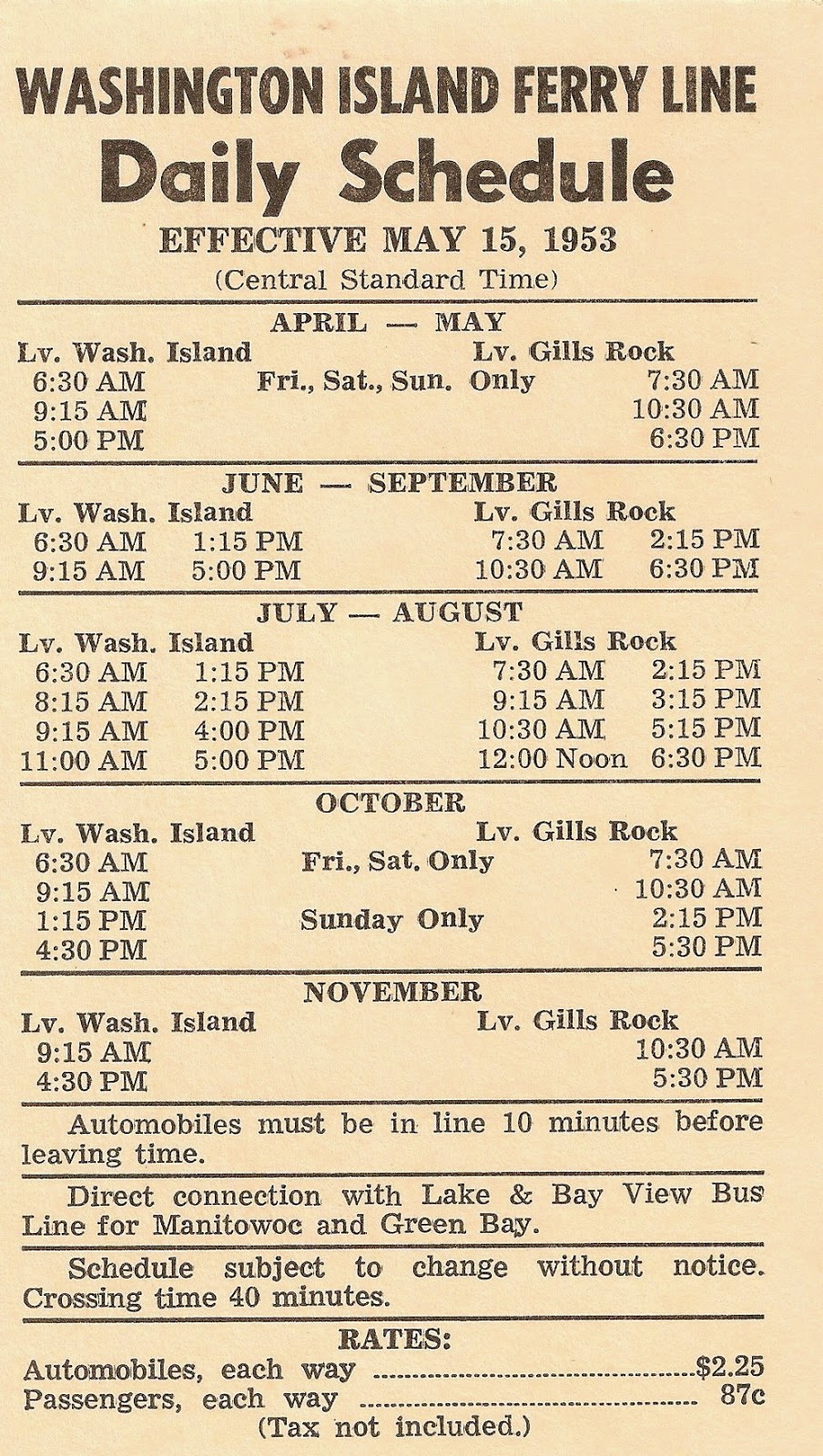
The schedule comparison shown above is interesting for a couple of reasons.  For one, there was deference paid to Carl in 1940, with credit paid to "Carl Richter & Son."  This would soon change, and maybe it was more practicality than anything, acquiring a business name that would be readily associated with Washington Island.  But over time it was still the Richter name, Arni Richter's name, that would be closely associated with Island ferry service, and in a general sense, with Washington Island as a whole.  Arni's involvement in the Door County Chamber of Commerce, his role as a director for the Bank of Sturgeon Bay, and his staunch support of the Republican Party (that brought him in contact with several Republican governors, state legislators, and Congressional representatives) held both social and business implications for the Richters and the Ferry company. 

Another interesting comparison is found in examining the rates, where one-way passenger fares ($1.00 in 1940 vs. 87 cents in 1953) and auto rates were actually less in 1953 than in 1940.   Perhaps increased volume had something to do with those rates, but in 1953 there were two, relatively new ferries, Griffin (1946) and C. G. Richter (1950), still working off construction debt.   Farming and fishing were then two booming Island industries, with dairy and potato farming continuing apace, and commercial fishing was the king industry in terms of incomes and steady employment.  Those industries translated to a great deal of freight hauled, meaningful in terms of revenue for both the Anderson Transit Co. and the Ferry Line.  Perhaps the freight revenues helped to meaningfully support the business overall. 

The construction of the Voyageur in 1960 departed from the side-loading ferries that required wooden planks (later replaced by a steel plate) to span the gap between vessel and shore.  Although the Voyageur had only a single ramp, located in the bow, loading could be accomplished quickly by directing drivers and backing autos on board.  A creative crew with the right mix of traffic could load a dozen vehicles in a short time.  Oftentimes, the load was a mix of autos, trucks and trailers, and occasionally large equipment that earlier ferries simply were unable to carry.   

Hauling a semi by ferry was novel, unheard of until the Voyageur.  That was
why this first-time photo was taken of a J. W. Cartage truck aboard early in the
1960 season.   The design of a larger, open-deck ferry today seems a no-brainer,
but Percy Johnson spoke often of Arni's agonizing the day before he had to
sign a contract to build the Voyageur at Sturgeon Bay Shipbuilding and
Dry Dock. Financing was always a challenge, and Arni's business style was
to first have the major percentage of new construction costs in hand before laying
a keel, a pattern that has been followed to this day in keeping debt
to a minimum.


By 1970 traffic justified a second open-deck ferry, an even longer vessel named Eyrarbakki.  If the Voyageur had been a grand improvement for carrying vehicles of all sizes, the Eyrarbakki went one better.  She had both a bow and stern ramp, and rather than the restrictive open deck of 50 feet of the Voyageur,  at 87 feet LOA the Eyrarbakki had approximately a 70-foot opening, making possible the loading of just about any combination of truck and trailer that could be brought over the bow.  (Eyrarbakki still has the largest unrestricted height, open deck space of all of the ferries.)   Standard vehicles (if they required less than a 9-foot overhead clearance) could be easily loaded in a drive-on, drive-off arrangement, and overall capacity came to 18-20 autos.  There were still large "Detroit boats" being driven for comfort rather than concern for fuel prices in those days, but new, smaller Japanese models had joined the highway mix, plus Detroit's "compacts" that provided options for crews to load an extra car here and there, maximizing usable deck space on a busy day.  

A major drawback in loading the C. G. Richter- especially in low water,
and especially with a heavy load - dealt with regularly throughout winter,
was to drive loaded trucks over the side ramp, timing the roll of the boat so that
the rebound in buoyancy would support the rear axle's wheels as the major
weight came into play.


On a cold winter's day, the Noble's hull was moved
from a construction shed to an opening and turned upright.
using two cranes.  Shown with the upright hull at PBI
are Arni Richter, Dick Purinton and Harry Purinton, who
represented R. A. Stearn, Inc. Naval
Architects.  Harry did much of the structural design and
engineering on this ferry, and the Washington in 1989 when
working for Tim Graul Marine Design.
At the time the Robert Noble was constructed, Tim Graul
headed up the PBI commercial design division,
completing Robert Noble design details. 


With a new ferry C. G. Richter in 1950, another in 1960 (Voyageur) and a third in 1970 (Eyrarbakki), there came a public tendency to believe that a new ferry would be built "about every ten years."  Pushing this theory along (and based solely on the coincidental rise in tourism and the need to keep pace with summer traffic, not a pre-ordained circumstance) was yet another ferry designed and built for launch in early 1979.  

Robert Noble launch, April 30, 1979 at PBI.  90' x 36', with
two, 365 hp Cummins engines, with 175 passengers, and 10'6" overhead
on the aft vehicle deck, made this ferry quite versatile,
the best in the fleet at the time.


The Robert Noble's design would enlarge, slightly, upon the dimensions and capacity of the Eyrarbakki, and in so doing it would render the C. G. Richter less useful - almost obsolete - as a summertime vehicular ferry. 

The answer, in order to get use from an aging vessel that still had many nautical miles left under her keel, was to convert the C. G. to summer passenger-only use.  

By 1984, an extension of 70 feet had been made to the Northport Pier, and as a result Gills Rock became a "passenger excursion" port, with the C. G. competing in summer, first with the Yankee Clipper, owned by Charles Voight, then after 1987, with Voight's new, aluminum Island Clipper.   

One fact of business Arni liked to recite was that each new ferry exceeded in cost the sum total of dollars spent on all previous ferries.  This reflected not only the nature of new construction, with increased complexity in safety equipment and design features intended to meet U. S. Coast Guard regulation, but also the tendency to improve each new ferry in size and utility.  With increased size came increased horsepower, and larger transmissions, all with added cost.   Each new construction contract was supported with the optimism that it would prove to be the right decision, and that a new ferry would help to sustain, if not increase, business for the Ferry Line and the Island.

Adding to the "ten year cycle" myth circulating in Door waters would be yet another ferry, Washington, also built by Peterson Builders, Inc., this one designed start-to-finish by Tim Graul Marine Design (TGMD).  It should be noted that during this period, Peterson Builders was attempting to transition from a heavy dependency on U. S. Naval contracts, which were becoming harder to obtain, while at Bay Shipbuilding nearly all shipbuilding efforts were going into the large commercial ship construction or repairs for the laker fleet.  Bay Ship didn't seek new, small vessel construction at this time, although that approach would change again in time.  

The Washington's design was a departure from previous ferries, most notably for the use of a center pedestal, or trunk, that supported a substantial superstructure.   The Washington had greater length and beam (100-ft. x 37-ft.) than previous ferries, but the increased overall dimensions, as it turned out, were somewhat offset by cramped lane conditions alongside the trunk, which incorporated public heads, engine room and passenger deck access stairs, piping and wiring runs, and light cargo storage.

Every vessel results in compromises, however, and overall, this ferry became a summertime savior by taking on long lines of vehicles and passengers, loading them with ease.   In certain instances, she's also been used in the freeze-up stages of December, having good sea keeping abilities, with less propensity to toss spray over the deck.  But, summertime use was its main purpose, to meet with the still-increasing patterns in traffic.   The 1990s, with dot.com financial bubbles not yet ready to burst, also brought increasing tourism, very much on the rise in Door County as a whole. This ferry, Washington, coupled with a new break wall built in 1994 that surrounded the Northport dock and made landings much less subject to wind and waves, became a very useful piece of equipment.  

Washington set to depart.   Crew: (L to R)  Jeff Cornell, Laura (Shellswick)
Lerner and Erik Foss.


The age of the C. G. Richter, having design qualities unacceptable to owners of longer and higher vehicles, and with increased bulk freight demand in the dead of winter (fewer Island goods were being stockpiled in advance, with less small package freight), and without the mass and horsepower to bull through frequently encountered ice conditions, and with its less-than-adequate passenger accommodations  (both heads and cabin space) her days were numbered.

But, it would take substantially more capital, plus the right design - whatever that might be - before a contract would be signed for a new winter ferry.  That timing proved to be 2002, a decision that followed much internal discussion and regular, annual deposits into a construction fund.  By that time, Arni Richter had retired (after making an official retirement statement, but one not always heeded!), and the new ferry to bear his name would have greater size, horsepower, and capacity than any of the other ferries.  And as before, it would result in greater expense than all previous ferry vessels combined!   

This card appeared anonymously one day at the Ferry Line office.
Its creator was quite perceptive of the divergence of opinion as
construction of the Arni J. Richter took shape in Nov. 2002.
(Taken on day of keel-laying at Bay Shipbuilding.)

The Arni J., as this ferry quickly became known, at 104-ft. LOA could carry 18 vehicles with ease, having broad vehicle lanes nearly 10 feet wide, with passenger cabins and passenger deck access, heads and engine room access offset in a structure along the starboard rail, giving it capability to carry several semi trucks by driving them straight through - this ferry came to be a considerable improvement for  winter and summer ferry service.  

Capt. Bill Jorgenson at wheel of Arni J., in ice.  Hull speed is
a consistent several knots, even in solid ice 10' thick.
Best of all, as it turned out the Arni J.  exhibited wonderful icebreaking capabilities.   This was due, in no small part, through copying the lines of the successful design of the most recent Drummond Islander ferry at Point DeTour, Michigan, also designed by TGMD.  A flight to Drummond Island in a small plane piloted by Graul convinced Arni there just might be a new and better design possible, rather than repeating or enlarging the C. G. Richter design.  (At one point, several years earlier, Arni had stroked his chin while he mused, "I don't think you'll ever find another design as good as the C. G. Richter for winter work!")

If Arni hadn't entirely agreed with the general design and parameters for the new ferry as they were developed with Tim Graul's expertise, he did go so far as to agree to put his name to it, and then to strike the bottle of champagne against a gangway upright when the moment for public approval was ripe.  His oft-repeated statement at age 92, and later, and not without intended humor, was:  "If my name's on it, it better be good!"  

-  Dick Purinton

Arni joked, after his first swing produced only a thud, that
he "might be getting a bit weak."  The occasion was
witnessed and enjoyed by several hundred people, and
accompanied by music, stories and adulations.

Friday, January 30, 2015

ISLAND WATERFRONT - Then and Now - Part II

Ole Christiansen's boatyard, with the Flotilla in the foreground on
blocks, and the Wisconsin moored at the edge of the solid ice.
Quite possibly this photo was one of Bill Jepson's, taken around 1930, prior to
his purchase of the dock property.  Today vehicles
drive out onto this pier to board over what we
refer to as the "south ramp."


Washington Island, Wisconsin -

Watching Mike Kahr drive steel sheets with his reciprocating hydraulic hammer yesterday, and noting the relative ease with which the sheets were driven into the bottom, caused me to think back on some of the other projects we've had over the years.

Many feet of steel sheeting were driven, especially at Northport around 1982-3, when John Fitzgerald and his crew extended the Northport Pier by some 70 feet, adding a slight wedge to the north corner, the design intention being to lessen lake swell action curling around the northern side of the pier.   That project came 11 years before the stone break wall was constructed with the aid of a Wisconsin DOT grant to Door County.   Prior to the breakwater of 1994, the pier projected unprotected approximately 100 yards from shore, an obstacle to waves and moving ice.

Welder Mike Brown fabricates the corner piece
from two sheets that can't be interlocked due
to the degree of bend.  In the background, Mike
Kahr uses a hydraulic hammer to drive steel sheets.

In order to accomplish the work of extending the pier in 1982, contractor Fitzgerald rented a diesel hammer.   The solid, heavy steel head slid up and down in a steel framework, powered at the bottom of the downstroke by an explosion (combustion chamber) that caused it to rise back up several feet in the air, then drop again to repeat the process.  The hammer head rig was positioned over the sheet being driven, and the whole works was held in place by a crane.  Before that project, John used a pile driver block that was repeatedly raised by crane cable 8-10 feet and then let free-fall, with gravity doing the pounding, one tap at a time.


The hydraulic hammer arrangement used today by Mike Kahr is rapid and flexible.  It seems to do a good job until progress is stopped by a large stone, and that was the case with several sheets on the inside of the slip.  Another improvement in equipment, too, is that this hammer head can be shifted quickly from one sheet to another by just lifting the arm of the excavator.   Kahr can use the excavator arm to pull or push plates to achieve the best vertical alignment.  And, it takes only minutes to detach the breaker head and install the backhoe's bucket for other work.

Contractor John Fitzgerald extended the
Northport pier, shown here in the summer of
1982 with a diesel hammer for driving sheets.


In all, over 200 linear feet of pier were enclosed with
sheeting at Northport in 1982.  Here, worker Don Beckstrom
cuts sheets to length.  Some sheets were driven in water depths
of 16 feet.
It was 1975 (now 40 years ago this June)  that the first hydraulic ramp was installed for easier, and safer, loading of ferries with bow ramps.  At that time, only the north slip was suitable for bow-loading of vehicles, in particular large trucks, buses, or trailers.   In 1960, when the first bow-loading ferry Voyageur was brought into service, enabling carriage of trucks longer than 25-feet for the first time, a pile of gravel was sculpted to roughly accommodate variations in water levels from season-to-season.  A thick rubber mat on the crest of the pile kept the steel ramp from rubbing against the gravel.   It was crude, but it worked, along with procedures that kept the vessel in  trim during loading.  Often this would mean shifting a few vehicles fore or aft to keep the bow height (and thus the bow ramp angle) in adjustment, sparing mufflers and tail pipes.


Myron LaPlant operated machinery for
John Fitzgerald.  
Ferry captain Dave Johnson backed this auto
onto the ferry (about 1972-73) over the gravel mound with rubber mat.
Mound accounted for height differences between
boat decks and dock, and with some work could be
seasonally adjusted by grading or adding more fill.


With a greater number of motor coaches, campers, trailered pleasure boats and heavy trucks, as well as an increase in general tourism traffic in summer, by the 1970s the gravel pile was no longer a good option.  


Arni Richter wanted to install a hydraulic ramp strong enough to hold a loaded semi.   R. A. Stearn Naval Architects, Sturgeon Bay, supplied engineering for the hydraulics (based, in part, on experience gained with engineering early Travelift units) and my father,  Harry Purinton, provided a fair amount of time - some personal and some through R. A. Stearn where he worked with hull and structure - to design the ramp details and footings.

Once steel was ordered, ferry captain John Hanlin cut and welded, and assembled the ramp in a level opening near the bike shop garage.  Kermit Jorgenson operated Njord Heim's crane to lift, and then turn over, the ramp.   Few pieces of equipment were available on the island at that time for such tasks, whereas now there are numerous loaders and excavators with the lifting capacity and reach for such an operation.

While the steel work progressed, a hole was excavated near the water for footings.  By late June, the foundation was ready to receive the ramp, and by the weekend of the Fourth of July, the ramp was in a pinned position, ready to be driven across, but it took several more days to complete electrical connections (Earl Frank was the electrician) and pipe the hydraulics (work by ferry crew), making the ramp fully adjustable at last.

During the construction of the foundation, ferries landed at the end of the south dock.  Today at that location, a wider, longer and heavier ramp is available,  installed in 2001.   The rams on this newer ramp permit adjustment under heavy loads, whereas the original 1975 ramp was incapable of adjustment under load, due to smaller rams and lower pump pressures.  

Kermit Jorgenson operated the crane as
Dick Hanlin offered advice.  Eldred
Ellefson, who loaned the crane from Njord Heim,
 observed in foreground as the
20 x 20 ft. ramp was turned over.


Setting wooden forms for pouring the first hydraulic ramp footings,
late June, 1975.    (l to r) Jensen brothers Norbert, Rich and Emil with
John Herschberger and Harvey Jensen, uncle of the brothers.
(Unknown observer.) 


A slightly different angle showing turning of the first adjustable ramp,
with Kermit Jorgenson at the crane controls.  Ferry crew Tim Jutila and John Hanlin
are on far side, and John Herschberger has his back to camera.  (June 1975)

Crowded near to the old office building, the foundation was poured for the
ramp.  Here, Earl Frank runs wire (far left), John Herschberger backfills
with a shovel, and at the rear of the box Arni Richter and John Hanlin
discuss installation of ramp hinges.  (June 1975)


Ferry captain John Hanlin, who was
also skilled working with steel.


Such improvements as shore ramps are quickly absorbed into the operation, becoming one more slight adjustment before loading or unloading, and a major adjustment when the load is long, low or exceedingly heavy.   The general public may not realize the benefits, but the advent of one, good hydraulic ramp on the island meant quicker and easier loading of each ferry using the bow ramp (the C. G. Richter still required side loading, until about 1989 when the Washington (dis)placed it into passenger only status).  In a few years' time, by 1980, a similar ramp was installed at Gills Rock, and early in the summer of 1985, the north ramp at Northport was installed.  In time, smaller ramps also went in at the island's south landing, and at Northport's winter landing slot.  All later ramps were based on the original 1975 structural design, with modifications made as needed.

-  Dick Purinton


Wednesday, November 26, 2014

ISLAND ICELANDIC HORSES

Young riders on their Icelandic mounts at a Field Wood
Farm show.  From L to R:
Erika Johnson, Heather Young, Evy Purinton and
Alex Trueblood.  Year unknown.
Washington Island, Wisconsin -

Note:   Last week we received in our mail the Winter 2014/2015 issue of Door County Living.  If you live in Door County and read your copy, I hope your reaction was as positive as mine.  (Copies are available - at no charge - at several county travel information outlets.)

Four separate pieces featured Washington Island.  The first three ran back-to-back for impact.  The four stories were:  “The Icelanders – A Settlement of Singular Significance,” by Stephen R. Grutzmacher;  “A Marvelous Legacy to Wisconsin – Thordarson’s Boathouse,” by Patty Williamson, PH. D.;  “Island Icelandics – 50 Years of Icelandic Horses,” by Richard Purinton; and featured separately, “How Washington Island Got Its Name,” by Jim Lundstrom.  

These features effectively connected Washington Island and its Icelandic heritage in a straightforward presentation of local history and cultural ties.  It was a refreshing change from the promotional journalism that most often appears in such magazines.  Graphics were also well done, using the distinctive Icelandic flag design overlaying Rock, Washington and Detroit Islands, the red, white and blue in constrast against the black and white historical photos shown.

Because of magazine space limitations, my story about Icelandic horses used only a portion of the text and photos I assembled.  For that reason, I’m devoting several blogs on this topic. 

Although I worked from a file of clippings, notes and letters gathered by Mary and Arni Richter, I relied heavily on Laurie Veness to help verify fine points and to fill in gaps.  Laurie, in addition to being a devoted lover of Icelandic horses, also keeps files – both written and in memory - of the Icelandic horses introduced here and their offspring.  

Laurie answered my questions, occasionally with long and detailed answers.   I also needed to take photos, and for this activity she directed me so that I stood in an optimum spot to capture her horses, one of them as it bolted across the pasture.

The Icelandic Horse and Washington Island

Icelandic horses are on Washington Island today, in part, due to a winter’s party held nearly 50 years ago at the home of Arni and Mary Richter.   Whether attendees at this party had previously discussed the notion of owning Icelandic horses isn’t known – there was advanced footwork done to determine source and price – but it appears that agreement on that occasion launched the venture in obtaining Icelandic horses.

Earlier, perhaps in the fall as her college courses got underway, Estelle Richter,  one of the Richter twins, discussed Icelandic horses with a girl in her school dorm.  By chance, this young woman’s father owned Icelandic horses in Maryland.   Samuel Ashelman, Jr. of Ashton, Maryland, had imported 13 non-related mares and one stallion from Iceland in 1960, for the purpose of breeding them and for trail rides.

Pedigree paper believed to be for one of the
original Island Icelandic horses.


Ashelman wrote to Richter on January 3, 1965 –
“Dear Mr. Richter:  My daughter Siri tells me that your daughter wrote asking information about our Icelandic ponies, saying you might be interested in 10 or so. 
“We have about 45 in our herd.  In 1960 I brought in twelve mares and a stallion but we lost three mares.  Out of the original group we have a stallion not related to the original stud and are now just expecting our first foals sired by him.  To date, we have, as a policy, not sold any foals (except for two who got hurt and were not as good as the rest) as I have wanted to build up the herd.   Icelandic ponies have gotten some publicity in the Eastern Sunday newspapers, and I felt they would be a drawing attraction at a summer recreation place we are developing in the mountains of W. Va.  This next summer I plan to run pack camping trips and got a very positive response from some of the outdoor writers who have promised to do feature stories in the major newspapers.
 “I think we are in a position that we could sell some of the foals this Spring.  I would prefer to sell some of last Spring’s foals or some from the year before.  As to prices, I have no idea what would be fair and would like to know what you would expect to pay.  To import would cost about $350 plus $100 quarantine etc. charges, and a lot of trouble and some danger of losing some in shipment.
“We found the ponies a lot of fun, very good disposition, excellent for teen agers and strong enough to carry a full grown adult.  Enclosed is a folder about them.  I can send you some pictures, if you like.  They are easy to train.  Most of our older ones have been ridden but the younger ones would need some working.  Let us know what you are planning to do and what your project is.  I hope we can meet.  Looking forward to hearing from you.” – Sam Ashelman

Richter responded Jan. 14, 1965:
“Dear Mr. Ashelman – Received your letter of Jan. 3rd and was happy to learn about your Icelandic ponies.  A small group on the Island became interested in these ponies last year and we have had considerable correspondence with the Icelandic Pony Club and Registry in Greeley, Colo.
“We are thinking seriously of purchasing ten ponies and build a small herd.  Eventually we would have a riding stable. Washington Island is becoming a very popular tourist center and we feel there would be a good demand for this service.  Washington Island had the first Icelandic settlement in the United States.  Therefore we feel it would be most fitting and interesting to have these ponies.  My grandfather was one of the first Icelanders to migrate to Washington Island.  His name was Arni Gudmundsen.
“My daughter Estelle was quite excited when she learned from your daughter that you were raising these ponies. She has always loved horses and is looking forward to the time when we may raise them too.
“Mrs. Richter and I are planning a trip East some time in Feb. and would like very much to stop by and meet your and see your herd.”
The Island group voted to move ahead, and a deal was made with Ashelman.   On June 23, 1965, Richter sent a check for $2560.00 “for the eight mares (all with foal, I hope). I am sure that the truck driver will find the island O.K. if he has a Wisconsin road map.  Tell him to call me from Sturgeon Bay (my phone number is 40-2).  Does he have insurance covering the horses in route?”

Arni Richter feeding horses.
(about 1966)


After their arrival - the trucking bill was $400.00 - The Door County Advocate Island Correspondent, Sarah Magnusson, wrote a story titled, “Hardy Icelandic Ponies are Thriving on Washington Island”:

“On a zero degree moonlight night in January I glanced out my kitchen window to see a dark blot against the white snow.  On closer inspection it proved to be an Icelandic pony.  I switched on the yard light and discovered that it was red with white in its face.  It was pawing down through the deep snow to get the dead grass. Wandering around day or night seems to be a characteristic of the Icelandic ponies.  Also, they are extremely hardy, and will go into a warm barn to eat, then sleep outdoors in the snow.” 
Sarah described the horses: 
“All were pedigreed, and the original pedigrees passed on to each individual buyer. Most of the ponies have Icelandic names, such as:  Elding (which is red and means flame in Icelandic), Hrefna (black), Naela (star in forhead, red with white feet), Thordur (called Sam), Kari, Bjorn, Groa, Loki (one of the Gods), Trygve, LIff and Ula.  The latter two are Arni’s colts.
“There are now 24 ponies on the Island, and there are several new owners.  Out of seven originals, each mare has had three colts, and all are expecting.  Most of the male ponies are geldings, Sam being the only stallion, and he is not related to any of the mares.  He is owned by Kathy Anderson.
“Icelandic ponies are docile, love people and attention, and are easy to train, say their owners.  Some of the children who now own them have taught them tricks like shaking hands, rolling over, and getting down on their knees.  The ponies become so attached to their young owners that they will stand by the beach while the children go swimming, or will stand by a frozen pond while the children go sliding or skating.”

Children’s book:   Bylur

Evy (Purinton) with Bylur, about 1985.


It was just such friendly and docile characteristics exhibited by her Icelandic horse, Bylur, that our daughter, Evy, described in her book, “Bylur, the Icelandic Horse.”  In the years she grew up with her horse, there were few outdoor activities in which her horse was not a part, including ice cream at the Albatross Drive-In.

Now, many years after losing Bylur to old age, Evy is excited to have Blitzen, another Icelandic, also pure white in color.

Recently, Connie Essig passed along to us at the Island Bayou Press unsold copies of Evy’s book, which was published in 1996.   The illustrations by Shea Ryan capture an idyllic island childhood, with horse and owner engaged in a variety of Island activities.  This book is now listed on my website, alongside books I’ve written. ( See  RichardPurinton.com ) 


Learning about Icelandic horses

In order to learn more about Icelandic horses I contacted Laurie Veness of Field Wood Farm, near West Harbor.  Laurie is a knowledgeable horsewoman who first came upon Icelandics when visiting Washington Island as a teenager, and she admits she was drawn to them.  An absence from them made her realize how great a ride Icelandics were in contrast to quarter horses and other breeds she’d worked with.  From 1971 to the present, then, Veness has owned, trained and bred Icelandics.   Her command of the various Icelandics’ names, lineages, and traits is impressive.

At one time she had as many as 44 Icelandic horses, offering trail rides and lessons.  Our daughter Evy was one of those young Island girls who became infatuated with horses at Field Wood Farm, learning all facets of care, including feeding and the cleaning of stalls, in exchange for the opportunity to ride.  

Star (Stjarna), a 38 year old mare at Field Wood Farm.


Today, Laurie's farm has 14 horses, and the facilities are rather run down and in need of repair.  

A first time visitor who might bring with them a child for the purpose of taking a trail ride, Laurie’s lane, home and barn emit a Ma-and-Pa-Kettle, helter-skelter ambience.  But I found myself attracted to the disarray, anxious see what lay around the next corner.  

The present state of her farm isn’t a reflection on Laurie’s inattentiveness, but rather her physical inability to do the work necessary following two debilitating auto accidents several years ago.  There are days she finds it difficult just getting from house to stable, much less performing the daunting chores necessary to maintain fences, gates and buildings.  I was pleased for that reason to be invited to spend some time with Laurie learning about her horses and Icelandics in general, to see her horses and photograph them.   

Laurie Veness with her companion.


Laurie is a smart, well educated woman, and she knows her subject matter.   She is also bold to tell anyone – including me – her ideas based on her storehouse of knowledge.  But when it comes to horses, at least her Icelandics and their offspring, her knowledge is considerable and quite complete.  

Her interest goes back to her childhood.

“I can never remember not being interested in horses,” Laurie said. “I rode my first Icelandic, Freya, owned by Cathy Newman, who was Pearl Haglund’s granddaughter.”  

But it was absence from the island and from riding Icelandics - including several years at SUNY, where she earned an associate degree in Animal Science, majoring in Horse Science - that deepened Laurie's respect for this breed.

One of the more interesting features I learned from Laurie about Icelandics - besides the fact they have several gaits unique to the breed that provide a smooth, even ride – has to do with their thick, warm coats.  I remembered how thick Bylur’s coat had been, even in summer, and his distinctive flowing mane and tail. 

Laurie described three different coat hairs that grow in to protect the horse from Icelandic weather that often includes wet, blowing snow.  “They have a 4-6 inch winter coat with down underlying it, which is the last to shed.  And there are guard hairs, up to 12 inches long, stiffer and shinier, that shed water.  If you put one of my guys in the barn right now [this was August], you would overheat them.”  
Snow and ice build up on the longer hairs and provide a protective shell for the horse, preserving body heat.  This can be seen most dramatically in the tail, a growth of longer hairs which Laurie described as a “caudal disk.”  With their backs against the freezing wind, their long tail hairs fan out in the breeze, collecting snow and ice and forming a windbreak of sorts.

Although there wasn't wind or snow on
this day, the caudal, or tail, fans out and
encrusts with ice and snow,
protecting the horse from cold winds.


The Icelandic horse - and not a pony, according to Laurie - is considered a purebred developed over centuries in the fields and mountains of Iceland.  At least in modern times, no other horses are permitted to be imported.  And once an Icelandic horse is exported, it may not reenter the island.  This is to keep the breed pure, but also to protect the native horses from disease.  Even riding boots and gear worn outside of Iceland is prohibited, unless such items are brand new and haven’t been used.

Rose, galloping across the field at Field Wood Farm in August.

  
These Icelandic horses are exceedingly sure footed, bred for rocky, volcanic ground that is commonplace in Iceland, and they carry more weight than a typical horse of their size.   An Icelandic can carry the weight of a horse half again as large, and they require less in return, living off sparse Icelandic pastureland and preferring the outdoors. 

Other Current Island owners

Besides Field Wood Farm, Jerry and Mary Ann Meiers own several Icelandic horses – one is a gelding and one a mare, half-brother and sister - as well as other horses of related Scandinavian breeds.  

Mary Ann Meiers of Norse Horse Farm with their Icelandic mare.


The Meiers bought their Icelandics from a farm in Iowa (prices start at around $8,000 each, Jerry said).
From his research, Meiers said that centuries ago, perhaps as early as 900, the Icelandics derived from the Dole horse and the Fjord horse (both are light Norwegian draft horses), and also the Russ or Gotland horse (from the Swedish island of Gotland.)
 
Norwegian horses have the same easy temperament as the Icelandics, Jerry said, although in his stable's pecking order it is the small Icelandic mare that dictates who comes in the barn, and who eats first.

The Meiers keep other animals, too, such as Icelandic sheep, Finnish sheep, and Swedish chickens.  Their intent is to show visitors the variety of Scandinavian livestock available, hence their farm’s name:  Norse Horse Park.   They do not breed their horses, and they do not offer trail rides.  Their farm is meant to be an educational experience.  This year their farm was closed, but they hope to reopen to the public again in 2015. 

-  Dick Purinton