Showing posts with label Jeff Cornell. Show all posts

Wednesday, July 15, 2020

MADONNA CONSTRUCTI0N - 37.0


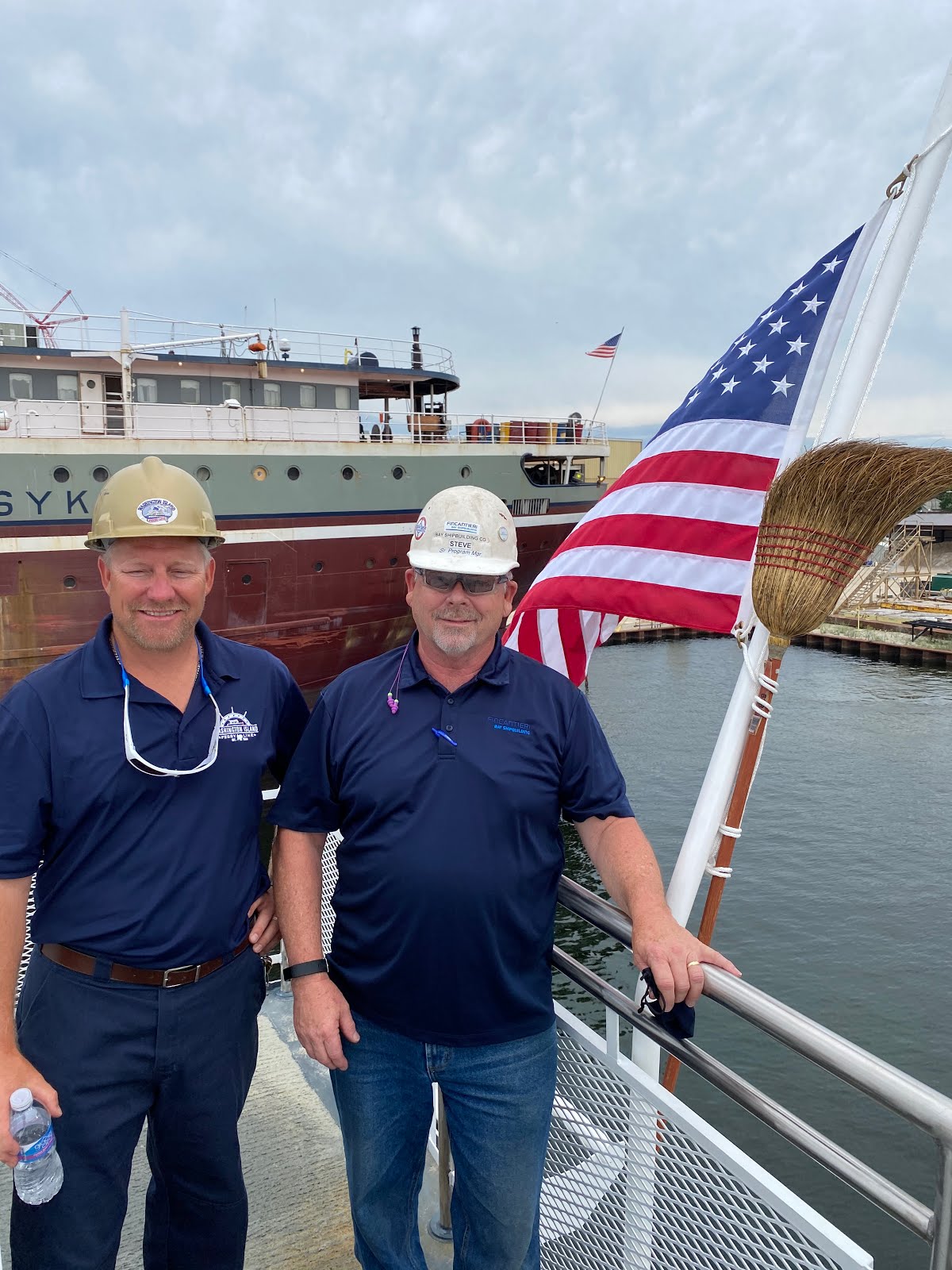
Capt. Joel Gunnlaugsson with Fincantieri
Senior Project Supervisor Steve Propsom, upon
return to port after sea trials.  Broom signifies
a "clean sweep", the satisfaction of
requirements for U. S. Coast Guard Certificate
of Inspection.  (Purinton photos in all cases)


Detroit Harbor, Washington Island -

Having been absent here for a few weeks in reporting on construction, during which time the christening took place at Fincantieri Bay Shipbuilding, we're now back to continue the story, with particulars of where the new ferry Madonna stands in terms of finishing and delivery.

First, we need to update statements regarding the steering system, because the first assessment for remedy didn't prove out.

One of many details added in the past weeks:
a step for crew to reach and tie mooring lines.
During Builder's Trials, a test run of the vessel's systems, its engines, electronics, etc., it was discovered that steering responsiveness seemed to lessen over time.  Greater revolution of the pilot house helm was required to move the rudder just a few degrees. The cause was determined to be hydraulic oil heating and thinning with longer running time time.  The probable fix appeared to be reduction of heating by means of installing a lower volume output hydraulic pump, and by enlarging the diameter of the piping from pump/reservoir to pilot house and to the steering rams back aft, a rather long run with many angles and turns in the piping.

Fincantieri pipe fitters began work right away and installed larger inside diameter piping.  But as for a lower output, CAT engine-compatible hydraulic pump, none was found in the marketplace.  Instead, a flow valve was installed, along with an oil cooler (fed by the same pump that flushes stern tubes). During a second Builder's Trial, performed two days ago on Monday, July 13, the steering seemed to perform well.

As can often happen with more time spent underway, a few more items also came to light, and they were highlighted on the punch list.

After Monday's successful underway trial, a second sea trial was then scheduled for Tuesday, July 14, this time with a U. S. Coast Guard Marine Safety Detachment observer on board.   This sea trial fell almost exactly 1-1/2 months beyond the original estimated Madonna delivery date, a point of secondary importance to getting steering, as well as other vessel functions, to where they needed to be.

In this photo, you're looking up the ladder
that leads from engine room to main deck.
Madonna engine room has come a long way:
a complex space of piping, wiring and machinery,
but with room to move about.  A Bay Ship
mechanic can just be seen between generators,
monitoring fluids and temperatures.
Clean bilge; CAT engine control boxes;
bilge piping manifold beneath.  One example of
well-laid out, yet separate, systems.


We departed the Bay Shipbuilding slip at 10:00 a.m. and proceeded to the outer bay, with approximately a dozen yard personnel plus five Ferry Line representatives on board.

Enroute to sea trials, Madonna passed
Cason J. Calloway, inbound to Bay
Shipbuilding for repairs.


At the conclusion of several drills and with Joel Gunnlaugsson
at the wheel in the pilot house:
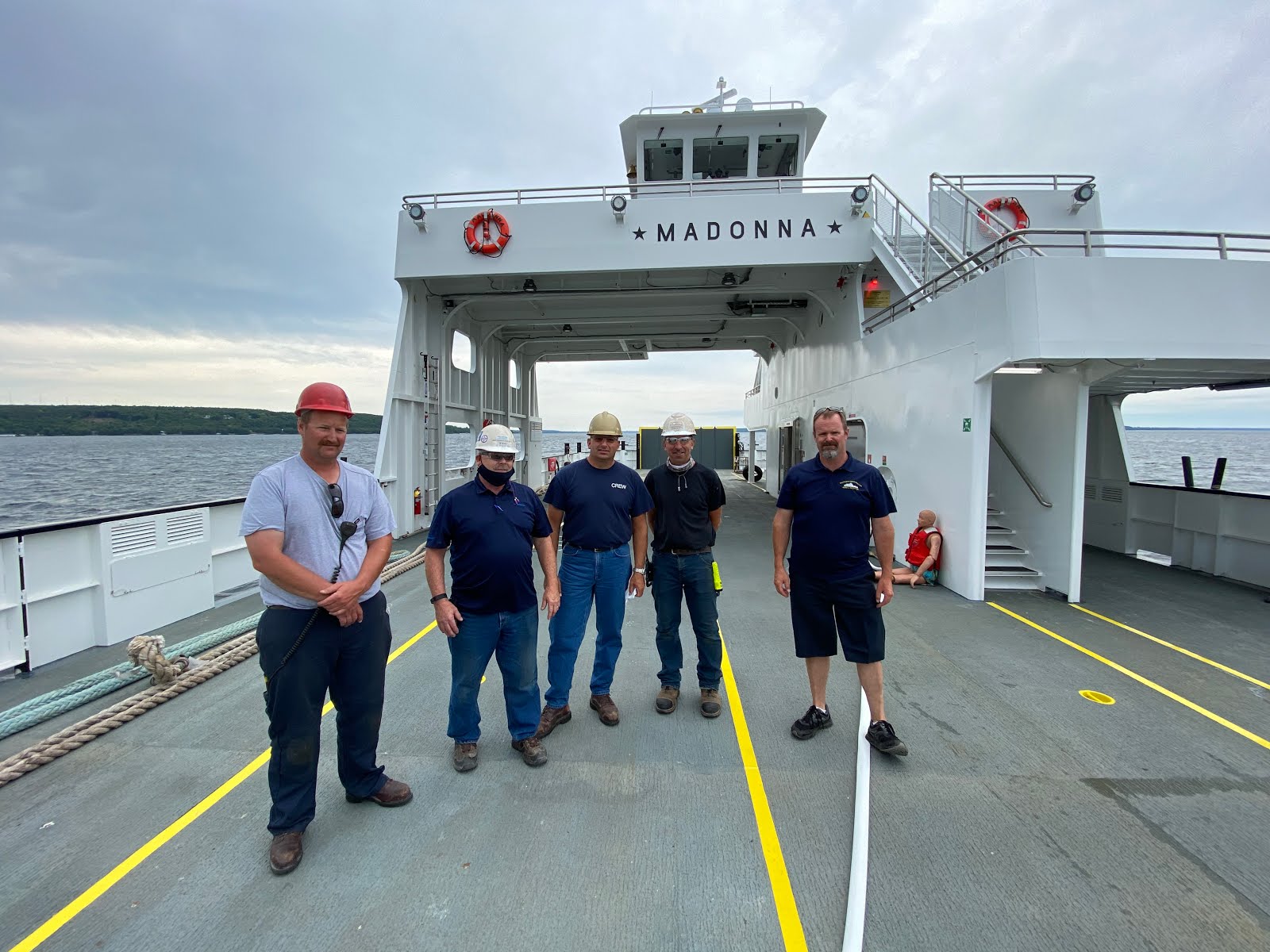
Rich Ellefson, Steve Propsom, Jeff Cornell, Dan Petersilka and
Hoyt Purinton.
By the time we reached Sherwood Point light, having passed port-to-port in the entrance channel the Cason J. Calloway, inbound to the shipyard for repairs, the Madonna's engines and fluids were warmed to anticipated operational temperatures.  Steering maneuvers, the shifting of generator loads, "crash stops" (full back while carrying typical forward momentum), a man overboard drill, and demonstration of good water pressure on main deck fire hydrants, were among items checked off during the several hours underway.  The sea trial was termed a success, and the number of items on the "to-do list" were trimmed even further.

A man overboard drill was conducted using a dummy
designed for such an evolution (approx. 150# with water
weight).  Shown:  Coast Guard observer Tom Hunninger,
Jeff Cornell, and Hoyt Purinton on bow ramp.

Another day or so will be used to tie up remaining loose ends, and to reconcile our standing with the Fincantieri yard regarding "who pays for what."  Those discussions may continue for some time, but a general understanding must be met in order to transfer ownership, and satisfy builder and owner product expectations, contractual items met, and with an appropriate USCG Certificate of Inspection forthcoming (like having a motor vehicle license plate, only with particulars of operation spelled out in detail).

A view of mezzanine cabin passenger seating.


When can we expect Madonna to be underway for Detroit Harbor?  Perhaps Friday.  We'll have to see.

  -  Dick Purinton

Upper deck passenger seating and pilot house.

Saturday, June 20, 2020

MADONNA - UNDERWAY - 36.0


Madonna underway off the stone quarry, outer bay,
during builder's trial, Friday afternoon, June 19.
(Photo by Erich Pfeifer)


Detroit Harbor, Washington Island -

After long days of chasing down and correcting details, some small, some large, Rich Ellefson reported that Madonna would sail from the dock for the first time.  This would be the "builder's trial" in which various components and equipment would be tried and tested, including running main engines up to temperature while various systems were monitored.   Apparently things went well (or, I just didn't hear about the glitches!).
Bay Ship and Ferry Line representatives gathered for
briefing on main deck prior to leaving pier, and again
upon their return dockside.  (Hoyt Purinton)
Hoyt Purinton, Erik Foss, Joel Gunnlaugsson and Jeff Cornell joined Rich for the day, their first opportunity to see and experience the vessel underway.  A few photos are shown here of the Bay Shipbuilding and WIFL crew members in conference, and on the bridge.   With a few more days' work, the vessel could be ready for U. S. Coast Guard sea trials by mid-week.

Ferry line captains Jeff Cornell, Erik Foss, Rich Ellefson
and Joel Gunnlaugsson on upper deck.

Christening plans

In a departure from christening of the last several ferries, a ceremony will take place within the shipyard, with members of the Fincantieri Bay Shipbuilding workforce present, along with a few invited guests.

We'll hold details of the christening back a few more days as we reflect back on other ferries and the christening ceremonies that took place, both at the shipyard and here on Washington Island, when the public was invited to take part in the festivities.

A few panels and wires yet to be made permanent,
but the pilot house was functional for builder's trial.
(Hoyt Purinton)
Several reasons led to our decision to hold the christening at the shipyard.  One, Fincantieri Bay Shipbuilding wishes to recognize its workforce for a job well-done on a product that will sail in their "backyard," so to speak.  We will join the yard management in offering our thanks, and congratulations for a job well done.  A substantial amount of pride has been evident in workers who participated in this vessel construction, intended for Door County service, what could easily be 4-5 decades or more of continuous use for ferry transportation.  This occasion also highlights the importance of shipbuilding to the area's economy, and the contribution building such a vessel adds to Door County and the region.  Another reason for holding the christening within the shipyard confines is that with Covid-19 as a threat to public health it becomes easier to hold the christening in a controlled setting.  All participants will be asked to wear a mask (the Bay Ship workforce has been doing this for five weeks or more).

In wheelhouse:  WIFL construction supervisor and vice-president Rich Ellefson
with Steve Propsom, Fincantieri Bay Shipbuilding Senior Project Supervisor.
(Hoyt Purinton photo)
We'll provide more detail in a few days' time.  -  Dick Purinton

Monday, April 27, 2020

MADONNA - A VICTORY LAP AFTER LAUNCHING - 29.0


Madonna being towed into the slip where work
will continue in readiness for sea trials in mid-May.
(Jeff Cornell photo)
Detroit Harbor -

Friday, April 24, Washington Island Ferry Captain Jeff Cornell visited the Fincantieri shipyard to witness the launch - in this case a gradual dip - of the new ferry Madonna.  

He was there as a guest, and as such he had the opportunity to be on board as the ferry floated free and was later towed from the floating dry dock to a mooring spot in the slip, just south of the Bay Shipbuilding main offices.  Since Jeff was there as a guest observer, and not in a working capacity, I think we can say that Jeff became Madonna's unofficial, first "passenger."  He later sent me several photos of the day's activities.  - Dick Purinton
Madonna pierside, early Saturday morning.
(Rich Ellefson photo)
Closing the pier where Madonna will moor
 for the next several weeks, Selvick tug on
 bow towline. Rich Ellefson ready on deck to
handle mooring line. (Jeff Cornell photo)


Monday, April 8, 2019

More Signs of Spring


Snow banks were reduced further in late Sunday's
rain, and in the morning's warmth mist hung over
Lobdell Point Road.


Detroit Harbor -

Always a slow process, the cool weather of the past several weeks slowed up melting of snow banks, and the reduction in bay and harbor ice.   Ever so slowly it disappears and softens, but it was only Saturday, March 30, a little over a week ago, when the bay broke up and fields began moving.  Large pieces headed toward the Door passage with the potential of blocking, or halting, the ferry in its movement. The last scheduled crossing of the afternoon was called off.  Patience proved a good thing as ice piled against the shoreline on the Green Bay side of the Island, providing spectacular shoves in the late afternoon, we were told.  By morning, ice movement had eased, and broken fields lay to the west of the Door Passage.

Otter's unmistakable profile was an early morning surprise.


We've often observed evidence of an otter having passed through the Bayou area, leaving characteristic sliding and tail marks behind in the snow.  Similarly, it often left behind unmistakable piles of excrement loaded with shells, crawfish parts and fish scales.   Two days ago Mary Jo spotted an otter crossing the harbor ice, harassed by three crows as it scampered its way to the nearest hole in the ice.  This morning while having breakfast, grandson Zander saw the otter on the ice south of our home.  I fetched my camera, guessing it might swim for the next opening to the north.  It did.  Quite elusive until now, I think he or she's making a home nearby.  Could be a rough time in store for the small mouth bass that spawn in this general area later in spring.

As dark crept in yesterday afternoon and rain fell, lowering visibility, 37 sandhill cranes made an appearance on the harbor ice.  They landed one pair at a time, in intervals, as if signaled to do so from a control tower.  There, they congregated on the ice for the night.  This morning they were still together, only farther out, across the harbor, closer to Snake Island.  A variety of ducks, Canada geese, eagles and now the first great blue heron are among the visitors making an appearance each day as the openings in the ice enlarge.


In terms of human activity this morning, members of the ferry crew found ideal conditions to prepare the Washington for the season.

This part of the harbor happens to be ice free at the moment, but up in the shallows there's soft ice.  Fields of ice, given the right push by wind, could still cause challenges.  But, for the most part, reductions in ice will increase.  Wind and rain are now the best thing to speed up the process.  A bit of rain tonight is forecast, then snow Wednesday night into Thursday.  Maybe our last significant snow of the season?

Jeff Cornell buffs fiberglass benches on
the Washington passenger deck.


Pete Nikolai touches up with a wire brush while Tully Ellefson steadies the raft, an annual task to keep the hull and exterior bulwarks in good condition.  Above, on the upper deck, Jeff Cornell buffed fiberglass benches.  Soon, more ferries will be in use, underway, as one-by-one each is cleaned, painted and readied for the season.

Pete Nikolai (L) and Tully Ellefson man the painting
raft in this morning's calm.
 -  Dick Purinton


Sunday, December 13, 2015

YEARS GO BY QUICKLY

Erik Foss turns 50 today!
Washington Island, Wisconsin -

The years go by quickly, especially when you're busy.

Erik Foss turns 50 today, a fact I had overlooked until his son, Christian, told me.  Where was his dad?  He was at work.  "He likes to work on his birthday," according to Christian.  Maybe working is intended to help this day pass more quickly, and not be reminded of the additional year.

During a "survival exercise" on the Arni J. Richter in 2004,
Erik helped adjust life vests on sons Doug and Christian.
Both boys have worked as crew during their summers in
recent years.


When looking at today's Ferry Line crew, there are many faces familiar to the public since their mid-teens.  Erik is one of those who rode in the pilot house and threw the mooring line to the spile as well as anyone, when he was still in junior high.  Official records kept for continuous employment show that Erik comes in a close second to Capt. Bill Jorgensen, who (like Erik) worked for the Ferry Line several summers before joining permanently in April of 1987.   There are many trips under the belt of these two captains, with Bill holding the unofficial record of having the most crossings of the Door, of anyone, with his long work record and many trips on the ferries each year.

It's fun to look back on the years as told in photos, so here are a selection of photos showing Erik, Bill, Joel Gunnlaugsson, Jeff Cornell and Rich Ellefson.  

I'm sorry I'm not able to date each photo with accuracy.  Time has a way of wiping out memory of the year without a date having been recorded.  Perhaps the people in the photos remember.

- Dick Purinton


Bill Jorgensen at helm of Voyageur,
around 1980-81.
Bill with son, Dale, in
wheelhouse of C.G. Richter.
(Year unknown)
Captain Rich Ellefson (year unknown),
now Ferry Line vice president and operations manager.
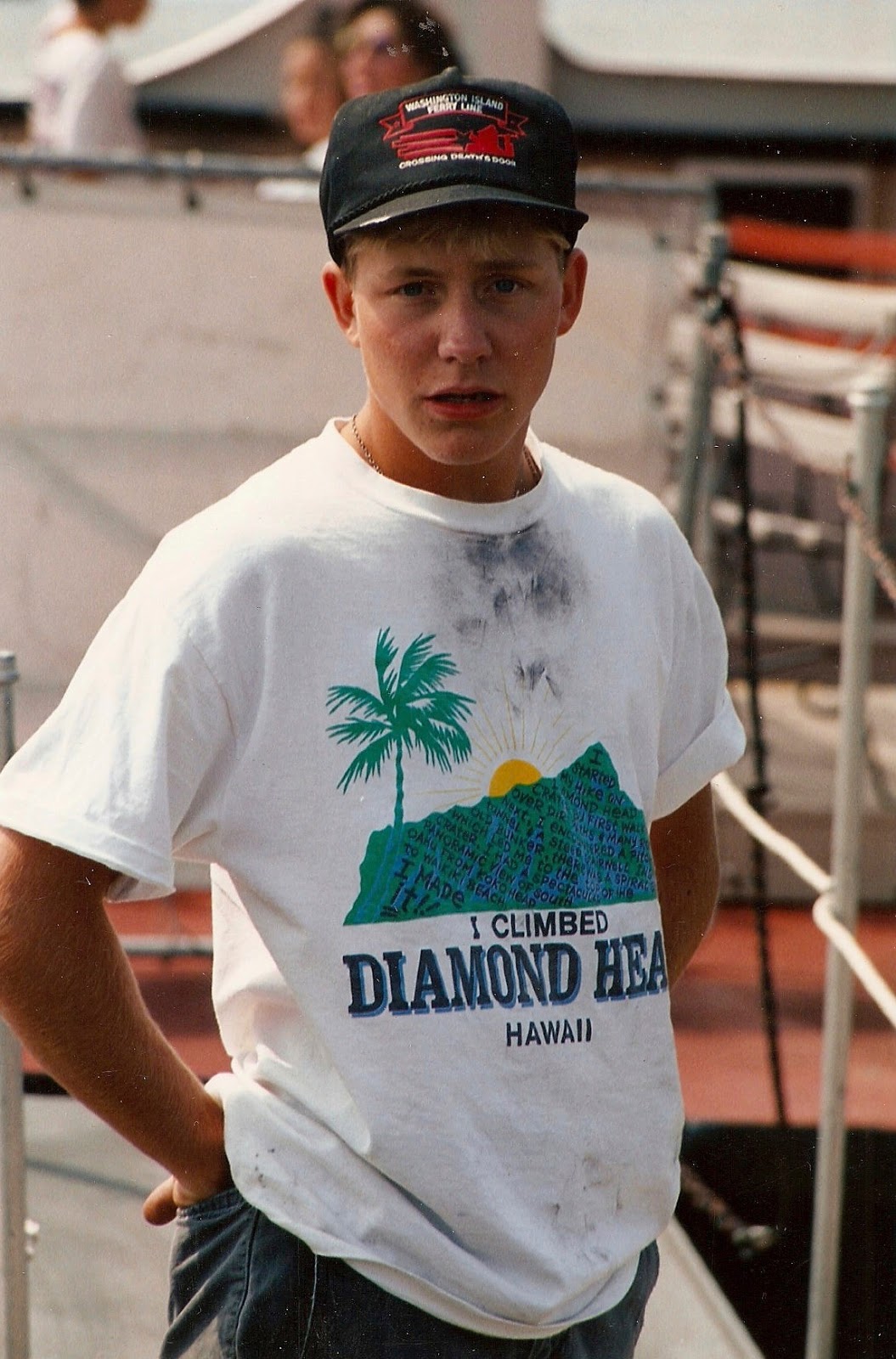
Captain Joel Gunnlaugsson (then summer crew 1993).   
Krista and Joel, before marriage, children, Town
government, County Board, etc. (1996)

Captain Jeff Cornell (year unknown) who operates
both Karfi to Rock Island and ferries to
Northport.

Saturday, May 30, 2015

ROCK ISLAND STATE PARK GETS NEW WELL

Rock Island and Thordarson boat house, after rain clouds cleared Wednesday.  
(Purinton)
Washington Island, Wisconsin -

I had the pleasure of operating the Karfi this past week on Tuesday and Wednesday.   Weather wasn't so great.  We had heavy fog early Tuesday, and then light rain, with rain again the following morning, finally giving way to a short stretch of afternoon sunshine and clear atmosphere.


Tuesday saw light passenger traffic and  a few campers heading back home.  Wednesday, after transporting a few passengers in the rain on the first run at 10 am, there were no takers for our noon trip to Rock Island. As it turned out, there were none waiting to return from Rock Island, either, so Christian Foss and I took advantage of the empty vessel to shut down, moor, and hike up the trail toward the lighthouse to examine the predicament faced by well drilling trucks the previous afternoon as they traversed the rugged, mostly uphill route.

Unloading the well drilling rig, one of the heaviest pieces of
equipment, with close wheel base, of the various vehicles carried
aboard the ferries.  (Purinton)

At midday Tuesday, in the height of the fog, Jeff Cornell and Hoyt had brought three trucks from Detroit Harbor belonging to Charlie's Pumps and Well Drilling, Brussels, Wisconsin.   As it turned out, transporting the equipment to the Rock Island dock and unloading it over the rather narrow pier was the easy part.


Karfi approaching Rock Island Tuesday morning.
(Kathleen Ernst photo)

The real challenge lay ahead for Randy Holm, Park Manager, his co-workers, and the operators of the trucks.   Anyone who has walked that trail knows that it is steep and rutted, sometimes sloping away from the hillside.   In addition, soils were soft and greasy from consistent rains over the previous several days.  Progress toward the light was halted, temporarily, approximately 3/4 of the way to the light.  That's where the trucks were parked for another attempt on Thursday, in hopes the rains would let up, giving the trail a chance to dry.

On Thursday, efforts to get the drilling rig and pipe truck to the light resumed.  Sixteen fiberglass mats were transported to Rock Island that morning, weighing approximately 100 pounds each, which were then laid end-to-end to ease the trucks over the, muddiest, steepest, and toughest patches.  Randy Holm described this operation as successful, but not without intensive labor on the part of the two drivers and the park employees who laid mats, then lifted them after the trucks had passed, scraped mud and rock from each, and then reset them on the trail that lay ahead.  With that effort, the drivers managed to get their trucks to the lighthouse grounds.

Then, as a first step, the well head was removed from the original, three-inch well, giving the drillers access by means of a pump dropped down the hole to a ready water supply, and with lubricating water, drilling commenced.  However, at approximately 25 feet, the drill head bit broke from the drill shaft.  As of this Saturday morning, their hopes are to retrieve it from the hole, possibly by adding cement and then pulling the entire plug, drill bit and all.   Not only is the drill bit worth several thousand dollars, it currently blocks drilling efforts made thus far.   If extraction is unsuccessful, a new hole using a new bit will have to be started.

This rather involved effort to provide a new well is designed to replace the original well, one that's been in use by lighthouse residents since approximately 1904-06 (the date is uncertain), when it was drilled by the Koyen brothers using a drop drill.  Randy Holm believes the old well was drilled to a depth of 155 feet (probably close to the vertical distance to the lake level from the top of the bluff).   For the past 100 and more years this well tested A-OK, but as older wells go it was uncased, and the State wishes to replace it with a new, cased well.   Undoubtedly, this new well will be of a deeper variety, probably producing typical iron content and water not nearly as tasty.  [Note:  In a conversation with retired Rock Island Park Manager Kirby Foss this afternoon, he said that August and Volney Koyen towed their drilling rig over the ice to Rock Island by horse team, and drilled the well in winter, to a depth of 195 feet.] 

This newly acquired liquid may be some of the most expensive water-per-gallon in the state!  We wonder how many cases of bottled drinking water could have been supplied for the same cost as drilling this well.  There would, of course, have to be the carrying of the occasional bucket up the steps from the lake for washing dishes and clothes, bathing, etc., the way it was done in the old days!  The thought of it all gives one a greater appreciation for life at the lighthouse prior to advent of the turn-of-the-century well, when fetching water from the lake must have been routine, in addition to capturing rain water.

Those new knees worked just fine

Christian and I paused near the Thordarson gate at the top of the first hill, above the tank house.  It's been fenced in for safety reasons recently, and in fact it was slated for removal this spring due to its deteriorating condition and the resultant liability it posed for park visitors.  However, keen public interest in trying to replace it with a similar structure brought a temporary stay to its demolition.  During what might be a rather limited window, Friends of Rock Island and park officials will seek funding and ideas to construct a similar replacement gate, one that might weather another 70 or 80 years.

Gate with hanging flower planter, made of native cedar, one of several
iconic structures on Rock Island built by Thordarson.  From this
location, visitors can enjoy a sweeping vista of the boathouse grounds
and Washington Island's northern shoreline.   (Purinton)


Christian and I then hiked past the gate another half-mile or so,  where we came upon the trucks parked in the center of a level section of trail.  This truck roadblock was the reason Holm had elected to temporarily close this trail to park visitors (other trails remain open), and for obvious safety reasons the grounds at the lighthouse will be likewise be closed during drilling operations - at least through June 6th.   Reopening of the lighthouse will depend on progress made in drilling during the coming week.


Every so often along the trail shoulders we saw deep ruts where the wide-tired front wheels of the well driller rig had gotten slightly off to one side.  On steeper portions of the slope where there were rugged vertical sections, there was evidence of struggles to move forward, and then get unstuck, using planks and gravel fill.  Given the challenges faced, it was surprising these two trucks got as far as they did that first day in the rain, with the steepest portions still awaiting passage.

To aid this project along, on Friday park workers carried a portable mixer and sacks of cement in the park's backhoe to the light, from the closed truck that was parked in the field near the boathouse.

When completed, this well drilling effort will mark a bizarre beginning to what we hope will be a good season for Rock Island park visitors.  Memorial Weekend traffic was steady, for both Washington and Rock Islands, and there are widespread hopes for good summer weather to provide many pleasant days outdoors for visitors.


Well drilling rig operated by Charlie's Pumps,
Brussels, Wisconsin, when progress was stalled
partway up the lighthouse trail.  (Purinton)
Meanwhile, our family has been preparing for months for a trip to Iceland, and in future blogs I'll feature what we'll see and do, as well as concerns we have regarding our travels.

-  Dick Purinton

Thursday, April 23, 2015

ISLAND WATERFRONT - Then and Now - Richter Ferry Line - Part XVIII

Ferry dock aerial 1978 -  Jon Gunnlaugson's  tanker Griffin is docked at
Hansen's Standard Oil (the concrete surface looks new in this photo) and the
 crew of the Eyrarbakki, largest of the three remaining ferries then, and in
its eighth year of service, prepares to discharge a Coke truck and other vehicles.  
Adjustable, hydraulic ramp in foreground is in its 4th season of use, the only
spot on the dock then set up for bow loading/unloading.  Voyageur (top) and
C. G. Richter are idled on this day.  Bob Bell's orange International Scout is
parked next to the ferry office, foreground.  A telephone booth is
handy, alongside the building for patrons coming off  the ferry.


Washington Island, Wisconsin -

We continue with the story of the Richter ownership and operation of the Ferry Line, now in its 75th year in this year, 2015.

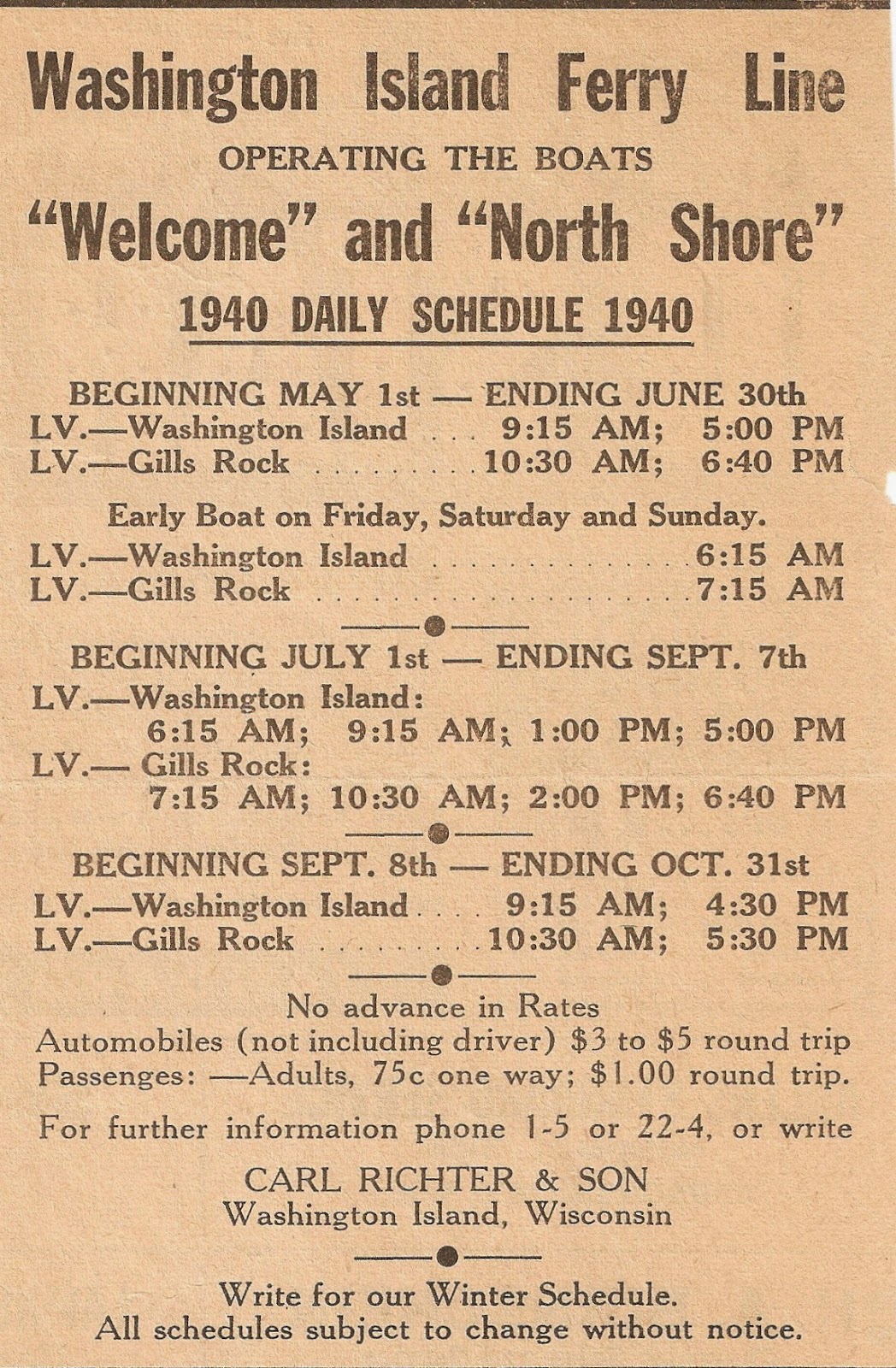
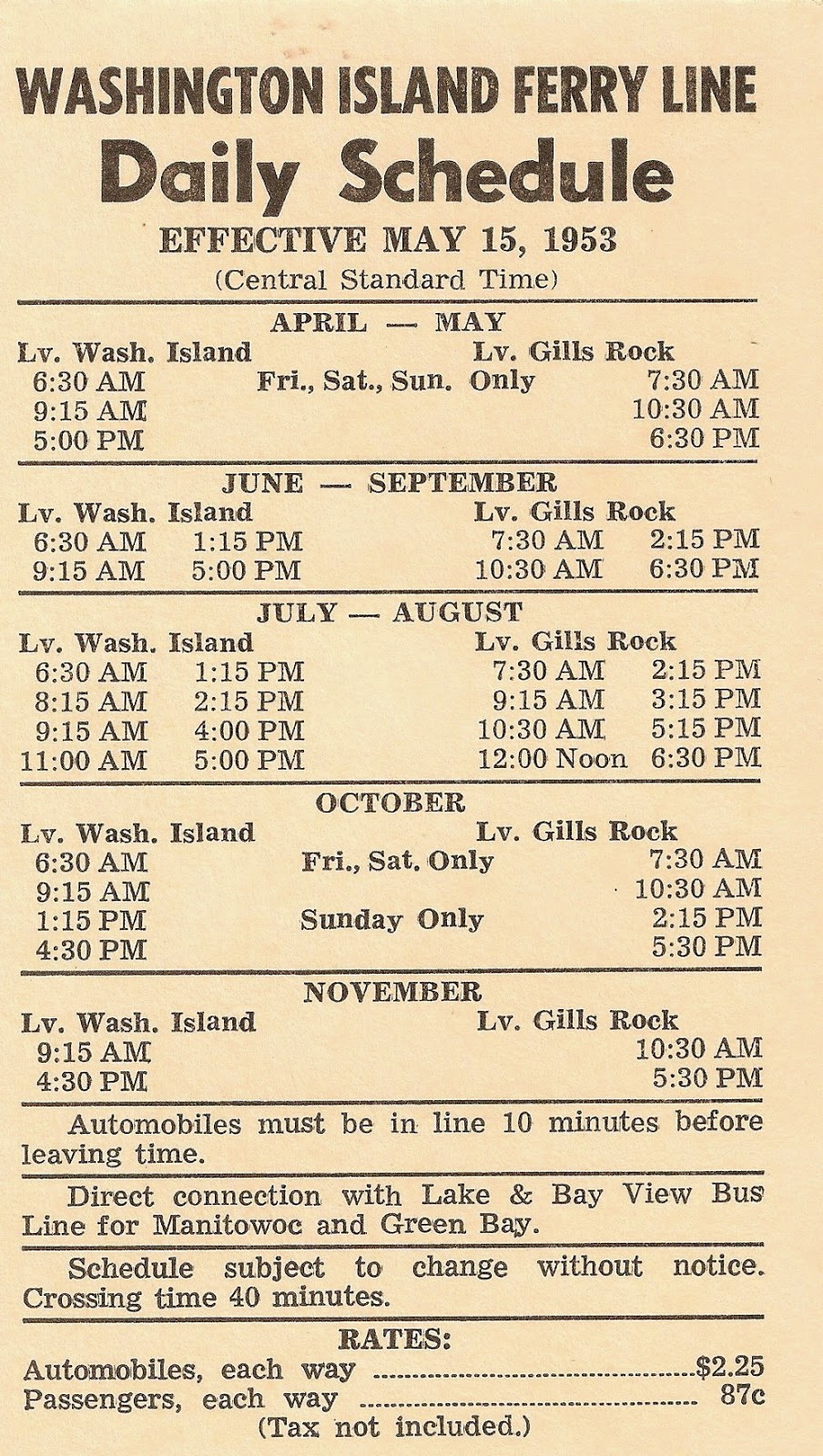
The schedule comparison shown above is interesting for a couple of reasons.  For one, there was deference paid to Carl in 1940, with credit paid to "Carl Richter & Son."  This would soon change, and maybe it was more practicality than anything, acquiring a business name that would be readily associated with Washington Island.  But over time it was still the Richter name, Arni Richter's name, that would be closely associated with Island ferry service, and in a general sense, with Washington Island as a whole.  Arni's involvement in the Door County Chamber of Commerce, his role as a director for the Bank of Sturgeon Bay, and his staunch support of the Republican Party (that brought him in contact with several Republican governors, state legislators, and Congressional representatives) held both social and business implications for the Richters and the Ferry company. 

Another interesting comparison is found in examining the rates, where one-way passenger fares ($1.00 in 1940 vs. 87 cents in 1953) and auto rates were actually less in 1953 than in 1940.   Perhaps increased volume had something to do with those rates, but in 1953 there were two, relatively new ferries, Griffin (1946) and C. G. Richter (1950), still working off construction debt.   Farming and fishing were then two booming Island industries, with dairy and potato farming continuing apace, and commercial fishing was the king industry in terms of incomes and steady employment.  Those industries translated to a great deal of freight hauled, meaningful in terms of revenue for both the Anderson Transit Co. and the Ferry Line.  Perhaps the freight revenues helped to meaningfully support the business overall. 

The construction of the Voyageur in 1960 departed from the side-loading ferries that required wooden planks (later replaced by a steel plate) to span the gap between vessel and shore.  Although the Voyageur had only a single ramp, located in the bow, loading could be accomplished quickly by directing drivers and backing autos on board.  A creative crew with the right mix of traffic could load a dozen vehicles in a short time.  Oftentimes, the load was a mix of autos, trucks and trailers, and occasionally large equipment that earlier ferries simply were unable to carry.   

Hauling a semi by ferry was novel, unheard of until the Voyageur.  That was
why this first-time photo was taken of a J. W. Cartage truck aboard early in the
1960 season.   The design of a larger, open-deck ferry today seems a no-brainer,
but Percy Johnson spoke often of Arni's agonizing the day before he had to
sign a contract to build the Voyageur at Sturgeon Bay Shipbuilding and
Dry Dock. Financing was always a challenge, and Arni's business style was
to first have the major percentage of new construction costs in hand before laying
a keel, a pattern that has been followed to this day in keeping debt
to a minimum.


By 1970 traffic justified a second open-deck ferry, an even longer vessel named Eyrarbakki.  If the Voyageur had been a grand improvement for carrying vehicles of all sizes, the Eyrarbakki went one better.  She had both a bow and stern ramp, and rather than the restrictive open deck of 50 feet of the Voyageur,  at 87 feet LOA the Eyrarbakki had approximately a 70-foot opening, making possible the loading of just about any combination of truck and trailer that could be brought over the bow.  (Eyrarbakki still has the largest unrestricted height, open deck space of all of the ferries.)   Standard vehicles (if they required less than a 9-foot overhead clearance) could be easily loaded in a drive-on, drive-off arrangement, and overall capacity came to 18-20 autos.  There were still large "Detroit boats" being driven for comfort rather than concern for fuel prices in those days, but new, smaller Japanese models had joined the highway mix, plus Detroit's "compacts" that provided options for crews to load an extra car here and there, maximizing usable deck space on a busy day.  

A major drawback in loading the C. G. Richter- especially in low water,
and especially with a heavy load - dealt with regularly throughout winter,
was to drive loaded trucks over the side ramp, timing the roll of the boat so that
the rebound in buoyancy would support the rear axle's wheels as the major
weight came into play.


On a cold winter's day, the Noble's hull was moved
from a construction shed to an opening and turned upright.
using two cranes.  Shown with the upright hull at PBI
are Arni Richter, Dick Purinton and Harry Purinton, who
represented R. A. Stearn, Inc. Naval
Architects.  Harry did much of the structural design and
engineering on this ferry, and the Washington in 1989 when
working for Tim Graul Marine Design.
At the time the Robert Noble was constructed, Tim Graul
headed up the PBI commercial design division,
completing Robert Noble design details. 


With a new ferry C. G. Richter in 1950, another in 1960 (Voyageur) and a third in 1970 (Eyrarbakki), there came a public tendency to believe that a new ferry would be built "about every ten years."  Pushing this theory along (and based solely on the coincidental rise in tourism and the need to keep pace with summer traffic, not a pre-ordained circumstance) was yet another ferry designed and built for launch in early 1979.  

Robert Noble launch, April 30, 1979 at PBI.  90' x 36', with
two, 365 hp Cummins engines, with 175 passengers, and 10'6" overhead
on the aft vehicle deck, made this ferry quite versatile,
the best in the fleet at the time.


The Robert Noble's design would enlarge, slightly, upon the dimensions and capacity of the Eyrarbakki, and in so doing it would render the C. G. Richter less useful - almost obsolete - as a summertime vehicular ferry. 

The answer, in order to get use from an aging vessel that still had many nautical miles left under her keel, was to convert the C. G. to summer passenger-only use.  

By 1984, an extension of 70 feet had been made to the Northport Pier, and as a result Gills Rock became a "passenger excursion" port, with the C. G. competing in summer, first with the Yankee Clipper, owned by Charles Voight, then after 1987, with Voight's new, aluminum Island Clipper.   

One fact of business Arni liked to recite was that each new ferry exceeded in cost the sum total of dollars spent on all previous ferries.  This reflected not only the nature of new construction, with increased complexity in safety equipment and design features intended to meet U. S. Coast Guard regulation, but also the tendency to improve each new ferry in size and utility.  With increased size came increased horsepower, and larger transmissions, all with added cost.   Each new construction contract was supported with the optimism that it would prove to be the right decision, and that a new ferry would help to sustain, if not increase, business for the Ferry Line and the Island.

Adding to the "ten year cycle" myth circulating in Door waters would be yet another ferry, Washington, also built by Peterson Builders, Inc., this one designed start-to-finish by Tim Graul Marine Design (TGMD).  It should be noted that during this period, Peterson Builders was attempting to transition from a heavy dependency on U. S. Naval contracts, which were becoming harder to obtain, while at Bay Shipbuilding nearly all shipbuilding efforts were going into the large commercial ship construction or repairs for the laker fleet.  Bay Ship didn't seek new, small vessel construction at this time, although that approach would change again in time.  

The Washington's design was a departure from previous ferries, most notably for the use of a center pedestal, or trunk, that supported a substantial superstructure.   The Washington had greater length and beam (100-ft. x 37-ft.) than previous ferries, but the increased overall dimensions, as it turned out, were somewhat offset by cramped lane conditions alongside the trunk, which incorporated public heads, engine room and passenger deck access stairs, piping and wiring runs, and light cargo storage.

Every vessel results in compromises, however, and overall, this ferry became a summertime savior by taking on long lines of vehicles and passengers, loading them with ease.   In certain instances, she's also been used in the freeze-up stages of December, having good sea keeping abilities, with less propensity to toss spray over the deck.  But, summertime use was its main purpose, to meet with the still-increasing patterns in traffic.   The 1990s, with dot.com financial bubbles not yet ready to burst, also brought increasing tourism, very much on the rise in Door County as a whole. This ferry, Washington, coupled with a new break wall built in 1994 that surrounded the Northport dock and made landings much less subject to wind and waves, became a very useful piece of equipment.  

Washington set to depart.   Crew: (L to R)  Jeff Cornell, Laura (Shellswick)
Lerner and Erik Foss.


The age of the C. G. Richter, having design qualities unacceptable to owners of longer and higher vehicles, and with increased bulk freight demand in the dead of winter (fewer Island goods were being stockpiled in advance, with less small package freight), and without the mass and horsepower to bull through frequently encountered ice conditions, and with its less-than-adequate passenger accommodations  (both heads and cabin space) her days were numbered.

But, it would take substantially more capital, plus the right design - whatever that might be - before a contract would be signed for a new winter ferry.  That timing proved to be 2002, a decision that followed much internal discussion and regular, annual deposits into a construction fund.  By that time, Arni Richter had retired (after making an official retirement statement, but one not always heeded!), and the new ferry to bear his name would have greater size, horsepower, and capacity than any of the other ferries.  And as before, it would result in greater expense than all previous ferry vessels combined!   

This card appeared anonymously one day at the Ferry Line office.
Its creator was quite perceptive of the divergence of opinion as
construction of the Arni J. Richter took shape in Nov. 2002.
(Taken on day of keel-laying at Bay Shipbuilding.)

The Arni J., as this ferry quickly became known, at 104-ft. LOA could carry 18 vehicles with ease, having broad vehicle lanes nearly 10 feet wide, with passenger cabins and passenger deck access, heads and engine room access offset in a structure along the starboard rail, giving it capability to carry several semi trucks by driving them straight through - this ferry came to be a considerable improvement for  winter and summer ferry service.  

Capt. Bill Jorgenson at wheel of Arni J., in ice.  Hull speed is
a consistent several knots, even in solid ice 10' thick.
Best of all, as it turned out the Arni J.  exhibited wonderful icebreaking capabilities.   This was due, in no small part, through copying the lines of the successful design of the most recent Drummond Islander ferry at Point DeTour, Michigan, also designed by TGMD.  A flight to Drummond Island in a small plane piloted by Graul convinced Arni there just might be a new and better design possible, rather than repeating or enlarging the C. G. Richter design.  (At one point, several years earlier, Arni had stroked his chin while he mused, "I don't think you'll ever find another design as good as the C. G. Richter for winter work!")

If Arni hadn't entirely agreed with the general design and parameters for the new ferry as they were developed with Tim Graul's expertise, he did go so far as to agree to put his name to it, and then to strike the bottle of champagne against a gangway upright when the moment for public approval was ripe.  His oft-repeated statement at age 92, and later, and not without intended humor, was:  "If my name's on it, it better be good!"  

-  Dick Purinton

Arni joked, after his first swing produced only a thud, that
he "might be getting a bit weak."  The occasion was
witnessed and enjoyed by several hundred people, and
accompanied by music, stories and adulations.

Wednesday, May 29, 2013

IN THE MERRY MONTH OF MAY

View from the ranks as Legion Color Guard led procession to
the Island Cemetery Monday morning. 
Washington Island, Wisconsin -

Visitors and residents of Washington Island enjoyed a near-perfect Memorial Day Weekend, with fine weather Friday through Monday.  Nearly any outdoor activity could be enjoyed, except for swimming or laying on the beach, since just one month ago the ice was leaving our harbors and the lake water is too cold for swimming.

The traditional Memorial Day Program with ceremonies at the cemetery and School House Beach afterward, sponsored by the local Gislason-Richter American Legion Post 402, was held at Bethel Evangelical Free Church.  Student Americanism Essays were read, selected war poems were recited by men of the Post, and the community turnout and support was again gratifying.

Approach to Rock Island, Saturday, May 25.


With the holiday over, we returned immediately to cooler, wetter weather Tuesday morning.  This year, with the addition of the small passenger ferry Karfi to the Ferry Line Fleet, I am under instruction with Jeff Cornell, who practically trained as a toddler under his Grampa Jim Cornell years ago.  Although a small vessel, rather straightforward in many ways, nevertheless there are characteristics and idiosyncrasies in this ferry not found on the larger vessels in Detroit Harbor.

This change of scenery is a welcomed one for me, and propitious, too, as I am just completing a book under the title, Thordarson and Rock Island.  This is a coincidental convergence of my earlier goal of completing this local history book, with the recent and unplanned acquisition of the Karfi by the Ferry Line company.  I am now  allowed the pleasure of working a few days each week on the Rock Island run.


After reading intently and organizing letter and document materials that were Thordarson's, with a steady, concentrated writing effort since January 1st, it is now a pleasure to set course for the Thordarson's stone edifice, the Rock Island State Park Boathouse.  It is Thordarson's best known structure and a most convenient point on which to steer when departing Jackson Harbor.

Jeff is particular as to how his operation should be managed, following years of safe and reliable transportation. I'm slowly gaining the needed skills.  If Jeff is to get his day off each week, my improved abilities will give him that opportunity.

There are two contrasting photos shown here of the Karfi's recent operations.  One was taken Saturday on the noon trip to Rock Island.  The other was yesterday morning when we had cool temperatures and a light rain.   I'm amazed, given that weather, that we had any passengers for a day of hiking and exploring on Rock Island.  It shows the possibilities when sunnier, warmer days arrive.

-  Dick Purinton   (Note:  Thordarson and Rock Island is a reasonable 4-6 weeks away from printing.  Estimated pages:  435; 100+ images with maps; paperback.   Price:  $27 + tax + S + H)