Saturday, January 24, 2015

ISLAND WATERFRONT - THEN & NOW - Part I

ISLAND WATERFRONT - THEN & NOW

- Washington Island, Wisconsin

After my last post and the photos that showed how piers in Detroit Harbor looked a few years ago, I decided it's a good time to go into more detail - as much as possible, that is.  A great deal of information has been lost, and as a result we use conjecture to reconstruct the way we thought things were.

This year will be the 75th for the Washington Island Ferry Line, hence the logo with the dates at the top.   If nothing else, this provides further excuse for delving into the past, something I always enjoy doing, especially when it involves old photos.  And in the case of Island harbor docks and activities, in many cased these photos seem to do more to tell the story than available written information.  So, I'll liberally illustrate the way things were in the harbors using photos available.   A few of these may look familiar.  Either I've already used them in earlier blogs, or they've appeared in Over and Back - A History of Washington Island Transportation (a book published in 1990, in timing with the Ferry Line's 50th Anniversary, and out of print since about 1997).


The pier photo shown in my previous posting was taken by Bob Williams in 1949 (related, I believe, to Dede Rollo, who had a cottage in Jensenville), and it showed the Chris Andersen freighter WISCONSIN, at the location we now know as the Island Outpost dock.  I believe that earlier this was the dock developed by J. W. Cornell, where he moored his fishing boats.

Because of the interest expressed, below are several more photos of the WISCONSIN during her earlier days of ferrying cars (most likely the mid-to-late 1920s).  The pier location at which she is loading, in my opinion, appears to be near the present day Shipyard Marina.  Perhaps the base of this pier was the former Gislason dock, used by the store's owners at the turn of the last century for receiving shipment of goods for their store.

This photo was taken of the J. W. Cornell family when four identical
autos were loaded aboard the WISCONSIN (maybe just arriving
at the island for the first time).  This photo also speaks of a
time when money was to be made in commercial fishing, as the
autos were purchased by sons of Clara and J.W. Cornell.  Sons

Claude and George are believed to be in the white hats, standing behind 
their parents.   They, and another son, Bill, we believe were the owners 
of new Hudsons.   Daughter Mary (Richter) is in the back row, 
right hand side, with dark hair, and her sister, Audrey, is in
front, blond hair, looking at the camera.  According to the Door County 
Advocate issue of June 24, 1927,  an article clipped by Eric Greenfeldt 
(grandson of Bill and Harriet Cornell):  " It is quite surprising how many
high priced autos have been sold on the Island recently.  George
Mann sold three Hudson cars in one day, which is suggestive
of the business being done in that line here."


This early photo showing folks dressed in
fashionable wear

speaks to an early tourism trade.
The end of this pier as shown is broad and smoothly decked-over, suitable for maneuvering and loading automobiles, passengers, or for stacking freight.  That was the location William Jepson, one of the early ferry operators, used until the very early 1930s, at which point he transferred landings to the present Lobdell Point ferry landing location.  Jepson purchased and then developed the boatyard property formerly owned and managed by Ole Christiansen.

Shown is the early beginnings of the ferry dock at Lobdell
Point.  Logs piled on ice show work is in progress.
A small shack in the background is on the
Standard Oil pier, where barrels can be
seen lined up along that pier.  Bill Jepson, who was

responsible for this dock work,
was an avid photographer, and so it is likely
this photo, as well as many other early 

ferry photos, were taken by him.
Ole's name popped up a number of times when I researched the Thordarson book.  At one time Ole had a pier in Jackson Harbor for the purpose of loading timber products.   I'm just guessing, but I think his pier may have been located in the fairly deep water tucked inside the northeast corner of that harbor (the remains of old cribs can still be seen there along the shore).  Ole, who was quite enterprising, also owned - and was the last owner  of - the schooner MADONNA.   In later years (about 1915 or so) this vessel was grounded and abandoned in Detroit Harbor, in the area immediately west of the old Ida Bo (or Holiday Inn) pier.   Bits and pieces of the MADONNA still are mired in the bottom in that general location.

Summer fun with a rowboat, taken in front of
the cottage currently occupied by
Connie Essig.  MADONNA remains are
in the background.
A photograph from old Koken photos show children (perhaps Koken grandchildren?) playing in a rowboat, with the remains of the Madonna visible in the background.   For general interest, I've included here another Koken photo, one of their motor launch BERYLUNE, shown loaded to the scuppers with cedar shakes.  Where those shakes came from is anyone's guess, but very likely they were transported to the island by ferry to the shipyard location, and then reloaded by the Kokens for transport across the harbor to … the bayou estuary, where the Kokens owned what became later on the Arni and Mary Richter property.  The Kokens had a small pier and, later, a boathouse with marine railway.   Many of the buildings on this piece of property were - and still are - sided with cedar shakes.


BERYLUNE is a fine little boat with classy lines, and if you'd like to see her in a beautifully restored condition, please visit the Gills Rock Maritime Museum where she's a featured display, complete with her 1-cyl. Straubel engine.  How this craft wound up in the Gills Rock museum, and what the trail of ownership might have been after the Kokens owned it would be a good research project.  (Perhaps a reader may know the answer?)

BERYLUNE at Bayou dock in Detroit Harbor,
loaded with bundles of cedar shakes. (photo
taken perhaps late 'teens or early 1920s)
But, back to the early ferry WISCONSIN, a wooden vessel pressed into service as an auto / passenger ferry back when only freight boats were available for such trade.   We can see that loading was no picnic, but with the use of planks three or four autos could be squeezed side-by-side, thwartships (or rail-to-rail, rather than fore and aft).   This worked for a number of years, with several different in service.

Next time I'll use information from early county newspaper accounts that detailed the efforts of several operators to start an island ferry service, sent to me by Eric Greenfeldt.

-  Dick Purinton

Thursday, January 22, 2015

WINTER DOCK WORK

Detroit Harbor scene.  In foreground, the Standard Oil pier,
later Hansen Oil, and as of late 2014, Ferry Line north dock
Behind that is the former Cornell dock, now Island Outpost,
with Chris Andersen and his freight boat Wisconsin.
(photo taken in 1949 by Bob Williams)
In the background are several abandoned vessels in the shallows,
near what was the Chambers dock, now  the location of the Town's
launch ramps and the Island Clipper pier.


- Washington Island, Wisconsin

Like many waterfronts, Detroit Harbor changed over time, but many of those same appendages that were fishing or freight piers years ago remain in place, raised up and shored up over time as better materials and construction techniques, and capital to make improvements became available.

The dock in the foreground was owned at one time by Standard Oil.  It looks quite trim, capped with concrete, and it was used as a platform for unloading barrels of petroleum products, as well as transfer and other freight from the Anderson Transit's American Girl and barge Oil Queen.  (The Island Electric Co-op, with diesels placed into service in 1946, was using several hundred thousand gallons of diesel annually, and the Oil Queen helped to fill the tanks that kept those engines working.)

In the 1960s a good portion of the Standard Oil pier was enclosed with steel, with sheets driven outside the existing timber cribs.

Over time, the timbers that made up the old pier deteriorated, and so have the steel tie-backs and whaler supports that hold the sheets from tipping outward shown significant corrosion.  Much of the pier's interior wooden cribs and steel tie backs will need removal, or replacing, in a shoring up process designed to strengthen the dock before new fill and a concrete cap are added.

Detroit Harbor is frozen solid, and has been for the past
several weeks.   Here, Rich Ellefson and Joel Gunnlaugsson
are shown on the pier.   Several openings were made along
the pier face for examination of existing
dock structure.


Steel arrived Monday by semi, and work is now underway, much of it undertaken by ferry crew as a winter project.  So far, they've been favored with mild and sunny January weather.   Tom Jordan, Island contractor, has some of his equipment on site to help break up the old concrete cap into smaller pieces, eventually to be trucked away.  Mike Kahr of Death's Door Marine will bring a larger machine later today, for driving sheets into the bottom.   This is an ideal time of year to get this sort of work done, as all of it can be done from the existing pier structure - and of course, there are few, if any, onlookers to get underfoot.

Con McDonald (L) and Tully Ellefson
cut steel for new dock brackets to support
tire fenders.      
With mild weather and relatively modest winds, recent ferry crossings have been excellent.

Other than a few fishermen on weekends, traffic is made up primarily of service providers, suppliers and Islanders who need to travel back and forth.

-  Dick Purinton


Sunday, January 11, 2015

DRIVING MISS DAISY

We drove to Jackson Harbor Saturday afternoon
and found everything in place,
exactly as anticipated.


Washington Island, Wisconsin -

For the past week temperatures have not varied more than a few degrees above or below zero.

Each day seems like a replay of the one before, although its been sunny and bright, and I suppose that alone makes it seem better if you're indoors safe and warm or in a spot outdoors sheltered from the wind.  

Recent ferry trips have gone like clockwork.  Ice to the west of the Door passage dampens the sea,  even when, like the other day, a large bite of ice left the waters in the Door and sailed out to the lake.  The exposed warmer water produced sea smoke or steam against the much colder air.   Because of ice upwind a mile or two from Plum Island, the brisk westerly winds didn't produce much of a sea.   The Potato Dock, loaded up from spray a few weeks back, received another light coating to freshen the glistening ice banks.

Arni J. Richter enroute to Northport, Saturday afternoon, Jan. 10.


We've taken to making short drives in the car to break up the tedium, with Mary Jo chauffeuring and me coiled up in the back seat.  It's an impossibility at this point to bend my knees tightly enough to get in the front passenger seat, and so we're imitating "Driving Miss Daisy" with me in the back seat offering suggestions on when to turn, what to see next.  It's in the grand tradition of Esther Bjarnarson and her green Checker taxi, with Oliver contentedly in the passenger seat, a fixture on the Island for many years.  

"You can dictate to Mary Jo, and she can
type your blog," Erik suggested.   


After several tries with my camera, I got a shot of the elusive Erik Foss who nearly always manages to duck, weave or otherwise put himself out of camera range.  Erik wondered why I hadn't done a new blog.  

"I posted one yesterday," I said.  "What'll I write about, anyway?  Any news you can give me?"

They spotted a snowy owl on the ice, and then an eagle, Erik said, but his curiosity soon switched to the topic of my knees and why I was sprawled in the back passenger seat.  My explanation included a display of the 9-inch scar over my right knee.

Bill Jorgenson and Pete Nikolai, who together with Erik were the Arni J's crew, nearing 1 p.m. rolled the UPS cart aboard, then pulled up the stern ramp and applied power to the screws.  The wash thrown up by the propellers was mixed with ground ice as the ferry started for Northport on its afternoon run.

How good it would feel to be to be able to join them, I thought, but slippery decks, multiple sets of stairs and weather elements presented barriers I'd never before considered obstacles.  I'm thankful the daily job of operating in winter is in the hands of such capable men.

We've taken to watching the ferry load up and then leave the island pier while parked along the side of the old office - an activity I'd never expected I'd be doing, or something that would give me such pleasure.  We were reminded of Arni's daily routine of parking his car at the ferry dock while in his nineties, observing the ferries come and go and reminiscing on how things had changed from the old days.

From Mary Jo's perspective - and she's been a saint - our current routine might seem more like, "You're driving me crazy," rather than "Driving Miss Daisy."  

At home, indoors, we're on our seventh jig-saw puzzle (tough ones with 1000 pieces).  WPR provides background music throughout the day.   Mary Jo helps me with physical therapy and fills the woodbox, stokes the fireplace, and fixes meals.    Her world has shrunken in scope along with my own these past weeks.  Visits from grandsons become highlights of our day, along with a leisurely spin in the Toyota along snowy Island roads.  It's become one way to relieve January's tedium.

The big football game - Packers vs. Cowboys at Lambeau field - begins at noon today.  This is the day for which many fans have waited, and it becomes the high point of not only their season of football, but of the winter itself.   We could say there might be disappointment on the part of some fans that the game time temperature time won't be colder than +17 degrees, when we've just experienced much colder days.   Talking about the weather and describing the effects of cold temperatures seems to describe best where we live and how we've chosen to live, even though most of us are content to watch such football games from the comfort and warmth of our living room recliners.

With Jackson Harbor frozen solid, the old
Welcome's mooring lines become window dressing.
  

-  Dick Purinton


Wednesday, January 7, 2015

WINTER IS HERE

Soft, late afternoon light is characteristic
of an island winter.  Here, looking toward
Door Bluff from the Potato Dock.


Washington Island, Wisconsin -

December 21st marked Winter Solstice, and those days were overcast and dark, but with temperatures that were quite mild.

This changed as the middle portion of the nation, and upper Wisconsin, consistently experienced cold air over the past four days, with temperatures slightly above zero, sometimes dipping below zero, with accompanying winds that made getting outdoors miserable.

Sunday's high pressure system brought gale force winds, and light snowfall early that morning.   Ferries that morning were cancelled.  Winds abated slightly by mid-day and the two scheduled afternoon trips were run, taking holiday visitors to the mainland and back home.   Monday brought even more cold air, and the Island schools - like many in northeastern Wisconsin - closed for the day.   It takes a day or two of such temperatures for everyone to get acclimated, it seems, as temperatures become more acceptable and manageable.   School was back in session Tuesday, and this morning, even with the thermometer reading -3 degrees, and biting winds, school was open.

Along the ferry route ice blew in from northern Green Bay waters Sunday evening, filling the span between Door Bluff and the island, stopping against the western shore of Plum Island.   Ice lays off the west side now as far as the eye can see, and it is setting up a bit more with each passing hour.  Monday morning, as timing would have it, marked the official beginning of our "Winter Ferry Schedule" -  just two scheduled round trips per day.   Given the ice conditions and the light traffic, this schedule change is good timing.

All ferries are now in winter layup, with the exception of the
Arni J. Richter (shown at end of pier).   Ice covers all of Detroit Harbor
and the West Channel, extending to Plum Island
and Door Bluff and beyond to the west.


For the first time since December 1st, the morning I shoved off to Green Bay for double knee surgery, I  paid a visit to the Ferry Line office, walking gingerly across mostly dry sidewalk to the customer door.  Warm smiles greeted me from the office staff (I had just missed the boat crews who departed for home about ten minutes earlier.)    This was my second time out of the house since coming home from the Rennes Rehab facility Dec. 19th, and it felt mighty good to see such friendly faces and familiar surroundings.  So good that we repeated the exercise yesterday, complete with an added look-see from the Potato Dock and a slow cruise around Green Bay Road before returning home once again.

Office crew in late afternoon:   (front) Bill Schutz,  Intern Chris Cornell, 
and Janet Hanlin.  (back)  Hoyt Purinton and Rich Ellefson.  
On desk in foreground is theFerry Reservation "Bible,"
 referred to thousands of times during the
three winter reservation months.


Happy Birthday! is in order for Bill Schutz, Ferry Line Office Manager who turns 58 years old today.  Bill has been a stalwart of the Ferry Line since his first day of work, tutored by Percy Johnson back in 1979, as I recall.   How the time has flown!   Bill will spend most of this special day harnessed in his familiar traces, quietly pulling the load from behind his desk, and we hope, enjoying the bright sunshine this day brings.

Joining our ferry crew this winter is high school student Chris Cornell, son of Mike and Sue Cornell, who is an intern during the afternoon with the Ferry Line.   Chris is a good worker, has a pleasant disposition, and he seems to be enjoying and benefitting from the experience.

Note:   Although we didn't make special mention earlier, the WIFL Board voted to keep rates for passengers and autos the same for the coming year.  (Effective at end of March 2015)  Ever-lower fuel prices - the lowest per gallon for bulk diesel in years - plays a key part in making this possible.

-  Dick Purinton


Monday, December 29, 2014

Thor with surprise Christmas table.


Washington Island, Wisconsin -

Tomorrow, December 30, will mark one month since my bilateral (double) knee replacement surgery.

I have to be honest in saying it hasn't been easy.  On the other hand, as time advances, and my mobility improves, and the discomfort lessens, I've come to think it was the right decision to do both knees at once, if for no other reason than I might never have the courage to do the second one a year or two down the road.   At this point, my daily stamina, mobility, and my ability to concentrate has increased to the point where I can at least think about doing a blog.

This Christmas we had the ultimate of surprises.   Our youngest son, Thor, brought with him sections of a table he created in his spare time, fulfilling Mary Jo's wish to have a table large enough to seat all of our family at one time (11).   Thor has been working on this on and off for at least several years, and we were led to believe it still wasn't quite ready.  However, a few minutes past midnight of Christmas day, when I couldn't sleep, I wandered in to the living room to find Thor assembling the various pieces of his table.   I was too excited, and impressed by his workmanship, to go back to bed without waking Mary Jo first.   We have no lack of pride in saying Thor has designed (all in his head) and executed a woodworking masterpiece, and already it's seen service for meals, card games and other family activities.

Grandsons Magnus and Aidan play cards.


The quality of construction is of the same high standard Van Dam Woodcraft is known for in its boats.  If you go to their website you will also find a large corporate table custom built by Van Dam (and on which Thor also had a major part).    But our table we think is quite unique, and therefore it deserves mention and description here.

Ends slide back simultaneously, smoothly,
revealing the center section beneath.


The basic dimensions were to be approximately 4 feet x 10 feet.   Thor created a mid-section using German hardware and a butterfly-like section that opens from underneath the table as the top halves are pulled aside.  The mechanism works like butter, smooth and with just the right clearances.   Aside from the key mid-section hardware and slide, however, the rest of the metal pieces were fabricated by Thor or friend Jess Brown, Van Dam's metal craftsman.

The four-foot mid-section features two inlays of reconstituted, colored  stone set in circles of curly maple, the image of a green tree frog.  (Based on a second place photo that I entered in the Peninsula Pulse photo contest several years ago.)   The main wood used on the table top is a veneer of island butternut, timber that was cut, sawn and stored over 30 years ago in our barn on Main Road.    The original plank was slightly over 10-ft, with several splits and a tremendous amount of worm holes.  The splits and worm holes were filled first with epoxy before Thor sliced it into 3/8 veneer, then fastened it to a stable backing of 1" foam insulation sandwiched between 1/4" marine plywood, a light but firm backing.   The edging is sipa, a wood closely related to mahogany.   The table top was finished with at least four clear coats of an automotive finish, impervious to moisture and nearly all liquids (although subject to hot temperatures) for a very smooth, shiny and durable top.   The skill of Van Dam's Trevor, who traded his time with Thor and who does nearly all finishing of Van Dam's watercraft products, is greatly appreciated.  It is an outstanding, smooth gloss finish.  The legs and underside has a satin finish.  The end product does resemble, in both size and quality, a corporate boardroom table.

The table underside also reveals a high
degree of finish craftsmanship.

With my recovery still ongoing, and my inability to get out to visit, we've enjoyed more than ever the visits to our home of grandsons, our children and their families, and occasional guests.  This table will enable many enjoyable hours with friends and family in the future.

Two other notes:   Have you seen the Van Dam name on the recent Craftsman tool ads on television?   The shop was closed for one day (rented out) when Craftsman's marketing people created the ad.  Ben Van Dam, company vice president, is featured in the ad, along with a very quick shot of Jess Brown, metal craftsman.   (Practically all of the Van Dam product line is of finely crafted wood, with only an occasional carbon fiber or other material called out by the owner.)

One of two mid-section tree frog
inlay designs, cut from colored sheets of
reconstituted minerals.  The frog's eyes
glow in the dark.

Second, a new project is now underway, an unusual Chesapeake Sandbagger sailboat to be built along traditional sandbagger lines using the Van Dam cold molded method for light, strong construction.

Sandbagers were working sail craft used to dredge oysters originally in the 1800s, that evolved into gentlemen's racers.  They are beamy but of shallow draft, with a huge, unreal amount of canvass.  To counter act the forces of wind on heeling, 50 lb. sand bags were slung out on hiking boards by the fishermen as they raced one another back to port, hence the name.  

Eventually, as racing became a popular pastime, human ballast replaced, or was added to, the sand bags.   In one photo I've seen, five crew each on two planks can be seen hiking out, well overboard, to keep the vessel at proper heel.

An incredible and highly unusual craft, this latest Van Dam project will be built for an east coast owner with delivery by early summer.  Thor has been given the opportunity to head up this project.   You may find progress photos soon posted along with many other Van Dam projects, past and present, at VanDamWoodcraft.com

A short history of the sandbagger can be found on the Mystic Seaport website: http://www.mysticseaport.org/locations/vessels/annie/

-  Dick Purinton

Sunday, November 30, 2014

VILHJALMUR STEFANSSON - THORDARSON ACQUAINTANCE PART III

Arctic explorer and anthropologist,
Vilhjalmur Stefansson (1879-1962)


Washington Island, Wisconsin -

My final entry in this series of three people who knew or corresponded with C. H. Thordarson - the Icelandic immigrant, inventor and title holder to many U. S. patents, manufacturer of electrical transmission and lab equipment, and a leading bibliographer of his day - is about Vilhjalmur Stefansson.

Having included the several letters I found between Stefansson and Thordarson in my chapter from Thordarson and Rock Island titled, "A Magnificent Library, a Lifetime of Books," ( beginning on page 265) I at first had no idea who Stefansson was, his background or what his accomplishments were.  The more I read about Stefansson, the more intrigued I became, because his life connected with other notable figures of Arctic exploration, a subject I've always found fascinating.  If Thordarson seemed a fantastic personality and individual of his day, Stefansson was his equal.

Map showing approximate routes of Stefansson over several
Arctic expeditions - nearly all on foot, towing a sledge.


My initial reasons as author/editor for including the letters between Stefansson and Thordarson was simply to demonstrate the range of Thordarson's correspondence regarding personal library acquisitions, and to illustrate the thorough knowledge he had for certain books, titles, editions and quality of copies.  Thordarson could be very discerning in his book selection, and this showed in his exchange with Stefansson.  But, by digging further I learned more about Thordarson and about Arctic exploration efforts that were either just completed or were being planned for the Arctic region.

Stefansson dragging a seal across the ice.


Thordarson's most frequent correspondent, Eugene McDonald of Zenith Corporation, you may recall, was a co-leader of an expedition to northern Greenland and the Arctic with Capt. Donald McMillan and LT Richard Byrd.  Their expedition in 1925 pioneered the use of aircraft for Arctic reconnaissance, and the use of short-wave radio for long distance communications.  Thordarson, an Icelander by birth, and one who seemed interested in all such ventures, must have found his friend McDonald's Arctic reports fascinating, and the use of Zenith Company products aboard his ship, for which Thordarson Electric Manufacturing supplied coils, meant that Thordarson had a personal stake in the success of that mission as well.

Book collecting helps display Thordarson's range of knowledge

Let's review Thordarson's ambitions in collecting rare books by reprinting several of his letters of correspondence with Stefansson, who at first I believed to be simply another ambitious, well-intentioned middleman of used and rare books.  How uninformed I was, and what a pleasant surprise to be introduced in this way to one of the most notable Arctic explorers of the 20th century.

Stefansson, born in Gimli, Manitoba in 1879 to Icelandic immigrant parents, was given an American name, William Stephenson.  He later changed it back to the Icelandic Vilhjalmur Stefansson,  which is probably a clue to his great amount of self esteem and self confidence, characterized throughout his life.  His family moved to North Dakota, to an area where many Icelandic immigrants had settled, and he received higher education in North Dakota and in Iowa.  Later, he was a graduate student at Harvard, first in the School of Divinity, then specializing in anthropology, which became his chosen and lifelong work.

He participated in his first Arctic expedition as a field researcher, but he was dissatisfied and quit and went on his own, later forming several of his own expeditions.  He approached his research and work during these several long expeditions by first learning the Inuit dialect, and he became fluent enough to understand most conversations, enabling him to live with and among the native people and be accepted by them.  His field notes and journals included observations on every phase of their lives from survival techniques to religious beliefs.  Stefansson was quite critical of the way in which Christian missionaries had influenced the Inuit, replacing their native beliefs, sometimes without clear guidance as to how interpretations ought to be made of scripture, and by the encouragement of the use of wood-framed structures instead of traditional skin tents or igloos, which Stefansson believed promoted disease.  He observed how they made their clothing and existed exclusively from fish and game (no fruits or vegetables) and he chose to do the same through hunting, fishing or trading with those he encountered for his survival.

Fannie Pannigabluk and son
Alex Stefansson.


One of his expeditions lasted four years, from 1908-1911, during which time he trekked hundreds of miles on land and over ice, lived 'off the land' (a remarkable feat compared with the many European explorers, some of whom met their demise, who packed in sacks of rice, flour, sugar and other western food items).  As a result of Stefansson's conscious choice to live as the natives did, he was rewarded with a less costly mission, less reliance on being resupplied, being more mobile - all of which made his research efforts highly successful.  (Stefansson later wrote a book extolling the benefits of living very well from a meat-only diet, and he carried out experiments to prove this could be done.  Stefansson himself was never choosy as to his source of food.  He ate whatever was available, including parts from a whale beached several years earlier, wolf (which he rated as tasting excellent), polar bear, seal - and when nothing else was available and starvation was a threat, he boiled the skins of animals that had been saved to be shipped to the Natural History Museum of New York.

From his journal book, My Life With The Eskimo (from his 1908-1911 years), he opens with this entry:

"I lived with the Eskimo at all, to live exactly as one of them, in their houses, dressing like them, and eating only such foods as they did.  I now found myself, in accord with my own plan, set down two hundred miles north of the polar circle, with a summer suit of clothing, a camera, some notebooks, a rifle, and about two hundred rounds of ammunition, facing an Arctic winter, where my only shelter would have to be the roof of some hospitable Eskimo house.  These were ideal conditions for me…This gave me a rare opportunity to know them as they are."

Stefansson is an objective observer who matter-of-factly retells in his journal one tale after another of survival, any one of which could have gone wrong had he not had his wits about him and a bit of fortune on his side.

Stefansson in the Arctic (possibly aboard ship?)


One of his intended goals was to find the "Copper Inuit," natives with blond hair and blue eyes who used copper tools, and who lived in the area of Banks Island, far to the north in the Canadian Arctic.  They were claimed to have been visited by one whaling ship captain a few years before.  Stefansson was successful, trekking every mile on foot, in finding the people who had never before seen a white man, and who exhibited characteristics of (Stefansson surmised) the Greenland Viking settlers who disappeared centuries earlier.  He makes his case that these native people assimilated the roving, or lost, Greenland settlers.  (A theory challenged since his time.)

In a letter to the American Museum, he announced his discovery:

   West of Coppermine we found over 200 people who had never seen a white man, whose ancestors had never seen one, who knew of no past relations with people to the west, and whose territory was supposed by geographers to be definitely known to be uninhabited (so labelled on official charts of the Canadian Government)…
   The general appearance was non-Eskimo - a sort of "portly appearance.
   It is hard to be specific in this matter, but the general impression is definite. My Eskimo companion was impressed no less than I.  He said, "These are not Eskimos, they are just like fo'cas'le men"  -  he has worked many years "before the mast" as a whaler. 

Stefansson returned from his four year excursion - during which time he also fathered a son, named Alex, born to his Inuit friend and one of several journey companions, Fannie Pannigabluk - and immediately mounts another expedition, one even more complicated in scope with a large crew, employing the former whaling ship Karluk.

On this expedition, 1913-1918, one member was photographer George H. Wilkins, a New Zealander with roots back to Britain.  Wilkins' photos, which he managed to salvage during an extended time on the ice, over the ice, and on Wrangel Island, after the Karluk was crushed by ice, help to illustrate the hardships of that journey, along with the excellent book written by Captain Bob Bartlet, "The Last Voyage of the Karluk, Flagship of Vilhjalmar Stefansson's Canadian Arctic Expedition of 1913-1916."  This book is tale of survival that easily rivals that of the more famous Sir Ernst Shackelton with the crew of the Endurance in the Antarctic, which occurred about the same time (1914-15).

Ill-fated KARLUK eventually was crushed in ice north of the Siberian Peninsula.  Stefansson had
left the ship to find provisions ashore, and the ship began drifting in the ice pack, separating him from
the ship and its crew.  Captain Bob Bartlett successfully, epically, made it to shore, and
secured help to rescue the remaining survivors from Wrangel Island.


George Wilkins, he learned, had a relative, Bishop Wilkins, who was prominent in English government in the 1600s, and who wrote about his idea for the submarine in his book, Mathematical Magick, quite possibly the first written account for underwater transport.  George Wilkins then, with his accumulated experience as a participant on several Arctic expeditions, and from his successful, first-ever flight across the Arctic by airplane (April 1928), plans to sail under the Polar ice cap by submarine.  That venture was brought with mechanical problems and went wrong, in part due to his lease of a poor, used U. S. Navy submarine.  But, his exchanges with Stefansson, and with Thordarson through Stefansson, apparently aided Wilkins in forming his plan.

With that background, then, here are several letters or their excerpts.  What had initially caught my attention was that Thordarson expressed no problem in outlining his ideas on how such a submarine expedition of the Arctic should be executed, having little basis other than his well-read opinion.  He also, characteristically, brings up short the well known Arctic explorer, writer, lecturer and academic, Stefansson, on the merits of a particular available copy of Marco Polo.

Stefansson, dressed in Arctic clothing.


In this first letter, Stefansson writes to Wilkins (who was knighted for his efforts in successfully crossing the Arctic ice cap by air):

Dear Wilkins:                                   February 8, 1931

When I came to prepare for the writing of the history of the submarine-polar idea, I could not find my copy of Mathematical Magick nor could I borrow one in New York city except for use in libraries.  My copy had been given me by C. H. Thordarson of Chicago, who has the finest private English language scientific library in America, and I wired him to lend me another.  He replied he would bring it when he came to New York and I received it from him today.

Mr. Thordarson not only has a complete collection of the Bishop's published writings (I believe something like seventeen titles) but also a book that was written at the time attacking him of this advanced heretical views.  This is a polemic against Wilkins' on "THAT 'TIS PROBABLE OUR EARTH IS ONE OF THE PLANETS" and is entitled "THE NEW PLANET NO PLANET, or, The Earth no Wandering Star Except in the Heads of Fallileans, etc." by Alexander Rosse, London 1646.

Here is an obligation on you.  It was Thordarson who first told me about the submarine idea in "MATHEMATICAL MAGICK" and then he gave me the book.   Since you say that you first heard of the Bishop's submarine ideas from me, it is really from Thordarson you got them. He has for years been a great admirer and protagonist of the Bishop and is much annoyed now because Jules Verne is getting the credit for originating an idea which he only copied from the Bishop.  [Presumably for his book, 20,000 Leagues Under The Sea.]

The way you can discharge the obligation in a manner to please Mr. Thordrson very much is to inscribe to him a copy of your "FLYING THE ARCTIC,"  and say in the inscription something that will tie up him and the Bishop generally with your present submarine plans.  The address is C. H. Thordarson, 500 West Huron Street, Chicago.

A copy of his letter to Wilkins Stefansson then sent to Thordarson, who responded on March 2, 1931:

My dear Mr. Stefanson,

Yesterday, in looking thru the Sunday papers, I found an article on Sir Herbert Wilkins' submarine boat.

It appears to me that it is a very dangerous undertaking and I venture to make one suggestion.  Mainly, I think it would be wiser to plan that trip as a double caravan, one in the submarine under the ice, and the other apart traveling on top of the ice and both moving together as near as possible to that they can be in wirelesss communication every minute of each twenty-four hours.   (Thordarson then continues at some length through several paragraphs to bolster his argument that use of both under and on the ice conveyance would be best and safest.)

Stefansson, who resided in New York at the time, then wrote Thordarson about a book copy he had access to, which might earn him a commission.   I believe Stefansson meant it also as a gesture of friendship to one who might appreciate his tip.  Stefansson alerted Thordarson to an available copy of Marco Polo.

Dear Mr. Thordarson,                           November 28, 1931

I have just received the following letter [from a contact] with regard to the Marco Polo:

    "You very kindly tried to sell my Marco Polo for me, but unfortunately we did not have any luck.  I am just wondering whether amongst your many wealthy friends interested in travel you could find a buyer.   As business is very slow just now I would be willing to take one thousand pounds for it.  It should be worth quite twice this amount in good times.  There are only two other copies recorded, both in London Museums."

You have seen the book.  If this hard times offer interests you, please let me handle it rather than your broker.  In any case, let me know prompt for I have two other collectors in mind.     S.  [Stefansson]

Thordarson responded and didn't hold back on his assessment of the book's condition or price:

My Dear Mr. Stefansson,                                      December 4, 1931

On my return to my office  yesterday from Rock Island, I found a letter from you dated November 28 regarding Marco Polo's book.

Does it not seem strange to you that this book has been going begging now for over two years, in which time, it has been sent two or three times to America?  The reason is obvious.  It was not worth the price the owner asked for it.  [About $3500 was asked.]

In about two months from now there will be a sale of very rare books, one of them is the first edition of Marco Polo.  This book has been described to me as a very splendid tall copy.  There is no question that your book seller is very well familiar with this fact and, naturally, most anxious  to get rid of his copy before the sale.

In view of the present poor business outlook, I would not be justified in bidding at any price at that sale.  It will, undoubtedly, be sold very cheap, probably very much below $3500.

I expect to be in New York City in about ten days and then I would like very much to have the pleasure of meeting you.

We can assume (but don't know) if the two men got together in New York.  There is no evidence that Stefansson ever visited Rock Island, or if he visited Thordarson in Chicago, for that matter.

After receiving a similar, direct reply from Thordarson in 1933 without a hint of 'thanks', Stefansson sent this note to Thordarson:  "I know there must be some misunderstanding and on account of my intermediary relation I hope you will tell me what it is."

Sir George Hubert Wilkins, Arctic explorer,
photographer, first to fly over the Polar ice cap,
leader of first submarine polar expedition.


There are a number of photos, from internet sources, that I've reprinted here, both of Stefansson and of George Wilkins.  (Sorry, but I do not have the photo credits.)  These photos depict a very hardy explorer in Stefansson, and of two men who left a major mark in Arctic exploration.  Both were widely recognized in their day for their achievements.

Stefansson, in excellent company:  Orville Wright, Amelia Earhart
and Henry Sperry, inventor of the gyro compass.
Wilkins renamed his submarine "Nautilus" despite the
controversy over whether his distant forbear Bishop Wilkins
had been the originator of the concept, and not
Jules Verne.


One last item that is related by general topic "Arctic" to Stefansson and to Wilkins:  The Washington Island Literary Festival 2015 will have as its featured guest the author Hampton Sides whose best selling non-fiction history is titled, "A Kingdom of Ice."

This book is about an earlier Arctic expedition, and the struggles of its members to survive.  Sides provides great historical background on why men undertook such risky ventures (we might even say "hair-brained" risks, given the misunderstandings of the times about the Arctic region).   Anyone interested in action, adventure, expeditionary history and tales of polar discovery will enjoy reading Hampton Sides' best seller in preparation for the 2015 Island Lit Fest.

The dates for this year's Island Literary Festival have been moved to:   September 18-19-20.

-  Dick Purinton


Saturday, November 29, 2014

H. R. HOLAND - THORDARSON ACQUAINTANCE PART II


Washington Island, Wisconsin -

Among the many men who corresponded with Thordarson over a period of several decades was Hjalmar Rued Holand.

Holand was born in Norway, October 20, 1872.   His last name comes from a farming area known as Holand (with an umlaut over the "o"), in a lower part of a valley slope known as Nedre Rued (Nether Rued).   He emigrated to America in 1884 with a sister, Helen, to Chicago.

He entered University of Wisconsin-Madison and earned a BA and an MA (1898 and 1899).  As a young man with a history degree, he bicycled to Door County.  Based on his pleasant experiences there, he soon purchased land, creating a small farm on rocky acreage in what is now Peninsula State Park.  He remained an Ephraim resident the rest of his life.

Holand distinguished himself locally by writing the two-volume History of Door County, published in 1917.  He served as president of the Door County Historical Society and was also active at the state level, too.

The pages of my book, Thordarson and Rock Island, begin with several paragraphs from Holand's paper titled, "A Forgotten Community:  A Record of Rock Island, the Threshold of Wisconsin," published by the Wisconsin State Historical Society in 1916.

Holand was a prolific researcher and writer, with many book titles to his credit:
   History of the Norwegian Immigration, 1908
   History of Door County, Wisconsin, 1917
   Old Peninsula Days, 1925  (many editions)
   Coon Prairie, 1927
   Coon Valley, 1928
   The Last Migration, 1930
   Wisconsin's Belgian Community, 1931
   The Kensington Stone, 1932
   Westward From Vineland, 1940
   America 1355-1364, 1946
   Explorations in America Before Columbus, 1956

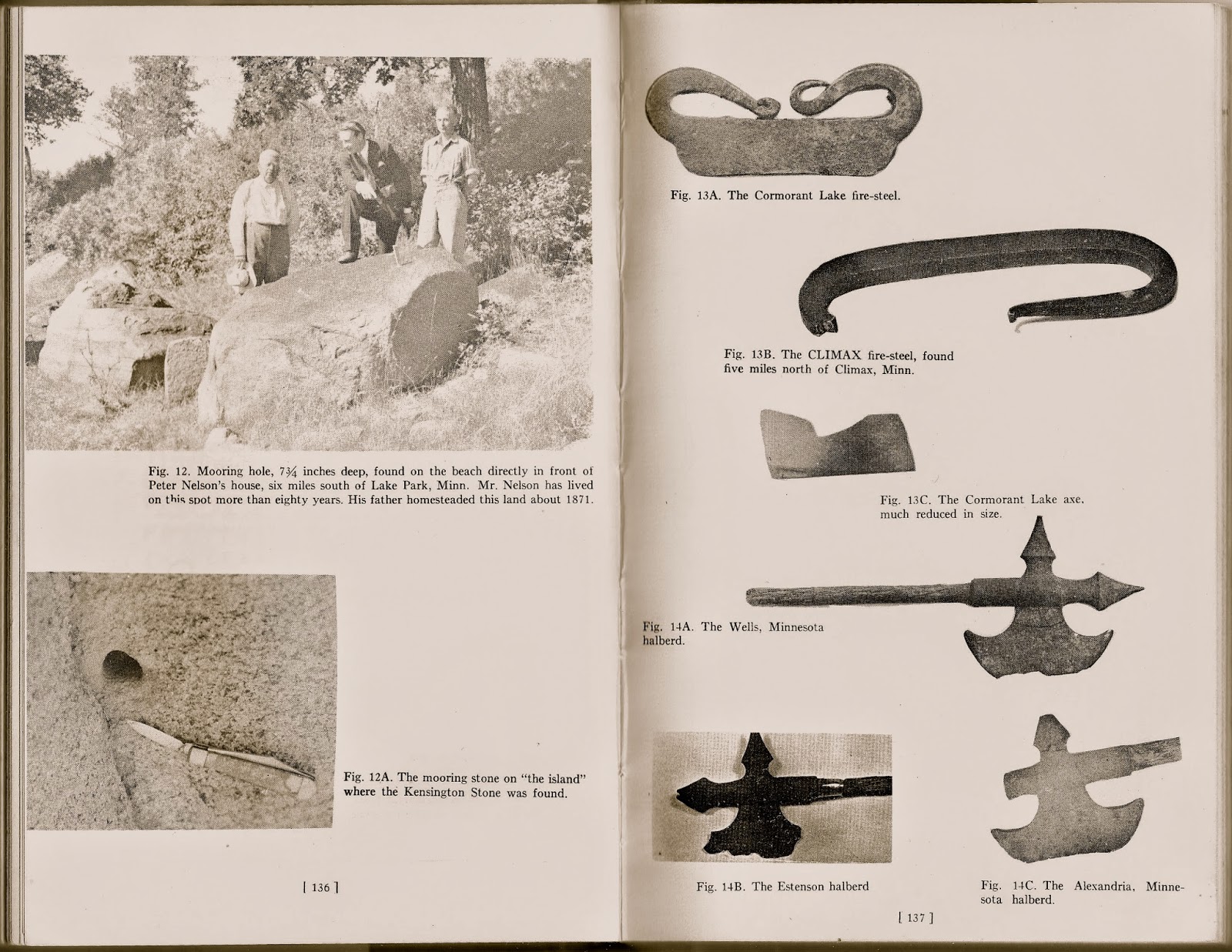
It's clear from the above titles alone that Holand's interest ranged wider in scope than Door County.  Much of his life he pursued the question of origin and authenticity of the Kensington Stone and the possibility of Norse presence in pre-European America.  The Kensington Stone was discovered by a Minnesota farmer, Olof Ohman, a Swede, in 1898, and it was touted as one of the most important discoveries of its time.  However, the stone's authenticity was challenged and discredited by certain experts.

In 1908, Holand took up the argument that it was authentic, and the stone came into his possession for a time, during which he went to great lengths to prove its validity.  (Including a trip to Norway to compare it with other stones with runic inscriptions.)  His defense of the stone extended to other artifacts and signs that had been discovered in the same general area of Minnesota, and also archeological discoveries in Vineland.  One side story to the Kensington Stone debate was that Holand "took" the stone from the poor farmer Ohmann, and that grant had been intended only for research, to eventually turn it over to the Minnesota Norwegian Historical Society, rather than to become, or be treated as, Holand's personal property.

His books, and I must say his arguments, are intriguing even if other researchers may not consider them air tight.   Holand brings forth many supporting artifacts and connections.  An interesting 69-minute video on this topic can be viewed online.  Search:   1362 Enigma documentary of the Vikings Arrival in Kensington   

It was Holand's idea to erect a totem pole on the Peninsula State Park property in order to memorialize the woodland Indians for their way of life prior to white settlement.  Pottawatomie Chief Simon Kakquados helped dedicate this totem pole, and he was buried a few years later alongside the pole on the edge of what by then had become a new golf course.  This historical and cultural monument was erected, despite the fact that totem poles were commonplace in the northwest, but not on the Great Lakes area.

Holand, from his book
"My First Eighty Years"


As Holand turned 90 years of age, a piece was written in the Door County Advocate by David Stevens:

"With a friendly aid from Supt. Doolittle, Holand saw a pine that had been lightly blasted by lightning and taken down.  Its 44 feet of timber were then to be carved by C. M. LeSaar on lines of drawings made by Vida Weborg, and then painted with care by use of primitive color mixtures.  The totem pole was dedicated on August 14, 1927.  Later, at its base, was placed the marker of the friendly chief of his tribe who had shared the days of dedication with his own people and the crowd of visitors.

"The total task of creating this memorial to Indian life and the making of Chief Simon Kakquados perpetually a part of local history, by virtue of burial beside the totem pole, constitutes the most signal act for history that Holand performed, almost singlehanded.  The start of the ceremonies was as taxing and important as the creative work itself.  At dusk, on the day before the dedicatory ceremonies, trucks loaded with 53 Indians appeared at the Holand home south of the park.  They had ridden impassively all the way from Forest County and were to be fed and housed.  Pitching a hayrack full of hay from his barn, Holand then led the way down Chrystal Spring Road to a building in the Park that was to be their community shelter for two nights.  He then carried out his agreements with the seven Ephraim hotels that had agreed to furnish in turn the seven meals required, free of charge, as their contribution to the gala day."

Holand died August 8, 1963 of "old age complications," according to his obituary titled, "Runestone Reader Dies."  

 "Curiosity about the discovery of America, and nonconformity in standing his ground, brought Holand this disputed fame.  Chief encyclopedias mention neither his name nor his stone.  Holand said he "spent 50 years and many thousands of dollars in travel, studying and writing to get to the bottom of the mystery."

A chapter from my book titled "Contemporaries in Door County" includes letters between Holand and Thordarson, at times a fairly regular correspondence.  Each man was driven by his curiosity for local history.  Thordarson was more specifically interested in the pre-European history of Rock Island.

In his letter to Holand of April 1, 1920, Thordarson wrote that he had become a lifetime member of the Wisconsin Historical Society, and he noted that "I believe you and I are the only two members of the Wisconsin Historical Society in Door County, which is a small record for Door County...  I have an album, an extra copy, of pictures of Rock Island taken about ten years ago that I wish to give you."

That album, a gift of Rock Island photos taken around 1914 when Thordarson had just begun renovating old pioneer structures, found its way just a few years ago, after passing through several hands, to the Washington Island Archives.  Holand so enjoyed and admired Thordarson's photos, he exclaimed,  "You certainly had a fine camera."

In May of 1920, Thordarson wrote to say he was mailing several Norse-related volumes to Holand.  One was a catalog of Vineland literature:

"My Islandic library is, next to Cornell, the largest Islandic library in this country and for fine bindings it is the finest that can be found anywhere.  As soon as I have a chance, I intend to send those books to Rock Island and erect a library there, as we are here too crowded for space."  Thordarson closed his letter with, "Hoping to have the pleasure of meeting you some time this summer…"

With their interest in local history in common, the years passed and the two continued to correspond, with Holand making arrangements on several occasions to bring Door County Historical Society members to visit Rock Island.

Despite their apparent friendliness and support of one another, on one occasion Thordarson seemed too preoccupied to show Holand the courtesy of simply writing a check, clearing any obligations he had made for the receipt of a box containing Holand's newest book, Old Peninsula Days, published in 1925.

Holand wrote that he was "scratching in every direction trying to raise enough money to pay my printing bill…I am obliged to write you to ask if you will kindly remit the amount of your bill - $130 - without delay."

Thordarson responded, "I am herewith sending you my personal check for one hundred and thirty dollars… I can only use about twenty of these books as presentation copies to my friends.  The rest I will have to dispose of by selling them to someone."

This tone was not uncharacteristic of Thordarson, and it is one of the reasons why I hesitate to use the word "friends" when describing such relationships, a word connoting warmth over "acquaintance."

Access to Thordarson's Norse library would have been helpful to Holand, although we can suppose Holand had his own sources for independent  research.   But about Thordarson's personal opinion regarding the Kensington Stone?   He was asked this by Eugene McDonald, Zenith Company president and one who was also quite interested in history of early North America.

Pages from Holand's "Explorations" book
show sampling of artifacts used to support
his belief in Norse presence in the 1360s
in Minnesota.


On Sept. 30, 1932, McDonald mailed Thordarson a clipping from the Chicago Sunday Times about the Kensington Stone, and he asked Thordarson, "I recall that the last time I talked with you, you still believed the Kensington Stone was not real.   As I recall, one reason you gave for your statement was that  there was a modern runic letter used.  Do you still feel the same way?"

The manner in which each runic character was made, and the phrases that were translated, put off other experts, too, men who were critical in their dismissal of the stone being real and not a fake.   Of course, Holand supplies a considerable defense of his own defending the validity of the stone, including the runic characters used, and several of his books provide platform for his arguments.

Because of his overall credibility established over a very long career, Holand has earned esteem among local and state historians.  He was an individual whose traits and interests were aligned in many ways with Thordarson.  At the very least, Holand's books make for entertaining and informative reading.

The Sons of Norway Lodge of Sturgeon Bay, Wisconsin, is named the H. R. Holand Lodge.

-  Dick Purinton


Thursday, November 27, 2014

THORDARSON ACQUAINTANCES

C. H. Thordarson - an early
portrait (perhaps in his thirties).


Washington Island, Wisconsin -

Introduction

This blog may be the first of three (we'll see how the time goes) regarding acquaintances of C. H. Thordarson.  I've given several presentations in the past year about Thordarson, and a part of my pitch is that despite the men of greater familiarity, and we might even say, notoriety, who associated with Thordarson, there were also many figures of the day who were equally important, and perhaps more significant in their lifetime achievements than, say, Chicago's Mayor William Hale "Big Bill" Thompson, or Sport Herrmann who at one period or another were acquaintances of Thordarson.

Of course, life is not a contest to see who is greatest, or who's name carries the most impressive legacy today.  Each man must be judged on his own merits.

But as an example, if the politician and glad-hander Thompson could have even suggested burning library books that were British in origin, as he professed in 1927 - even though it may have been only a statement to obtain publicity - how could such behavior we might consider almost barbaric and boorish have sat with bibliophile Thordarson?  How could Thordarson have been attracted to Thompson in the first place to such a degree that he offered to build a cabin for him on his otherwise very private Rock Island, a promise that came apparently after just one weekend's visit  - at no cost to Thompson, his to use for life, for Big Bill and his friends to enjoy as they wished?   Could that have been the same Thordarson, the private, thoughtful man who guarded his estate carefully from trespassers, and who when in company of others still kept a notebook handy to record his stream of private, creative thoughts?

The basis for Thordarson's friendships seemed to stem from the ideas and information others could supply him.  Social companionship, friends just for fun, didn't seem all that important to a man engaged in too many other activities to divide his time.   For that reason, perhaps, a genuine admiration for Thordarson's accomplishments, including his scientific prowess with electricity and his widely admired collection of books, and appreciation for his unique Rock Island estate, a subtle massaging of his ego,  may have succeeded in such friendships.

Well, there were many other figures besides Thompson, Herrmann and McDonald - that tight group of Chicago friends - who also drew near to Thordarson through socializing or by correspondence.  These men were often people representing academia, professors or experts in their fields who could relate to Thordarson and his natural and earned gifts on several levels.

I'd like to outline three such men.  During the time I researched and wrote about Thordarson, the names of these individuals didn't stand out.  In fact, I was quite unaware of their range of accomplishments until I did a bit more digging.  But I came away thinking that these men would have been a closer fit as friends and acquaintances of Thordarson's.   But that's bias on my part, thinking this is how it should have been, and it is not supported one way or another by the record of Thordarson letters and documents.

*    *   *   *

John Paul Goode


J. Paul Goode was born in Stewartville, Minnesota, in 1862.  (CHT was born in 1867 in Iceland.)  He was well educated, teaching for a time in Minnesota after his initial degree before receiving his doctorate in economics from the University of Pennsylvania in 1903.  He later moved to Chicago where he joined the University of Chicago faculty.  He was a geographer and cartographer, but he combined those interests with his expertise in economics to, among other things, make the pages of an atlas come alive with facts and information.

Many readers may recall using the Goode Atlas in school, first published by Rand McNally in 1923 as Goode's School Atlas, and still published today as Goode's World Atlas, now in its 22nd edition.  Pages and maps are jammed with useful information about demographics: population, production, weather, crops, religion, etc.

Goode disliked the Mercator projection so much that he was encouraged to devise a combination of the holographic and sinusoidal projections, calling it "Homolosine."  (Do you recall using those "orange peel" Mercator maps in grade school, where Greenland was twice as large in scale as North America?)

You will see Goode's Homolosine maps used on many - but not all - pages of the Goode World Atlas.  I learned there are actually several versions of the Goode Atlas now available:  the Goode World Atlas; the Goode Atlas of Physical Geography; and the Goode Atlas of Human Geography.

We find Goode's name on the report to the Chicago Harbor Commission, published in 1909.  A number of noteworthy suggestions were made by this committee that cited, above all, the need for and the elements required for a good harbor.  Chicago's prime location as a commercial, industrial center with both rail and water connections was noted, along with the need for good bridges and piers.  One of the Harbor Commission's recommendations: "The Chicago Sanitary and Ship Canal is intended to form a link in the Lakes-to-Gulf Waterway.  When that waterway is completed the question of a satisfactory outlet to Lake Michigan will become important."

The Commission's report also recommended "securing to the people access...as both a necessity and a wisdom."   Up to this point, the waterfront was controlled and used, primarily, by industry and the railroads.  Perhaps it was this committee suggestion that was responsible for turning around the Chicago lakefront as public space with parks and pavilions.

Goode had a highly esteemed and respected career as teacher, author and lecturer.

During the early 1930's, he was involved in an organization called the Gathmys Research corporation, based in Chicago, of which Thordarson was named a director.  Other directors were Chicago industry giants of the day, or fellow academics of Goode's with special areas of expertise.  According to a paper authored by Samuel L. Madorsky (published in the Industrial and Engineering Chemistry journal, January 1931), it was J. Paul Goode who, while traveling through Norway,  "conceived of the idea of utilizing the water-power resources of Norway to produce electrolytic hydrogen and then to apply this hydrogen in the reduction of Swedish ores which are not far from the water-power sources."  Upon his return to the U. S., Goode then organized the Gathmys Research Corporation, and the author, Madorsky, was employed to research the feasibility of producing "...in one step a good grade of iron from ordinary iron ore, using hydrogen and other gases as reducing agents."  (Several related exchanges in correspondence originating from the Gathmys Research group were reprinted in Thordarson and Rock Island.)

The sole early example of correspondence between Thordarson and Goode reflected a highly social quality to their relationship, something not often found among Thordarson's other correspondents.   It appears that at least for awhile that both of the Thordarson's, C. H. and his wife, Juliana, were close friends with the Goodes.

The earliest records of guests on Rock Island is the letter written by Goode who effusively thanked his host for a wonderful time.   Though accommodations may have been quite primitive, given the fact Thordarson may have just gotten started with his renovation of early pioneer structures along the east side of the island, Goode was clearly impressed.  He extends an invitation to Thordarson to visit him while his wife is away in Minnesota.

In a box of old Thordarson photos were B & W snapshots of the Goode cottage on the shore of Lake Michigan, large sand dunes surrounding it, and the caption of one identifies Mrs. Goode sitting in what appears to be a screened porch.  We can't know who took the photo, but the photo and caption further indicate friendship between the Goodes and Thordarsons, an apparent familiarity implied with the exchange of cottage photos. We might even surmise the Thordarsons were their cottage guests.

Caption on reverse says:  "Mrs. Goode in the 'Den'
at Crowesnest - 1919"
Caption on reverse says:
"Bungalow of Mr. and Mrs.
J. P. Goode at Little Point Sable,
Mich.  1919


Following is the letter written from Goode to Thordarson (also reprinted in my book, Thordarson and Rock Island, 2013):

The University of Chicago, Dept. of Geography                 August 24, 1914
J. Paul Goode
Economic Geography, Cartography

My dear Mr. Thordarson,

I saw Dr. Caldwell Saturday and he told me you had gone again to the "Enchanted Island".  So I am addressing you there, and giving myself the pleasure of enclosing some of the photos I won in my glorious vacation there.  Some of them are not so good as they should be, and there are not nearly so many of them as I wish there were.  But was ever there a vacation without a flaw?  Hereafter I'll have a vest pocket Kodak so I can take snaps on such a rare ride as we made across the strait that Sunday eve!

I remember with the greatest pleasure every nook and corner of that glorious Island and the generous hospitality of the "Laird of O'Pottowatomie" and his fair Layde.   -  Even the riotous night of storm and stress with the ghost in the haunted house.  When we are all back from vacation I want to have a reunion of the three families.  I recall many pleasures of the Enchanted Isle.

My wife and boy have gone to Crookston, Minn - Mrs. Goode's old home - for their vacation - and I'm all alone in the house.  When you get back you must call me up.

Best regards to you all   J. P. Goode

There are only a very few pieces of correspondence between the two men existing, and so we have no idea of how close they remained through the years.  These two men, apparently well suited to one another, each became extremely busy in their own lives and careers.

Part II will feature noted Door County and nationally known historian, Hjalmar R. Holand.

 - Dick Purinton