Showing posts with label Mike Kahr. Show all posts

Saturday, February 1, 2020

HIGH WATER COMPLICATES FERRY OPERATIONS


Magnus and Hoyt Purinton at the new steel foundation box
formed for the Island's north ramp, adjacent to the Standard
Oil pier.  (R. Purinton)


Detroit Harbor, Washington Island -

When we had extremely low lake levels - January 2013 was the record low - we dredged to allow for ferry maneuvering.  Then the level of Lake Michigan began to rise, so that on numerous occasions by 2019 we were at near-record highs.

At least a dozen times water overtopped the Island docks - which are lower in elevation than the pier at Northport - and that created ankle-deep ponding for pedestrians trying to access the ferries.  Most of the time such extremes were brief, driven by winds or created by low pressure cells.  But the forecast for the coming year indicates a likely return to high, dock flooding levels, perhaps even a few inches higher than in 2019.

"Indications are we could easily see eight inches more in lake level this summer," Hoyt Purinton said, "and of course, more than that if its a wind-driven event."

What can be done about it, from a ferry operator's point of view?

Several feet of water currently flow beneath the
Island's south ramp. A steel ice barrier was
created using stacked H-beams that can be
removed when water levels drop.

A new, longer approach for the adjustable, south loading ramp at north port was completed last summer.  This winter, work began in December on several loading sites.  In December 2019, the ramp at the end of the Island pier, used most frequently for landing since it was installed in 2001, had footings driven.  This December, two long pipes, approximately 30-ft. each, were driven inside the steel sheeting, and the gap beneath the ramp was filled with stacked H-beams.  This was done to prevent ice from sliding beneath the ramp, possibly damaging hydraulic lines or cylinders.  (Similar work was accomplished at the pier end-ramp at Northport, where the ramp structure is exposed to lake swells and sloshing winter ice.

Following those two preventative measures, a major job of improving the north ramp began.

This adjustable ramp was originally installed in 1975.  Several minor improvements have been made from time to time,  but high water dictates more work be done now.  High water, gradually sinking dock fill and concrete, slight misalignments between dock face and ramp centerline, and the need for a quality, dependable landing for the new, 124-ft. Madonna dictated more extreme measures be taken.   

Thirty or more years ago, sheeting and pipes were driven 8-10 feet into the bottom, less if a large boulder was struck first.  Now, Mike Kahr has driven new, 30-ft. pipes to bedrock where mooring tires will be hung.   Interlocking sheets 25-ft. in length were driven along the face of the pier to square it up with the Standard Oil pier.  Along the face of that pier, where the side of the ferries moor, additional, heavier steel pipes were driven to provide mooring tire supports and absorb side-forces as ferries come up against them in stiff southerly winds.   The new Madonna has a 40'-7" beam, and that will require a slightly wider berthing area, another reason for the southerly shift in orientation of the north ramp.

Ferry Line crew welded (Con McDonald, top) cut and
bolted steel sheeting for the Island's north ramp.
(Jake Dahlke and Dave Heath, foreground)
Taken several weeks ago.
All of this takes a great deal of work, along with a long range plan for what might still work should the water level continue to rise.  Right now, according to Hoyt, winter's precipitation has been less than anticipated, so that by April we might find the level down a few more inches.  But, with lots of liquid still ready to flow downstream in the Upper Great Lakes, that may not be long-lasting, and no quick remedy is foreseen to combat every circumstance.

Changes to ferry landings are one thing: concrete, steel and lots of labor can make them serviceable for the coming summer.  But, what about dock surfaces?  They could be at or below water level, and that's not a good thing for pedestrian traffic heading to or from the ferries.  Fill of some sort can be helpful - it would have to be stone or gravel to avoid washouts - but too much fill can trap dock overflow, becoming isolated ponds.

Such remedies have their limitations in engineering solutions, cost and practicality.  No single solution seems to meet all foreseen challenges. Only a gradual drop in Lake Michigan water levels brings a certain solution to this problem.

-  Dick Purinton  

Friday, January 17, 2020

FERRY MADONNA PROGRESS REPORT - 14.0


No artsy Chamber of Commerce shoreline photo; just the opposite.
High lake levels plus settling of dock fill 
require a means of
warding off ice shoving beneath the loading ramp structure.

In order to protect hydraulic lines and rams, 30-ft. H-beams were
driven inside the line of dock sheeting.  Several beams were then
stacked, and welded, to take the brunt of ice pressure.  This is the
south loading ramp at the Island ferry dock.  (Purinton photo)
Death's Door Marine backhoe next to the old ferry office.  
Steel pipe and H-beams in the adjacent lot await improving 
the dock structure and mooring pilings.  (Purinton photo)


Detroit Harbor, Washington Island -

The title of this blog refers to construction progress on our new ferry at the Fincantieri  Bay Shipbuilding facility.  But high water dictates a quick look first at what's happening at our loading ramps.

Mike Kahr with his equipment, along with his helpers and Ferry Line assistance, drove beams down to bedrock just inside the line of steel sheeting, then added some horizontal beams as buffer to ice cakes.  Similar work was also undertaken at Northport, where there is even greater lake swell action and the chance of ice jamming beneath the ramp itself.

At the Island's north ramp, which was installed in 1975 as the first hydraulic, adjustable ramp, several goals are sought.  The floor of the ramp "box" is a concrete mud slab, and it's now under 3-4 feet of water.  While there's not much chance of ice cakes pushing into the slip there, the concrete structure along the bulkhead line gradually settled over the years, along with old wooden cribbing and fill.   And, while the equipment is handy, the ramp will be slightly reoriented, squared up, with new pilings driven along the face to better accommodate mooring tires.   All of this work can be done from shore, at a time when use of the ramp isn't essential.

WHERE DOES THE MADONNA PROJECT STAND?

Anyone taking a drive along North Third Avenue in Sturgeon Bay and past the Bay Shipbuilding facility can still see the Madonna sitting outdoors on blocks.  After the two halves were turned upright and placed together on blocks, and welded as one, the main CAT engines with gears were lowered in place.  Next came a lube oil tank; then the two Northern Lights generators.  The two main deck access holes were then covered, while welding below decks continued.

Late last week, large sections of superstructure were transported outdoors from Bldg. 311 and set in place, and lightly secured, and adjusted for exact placement before being tacked to the main deck.

Starboard side structure to support the upper passenger deck 
is being lifted into position here.  (Rich Ellefson)
Starboard side panel stood upright, in the approximate,
designed location.


What has been happening this past week, then, is the adjustment of the sections, and the trimming of the additional metal from the bottom of each piece.

With the workforce assigned to the Madonna now cut back, at least temporarily, the vessel is scheduled to be moved back indoors next week.   At that point, other trades besides welders and fitters should begin their work.

With several months of winter remaining and lots of work yet to be accomplished, it will be done more efficiently once the vessel is back indoors.

-  Dick Purinton

Upper passenger deck section swung into position 
by the Bay Ship gantry crane.  (Rich Ellefson)
Deck and ship's starboard side sections, joined.  (Rich Ellefson)

Wednesday, May 1, 2019

HIGH WINDS, HIGH WATER and RISING ANXIETIES


May 2nd - Lake Michigan's level nearly overtops bulkhead at ferry dock.
Extensions to mooring pipes and raised fenders--work
accomplished in the past year, now prove essential.
essential under such conditions.


Detroit Harbor, Washington Island -

Yet another dirty, windy day.  Winds continue from the ENE, currently spitting moisture in gusts of 30 mph or more.  Not a good day to rake, garden, golf or participate in outdoor activities, including a short dash from house to car, from car to grocery, or from car to post office.

Of course, there are workers who must be outdoors and perform their duties through the day, and they include the ferry crews.

Spring, if it will ever come, has been reluctant to show itself.  Temperatures have consistently been in the low 30s to mid 40s, and we've even seen flakes of snow on occasion.  But we're not alone here on the island.  Snow accumulation occurred in past weeks throughout Wisconsin, south and north.   I stopped one day at Home Depot in Green Bay, and I couldn't help but smile at the line of mowers covered in snow.  Rushing the season, I wondered?

Home Depot in Green Bay in early April


Looking down the waterfront, in particuar at the Island ferry landings, the rise in water level is inescapable.  Nearing the high water marks  recorded in the late 1980s, and with ferry decks considerably above the level of our docks, changes have to be made for ease and safety in loading.

In order to provide means of proper adjustment, steps were recently taken to raise the main ramp located at the end of the Island pier.

Contractor Mike Kahr, in coordination with Ferry Line crewmen, removed that ramp section and installed hinge beams to which the inboard end of the ramp is connected.  Concrete adds (a temporary measure, we hope) slope to meet the new ramp height.  Such changes are time-consuming, add to operational costs, but hopes are that this solution will serve our purpose, and that even more extreme future measures will not be necessary.  Who can predict if this high water mark will be the maximum?

Work will continue to provide the public with greater ease and safety in boarding, with the avoidance of extreme slopes on ferry ramps at Northport.  That plan will call for removal of the short ramp located on the pier's south side, and in its place sections of the ramp formerly located on end of that pier will be installed.  Those two 20 x 20 ramp sections will be joined strengthened for a longer approach on the south side.  New piling foundations will be required to hold this structure in place.   (Previously, for the past 35 years or so, electric screw jacks were used to adjust the south ramp angle.)

All such work, it is anticipated, will be completed prior to the busiest traffic season, when increased passenger and vehicle traffic demands usage of multiple landing points.

Jon Mann, Jed and Rich 
Ellefson and Hoyt Purinton shovel and level
cement from Martin Andersen's truck.


Sunday morning pour - Saturday's 20 x 20 pad was enlarged
with another, sloped section.  Location of pour
was complicated by two ferry ramps in close
 proximity to one another.


Jon Mann clears chute as Martin
Andersen, driver, prepares to reposition
truck.


In addition to such waterfront projects, an upgrade in Island terminal restroom flooring and partitions, a new water cooler with water bottle fill option and new carpeting, have been installed in late March, early April.  Not something one often notes as a highlight when traveling, but the results should make for a more pleasant experience overall.

What else goes on here in spring, you ask?

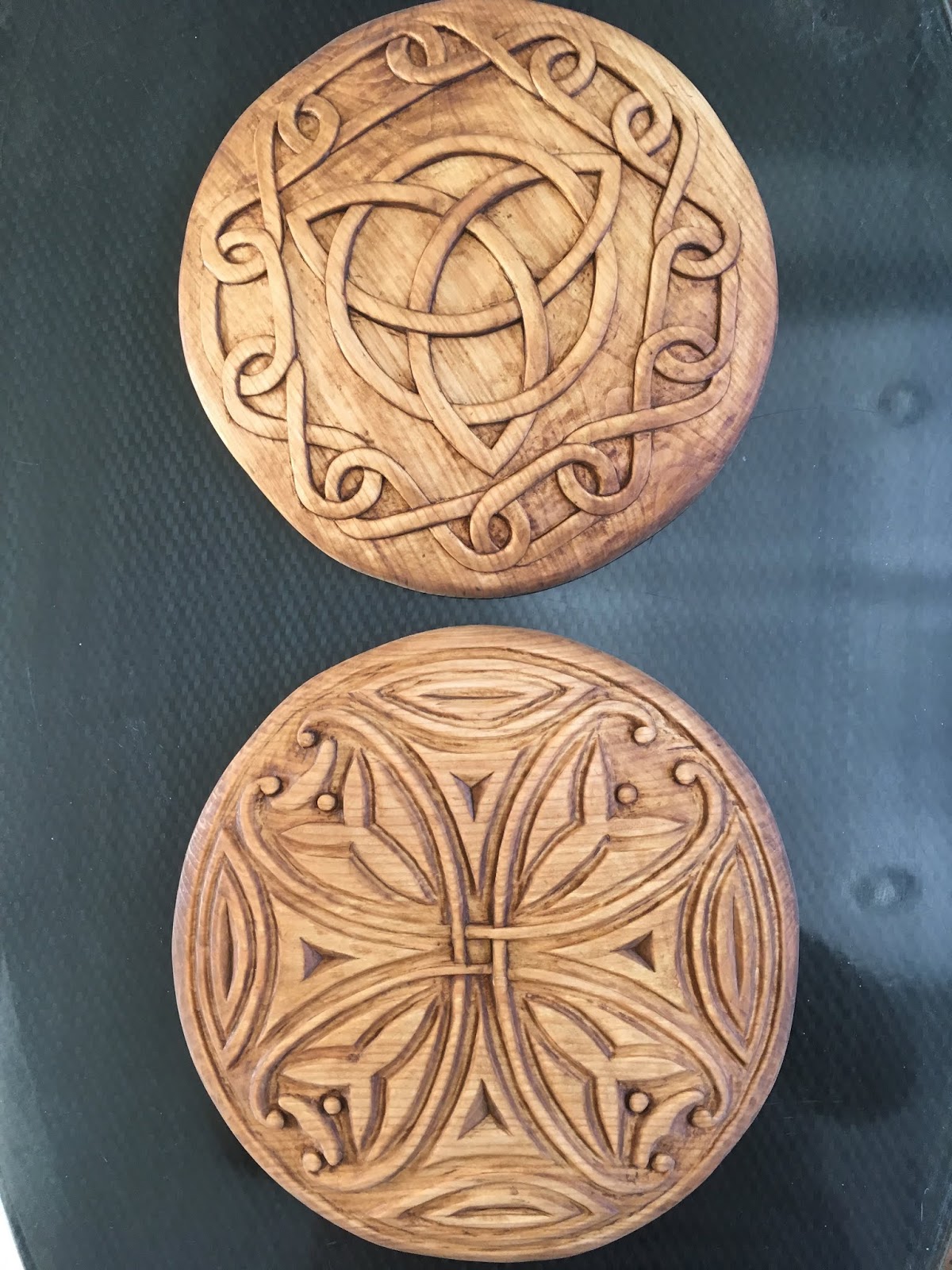
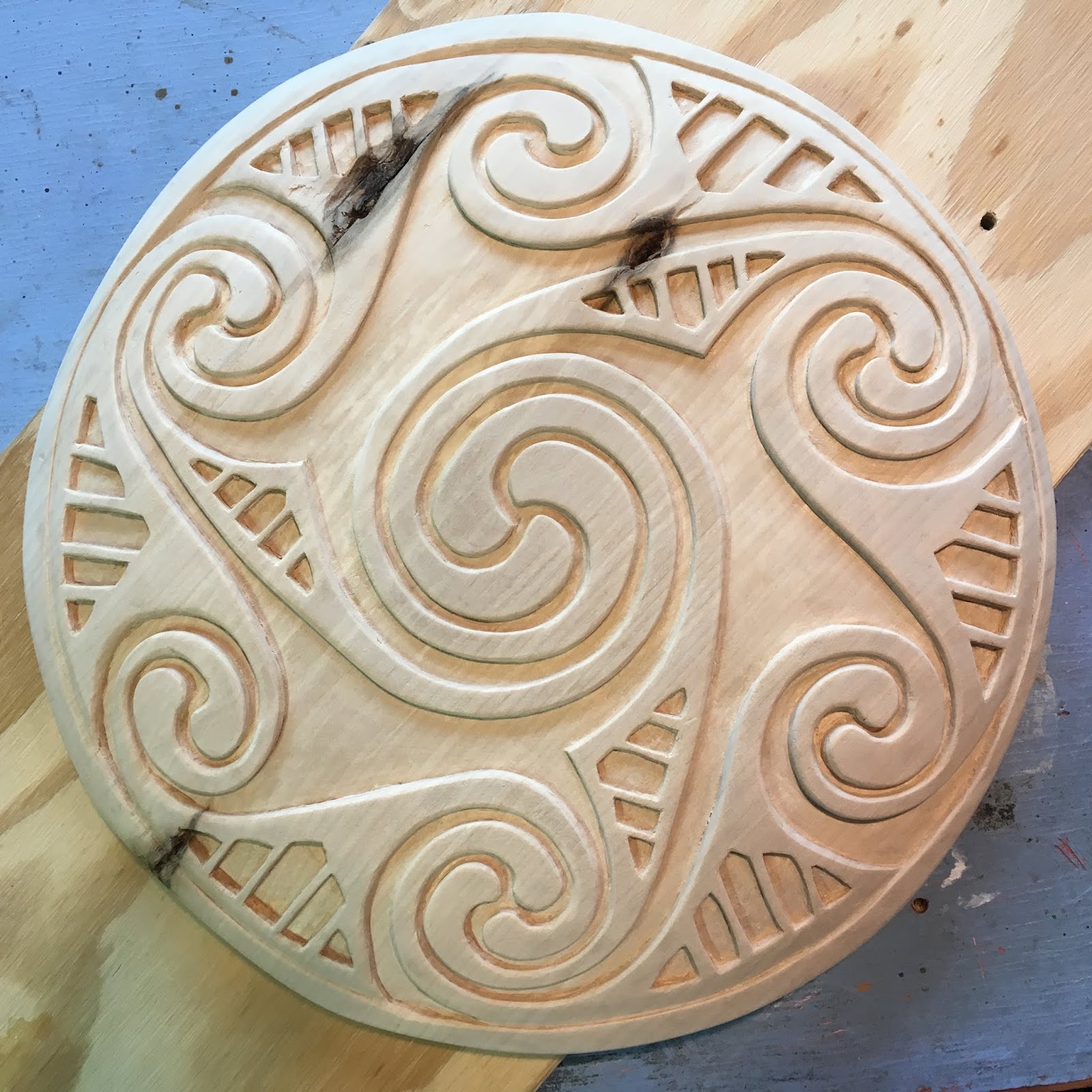
I've recently completed several carvings that I call "medallions," intended for application to the interior of the Stavkirke.   Initially inspired by a Norwegian pendant worn by Connie Sena, I expanded that design to a 12-inch diameter line drawing.  As this carving neared completion in early April, I found other pleasing designs of either Celtic or "Viking" origin.  (Such designs are, for the most part, culturally interchangeable, artistic motifs that were incorporated in ancient jewelry, weaponry, stone and wood.)  Included here are the examples thus far completed, installed in the Stavkirke.

Bottom design taken from Connie Sena's
Norwegian pendant.


With the activity of wood carving plus other repeated physical motions, I developed, temporarily, I hope, signs of bursitis in my right elbow, and later, finger joints. Better now, I can type on this computer, and I've even taken up the carving tools once again.  Summer, sunshine (but probably not raking) lie ahead, and I look forward to working outdoors once again.

-  Dick Purinton

Friday, January 30, 2015

ISLAND WATERFRONT - Then and Now - Part II

Ole Christiansen's boatyard, with the Flotilla in the foreground on
blocks, and the Wisconsin moored at the edge of the solid ice.
Quite possibly this photo was one of Bill Jepson's, taken around 1930, prior to
his purchase of the dock property.  Today vehicles
drive out onto this pier to board over what we
refer to as the "south ramp."


Washington Island, Wisconsin -

Watching Mike Kahr drive steel sheets with his reciprocating hydraulic hammer yesterday, and noting the relative ease with which the sheets were driven into the bottom, caused me to think back on some of the other projects we've had over the years.

Many feet of steel sheeting were driven, especially at Northport around 1982-3, when John Fitzgerald and his crew extended the Northport Pier by some 70 feet, adding a slight wedge to the north corner, the design intention being to lessen lake swell action curling around the northern side of the pier.   That project came 11 years before the stone break wall was constructed with the aid of a Wisconsin DOT grant to Door County.   Prior to the breakwater of 1994, the pier projected unprotected approximately 100 yards from shore, an obstacle to waves and moving ice.

Welder Mike Brown fabricates the corner piece
from two sheets that can't be interlocked due
to the degree of bend.  In the background, Mike
Kahr uses a hydraulic hammer to drive steel sheets.

In order to accomplish the work of extending the pier in 1982, contractor Fitzgerald rented a diesel hammer.   The solid, heavy steel head slid up and down in a steel framework, powered at the bottom of the downstroke by an explosion (combustion chamber) that caused it to rise back up several feet in the air, then drop again to repeat the process.  The hammer head rig was positioned over the sheet being driven, and the whole works was held in place by a crane.  Before that project, John used a pile driver block that was repeatedly raised by crane cable 8-10 feet and then let free-fall, with gravity doing the pounding, one tap at a time.


The hydraulic hammer arrangement used today by Mike Kahr is rapid and flexible.  It seems to do a good job until progress is stopped by a large stone, and that was the case with several sheets on the inside of the slip.  Another improvement in equipment, too, is that this hammer head can be shifted quickly from one sheet to another by just lifting the arm of the excavator.   Kahr can use the excavator arm to pull or push plates to achieve the best vertical alignment.  And, it takes only minutes to detach the breaker head and install the backhoe's bucket for other work.

Contractor John Fitzgerald extended the
Northport pier, shown here in the summer of
1982 with a diesel hammer for driving sheets.


In all, over 200 linear feet of pier were enclosed with
sheeting at Northport in 1982.  Here, worker Don Beckstrom
cuts sheets to length.  Some sheets were driven in water depths
of 16 feet.
It was 1975 (now 40 years ago this June)  that the first hydraulic ramp was installed for easier, and safer, loading of ferries with bow ramps.  At that time, only the north slip was suitable for bow-loading of vehicles, in particular large trucks, buses, or trailers.   In 1960, when the first bow-loading ferry Voyageur was brought into service, enabling carriage of trucks longer than 25-feet for the first time, a pile of gravel was sculpted to roughly accommodate variations in water levels from season-to-season.  A thick rubber mat on the crest of the pile kept the steel ramp from rubbing against the gravel.   It was crude, but it worked, along with procedures that kept the vessel in  trim during loading.  Often this would mean shifting a few vehicles fore or aft to keep the bow height (and thus the bow ramp angle) in adjustment, sparing mufflers and tail pipes.


Myron LaPlant operated machinery for
John Fitzgerald.  
Ferry captain Dave Johnson backed this auto
onto the ferry (about 1972-73) over the gravel mound with rubber mat.
Mound accounted for height differences between
boat decks and dock, and with some work could be
seasonally adjusted by grading or adding more fill.


With a greater number of motor coaches, campers, trailered pleasure boats and heavy trucks, as well as an increase in general tourism traffic in summer, by the 1970s the gravel pile was no longer a good option.  


Arni Richter wanted to install a hydraulic ramp strong enough to hold a loaded semi.   R. A. Stearn Naval Architects, Sturgeon Bay, supplied engineering for the hydraulics (based, in part, on experience gained with engineering early Travelift units) and my father,  Harry Purinton, provided a fair amount of time - some personal and some through R. A. Stearn where he worked with hull and structure - to design the ramp details and footings.

Once steel was ordered, ferry captain John Hanlin cut and welded, and assembled the ramp in a level opening near the bike shop garage.  Kermit Jorgenson operated Njord Heim's crane to lift, and then turn over, the ramp.   Few pieces of equipment were available on the island at that time for such tasks, whereas now there are numerous loaders and excavators with the lifting capacity and reach for such an operation.

While the steel work progressed, a hole was excavated near the water for footings.  By late June, the foundation was ready to receive the ramp, and by the weekend of the Fourth of July, the ramp was in a pinned position, ready to be driven across, but it took several more days to complete electrical connections (Earl Frank was the electrician) and pipe the hydraulics (work by ferry crew), making the ramp fully adjustable at last.

During the construction of the foundation, ferries landed at the end of the south dock.  Today at that location, a wider, longer and heavier ramp is available,  installed in 2001.   The rams on this newer ramp permit adjustment under heavy loads, whereas the original 1975 ramp was incapable of adjustment under load, due to smaller rams and lower pump pressures.  

Kermit Jorgenson operated the crane as
Dick Hanlin offered advice.  Eldred
Ellefson, who loaned the crane from Njord Heim,
 observed in foreground as the
20 x 20 ft. ramp was turned over.


Setting wooden forms for pouring the first hydraulic ramp footings,
late June, 1975.    (l to r) Jensen brothers Norbert, Rich and Emil with
John Herschberger and Harvey Jensen, uncle of the brothers.
(Unknown observer.) 


A slightly different angle showing turning of the first adjustable ramp,
with Kermit Jorgenson at the crane controls.  Ferry crew Tim Jutila and John Hanlin
are on far side, and John Herschberger has his back to camera.  (June 1975)

Crowded near to the old office building, the foundation was poured for the
ramp.  Here, Earl Frank runs wire (far left), John Herschberger backfills
with a shovel, and at the rear of the box Arni Richter and John Hanlin
discuss installation of ramp hinges.  (June 1975)


Ferry captain John Hanlin, who was
also skilled working with steel.


Such improvements as shore ramps are quickly absorbed into the operation, becoming one more slight adjustment before loading or unloading, and a major adjustment when the load is long, low or exceedingly heavy.   The general public may not realize the benefits, but the advent of one, good hydraulic ramp on the island meant quicker and easier loading of each ferry using the bow ramp (the C. G. Richter still required side loading, until about 1989 when the Washington (dis)placed it into passenger only status).  In a few years' time, by 1980, a similar ramp was installed at Gills Rock, and early in the summer of 1985, the north ramp at Northport was installed.  In time, smaller ramps also went in at the island's south landing, and at Northport's winter landing slot.  All later ramps were based on the original 1975 structural design, with modifications made as needed.

-  Dick Purinton


Thursday, January 22, 2015

WINTER DOCK WORK

Detroit Harbor scene.  In foreground, the Standard Oil pier,
later Hansen Oil, and as of late 2014, Ferry Line north dock
Behind that is the former Cornell dock, now Island Outpost,
with Chris Andersen and his freight boat Wisconsin.
(photo taken in 1949 by Bob Williams)
In the background are several abandoned vessels in the shallows,
near what was the Chambers dock, now  the location of the Town's
launch ramps and the Island Clipper pier.


- Washington Island, Wisconsin

Like many waterfronts, Detroit Harbor changed over time, but many of those same appendages that were fishing or freight piers years ago remain in place, raised up and shored up over time as better materials and construction techniques, and capital to make improvements became available.

The dock in the foreground was owned at one time by Standard Oil.  It looks quite trim, capped with concrete, and it was used as a platform for unloading barrels of petroleum products, as well as transfer and other freight from the Anderson Transit's American Girl and barge Oil Queen.  (The Island Electric Co-op, with diesels placed into service in 1946, was using several hundred thousand gallons of diesel annually, and the Oil Queen helped to fill the tanks that kept those engines working.)

In the 1960s a good portion of the Standard Oil pier was enclosed with steel, with sheets driven outside the existing timber cribs.

Over time, the timbers that made up the old pier deteriorated, and so have the steel tie-backs and whaler supports that hold the sheets from tipping outward shown significant corrosion.  Much of the pier's interior wooden cribs and steel tie backs will need removal, or replacing, in a shoring up process designed to strengthen the dock before new fill and a concrete cap are added.

Detroit Harbor is frozen solid, and has been for the past
several weeks.   Here, Rich Ellefson and Joel Gunnlaugsson
are shown on the pier.   Several openings were made along
the pier face for examination of existing
dock structure.


Steel arrived Monday by semi, and work is now underway, much of it undertaken by ferry crew as a winter project.  So far, they've been favored with mild and sunny January weather.   Tom Jordan, Island contractor, has some of his equipment on site to help break up the old concrete cap into smaller pieces, eventually to be trucked away.  Mike Kahr of Death's Door Marine will bring a larger machine later today, for driving sheets into the bottom.   This is an ideal time of year to get this sort of work done, as all of it can be done from the existing pier structure - and of course, there are few, if any, onlookers to get underfoot.

Con McDonald (L) and Tully Ellefson
cut steel for new dock brackets to support
tire fenders.      
With mild weather and relatively modest winds, recent ferry crossings have been excellent.

Other than a few fishermen on weekends, traffic is made up primarily of service providers, suppliers and Islanders who need to travel back and forth.

-  Dick Purinton


Thursday, April 18, 2013

CHANGES IN THE WEATHER

DETROIT HARBOR -

First a photo of a bright crisp morning taken last Sunday, following three days of nearly non-stop snow.

Washington Island, for some reason, maybe lake effect, received 8.5 inches of rather wet snow.  It was a strange time, with pavement and patches of ground that remained totally bare because they'd been warmed during the previous week.

Sunshine and warmer temperatures melted nearly all snow, then more precipitation fell today, this time rain.

The overall change in lake level has been positive, an 8 or 9 inch increase since early January and higher during the gale force NE winds of last Thursday.  That afternoon, because of lake swells and not much ice to dampen their motion, the Arni J. Richter landed in the afternoon at Gills Rock, the first time in several years.   By Friday morning it was back again at Northport where, thanks to wind-driven lake levels that ferry was able to back in to the pier for the first time since October.  

We are still hopeful that all ferries will be able to transit the Detroit Harbor channel - if water levels continue to rise to allow business "nearly usual" - by late May.  The shallower draft Eyrarbakki, at approximately 8.5 ft., should be able to begin service sometime next week, after Coast Guard approvals on the installation for rebuilt equipment is granted, and final maintenance details have been completed.

Mike Kahr continued to dredge at Northport, completing work left undone there in early February.  That dredging permit, and the job of breaking and digging rock off the end of the Northport Pier, is finished, for now.  His next project will be for the State Park in Jackson Harbor.  It will impact where the Karfi can land.  He's also been contracted by the State to dredge loose cobblestone accumulated near the pier at Rock Island.

This has been a long winter, but we're starting to emerge from our hole.


April 11, 12 and 13 we received snowfall.  But now when the
days warm, it often reaches close to 50 degrees.


Good news of a different sort

Tuesday night the Town of Washington Board of Supervisors opened bids from three contractors for the job to dredge the Detroit Harbor channel.  The requirements were for three separate funding scenarios, so each bid package contained three different proposal figures.

There is more review to be done by the Town, assisted by their consulting firm Foth Environmental, before a contractor is named.   But, good news at this point is that each of the bids came in lower than we had anticipated, and it appears the bids might allow for doing the entire project in one, continuous effort.  They range from approximately $3 million (low bid) to $4.7 million (high bid).  Added to the contractor fees will be costs to repair Town roads, engineering and construction oversight fees, and a 15% project contingency.

East Side Road, Sunday morning April 14..


No official award has yet been made by the Town, but that should be forthcoming once finer details of the bids have been vetted.

State officials ought to find this basic set of bids well within their acceptable, affordable range, and Washington Island's citizens would be very surprised - and disappointed - if given these figures the State won't follow with project approval, then funding, over the next several months.

-  Dick Purinton


Monday, April 1, 2013

PRE-BID CONFERENCE HELD


Aerial view of Detroit Harbor - thought to have been taken
prior to 1964, as lake level approached record low.  
Shallows south of ferry dock were dredged in 1964, and spoils
were dumped along shoreline (currently location of
 island ferry terminal).  Appendage at Kap's Marina extending toward
channel was not yet constructed.
At lower left:  Green Bay Road and access road to Potato Dock.

(Ferry Line archives photo)
Washington Island, Wisconsin -  

A pre-bid conference for the Detroit Harbor dredging project was held in the Rutledge Room of the Community Center Thursday, March 28 at 10:30 a.m.  

The 90-minute conference with discussion was followed with a drive to inspect the probable trucking route, the Town spoils receiving site (adjacent to the waste transfer facility), and the spoils off-loading site at the Potato Dock.  Potential contract bidders were able to see first-hand the island facilities and locations that will be used.  Concerns regarding bid specifications were encouraged to be aired in the presence of the Town's engineering consulting firm, in order to provide clarification.  Each contractor was given a bound specification book prior to the meeting that included bid requirements and questions to be answered in order to submit a qualifying bid.

Sealed bid documents must be received by the Town of Washington no later than 4 p.m. Monday, April 15.  These will be opened at a Special Meeting of the Town Board, 7 p.m. Tuesday, April 16th.

If and when funded, the project start date would be no earlier than August 1, 2013, beginning with site preparations for receiving dredge spoils.  Digging and trucking would not begin before the close of Labor Day weekend, 2013.   Then, depending upon the project options selected and funded, the project could be completed as early as Memorial weekend of 2014, or it could extend beyond the summer of 2014 (with no trucking during peak summer months) concluding in late 2014.  The fact there are numerous project options, each requiring separate bid information, raises many potential questions. Clarification of contractor expectations was an important reason for the in-person conference.

In order to first qualify as a bidder, each contractor had to demonstrate that their company owns or manages the necessary equipment and has the expertise to handle such a project.  Barges, cranes or similar mechanical digging devices, and the successful completion of a project of at least 25,000 cu. yds. within the past three years, were among those qualifying requirements.

The Detroit Harbor project is sizable, both in terms of yardage and cost.  It is estimated 135, 457 cu. yds. will be dredged if the full project depth and dimensions are funded.  (One option includes widening the channel by 20 feet; others call for completion in consecutive funding years, at different project depths.)

The final engineering study recently completed under a State of Wisconsin grant late last fall helped to further define the project scope.  Foth Infrastructure and Environment, LLC was awarded that contract.  Their bidding document addressed the range of basic information a contractor should know before submitting a realistic, informed bid.

Because State funding for this project is still in question, and the dollar amounts of the project aren't yet exactly known (but is believed to fall in the $9 + million range) bidders were asked to submit their bids based on three option packages.  The project could be one, large continuous project - interrupted only by winter - if all of the dollars needed were granted at once.  Or, the project could be split into two phases over different funding years and at different project depths.  Those variables and uncertainties make it difficult to plan such a project, and it also requires faith on the part of an interested bidder to participate when funding and timing is uncertain.  From the State's funding point of view, having an actual contractor bid helps legislators and administrators to identify appropriations for WDOT.

Answers to the pieces of a fairly complex project were needed in order to better define the project.   One example:  in order to analyze bottom material that may be encountered, a number of core samples were taken in late December.  Those core samplings help a contractor determine what sort of equipment will best do the job, how difficult the digging might be, and in turn, how long it might take to complete the project.  Each miscalculation could markedly add to the project expense.

Much of last Thursday's discussion centered around offloading, trucking and dumping of spoils.  All phases - for which the selected contractor assumes responsibility - must work smoothly along with digging, in order to efficiently use equipment and labor.  Trucking will involve many hundreds of round trips by dump trucks to the Town's spoil site on Gunnlaugsson Road, and this activity is viewed by experienced contractors as the "choke point" of such projects.  If trucks can't keep up with the supply of dredged material, then it doesn't matter how fast material can be dug.  The actual trucking route, possible restrictions on hours for trucking, and the inevitable road damage that results from repeated, heavy traffic were among the concerns expressed.

Toward the close of the meeting, Foth moderator Ken Potrykus said it will take coordination of all parties involved in order to accomplish the goals of this project.   

Besides two Foth representatives who moderated the meeting, three marine contractor companies were represented:  Roen Salvage Company of Sturgeon Bay; Luedtke Engineering Company of Frankfort, Michigan; and Gro America of White Lake Dock and Dredge, Montague, Michigan.  Also present were Town Chairman Joel Gunnlaugsson, Town Supervisors Randy Sorenson and Tom Jordan, and audience members Lonnie Jorgenson, Mike Kahr, Hoyt Purinton and Richard Purinton. 

Attendance was mandatory for interested bidders, so that any questions and concerns regarding bids, and the responses, could be fairly addressed in an open forum.

-  Dick Purinton

Tuesday, March 26, 2013

ROCK, CONCRETE & STEEL

Work began Sunday, March 23, on the east end
of the Island ferry dock. Ramp in foreground was removed
for access to footings beneath.  This ramp was used more
than any of the other landing points since
installation in 2000.
Detroit Harbor, Washington Island -

Dredging around island ferry docks was nearly complete as of this past Sunday, March 23.  Work immediately shifted from removal of bottom material to the repair of the docks themselves.

The original foundations for these piers were wooden cribs, protected by driven, wooden piles.  The first work was completed around 1931, when Captain Bill Jepson moved his ferry operation from the shipyard at the eastern end of the harbor to the former Ole Christianson boatyard site.  Slowly, those docks were expanded upon and repaired over time.  During the 1960s, interlocking sheets of steel were driven outside the wooden structure.  This provided a tight and lasting perimeter for the wooden pier, encompassing all of the rock and fines that filled the interior.  Concrete was added later to the margins, both below and above dock surface, caulking holes that appeared from time to time from settlling.  This capped the material that lay beneath the dock and provided a cleaner, more durable surface.  It was thought at the time each work phase was completed, that stability would be brought to that portion of the pier for decades to come.

View from end of island pier looking west, shows pier
 under construction with A-frame pile driver / dredge
moored to left.  This is the same basic shape as the pier today.
To the north (right) is the Standard Oil dock.
A guess as to the date: 1931


But as will happen with fluctuating water levels, the finest materials wash and settle, and if there is a chance of escaping outside the sheeting, they will.  Voids can open up beneath the concrete and blacktop, and yet for appearances it still looks like one, solid dock.  Large voids within the dock are what occurred in two locations where the interlocking sheets of steel years ago weren't driven deeply enough into the bottom.  Then, lower water levels coupled with aggressive wash from the ferry propellers when backed in stern-first created openings at the foot of those sheets.  This became most pronounced where the ferries back in frequently with props toward the pier, at the east end and south side ramps.

[Last August in order to examine those voids, Hoyt Purinton dove with a video camera and filmed the underwater structure.   He discovered dozens of smallmouth bass resting within the shade of those mini-underwater caves.  You can see several minutes of his underwater footage - and lots of bass - by going to the Ferry Line's website  wisferry.com     and there will be a tab along the top to take you to the Facebook page.  Hoyt is working with that video so that it will load more easily.   Patience, please!]

Step one in repair was removal of the 20 x 20 steel ramp from its foundations at the end of the dock, so that a hammer could break up the concrete cap.  Like a dentist drilling into a decayed tooth, large voids were exposed, and the result was nearly as painful to see as the trip to the dentist can be under such circumstances.   The exposed cavities beneath the concrete were larger than anticipated, and the scope of work quickly expanded.  (Thinking root canal, I was...)

Added to our current navigational problems with water depth is the fact that these adjustable ramps have been at their lowest possible settings most of this past year.  The steel and concrete foundation "floor" prevented them from going lower.  But low water also presents the perfect opportunity to fix the pier and to lower the ramp.

A horizontal beam called a whaler ties all of the sheets together in a straight line, and such a beam was installed on the inside face of the sheeting.  The lowest practical point a whaler can be attached to sheets is just above the lake level, where cutting and welding and fitting can be managed.  Now that the water level is down, this whaler can be lowered to accommodate the new lake level.  The H-beam whaler and the 1-1/8" steel rods that tie it in place are fastened to a pile driven vertically into the pier and later covered up with fill.  This whole arrangement can be installed to accommodate the new lake levels.  (Some day, this installation may be beneath the lake if water levels rise.  But we'll deal with that if and when it happens.)

Rich Ellefson inspects and pulls pieces of broken concrete
from one of the two deepest voids on either side of the ramp box.
Daylight can be seen, down five feet and to his left.
This project may sound fairly easy and straight forward, but there are many steps, each with a great deal of handwork:  cutting concrete; cutting steel, welding and grinding,  besides use of heavy equipment to break up and lift concrete and rock.

The two deepest voids, on each side of the ramp box, had to be dug by hand, one piece of rock or concrete at a time.  Those large boulders seen piled on the dock in the top photo were set aside by Mike Kahr from recent dredge spoils.  They'll be packed into the voids to anchor the base of the sheets from inside the pier.  To that mass will then be added smaller pieces of broken, jagged rock.  Concrete with steel reinforcement will cap the rough rock.

This project is expected to take several more weeks, during which time the bay and harbor ice may begin to soften.  (Night time temperatures are still lower 20s, and we've barely been above 35 for the daytime temperature.)  Its a good bet ice will still be around, in and near our route during that time, so the Potato Dock remains the landing of choice.

Excavator breaker was used to open up concrete
foundation (about 10 inches thick) and create trenches for tie-backs
to the new deadman, the pile driven at left.
Besides extensive dock work is the pair of engines and gears waiting on the deck of the Eyrarbakki for installation, back on the island after major overhaul.

There has been no shortage of winter work.  Keeping our heads (and keels) above water has not been easy.

-  Dick Purinton

Tuesday, March 12, 2013

ENJOYING WINTER ?

Atlas Beneda skied alongside ice shoves on west side, March 7.
I began with the title "Enjoying Winter" as a statement, to reflect the many enjoyable days we've had so far, but later I added the question mark, to elicit response from readers.  Not everyone views winter from the same point of view, of course.

In the photos below, and in the blogs that will follow this one - as I get back on track - we'll look at some of the scenes and conditions observed in past weeks.   We've had lots of snow, more than usual depth for late February or early March, some rain and melting, refreezing, fog...a variety that can come with winter.   No real snowstorms in recent weeks, but many of us hope for at least one more, to put another foot of snow on the ground.   April's often a crummy month here.   Might as well have some snow to play with.

Late last week, grandson Atlas - his third time on skis - and I crossed part of Little Lake, then skied over the ridge separating that lake from the bay.  We were rewarded with a wonderful view: jumbled ice fields.  Close to shore were several ice piles I would estimate to be 15-18 feet high, made up of hefty ice pieces from fields that moved across open waters a month or so ago, before they were stopped at the island's rocky shores.  It will take weeks for those ice shoves to melt, so there is no hurry to get out there if you'd like to see them.

Vehicles - pickups and snowmobiles mostly -
made an ice highway this winter to fishing shacks.
Landing at the Potato Dock: Other than an hour's delay
for fast-moving ice during a February blizzard, no
 crossing problems have been encountered this winter.


With the amount of snow cover, skiing or snowshoeing was one of the few ways to get around by manpower.  Of course, snowmobiles had good conditions, too, for a change, once a snow base was established.  Ice fishermen made regular trips back and forth over Detroit Harbor ice, to set tip-ups or jig.  Fishing results spotty.  Most shanties are off the ice now, after a major melt on Sunday that left slop over the surface. This is, according to local experts, the time of season perch will bite - if they're ever going to.  

Sunday morning in heavy fog, Mike Kahr pushed his rig from Northport back to Washington Island.  He immediately began dredging near our regular island ferry docks.

Kahr ran short of time at Northport, but plans to return after Detroit Harbor work is accomplished.

We've landed bow-to the Northport pier with the AJR these last seven weeks to avoid putting screws into shallow water near the pier.   Depth was increased there, but not yet uniform enough to risk backing in.


When his barge got close to our docks, Kahr used his backhoe
to steer and to break ice near the ferry terminal
 (so his second backhoe could be off-loaded to shore).


The Ferry Line received an extension to the island dredging permit (now April 1st), for which we're thankful. That should give Kahr time needed to deepen waters near the island docks.  He's backed up with other work now, customers waiting for him to do similar work at their locations.  We're thankful the weather's been mild and conditions were good for his tow across the Door.  The Arni J. Richter led the way and widened a track through loose, but substantial, bay ice.

Pneumatic breaker point on excavator
 (foreground) was used to break up
rock strata at Northport.


Snowfall amounts this winter bode well for improved lake levels.  By May, we hope to be using multiple ferries at our traditional landing sites.   -  Dick Purinton


By law, fish shanties have to be removed by the middle of March, but
with melting snow and rain last weekend, these were pulled early.

Monday, January 21, 2013

HAVE AN ICE TIME!

Traffic boarded the Arni J. Richter from
the Potato Dock for the 8 a.m. departure.
Detroit Harbor, Washington Island -

This Monday morning was the first trip of the winter for the Arni J. Richter, and the first official loading at the newly dredged Potato Dock.  Pete Nikolai met traffic waiting to board and worked with components of a new, portable ticketing system.  Crews prepared the decks for possible freezing spray as the engines warmed at the pier.

Pete Nikolai met customers at the upland staging
 area, using a new portable ticketing system.


Traffic included the typical load of autos and passengers, with a pumper unit belong to the Washington Island Volunteer Fire Department being the first truck to load on a scheduled run from that location.  Joel Gunnlaugsson was driving the truck to a facility in the Fox Valley for maintenance.   One standard item not loaded on board due to observance of Dr. Martin Luther King's birthday was the U. S. Mail.

Joel Gunnlaugsson, who also wears hats of
ferry captain and Town Board Chairman, drove the pumper
truck off the island for maintenance,
also on his way to attend a meeting
as a County Board Supervisor.


It was that time of year for beginning a new, anticipated routine.  Morning air temperatures hovered at +2 degrees F with a sharp NW wind.  New ice, some made overnight, the rest blown in from the north, covered approximately 80% of waters between Washington Island and the Door Peninsula.  Steam rose from patches of open water to the east where the bay opens to the lake itself.  After toying with us for the past month, winter seemed finally to settle in.

The Island's two remaining commercial fishermen brought their tugs C & R (Jeff McDonald) and Sea Diver (Kenny Koyen) around the island from Jackson Harbor Saturday, in advance of the predicted cold spell and ice that would lock them in at Jackson.

The Detroit Harbor channel with ice now formed to the entrance buoy and beyond will not be navigable for the ferry Washington.  That ferry, with less draft than the AJR, made all ferry trips in early winter, given the lack of ice during that time.

Crews began the winter layup process immediately after the AJR's departure, starting with the draining of engine room water lines and pumps, necessary before turning off electric heaters.  We're now beyond the middle of January, and given what may be a shortened ice season (no certainty, of course), within a few months a non-ice breaking ferry could once again operate from our main docks near the Island Ferry Terminal.

Until then, crews and passengers will have time to adjust to the new routine of operating from the Potato Dock using the ice breaker Arni J. Richter.

This coming week may prove too cold to accomplish any dredging at Northport, due to icing of the spuds in their wells on his barge, but Mike Kahr had begun work there with his machines.  He switches back and forth between two excavators on board the barge. One is fitted with a breaker point to loosen the bedrock before scooping it up with the second machine's bucket.  When the temperatures rise once again, he will continue deepening the maneuvering area off the end of Northport Pier. Then, if ice allows, he'll return with his barge to Detroit Harbor where more dredging and dock work awaits.

Mike Kahr broke up rock ledge to deepen
waters near the end of Northport Pier.
Photo taken Friday afternoon, Jan. 18.


Monday morning ferry departure from Potato Dock.