Showing posts with label Thor Purinton. Show all posts

Tuesday, April 14, 2020

USING TIME WISELY


Detroit Harbor, Washington Island -

For several weeks now we've been home and indoors much of the time, for reasons having as much to do with weather as anything.  There's still plenty of raking to do, and other spring yard work, should the temperatures warm up.  Last night, the 20s brought skim ice in this corner of the harbor, and shaded ponds and hollows are still iced over.  Looking across the harbor now in the late afternoon we see snow squalls, brief, intermittent, but enough to discourage us from getting back to that yard work.

One activity I've done more of this winter is carving.  I can go to the basement and, while listening to a book on CD, design, carve and, depending on the project, add color paints.  The time goes quickly and it's soon late afternoon.


 I use a basswood board, trace my design using carbon paper, and begin making small wood chips.   Ten, 20 or more hours later I reach a point where I've done enough, the detail is what I hoped it might be, or I just get tired of the same theme and want to move on.  Maybe it's time to write, walk or take a nap instead.


There is no time clock structure to my day, these days.

Shown is an example of an early stage in carving the voting piece. The concept uses old-style voting booths with curtains, but with the modern-day addition of voters wearing face masks for protection against contracting or spreading the coronavirus.

The long lines of Wisconsin voters we saw on April 7 on TV, snaking down the sidewalks and around the corner in very unpleasant weather, amazed me.  Citizens displayed an unbelievably strong desire to vote, despite challenges that included the lurking danger of corona virus infection.

I began with a couple of ideas for a caption, spoken by the lady at lower left:

1).   "I think he's confused.  He asked me, 'Who should I vote for?' and I said, 'Just vote your conscience'."

2). "We've been standing in line since 8:00 am."

3.). "Shouldn't he be wearing a mask?"

Still in the early drawing/concept stages, I asked for help.  Daughter Evy quickly responded with these:

4).  New virus symptoms discovered at polling center.

5).  A new Write-in this go-round.

6).  Polling centers lure in voters with full rolls of TP.

7). If the candidates look like crap, sound like crap, and smell like crap, it's probably crap.

8).  Politics have taken a real dump lately.

     Thor got in on the fun one day later with his suggestions:

9).  "Aren't they glad we didn't vote by mail?"

10).   "Participating in this process is just so liberating!"

11).  "What can I say?  He always speaks truth to power."


Maybe you have other suggestions?  Let's hear them!

And now, before closing, I'll post a close-up of the previous piece, a summer beach scene titled, "Norskies at the beach."

I was inspired by a story the late Dr. Rod Johnson told me of his childhood on a Minnesota farm when he and a brother visited an old Norwegian bachelor who lived in a one-room shack.  Inside, in one of the dark corners, was a huge pile of empty sardine cans.


Enjoy these days while they last!  -  Dick Purinton

Tuesday, March 3, 2015

ISLAND WATERFRONT - Part VII - Elbow Light

Arrow points to a vertical timber lifted by ice, its lower end
still embedded in the base of stones.  This aid marked the old
channel into Detroit Harbor.  Many years, during average
water levels, both this timber and the rock pile
supporting it lay just beneath the surface.  The modern-day
aid (#8) is a steel nun chained to a cement anchor
and maintained by the U. S.  Coast Guard.


Washington Island, Wisconsin -

Over the weekend of Feb. 21 we drove around the upper part of Lake Michigan to visit son Thor.  It was his 35th birthday.   If he thought those 35 years went by quickly, it was like lightning for us.

Passing through Green Bay, I took the opportunity to have my three month check-up on the titanium implants in my knees.   I received confirmation that the occasional clicking sensation in my new joints - something that concerned me - was simply the clatter of plastic inserts glued to the underside of each patella.  It wasn't quite the same as sloppy clearances on valve tappets, I was told, and I shouldn't worry as it's quite a normal function of artificial knees.

We looked forward to our winter's trip from the Island, and the further north we drove into the UP, the snow showed greater accumulation, more in keeping with expected ground cover for late February than our skimpy Island snow cover.   A major portion of the highway vehicle traffic we saw, especially as we drew closer to the Straits, consisted of 4-wheel drive vehicles pulling snowmobile trailers, dozens and dozens of them.

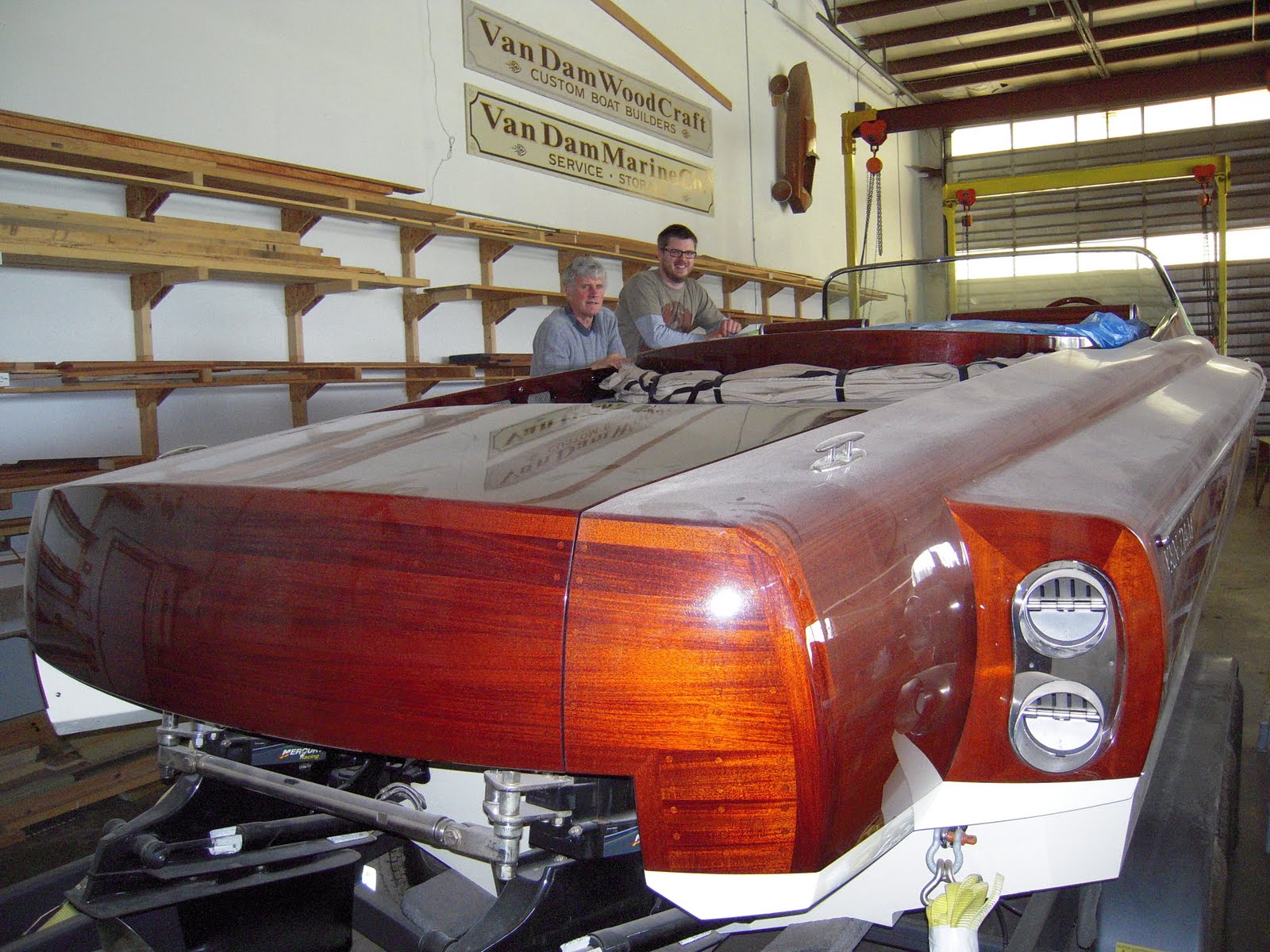
Between card games and snacks at our comfortable hotel in Petosky, we sandwiched in a couple of visits to the Van Dam shop in Boyne City to observe progress on their latest boat building projects.  Friday afternoon I met several of the craftsmen who were still working, winding up the last half-hour of their day and their workweek before they put tools away, swept up and departed for the weekend.

For someone who enjoys this specialized boat construction process, there's a lot to take in at the Van Dam shop.


The hull of a sandbagger, a uniquely developed
 Chesapeake Bay sailboat design, takes shape
quickly as the first longitudinal strips are added.
Here, at the end of the day, Thor scrapes
excess epoxy oozing from joints of
recently attached strips.   Beamy, bow-on view
with low freeboard resembles a Viking
longboat.
Strips of cedar, about one inch in thickness, provide the first
layer in this sailboat's hull.   Two more layers of 1/8"thick
mahogany strips, laid on a 45-degree bias,
will follow, also held in place with epoxy.  Due to
hull curvature, stainless screws and washers
 are used to secure strips until the
epoxy dries, after which time they'll be removed.

So far, this blog departs from the subject of my previous several blog entries, but doing so allows me to get underway slowly by inserting a few loosely related comments and photos, before spinning off into a continuation of Island waterfront history.

From the ferry's deck the morning we left, against the low sunlight I noticed a timber projecting upward from the old stone pile, the remains of the original channel marker.  During these past two months this same timber has risen between 3-4 feet, forced upward by the grip of ice and the rise in harbor water levels brought on by strong southerly winds.

My photo (at top) shows what nearly every winter traveler sees from the Arni J. Richter as the ferry departs from the Island dock and makes its turn southward down the channel and on toward Northport.  I highlighted the old timber with a hand-drawn circle and arrow.  The modern day red nun marking the east side of the dredged channel is frozen in the foreground ice.   You may recall I pointed out the old channel marker in my Jan. 31 blog, noted in a photo in which Dora Engelson stood before the ferry Welcome with several children in tow, taken sometime in the early 1940s.   As a novice, I learned from Captain Nathan Gunnlaugsson that this pile of stones with a timber protruding from it marked the "false channel."  It had been worn down so by ice movement and waves that most years it lay in waiting beneath the surface to snag unsuspecting boaters.  This "false channel" was the original, or natural, channel denoting acceptable depths, and it was used for many years by vessels entering Detroit Harbor proper.

The forces that are brought about by the hydraulic lift of the lake, following hard freezing around an object, has destroyed many a massive crib of timbers filled with stones.   We can see evidence along the island shoreline today of old fishing docks, torn apart even when considerable efforts were made by the pier owners to repair them.  Eventually, most crib docks and timbers were leveled, some in only a few years' time.   So, it comes as no surprise that a single timber remaining upright from an old navigational mark should be lifted by the ice, too.  What does amazes me is that this process took so many decades, including years when the stub projected above the lake level.  This winter, mother nature managed to extract this timber.

What is the history of this particular stone pile with timber?  Eric Bonow sent along some interesting information about the origin of this navigational marker, officially referred to as "The Elbow Light" (likely it referred to the dog-leg course change leading mariners into Detroit Harbor from the West Channel).   The photos and documents provided by Eric are courtesy of the Washington Island Archives.

At far left, the "Elbow" marker when it was in good shape (year unknown).  
 An unidentified small sloop heads into the harbor, its crew 
bundled in jackets and caps.  In the background on "Richter's Point,"  
Detroit Island, are buildings of the old fishing camp.

Fred Richter's application for a fixed red light was
made July 31, 1924, at a time when small freighters,
commercial fishing vessels, and relatively recent
auto & passenger ferries entered Detroit Harbor
with frequency.  The photo of a Goodrich steamer was
included with his application as an example of area maritime
trade, but it is unlikely this steamer (or any of similar
size) ever navigated to or from Detroit Harbor.


Fred Richter was one of nine children of Jacob and Anna Marie (Kalmbach) Richter.  He fished, along with his wife, Ida (Cornell), and they at one time owned the Pearl, a  boat named after their daughter.  (Two sons were Roy and Earl.)  The Pearl, according to a record of vessels compiled by CAPT Gene Gislason, was just under 30-ft. in length, and had been built by Nels Jepson in Detroit Harbor in 1906.


In the official Great Lakes light list, published some time after the light was installed, the aid's characteristics were as follows:

Fixed red, in 7 feet, on east side of north end of channel, at turn.

The light was affixed ten feet above high water, atop an "unpainted pile."

Under Light List "Remarks":
      Maintained by Mrs. Fred Richter, Detroit Harbor, Wis.

Anyone who has been boating at night in this harbor without the benefit of radar, GPS or depth finder knows how hard it can be to differentiate land formations from good water.   Although the gas buoy was in place at this time, located seaward from the entrance to the West Channel, we can assume the addition of this Elbow Light was welcomed enthusiastically by mariners for both nighttime and daytime navigation.

-  Dick Purinton

Monday, December 29, 2014

Thor with surprise Christmas table.


Washington Island, Wisconsin -

Tomorrow, December 30, will mark one month since my bilateral (double) knee replacement surgery.

I have to be honest in saying it hasn't been easy.  On the other hand, as time advances, and my mobility improves, and the discomfort lessens, I've come to think it was the right decision to do both knees at once, if for no other reason than I might never have the courage to do the second one a year or two down the road.   At this point, my daily stamina, mobility, and my ability to concentrate has increased to the point where I can at least think about doing a blog.

This Christmas we had the ultimate of surprises.   Our youngest son, Thor, brought with him sections of a table he created in his spare time, fulfilling Mary Jo's wish to have a table large enough to seat all of our family at one time (11).   Thor has been working on this on and off for at least several years, and we were led to believe it still wasn't quite ready.  However, a few minutes past midnight of Christmas day, when I couldn't sleep, I wandered in to the living room to find Thor assembling the various pieces of his table.   I was too excited, and impressed by his workmanship, to go back to bed without waking Mary Jo first.   We have no lack of pride in saying Thor has designed (all in his head) and executed a woodworking masterpiece, and already it's seen service for meals, card games and other family activities.

Grandsons Magnus and Aidan play cards.


The quality of construction is of the same high standard Van Dam Woodcraft is known for in its boats.  If you go to their website you will also find a large corporate table custom built by Van Dam (and on which Thor also had a major part).    But our table we think is quite unique, and therefore it deserves mention and description here.

Ends slide back simultaneously, smoothly,
revealing the center section beneath.


The basic dimensions were to be approximately 4 feet x 10 feet.   Thor created a mid-section using German hardware and a butterfly-like section that opens from underneath the table as the top halves are pulled aside.  The mechanism works like butter, smooth and with just the right clearances.   Aside from the key mid-section hardware and slide, however, the rest of the metal pieces were fabricated by Thor or friend Jess Brown, Van Dam's metal craftsman.

The four-foot mid-section features two inlays of reconstituted, colored  stone set in circles of curly maple, the image of a green tree frog.  (Based on a second place photo that I entered in the Peninsula Pulse photo contest several years ago.)   The main wood used on the table top is a veneer of island butternut, timber that was cut, sawn and stored over 30 years ago in our barn on Main Road.    The original plank was slightly over 10-ft, with several splits and a tremendous amount of worm holes.  The splits and worm holes were filled first with epoxy before Thor sliced it into 3/8 veneer, then fastened it to a stable backing of 1" foam insulation sandwiched between 1/4" marine plywood, a light but firm backing.   The edging is sipa, a wood closely related to mahogany.   The table top was finished with at least four clear coats of an automotive finish, impervious to moisture and nearly all liquids (although subject to hot temperatures) for a very smooth, shiny and durable top.   The skill of Van Dam's Trevor, who traded his time with Thor and who does nearly all finishing of Van Dam's watercraft products, is greatly appreciated.  It is an outstanding, smooth gloss finish.  The legs and underside has a satin finish.  The end product does resemble, in both size and quality, a corporate boardroom table.

The table underside also reveals a high
degree of finish craftsmanship.

With my recovery still ongoing, and my inability to get out to visit, we've enjoyed more than ever the visits to our home of grandsons, our children and their families, and occasional guests.  This table will enable many enjoyable hours with friends and family in the future.

Two other notes:   Have you seen the Van Dam name on the recent Craftsman tool ads on television?   The shop was closed for one day (rented out) when Craftsman's marketing people created the ad.  Ben Van Dam, company vice president, is featured in the ad, along with a very quick shot of Jess Brown, metal craftsman.   (Practically all of the Van Dam product line is of finely crafted wood, with only an occasional carbon fiber or other material called out by the owner.)

One of two mid-section tree frog
inlay designs, cut from colored sheets of
reconstituted minerals.  The frog's eyes
glow in the dark.

Second, a new project is now underway, an unusual Chesapeake Sandbagger sailboat to be built along traditional sandbagger lines using the Van Dam cold molded method for light, strong construction.

Sandbagers were working sail craft used to dredge oysters originally in the 1800s, that evolved into gentlemen's racers.  They are beamy but of shallow draft, with a huge, unreal amount of canvass.  To counter act the forces of wind on heeling, 50 lb. sand bags were slung out on hiking boards by the fishermen as they raced one another back to port, hence the name.  

Eventually, as racing became a popular pastime, human ballast replaced, or was added to, the sand bags.   In one photo I've seen, five crew each on two planks can be seen hiking out, well overboard, to keep the vessel at proper heel.

An incredible and highly unusual craft, this latest Van Dam project will be built for an east coast owner with delivery by early summer.  Thor has been given the opportunity to head up this project.   You may find progress photos soon posted along with many other Van Dam projects, past and present, at VanDamWoodcraft.com

A short history of the sandbagger can be found on the Mystic Seaport website: http://www.mysticseaport.org/locations/vessels/annie/

-  Dick Purinton

Friday, August 22, 2014

INITIAL PLUM ISLAND OPENING REPORT

Thor Purinton and friends visited Plum Island Saturday, August 16,
on the first of two special days when the public was welcomed
to visit and hike trails.  Shown near the forward range light, L to R:
Dr. John Buckley and his wife, Susan, of Tuscaloosa, Alabama;
Jamie Kornacker, Charlevoix; and Jess Brown, a Van Dam Woodcraft
craftsman who works with Thor in the Boyne City,
Michigan, boat shop.  (photo by Thor)
Plum Island, Death's Door, Wisconsin -

When they returned from their trip on the "family yacht" Moby Dick from Plum Island last Saturday, August 16, I asked youngest son, Thor, how it went.  "Terrific!  We had a great time."

This comes from Thor, who's been on Plum Island numerous times in years past, hiking, hunting, and swimming along a southern beach.  But that was during BLM ownership, after the Coast Guard moved their search and rescue operations to Washington Island, and prior to the U.S. Fish and Wildlife Service (USFWS) taking over and closing down the island to visitors.   In recent years, unless you had specific permission, such as research or as a work party member under Friends of Plum and Pilot Islands (FOPPI), partner with USFWS, you were not welcome to set foot on the Plum Island shores.

This is about to change, although in a carefully controlled way, starting with two special visitation Saturdays, August 16 and August 23.   One hitch for potential visitors, at least on day one, was that you needed your own watercraft for transportation.

Returning to the old Coast Guard station, near
boathouse and pier.  All structures, except the boathouse which has
already had a once-over,
await major repairs and restoration. 

Plum Island's first official guests for day one included Thor and friends who visited from Alabama and the Boyne City/Charlevoix area.  Dr. John Buckley and Susan are frequent travelers to the Van Dam workshop where they built a beautiful boat several years back, Susan C, and they're now partway along on their second project, Victoria Z.  Through the process of designing and building and observing, sometimes hands-on with suggested changes in details, they've become very close to the Van Dam craftsmen in what seems to be both an extraordinary and respectful relationship.  This past weekend the Buckleys traveled a long way to join Thor, Jess and Jamie on Washington Island, visiting Plum and Rock Islands also during their stay.

Thor's group was greeted near the boathouse by FOPPI president and volunteer, Tim Sweet, and two USFWS personnel who gave them a basic introduction that included a trail map and a sheet of guidelines, as follows:

  *  Refuge open during daylight hours only
  *  Foot travel only on the island
  *  Access for wildlife observation/photography hiking are limited to the established hiking trails
  *  Boats are required to moor at boathouse; dock space available on first-dome-first-served basis
  *  Kayaks / canoes must use designated launch / landing areas
  *  Dogs are welcome but must be leashed
  *  fishing from the dock and beach not allowed
  *  NOT PERMITTED on the refuge:  collection of plants, berries, seeds, mushrooms, rocks, fossils, lantern, or other artifacts; fireworks; camping; campfires; geocaches

Those restrictions aside, several fine options are available in hiking trails, the longest one being the Island View Trail (3 miles) that loops the island, more or less paralleling the beach.

From my own past experiences there, both in hunting and searching out trees with Roy and Charlotte Lukes, crossing the interior on any route other than a maintained trail would not be advisable anyway, under any circumstances, due to wind fallen trees, nettle plants that are six feet tall, and a parsnip plant that can deliver a nasty chemical burn.  From the maintained trails you will have ample opportunity to see Plum Island's varied shoreline and habitat, amazing for such a small island.   In addition, there are the several, interesting former government lighthouse and life saving structures found there.

It is for this second reason many will want to visit Plum Island and absorb the rich and fascinating maritime history of the Death's Door area, with Plum Island at the center of that activity.   The opportunity to view the range light structures up close, along with the old, original Death's Door 1849 lighthouse remains, is reason enough to visit Plum Island.  This old foundation was recently examined by archeologists, and their future reports will help to fill in blanks regarding this early Plum Island navigational aid.

Tomorrow, Saturday, August 23, will be day #2 for public visitation, coinciding with the Death's Door BBQ competition taking place on Washington Island's airport grounds.

-  Dick Purinton

Sunday, December 1, 2013

A CALL TO FAIRNESS IN REPRESENTATION!

Washington Island, Wisconsin -

The image above is of a page from the BMW owner's magazine (Roundel - Nov. 2013), of  a column written by Nikki Weed titled, "The 1 Series travels to Devil's Island."

As poorly researched, written and disguised a journalism piece as that is, it is even more surprising that the reputable carmaker BMW's magazine editors would print her submission.

But, we'll let you read it for yourself, as many Islanders already have.  (You may want to go to the Roundel website and print your own copy for easier reading.)

In the interest of fairness, and at least the resemblance of balance, Weed and her editors ought to retract their words with an apology, and perhaps print a selection of some of the comments representing a more realistic (and positive) side of Washington Island, not just the thinly distorted slice presented by Weed.

A well-written, solid response to Ms. Weed was written by youngest son, Thor Purinton, visiting over Thanksgiving.  He "penned" his first draft using an iPhone, while waiting in line for the ferry at Northport.   His comments (Nov. 30, 2013) follow:

Dear Ms. Weed:

I write to you today regarding a column you wrote entitled, "The 1 Series travels to Devil's Island," published in Roundel magazine, November 2013.  What you said in that column about the people of Washington Island, and ferry captains in particular, was insulting and offensive.   I demand - and expect - an apology from you and your editor.  It's unfortunate that you seem to have had a bad experience there, and I do not presume to tell you how to feel.  You are certainly entitled to your opinion, whether or not I find it offensive, but your editor should certainly know better.  "Devils Island" is a pretty thin veil - enough to protect your publication from accusations of libel, perhaps, but transparent to any reader familiar with Door County geography.  There is, after all, only one island in Door County with regular car ferry service, and the list of ferry captains in Door County is a short one.  All of the people on that list I call friend, and two of them are members of my immediate family.  It may surprise you to learn that at least one of them is an accomplished author.   I'll let you use your sharp journalistic skill to figure out who that may be…

It's difficult, as I write this, to avoid attacking you personally, as I did just now.  I apologize for that, and for those quips that may slip through hereafter.  Such is the visceral nature of my reaction to your column.  But let me be clear:  I want to be your friend, Ms. Weed, and in the spirit of friendship I'd like to try to clear up some of the obvious misunderstandings in your piece.  First and foremost, the only ill will you will find on the island is that which you bring with you.  In your column, you adopt a tone of being in some sense better than the locals you encountered.  Now, looking down your nose at every one you meet is hardly the way to make friends, is it?  I think all of us, yourself included, tend to get defensive in perhaps an abrasive way when confronted by a stranger who considers himself - or herself - their better.  That's just human nature.

Since we're already on the subject, I'd like to talk a little more about your tone and your intended audience.  Your tone seems to be that of an urban, upper-middle-class automobile enthusiast who looks down on those in less "civilized" areas, in tougher economic circumstance, or who don't happen to bear a striking resemblance to Ann Coulter.  I'm worried that you, by writing from the perspective of a typically urbane BMW owner out for an adventure among the rustics, are doing a disservice to other BMW owners, many of whom are in actuality well-adjusted adults.  That your editor read and approved the piece before publishing speaks to the contrary, and is a condemnation of his or her diligence.

The other misunderstandings are relatively straightforward. Calling the Island uncivilized is perhaps obvious to someone from an urban area, and let's face it, what most others would call a small town seems big to an islander.  But what exactly were you expecting to find there?  Curbs?   Traffic signals? A Starbucks nestled at the foot of a twenty-story office building?  I would argue that the bedrock of civilization is a sense of community, a cooperative spirit.  These qualities are necessary for a community that relies mainly on tourism for its economic well being in a climate that permits at best a five-month tourist season, and I'm sure you can understand that a column such as yours, even in a reasonably obscure car club newsletter, raises our hackles a bit.

Also worth noting, Old Style is not the libation of choice on the island.  It's probably a close race between Anheuser Busch and Miller products, just like the rest of America, but you may be surprised to learn that Capital Brewery, of Madison, Wisconsin, brews a number of beers exclusively from grain grown on the island.  There is also a line of spirits, under the moniker of "Death's Door,"  distilled near Middleton, Wisconsin, from Island-grown ingredients.  Both beer and spirits are quite tasty, and I invite you to try them at your leisure.   If none can be had where you are, I'd be happy to mail you a sampler.

And now to your jab at ferry captains, your coup de grace as it were.  You begin by saying that you missed the last ferry.  If you like, I'd be happy to explain what a schedule is and how it works, and answer any questions you may have about what time the 5:00 boat actually leaves.  I suspect you may have been a little angry at yourself for missing it.  All of us who call ourselves islanders know how that feels.  It certainly was lucky that there was an extra trip that night, or some innkeeper or there would likely have had to square off against a crafty, fast, multisyllabic speaker armed with such vertiginous and obtuse bits of thrasymachian sophistry as to make Plato himself blush in frustration.

In summation, I am not happy that a self-described "random blonde" came to the place I call home, insulted it and the people with whom I share it, and then went out of her way to insult a captain who was certainly my friend, and may also have been my brother or father.  For that, I require an apology. As you may expect, an island full of American steel is pretty short on subscriptions to Roundel.  I suggest a heartfelt, concise apology be sent to the local paper, the (Washington Island) Observer, at:
   
    Washington Island Observer
    1253 Main Road
    Washington Island, WI  54246
    office@washingtonislandobserver.com

Going forward from there, I'd like to invite you to visit the Island again.   I would relish the opportunity to prove to you how wrong you were, to show you the places and introduce you to the people that make this island so special.  

Very Sincerely Yours, Thor Purinton   
thorpurinton@yahoo.com

PS:  I've taken the liberty of reading the portions of your blog that aren't password protected, in an effort to get a better sense of your background and writing style.  You'll find I am follower number twenty-two.  It occurred to me that your column was maybe a misguided attempt at humor, which to be perfectly honest, is a whole lot more troubling than a simple bad experience or misunderstanding.  Make no mistake, Ms. Weed, to make game of a community in that manner is mean-spirited, and belies a profound insecurity on the part of the author.  So, I wasn't all that surprised to learn that you have had trouble with eating disorders, it being the case that those disorders are often rooted in one's self-image.  Battling that sort of thing takes no small amount of courage, and you have my sympathy and support. But, I promise you, your road to happiness will be much smoother if you can find more positive ways to express yourself.

Cheers - Thor

PSS:
A few observations on the craft of English composition:   You will find that readers take what you have to say more seriously if you can refrain from describing things, and especially yourself, as random.  You will also find that relying less heavily on parenthetical interjections will force you to structure sentences in a way that is clearer and more direct.  It's a habit that's hard to break, I know.   I once went through a phase when I thought that frequent use of semicolons made me sound more intelligent. It certainly did not.  Good, sound, inexpensive advice on the nuts and bolts of writing can be had at many community colleges all across this great nation of ours, and I am confident that you would be pleasantly surprised at how rewarding mentorship in the areas of creative and expository writing and poetry can be.    

-   T

[A "well-done" to youngest son, Thor, who originally learned about the Roundel piece from Facebook connections with Island friends and was inspired to try to balance the record. - Pops]

   -   End  -

Tuesday, June 14, 2011

GOLD CROWN REUNION TOUR

Tom Wilson powers the cable barge across Kitchi-Ti-Kipi Springs
(Big Springs) at Palms Book State Park, near Manistique, MI

Around Michigan With Our Island Dentist, Friend -

The weather forecast for the weekend was to be rainy and cool.  At the Wilson home in Sister Bay Saturday a baby shower was planned for expecting daughter, Erika.  Tom's wife, Gunilla, had invited  lady friends and relations for the party.  It was a weekend made for getting out of town, or off the island, and that is what island dentist and friend Tom Wilson and I did.

Its a current trend among aging rockers to dust off their amps, tune their guitars, and polish their acts before hitting the road with a "reunion tour," in an attempt to ignite yesterday's memories.  In a manner consequential only to us and those we know, Tom and I hoped retracing old tracks and making a few new ones across the Upper Peninsula of Michigan might rekindle memories from our 1976 road trip to the Iron Mountain Veteran's Administration Hospital.

Tom and I became good friends during island winters starting in 1975, days when our winter ferry made only a single round trip. Tom joined Mary Jo and me, and our kids, for supper, TV and an overnight on our couch Tuesday evenings following island dental appointments.  Once the new and more powerful icebreaker ferry Arni J. Richter began its twice-a-day scheduled service in the winter of 2003-04, those overnight visits ended.   Tom for the first time was able to work a short day on the island and then return to his Sister Bay home in the afternoon.  

Our excursion came in late October, 1976, approximately one year after my discharge from the U.S. Navy. During that year Tom completed extensive dental work approved through the VA.  He drilled away brittle amalgam, one tooth after another, then capped my molars with gold crowns.  Before reimbursement could be made, the work had to be verified by a VA dentist in Iron Mountain, MI.

I suggested we make my dental appointment into a two-day trip.  We would drive to Escanaba, stay with Emma Richter for the night, then drive on to Iron Mountain the next morning by way of Paul Richter's hunting camp near Gwinn.  That was Tom's first foray into the heart of the UP.

Kate's Lake


Paul Richter's Camp 55 was named for the distance from his Escanaba driveway to the middle branch of the Escanaba River where his cabin was located.  The way to camp took us on a series of roads that decreased in size from the 4-lane US-2, down to paved, then dirt county roads, and finally, the last stretch was a seven-mile long, straight-as-an-arrow pot-holed grade road.  You had to know where you were headed and have good directions to find it, because you would never stumble upon it by accident, and there would be no one to ask for directions.  This log cabin was well out of normal traffic patterns, seventeen miles from the nearest black-topped road, built in the 1860s as a surveyors cabin at a time when there were no roads.  A set of railroad tracks not far away that served to transport timber to the sawmills ran along a level bed.  That former rail bed is known as Kate's Grade, a 16-ft. wide strip straight through woodland, wetland and thick bush.

When we arrived at Camp 55 on that 1976 trip, it was around 10:30 a.m. of a late October morning.  Wood smoke curled from the cabin chimney as light snowflakes fell.  Uncle Paul was inside, pumping the treadles of his player piano, singing and entertaining himself.  We heard the honkey-tonk notes through the log cabin's walls.  Not only did it feel like we were home, we felt incredibly lucky to have found this oasis amidst the hundreds of square miles of woods, logged-over swaths and swamp.  We visited with Paul for about an hour before we set off again, this time to the west, following a two-track logging trail he guaranteed us would intersect with a black topped road some 15 miles to the west.  ("Take a left on the blacktop road and it'll take you right in to Iron Mountain.")

Paul spent nearly all his spare time at camp, right up until his death, tending a garden, feeding the animals, observing nature, and playing his piano, either alone or as he entertained camp neighbors and friends.

I'd returned a few times in the intervening years, including last September, 2010, when Mary Jo and I rode over that unforgettable, unpaved approach on my motorcycle.  We found the place successfully, after doubting many times if we were on the right track.  When we got there, Porkey and Marlene Prudhomme, who now own the property, weren't home.  So, we left them a note with a ferry schedule at their locked gate, and I followed up three months later with a Christmas card.  This couple had been best friends with Paul, and now they were the caretakers/owners of this forested camp property.

Porkey and Marlene first lived in an original log cabin neighboring Paul's camp, dating to the 1800s.  Their log cabin was used as a school for children of lumber camp supervisors.  It was about a half mile from Paul's camp, and right on the shore of a small lake.  The first teacher had been Kate, and that was how the nearby small lake was named.  In recent years, with an aging cabin and their own age begging for less maintenance, Porkey and Marlene decided to put up a new home where the cabin had stood.

Prior to this current trip, I had mailed a post card to Porkey and Marlene, hoping they would receive it in time to know of our travels.  As it happened, Porkey drove into town the day before we arrived and picked up his mail, so in anticipation of our arrival, he left the gate unlocked at the end of the long lane.  We were met warmly, first by their two little house dogs, then with refreshments, then supper.  We exchanged stories about the two Richter brothers, Paul and Arni, inquired of the Prudhomme's life in the woods, and related Washington Island events.  Porkey and Marlene had visited Washington Island only once, with Paul Richter.   It also happened to be Porkey's first time beyond Green Bay and into Door County.

"What about mosquitos? Doesn't it get pretty bad out here?" Tom asked Marlene.

Marlene shrugged.  "Nah.  We have them, sure," she replied.  "When I slowly paddle the canoe on the creek while Porkey fishes, that's when you get mosquitos.  But I don't let them bother me."

"Any black bears?"  Tom eyed several framed close-ups of bears hanging on the sitting room wall.

"Those bears were at our other camp, before we moved here," Marlene said. "A couple of miles to the west. We haven't seen many here.  But I've seen a moose several times from my four-wheeler.  I didn't know what I was looking at, at first.  Now, moose, they are big!"


A Richter family air-loom is discreetly passed.
"Wait a minute," Porkey said.  "I've got something for Thor from Paul's camp that Thor said he enjoyed."

Porkey went into a bedroom off the kitchen and rummaged a bit before returning with a box.

"Paul's Pet Fart. Thor will enjoy that, Porkey,"  I said.

Tom was already unscrewing the lid, curious to see what was inside the white plastic jar.

This well-used curiosity had brought many laughs in its day, and it brought back memories of other, less-repeatable gags and plaques that made up the major part of Paul Richter's cabin decor.

I took a few photos of the formal presentation before we departed at dusk.  We dodged young snowshoes that had come out to enjoy green shoots of spring grass as we bounced along the seven mile stretch of grade road.  We hoped returning in daylight would help us to make the right choice at each dirt road intersection on the way to the asphalt county road, then U.S. 2, and onward toward the Straits of Mackinaw.  

Mackinac Straits Bridge
Mackinac Straits and Boyne City


The road to the Straits was new territory for Tom.  As it had on Friday's drive, the time and the towns flew by without our notice as the conversation logjam of the past several years loosened bit by bit.   We discussed families, work, politics, the direction our home towns and county were headed, the status of the state and the nation.   When politics ebbed, it was sports and the NBA finals.

Saturday morning was overcast, lower 50s, wet and windy.  The Mackinac Bridge was barely visible in the fog and rain.  At Mackinaw City, on the tip of the Michigan mitt, tourists jammed shops and restaurants to get out of the weather, and the boat docks appeared sparsely dotted with tourists.  The same, slow boat traffic was undoubtedly being witnessed by ferries at home.

One hour after we crossed the long suspension bridge we were at son Thor's home in Boyne City, a small town on the inland bight of Boyne Lake.  Petosky, Walloon Lake, and Horton's Bay are a few of the place names on the route to Thor's home.  These places were an important influence on Ernest Hemingway's youth, later playing a role in his Nick Adams Stories and other works.

Thor led us on a quick tour of the Van Dam Wood Craft shop where top-end, classic boats are built for clients all around the country.  At this time, many boats were in the completed stages and were ready to be delivered.   One classic runabout restoration project was in progress, and a new hull would be started in the coming week.   These products are breathtakingly fine in line and workmanship, gleaming even under the light coat of shop dust.  From the Van Dam shop, we rounded Boyne Lake and Lake Charlevoix by way of the Ironton cable barge (four car capacity, four hundred yards distance), through the town of Charlevoix, rounding the north side of Boyne Lake into Horton Bay, where we stopped at the Red Fox Inn.

Thor and Tom feign enthusiasm
as I eagerly await encounter with
a Hemingway relative in
Horton Bay.


Typical top quality Van Dam custom craft


The lights in this old hotel turned museum/book store/shrine-to-Ernest Hemingway were burning brightly, and we heard footsteps as upstairs someone got to their feet and clomped down the steps to the former hotel dining room.

I had met James Hartwell before, the present day owner and descendent of the first hotel owner  (it is said by James Hartwell, among others, that Ernest Hemingway was taught to fish by this man.)   Books, magazines and mementos mostly honoring Hemingway were on display or for sale.   James remembered me - or remembered having talked about Washington Island, anyway - from my visit several years earlier.

You need a fair amount of time to catch up on all the news with James.  The new tidbit divulged this time was that it had recently been established, beyond a doubt, that James was actually fifth cousin to Ernest Hemingway.   As my two traveling companions excused themselves from the store, I carried on as polite listener, eventually purchasing two Hemingway books.   There is something about the old hotel and the former general store next door with its doors still open, and the enthusiasm of James Hartwell, that easily takes one back to an earlier time, the early 1900s, when families like the Hemingways spent summers in the north of Michigan, after taking steamers and trains to those rustic retreats far removed from Chicago.  Too, there is the literary connection that is fascinating.

We had a great dinner at an Italian restaurant, newly opened by acquaintances of Thor's, then packed some rhubarb from Thor's garden plot, and we headed back toward the Straits.

Big U.P. - Not nearly enough time

We did our best to cover as many points of interest as possible, and yet we hadn't scratched the surface as we headed back toward Escanaba on U.S. 2 Sunday morning.  We had an early start from St. Ignace which allowed us a quick stop at Big Springs, along the west shore of Indian Lake near Manistique.  The barge on cable, powered by its passengers turning the wheel, floats over the heart of the natural springs, clear waters 25 or more feet deep.  It is an out-of-the-way place, as nearly all U.P. places seem to be, but reward is found again in these locations with beauty, history, and an element of pleasant surprise.   Tom and I were half the tourism compliment floating across the springs that morning.

I couldn't pass up this opportunity to detour southward, toward point Detour, down the Garden Peninsula through Garden, with a quick stop at Fayette State Park and its beautiful Snail Shell Harbor.   It had been 40 years since I'd last seen the old company town buildings there, and the Michigan Parks people have done a great job of restoring and providing interpretive signage.   Fayette is another unexpected gem, and it takes a few hours of time to see it properly.  We did it in 30 minutes, but as I told Tom, "We're stopping, because you never know if you'll get back here again."

As it was, the next five hours included just two stops, for gas and food.   Otherwise, it was continuous driving from the peninsula that resembles Door County - minus people and tourism development - and I just made the 4 o'clock ferry at Northport with minutes to spare.  The car Trip Odometer showed 1000.1 miles at the top of the Sister Bay hill.  When we arrived in his driveway, Tom and Gunilla's home was quiet. All guests had left, and Tom planned to go for a late afternoon run while Gunilla would walk on a favorite  Liberty Grove back road.

This 2011 U.P. Reunion Tour had been nothing really special, but yet everything was special about it, including the memories we added to our first trip.  There would be no follow-up commemorative CD, no final Madison Square Garden bash.  Only this blog.

The gold crowns?   They're in great shape, still protecting the tooth under each crown.  Only one crown came off in thirty-five years, and Tom replaced it with modern epoxy.  I estimate that each crown is responsible for successfully aiding the ingestion of tons of food during those years.  I have Tom to thank for that handiwork.

  -  Dick Purinton