Monday, May 19, 2014

A TIP OF THE MILITARY CAP


- Washington Island, Wisconsin

Note:   This interview began with Allen Thiele in March of 2013, with more recent, shorter conversations added.

Allen, pictured above, entered the Coast Guard as a young, energetic recruit.  He nearly left after his first enlistment with disappointment at not advancing in grade to Third Class.  But, he got his advancement and reenlisted, for another hitch, and then another.  Pretty soon, some 28 years had passed and he was selected as the Coast Guard's leading enlisted man, Master Chief of the Coast Guard, with responsibilities only a very few, before or since, have had the honor to carry.

This interview is split into two parts, and a large part of it is a transcript of Allen's voice narrating the twists and turns of his career.  
  
We're proud to have Allen as an Island resident, and I believe this piece is fitting for publication in the days leading up to Memorial Day 2014.  -  Dick Purinton


PART I -  An Interview With Coast Guard Master Chief (Ret.) Allen Thiele

Allen Thiele joined the Coast Guard at age 18.  Early in his career, he served at the Plum Island Station, and during that time he met his future wife Nancy (Llewellyn).   

In a Coast Guard career that spanned 32 years, Allen 's final assignment was in Washington, D. C. as the fifth Master Chief of the Coast Guard, representing the interests of all enlisted Coast Guard men and women.

Allen was born May 28th 1940 in Manitowoc, Wisconsin.  His grandparents had a farm near Manitowoc, and his father, Don, worked for the Chicago Northwestern Railroad (CNWRR) as a railcar inspector.  He also helped out on the family farm near Clover, Wisconsin.

Allen had two younger brothers, Chuck, born in 1941, and Bill, born in 1953.  He attended Manitowoc’s Lincoln High School and graduated in 1958.  He then worked for the Manitowoc Herald Times in the circulation department operating an Addressograph, and he helped deliver papers on mail routes. 

Allen joined the Coast Guard in November 1958.  At that time, a recruiter from Green Bay came to Manitowoc one day each week, and the recruiter set up in the hallway in the Post Office across from the Herald Times.   Newspapers then sold for a nickel.  (Allen recalled when they went to seven cents, because the people who bought papers questioned in disbelief, “SEVEN CENTS?”)   The recruiter bummed a newspaper from the first batch of papers that came off the press, the odd cuts and seconds before the presses were up to speed. 
  
Al recounted the conversation that led to him joining the Coast Guard:

So the recruiter said of the imperfect copy of the paper we pulled aside, “That’ll be fine.  That’ll be fine.”  So we’d give him one of those papers.  And he’d always ask, “What’re you guys going to do when you get out of high school?”

“Well, we don’t know,” we’d reply.  He said, “Well, there’s the Coast Guard.  You can join up for $78 per month, with 30 days paid vacation each year … and free travel.   It’s not a bad deal.”
  
Okay, so we thought about that.  Medical is paid, and everything.  Well, Okay.  He did that every week for about…three months, as I can recall.  Finally, I said to my buddy at the newspaper, "When that recruiter comes around next time, I’m going to say, 'Yeah.  I’ll join.'  See what he says.  What about it, Frank?  You and I go in the Coast Guard?”
  
“Ya, that’s a good idea, Al,” Frank responded.
 
When the recruiter came by again, and he gave us the same pitch after bumming yet another newspaper, I said, “Well, I’ll join.  Frank, you too, right?”
  
Frank said, “Well, I don’t know.”
 
“What do you mean?  You just told me the other day we were going to do this.” 

“Well, now I’m not sure.” 

The recruiter picked up on this and he said, “Al, can I get your address?  I want to stop by and see your parents.”  

So there I am.  I’m not going to back out of this.  I never backed out of anything.  Grampa always said, “You’re gonna make a deal, you follow through.”  So I said, “OK, I’ll still join.”
 
And the rest was history.  I joined.  I had to wait from graduation until November for a boot camp opening.  I got to boot camp in time for Thanksgiving.

 *      *     *

It was November 1958 when Allen was officially sworn in, and he traveled to Cape May, New Jersey.  (At that time, there was one other Coast Guard boot camp in Alameda, California.)  Ironically, he notes that the size of the U. S. Coast Guard force had remained pretty much the same, with manning levels similar to what they were just after WWII.  The size of the Coast Guard has always been at around 39,000 – 41,000 max, he said, and it just never changed much in size.

Boot camp lasted 13 weeks.  Having just arrived there in November, they closed it down for Christmas.  They were told by camp officials, “You can go home on leave if you can afford it, or you can stay right here."  

"And because I had some money, the train was the way to go.  So I took the train home.  I wore my uniform.  I was as proud as all get out.  

"I’ve got to tell you a story about that.  I had gone as a kid to parochial school, the First German Grade School.   I knew the minister, who was also the minister when my mother went to school, an old German guy.   We went to church on Christmas Eve, and man, I wore my uniform.  I was so proud of that.  On the way out of church, the pastor and his wife were greeting everybody.  And when I got to the door with my mom and brother, my mom said, “Look, here’s Allen, home on leave from the Coast guard.  We’re so proud of him.” 

The pastor’s wife said, "Isn’t it a shame what the military’s doing to our young men?"   

I said, "What?"

She said, "Well, they’ve got men fighting, teaching them to kill people.”

So I said, "You don’t approve of the military?"  

"Well, it’s just so sad."    

"I said, 'I’ll never come back here again."  And I never did.  I’ve been back to that church for a funeral, only.   My uncle’s.  They’ve since put in another church on the other side of town.
 
*    *    *

What were your duty stations during your career?   

Allen went down the list, which took some time, with a few side trips into the specifics of his duties and the times:

1.  November 1958 - March 1959 – Boot camp in Cape May, NJ.

2.  March 1959 - Nov. 1959 -  Pilot Town, LA –  Located at the mouth of the Mississippi, where the South Pass and Southwest pass of the rivers come together.  We shared a facility with Fish and Wildlife and moored our boats there.  We had three 40-footers down there.  We also stood watches on ships that arrived from overseas, the Iron Curtain countries, and those ships that had visited Iron Curtain countries in the previous six months.

3.  Nov. 1959-1960  -  A Coast Guard Loran Station for maritime navigation, Cantanduanes, Phillipines.

4.  1960- Jan. 63 -  Assigned to Light Station Algoma.

During his first 1½ years Allen had four different station assignments.
 
 Were you a bosun mate striker at that point?

Yes, I made Third Class when I was stationed at Algoma. That was pretty ironic, because the Chief in charge there, Art Mitchell - my brother was stationed with his brother.   Both Mitchell brothers ended up being master chiefs, and both retired from the Coast Guard.
 
In Algoma, I was two weeks away from the end of my first enlistment.  I was ready to get out.  I was a seaman, bosun (boatswain’s) mate striker, and I had been on the list for Third Class for almost two years - 22 months.   I said, "I just can’t stay.”

Mitchell asked me, “What would it take for you to reenlist in the Coast Guard?”  

I replied, “I don’t know.  I started out 186 on the list, and now I’m down to number six, after 22 months.  And it doesn’t look like I’ll make it to Third Class in the next two weeks.  I’m not going to reenlist as a seaman.”

“If you reenlist as a Third Class, would you stay then?” Mitchell  asked.     

“Would I get a bonus at all?”

“$1300.”
    
I said, “Really!  Sure.”
   
“Is it for the money?” he asked. 

“No, I like the Coast Guard.  I’ll stay if I make Third Class.”
 
The Chief picked up the phone and called the Group Commander down in Two Rivers.  They talked for just a few minutes.  I didn’t hear a lot of the conversation.  Then he hung up the phone.    The next day when the phone rang, he answered and said, “Thiele, it's for you.”

I said, “Yes sir.”  It was the Group Commander Hutchison.  He wanted to see me that next morning at 8 am.  

“Thiele, have your dress blues on, and make sure you have that Third Class crow sewn on.  You’re reenlisting.  Tomorrow morning.  Don’t forget to sew on that crow.  You’re making Third Class, right now.  I just took care of it.”

"I hung up the phone, turned around, and said to myself, “Holy Cripes.  If a chief has that much pull to just pick up the phone and talk with the Group Commander, I know I want to be a chief."  And that’s how I stayed in the Coast Guard.  Ironically, in 1976, when I got transferred from Governor’s Island, New York, to Green Bay, Mitchell was in charge of recruiting for all of Wisconsin and part of Upper Michigan.  Here I was, relieving him after his 30 years of service.  He now lives in Iron Mountain, and we still talk.  I spoke with him just the other day.  We’ve been friends since - gosh, since 1961."

5.  Jan. 1963   “I made Third Class while in Algoma.  Then I got transferred to the Raritan in January 1963, which was stationed in Milwaukee.   It was built in Bay City, Michigan in 1939.  It was on the east coast during the war, on patrols from the east coast to Greenland, assisting troop ships headed for Europe.  On the Lakes, Raritan broke ice out of Milwaukee, going to Grand Haven and Muskegon.  The whalebacks were running then [the Jupiter and Saturn were oil tankers of the unique whaleback design] but they didn’t have much power.  We were constantly trying to break them out. “
  
Al was assigned to the deck force of the Raritan .  (The Arundel, also an ocean-style tug in appearance and was a sister ship to the Raritan.  Both were 110-ft. long.)

6. I came to Plum Island in 1964.  We closed the Plum Island Station at Christmas  time, and I was transferred to the Mesquite for duty, from Christmas to April 1st.   The skipper was a guy who ran the thing aground.  He was a short man, and they built a box for him so he could stand on the bridge wing and look down on the buoy deck.  When they got ready to set the buoy, he wanted to be the one to holler, “Set the buoy.”  No one was going to say that but him.  The crew had the buoy set to go, and all they had to do was knock the pin out.  

“One time - and it was noisy down on deck - he hollered, but nobody heard him.  He started getting upset. Then he got a whistle.  The Chief Bosun just about went nuts with that whistle, and the Chief said, "I’m going to fix that damn whistle thing, once and for all."  So he set me right up.  I’m down on deck, and we had a buoy ready to go over the side.  The skipper was up there ready with his whistle.  The quartermasters were maneuvering the ship to get it into position.  The Chief said to me, “Go to the bridge and ask the skipper … “

I said, “But we’re setting this buoy.”

“Thiele, get up there.  Right now! Ask him…”

“Okay, Chief.”
    
"I asked the question (which Al either can't, or prefers not to, remember) just as the skipper was about to whistle, and in the middle of my question he dropped his whistle over the bridge wing onto the deck below.  The chief walked over, stepped on it and broke it.  We laughed so hard.  That was a funny day!
Not the most harmonious officer.  Our skipper was a marine inspector kind of guy, and he didn’t have the charisma to bring the crew together.  He didn’t establish a working relationship with the crew.” 
 
7.  April 1965 -     “We opened Plum Island.  At Easter, we used our boat to break ice into Gills Rock.  I was with Bill Oldenberg who was from Baileys Harbor.   He and I served on the Raritan together.  Our Station Chief said, ‘Break a track into Gills Rock, but don’t kill the boat.’  We spent three or four hours against heavy ice.  Then, in the afternoon he asked us to go to the island for mail and supplies.  On the way back to the station from the grocery store, Oldenberg, who was riding with me, asked me pull in to Nelsen’s Hall."
 
He said, “I think I recognize that car.  I think its Jo Ellen’s car.”  He had evidently dated her in the past. 

“But Bill, we’re on duty,” I said.

“We’re just gonna see if she’s here.  I went out with her a few times.”

“That’s when I met Nance.  She and Sherry (Bjarnarson)were playing a game of pool.  I don’t know nobody.  Oldenberg’s down there at the other end of the room, happy as a … so I’m like a wallflower.   Here’s these two girls.  They got done with their pool game and I said, ‘Would one of you two girls like to play a game of pool?  Sherry just turned and looked at Nancy, and Nancy said, 'I will.’"

“I didn’t know she was a pool shark.  Oliver Bjarnarson, Frankie Gibson…they taught her how to play pool.  I mean, for years since she was a young teenager she played pool.  She beat me two games in a row, and that was the last time I played pool with her.  And I married her!
 
“She wrote her phone number down on a matchbook.  She probably figured I’d never, ever call her.  She was working in Milwaukee and living with Florence Jess (Butch Jess’s mom).   Meanwhile, I had an aunt and uncle who lived in Cedarburg.  So I’d go down to Cedarburg and help him with his mud-jacking business.  So I called her up and said, “I’m off Plum Island.  Remember me?  Want to go on a date tomorrow night?  Have something to eat?” 

“And that was it.  The rest was history.”  

*           *          * 

Looking around the Thiele home many photos, memorabilia and awards can be seen.  

Somewhere you have a picture of you alongside Colin Powell," I noted.  "Was that taken on your retirement?”         

“No…that picture with Colin Powell was taken in his office in the Pentagon, the day after we went into Panama to capture Noriega.  He called us to brief all four of us – the Army Sergeant Major was in Panama with his troops.”
“And here's a picture of the boat I had in Dubuque, the Wyaconda, pushing a 130-ft. barge.”

*    *    *

Allen's duty station conversation continued…Allen picked up from the time when he met Nancy.

“We got married September 17, 1966.  By that time (in 1965) I had made Second Class on Plum Island.  And from there, I was transferred to Two Rivers.  It was while I was at Two Rivers that we got married, and once we were married Nancy moved with me each time I changed duty stations.
  
“I got transferred from Plum Island in December of ’65, and they sent me to Great Lakes Training Center so that I could become an Officer in Charge of the law enforcement detachment in Two Rivers.  I had just made First Class.” 

Advancement was rapid after your initial promotion?

“I was in Two Rivers by January of 1966, at that Boating Safety Detachment, and I stayed there until July of 1969.   In October of 1968, I made Chief.

“I went from Seaman to Third Class in four years, from Seaman to Chief in 9 ½ years.   There were a lot of First Class who suspected something was up, that I cheated on the exam and so on.  They said, 'He’s too young to make Chief!'  I was 28 years old at the time.
 
“Advancement includes time-in-service as well as time-in-grade.  Only 6 months is required between Third and taking the test and getting Second Class.  One year is required as a minimum time-in-grade between Second and First Class, then two years is the minimum between First and Chief.  I was right at that two-year mark.

“Then, from Two Rivers we moved to the island of Kauai, Hawaii.  I was the Executive Petty Officer at that station, about 25 people in all at that station.  It was a Loran station, so a lot of electronics people were stationed there.  The main objective was to continually put out a navigation radio signal.  Kauai was also a mini-group office, because there were also two light stations on Kauai, and a small search-and-rescue boat run by a Second Class Bosun.  As the Executive Officer, I was administrative, shuffling papers."

8.    August 1971 to June 1973  -   “From Kauai I went to the Owasco, a 255-ft. ocean-going cutter from WWII, built in 1941 or 1938.  They built a fleet of them, something like 14 of them.  She was home ported in New London, with a crew of 150.  As a Chief I was in charge of deck force, and we had about 20 people in the deck crew.  

“We’d run ocean stations in the North Atlantic.  For example, Station Bravo was between Nova Scotia and Greenland.  A tough area.  In winter, we were often on Ocean Station Charlie, about 600 to 800 miles east.   There was a 100-mile grid, with ten-mile blocks, and the center was labeled ‘OS’ for On Station.  Our mission was primarily weather reporting, and reporting icebergs.  We monitored planes that flew over and other ships that were in trouble.  Mostly we tracked commercial flights, not so much military flights.   We were supposedly there to assist the commercial planes if they were slightly off course.   We ran on Loran C, and the planes generally had better equipment than we did.  Those stations are now all gone.  Everything in navigation now is done by GPS.

“We used to have Loran stations all the way out on the Aleutian chain of islands.  There is very little presence in those remote waters today.  We had as many as 26 people sitting out there on a rock, isolated duty, tending the Loran station equipment.  Some places it was good duty, other places not so good."

1973–1976  -  “From the Owasco I was transferred to Governor’s Island, New York, and the Cutter Tern, the Coast Guard’s only 81-ft. stern-loading buoy tender."  

Did you ever run into many people you knew?  

“With 4,000 Coast Guard on Governor’s Island, it was a great place to run into old shipmates you served with on previous tours.  I was on the Owasco with Gussie Peterson.” (From Washington Island, son of Phil and Evelyn Peterson). 

[Allen showed me photos of the Chief Master Sergeant of the Air Force, Sergeant Majors of the Army, and Marines and the Master Chief of the Navy, all whom he knew well when he was stationed in Washington D. C.   Each wore a similar uniform device showing their position.   ]

“The Owasco had a rounded bilge shape with a hangar back aft for preparing and launching weather balloons. 

“The Tern is no longer in the Coast Guard.   It was a boat that was built to fit a certain deck crane.  It didn’t work well, coming from a barge that was pushed by a tug.  The next idea was to design a boat around that crane, using a constant speed engine.   If you threw the toggle switch for hydraulic pressure, it went to 2000 psi instantly, and it blew fittings and hoses regularly.   I issued rain slickers to the crew, and it wasn’t for rain! 

“Finally, I pulled out a key from my desk drawer - and I have no idea what it was from - and I wrote a letter to my superiors, saying, "Here is the key to the boat.  If you want to see this boat underway any more, bring the key, bring the money, and let’s get this thing fixed the way it should be."
 
“I had a captain and a commander who said, "Who the hell is this?  Who does this insubordinate little chief think he is?" But once they saw what the problem was, and we got to talking, they backed down from their footstool, or whatever it was.  They said, "Let’s get it fixed."  

"This was only about my tenth letter," I said.  "I’ll show you the file.  I don’t know what you did with the rest of my letters…" 

"It was very interesting." 

*   *    *

1979  –    From duty based on Governor’s Island with the Tern (1976 to 1979), Allen was transferred in 1979 to Milwaukee as recruiter.  

“I thought I’d have the office in Green Bay like Mitchell did, but I had no sooner had I relieved him when they called up and said, "Hey Thiele.  We want you to move that office to Milwaukee.  We’re going to downsize it to one man.  That’s where the schools are, and so on."
 
“I said, ‘Aye, aye.’  That took care of that.  But it was good.  We lived in Port Washington.  In fact, we lived in the old lighthouse, now a museum.  We were on the second floor.
 
“Then, in June of 1982, I was selected to be the Senior Enlisted Advisor by the Admiral for the Pacific.  And I traveled throughout the Pacific:  Japan, Eniwetok, Yap, Guam Saipan, Iwo Jima, Midway, to name a few.” 

When was the cutter Washington Island christened?

“The cutter Washington Island was christened in 1989, while we were in D. C.  Nancy was the sponsor.  One photo of it was given to the Ferry Line, where I thought more people would be able to see it.  The photo and an  engraved nameplate were made by Bollinger, a shipbuilder in New Orleans, and a copy of the ship’s bell was placed at the Maritime Museum.  It was a second bell similar to the ship's bell that the builder had cast and engraved."

1982-1986  -  “So, from Honolulu I went to the Wyaconda, home ported in Dubuque, Iowa, from August of 1982 to 1986.

“From Dubuque, I originally had a set of orders in my pocket to another buoy tender in St. Louis.   Because about 30 candidates had applied for the Master Chief of the Coast Guard job, they pared the names down to five men, and then the five of us were brought out to Washington DC for interviews by the soon-to-be Commandant, just selected, ADM Paul Yost.”

Will there ever be a female Master Chief? I asked.   

“Sure. Its only a matter of time.

“The Master Chief for each service as a concept started in 1967.  I met the first Master Chief selected for that position when I was in Kauai, when he traveled to talk to the different crews in the Pacific.”

Describe your responsibilities as CG Master Chief:

“I was just going on 28 years in the Coast Guard when I got that job.   What you are is the go-between, to travel and to find out what the feeling of the sailor is at the deck plate level.  Are there any family problems?  Medical issues?  We don’t have hospitals in the Coast Guard, or even Coast Guard bases, in many cases.  Because of that, everything is done commercially, contracted out.  For the Coast Guard, you have to rely on yourself, with people scattered all over, often on small stations.

“There’s a great deal of consternation with assignments.   Most shipboard assignments were two years; shore billets for three years.   The assignment detailer would work with the crew, but often the crew felt they got the short end of the stick with back-to-back tours on ships, etc.   The E-9s would try to resolve it at their level, but if they couldn’t they’d say, ‘Al, here.  Take a round turn on this one, and see if we can get this thing resolved.’

“I’d go right to their offices and try to resolve it.  There were very few times I had to go to the Commandant for anything.” 


What was your level of job satisfaction as Master Chief?

“What we did, which was really great…was to get together with my other counterparts, the five service representatives, with our wives, once each quarter.   Different problems would come up, but we found we had identical things happening across the services, without having to kick it up to the big stars, or into the political arena.

“We did get involved with the associations.  For example, the NonComOfficers Association.  They have around 400,000 members, with lobbyists.  We’d discuss retirement vs. active duty benefits, and so forth, or co-pay on health, as an example.   

"I’ve been called to testify before the Maritime Commerce Committee.  They requested my presence before the committee, and then a short time later,  I was asked to furnish X number of copies of my testimony 10 days before appearance.  I had no idea this is what they expected.

“The Captain said, "You can’t go up there and just say anything.  You can add to it, especially if asked a question.  But they want to know what you’re going to say, and they want to prepare themselves. They don’t ever want to look bad on camera." 

“One of the members of the Committee was a retired Coast Guard Captain, Howard Coble, North Carolina.   He came down from behind the dais and introduced himself before the hearing began.   Coble shook my hand and said,  "This is your first time testifying, isn't it?   It’ll be OK.  Just be as frank as you can.  We just want to know what’s going on.  You’ll be OK."
  
“Then just after the meeting began, in walks young Joe Kennedy.  Late.  And he sits down, with his staff behind him.  When his turn comes, Coble, as the senior member, cut him short by saying, "Mr. Kennedy, you were a little late.  That question has already been answered.  You can read about it in the testimony.  Do you have another one?"


“I thought, ‘Oh, man!  It’s a one-upmanship game, all of the time.' ”

[To be continued with Part II ]  -  Dick Purinton


Friday, May 16, 2014

SQUADRON MOORS IN DETROIT HARBOR GRASSES

Photo taken 8 a.m. Friday morning in Detroit Harbor.
Detroit Harbor, Washington Island -

Resting from their maneuvers for a brief time, a squadron of five white pelicans joined two great blue herons and two great egrets (at left) in the grassy shoreline of Detroit Harbor this morning.   We've seen pelicans paddling about offshore and on the wing, but not resting and preening on shore as they did this morning.  The warmth of the rising sun, coupled with the morning's cold air - 38 degrees - may have encouraged them to come ashore.

Since before ice departed at April's end - not all that long ago - we began seeing these birds in the harbor, but they never posed together for a photo as they did this morning.  Old timers would have choked on their Plow Boy chew if someone claimed to have seen a pelican or an egret on Washington Island, but these birds have been as regular as robins in recent years.

A few days ago, word and photo were passed along that Randy Holm, Rock Island Park Manager, spotted a tropical crested caracara near his home.   Apparently, it was feasting on a raccoon carcass.  Melody Walsh surmises it might have flown north with turkey buzzards.  

A number of passengers seen onboard the ferries recently with binocs dangling from their necks and notebooks at the ready would indicate there will be interest from the Wisconsin birding community.  If this bird fancies raccoon, a common enough roadside mammal, perhaps we'll see more of it in the coming days.

We find it almost impossible to believe, but bob-o-links that nest in this same field on Michigan Road near where Randy spotted the caracara are believed to fly all the way from way south in South America (Argentina) to lay their eggs here.  Quite an undertaking.

Such sighting information may serve as a good reminder to birders that the Island Bird Festival isn't far away, the weekend of May 31/June 1.     The banquet registration deadline is today, May 16.  For registration and general festival information go to:     www.islandbirdfest.org  

-   Dick Purinton


Tuesday, May 6, 2014

MAY IS LOOKING UP

Treasure Seeker,  former C. G. Richter, recently
photographed moored in St. Marten harbor.
Detroit Harbor, Washington Island -

Our foreign correspondent and his wife were recently vacationing on St. Marten Island, where he took this picture of the Treasure Seeker.   Other than her hull still floating, there wasn't much to indicate she ever left the mooring in Philipsburg Harbor.   Locals said the Treasure Seeker had been stationed there since some time in November.  "Maybe awaiting a gold shipment from South America to Europe" was how our correspondent interpreted the situation.

We can imagine the salt air and salt water are by now taking their toll on the old girl.  Keeping up with pockets of rust had become a standard spring activity during the last years here, in fresh water, even long after the last trips as a ferry.  Time and the elements are not kind to vessels, despite lack of daily service.

Water levels continue to rise

Our Lake Michigan water levels are up nicely over last spring, and a rather wet week with strong easterly winds knocked out the last of the bay and harbor ice in addition to contributing moisture to the lake.

According to the Army Corps, Lakes Michigan and Huron are now about 11 inches above last year's level, with another expected rise of at least five inches over the next month.

With the harbor ice gone and danger of ice en route being eliminated, the ferry Robert Noble made its first trip of the season May 1.  The Arni J. Richter, which began winter service back on December 10, 2013, was sidelined for cleaning and routine maintenance, some of it deferred during that period due to the daily need for availability during the period of ice.   With so much ice in the bay this winter, and the potential for problems during breakup, this year's process nevertheless went quite smoothly, with only one day's interference during a heavy snowstorm three weeks back when a large field came against Plum Island.  From then it was smooth sailing, and the bay ice melted, more or less, in place.

Saturday, May 3, the ferry schedule bumped up to 11 daily round trips, one per hour through the heart of each day.   We hope adequate traffic will soon follow.

Dredging progress

Since resuming the Detroit Harbor channel dredging project in April, the Roen crew has made good progress, edging the 80% mark by last week's end.  The rig with backhoe and crane moved into the middle section of the channel, as the WDNR requires with three designated "fish windows."  Foth Project Manager Ken Aukerman now believes they are on track to complete this project by the middle of June.  This is good news for everyone, in that the trucking and the resulting mess on the roads will settle down in time for the start of the heaviest tourism season.

Dredging in fog April 30.


The Town's gravel pit, the receptacle for the dredge spoils, is fast filling up.  Much of the material in the past weeks has been exceptionally sloppy and mucky - easy to dig and transfer, but not particularly easy to truck, or to contain on site.   This, too, should change as the rig works its way further out the channel, where higher stone content has in the past been found.

This has been a big project, and while it stirred up commotion in terms of truck traffic, road damage and so forth, none of that comes as unexpected.  One positive is that, perhaps in late August, brand new asphalt paving is expected for those trucking roads, in addition to other roads the Town of Washington and Door County designate for paving.   Six months from now, we should see many, excellent miles of newly paved roads.

Currently, with temperatures pushing to edge above the 50 degree mark (it was 33 degrees yesterday morning), it's hard to believe that Cherry Train tours begin in two weeks, and that we'll entertain Memorial Day guests with an Island that is now only partially awake from a long winter.

-   Dick Purinton


Thursday, April 24, 2014

2014 ISLAND LITERARY FESTIVAL ANNOUNCED


Detroit Harbor, Washington Island-

The list of authors and presenters for the 2nd Island Literary Festival, sponsored in part by the Trueblood Performing Arts Center of Washington Island, was recently released by Festival Chair Betsy Wallman.

This year's Literary Festival will be held Friday through Sunday, October 2-5, similar to last year's time frame but with expanded activities for two days over last year's schedule.  Additional time on Thursday, Oct. 2nd, and Friday, Oct. 3, will be used to facilitate workshops.  (Workshop details and separate fees to be forthcoming.)

This year's Festival theme is,  Rooted in the Heartland:  Themes of Family.  Through consideration of this theme a selection of authors was made, and invitations accepted.  Those named on the announcement will center discussion and presentations throughout the weekend around this theme.  A concerted effort was made to invite authors who are from the midwest, or who write about midwestern experiences.

The primary purpose for making this announcement now, in addition to letting everyone know the dates and the basic festival outline, is to provide avid readers the opportunity to assemble a reading list.   Attendees at last year's Festival said they would have preferred advanced notice to enable them to purchase, read and absorb works by featured authors.  Greater attention will also be given this year for the on-site purchase and signing of books.

Although local, Island book stores may not open until Memorial Weekend, we presume that when they do, many of the titles listed on the Festival flyer will be stocked, in anticipation of reader interest for the coming summer months.

Knowledge of featured authors and their titles will certainly help enhance your Literary Festival experience - although I must say, it didn't detract in the least from my enjoyment as an audience member.  Each presentation was a pleasant surprise, entertaining and unexpected fun.   (Perhaps I harbored memories of sitting through college classes in Madison when I longed to be out rowing on Lake Mendota.)

This same above schedule can also be found through the truebloodpac.com website, but you'll have to search a bit in the general calendar of events to find the link.  More details are sure to be offered there in the coming weeks.

-  Dick Purinton  


Tuesday, April 22, 2014

DOOR ISLANDS BIRD FESTIVAL 2014

Kingfisher on flagpole.
Washington Island, Wisconsin -

Harbor ice is now about 60% gone from the surface of Detroit Harbor, and on the route very little ice has been encountered in the past week.

Those piles of ice along the shore of Plum Island? Still there, shrunk slightly by Sunday's rain.   Ice could remain as late as Memorial Weekend,  given the density of the ice.

We've seen many more birds lately.  In Sunday morning's rain the Kingfisher (we assume its the same one as other years) sat on tall waterfront perches.  Since only the shallowest parts of the harbor were ice free, this bird's hovering and diving for food was limited.

Monday, a great white egret showed up, and blackbirds that enjoy being among the cattails.

All of this comes as a reminder to remind readers that the 8th Annual Door Islands Bird Festival is coming up very soon, May 30 - June 1, 2014.  A copy of the flyer and a registration form appear below.  Look up the website for additional details.

This event was well received by those who've previously joined Sandy Peterson, Melody Walsh, Char Rutledge and other Island birding experts.  They enjoy leading groups to their favorite, productive birding spots on Washington and Rock Islands.  (And in certain years, Plum Island.)

The Bird Festival idea originated with Sandy Peterson, and she's followed up the initial year with excellent planning for day events, plus an evening banquet where there is always an expert presenting a related topic of interest.

Interested birders are asked to register prior to May 16th.  Send your check and registration to:  Island Birding Inc.
PO Box 607
Stoughton, WI  53589
For more details and registration form, go to:             www.islandbirdfest.org


Ice shoves

While still on the topic of birds, I spotted an eagle, a younger one in dark feathers, sitting on one of the highest points of the ice piled on Plum Island yesterday.    The day was, once again, dark and gloomy, so the ice didn't appear as blue as it might with sunlight illuminating the large pieces.

For a number of days, since ice pushed back into the bay on a southerly wind, the ferry route has changed its route to the west side of Plum Island, first time since way back in early December.  All the better for passengers to view the ice shoves.

Reading Great Lakes shipping news on the BoatNerd website gives you an instant feel for what is happening around the upper Great Lakes regarding the difficulty of ice breaking and ship movement.  The name of the game so far has been patience, waiting for available ice breakers to arrive on scene to open up tracks, or to break out harbors that have been ice-bound all winter.  Some of the worst conditions have been on the St. Mary's River and on Lake Superior.


So far, other than holding in for weather one morning a week ago, the Arni J. Richter continues to make excellent crossing time.  Conditions are also excellent for the continuation of the dredging project in the Detroit Harbor Channel.

-  Dick Purinton


Thursday, April 17, 2014

FAT FLAKES, SLIM SUNSHINE

 A twofer -  Snowfall plus dredging, taken at 8:35 this morning.
According to the weatherman, we'll see some sunshine later today
as this patch of moisture heads to the northeast.
Washington Island, Wisconsin -

Following Monday's snowfall, which let up in the early afternoon, our temperatures turned colder on the northerly wind, dipping into and staying in the 20s for several days. But, we at least saw sunshine, to help brighten our mood.

Monday evening's moon was terrific, the so-called blood moon. (I had to take Mary Jo's word for this one, a spectacular eclipse seen around 3 a.m.).  I did manage to stay up Tuesday evening (9:30 p.m.) for the moonrise, the official full moon.  It couldn't be missed because its light reflected from the slick surface of the refrozen harbor, brightening up the landscape.

I thought of the second shift crew as they dredged, and how working that evening must have been quite pleasant, given the garbage they put up with in the prior 24 hours.  Made me think of that Van Morrison song, with a local variation: "We get it almost every night, And when that moon gets big and bright, It's supernatural delight, Everybody was dancing (digging) in the moonlight." Or, for you hipsters out there, "digging the moonlight."  (Make your own variations.  It will stick in your head through this day, guaranteed.)

Tuesday evening, moonrise over Snake Island.
Dredging production since the project really got rolling Sunday has been quite good, with only short lapses for movement of the rig, and a blown hydraulic line on the excavator.  Trucks have been pounding the pavement - not an exaggeration.

The roads over which the spoils are trucked have been taking a spring beating, laden with frost and moisture.  The roadbeds are not all that deep to begin with, and as on Lakeview, bedrock isn't far beneath the surface.  Gargantuan potholes have developed, and the Town has been working to fill them with gravel, about the only remedy at this point.

Two Door County Highway dump trucks came in on today's morning ferry, and I can see another in the Northport webcam in line for the ferry, in an attempt to stockpile material for maintaining the roads.  Motorists are advised to go slowly over these roads, warned sufficiently in advance by orange Caution signs.  The toll on island blacktop is always great this time of year, but we'll see even more as the ground is still oozing moisture.

This County Highway truck, wing plow still attached,
was one of two trucks bringing gravel to
the island this morning.  
Why must road gravel be imported to an island famous for stone?

According to Town Chairman Joel Gunnlaugsson, the recommended size of aggregate for road base is larger than that which the Town has on hand (and possibly less sand content).  It is presumed - although I didn't ask - that such costs will be reimbursed with road maintenance dollars identified for road resurfacing in the dredging project funding.

Currently, there is little to no ice in the ferry route.  The large field jammed against Plum Island acts as a stopper in the bottleneck for the time being.  Pieces of drift ice that were problems last week have been blown far enough down the lakeshore that digging has not been affected, even with a southerly flow of wind last night.  A wind shift to the west later today should help to keep the channel open.

Due to the presence of ice in the route, or the threat of it, the Arni J. Richter remains the only ferry operating these days because it can navigate in ice.  And because the ferry schedule of six trips are more or less back-to-back, with little breathing room between departures, special runs for flammables such as fuel must be made in the off-hours.  This was done last evening when two tankers, one for LP, one for gasoline, were transported to the island around 6:30 p.m.

Digging Wednesday evening, without the benefit of moonlight.
This spring's extended winter touches many and varied parts of the island's economy.   In "normal" years the transport of fishermen and boats and trailers,  and of seasonal homeowners who start opening up their cottages, helps jumpstart tourism revenues.   Lacking that influx this year, dredging operations provide a needed boost for many local businesses.

-  Dick Purinton  

Monday, April 14, 2014

A RIGHT, THEN A LEFT, THEN A RIGHT...

Wind-driven, heavy Green Bay ice piled on the western side of Plum Island
during the early morning.
Washington Island, Wisconsin -

A gray, bleary Sunday turned out to be our best day of the weekend in what could otherwise be termed a stretch of poopy weather. (Is that an approved meteorological term?)

We got comfy and spent several hours yesterday watching those folks in short sleeves and shorts as they watched the Masters in Augusta, Georgia.  And, we don't golf.  We just wanted to be transported to someplace for a few hours, to see what green grass and bright spring flowers look like.  After Bubba Watson put on his new green blazer, I went outdoors to put away sleds and shovels, and raked in a few small sections of lawn where it had dried.

I had no sense, believing the TV weather picture that had the snow north of our location.  By daybreak Monday morning, rain having turned to snow during the night, winds from the NW picked up and temperatures dropped, and we looked out the window to a fresh blanket of heavy snow.  This latest snow storm, by my official boot top measurement and estimated shovel weight, put another five or so inches on the ground.

With the high winds and poor visibility, and the likelihood of ice coming out the Door passage, the morning ferries were canceled.  Although Islanders were headed down the line (to hear the Governor speak at the Door County Economic Development Corporation's Annual Banquet, among other things), the poor roads and difficult conditions reined in such impulses. School was first delayed, then canceled.   Students may have been happy to be home, indoors looking out, but that was before the other shoe dropped.  The power went out, and it remained out for three to four hours.

Tree limbs were down over power lines and roads in many locations. The Town crew tackled limbs as  the REA crew worked to restore power.  According to Mary Lynn at REA Phone Central, what was first a local problem grew as a phase was dropped from the Mainland, and one of the Island generators had a problem that caused "an imbalanced load."  Power was restored in time for a hot lunch.

Beyond these several setbacks there was good news.  The Roen crew dug today throughout the blizzard-like conditions, and as of 4 pm the tug Stephan M. Asher was pushing the third loaded scow of the day to the Potato Dock, with the possibility of a fourth scow being filled in the early evening.  Although roads were plenty sloppy in places, the main trucking routes that were plowed by the Town early in the morning seemed exceptionally dry and snow-free, thanks to melting from pavement heat.

Dredging days have been few and far between this spring.
First, ice and cold weather, then broken ice in
the channel blocked operations.   


This day marked only the second full 24 hours of dredging so far in 2014.

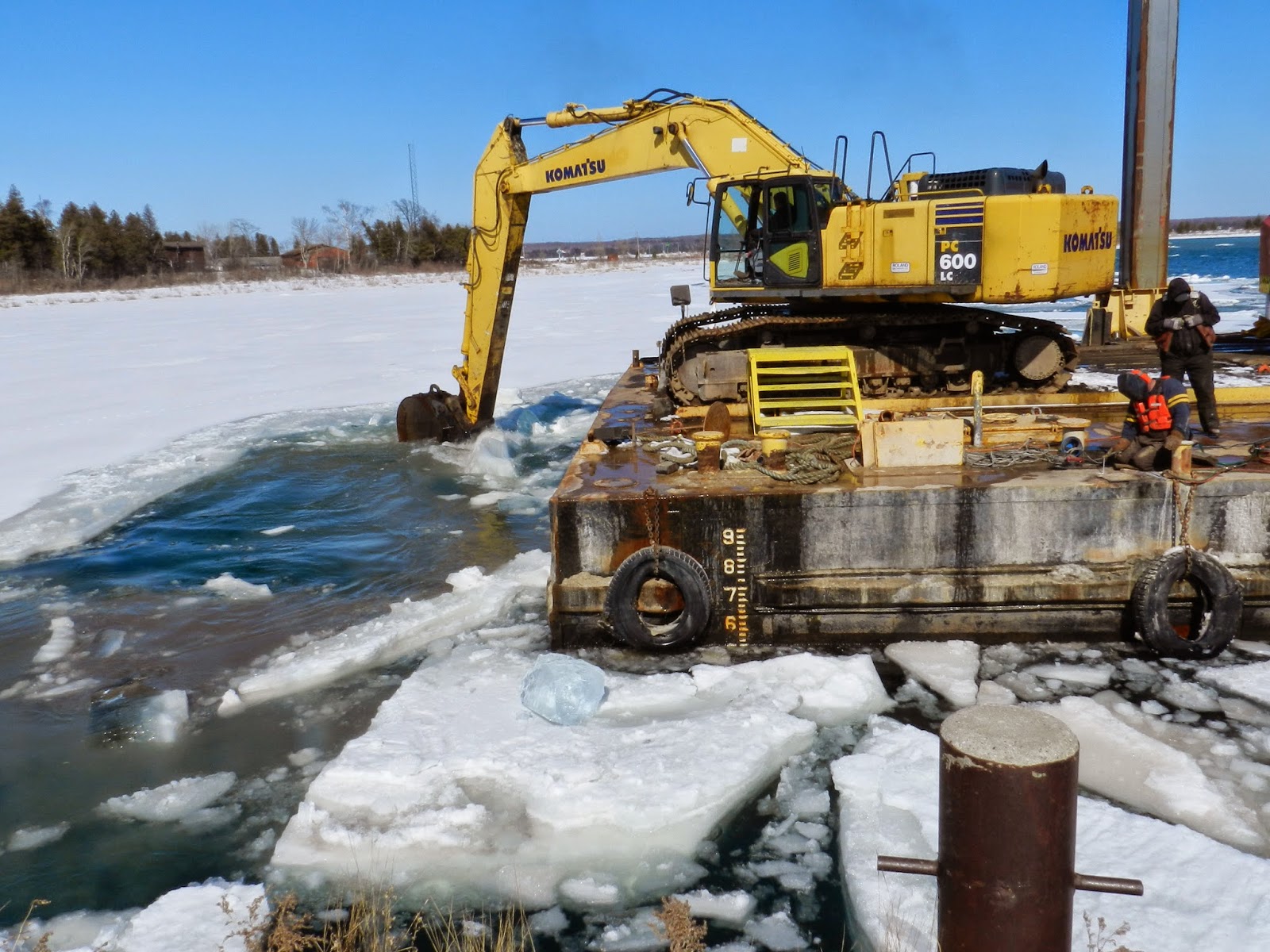
Tuesday, April 7th, the Detroit Harbor project resumed, only to have progress quickly curtailed by a damaged silt curtain.  Several days passed while repairs were made, during what were ideal weather and ice-free conditions.  But, by the time the crews and equipment were ready to dig once again, ice chunks filled the channel, floated in on a southerly breeze.

With no prospect for the wind to shift and the ice to leave, crews departed for a couple of days off. They reported in again Sunday morning, just as the shifting northerly breeze blew ice toward the open lake.  With April now already half over, and only two days of dredging accomplished,  in order to gain on the schedule imposed by the WDNR permit for digging, the contractor will need assistance in the form of favorable winds - meaning more northerly than any other direction.


According to Hoyt Purinton, the bay ice that blew down this morning against Plum Island was a single, large field, with nary a visible crack running through it.  Plum Island became an effective Door stop, but not before the edge of the field piled some 30 feet into the air.  (That's an estimate, as there is little but the nearby tree line for a gauge.)  The Bay of Green Bay has yet to break up into small fields.

A friend earlier this winter indicated to me that he read my blogs, but he just about had his fill of dredging photos.  Sorry!  I guess the same might be said for snow pictures. When there are few local events to mark these days, we'll keep covering the same-old.   [But really, how exciting, isn't it, to see the dredge dredge for a change?  And fresh snow fall sideways in a breeze, and then the white aftermath…]

Some day soon, summer will come along and then we'll be yawning, waiting for fall colors and another cycle of nature.

-  Dick Purinton

Sunday, April 6, 2014

SPRING STUTTER-STEPS


Ice several feet thick had to be broken by machine in order
to open the approach to the Potato Dock Saturday afternoon.

Washington Island, Wisconsin -

It's not over yet, Old Man Winter, and we were reminded of that fact Friday, with 4-5 inches of heavy, wet snow.  We saw a brief let-up around noon, then snowfall resumed, even harder, in the late afternoon.  Large disks of lake effect snow were whipped by high winds.

Those winds, which strengthened and backed toward the north, were enough to stream heavy ice through the Door Passage into the lake.   This, coupled with hampered visibility for what was in the ferry's route,  brought cancellation of the first Friday evening trip of 2014.  By Saturday morning the snow had ended, and the sky was sparkling clear - and ground cover sparkled, too.    Fresh snow stuck in the trees, and the air temperature was at 23 degrees at 7 a.m.

With a few passes of the shovel, clear patches here and there, the rest was left to intense sunshine.   Most of our snow was gone or on its way out by late afternoon.

The Roen crew had arrived at the end of the week to get their equipment running.  Saturday morning their tug was operational and the crew broke out their crane barge.  By Saturday afternoon they were engaged in opening up the area next to the Potato Dock, so that dredging can begin soon and scows of spoils can be pushed alongside that pier for offloading.  The channel dredging project should move forward this week if ice and wind don't interfere with the maneuvering of the scows or with the rather delicate silt curtain, a requirement while when digging takes place.  (As of Sunday afternoon, the northern half of the channel in Detroit Harbor had broken ice, floated in and held by southerly wind.)

School Navigators Unit is a success

One point I want to relate was the great success Washington Island Schools Navigators unit.   The unit began, if you'll recall, with a trip aboard the Arni J. Richter on St. Patrick's day, March 17.

This Friday afternoon, with their work completed, students and staff hosted an Open House for the community at Washington Island School.  All ages and all grade levels participated in this project.  Clearly, each class put in a great deal of work and thought on this project.  I was impressed with the quality of their end-product, and the enthusiasm the students showed for their work, which was designed to help them learn more about their community, past and present, and learn new skills in the process.

In the 4-6 grade room, Ryan, Max and Aidan showed Mary Jo and I around their computer website, after ensuring we were property greeted, then comfortably seated, to observe their product.  Mary Jo was one of several Islanders interviewed as a former student of the old Detroit Harbor School, but there were many interviews done by the students.  They set up the interview appointments and asked the questions, and took notes, and later wrote up their notes, which can be seen on their website, along with photos.

Elementary school children listen to early
Islanders' stories onboard the Arni J. Richter.
Students, even the lower grades, became adept
interviewers, researchers and historians during the
following weeks.
You can learn about their Navigator unit, too.  Go to the school's website, and from there you'll find pages for each grade levels.   Given a close look you'll see the results of their many hours of interviews, research, and discussion.  It's a masterful job by both staff and students, and should itself be entered into the Island Archives.

Here is the web address:      www.island.k12.wi.us        click on:  WINS Spring 2014 Voyage

Birds and such

Aside from the fresh snow, the first thing I noticed Saturday morning when I looked out the window toward the harbor was a large bird with the appearance and size of a hawk struggling to subdue a duck.  This struggle took place about 15 feet from the edge of a small opening in the ice where springs keep the ice from freezing.   According to fresh tracks in the snow the larger bird and duck had already dragged about 20 feet.   The duck, using all of its remaining strength, was scooting the pair toward the opening's edge.

I was too excited at this point to grab a pair of binoculars or my camera as the drama unfolded.  I expressed an inner "Yes!" when the duck maneuvered itself into the water, large bird still firmly attached.  If it can make it to the pond, I thought, the larger bird might let go.  But, with equal grit and determination, and superior strength, the hawk-like bird pulled the duck back onto the ice.  Once on its back, the duck's feet went skyward in classical, almost cartoonish style, and they ceased to kick.

With a fleeting chance for a good Falcon photo,
my camera was set on autofocus.  As a result the foreground
branches are sharp while the bird is out of focus.
Within seconds (and this whole scene unfolded in less than two minutes) the large bird took off with its prey to one of the trees east of our home, out of sight.  This bird had a meal, and I suppose I should add deservedly so, given the work put in.

In about half an hour this same bird appeared again and roosted in a branch above spring opening.  There on the branch it preened and spread its feathers, drying them (I guessed) from the quick dip in the pond.  After 20 minutes it moved from that perch to another tree on the far side of the opening, and it resumed its preening.

Now I could see more clearly through binoculars, and I took a few photos (they turned out quite blurry, sorry). Mary Jo and I are quite certain it was a Peregrine Falcon.  (If bird experts out there differ in this opinion, please let us know.)

About an hour later, a young eagle was seen circling over the same small pond, swooping low, also looking for a duck dinner.

In the last 10 days we've seen the arrival of geese and sandhill cranes, pairs that would in past springs be swimming close to Snake Island or the old, partially submerged Ida Bo dock, or walking the shoreline looking for food.  The sandhill crane pair walked past our home on the ice during Friday afternoon's storm when snowfall was heaviest.  What they're finding to eat, with insects not yet out and ice covering the harbor, is hard to imagine.  The few openings in the ice that appear near shore, where springs keep the waters ice-free, become sought after holes for wading and swimming and finding food, maybe.

We're not the only ones anxious for warmer weather.

-  Dick Purinton

Thursday, April 3, 2014

INTO APRIL

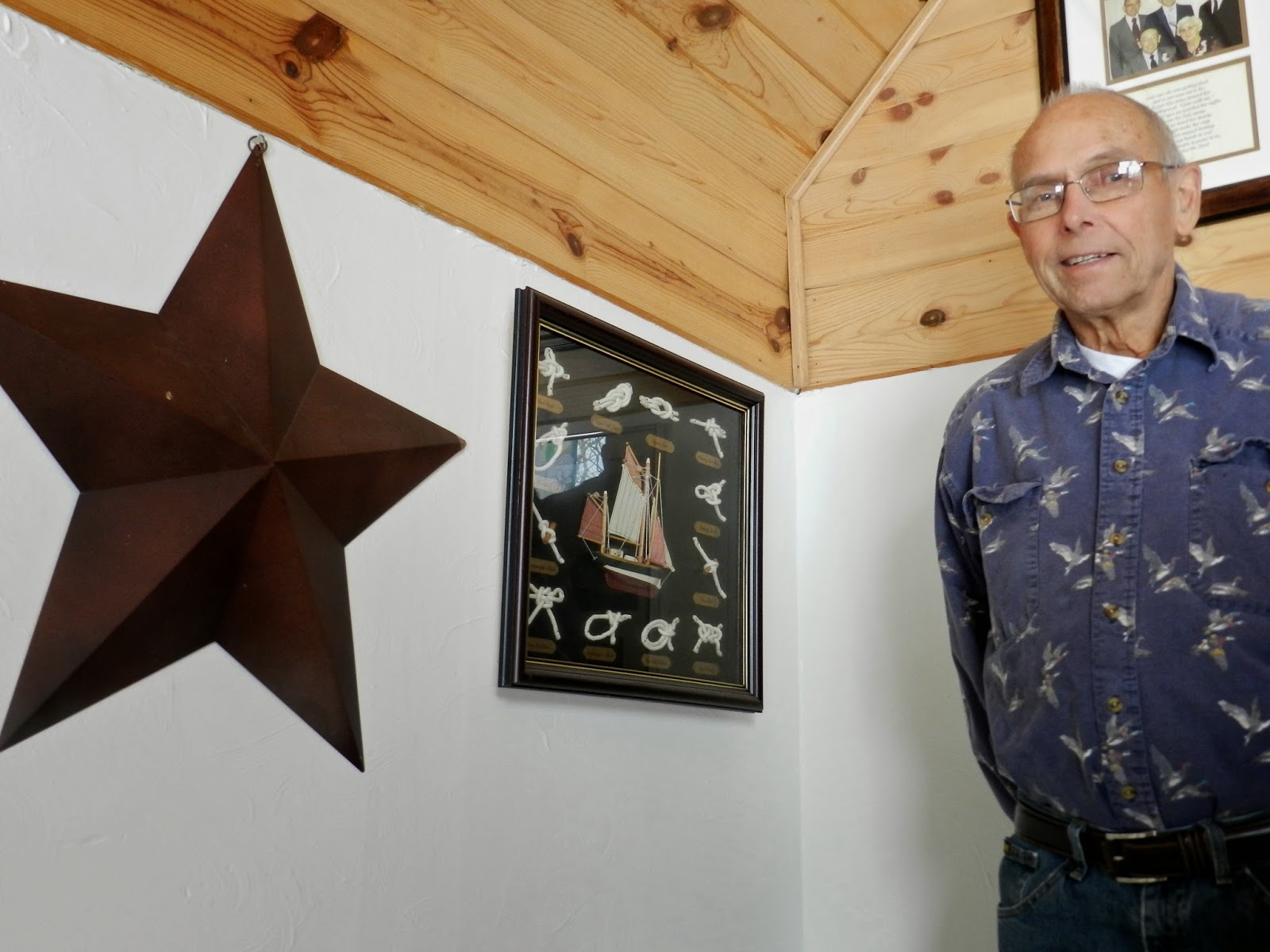
April 3 - Al Thiele with a few of the many photos and
momentos from 32 years of Coast Guard service.
Washington Island, Wisconsin -

This posting won't be about Al Thiele, shown in the photo above, taken this morning.  That blog is yet to come.

In a time of year when there aren't many spring photo opportunities, however, no daffodils or tulips poking their heads above the earth in this part of Wisconsin, Al's story emerges like the freshness that is spring.

When we visited approximately one year ago at Al's home for an interview, to talk about Al's career in the U. S. Coast Guard, he was a very sick man.  He had recently received a diagnosis that, had he not questioned his options more carefully, would have provided him a new address at School House Beach Cemetery rather than his home on Swenson Road.  But question he did.  Following a trip to Mayo Clinic for a second opinion, and a fairly routine medical procedure(s), along with faith that his health would improve, Al and his wife, Nancy, continue to enjoy life with their friends, children and grandchildren.

A more detailed piece on Al and his rise from Seaman to top enlisted man, Master Chief of the Coast Guard, will be coming later this month.  It's an interesting story, and one that should be published and introduced to the Island Historical Archives now, and not as a posthumous contribution.

Helene Meyer continues to improve

Word of Helene Meyer's steady recovery continues to be received on Washington Island.  Following a very serious auto crash, Helene's guarded condition initially could only be considered a long and upward climb.  And yet, while we are assured her situation is no picnic, she continues to mend, as breaks in her bones begin to heal.  Her mind and her disposition have escaped trauma, it seems, and she's been asking for books to read, activity to occupy her mind while the physical mending takes place.

So, it wasn't surprising to see a photo taken recently of Helene, her arms outstretched, welcoming a photographer.  Cards may now be welcomed, a way to enhance her day in addition to expressing our concerns and gratitude.

You may send your cards to:   (the address given below was updated 4/4/14 to reflect Helene's move from the hospital to this recovery center - another sign of progress)

Helene Meyer
Rennes Health & Rehab Center
325 East Florida Ave.
Appleton, WI  54911

Not an April's fool joke

I avoided producing a blog on April 1st because, I thought, some readers might confuse validity with bogus information.

But, now, I want to express my genuine thanks for your faithful readership, both ferrycabinnews Followers and occasional readers.  The fact that there are hits from just about every continent and country on the globe, as shown on the revolving Globe, I'd have to guess that many of these visits are accidental blog landings.  On the other hand, I also know there are intentional readers from exotic locations, and some are friends who live in or visit these places.  Each such visitor, in my mind, produces a special "ping" of distinction.

Yesterday, just before the noon whistle blew for lunch, my Globe meter turned the 100,000 mark.  Now, if that individual (Mr. or Mrs. 100,000) can identify themselves as being the 100,000th visitor, and offer me reasonable proof, I'll buy them a hot dog and soda at the Jackson Harbor Time Out Concession in July.  (I was visitor 100,103... so that number is taken.)

This "blog site visitor tally" began, if I recall correctly, about three years ago when the counter with globe was introduced to my site.  This was several years after I began the blog.  While there must be some weblogs that get this many hits on a daily basis, for me 100,000 represents a milestone.  I remember back to March of 2008, following the inaugural posting, how I was thrilled just to reach 20 readers.  And that number grew, but mostly on days when fresh, new blogs were posted.

Gradually, over several years' time, the hits counter crept to the 40-50/day range, then 75-80/day, and finally, 100 or more hits on a regular, daily basis.  All-time peak activity came in early March of this year, with over 1400 hits in one 24-hour period.  That was when the U. S. Coast Guard helicopter landed in deep snow on the Island's eastern shore, a precautionary landing, then was removed on trailer the following day.

I know many readers are brought to my site by Facebook mentions, a social media phenomena that I've not paid much personal attention to.  I have to acknowledge Facebook's power to get word out quickly about people and events.  Social networking's just not been my cup of tea.

Maybe the next 100,000 hits will come more quickly.  It really doesn't matter, except to salve my ego when I get discouraged.  (The inverse also happens.  I get down when the hits don't rise to my expectations.)   I track blog hits on a daily basis to see what topics or presentations strike people's fancy, and in this endeavor I still can't predict what captures people's interest most intensely.  Postings I consider "duds," not much more than filler,  sometimes get higher responses than those I've worked on the hardest, proud to finally hit the "publish" button.

Blog comments have also increased, and perhaps that's a better measure of the reader's interest.  It lets me know people are quite engaged in a variety of topics related to Washington Island.

In a round-about way, I believe that by providing this tether to the Washington Island community, the occasional blogs, means something to people.  It may even be that blogs, communications about the Island, have helped steer decision making for those considering buying land or settling down here in retirement, rather than some other community.   It works in this way as a soft marketing tool for the local economy, tying together people through positive attributes of community life on this small island.

Of course, there are many who don't read this blog, or who seldom look at the internet, and they may reach similar conclusions from entirely different sets of information.  Its hard to measure the reach, but I have this feeling, and it's based on pieces of conversation and correspondence.  (That's why I also believe its important to have a good Island newspaper, the Island Observer, and it can serve a real purpose beyond the delivery of 'hard' news.)

Another by-product of this blog is that it keeps me closer to the streets, the woods and harbors, especially now that I'm in a semi-retirement mode.  Thinking on paper, informing, entertaining myself and others - whatever it is people might find worthwhile in reading such posts - requires continual consideration of Island events, politics, history and its future.

As the list of blog Followers and site visitors continues to grow, so does my sense of responsibility to provide columns worthwhile to read.

And the best part, of course, is that it's free to the reader!  No pop-up ads or distracting, crashing videos.  But, those might be directions to consider for another day.

Thanks for your continued interest!  -    Dick Purinton

A peak rose from the plain of the average daily readership in early March.