Showing posts with label Roen Salvage. Show all posts

Tuesday, May 6, 2014

MAY IS LOOKING UP

Treasure Seeker,  former C. G. Richter, recently
photographed moored in St. Marten harbor.
Detroit Harbor, Washington Island -

Our foreign correspondent and his wife were recently vacationing on St. Marten Island, where he took this picture of the Treasure Seeker.   Other than her hull still floating, there wasn't much to indicate she ever left the mooring in Philipsburg Harbor.   Locals said the Treasure Seeker had been stationed there since some time in November.  "Maybe awaiting a gold shipment from South America to Europe" was how our correspondent interpreted the situation.

We can imagine the salt air and salt water are by now taking their toll on the old girl.  Keeping up with pockets of rust had become a standard spring activity during the last years here, in fresh water, even long after the last trips as a ferry.  Time and the elements are not kind to vessels, despite lack of daily service.

Water levels continue to rise

Our Lake Michigan water levels are up nicely over last spring, and a rather wet week with strong easterly winds knocked out the last of the bay and harbor ice in addition to contributing moisture to the lake.

According to the Army Corps, Lakes Michigan and Huron are now about 11 inches above last year's level, with another expected rise of at least five inches over the next month.

With the harbor ice gone and danger of ice en route being eliminated, the ferry Robert Noble made its first trip of the season May 1.  The Arni J. Richter, which began winter service back on December 10, 2013, was sidelined for cleaning and routine maintenance, some of it deferred during that period due to the daily need for availability during the period of ice.   With so much ice in the bay this winter, and the potential for problems during breakup, this year's process nevertheless went quite smoothly, with only one day's interference during a heavy snowstorm three weeks back when a large field came against Plum Island.  From then it was smooth sailing, and the bay ice melted, more or less, in place.

Saturday, May 3, the ferry schedule bumped up to 11 daily round trips, one per hour through the heart of each day.   We hope adequate traffic will soon follow.

Dredging progress

Since resuming the Detroit Harbor channel dredging project in April, the Roen crew has made good progress, edging the 80% mark by last week's end.  The rig with backhoe and crane moved into the middle section of the channel, as the WDNR requires with three designated "fish windows."  Foth Project Manager Ken Aukerman now believes they are on track to complete this project by the middle of June.  This is good news for everyone, in that the trucking and the resulting mess on the roads will settle down in time for the start of the heaviest tourism season.

Dredging in fog April 30.


The Town's gravel pit, the receptacle for the dredge spoils, is fast filling up.  Much of the material in the past weeks has been exceptionally sloppy and mucky - easy to dig and transfer, but not particularly easy to truck, or to contain on site.   This, too, should change as the rig works its way further out the channel, where higher stone content has in the past been found.

This has been a big project, and while it stirred up commotion in terms of truck traffic, road damage and so forth, none of that comes as unexpected.  One positive is that, perhaps in late August, brand new asphalt paving is expected for those trucking roads, in addition to other roads the Town of Washington and Door County designate for paving.   Six months from now, we should see many, excellent miles of newly paved roads.

Currently, with temperatures pushing to edge above the 50 degree mark (it was 33 degrees yesterday morning), it's hard to believe that Cherry Train tours begin in two weeks, and that we'll entertain Memorial Day guests with an Island that is now only partially awake from a long winter.

-   Dick Purinton


Sunday, April 6, 2014

SPRING STUTTER-STEPS


Ice several feet thick had to be broken by machine in order
to open the approach to the Potato Dock Saturday afternoon.

Washington Island, Wisconsin -

It's not over yet, Old Man Winter, and we were reminded of that fact Friday, with 4-5 inches of heavy, wet snow.  We saw a brief let-up around noon, then snowfall resumed, even harder, in the late afternoon.  Large disks of lake effect snow were whipped by high winds.

Those winds, which strengthened and backed toward the north, were enough to stream heavy ice through the Door Passage into the lake.   This, coupled with hampered visibility for what was in the ferry's route,  brought cancellation of the first Friday evening trip of 2014.  By Saturday morning the snow had ended, and the sky was sparkling clear - and ground cover sparkled, too.    Fresh snow stuck in the trees, and the air temperature was at 23 degrees at 7 a.m.

With a few passes of the shovel, clear patches here and there, the rest was left to intense sunshine.   Most of our snow was gone or on its way out by late afternoon.

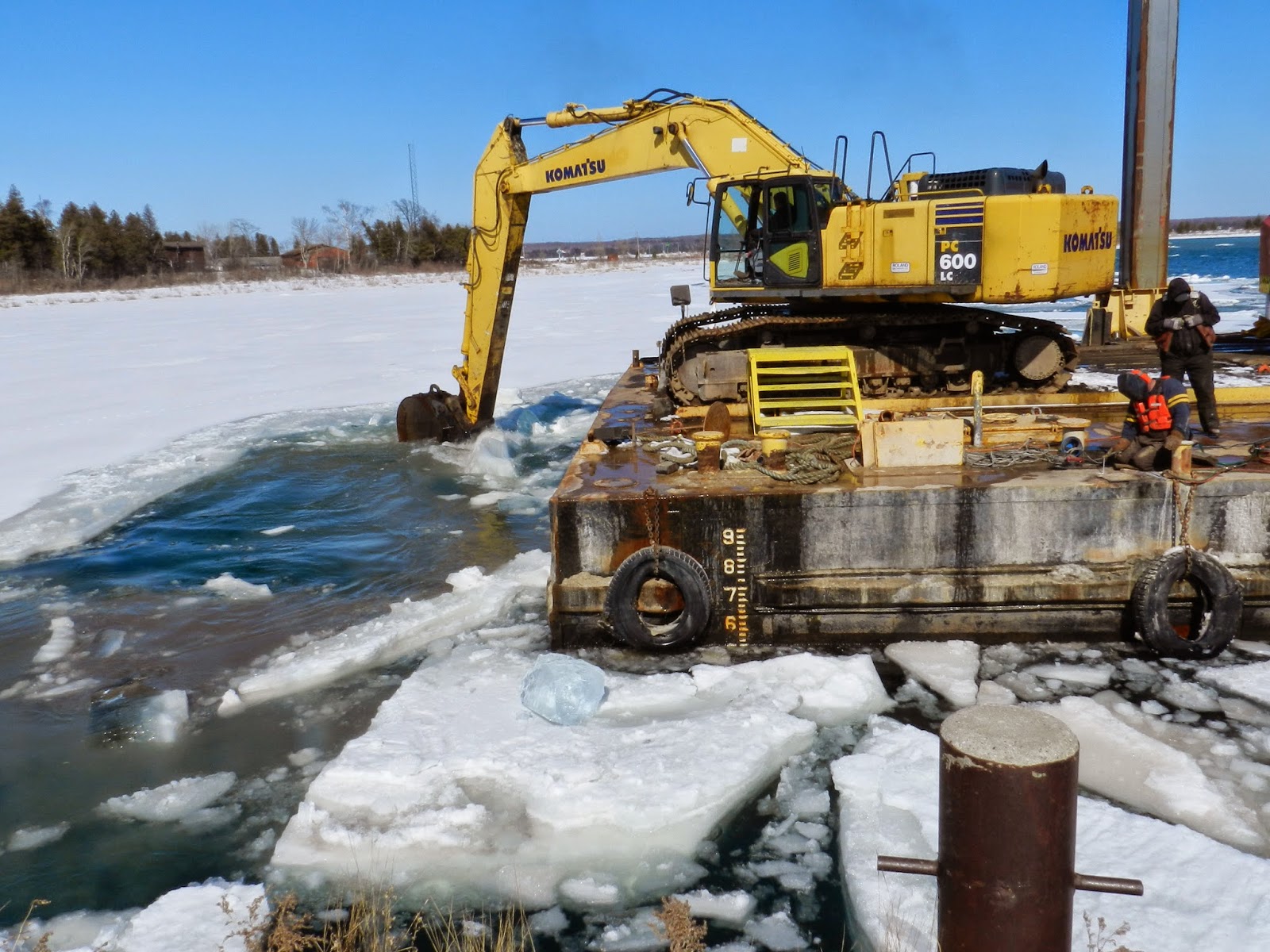
The Roen crew had arrived at the end of the week to get their equipment running.  Saturday morning their tug was operational and the crew broke out their crane barge.  By Saturday afternoon they were engaged in opening up the area next to the Potato Dock, so that dredging can begin soon and scows of spoils can be pushed alongside that pier for offloading.  The channel dredging project should move forward this week if ice and wind don't interfere with the maneuvering of the scows or with the rather delicate silt curtain, a requirement while when digging takes place.  (As of Sunday afternoon, the northern half of the channel in Detroit Harbor had broken ice, floated in and held by southerly wind.)

School Navigators Unit is a success

One point I want to relate was the great success Washington Island Schools Navigators unit.   The unit began, if you'll recall, with a trip aboard the Arni J. Richter on St. Patrick's day, March 17.

This Friday afternoon, with their work completed, students and staff hosted an Open House for the community at Washington Island School.  All ages and all grade levels participated in this project.  Clearly, each class put in a great deal of work and thought on this project.  I was impressed with the quality of their end-product, and the enthusiasm the students showed for their work, which was designed to help them learn more about their community, past and present, and learn new skills in the process.

In the 4-6 grade room, Ryan, Max and Aidan showed Mary Jo and I around their computer website, after ensuring we were property greeted, then comfortably seated, to observe their product.  Mary Jo was one of several Islanders interviewed as a former student of the old Detroit Harbor School, but there were many interviews done by the students.  They set up the interview appointments and asked the questions, and took notes, and later wrote up their notes, which can be seen on their website, along with photos.

Elementary school children listen to early
Islanders' stories onboard the Arni J. Richter.
Students, even the lower grades, became adept
interviewers, researchers and historians during the
following weeks.
You can learn about their Navigator unit, too.  Go to the school's website, and from there you'll find pages for each grade levels.   Given a close look you'll see the results of their many hours of interviews, research, and discussion.  It's a masterful job by both staff and students, and should itself be entered into the Island Archives.

Here is the web address:      www.island.k12.wi.us        click on:  WINS Spring 2014 Voyage

Birds and such

Aside from the fresh snow, the first thing I noticed Saturday morning when I looked out the window toward the harbor was a large bird with the appearance and size of a hawk struggling to subdue a duck.  This struggle took place about 15 feet from the edge of a small opening in the ice where springs keep the ice from freezing.   According to fresh tracks in the snow the larger bird and duck had already dragged about 20 feet.   The duck, using all of its remaining strength, was scooting the pair toward the opening's edge.

I was too excited at this point to grab a pair of binoculars or my camera as the drama unfolded.  I expressed an inner "Yes!" when the duck maneuvered itself into the water, large bird still firmly attached.  If it can make it to the pond, I thought, the larger bird might let go.  But, with equal grit and determination, and superior strength, the hawk-like bird pulled the duck back onto the ice.  Once on its back, the duck's feet went skyward in classical, almost cartoonish style, and they ceased to kick.

With a fleeting chance for a good Falcon photo,
my camera was set on autofocus.  As a result the foreground
branches are sharp while the bird is out of focus.
Within seconds (and this whole scene unfolded in less than two minutes) the large bird took off with its prey to one of the trees east of our home, out of sight.  This bird had a meal, and I suppose I should add deservedly so, given the work put in.

In about half an hour this same bird appeared again and roosted in a branch above spring opening.  There on the branch it preened and spread its feathers, drying them (I guessed) from the quick dip in the pond.  After 20 minutes it moved from that perch to another tree on the far side of the opening, and it resumed its preening.

Now I could see more clearly through binoculars, and I took a few photos (they turned out quite blurry, sorry). Mary Jo and I are quite certain it was a Peregrine Falcon.  (If bird experts out there differ in this opinion, please let us know.)

About an hour later, a young eagle was seen circling over the same small pond, swooping low, also looking for a duck dinner.

In the last 10 days we've seen the arrival of geese and sandhill cranes, pairs that would in past springs be swimming close to Snake Island or the old, partially submerged Ida Bo dock, or walking the shoreline looking for food.  The sandhill crane pair walked past our home on the ice during Friday afternoon's storm when snowfall was heaviest.  What they're finding to eat, with insects not yet out and ice covering the harbor, is hard to imagine.  The few openings in the ice that appear near shore, where springs keep the waters ice-free, become sought after holes for wading and swimming and finding food, maybe.

We're not the only ones anxious for warmer weather.

-  Dick Purinton

Sunday, November 3, 2013

WET WEATHER CONTINUES


Washington Island -

The photo of our Island post office was taken Thursday morning, around 7:35.   It was a dark, foggy morning with rain during the night.  A few cars were out.  Dump trucks were running dredging spoils to the Town's site on Gunnlaugsson Road.   A few patrons were next door at the Red Cup.  In many respects, though, it was a very quiet day, heading into the first of November.

Unfortunately for youngsters who were looking forward to trick-or-treating, the day didn't improve much from this point.  By 4 p.m. rain put the damper on an outdoor Halloween activity at school, with accompanying temperature in the lower 40s.

Danish Mill - a wet but inviting scene in the early morning hour.


Rain doesn't stop dredging.  In fact, the good thing about these past days was the low daily wind speed.  However, a windy stretch is forecast, and the Roen crew may take the next two days to reunite with family members.  A broken pin on the excavator bucker in mid-week required switching back to the crane with bucket for a few days, until the new part was obtained.   The material dredged in the previous 48 hours was as rocky as any thus far.  On the one hand, it's a good thing the excavator can dig through those areas.  However, the offloading into trucks is slowed because the stones (combined with some softer material) is harder for the crane bucket to grab and place into trucks.

Water levels fluctuated greatly in recent weeks. Today, Sunday, the level is as high as a month or more ago.  But we've also seen dips in the level when the wind is northerly.  The Army Corps measurements indicated Lake Michigan was approximately 7.5 inches higher than at the same time last year.  At least that's a net gain for the year, so far.

For the month of September, Island Weather Observer John Delwiche reported rain fall amounts a few hundredths over the historical monthly average of 3.21"       For the year, however, we are nearly 7.5 inches above average, which accounts in part for the overall increase in lake level.

-  Dick Purinton

Friday, October 25, 2013

ISLAND DREDGING - A REALITY

One of approximately eight dump trucks that hauls dredging
spoils on the six-mile route to the
town gravel pit, off Gunnlaugsson Road.
Detroit Harbor, Washington Island -

The Detroit Harbor dredging project, the digging and hauling part of this project, is now in week five, and approximately 25% of the total project depth for the channel has been achieved.

That figure, 25%, is an approximation that is based on counts of barge-loads of spoils.  Actual figures will be derived from the differences calculated from pre and post-project depth contours.  But, the estimates show weekly progress in what is not necessarily straight-forward digging by the primary contractor, Roen Salvage Company of Sturgeon Bay.   When weather permits, an excavator digs on a round-the-clock basis.  Off-loading of the spoils barges and trucking occurs only between 6 a.m. and 9 p.m.  This window for trucking - most of it during daylight - is intended to reduce noise for residents when the trucks pass by homes and businesses.  It also enables better and easier monitoring of loads, road conditions and dumping at the spoils site.

It's surprising and annoying that with what should be considered a positive project with the island's welfare in mind, that there are still a number of detractors.  Whether they're driven by personal business reasons, ego magnification, or just plain small-town pettiness, the complaint calls (some anonymous), whether about trucking, digging or otherwise managing this large project with many pieces, it gets old after awhile.

We've heard some rumbling about those occasional large stones that were dug from the bottom of the harbor, then set aside on the Potato Dock because they're too large to fit into dump trucks without removing the tailgates.  To whom do they belong, and, aren't they Town property?  

Perhaps the Town of Washington might wish to mark the Community Center parking lot with those beauties.  For now, at least, those stones considered too large to haul in trucks (because they would require tailgates to be removed) have been set aside along the western edge of the Potato Dock, just to get them out of the way.  Perhaps they'll be moved later, and perhaps not.  It's up to the Town.

We should make clear, once and for all, that use of the Potato Dock facility for this project (a private property leased by Washington Island Ferry Line) is being made available at no cost to the Town or to any contractor.  The pier, given its geographic location a short distance from the channel, is a logical place to unload dredge spoils, moor barges, and position other related equipment.  We've called it "our contribution" to making this project work, and it further reduces the overall cost of the project.   WIFL does not intend to charge "tipping fee" for stones placed on the Potato Dock, whether such placement is permanent or temporary.  Perhaps the Town of Washington will offer these stone as souvenirs to interested citizens who may bid for them and pay for trucking to their properties.

Let's get real, people!

Thankfully, detractors of projects such as this  (who, by the way, always have the better solution) are a very small minority.  The majority of Island citizens and visitors plainly see the need to get this work done, and they understand that when you dig and transfer mud and stone there will always be dust, minor spillages, busted blacktop and the associated noise of engines and machinery.  All of this comes to a halt when the project depth is achieved, or it will come to a temporary halt when freezing and ice enters the picture.

Dave Hanlin runs two of the trucks for the offload.  Shown is Rich Ellefson,
unlocking the tailgate of the truck he's driving for Hanlin. 


It looks now like the change in seasons with freezing temperatures will shut down dredging operations in late December or January, before this project is completed.  If that is the case, then dredging would resume when the ice is melted and when WDNR permits allow for the continuation of digging.

Economic benefits, too

Everyone knows that without a harbor deep enough to navigate, the Island's economy and our community would be in jeopardy.  But along with this necessary and considerable work being accomplished by a number of contractors and workers, there is a positive economic spin-off.  Dollars are spent in motels, restaurants, stores and other establishments.  Workers engage in twelve-hour shifts, and during that time they eat lunches purchased locally.  When not on duty, they sleep and eat on the Island.  Lunch breaks for truckers consist of food grabbed on-the-fly, resulting in hundreds of dollars in food each week from restaurants and stores.  (Two trucks were parked briefly at the Albatross one noon, as their drivers ordered lunch-to-go.)

 A loaded material barge approaches the Potato Dock.
The shore-based crane swings the empty away from
the pier to make room.  The dredge is in the background.


We should also recognize there are Wisconsin taxpayer dollars, paid to Wisconsin contractor companies, and to their to workers and subcontractors, workers who, with few exceptions, live in our state and pay Wisconsin income taxes.  The primary contractor is Roen, Sturgeon Bay based, and most of their men are from Door County.  The trucking is nearly all by island men, and the trucks are owned by Islanders.  How much more local can we get in terms of keeping these dollars near home?   Paychecks, fees and products purchased result in multiple turnover of dollars, further helping to strengthen local and state economies.  Nowhere will the impact be appreciated, however, as much as at our local, Island level.

Remember the visit from Senator Feingold about six years ago, with whom the topic of dredging of the Detroit Harbor federal channel was first broached?

Given the long run-up to achieving a shovel-ready, fully-funded project, I count myself among those pleasantly surprised by the way things have thus far progressed.   This is a huge undertaking, with major expense, and we need to thank our lucky stars it is happening today. (We need to thank our key legislators, too, for their steadfast support resulting in funding legislation).  Future generations of Islanders and Island visitors, we hope, will not be adversely impacted by low water in Lake Michigan, such that it could jeopardize ferry transportation or drop property values.

-  Dick Purinton


Wednesday, December 26, 2012

DREDGING CONTINUES

Excavator on Roen barge.
Detroit Harbor, Washington Island -

The barge and barge crew represent Roen Salvage.  The yellow excavator belongs to Mike Kahr of Death's Door Marine.  The excavator operator is Island contractor Tom Jordan.  It's a team effort to beat the weather clock.

In a process that often seems laborious but straightforward, one surprise was encountered this morning.  Rather than scraping against a ledge of stone, or  stones hard-packed in clay, the excavator has been bringing up buckets of loose cobblestones. This the sort of material you'd expect to find along an old beach line, maybe when the lake level was significantly shallower than it is today.  Occasional sharp-cornered, large rocks and clay are also present.

Switching to this machine for the time being hasn't appreciably slowed the dredging process much, but a shorter reach means the barge as work platform has to be frequently repositioned, and some time is lost then.  Jordan digs three full buckets in about the same time as it took to get one larger bucket with the crane.  But, once softer material is encountered again, the crane with clamshell will be put back in service.  

The material barge should be loaded before dark this afternoon, when unloading and trucking begin once again.    -  Dick Purinton


Thursday, December 20, 2012

DREDGING, DEPTHS AND STORM WARNINGS

Roen construction barge and material barge,
4:30 pm, Wednesday Dec. 19
filling the first barge load of spoils.
Detroit Harbor, Washington Island -

With what could be described as one of the most perfect days of the year - calm, sunny, mild - Roen Salvage arrived shortly after noon Wednesday at the Potato Dock location after a tow of equipment from Egg Harbor that began early the evening before.

Potato Dock operations began
with perfect weather Wednesday.
Dredging operations began with the first bucket scraping hardpan around 1:30 pm, and there was very slow progress in the first several hours, despite digging with several different styles of buckets.  Barges were repositioned shoreward, where bottom material was somewhat softer, and better progress was made, roughly 350 cubic yards by 9 pm.   By that time the barge had settled under its load so that maneuvering depths were near zero.

At 7 am this Thursday morning, unloading began as five dump trucks owned by Island contractors lined up to begin hauling.   It is hoped this first barge load of many can be off-loaded in time to start on a second barge, prior to the impending, predicted storm.  (Rich Ellefson, coordinating trucks at the Potato Dock, reported 38 truckloads @ 10 yds. per truck to empty the barge.  Digging has commenced once again.)

Offloading this morning, 9 am, Thursday.
 This entire dredging exercise, just this phase, could take easily a week or more, and it's dependent upon cooperative conditions for wind, sea and air temperature.  If it becomes too cold, for an extended period, Roen's equipment will have to return to Sturgeon Bay, where it will be wintered.

Contractor Mike Kahr is also anticipated to be available soon, and both the Northport dock and the toughest areas to dig around the Potato Dock may be left for his excavator and hydraulic hammer.  His equipment takes a smaller bite, which means it takes longer to dig an area, but for the toughest, rockiest bottom areas it may be the only solution.

As of 9:00 am this morning, winds were between 15-20 mph, easterly, and the air temperature was 35 degrees.  Still good for our ferry trips and not a problem for the dredge.

However, since that time heavy rains began to change over to sleet, and wind gusts have increased to 30 mph as the wind direction shifted to NE.  Velocities are expected to increase to 45-50 kt. by late afternoon, according to the NOAA marine weather forecast.  Most commercial ships have either stayed in port, or they are currently heading to safe harbor at this time.  Snow began to fall farther south, already 7 inches in Madison, 4.5 inches in Wausau, and so forth, but here on the Island and along the lakeshore, temperatures have given us (much welcomed) moisture in the form of heavy rains.

Now, as of 11:15 am, sleet appears to be changing over to snow.  

Our plan is to run this last ferry trip of the morning, then suspend ferry service until after the storm winds have passed - which could be at some point Saturday morning.  No way of knowing for sure, at this point, but all forecasts indicate both high winds and lower temperatures, so that even 30-kt. winds, manageable back in October and November, would cause heavy build-up of ice on deck.  We will avoid that, and the low visibility predicted with blizzard-like conditions.

-  Dick Purinton

Thursday, June 28, 2012

COMPLETION OF HARBOR AIDS TO NAVIGATION


Detroit Harbor, Washington Island -

Roen Salvage work barge No. 73 entered Detroit Harbor late Wednesday morning, and within approximately 5 hours the crew had set the two aluminum poles atop Aids to Navigation bases #4 and #5.  I had received an email or two asking about the completion of these cylinders just the previous day, and as if prompted by public curiosity, the tug and barge appeared, rounding Door Bluff on a stiff southerly breeze with the two towers on deck.


These towers appeared to be fabricated entirely of welded aluminum, built and installed to fail-proof federal government (U. S. Coast Guard) specifications, with foot pegs and a trap door for access to the light platform.  Each all-alminum platform with rails will hold a battery, solar panel, light and day boards.  These light bases are substantial, bolted to the top of robust - some have used the word "overbuilt"- concrete, steel and rock pedestals.  These massive objects take the place of the former red nun and green can floating buoys that were held on station by chain and concrete sinker.

The Roen tug Charles Asher and the work barge under command of Don Sarter, having finished their work here, then waited until the southerly winds diminished before setting a course in northern Lake Michigan for the Straits of Mackinac, St. Mary's River, and then a long tow across Lake Superior to Duluth.  There, contract work involving dredging and driving pilings awaits in Duluth harbor.

This morning, Thursday, by 10:30 a.m., U. S. Coast Guard Aids to Navigation personnel from Milwaukee's Sector Lake Michigan were on hand to complete activation of the aids.  Green or red day boards were bolted to the railings, solar panels installed, and a corresponding light with battery were added to the circuit, making the aids fully functional.

Arni J. Richter approaches island dock as Coast Guard personnel
complete work on light structure #5.
Mariners are advised to keep both hands on the wheel and reduce speed when approaching these new, immoveable objects!

-  Dick Purinton

Thursday, May 31, 2012

Buoys Replaced By Structures

Detroit Harbor -

Two of the floating aids in the Detroit Harbor channel, buoys number 4 and 5, are being replaced by permanent structures.  The new aids to navigation will be solid cylinders of steel, cement and stone, anchored by nine H-piles into bedrock, and topped with a steel pole upon which will be a light, solar panel and battery.

This contract, estimated to be in the half-million dollar range, was bid to the Rock company of Pontiac, Michigan.  Door County marine contractor Roen Salvage, of Sturgeon Bay, is the major sub-contractor.  Other subcontractors include the drilling company that bored the holes for the pilings, and suppliers of the buoy cylinders and light towers.

Two of Roen's work barges are shown in the photo here shortly after they began the project.   Pipes of 14" diameter were set into the bottom a the buoy locations, then used as guides as they were drilled out, down three feet into bedrock.  Nine H-piles per navigation aid were then inserted into the drilled holes inside each pipe, and then epoxied into place using a special grout mixed with sand.   The pipes were removed once the epoxy was set

These permanent aids to navigation had been proposed for several years by the U. S. Coast Guard, but funding wasn't in hand until this fiscal year.   The new aids should eliminate drift from station (something that did occur with the older, floating buoys, especially as ice forced against them).  Batteries, solar panels and bulbs can be accessed easily for servicing by Coast Guard Aids to Navigation team members by small boat.  Formerly, a shallow-draft Coast Guard vessel would cross the lake from its home port in Muskegon to lift the floating aids with an A-frame, and its crew would inspect each chain and sinker.  The buoys would then be repainted, with chain replaced, if needed, before being reset on station.  

The tops of the new 12-ft. diameter cylinders will stand approximately 7 1/2 feet above water level, and  have a nearly 20-ft. mast on top of that.  These will make a strong target on radar scopes, and they will also be more easily seen during nighttime or low visibility by vessel operators.  (One of two cylinders is shown in the photo below as it is lifted from the semi to the Roen work barge, alongside Northport Pier.)


Roen Salvage is the largest and oldest marine contractor in the area.  This company typically bids on  marine construction projects such as dredging, break wall and dock construction around the Great Lakes.  From Detroit Harbor, this rig will prepare to sail to the upper St. Mary's River, where several similar, but larger, navigational aids will be constructed.  When that job is completed, the construction equipment will be towed to Duluth harbor at the western end of Lake Superior for another project that will include dredging of 200,000 cu. yds. and driving pilings for commercial shipping.

Actual work on the Detroit Harbor aids to navigation began Monday, May 24, after the equipment had been mobilized to the island. Work is expected to be completed - barring delays in supply of the light towers - by Friday, June 8th.   The steel cylinders that shape the base of the aids and the light pole assemblies are pre-fab items subbed to another company in the Fox Valley.  Delays in receiving those items could possibly prolong the project's completion.

Shown below is Don Sarter, Construction Supervisor and a 39-year Roen employee, who also operates the tug Stephan M. Asher that tows and positions the work barges.

Not yet known, but to be determined soon, is the fate of the dredging application by the Town of Washington for the Detroit Harbor channel.  This application, submitted earlier this calendar year, is believed to have cleared the citizen's committee that reviews such applications.  If so, it now awaits further review for approval by the WISDOT secretary, and finally, approval and signature must be given by Wisconsin's governor.   If approval is given and funding is released, this would mean a huge improvement for Washington Island, a major dredging operation that will widen and deepen a  navigation channel last touched in 1937!

This project could possibly be undertaken yet this calendar year.  However, approval and funding dollars through a Wisconsin Harbor Assistance Program Grant to the Town of Washington must first receive approval in order for any dollars to be allocated.  There were four or five other Wisconsin commercial port applicants, each with worthy projects competing for those same dollars.

-  Dick Purinton