Showing posts with label American Girl. Show all posts

Wednesday, August 3, 2016

SIDE BENEFITS


Although the life ring says U. S. Coast Guard, this small lifeboat,
according to Eric Bonow, came from the American Girl, which
is now displayed in the Gills Rock Maritime Museum.
(Eric Bonow photo)


Washington Island, Wisconsin -

When a topic presents itself, as did  Jim Anderson's stories of freighting with his close family members on the vessel American Girl, research and information can take unusual turns, and that's a fun side benefit to doing such projects.

I'm referring to the work done with Jim Anderson for his book, Memories of the American Girl - Stories of a Washington Island family freighting business.  Although the print run wasn't large, sales have been unexpectedly, pleasantly brisk in the past several weeks, encouraging me to reorder from Seaway, the Green Bay printer we worked with.

An interest I had in doing this book was to learn a bit more about the American Girl as a vessel, both before and after the Andersons owned and sailed her from Washington Island.  And, too, the Oil Queen, their tank barge built especially for hauling oil products from the Green Bay terminal to Sturgeon Bay and Washington Island.

I often go to Eric Bonow for answers to my questions, and even when he's out on the lakes in his capacity as a mate aboard one of the Great Lakes ore boats, he generally responds within a day or less, providing me with helpful direction, additional information, photos, maps or charts, and other connecting bits.   Such were the two photos he took of the old American Girl lifeboat, now on display at the Gills Rock Maritime Museum. I'm also looking at an old photo of the American Girl - on file with the Bowling Green University's Collection of the Great Lakes - when she was new, in Benton Harbor, Michigan.

American Girl as new vessel in 1922,
with lifeboat on after, upper deck.  Also, this
original profile matches closely the modifications of the
American Girl by Matt Fogg of Fogg Towing, and
St. James Marine, of Beaver Island.  (photo
from Great Lakes Historical Collection,
Bowling Green University.)

It appears to be the same lifeboat  boat that is shown on the top deck, judging by lines, length, and so on.

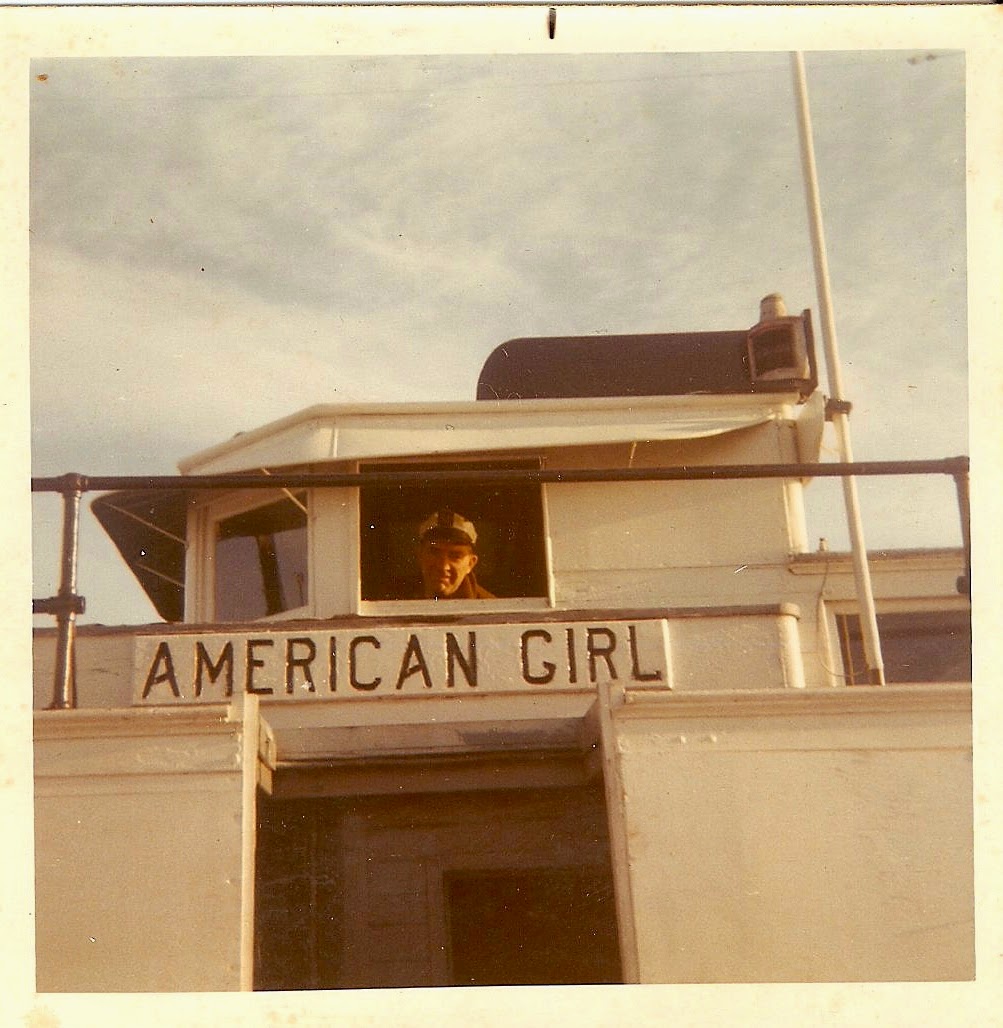
Later photos of when the Andersons sailed her depict a smaller, newer model tucked behind the pilot house of the American Girl, probably lighter, easier to handle, and less prone to leaking.  Here is one photo, from the mid-1960s, with Jim Anderson on the upper deck, with the newer lifeboat version secured in the background.


Jim Anderson on top deck of American Girl.
(Jim Anderson photo)


Trip to Ironton

In order to see the American Girl as she looks today, and to obtain a comparison photo or two for Jim's book, I rode the Badger car ferry with Tom Wilson on a wet day in mid-May.

I was fortunate to able to first connect with owner Matt Fogg by phone to set up a visit for Saturday morning.  On the previous day he had been working at North Fox Island and just returned to his docks at Ironton, Michigan.


Matt met us at his landing property a  few hundred yards west of the Ironton cable ferry.  This ferry provides a shortcut across an arm of Lake Charlevoix that leads to East Jordan, Michigan.  This location was, conveniently, a mere 20-minute drive from son Thor's home in Boyne City.

The exterior of the American Girl looked great, as did the wheel house and interior spaces above decks.

Much maintenance work was done by Matt and his crew to keep her useful and operational during his years of ownership.

Below decks, the former wooden bulkheads that separated the machinery space from the rest of the vessel have been mostly removed.  (Those bulkheads also served as vertical points to stack freight against to keep it from shifting when underway, according to Jim Anderson.)


Standing near the Caterpillar engine, one can look fore and aft to see both stem and stern.  It is one, long and open space.

Original, riveted shell plating clearly shows without any sort of inner liner to cover it up.  The general look reminded me of a gill net tug, only much larger.

The American Girl wasn't used much in recent years because Matt nicely refitted a former U. S. Army tugboat he acquired on the east coast a year or two ago.  This new tug has more power (a single, Cat 3508 engine), with more speed, a good towing winch, and spacious accommodations for himself and his crew when they engage in long tows or contract construction work where they're away from home for long periods of time.  The Fogg landing in Ironton provides room for staging and loading materials and large pieces of equipment, much of it destined for Beaver or nearby Michigan islands.   This is a niche business that also hauls up cargo that the Beaver Island ferry is unable to carry.

With owner, Capt. Matt Fogg, on the American Girl.
A part of the former bulkhead can still be seen at left.


The American Girl, should anyone be seriously interested, is for sale, according to Fogg.

Her hull is sound.  The pilot house appears to be well-appointed and ideally set up for long transits.

Matt is presently working on an overhaul of the engine, and several system components, such as the sewage holding tank, will be modified.  But, the basics are certainly there, and the vessel is in near-ready to sail status.

All of this is quite amazing, I find, for a vessel that has seen her share of hard work in all sorts of conditions, and has wintered in ice, most of her 94 years.

And, finally, thanks to Eric Bonow who stuck his camera lens through the Basic shipyard facility chainlink fence one day, on a pleasure walk from the Escanaba ore docks.  His photo shows the Oil Queen resting in a field.  As far as we know, this is still her home and it will likely remain so until she's cut up for scrap.   The deep hull was built for holding liquid product is not readily adaptable for other work, and with today's current requirements for double-skin tankers, it is obsolete and non-compliant as a product tanker.

American Girl, below decks, looking aft.


After a second career on Beaver Island under the ownership of the Gillespie
family members, Oil Queen was retired.  Today, a new tanker that meets
U. S. Coast Guard requirements hauls oil products to Beaver Island.
(Eric Bonow photo)


These are but a few of the side trips made to learn more about the vessels used in the Anderson freighting business.


-   Dick Purinton

Sunday, July 17, 2016

AMERICAN GIRL BOOK LAUNCH


Jim Anderson signed books for the many well-wishers who
came to the Ferry Terminal lobby, Saturday.


Washington Island, Wisconsin -

There were many who were interested in learning more about a chapter in Island history, about the Anderson family's freighting with the American Girl.   But it also appeared that those who gathered wanted to meet and visit with Jim Anderson, the former manager of the Island Outpost store at Lobdell Point, something they remembered and missed from the years past.

The Island Outpost was Jim's business for 43 seasons and a point of personal connection with many who were not only shoppers, but boaters, sportsmen and Island visitors.

Mike Berger, a close friend of Jim's, said, "Jim has an uncanny knack, like no one else I know, for remembering the names of people.  And the names of their dogs, too."

After several hours of non-stop signing of his new book, Memories of the American Girl, Stories of a Washington Island  family freighting business, Jim admitted he was deeply touched by the well-wishers, some of whom had traveled a distance to be there, many whom he hadn't seen in a number of years.


Official delivery of Jim Anderson's book at Seaway
Printing in Green Bay.

His book reflects the same care for people as did his opportunity for personal contact Saturday.  

Publication by Seaway Printing of Green Bay was completed in timely fashion Thursday afternoon.  The books were picked up Friday morning, July 15, and a box holder notice was delivered that same day.  It was close and fortunate timing for a signing event Saturday afternoon.

-  Dick Purinton
While their wives chatted, Al Thiele and Butch Jess wasted
no time previewing Jim's book. (photo by Barbara Greenfeldt)

Thursday, April 9, 2015

ISLAND WATERFRONT - Then and Now - Anderson Transit Co. - Part XV

Cecil Anderson in wheelhouse of American Girl.
Loading freight in Green Bay.  Shown are Jack Anderson's sons,
Jackie (L), Cecil (in gangway), and grandson Jim.  (Unknown visitor
appears in the opening beneath the name board.) "We were always
having visitors come aboard," Jim said.


Washington Island, Wisconsin -

We mentioned the unfortunate loss of the Lawrie boat North Shore when it sank in 1930, taking the life of Ervin Anderson, his wife, Harriet, and four others.   The Anderson family experienced another tragic loss a few years later when the youngest son, Elliot, drowned.   The July 22, 1932 Door County Advocate (DCA) carried the story:

Struck by lightening and tossed into Lake Michigan from the rowboat in which he was riding in tow of his father's small freighter, Diana, midway between Plum Island and Detroit Harbor, Elliot Anderson, 14, son of Capt. and Mrs. John Anderson of their place, was instantly killed or drowned after being knocked unconscious Wednesday afternoon about 3 o'clock.

About ten motor boats and rowboats, including three from the Plum Island Coast Guard station in charge of Capt. Mattie Jacobson, went to the scene to aid Capt. Anderson in the search for the body which was brought up by the father by means of a couple of trout hooks on a long line just before dark.  The water in the passage at the point of the drowning was about 60 feet deep.

The Diana with Capt. Anderson, his sons, Cecil and Elliot, and Haldor Gudmundsen, Standard Oil Company representative here, went to the Plum Island Coast Guard station early in the afternoon Wednesday with a load of oil.  They were on the return trip, half way across the two-mile wide passage, when the thunderstorm struck, accompanied by a slight squall.  The bolt that hit Elliot first struck the stern light post.  Part of the charge glanced into the row boat and the balance went up an aerial, snapping off the wire which fell to the deck and hit one of the men but without serious consequence.

Coroner Elmer Christenson of Sturgeon Bay was notified of the death by William Jess, chairman of the township, and authorized the latter to act as his deputy in the case.  No inquest will be held.

Elliot was born here and was a graduate from the eighth grade of the Detroit Harbor School. He is survived by his parents, two brothers, Cecil and John Jr., and seven sisters, Myrtle, Florence, Beatrice, Genevieve, Effie Belle, Edith Jane and Mary Anne.  The funeral will be held Saturday from the home and the Lutheran Church her with the Rev. John Christianson officiating.

Despite these setbacks, events that surely changed their lives, the Andersons' freighting continued - the process of loading, unloading, tracking orders and billing, not to mention departing in a wooden vessel at a time when weather forecasting was based mostly on a barometer.  By the time World War II ended,  Washington Island's freight volume had increased - or at the very least, it was being carried by a couple of remaining wooden freighters.   Business demands, and the age and capacity of the Diana, led to the purchase of the American Girl in 1947.

It was far from being a new vessel, having been built by DeVoe in Bay City, Michigan in 1922, but it had been well cared for.  Compared with the older, wooden boats, the steel-hulled American Girl was spacious, with good load capacity,  good power, and it was fully enclosed for operating in much harsher conditions, including colder seasons of the year.

When the Washington Island Electric Co-operative started up its diesels in 1946 in order to energize Island homes and businesses, fuel was consumed by either one or two diesel generators that ran 24 hours a day.   With competition from other freighting outfits gradually lessening, by the early 1950s the Andersons and the Ferry Line remained as the only carriers of freight.  Bulk orders for the Island's groceries still came direct from Green Bay aboard the American Girl, as did lumber and building materials, kegs of beer, cases of soda pop, tires and automotive parts, and for Island homes still dependent on coal as heating fuel, loads of coal.

The labor expended to load and unload seems staggering when compared with today's mechanization.  For instance,  transporting coal began when a C. Reiss Coal Company truck would back up to the American Girl at the Green Bay landing and dump its load down a chute into the boat.  The Andersons then unloaded at the Island using a large bucket, winch and hooks.  Later on, Cecil asked Clyde Koyen to fabricate a mechanized conveyor system that brought in freight through a side door, a labor and time saving device that made the crew work more rapidly to keep up with the conveyor's pace.        

Trips leaving the Island often consisted of empties:  beer kegs, pop and beer bottle cases, and empty petroleum barrels.  This was a time when lube oil and gasoline was still transported by individual barrels.  This latter operation brought special concerns, that bung plugs on the barrels might be loose and leak product into the bilge, with the potential for an explosion.

Once the Ed Anderson potato farm operation was in full swing, in the closing 1940s,  potatoes became a seasonal product shipped in the fall to Sturgeon Bay and also Escanaba.  The American Girl as well as other Island vessels unloaded potatoes from vessel to box car at those ports.  Herring, caught by the ton in the early 50s, also required special runs, usually to Menominee, Michigan.  These special, seasonal runs were quick, turn-around trips, sandwiched into the schedule so that the regular Island run to Green Bay for fuel and freight could be maintained.  In a typical week, the Andersons might enjoy one day at home, a Sunday, with the rest of the week consisting of long days spent either loading or unloading, or in transit between ports.

Following are descriptions of the American Girl freighting operations in Jim Anderson's words:

Hauling coal:

At that time, we also hauled a lot of coal, as many homes had coal furnaces then, so we would usually haul most of that in late summer and early fall, in preparation for the winter months.  This was delivered to us bulk by a truck in Green Bay from the C. Reiss Coal Co.  They would bring a dump truck load of whatever coal was ordered, such as briquettes or lump coal, and then they dumped it down a coal chute, in to the hold of the American Girl.  We, in turn, would unload at the Island with a big, hinged bucket which would be lowered down into the hold of the boat via the boom and winch.  The bucket would be filled by two of us shoveling the coal into the bucket and, in the case of large, lump coal, simply picking up pieces and placing them in the bucket. 


When the bucket was filled, the winch operator on deck would get the signal to lift it up, and when it cleared the hatches and gangway it was pulled to a waiting truck by a rope attached to the boom.  Then, the trucker would position the bucket where he wanted it dumped on the truck, grasp it by the bottom, turn it on its hinge and dump it.  Then he would right the bucket and push it backwards toward the opening of the hold, stopping it with the rope on the boom.  The winch man would drop it down to the deck of the hold, and the process would start over again.  In this way, we also roughly figured the weight of the coal, so much per type of coal per bucket.  So if the Reiss Co. brought us 20 tons of coal, it might be going from two to four different customers on the Island, so if, say, Nelson Bros. had five tons ordered, they would get the right amount of buckets to approximate that weight.  The trucker would then deliver that load to the customer and then return for another load.

Hauling fish:

In the 50s, there was also a lot of commercial fishing here and the American Girl was used to haul herring to Menominee, Michigan, when the herring run was on.  We also used to haul wood fish boxes which were made at M & M Box Co. in Menominee.  There were brought back to the fishermen on the Island to be used by them.  I remember going on the American Girl when I was pretty young, after a load of fish boxes.  My dad always would take me to the box factory there by the river, and I can still remember the wonderful wood smell of that box factory.   It was there that I saw my first pop machine, one of those that had the ice water in it and the bottles of pop hung suspended on a rack in the very cold ice water.  I can still remember my dad taking me there and putting a nickel in the slot and fishing out an ice cold bottle of orange soda for me.  It was wonderful.

Transporting potatoes in the fall:

Another major cargo at that time was potatoes.  In the 50s, Ed Anderson’s potato farm was in full swing, and it produced approximately 250,000 bushels a year.  All those potatoes had to get to market by boat, and the American Girl hauled a lot of those potatoes.  Also, the Washington Island Ferry Line used the ferry Griffin, and Chris Andersen hauled some on his 65-foot hooker, Wisconsin.

In the early days of the potato harvest, the method was hand-picking into baskets which were dumped into a bulk wagon, and then bagged back at the farm.  The weight of the bags was approximately 100 lbs.  The bags were transported by truck and wagons to the American Girl, where 1100 of those bags were loaded on to the conveyor system into the hold of the boat.  The hold was filled from bottom to top, utilizing every inch of space, and when the hold was filled the hatches went on and the deck and gangways were then piled full.  When she was all loaded, the only way into the boat was through the top of the pilot house connecting hatch.  Then the gangways were put in and doors pulled shut and she was pretty well closed up.  They were then hauled to Sturgeon Bay and loaded  by conveyor into the railroad cars.  During the peak of the season, the American Girl would make a trip a day with a load of potatoes to Sturgeon Bay.  They would to this for a week or so with a break in between to make a run to Green Bay for a load of gas and oil and groceries and other cargo needed on the Island – then back to the potato run again.

On hauling fuel and lube oil, before the Oil Queen:

When she first got here, the American Girl hauled whatever my grandfather and father could find to transport.   At that time, they hauled all the oil and gasoline to the Island in 55 gal. barrels.  They were loaded into the hold of the boat with the winch and boom and barrel hooks, and they were unloaded the same way on the Island.  They were then pumped out into storage tanks which Standard Oil Company had here on the island.  Then, all the empty barrels were transported back to Green Bay.

This was a lot of work and danger, especially with gasoline and the greatest fear was that of a barrel with a loose bung might create a gas leak and an explosion in the hold of the boat.  At that time, they also hauled coal, groceries, fish or anything that had to be moved.

In 1949, the Standard Oil Co. and my father and grandfather could see a need for a better way to transport oil and gas to a growing Island community, and so they had a 65-ft. steel tow barge built in Sturgeon Bay, Wisconsin, by Christy Corporation.

She was named the Oil Queen and held 28,000 gallons of product.  Then the need for barrels was eliminated and fuel was bought bulk except for lubrication oil.  The American Girl was repowered by a Caterpillar diesel engine and fitted with a winch in the aft cabin to tow the barge. The winch held 600 feet of 1” cable, and usually the barge was towed approximately 550 feet behind the American Girl.

For many years, two phones for two different
phone systems were used, one
for the Island (above) and one for Green Bay (below).

 
Jack Anderson, on the phone about a freight order.  
Island and business growth:


So as the Island's economy started to grow in the early 50s, so did the amount of freight coming to the island.  My grandfather by now was a bit older and his youngest son, Jack,  took over his ½ of the business, and he and my father became partners in 1955, and from then on it was called Anderson Transit Co.

On navigation before electronic devices came along:  

Navigation equipment in those days on the American Girl consisted of a compass and an alarm clock.  You ran your courses on times and factored in other circumstances.  They didn’t have such things as radar, loran or GPS.  In fact, I can remember how excited dad was when they got a fathometer, and then later, a ship to shore radio.   My father then was the pilot and navigator, and my uncle Jack oversaw the engine room.  My dad had started sailing with his dad full time when he was 12 years old, and of course he became quite experienced after all those years.  After they got the fathometer, my father kept track of all the depths wherever they went and kept all info in a logbook along with his courses and times, to run from one checkpoint to the next checkpoint.   All weather condtions were kept track of and noted down as they all could have effect on the course your were sailing.      
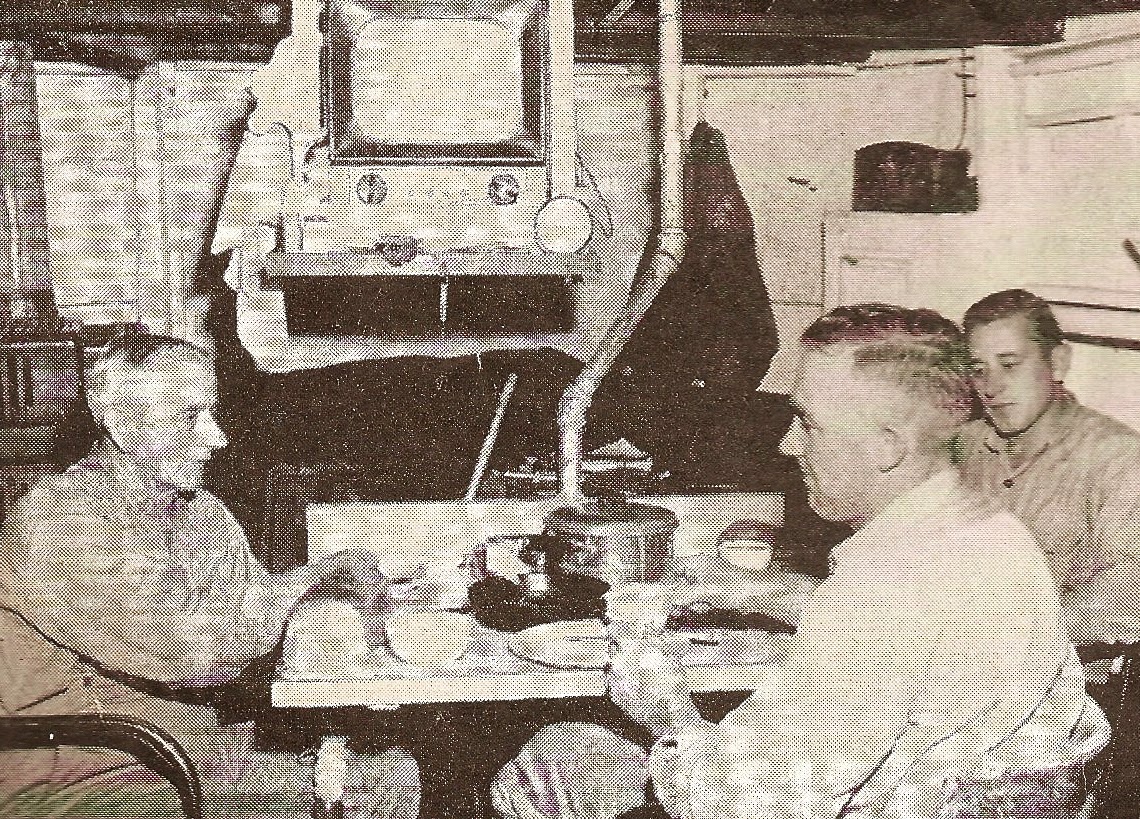

Capt. Jack, Cecil and Jackie in the galley, published
in a phone company brochure.     Jim remembered, "
It was in
those years, from 1955 to 1974, that I remember
as from the time I was small my dad always had me
“out to the Point,” and by the time I was 12,
I spent summers working on the boat for my dad and uncle.
My grandfather still came along and
was the cook, and he still took a turn at the wheel
and liked to give orders when he could!

Launch day for the Oil Queen in 1949 at the
Christy yard, Sturgeon Bay.  (Herb Reynolds
photos)


The Andersons' investment in a new oil barge was helped by the Standard Oil Company, which awarded them with a contract to fill tanks at a Sturgeon Bay waterfront location.  The loaded Oil Queen would sometimes moor in Sturgeon Bay, leaving Jackie on board, who then pumped off the product while the American Girl  headed north with freight - which often included perishables.   Jackie would then hitch a ride to Gills Rock or Northport and arrive at the Island in time to help unload.

Business was steady in the 50s and 60s, with a general progression in freighting.  There was the steady requirement to supply the diesel, gasoline and heating oil needs of the Island.   But, there was the extra work and concerns brought on with towing the oil barge.  

After the Washington Island Ferry Line brought on a new ferry in 1970, the Eyrarbakki, and converted the C. G. Richter to a single screw for winter ice work, the Andersons bought the Griffin in late 1971.  Then, they converted the Griffin from an auto / passenger ferry to a tanker at the Palmer Johnson Boatyard in Sturgeon Bay, and for the 1972 season the Griffin took over the freight runs carrying both deck freight and oil products in the tanks.  

Griffin as a tanker passing through Sturgeon Bay's  Michigan Street bridge in 1973.

With the Griffin then handling oil products, the American Girl and Oil Queen barge were sold to a Beaver Island man, Jewel Gillespie, who continued with the pair of vessels, supplying Beaver Island's needs.  Although the Oil Queen no longer is used today, the American Girl is still operating, refurbished and repowered, still under the same name.  It tows freight barges, and the owners take on other towing opportunities, but its run is mainly between Charlevoix and St. James Harbor, Beaver Island, Michigan.  

The Griffin then continued to serve Anderson Transit's freighting needs until 1974.   Jackie Anderson died of cancer that year.  Cecil had turned 62, and he considered selling.  Son, Jim, was back from serving in the U. S. Air Force, and in 1972 he had started a sporting goods retail store near the family pier, the Island Outpost.  

Cecil and Cynthia, Jackie's widow, sold the Griffin to Jon and Lois Gunnlaugson, who continued to operate it as a tanker / freighter for approximately ten more years.  During that time, the manner and timing of supplying oil products began to change, with greater emphasis on stocking up in the late fall, rather than gradually over summer and fall.  This brought added pressure on the operator requiring more trips in the worst season of the year.  

Griffin, around 1980, wintered at Standard Oil pier.
(Purinton photo)
Meanwhile, the Ferry Line's several open and flat-decked ferries were considered for hauling  Amoco gasoline and diesel products, and soon bulk tanker trucks were scheduled, hauling product direct from the terminal in Green Bay to the Island bulk plant via ferry. 

Groceries and other bulk items, too, such as lumber and cement, general merchandise that was a  part of the freighting income that supported the Griffin's operation, were likewise shifted to trucks that delivered directly to, and unloaded at, the premises of Island dealers.  

The Griffin was sold in 1985 to Chicagoan Glen Dawson, who converted it from a tanker back to a passenger vessel and used it for dinner cruises and sightseeing in the Chicago harbor area.

From 1984 onward, nearly all freight consigned to Washington Island arrived by ferry, either on deck, by trucks that were driven onboard the ferry, or carried in smaller volumes in the vehicles of Island residents and business owners.
-  Dick Purinton    (With thanks once again to Jim Anderson for the many photos and information.)

Jackie and Cecil with the Oil Queen.


American Girl and Oil Queen at Standard Oil dock - 1950s.


Recent photo of the American Girl.  More information can be
found on the website http://www.stjamesmarine.com/american-girl/

Wednesday, April 8, 2015

ISLAND WATERFRONT - Then and Now - Anderson Freighting - Part XIV


Ervin Anderson, shown aboard the
Lawrie Transportation Co. passenger / freight vessel
Lois Pearl, home ported in Milwaukee, Wisconsin
(possibly 1929)

Washington Island, Wisconsin -

Over the years, freighting supported a number of Island families.  This post is about Captain John Anderson (called Jack by his close friends), his sons and their vessels.

The Andersons were very much involved in freighting through several generations, starting in the early1920s, owning and operating a number of vessels:   Agnes H.;  Diana;  American Girl; and Griffin.  Each was used for hauling a variety of commodities.  Like many Island families who made a living working on the water, whether freighting or fishing, tragedy and near-tragedy visited the Andersons several times, in several different ways.

On Sep. 26, 1930, the 25-year old Ervin Anderson, son of Capt. John Anderson, Washington Island, operated the Lawrie Transit Company's new, welded, steel-hulled North Shore from St. Joseph, Michigan, heading for Milwaukee.  (The photo at top shows Ervin posing in the door of the wheel house of the Lois Pearl, another of the Lawrie Company's boats, in an earlier time.)  Joining Ervin on that trip across the lake was Harriet, his new bride of several weeks, engineer Joseph Tekus from Cudahy, deckhand Arthur Peters from Milwaukee, and two unidentified passengers.  Before leaving the Michigan harbor, they loaded of 3,000 baskets of grapes aboard the North Shore.

According to an account by Lois Lawrie Rehberg, a daughter of William Lawrie who owned and operated the Lawrie Transit Co. of Milwaukee, and who was a young girl at the time, "A sudden Lake Michigan gale struck when the boat was about thirty miles out of St. Joseph."  The North Shore and the six on board were lost in the storm.  Approximately two weeks later, the body of Arthur Peters was recovered, wearing a life jacket.  None of the others were found.

As we noted in the last blog post, within a year William Lawrie built a new, wooden-hulled North Shore as a replacement, and this North Shore would be the same vessel in five years that would find its way to the Island ownership of William Jepson, where it joined the Welcome for auto/passenger and freight service.  (In the way of making further connections, William Jepson's sister, Annie, was the wife of Capt. Jack Anderson.)

With permission from Jim Anderson, grandson of Jack Anderson, we publish a letter written July 8, 1929 on Lawrie Transit Company stationery by oldest Anderson boy, Ervin, in which he addresses his younger brother, Cecil (whom he fondly calls "Duke").   Ervin's letter reveals an eagerness to return home and work in the family's freight business after a year or two spent sailing in Milwaukee, if his services should be required on the Diana.   Beatrice is the cook, and she's a sister to Ervin and Cecil.

According to Advocate entries, Lawrie's South Shore put in at Washington Island fairly regularly for off-season freight, and she also was hauled for work one time at the Island's shipyard, connections through which Ervin quite possibly came to his employment at the Milwaukee boat company.

Dear Brother,

Just a few lines to find out how things are going on "The Diana."  How did she pass Inspection?  And is Freighting any good?  Do you think it would be better if I came home?  I'm sending you a bill I want you to mail to Dormer Fish. Co.  That is if they haven't already mailed the check.  If they sent it, mail it to me as I sure need it.  Write and let me know if you think I should come home so I can give Bill [Lawrie] a couple weeks' notice.

I seen Tom Williamson the other day and he said he seen you in Green Bay and he also said the Boat looked good but the cook looked better - be sure to tell Beatrice that.  

Well Duke Sir got to take her in to the dock now write we all need the News   tell Ma to write.  You may not be able to read this but the boat shakes so darn much I can't do better.  From Ervin
  (my regards to Alvin)

PS  Do we get half the oil or does Christ [Andersen] get most of it yet?  -  EA

Jack Anderson, as far as records show, began hauling freight with the hooker Agnes H. in the early 1920s.  Agnes H. (42 x 13.4 x 5.8, with a 40 h.p. gas engine) was built in 1914 by Rasmus Hanson in Jackson Harbor and was named for his daughter, Agnes.  The 1920s were an active period for freighting, with frequent news reports of loads taken by various vessels and their owners, both to and from Washington Island, with an occasional load for a non-island destination.

A sample report:  the Oct. 2, 1925 Door County Advocate reported that,  "Capt. Al Shellswick, Diana, has gone south in quest of freight.   Capt. Wm Jepson, Wisconsin, has gone in to the fruit trade.  Capt. John Anderson, Agnes H., is making irregular trips."

In the fall of 1926, Agnes H. lost power and went ashore on the rocky beach near Bowyer Bluff.   The Advocate reported, "The Agnes H. went on the beach Oct. 30 and is laid up for repairs. It's difficult for "hookers" to handle freight."  

[The term "hooker" was described by Jim Anderson in the following way:   "…the type of freighter which mainly carried their cargo in "the hold" of the boat and was lifted out by means of a boom, winch and hooks - so came the name hooker."]

Jack and his son, Ervin, were aboard the Agnes H.,  but no one was harmed and the vessel slid from the rocks with the aid of timbers placed under the keel and two vessels straining on tow lines.  It's rudder in one of the photos appears bent at an angle.  But the hull, all things considered, was only slightly worse for the experience.  The following series of photos of the incident shows the efforts made to remove the Agnes H. from shore, observed by many bystanders.

Agnes H. on the beach with salvage efforts, observed
by a crowd on shore, 1926.  John and oldest son Ervin
Anderson were on board at the time.
(all of the above photos including Ervin Anderson on
the Lois Pearl are courtesy of Jim Anderson)


A few years later, March 30, 1928, the DCA reported:

 Capt. Chris Andersen made the first spring trip to Sturgeon Bay on the hooker Diana, leaving Friday A.M. and returning Sunday A. M.  He carried about 4 tons of fish.  John Anderson arrived with another boat Saturday. The new boat will replace the Agnes H., which was wrecked at Whitefish Bay late last fall.  The new boat, South Shore, of Milwaukee will tow a new fish boat from Sturgeon Bay Boat Works to Two Rivers where a crude oil Kahlenberg diesel will be installed.

Cecil Anderson was about ten years of age when the
Agnes H. foundered near Sturgeon Bay.  He and his father were rescued by members of the U. S. Coast Guard from the Sturgeon Bay Canal Station.  The vessel broke up in the following days.  Cecil, now seasoned with experience, continued in what would become a long and successful career in freighting.

Two vessels in an early photo (year unknown).  The Arrow, Abe Jessen's boat, is moored at left,
and the Andersons'  
Diana is at the Cornell dock, with the tip of Detroit Island in background.  (Jim Anderson photo)


The Anderson's operation of the Lawrie Company boat South Shore was temporary.   The loss of the Agnes H. soon led to purchase of the Diana from Alfred Shellswick, who had used it for freighting since approximately 1919.  It was launched at Burger Boat in Manitowoc in 1906, and originally it was a yacht, measuring 60.5 x 12.4 x 6 ft.   Diana's name frequently appeared among the small freighters listed in the shipping news published by the Advocate, hauling fish and assorted freight from the Island.  For a time, Shellswick leased Diana to Chris Andersen, but with it's somewhat limited carrying capacity, Chris Andersen was in the market for a larger vessel, and he found it in the Wisconsin when Bill Jepson (who had operated the Wisconsin in freighting and ferrying for years, ever since he built it at the Sturgeon Bay Shipbuilding and Dry Dock) brought out the brand-new Welcome in 1929.

The following DCA news item recorded the changes in vessel ownership that year:

March 29, 1929 - Chris Andersen and two twin boys, Ray and Roy, bought the motorboat freighter Wisconsin from Wm. Jepson who had it built several years ago and used it as a freighter in several places, but ferried autos and passenger across the Door for the last three years.   Chris had been renting Alfred Shellswick's Diana, originally a twin screwed yacht which Al had converted to a single screwed "hooker".  Chris carried Island fish to Green Bay and returned with whatever back freight he could get.  Many times the Diana was too small for the freight volume.  Sometimes as high as 100 fifty-five gallon barrels of gas needed to be brought to the Island and this weighed over 50 tons, but the Diana's capacity was 40 tons so Chris could not handle all of it.

The Diana served the Andersons well from approximately 1929 until the spring of 1947.   Photos of the Diana show that it continued as a hard-working freighter, already into its third decade of service when Capt. Anderson bought her.  By the time WWII came to a close, with some 40 years under her bottom, this vessel's serviceable life was used up, and Jack and Cecil purchased the American Girl.

Scrap iron loaded on Diana's deck was a frequent commodity.  Here, in 1942, 
at least some of the bits and parts appear to be from old ships.  (Jim Anderson photo)


The Islander, Washington Island's newspaper of the day, the editor reported the new vessel in it's February 11, 1947 issue:

American Girl coming here - The American Girl is the name of the 65 foot steel freighter, recently purchased by Jack Anderson and Sons for the freight run between Washington Island and Green Bay.  The transaction will be completed in ten days, but the boat will not be brought here until weather permits.  
The American Girl come from Sheboygan(sic), Michigan, where it had been used for hauling fish from Canada before the war.  Mr. Anderson plans to make a tow-barge out of his present boat, the Diana.


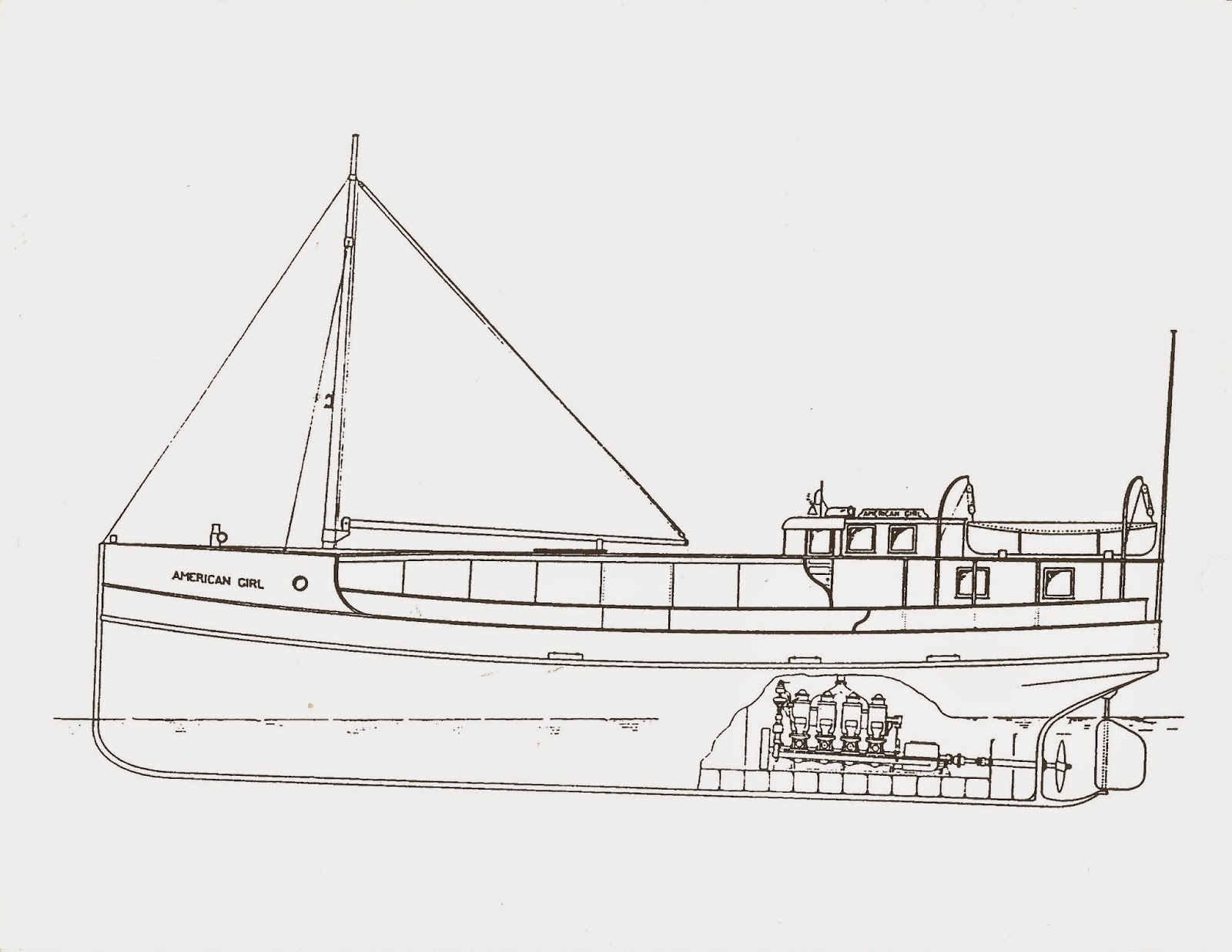
Side profile of American Girl as originally built.  Slight changes
were made over the years, but the vessel's name stayed the same.
The American Girl was a substantial addition to Island freighting, coming along at a time when nearly all of the older, wooden hulled vessels were nearing the end.

By 1949, Chris Andersen's Wisconsin would be finished.  None of the other familiar names from the past continued to sail - at least not locally.  Instead of serving out its final couple of years as a barge, as the news article indicated, Diana's usefulness may have been relegated to that of a "floating warehouse."

By the early 1950s, she, too, was no longer useful or fit for sailing.  Moored to the Chamber's dock and leaking, the Andersons pumped her out and towed the hull away. (With the assistance of crew members from the nearby Plum Island station, Jim Anderson noted)  Then, she was intentionally sunk off the south shore of Detroit Island.   A series of photos shows the Diana, with Coast Guard's pump on the pier, ready to depart alongside the American Girl.  A list to the hull is visible in the second photo as she is towed, and in the third photo she is adrift.  A series of several forceful bumps from the American Girl's bow finally caused her to sink, which brought tears to the eyes of its owner, Capt. Anderson.

Diana in preparation to be scuttled off Detroit Island's shore.  A young Walt Jorgenson
(wearing cap) can be seen in the bow.  The Coast Guard's gasoline pump used to float
the hull is on the pier, with the American Girl tied alongside.
(series of photos courtesy of Jim Anderson)
The story of the Anderson freighting business will continue in the next post.

Thanks to Jim Anderson for the many great photos and information.

-  Dick Purinton