Showing posts with label Griffin. Show all posts

Monday, April 20, 2015

ISLAND WATERFRONT - Then and Now - Arni and Carl Richter Years - Part XVII

Carl Richter, on board the ferry C. G. Richter
Washington Island, Wisconsin -

When Carl and Arni made their decision to purchase Jepson's ferries, after nearly nine years freighting and carrying mail, with the occasional passenger, aboard the little tug Welcome, Carl was 69 years of age.   Hardly a time to jump into a new venture with both feet.

But, his son Arni, who would have just turned 29 in 1940, was in the prime of his life, married to the former Mary Cornell, and he had experience gained in both the navigation and the administrative side of a freight transportation business. In addition to his duties with the Welcome he was a fish wholesaler, buying and then shipping Island fish to markets in Chicago and New York.  To Arni, an expanded ferry business made economic sense, although there were challenges with a war effort coming on, and two older, wooden ferries to maintain.

 He helped deliver ice with horse and buggy for the Gislason store, in Jensenville.  As a youngster he had always loved horses, and Arni's first desire was to become a farmer.
Arni Richter, as a toddler.

The opportunity to operate a ferry business meant the chance to live on the Island and to continue working with his father.  It could be said by those who came to know him that he seemed to have a head for business and the decision-making that went along with serving customers and keeping boats running.   One of their great challenges, and one that seemed out of reach for several years just as it had for William Jepson, was to solve the winter transportation issue.

Crossing on ice was a risky business, but often it was the only way to get the mail and goods back and forth.  The wooden ferries they inherited were getting softer around the shaft logs. (Arni had privately wondered if the Steamboat Inspector Erikson hadn't been considerate by overlooking some aspects of the ferries' ages, knowing that it would be a few years before a new ferry could be built?)

Due to the absolute necessity of Island ferry transportation, Arni did not join the military service when the war was on.  Those years were a struggle for the business, however.

When the war ended, he redoubled efforts to design and build a new ferry with a steel hull and sufficient power for ice work.   He enlisted the services of Naval Architect Walter Haertel, Sturgeon Bay, with rough proposals from several builders.  Obtaining financing proved most difficult, without a local bank, or any bank along the Lake Michigan shoreline for that matter, willing to take on the risk of financing a new ferry.   Arni believed that their small revenue stream and the fact they hadn't been in business for long made the venture seem risky.  Only as a last-ditch idea, on his return from points as far south as Kenosha and Waukegan (where he had worked in his twenties in fish stores) did he try Henry Schuette of the Manitowoc Bank.

A long-ago connection the Manitowoc Bank had with a schooner named White Swan was a long shot, but in this case, it worked.  Mr. Schuette's father had been with the bank years before, and the bank had part ownership in the vessel that called at Jackson Harbor occasionally for a load of grain.   Arni, as a youngster in his early teens, once had the opportunity to sail on the White Swan for a trip down the lake, from the Island to Manitowoc, where its load would be deposited at the mill that produced flour of the same name as the ship.

Later, Mr. Schuette's pleasure in seeing the difference his loan made in Island ferry transportation was repeated on many Sunday afternoons, when he and a granddaughter would drive to Gills Rock and ride round-trip on the Griffin.

The only Richter ferry not built by a Sturgeon Bay shipyard, as it turned out, was the Griffin, which was constructed by Krause Kraft of Kewaunee, Wisconsin.  It was 65-ft. x 20-ft. beam, 7-ft. draft, with capacity for approximately 9 autos and 100 passengers.  She was powered by a 180 HP Kahlenberg engine.  The access to the passenger deck above the vehicles was located at centerline, a trunk that made loading somewhat awkward (as compared with the C. G. Richter of 1950 that had its engine room access and cabin stairway access along the port rail.)  Nevertheless, the improvements in operations with this new ferry in the 1946 season were immediate.  It's steel hull brought even greater benefit for the winter ferry service, when one trip each winter day was scheduled (but none on Sunday).  The Griffin became a most useful and relied upon Island ferry.

The wooden ferry Welcome was the first of the old ferries to be traded, and then in 1950 the North Shore was sold to make room for the twin-engine C. G. Richter was constructed at Sturgeon Bay's Shipbuilding and Dry Dock Company, and it was also a Haertel design.  There was a section on the car deck, all the way aft, where the tail-ends of vehicles overhung a steel beam.  This, in theory, shortened the useful overall vessel length, which kept her in the classification known as "Small Passenger Vessel," according to the federal Subchapter T Regulations, an advantage in both outfitting and manning.

From a 1990 interview with Arni Richter, from Over and Back (WIFL - 1990):

It was evident from the last dry-docking of the Welcome in the late forties that she was getting old and was going to need a major overhaul soon.

We found a buyer for her down in the Lake Erie islands.  Having a buyer was a deciding factor in going ahead with a new ferry for the 1950 season.  Walter Haertel designed the C. G. also.  She was twin screw and built for winter service.  Twin screws did not prove to be a good arrangement for ice work. We bent both stats the first winter we tried using her in ice and went back to using the Griffin for winter crossings.

After the Eyrarbakki was added to the fleet in 1970, we sold the Griffin to the Anderson brothers [Cecil and Jackie] soon afterward.  Then we converted the Richter to a single screw, single engine boat, and it has been the winter ferry ever since.

Preparing for launch, Griffin in 1946 in Kewaunee.  A stoutly-built ferry,
Arni noted she had very little dishing to show for over 20 years of ice work.


The C. G. Richter had softer chines and easier lines all around than did the Griffin, and she carried nine autos and 100 passengers quite easily.  Power was furnished, not by Kahlenbergs this time, but by twin Murphy 150-HP diesels, for good speed and for maneuverability at the pier.  But, as noted by Arni, it wasn't good for ice work in winter.  Carl's name went on this ferry, and family members were present to see it launched in Sturgeon Bay in the early summer of 1950.   Those two ferries, Griffin and C. G. Richter, kept people, vehicles and freight moving back and forth to the Island throughout the next several decades, to be joined in 1960 by the first open-deck ferry, Voyageur.

Launch day at the Shipbuilding and Dry Dock yard.  Maggie and Carl Richter stand with
granddaughters Carol (Richter) and Jeannie (Leasum).  Arni and Mary Richter,
Margaret Leasum, Emma and Paul Richter stand at bottom of steps.


When the Voyageur was designed (again, by Walter Haertel) it's purpose was to move more and larger vehicles.   Almost immediately it's attributes were put to work in Sturgeon Bay, following her first season of Door crossings, when the highway bridge was struck by the Swedish freighter Carlsholm, Oct. 21, 1960.  The northern portion of the county's peninsula was instantly separated by water, and it would be weeks before the single Michigan Street Highway Bridge would be repaired.  For the first several weeks, until a barge-bridge was put in place across the narrows of the ship canal within a mile or so of Lake Michigan, ferries from Washington Island provided 'round the clock service for people and vehicles.   This was at a time when the apple harvest was still in full swing, with the Fruit Growers Co-operative located on the north side of the bay, adjacent to what is now the Great Lakes Marina. (Then the Palmer Johnson Boatyard.)  Arni sent the C. G. Richter almost immediately to Sturgeon Bay, and by 7 p.m. that same day, the Voyageur had joined her, with their crews shuttling equipment, freight and people across the bay, leaving the Griffin to handle the off-season Island traffic.  Tourism, not yet what it would become a decade or so later, slowed greatly after Labor Day weekend, and with the bridge out, traffic headed into northern Door County slowed to a trickle.  If anything, the novelty of having a damaged bridge and two of the Island ferries in town increased the traffic of bystanders and vehicles locally, at least for the first several days.

Jerry Potter enjoyed this photo of his Cadillac coming
off the C. G. Richter so much he asked for a special print.
Side loading became a slow-down factor as newer ferries
loaded more quickly, easily and safely.

Griffin, loaded with sacks of potatoes from
the Anderson farm for Sturgeon Bay. (1950s)
Arni Richter, when asked in 1990 about the impact new ferries had on the ferry business and the Island as a whole, said:

Of all the ferries, I think the Griffin and the Voyageur made the greatest economic impact on the Island.

Fish and freight were a big part of the operation in the 50s.  one year, we hauled over 1 1/2 million pounds of fish!  In the In the fall, after labor Day, one boat hauled just herring to Menominee.   Later in the fall, we hauled potatoes for Ed Anderson to Sturgeon bay.  Tourism was picking up then, too.  

In Florida I saw an open deck ferry which ran to Sanibel Island, and it gave me the idea of building a boat to handle large trucks.  Walter Haertel and I worked out a design which became the Voyageur, built by Bay Shipbuilding & Dry Dock for the 1960 season.  That was a real change after the Voyageur came out.  We hauled lots of heavy loads in the 60s with her…semis, log trucks, highway equipment, road oil in semis for Island blacktopping…I think it encouraged Island development.

Island traffic, thanks to increased tourism in the late years of the 1960s, seemed to have outgrown ferry capacities in the peak days of summer.   More motorists towed trailers and boats and hauled goods for their cabins.   More freight arrived in bulk, delivered by truck.  Island roads were slowly becoming paved, and in order to mix asphalt, tankers of heavy road oil and specialized equipment like stone crushers came back and forth.  At 65-feet in length, the Voyageur had become a workhorse, but her deck barely held the ever-longer semi-trucks.  The Voyageur investment showed that an open-deck ferry with unlimited overhead dimensions was the wave of the future.   The Eyrarbakki was built in 1970, and the C. G. Richter would then undergo a conversion to single-screw, replacing the Griffin in 1971 as the Island winter ferry.

Arni often enjoyed a cigar, as did his
father, Carl.  Shown here in his 60s, he
also enjoyed taking the helm of one of his
ferries - in this case the Voyageur. 

By 1969, Arni had begun to consider another, longer ferry, one with greater capacity for autos and large trucks, and for passengers.  The year 1970 would be a special year, and as one who served as a director, and then president, on the Door County Chamber Board, and who was in tune with Door County's emerging tourism economy, it seemed natural to Arni (and to Mary Richter) that a celebration of Icelandic immigration be combined with a christening ceremony.

In 1970, the Eyrarbakki would become the newest ferry, one of the earliest of hulls constructed by Bay Shipbuilding, the Manitowoc shipbuilder that had recently moved its operation to Sturgeon Bay, taking over the Christy and Shipbuilding and Dry Dock and Roen Salvage yard properties.

Nathan Gunnlaugsson, long-time ferry captain, on one of the early trips
aboard the Eyrarbakki in 1970.
 -  Dick Purinton

Thursday, April 9, 2015

ISLAND WATERFRONT - Then and Now - Anderson Transit Co. - Part XV

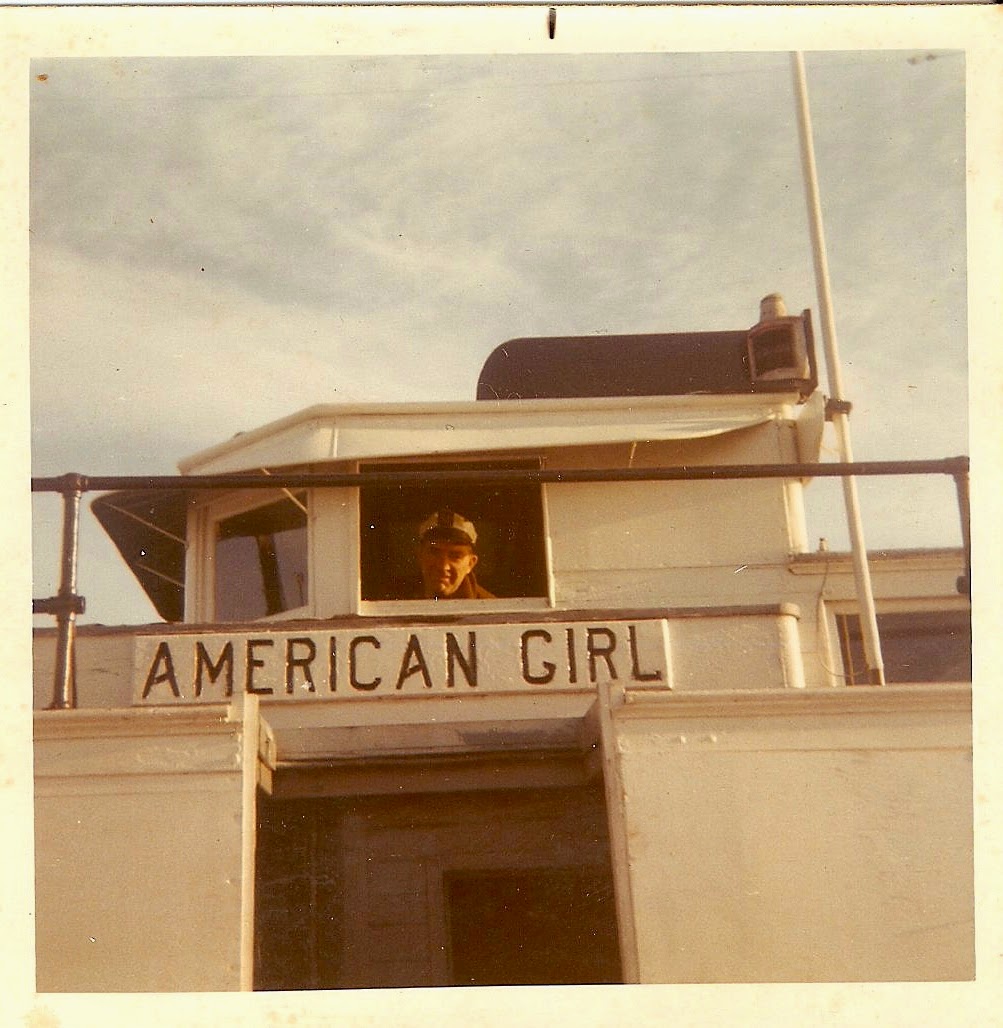
Cecil Anderson in wheelhouse of American Girl.
Loading freight in Green Bay.  Shown are Jack Anderson's sons,
Jackie (L), Cecil (in gangway), and grandson Jim.  (Unknown visitor
appears in the opening beneath the name board.) "We were always
having visitors come aboard," Jim said.


Washington Island, Wisconsin -

We mentioned the unfortunate loss of the Lawrie boat North Shore when it sank in 1930, taking the life of Ervin Anderson, his wife, Harriet, and four others.   The Anderson family experienced another tragic loss a few years later when the youngest son, Elliot, drowned.   The July 22, 1932 Door County Advocate (DCA) carried the story:

Struck by lightening and tossed into Lake Michigan from the rowboat in which he was riding in tow of his father's small freighter, Diana, midway between Plum Island and Detroit Harbor, Elliot Anderson, 14, son of Capt. and Mrs. John Anderson of their place, was instantly killed or drowned after being knocked unconscious Wednesday afternoon about 3 o'clock.

About ten motor boats and rowboats, including three from the Plum Island Coast Guard station in charge of Capt. Mattie Jacobson, went to the scene to aid Capt. Anderson in the search for the body which was brought up by the father by means of a couple of trout hooks on a long line just before dark.  The water in the passage at the point of the drowning was about 60 feet deep.

The Diana with Capt. Anderson, his sons, Cecil and Elliot, and Haldor Gudmundsen, Standard Oil Company representative here, went to the Plum Island Coast Guard station early in the afternoon Wednesday with a load of oil.  They were on the return trip, half way across the two-mile wide passage, when the thunderstorm struck, accompanied by a slight squall.  The bolt that hit Elliot first struck the stern light post.  Part of the charge glanced into the row boat and the balance went up an aerial, snapping off the wire which fell to the deck and hit one of the men but without serious consequence.

Coroner Elmer Christenson of Sturgeon Bay was notified of the death by William Jess, chairman of the township, and authorized the latter to act as his deputy in the case.  No inquest will be held.

Elliot was born here and was a graduate from the eighth grade of the Detroit Harbor School. He is survived by his parents, two brothers, Cecil and John Jr., and seven sisters, Myrtle, Florence, Beatrice, Genevieve, Effie Belle, Edith Jane and Mary Anne.  The funeral will be held Saturday from the home and the Lutheran Church her with the Rev. John Christianson officiating.

Despite these setbacks, events that surely changed their lives, the Andersons' freighting continued - the process of loading, unloading, tracking orders and billing, not to mention departing in a wooden vessel at a time when weather forecasting was based mostly on a barometer.  By the time World War II ended,  Washington Island's freight volume had increased - or at the very least, it was being carried by a couple of remaining wooden freighters.   Business demands, and the age and capacity of the Diana, led to the purchase of the American Girl in 1947.

It was far from being a new vessel, having been built by DeVoe in Bay City, Michigan in 1922, but it had been well cared for.  Compared with the older, wooden boats, the steel-hulled American Girl was spacious, with good load capacity,  good power, and it was fully enclosed for operating in much harsher conditions, including colder seasons of the year.

When the Washington Island Electric Co-operative started up its diesels in 1946 in order to energize Island homes and businesses, fuel was consumed by either one or two diesel generators that ran 24 hours a day.   With competition from other freighting outfits gradually lessening, by the early 1950s the Andersons and the Ferry Line remained as the only carriers of freight.  Bulk orders for the Island's groceries still came direct from Green Bay aboard the American Girl, as did lumber and building materials, kegs of beer, cases of soda pop, tires and automotive parts, and for Island homes still dependent on coal as heating fuel, loads of coal.

The labor expended to load and unload seems staggering when compared with today's mechanization.  For instance,  transporting coal began when a C. Reiss Coal Company truck would back up to the American Girl at the Green Bay landing and dump its load down a chute into the boat.  The Andersons then unloaded at the Island using a large bucket, winch and hooks.  Later on, Cecil asked Clyde Koyen to fabricate a mechanized conveyor system that brought in freight through a side door, a labor and time saving device that made the crew work more rapidly to keep up with the conveyor's pace.        

Trips leaving the Island often consisted of empties:  beer kegs, pop and beer bottle cases, and empty petroleum barrels.  This was a time when lube oil and gasoline was still transported by individual barrels.  This latter operation brought special concerns, that bung plugs on the barrels might be loose and leak product into the bilge, with the potential for an explosion.

Once the Ed Anderson potato farm operation was in full swing, in the closing 1940s,  potatoes became a seasonal product shipped in the fall to Sturgeon Bay and also Escanaba.  The American Girl as well as other Island vessels unloaded potatoes from vessel to box car at those ports.  Herring, caught by the ton in the early 50s, also required special runs, usually to Menominee, Michigan.  These special, seasonal runs were quick, turn-around trips, sandwiched into the schedule so that the regular Island run to Green Bay for fuel and freight could be maintained.  In a typical week, the Andersons might enjoy one day at home, a Sunday, with the rest of the week consisting of long days spent either loading or unloading, or in transit between ports.

Following are descriptions of the American Girl freighting operations in Jim Anderson's words:

Hauling coal:

At that time, we also hauled a lot of coal, as many homes had coal furnaces then, so we would usually haul most of that in late summer and early fall, in preparation for the winter months.  This was delivered to us bulk by a truck in Green Bay from the C. Reiss Coal Co.  They would bring a dump truck load of whatever coal was ordered, such as briquettes or lump coal, and then they dumped it down a coal chute, in to the hold of the American Girl.  We, in turn, would unload at the Island with a big, hinged bucket which would be lowered down into the hold of the boat via the boom and winch.  The bucket would be filled by two of us shoveling the coal into the bucket and, in the case of large, lump coal, simply picking up pieces and placing them in the bucket. 


When the bucket was filled, the winch operator on deck would get the signal to lift it up, and when it cleared the hatches and gangway it was pulled to a waiting truck by a rope attached to the boom.  Then, the trucker would position the bucket where he wanted it dumped on the truck, grasp it by the bottom, turn it on its hinge and dump it.  Then he would right the bucket and push it backwards toward the opening of the hold, stopping it with the rope on the boom.  The winch man would drop it down to the deck of the hold, and the process would start over again.  In this way, we also roughly figured the weight of the coal, so much per type of coal per bucket.  So if the Reiss Co. brought us 20 tons of coal, it might be going from two to four different customers on the Island, so if, say, Nelson Bros. had five tons ordered, they would get the right amount of buckets to approximate that weight.  The trucker would then deliver that load to the customer and then return for another load.

Hauling fish:

In the 50s, there was also a lot of commercial fishing here and the American Girl was used to haul herring to Menominee, Michigan, when the herring run was on.  We also used to haul wood fish boxes which were made at M & M Box Co. in Menominee.  There were brought back to the fishermen on the Island to be used by them.  I remember going on the American Girl when I was pretty young, after a load of fish boxes.  My dad always would take me to the box factory there by the river, and I can still remember the wonderful wood smell of that box factory.   It was there that I saw my first pop machine, one of those that had the ice water in it and the bottles of pop hung suspended on a rack in the very cold ice water.  I can still remember my dad taking me there and putting a nickel in the slot and fishing out an ice cold bottle of orange soda for me.  It was wonderful.

Transporting potatoes in the fall:

Another major cargo at that time was potatoes.  In the 50s, Ed Anderson’s potato farm was in full swing, and it produced approximately 250,000 bushels a year.  All those potatoes had to get to market by boat, and the American Girl hauled a lot of those potatoes.  Also, the Washington Island Ferry Line used the ferry Griffin, and Chris Andersen hauled some on his 65-foot hooker, Wisconsin.

In the early days of the potato harvest, the method was hand-picking into baskets which were dumped into a bulk wagon, and then bagged back at the farm.  The weight of the bags was approximately 100 lbs.  The bags were transported by truck and wagons to the American Girl, where 1100 of those bags were loaded on to the conveyor system into the hold of the boat.  The hold was filled from bottom to top, utilizing every inch of space, and when the hold was filled the hatches went on and the deck and gangways were then piled full.  When she was all loaded, the only way into the boat was through the top of the pilot house connecting hatch.  Then the gangways were put in and doors pulled shut and she was pretty well closed up.  They were then hauled to Sturgeon Bay and loaded  by conveyor into the railroad cars.  During the peak of the season, the American Girl would make a trip a day with a load of potatoes to Sturgeon Bay.  They would to this for a week or so with a break in between to make a run to Green Bay for a load of gas and oil and groceries and other cargo needed on the Island – then back to the potato run again.

On hauling fuel and lube oil, before the Oil Queen:

When she first got here, the American Girl hauled whatever my grandfather and father could find to transport.   At that time, they hauled all the oil and gasoline to the Island in 55 gal. barrels.  They were loaded into the hold of the boat with the winch and boom and barrel hooks, and they were unloaded the same way on the Island.  They were then pumped out into storage tanks which Standard Oil Company had here on the island.  Then, all the empty barrels were transported back to Green Bay.

This was a lot of work and danger, especially with gasoline and the greatest fear was that of a barrel with a loose bung might create a gas leak and an explosion in the hold of the boat.  At that time, they also hauled coal, groceries, fish or anything that had to be moved.

In 1949, the Standard Oil Co. and my father and grandfather could see a need for a better way to transport oil and gas to a growing Island community, and so they had a 65-ft. steel tow barge built in Sturgeon Bay, Wisconsin, by Christy Corporation.

She was named the Oil Queen and held 28,000 gallons of product.  Then the need for barrels was eliminated and fuel was bought bulk except for lubrication oil.  The American Girl was repowered by a Caterpillar diesel engine and fitted with a winch in the aft cabin to tow the barge. The winch held 600 feet of 1” cable, and usually the barge was towed approximately 550 feet behind the American Girl.

For many years, two phones for two different
phone systems were used, one
for the Island (above) and one for Green Bay (below).

 
Jack Anderson, on the phone about a freight order.  
Island and business growth:


So as the Island's economy started to grow in the early 50s, so did the amount of freight coming to the island.  My grandfather by now was a bit older and his youngest son, Jack,  took over his ½ of the business, and he and my father became partners in 1955, and from then on it was called Anderson Transit Co.

On navigation before electronic devices came along:  

Navigation equipment in those days on the American Girl consisted of a compass and an alarm clock.  You ran your courses on times and factored in other circumstances.  They didn’t have such things as radar, loran or GPS.  In fact, I can remember how excited dad was when they got a fathometer, and then later, a ship to shore radio.   My father then was the pilot and navigator, and my uncle Jack oversaw the engine room.  My dad had started sailing with his dad full time when he was 12 years old, and of course he became quite experienced after all those years.  After they got the fathometer, my father kept track of all the depths wherever they went and kept all info in a logbook along with his courses and times, to run from one checkpoint to the next checkpoint.   All weather condtions were kept track of and noted down as they all could have effect on the course your were sailing.      


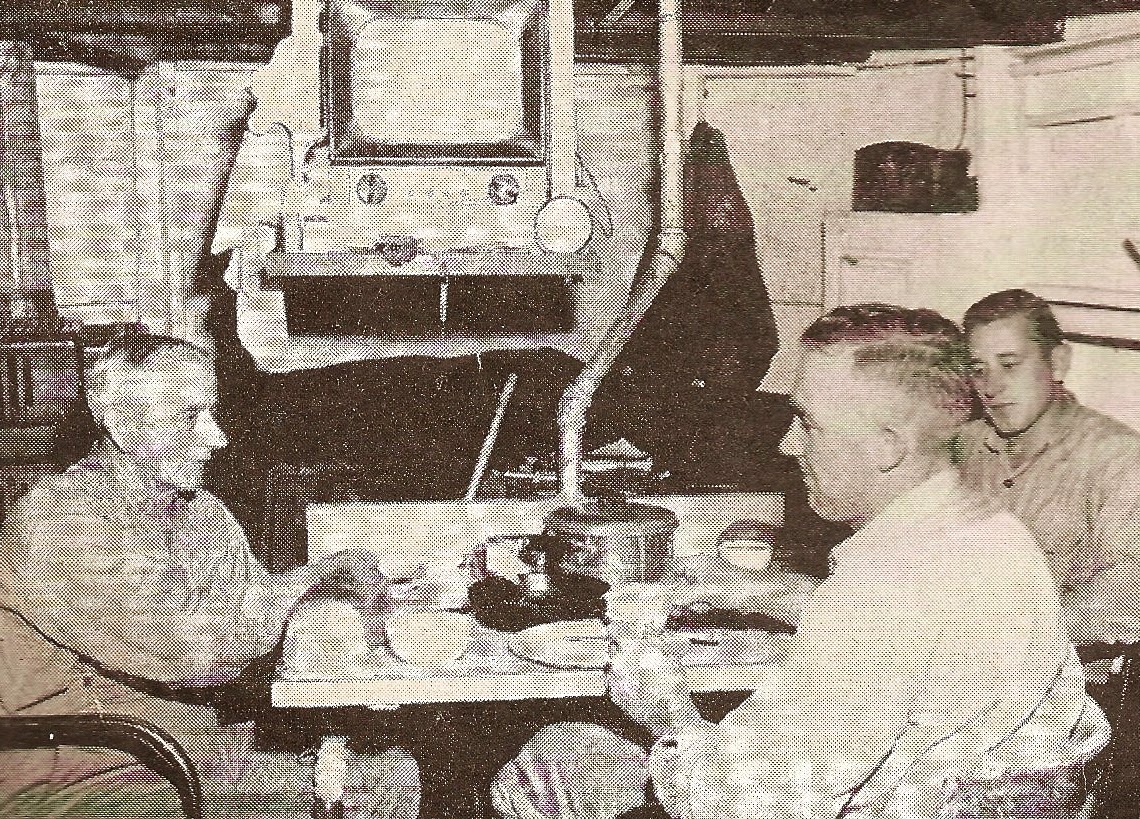
Capt. Jack, Cecil and Jackie in the galley, published
in a phone company brochure.     Jim remembered, "
It was in
those years, from 1955 to 1974, that I remember
as from the time I was small my dad always had me
“out to the Point,” and by the time I was 12,
I spent summers working on the boat for my dad and uncle.
My grandfather still came along and
was the cook, and he still took a turn at the wheel
and liked to give orders when he could!

Launch day for the Oil Queen in 1949 at the
Christy yard, Sturgeon Bay.  (Herb Reynolds
photos)


The Andersons' investment in a new oil barge was helped by the Standard Oil Company, which awarded them with a contract to fill tanks at a Sturgeon Bay waterfront location.  The loaded Oil Queen would sometimes moor in Sturgeon Bay, leaving Jackie on board, who then pumped off the product while the American Girl  headed north with freight - which often included perishables.   Jackie would then hitch a ride to Gills Rock or Northport and arrive at the Island in time to help unload.

Business was steady in the 50s and 60s, with a general progression in freighting.  There was the steady requirement to supply the diesel, gasoline and heating oil needs of the Island.   But, there was the extra work and concerns brought on with towing the oil barge.  

After the Washington Island Ferry Line brought on a new ferry in 1970, the Eyrarbakki, and converted the C. G. Richter to a single screw for winter ice work, the Andersons bought the Griffin in late 1971.  Then, they converted the Griffin from an auto / passenger ferry to a tanker at the Palmer Johnson Boatyard in Sturgeon Bay, and for the 1972 season the Griffin took over the freight runs carrying both deck freight and oil products in the tanks.  

Griffin as a tanker passing through Sturgeon Bay's  Michigan Street bridge in 1973.

With the Griffin then handling oil products, the American Girl and Oil Queen barge were sold to a Beaver Island man, Jewel Gillespie, who continued with the pair of vessels, supplying Beaver Island's needs.  Although the Oil Queen no longer is used today, the American Girl is still operating, refurbished and repowered, still under the same name.  It tows freight barges, and the owners take on other towing opportunities, but its run is mainly between Charlevoix and St. James Harbor, Beaver Island, Michigan.  

The Griffin then continued to serve Anderson Transit's freighting needs until 1974.   Jackie Anderson died of cancer that year.  Cecil had turned 62, and he considered selling.  Son, Jim, was back from serving in the U. S. Air Force, and in 1972 he had started a sporting goods retail store near the family pier, the Island Outpost.  

Cecil and Cynthia, Jackie's widow, sold the Griffin to Jon and Lois Gunnlaugson, who continued to operate it as a tanker / freighter for approximately ten more years.  During that time, the manner and timing of supplying oil products began to change, with greater emphasis on stocking up in the late fall, rather than gradually over summer and fall.  This brought added pressure on the operator requiring more trips in the worst season of the year.  

Griffin, around 1980, wintered at Standard Oil pier.
(Purinton photo)
Meanwhile, the Ferry Line's several open and flat-decked ferries were considered for hauling  Amoco gasoline and diesel products, and soon bulk tanker trucks were scheduled, hauling product direct from the terminal in Green Bay to the Island bulk plant via ferry. 

Groceries and other bulk items, too, such as lumber and cement, general merchandise that was a  part of the freighting income that supported the Griffin's operation, were likewise shifted to trucks that delivered directly to, and unloaded at, the premises of Island dealers.  

The Griffin was sold in 1985 to Chicagoan Glen Dawson, who converted it from a tanker back to a passenger vessel and used it for dinner cruises and sightseeing in the Chicago harbor area.

From 1984 onward, nearly all freight consigned to Washington Island arrived by ferry, either on deck, by trucks that were driven onboard the ferry, or carried in smaller volumes in the vehicles of Island residents and business owners.
-  Dick Purinton    (With thanks once again to Jim Anderson for the many photos and information.)

Jackie and Cecil with the Oil Queen.


American Girl and Oil Queen at Standard Oil dock - 1950s.


Recent photo of the American Girl.  More information can be
found on the website http://www.stjamesmarine.com/american-girl/

Monday, March 9, 2015

TRAGEDY of MARCH 1935 - Island Waterfront - Part XI


Island Archives photo showing the car emerging from the Death's door waters.
 A grapple caught the right front wheel, and men on the right - with yet 

more men off-camera - strain on the line. 
 Men in center stand on a boat's cabin top.  
The photographer is unknown, but Mrs. Jacob Johnson of Gills Rock,

who believed she saw the car pass her home early Sunday morning,
and whose husband was later credited with being among the first to locate 
the site of the disaster after following wheel tracks out onto the ice,
was credited for another photo published by the newspaper.  It's 

possible Mrs. Johnson was the photographer here, too.


Washington Island, Wisconsin -

March 10 of this year marks the 80th anniversary of a tragedy in which six young Island men lost their lives when their car plunged through thin ice in Death's Door.

Despite the passing of years, this incident still taps into veins of emotion, because of the details that surround the incident, and because of the number of lives in this community that were changed by the event.   In researching this blog, I've used various newspaper reports, some published only a few days after the event itself, and others that were written years later in retrospective.  These
reports reside in the Washington Island Archives in a file named, appropriately, "Island Tragedies."

The six young men left the Island to play in a basketball game on the peninsula, in Ellison Bay, on Saturday, March 9, 1935.  There were also fans who attended the game.    Collectively, fans and players traveled on to Sturgeon Bay and a hotel Saturday evening.  The general plan was that all parties in their several autos would meet up again in Ellison Bay at a set time on Sunday, and then return across the ice together.  For unknown reasons - impatience to get home, perhaps - and at an exact time still not known for certain, the single car carrying the six basketball players departed Gills Rock for the island and in their route across the Door veered from the prescribed, safe track by heading too far east, only to find ice too thin to support their car.

Others, when they returned later that Sunday, had no idea the players were missing until it was discovered that none of the group had yet reported home.  That was in the early afternoon of Sunday, the 10th.   Searching was initiated.   Car tracks in the snow leading from the Gills Rock shore were followed over the ice, eventually leading searchers to an open hole.  An airplane plane from Escanaba was also alerted, but by the time it arrived over the area, the scene of the car's disappearance with the six players was already known.

What remained was the unpleasant task of retrieving the car and bringing the six bodies to the surface.   For more complete details, the reporting in the Door County News (Thursday, March 14, 1935) serves best.

               *     *     *                                             *     *     *

                                      SIX YOUNG MEN DROWN IN DEATH'S DOOR

Caption reads, in part:  "This photo was taken
as the body of Ralph Wade was found -
photo by Mr. Jacob Johnson, Ellison Bay"
ALL WASHINGTON ISLAND RESIDENTS
                                  -
Accident Occurred Before Noon on Sunday
                                  -
CAR PLUNGES THROUGH ICE
                                  -
All Bodies Recovered; Funerals Held This Week
                                  -
Bulletin:  Calmer Nelson, Door county coroner, made the statement that an investigation into the accident would be conducted next week.  The date for holding the investigation was not announced.
              -           -           -
The worst tragedy in the history of Washington Island occurred some time Sunday forenoon, when an automobile bearing six young men, all prominent in the life of the community, dropped through the ice of Death's Door as they were enroute to their homes from a short trip to Sturgeon Bay, and they lost their lives by drowning in the icy waters.

Those in the group were John (better known as "Bub") Cornell and Ralph Wade, the former 22 and the latter 28, both married; Leroy Einarson, 21; Norman Nelson, 19; Raymond Richter, 21; and Roy Stover, 19.

Wade was the owner of a tavern and dance hall.  Cornell, married last September, was a fisherman, the son of Mr. and Mrs. J. W. Cornell.  Einarson was a son of Mr. and Mrs. Henry Einarson, proprietors of the IdaBo Inn;  Norman Nelson, son of Mr. and Mrs. Nels C. Nelson, assisted his parents on their farm.  Richter, a member of the coast guard at Jackson Park, Chicago, was a son of Mr. and Mrs. Earl Richter.  He was home on a 25-day leave of absence.  Stover was the son of Mrs. James Johnson.

It appears that the young men formed part of a group to come from the island to witness and participate in a basketball game played at Ellison Bay Saturday evening.  Following the game they decided not to risk the trip across the ice of Death's Door after dark and came to Sturgeon Bay to spend the night.  They left Sturgeon Bay about 9 a.m. Sunday and it is reported that the car, driven by Cornell, was seen going onto the ice at Gills Rock about 11 o'clock.  When they did not reach home by noon, searching parties of island people were formed, and late in the afternoon an airplane from Escanaba, Mich., was chartered in an effort to determine whether they had become lost in the fog or had met with misfortune.  It was too late that evening for the plane to do anything, but early Monday morning searching parties located the spot where the car disappeared through the ice, only a mile and a half or two miles from Gills Rock.

The spot where the car plunged to its watery grave was located by Wally Arneson, Escanaba, in an airplane and Jake Johnson, of Gills Rock, and the bodies of Cornell and Wade were recovered.  The car had gone down in 120 feet of water and it is thought the two men, who were in the front seat, were able to get out and attempt to reach safety by crawling on the ice.  However, the water was so cold that they were unable to stand it, and apparently sank after putting up a stubborn fight.  Their bodies were removed Monday forenoon by coast guardsmen.


(The search was then called off until the next day due to weather, and it resumed on Tuesday, March 12.)

The intensity of the search effort can be seen in the face
of the man at left above the taut grapple line.
The Coast Guard's boat "Bull" appears to be
the vessel shown in the background.
(Island Archives photo)


At about noon Tuesday the body of Norman Nelson was removed from the water by coast guardsmen and volunteer workers, who remained constantly at the spot endeavoring to get a grappling hook on the car.  

The stubborn fight which John Cornell put up to escape death was shown when searchers came to the hole in the ice Monday.  Thrown up on the slush ice were his cap and mittens and a package of cigarets which he apparently had in his hand when the car plunged to the bottom. Mute testimony of his desperate struggle was also shown by the way the thin ice had been broken away as he attempted to get to solid ice and crawl out.  his chest was also severely bruised as he apparently tried to cling to the ice until help might arrive.  Just how long he struggled in the icy water will never be known.

The bodies of Cornell and Wade were removed to the Casperson Funeral Home at Sister Bay immediately after they were recovered, where they were prepared for burial.  Funeral services for both men were held Wednesday afternoon, with every resident of the Island who could possibly attend being present.

Mr. Cornell is survived by his bride of six months, the former Varian Hanson, his parents, and four brothers and four sisters.

Mr. Wade leaves his wife and two sisters.

At 4 o'clock Tuesday arrangements had not yet been made public as to funeral services for Norman Nelson.  In addition to his parents, he is survived by one brother and two sisters.

Leroy Einarson was the adopted son of Mr. and Mrs. Henry Einarson.

In addition to his parents, Raymond Richter leaves one brother and two sisters.

Those left by Roy Stover are his widowed mother, Mrs. James Johnson, and two sisters.

Even in sorrow, residents of the Island breathed a sigh of relief Tuesday afternoon when coast guardsmen and other workers were able to bring the car to the surface and with it the bodies of the three remaining victims of the tragedy, Leroy Einarson, Raymond Richter and Roy Stover.  The bodies of the three men were in the rear seat of the car.

As in the case of the Cornell and Wade funerals held Wednesday, it is expected that practically every resident of the Island will attend the funeral for Norman Nelson today (Thursday), and the rites for the other three men on Friday.  In addition to Island residents, many friends from distant points and people of Door county made the trip to the Island to be present for the last rites.

Ice floes handicapped workers in attempting to grapple for the car Tuesday, and the fish tugs Clara C., Velox and Dawn, and coast guard boats broke through the slush ice and by maneuvering back and forth it was possible to clear a space large enough to permit grappling hooks to be manned and when a substantial hold was secured on the car it was hauled out on solid ice.  

                   *     *     *                            *     *     *                        *     *     *

During the days the recovery search continued and funeral services were planned - and likely for days and weeks afterward -  this understandably was the major island news, reaching everyone.   Imagine, for a moment, those family members who traveled to the island to attend one of the six funerals, and taking a similar route over the ice, perhaps questioning their own safety with the incident still so strong in their minds.  They would retrace their travels over the ice once more on their way home.

There were no portrait photos published of the young men, probably because there was no time to obtain them before going to press.  In order to make the news account more personal the names of off-island visitors and pall bearers were listed for each of the victims.

As noted in the Door County News story, there was fog on Sunday, a somewhat unusual but not unheard of circumstance in winter.  Such fog is often worse in the early morning hours, with visibility improving as the day goes on.  If fog had been encountered, this would help explain why the six, returning from the mainland earlier than the others, might have veered from the prescribed, safe route.  Autos with fans who returned later in the day, toward early afternoon, apparently met no difficulty in finding their way safely home.

Jake Ellefson, a retired Island commercial fisherman who was but 10 years old at the time, reflected on this incident, noting how disarming fog can be, generally thicker over water than land, and the boys may have committed themselves to continuing their crossing once out on the ice and beyond the peninsula, already partway home.  Jake's older brother, Steve, then a high school student of 17 or 18 and also a basketball player, also traveled to the mainland for that game.  However, Steve had received strict instructions from their dad that if he wanted to go, he would ride with Fred Mann, and he followed that advice, Jake said.  Noting the tight interior of the model of Wade's car, and given the fact the players were known to be quite tall, it was doubtful there would have been room for another in that car, anyway.  Such a tight, two-door car was a "coffin car" for ice travel, Jake noted.

Weather had been reported as being warm during the period leading up to the weekend game, and Jake surmised that snow mounded to support small trees or boughs that marked the safe route could have softened, with boughs easily toppled over, adding to uncertainty about the safest route that morning.

At the J. W. Cornell home that afternoon, Mary Cornell and her friend, Arni Richter, had returned from across the Door and were awaiting her brother, John Cornell, puzzled when he had not yet returned.  J. W. and Bub's older brothers would take part in the search, using their fish tug Clara C.   Upon the first body retrieved reaching the surface of the water, the newspaper reported that J. W. exclaimed, "That's my Bub!"

Arni Richter had been John's best man at his wedding, and Mary was maid of honor for her friend Varian Hanson.  In time, Varian would marry Don Olson, and they would raise their two children, Mary and Jim, in their Sturgeon Bay home.    Arni Richter and Mary Cornell married in November 1936, and four years after that, in April 1940, Carl and Arni took over ferry services from William Jepson. 

Roland Koyen, Bub and Harvey Cornell,
taken in 1930 when the Island ball team
traveled to Baileys Harbor for a game.
(from Mary (Cornell) Richter photo album)


Close friends Mary Cornell, Sis Hansen and
Varian Hanson (from Mary's photo album,
around 1930.)

             *     *     *

A Door County News editorial underscored the desperate need for safe winter travel for Islanders:

The people of Washington Island should have a safer and better mode of travel during the winter months than is provided by either automobile or boat, over the ice during the fall, winter months.  

While establishment of an airplane route between Washington Island and the mainland would be an expensive proposition, if it prevented another such catastrophe as occurred last week it would be well worth whatever the cost might be.  The Island people have gone further in development of air transportation than any other section of Door county, and have a landing field the has been frequently used, and which has placed Washington Island in closer touch with Escanaba, which has an airport, than it has with the Door county peninsula.

With a good airport within the near proximity of Sturgeon Bay it is possible that a mail route which would also take care of a certain amount of passenger business, might in time be established between Washington Island and this city.   The people of Washington Island are entitled to the full co-operation of all the people of Door county in any proposition that might better their transportation facilities, whether it be in the air or on the water.

Air service was out of the question as being too expensive, and the wooden-hulled ferries used in the 1930s, even when sheeted over with light iron, could not stand up to the punishment of ice service.  The dilemma of how to provide winter ferry transportation after 1940 fell on the shoulders of the Richters as the owners and operators of the Island ferry service.  But it wasn't until 1946, when WWII had ended and steel and motor parts and other needed materials were once again available for commercial shipbuilding, that the steel-hulled ferry Griffin was constructed and began Island service.  From 1946 onward, the former necessity of crossing over fields of ice in the Door in questionable conditions would be greatly diminished, with a few exceptions now and then.  Every so often, there would still be the need to take to the ice in order to transport mail, freight, and the occasional passenger, to and from Washington Island when the ferry couldn't get through.

     *     *     *                               *     *     *                      *     *     *

Added note:

In the hand-poured slab in the garage behind the J. W. Cornell home on Main Road (where our own family had the privilege of living for some 36 years, and where our daughter and her family live now) initials were scratched in the cement in October 1916,  Bub's (age 4 or 5) and those of his older brother, Claude (age 20).   In 1933, Claude Cornell became owner of a Stinson Jr., the Island's first plane.

-  Dick Purinton


Thursday, April 26, 2012

AUDUBON'S BIRTHDAY


Robin's nest with two eggs at island ferry terminal entry,
observed by Atlas Beneda and Mack Ellefson.


Washington Island, Wisconsin -   

How do eggs hatch if the mother is off the nest for long periods of time?   We're about to find out.  This smoker's kit near the west entry of the ferry terminal may have been a secure place to build a nest, but its location means foot traffic passing nearby approximately ten hours each day.   So far, we've not once observed mother robin.

Today is the birthday of John J. Audubon, and in observing his birthday I reprint here the flyer sent to C. H. Thordarson, collector of books on nature, science and English literature during his lifetime.  Thordarson was solicited as a very active and interested collector for a set of Audubon folios, books that are approximately two feet wide by three feet high.  Engravings were made in Europe that reproduced Audubon's life size renderings of American birds, which were then hand-colored. 

From a prospectus sent to Thordarson by book dealer Walter Hill on Sept. 20, 1913:  

THE GRANDEST WORK EVER PRODUCED ON ORNITHOLOGY
AUDUBON (J.)        BIRDS OF AMERICA.    The Genuine Original Edition, Complete Set, containing 435 superbly coloured plates engraved by W.  H. Lizars or R. Havell &  Son, from drawings by AUDUBON.

4 vols. double elephant folio.  Fine set in contemporary full red morocco, g. e. 1827-1839.        $3250.00

The 435 plates in this Magnificent Work, illustrate 1065 species of birds – all delineated in their natural size and colours.   Cuview expressed the opinion that this work “is the most magnificent monument that art has ever erected in Ornithology.”

Everyone who attempts to describe the plumage of a bird, realizes how inadequate language is to convey a just idea of the richness and peculiar beauty of Nature’s living tints.
Each plate is one of the original copper-plates engraved in London and accurately colored by hand by W. H. Lizars or R. Havell and Son;  their extreme beauty makes them particularly desirable for mural decoration, and their rarity tends to make them exclusive possessions.  

“There has never been a keener eye than Audubon’s” says “Old John” Burroughs, and these plates in their unparalleled beauty, accuracy and spirit, prove it.  They form size 38 x 25 ½.   The plate-mark, or the size of the picture itself, necessarily varies, as the birds are in all cases represented of the size of life.  They must not be confounded with the copies made in 1861 by lithography, which are not in the slightest degree worthy of comparison with originals.

It may be noted that this is an extraordinary opportunity for the buyer and one which may not occur again.
A complete set of the work sold at auction for over $4,000.00

When Thordarson purchased this distinctive set, he added to the many rare and unusual books already in his library.  He collected up to the time of his death, a count that approached 11,000 by 1945.  These books were housed in special book cases, custom built for his collection in his Chicago office.  Later, in 1942, he transferred those cases and his library to his Rock Island boathouse where they remained until 1946. 

One reason for their removal to Rock Island was that Thordarson believed his books would be safer on Rock Island in time of war, should German bombing of Chicago become a threat.  Second, and maybe as practical a reason, was that the Thordarson Electric Manufacturing Company was bought out by the Burgess Company at that time.   His office items and files were moved to the basement of his factory, but the books and carved furniture were moved to Rock Island boathouse, a structure he believed to  be nearly fireproof, for safekeeping his books.

Following Thordarson's death in 1945, the University of Wisconsin entered into an Agreement to Purchase with the Thordarson heirs, and with that agreement in hand, the books were moved to Madison for their protection, complete inventory, and contemplation of how they would be incorporated into the library system.  This move also bought time for gaining additional university support and the arrangement of funding.  

The Thordarson library was ferried from Rock Island to Gills Rock by the Griffin, then by truck to Madison, where it then resided in the crowded old library building, now home of the Wisconsin State Historical Society.  A new university library was built in 1950, and the books were moved into the new building.  Volumes from the Thordarson library, selected books from that library that included the Audubon folios, formed the basis of the university's new rare book collection, kept in a carefully controlled environment.  Other volumes not considered rare were set out on shelves with other library books for borrowing.   

University officials stated at the time of their purchase that the value of the Thordarson collection was in scholarly research, and it was not intended as an investment.   But in fact, the value of his collection, with many individual volumes considered among the finest and rarest examples of early English language books in this country if not in the world, has appreciated considerably.  

Perhaps the most valuable among them are the Audubon folios.  

The entire Thordarson collection was purchased by the University of Wisconsin in 1946 for $170,000, plus a broker's fee of $30,000.   According to an internet auction source, an original Audubon folio set fetched $8,800,000 in 2000, and a single engraving brought $150,000.  By 2011, the auction sale of a "rare double-elephant folio"set had risen to a record $11,500,000 and a single print may now command $200,000.

The dear price of a set of Audubon's books today is supposedly a good thing, in that owners and dealers will be less inclined to sell plates separately, something that had been done in past years.  Also, most copies now reside in institutions, such at the University of Wisconsin rare books collection, where they will presumably remain intact for future centuries.

-  Dick Purinton