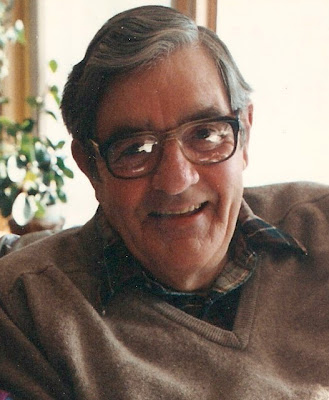
Showing posts with label Clay Blair. Show all posts

Saturday, October 1, 2011

PART III - CLAY BLAIR WITH ISLAND WRITERS - 1994

Washington Island, Wisconsin - 
Note:    This is the final installment of a transcribed recording from Feb. 1994, when Clay Blair was a guest of the Island Writers Society.   
   In Part I, Clay spoke about his latest book about German U-boat warfare, and previous books he and Joan collaborated on.  In Part II he described his early years as a journalist and writer.  
  In Part III, below, he responds to questions asked by members of the audience, having to do with writing, and with the topic of submarine warfare.   -  DP


PART III - AN ISLAND WRITERS GROUP MEETING AT REC CENTER WITH CLAY BLAIR


Question:  How do you go about getting an agent?

Clay -  This book, for example (holds up a copy of Silent Victory), was published by Random House.  The way this works, you have a proposal that you type up and send to your agent, after you’ve talked on the phone.   And he may also include ideas before sending it on to a publishing house.  They’re not very many publishing houses left.  They’re all merging, merging and folding divisions, so that at the most there are only about ten major publishers.  

Then he’ll look to see what other books have been published that are similar.  They’ll send it on to maybe six editors, within a house, who may be interested in the subject, or the author.  

We’re lucky in that we’ve had the same editor for four years, and he’s an absolute crackerjack.    He can make commitments without sitting in a committee.  So we’ve published with Simon Schuster, Random House, Lippencott. 

Question:  How does it go from a book to a movie?

Clay -  We’ve had that experience twice in fifteen books.  It’s a wild crap-shoot. 
 
The best thing I can say for writers is that Hollywood has an insatiable demand for material.  I’m not talking about TV, now, but theatrical movies.   And the way Hollywood works, is, a project goes into what is called a “development stage.”   Let’s say for every 1000 development movies, a few get made.   You can get a book option with pretty good option money and have it go into a development stage, at which time a professional screen writer takes your material and begins to fashion it in his own treatment - a screen play which now you have nothing to do with, unless writing a screen play is part of the upfront deal.   We wrote a screenplay for a terrible movie. 

The normal process is that a book comes out - there are 55,000 books published every year… how about that!  - and a tiny few get reviewed.  Still a tinier number get on the “best seller list,” such as the New York Times or the Washington Post.  But it’s really a miniscule number we’re talking about here.  In the whole 55,000, maybe 200 books on the outside, in the whole year. 
  
Normally a book gets on the bestseller list and the lords of Hollywood leap on it.   Every book that becomes a best seller that could possibly be made into a movie - even a book like Everything You Wanted To Know About Sex But Were Afraid to Ask, from 20 years ago, there was an option to make that into a movie.   That’s how books are made… a tiny bit of them are actually made into movies. 
And then, there are movies made that are not released.  That was the case with our two movies. They should never have been released!  

We’ve been with the same agent for 25 years.  Agents have really replaced the image of the old editor with the typewriter, the tweed jacket-type guy who cares about the writer.   An agent goes after the best deal because they get 10% of everything you do.  And they might even like you, as well…but there’s no assurance of that.

There have been some defections recently, I’ve noticed.  Agents die.  Ours died.  It was very difficult trying to deal with him from the grave.   We found a new one, someone in the same firm.  Chief agent dies; little guys move up.   Our big agent died, who was the biggest agent in New York, really.  He dies, and his wife tried to take over the company.  She was a flake.  All three top agents left and went on their own, so we went with them.  You might not follow that editor, but you follow that agent, because he knows where the money is.

Question:  How did the German U-boat compare with the American submarine? 

Clay -  The Americans fought a different kind of submarine war than the Germans.  In each case the objective was the same.  

The German objective was to isolate Britain and starve it out, and shut down all the imports so that you couldn’t build war machines or conduct war.   That was their objective.  Our objective was actually the same.  That is, Japan was not unlike Britain.  Our idea was to draw a noose around Japan, and starve it out.   Both objectives were the same.  

But the submarine war was fought very differently.   Ours was basically a one-boat operation. A boat went out on patrol by itself, and our submarines were big, and quite comfortable, I mean relatively comfortable, and they carried torpedoes and a lot of fuel.  You could go out for two months, two months and a half, then return to your base, Midway or Pearl Harbor, or wherever it might be.   Germans, on the other hand, had little submarines, about ½ to 1/3 the size of ours. They carried 11 torpedoes, half as many, with terrible habitation.  They lived like pigs, no water to shave or shower.  They were all stinking, and when you combine that with the smell of a diesel engine in a tiny little boat…the living was just horrible.   The food had maggots in it.  Just awful.  

And their task, all through the war, was to attack convoys in wolf packs, as we called them, anywhere from ten to 40 U-boats.  They had arrived at this strategy on the grounds that in WWI we had revived the convoy system of old, and there were so many ships and so many escorts that a single U-boat had a very difficult time with a large convoy.  

Our thing worked. We sank just about 1000 Japanese ships.   They didn’t sink many ships, but we did.   We sank about 5 million tons and a bunch of war ships, and we literally shut down war material and food and such. 

We never used the radio.  The Germans used the radio all the time because they were patrolling according to official headquarters ashore, the admiral.  He’s talking to them all along:  “Where are you?  How much fuel do you have?  How many torpedoes have you got?  If you see a convoy, don’t shoot, tail it, and we’ll get more boats in there.”    And so all these messages were going back and forth, but we’re breaking their code, we’re reading all this.  A lot of the time we knew exactly what they were doing.   They were playing with an open hand, like cards in a poker hand.  

And besides that, when a boat got in behind a convoy to tail it, they had to send beeping signals to the other boats.   We invented radar, which was a factor in all this, a high frequency direction finder, called HFDF (huffduff).  These were shore and shipboard high frequency direction finders, so that the minute the Germans sent out a signal that said, “Here I am, guys, home in on me,” we would home in on them using HFDF.   So one of the escorts would peel out and either drive that boat under or sink it.   Driving it under was good enough, because you could turn the convoy 90 degrees, and by the time that guy comes up – and the Germans don’t have radar, so he can see only about five miles – he doesn’t know where everybody’s gone.    Finally the admiral would come in tell them to search a certain way…so all that radio chatter gave us a total look at all their operational directives. 

We did not use the radio.  Only very rarely did we use the radio. 

Question:  What was the reason for withholding the information on the submarine warfare for so many years?  

Clay -  It was a number of things.   The main thing was that during the war…first was that the Poles broke the German Enigma machine, and they gave it to the British.    And then British were breaking the codes, using machines.   The German Enigma was a machine, a machine encoder, and the British developed a machine for decoding.   So after the war – the British had mastered a large store of machine coding and decoding.   They sold these coding machines to everybody in the world, Indians, South Africans, everybody in the Dominion, and then other places as well.   So the British were reading all the codes of all of their surrogate countries, reading all their policy decisions, everything that was going on in these countries, at a time when the Empire was breaking up and any information was quite valuable.  
So they didn’t want us to release information that we had broken the code in WWII because their customers were out there banging away on these things.  That was one reason.  Another reason is, people historically never talk about code breaking.  That’s a state secret of very high standing.   It’s just not done.   We don’t talk about it today, even though we’re breaking everybody’s code all over the world, without a doubt.  

I think its fair to say that all code breakers are secret-type of people.   All of them. We’ve met quite a few of them, and they’re all reluctant to toot their horn, or say anything, really, because they worked so hard, such a mind boggling thing to achieve this little success, or big success as the case may be, and they don’t want to give it away.   Anybody who was in any way ever connected to code breaking took an oath to never disclose anything about it.  A lot of people maintain that to this day.  I had a close personal friend who was a code breaker who died last month, and he would never talk about it.  
 
Advice for becoming a writer?

Clay - If you’re going to be a writer, it takes a special person to withstand a threatening environment.   I instinctively took a route without even knowing it, being aware of doing it.  I found myself in New York, I enrolled in school with writers, and I got a job at Time.  And actually Time magazine was so exciting, and things were going on there.  I started out to be a novelist, but I believe it was Scotty Reston who said, “The 19th century was the age of the novelist.  The 20th century is the age of the journalist.”  And I really went for that, and became involved in Time magazine operations.

We used to say, “You want to get a job as a writer, get a job on a country newspaper, and you’ll learn everything there is to know about a newspaper.”   That’s how all newspaper reporters started out then.  How to approach city hall, fires, and so on…

It’s a place where you learn to write, and write and write, and that’s how you learn how to write.
So without the loose screws and the terrible childhood and all that, I somehow gravitated to the very place I should be, which is in a journalistic, threatening environment.   And progressed from there. 

And so I would say to any would-be writer, go work for a newspaper.   Don’t work for an ad agency, because ad agencies are sleaze, and they deal in illusion, not facts.  Real facts.  Go work for a newspaper.  Go work for a publisher.   Don’t go to university and teach English.  That’s the worst thing that could happen, because it will isolates you into a special group that in most cases lifts you away from life and experiences and puts you away in an ivory tower.  That’s not always true, because there are many who have done very well with academic exposure, but again, I say, they’re all writing the same stuff.  It’s almost interchangeable.  

People say, I want to be a writer.  I say, go to work and get a job where you write all day long.  
(Conversations with the audience became layered as Clay Blair’s presentation to the Island Writers Society came to conclusion, and voices became impossible to track.)     -  End  - Dick Purinton


Thursday, September 29, 2011

Part II - CLAY BLAIR WITH ISLAND WRITERS - 1994

Washington Island, Wisconsin -


Note:  This is Part II of a February 1994 presentation Clay Blair gave as guest of the Island Writers group.   He began with a description of the latest book project he and Joan had recently completed. (He thought they had completed the book, but this project eventually became two, large volumes, the second one published shortly before his death in 1998.  For more details, see interview with Joan Blair in the August 7, 2011 blog that followed the seven-part Clay Blair interview).   
   Here, in Part II, Clay recounts his younger years, his entry into journalism, and his early career as a writer.  While some of the material in this presentation covers similar ground with the interview of Feb. 1994, the reader will also find new material and new insights on writing not covered by the interview transcript series.
 - Dick Purinton


PART II - AN ISLAND WRITERS GROUP MEETING AT REC CENTER WITH CLAY BLAIR
I have to tell you that the work we do is a joint endeavor, Joan and I.   We work side by side in the archives.  She will research this line, I’ll research that line, and we bring all of this stuff back here, to write.  And that’s the only drawback, that you have to get two or three railroad cars full of research and bring it back.   But then, the other six years (working on this book) were really wonderful.

I write, Joan edits and puts it in the computer.   The way it stands, a chapter - and there are 20 of them - each chapter is 40-50,000 words, which is really a book.  And so, we did 20 little books.  All chapters, of course, on the same subject.

Our writing is aimed at, you might say, the Book-of-the-Month Club mentality.   We try to deliver that in terms of writing and subject matter and style, in a way that it will be interesting, if not gripping, and in language that will pass muster with the Literary Guild or Book of the Month. In fact, we’ve been lucky to have one main selection as Book of the Month.  We’ve been selected by the Literary Guild, and many other book clubs. 
 
We research and present our material on a level well above PhD or professional historian.  We do these serious things, but we’ve also done all sorts of other things, very short, quick, fast books. We’ve published novels, and non-fiction work, and a whole bunch of other stuff.  

***

Now, I’ll talk a little bit about how I became a writer.

A writer.  I’ve been a writer for almost 50 years. 
 
I’ve known a lot of writers, and they’re all, like, drunks… crazy like I am.   No…they’re really different.  I think a writer – a real writer – there again there are writers, and there are writers … I’m talking about real writers, professional writers now… they’re doing the screen work, for sure - that’s the only general definition I can make.

If you look in the lives of many writers across the USA, you find out they lost their parents.   Hemingway lost his father.  His father was shot when he was 14 years old.   I did a little study one time.  His father shot himself when he was a kid.  You can find this stuff, this adversity.  That’s generally another factor that goes into it:  screw loose;  adversity in childhood. These are all givens, I think.  

And then, a talent.   Talent somehow for writing a sentence.  Talent.  Not a learned talent, just a talent that sort of spews out.   I can’t, I can’t for the life of me begin to tell you how that happens.  
I’ve been through all kinds of theories about this, how a writer translates things into different terms.  That good writers have conflict, have plot.   That the writers with a screw loose from childhood were really playing out a natural plot in disguised form.

But, again, we’re really way out, up on the wall now, and I don’t know how this sets a pattern. 

I do know that in my own case, maybe starting in 8th grade, I was writing essays in English class. Everything just came naturally.  And I read a tremendous amount as a kid.  I was a lone wolf and a lone sheep.  Kept to myself pretty much.  I did not engage in sports in younger years, or hunting, fishing, or any of that.    I just read a lot, and that also is a very important factor in being a writer.

You read, read and read all your life and never stop reading, because that’s how you learn to write.  You absorb that by osmosis in some way.   I mean, you don’t sit down and study somebody’s columns, for that sentence or that word, but if you read and read and read – good stuff - and if you are a writer to start with, then you’ll absorb it.   And it will show and become your own writing - not consciously - because that’s, to my view, that’s the end.   When you’re writing against the show of conscious...if that’s what you’re writing, the effort to write or to copy somebody else - it shows.  And that’s no good.  That doesn’t work. 

I was in the navy in WWII.  I was on a submarine, and the first thing I ever published was related to the submarine.  

After the war we came home to the sub base in New London, Connecticut, to mothball our submarine.   And at the end of that period you have a decommissioning party, for your boat, your crew, and they have a printed menu – you know, turkey, giblets, gravy, rolls.  And they had a lot of blank space on the menu because its not like a funeral here where there is a Psalm to read, verses, a biographical sketch based on this person.  For this souvenir menu I wrote a poem about our ship, and we put it on the back – they put it on the back – and that was my first published thing.
 
That was a hell of a good poem!  (pauses)  No, it was really dull!   

It was a tribute as well, the sadness of this decommissioning trip to Connecticut.  You’d probably look at that and say, “My goodness, he’s probably a war lover.”   I might be.  But you can tell it was my first published effort.
 
****     ****
And then I went home after the war to college at Tulane University.  I entered the School of Architecture because I always thought I would be an architect.   And after I’d been there several months, the dean called me.  I had a very tough time with algebra and trig, which I hadn’t seen in three years, if not four.  I must say, I was not the top student in the classroom.  We took aptitude tests for engineering.
  
And he said, “Mr. Blair, do you have other interests?” 

That was the end of my architecture.   The fact is, I did quite well in the English Department through high school, and so I moved into my writing on the GI Student Loan. 

This thing happened.  I wrote this short story.  Boom!  Right out of the blue.   And so I typed it out and put it in a drawer.   I had no intention of being a writer.  I had a roommate, and he took this story to our college literary magazine, the Tulane magazine, and gave it to the editor who then published it, and I won the prize for the best short story of 1947.   And $25!   This is really true.  And that really impressed me.  Because this was so easy, I thought, Wow! I could do that for a living.   So, then I decided to be a writer.

There were very few places you could go then and be a writer, or study being a writer.   One of them was Columbia University, New York, which had a school of creative study.  They had a writing thing in their curriculum.  You could take play writing, novel writing, short story writing, journalism, poetry…anything. 

And so I wrote short stories, more stories, and sent them out to Columbia, and they accepted me.   And it turns out, there were quite a few other kids in college at the same time doing the same thing (applying to Columbia).   I didn’t even know this.  But when we arrived we were sort of an expatriate southern group, and we had our own little community.   Columbia, and Southern Columbia, I should say.   

We didn’t have any money.  I got a job at Time Magazine as a copy boy.   All the copy boys were either in the PhD programs or were writing "their novel.”  We were all in the same boat then.  And it was the most disorganized, fouled up outfit you’d ever seen.  There were like 30 of us.
 
And, I had some experience in the navy heading up a department, so I fixed this department, and he (Clay's boss at Time) was so impressed with that, for having done it, that he offered me a job to be a trainee correspondent.   They’d teach me how to write and be a reporter.  And although I had not graduated from college yet - I still had a year to go because I couldn’t transfer all my credits from Tulane - and so I had this terrible angst, Gesthemane, and I finally decided I would take the job, even though I hadn’t finished college, hadn’t graduated yet.  And the rest of it is…history.
  
I was in a year’s training, a youth writer who aspires to be a writer.  You talk about a wonderful experience.  All my life I’ve fallen into things like that.  I guess I was, in a way, prepared. 

The bureau chiefs kept moving me around…and all these people were critiquing me week in, week out, month after month.   And it was just fabulous.  So at the end of that time, I’m up in Washington, at Time Magazine, and the day this war broke out - June 25th, 1950, the Korean War broke out - the regular national security correspondent at Time was named Bob Sherry.  He was away writing a picture history of WWII.  It was like a sink-or-swim deal.   And, I swam.   I did all right.
 
The guy who went to write the picture history never came back, and so I was the Pentagon guy for years.  I made the connections in Washington that I used when I began to write books about the military, and to make a long story short, I became a staff writer for Time

I wrote no less than 10,000 words a week, in eight or ten written stories.   And in those days, what you did was, you “over-filed” for Time, and then the writers in New York rewrote it.   If I filed 1000 words, they might boil it down to 200.  So they would completely rewrite your stuff.  And meanwhile, you’re filing at length.  And the cover stories for Time Magazine - they had no rule - but I had to do one cover story about generals and admirals in Korea that was about 25,000 words.  And then their writer in New York would take your 25,000 words and boil it down to 5,000 with no attributions, no name on it, no nothing.   They called it “group journalism.”  We called it “gang journalism.”  

It was a fabulous way to learn to be a writer, but very unsatisfactory in terms of recognition.  So I started writing long pieces, 5,000 words of my own, and I published eight or ten of those, and because of that, and because I liked that so much, I went over to Saturday Evening Post after eight or nine years at Time as a staff writer.  

At the Saturday Evening Post the people were old, they were tired.   Television had come and they were taking advertising from magazines like the Saturday Evening Post, which was carrying Ladies Home Journal, Holiday, House and Home.  They then asked me to be Editor of the Post.   It was a wonderful job, but I didn’t know about all the problems of the corporation.  I went up to Philadelphia and was Assistant Managing Editor, then Managing Editor, got caught up in corporate BS, the trench warfare.   We had a circulation of 7 million a week, and you had to produce 10 or 12 stories, fiction, and covers…an incredible rat race. 

In 1965 I left that, and I had what I call a “brass parachute.”    It was enough to get started on being a freelance writer who wrote books.  I went to Washington, and I needed a typist.   (Looks at Joan in audience.) 

“You want to tell that part?”  

I met Joan, and we talked about Washington Island.  I didn’t know where this place was. I couldn’t conceive of it.  We ran off together, and we had a wonderful life.  We’ve written …how many books? 

Anyway, our lives have been hectic, and scary at times.  We’ve managed, since 1967, to write many books.  Sometimes we’ve had some pretty good luck with very good sellers.  There’ve been very lean times, too.  Feast or famine, unless you hit one big one.   But, it’s a very rewarding life.   We’re very pleased now to see books such as David Halberstam’s new book The Fifties using our books as references for this war. 

End Part II  -  Dick Purinton

Wednesday, September 28, 2011

CLAY BLAIR WITH ISLAND WRITERS -1994

Clay Blair - 1994
 - Washington Island, Wisconsin

Notes:  Several months ago I ran a seven-part series of an interview with Clay Blair that was recorded in February of 1994.  Unfortunately, I had not properly operated the recorder during the second afternoon, overriding the first part of our interview in which Clay talked about his early days in becoming a writer.  
  I had one other tape that was recorded also in February of 1994 when Clay was invited to speak to the Island Writers, a group of 20 or so persons gathered in the meeting room of the Rec Center.  From the interest of several readers of this blog in the writing life of the Blairs, I decided to transcribe this tape, too.  During this taped presentation - which is very difficult to understand because I sat with my tape recorder several rows from the front - Clay does talk about writing and how he became a writer.  I had found it interesting then, and did so recently, too, when I transcribed the tape.  
  Due to its length, as with the previous transcribed interview, I've chosen to break it up into several installments.  This first installment describes his latest project with wife Joan Blair, a book about the German U-boats in WWII.   Although some of this information is covered in the prior interview installments, rather than cut-and-paste and have it not flow, I've chosen to reprint it here as he spoke it.   The parts that occurred where his words were unintelligible I've edited from the final copy you see below.  -  Dick Purinton


AN ISLAND WRITERS GROUP MEETING AT REC CENTER WITH CLAY BLAIR – [Recorded the evening of 2/24/94… in which Clay talks about his early years, getting started into journalism, and his interest in military history.]

I am asked to talk about – if I understand the format – how I got to be a writer.

The one question I can’t answer is, how you get a literary agent.  I don’t know that answer. 

To the present project…that we’re now very happily winding up after seven years of work, basically a history of the German U-boat war in World War II.   As some of you probably know – but not all of you, because you’re too young – in WWII, in the Atlantic Ocean, there was a horrendous naval war that went on for all of six years.  You may have seen movies about it, the German super-battleship Bismark, the actions in the Atlantic.  The principle weapon that the Germans had to use against the Allies was the U-boat, or submarine, and they built about 1200 of them during this long, long six years of war.   They didn’t have 600 when the war started, or any such numbers as that, but during the full course of the war they built a lot of submarines, and lost a lot of submarines.  This was a very complex war, in that nothing like this had ever been fought before on this scale or this magnitude.

At the end of the war, the very end of the war, the last days of the Third Reich when Hitler and his cronies were holed up in a bunker at the Reich Chancellery.   Hitler decreed – he was crazy then, crazier than he was – that all the records of the German navy be destroyed.   And this was part of the general destroying of documents that went on in the bunker, that he ordered others to do so.  

But the German navy was a little bit apart from the Nazi party, a little bit aloof.  Mostly at sea, they had their own network of people and installations, and by and large throughout the entire reign of Hitler they were aloof or removed from the Nazi party.  And it was not untypical that when Hitler gave his order to destroy all records, that they wouldn’t do it.   In fact, the chief archivist of the German navy packed all of these records into a box – boxes – into about 20 or 30 trucks and drove them out of Berlin in the midst of Russian shelling.  The Russians by now had almost encircled Berlin – and they drove madly through the night to a castle named Kambach (?) and there the archivist and his helpers buried all of these records, all throughout the grounds of this castle.    And within a few days, Patton’s Third Army came right through there.  And attached to Patton’s Third Army was a British intelligence unit, and they made contact with the guard there and dug up all these records, and the British air force took them to London, where they had possession of the entire German naval archive dating back from 1850.   Now they added hundreds of documents up to WWII, and this included hundreds – no thousands, tens of thousands – hundreds of thousands of pages of documents of U-boat war patrol reports, headquarter diaries, listing of the U-boat command, the whole naval command, and the daily diaries.  Everything you could possibly imagine was in these boxes. 

After the war, as you know, we had wartime scholars at Nuremburg, and the British, particularly, were out to hang the German navy people for engaging in submarine war against our shipping, submarine warfare of the type known as unrestricted warfare,  whereby you just shot at a ship of any kind, without any warning, without time for people to get into lifeboats and so forth.  In any case, in order to make the case against the German naval seniors, the English had tens of thousands of pages of these war diaries translated into English.   So that by the time the barristers were combing through these documents, looking for something they could hang the German admirals with, like an order to machine gun the survivors of a sunken battleship, or destroy all evidence of its sinking.  But, they didn’t find that because the Germans fought a clean war, cleaner than we expected, cleaner than the one we fought against Japan.   

And so it came to trial, and the admirals were the least punished of all the German war criminals. 
These documents were then classified, and put in British archives.  (They generously gave us a microfilm of all these documents.)   These documents were then kept under lock and key for about 30 years, and the reason for this was that code breaking played such an enormous role in both the German U-boat attacks against our shipping, and our attacks against U-boats.   In other words, the Germans were breaking our codes, and we were breaking their codes, so that you could see by the anti-warfare documents the stuff they had done, and were very proud of, and if you could put it (our ship movements) against the submarine patrol reports by the Germans, you could see that one boat (of ours) make a change of course followed by the German U-boat changing its course, also.   And you’d say, “Holy smokes, what’s going on here?”  

And the answer is, that they were reading our codes, and we were reading their codes.  So every time the enemy made an adjustment, the other side had to react to it. 

So the British and the Americans entered into an agreement after the war to withhold, as tightly as anything has ever been withheld, all documents related to code breaking even though the U-boat documents were not directly related to code breaking.  So, these records remained secret for many years.  All kinds of U-boat books came out, some trash, some that were fairly good books, but they were not very accurate and they never told about the war in any kind of detail, because these records had not been released. 

And in the mid-70s when the British published several books about code breaking, several unauthorized books, then their government started releasing documents on code breaking, and not long after that, the U-boat records.   So that one could finally take the primary documents relating to this war, this six-year war, and write a history about it.   And at the same time, overlay or underlay all the programming as applied to the U-boat activity.

Quite a few years ago, in 1975, we wrote the definitive history of American submarine warfare against Japan.  This was quite well received.  And we were asked to write the German U-boat history, but we couldn’t do it because these records were still locked up.    So we did all those other books.  And finally, everything came together:  money, with much commitment from the publisher; documents; code breaking declassification.  And so one could write this story for the first time in an authoritative way.  
And, I will say in conclusion, it’s an insanity!  Total insanity!  We’ve got … we went to London, Washington, where we made a copy of all the microfilm.  London is where they had all the records.   Germany, where we went to get the German U-boat skippers’ records.  And we have, besides microfilm and books, hundreds of thousands of papers and documents in our house.   I must repeat, that to undertake such a project, we had to be crazy.   And over the seven years that we pursued it, we’ve grown crazier and crazier!  

And now, we’re almost done.  The book will be probably about this size, about 1000 published pages.   It will take probably a year to review every last final word, and a whole year to copy edit and process this book, to give us a legal reading.  We have to do the index, a mind-boggling index … just thousands and thousands of people and U-boats, that we can’t even deal with it.  

Hopefully the book will be out and arrive by the 50th anniversary of the conclusion of the war with the Germans. 

We found out a lot of amazing things about this war which I do believe will compel historians writing after us to change their views on U-boats based on what we found - generally speaking - that German U-boats were a failure, were a flop, badly built, wrong type of submarines for the mission, and a number of other things.  We tended to treat German submarines as being “ten feet tall” and they weren’t.  They weren’t “pygmies” at all, either, but all kinds of serious historians have made all kinds of very serious statements to the effect that these U-boats delayed our overthrowing the Germans in France and various other claims.  

But our research has shown us that in the entire war, the U-boats sank only 1/10 of one percent of shipping.  In other words, 99 point something-or-other got through.   So, anything said at all about the U-boats is basically nebulous. 

That’s the end of that!

So now, we’ll talk about … how much time do we have left?  20 minutes?  I was going to read a chapter! (laughter from audience)

  End Part I -  Dick Purinton


Sunday, July 31, 2011

BLAIR INTERVIEW - PART II

WASHINGTON ISLAND, WISCONSIN -

BLAIR INTERVIEWS -   This is the second part of several installments of a taped interview from February 1994 with Clay and Joan Blair.   In Part I, Clay had taken a position with Curtis Publishing after having been a Washington correspondent for Time Magazine.   Despite efforts to right the ship, Curtis Publishing was about to go under, and Clay had become greatly disillusioned with the corporate situation.   He had already worked on fiction, and now he was anxious to get back into writing.  -  DP


PART II


I had left Curtis with a parachute – a brass parachute -   but with enough funds to write a
book.  And so, I went back to where I had left off in 1949, with notes, to write a novel.  

I had started out at Columbia, then went into journalism, then I decided to come back to that and write a novel.   And a lot of publishers were anxious for me to write about Curtis, the sinking of the Saturday Evening Post and all of that.  I did.  I wrote a novel called The Boardroom, which was published by Dutton in 1969. 

The publishing company died instantly after it was published.   I started this novel.   In the middle of it I moved back to Washington, in 1967.  I worked on this novel in Greenwich for about two years.  I had a difficult time with it, then I moved back to a Washington DC suburb, Potomac, MD, still working on the novel. 
 
I had tremendous difficulty distancing myself from the chaos and the likes of Curtis Publishing to write a book about it, to get separation from the subject.  So, I was leading a very reclusive life, working on this novel.   I needed a typist.  I had a typist in Greenwich, and I had to go find a new one.  
That’s where she comes in!   (Refers to Joan, who is also present.)

Q - The difficulty you had was primarily because of the closeness?  

Having the deadline removed also made a difference.   First, I wrote just for my own self and records, a complete non-fiction book about Curtis, a long document in around 1965-66.  I didn’t publish that book.  One of the provisions that I had in my brass parachute was that I wouldn’t write about it.  

So I did write about it, but didn’t publish it.  The novel came as a made up story. Curtis was still limping along.  They had done all of the things I had recommended, selling the paper mills.   Now, they were broken up, bought out by other publishers, each of the magazines.   The whole company was broken up piece-meal.   This was my program, put into effect much too late.  Maybe we would have had a chance, maybe not.   In any case, I was sitting in Greenwich as the thing was going down the abyss.   The novel wasn’t contractually prohibited, a fiction book, so I knew I could do this.   I filed away the non-fiction account, which is now with my papers in Wyoming.  

When I was at Curtis, even before, I had copies of my files, and then the stuff from Curtis.  All of my correspondence.  I ran a study group on how to dismantle the company.   Hundreds and hundreds of documents, and all these books I wrote.  All my papers, 257 boxes.  All the Army stuff has gone to the U.S. Army Military History Institute, at Carlisle, PA.   The army papers are there.  We did three army books.

The other books are at the American Heritage Center at Laramie, WY, 82701.    Mostly (the Laramie Center) had to do with Western stuff, native American, Wyoming books, mining, and so on.  An incredible place.  It is a museum archives.   They have the papers of a lot of journalists, Hugh Downs.   They also have ADM Kimmel’s papers from Pearl Harbor.   At one point, they embarked on mid-century journalists.   And that’s how I got there. 

I was moving, and said, “I’ve got to get rid of this stuff,” when, sure enough, the phone rang.  Would you leave your papers to the university, and I said, I sure would. And we’ve been sending our papers to them ever since.  People have used our papers, but we’ve never been there ourselves. 

Q - We’ll back up a bit to where you needed a typist.

Joan -    I had graduated from college in 1951 from Washington Univ.  (St. Louis), and I was recruited by the CIA.  I was recruited and went to Washington for about six months, and they sent me to Japan, where I met and married David (first husband), who was also in the CIA.  

We were there about two years and came home in the summer of ’54, I’d guess, then we went to Holland for three years.  Then in 1961 back to Japan for about 2 ½ years. Then we were in Hong Kong for about three years.   Then in ’66 we came back to the states, to Washington.  We had a house in McLean, VA.  When we came back the last time, David went to Viet Nam.  I suddenly realized I wanted a divorce, and I came up to the island with the kids, and I told Daddy I wanted to get a divorce.
I went back to Washington, and I needed to get a job - needed to learn typing.   And a friend said she had a friend who was a writer and he needs somebody to type his manuscripts.   So I really did start out as a typist.  That’s how that started.   It was the Boardroom novel.

Clay -  To complete the link-up, we both got divorced, moved in 1968 to Washington, by which time we finished The Boardroom.  Joan was very interactive with the ideas, the collaborative efforts, even though her name wasn’t on the cover, not at first.

Q – What about research?  

Joan - The Archbishop we did from analysis, the newspapers, not a whole lot of research. 

Clay -   When I was in Greenwich, I got plugged into this dissident faction of the Catholic church, a strong liberalization where Pope John XXIII, the Vatican, liberalized the church, and I was deeply involved in all sorts of movements at this time, and it was reflected in the things I did at the time at the Post.  Things like Montessori that was really an outgrowth of the liberal church.   Montessori, as opposed to the traditional Catholic parochial school.   And so I had known a lot of dissident priests in Greenwich that had been in combat with the Vatican for promoting liberalization issues.

Of course, I was a Catholic – a disenchanted Catholic – and this book, The Archbishop, had a lot of that in it.    I drew on all that stuff I’d been involved in.  

Joan  -  We’d try to think up plot lines of things we could write about.   Then, a few months later, we’d read in the papers - there it was - the things we thought were so far out.  

Q - Why did you depart from the successful current event, popular subject matter?   Why didn’t you stay with that, the topical novel, and go into the technical, historical writing?

Clay - I wrote a non-fiction first about Curtis, then worked for about a year on the childhood, teenage years…then The Boardroom.   The Archbishop was the next project, also quite topical.  There was quite a deal going on in Washington, an open revolt, a dissident priest element there, too. 

Joan -  Then while you were doing that, the James Earl Ray thing was going on, and we would go off and work on the James Earl Ray thing.

Clay  - Really?  In the middle of The Archbishop

We were in Washington when the James Earl Ray thing was going on.  This was a non-fiction project.   We were asked to cover the trial.  
 
Joan  - They wanted an instant book. 

Clay -   No, they wanted the trial, and preliminary to the trial we started doing research on his life.  And the background for the trial research about the mid-west, his friends, the prisons and all of that.   And at the trial in Memphis or wherever that was.  And there was no trial.   He pled guilty at a hearing. 
 
So we had all this research, but no place to go, and so the publisher said, “Let’s see what you’ve got.” And that’s how we published the book.  I used the publisher’s office, and, quite literally, wrote it there in ten days.   It’s just a question of sitting down and writing it.  Put the trial transcript in the back.   An instant book.

(tape:    February 8 - side #2)

Joan -  But I was never in Memphis. 
 
Clay -  It did alright, made a little money. 

Joan -  It was right in the middle of The Archbishop book.   For Bantam World.    That’s when World died. 

Clay - They presold the paperback, and it farmed out to the hardback, subsidized the hardback.  World collapsed in bankruptcy, and that book barely got published in hardback. 
 
Joan -  That woman who ran the book store sold lots of copies, she just loved it. 

Clay -  That was as topical as you could possibly be.

The next was Pentagon Country, a Bantam deal (with McGraw-Hill), and they had great faith in the novel’s future, trying to make us into best-selling novelists. Which is actually where I wanted to be.  We had a very good relationship.

This was an anti-Viet Nam book.   We went to the Pentagon, and they showed us the basement, the storeroom where they had all of the stuff stored since Civil Defense days.  Gigantic.

Pentagon Country:  This was about a Navy Captain with two sons, one an officer, one who sets himself on fire.   That came out in 1971 at the height of the Viet Nam protest movement when Nixon snuck out in the middle of the night and observed them .

None of the novels set the world on fire - but you don’t remember that (part).  Actually, we got discouraged about the novel career.  Then we had a big discussion about what to write next with Mark Hill.

Joan -  He asked you, “Weren’t you in the war?   WWII?” 
 
Mark said, “Why don’t you do something about submarines?”

Clay -  This started serious history. 

Joan – That was Victory.   

Clay - Also had a novel on submarines?  Yes.  That was just a little flip-back thing, not important.    But we put our time in on Victory.  That was in ’71.   That was a whole whirlwind, going to Washington, getting documents.  We’d never done anything like this, a sense of real history, using primary documents, interviews of war people.

Joan -  We interviewed as many living submarine skippers as we could from WWII.  We drove all around the country, interviewing these people on tape.  Hours and hours and hours, every interview was hundreds and hundreds of hours, weeks and weeks, time in the Navy archives, looking at patrols.   In those days they were great.  They gave us a Xerox machine and said, “Here.”    And they declassified things for us.

Clay -  We Xeroxed with our little machine 15,000 pages.

Joan -  We bought our own paper, but it was wonderful.  Nowadays they charge you 25 cents a page, up to 30 cents a page, to Xerox.   Can’t do that anymore.

Clay -  The research process was about a year, I think.   I had trips back to Washington every month.  If you add all that in, I think it would be a full year, but not all at once.

Q - How many pages?

Clay  -   1100  pages.   

Joan  -  It was a biggie.  But it was the smallest of the biggies.  They went on from there.  (laughs)  We thought that was pretty big at the time.

Clay  -  We finished this book –

Joan -  We started in ’71 and we didn’t actually finish until -  ’74.  

Clay  -  Yes, but we did Survive in there, too.  (Holds up copy of Silent Victory).  This was 1072 pages. 
This book was published in 1975, and it was tremendously well received.  It was a classic book.  It was used at the Naval Academy.  It’s a definitive book of that element of the war.   Nobody could ever…it’s a work of madness.

Joan  – No, that wasn’t a work of madness.    This is. (She refers to their latest project.)

Clay – You forgot what a work of madness is!

Joan – Oh no!  

Clay  -  It was a work of love, actually.    ‘Cause when we began to look at this thing, to write the story, we didn’t know what we were going to write.  And then we realized, there was no history of this war.   
So that’s what we did.   It was very well received.  There was the Book Club.

There had been some novels, and some non-fiction done on submarines in WWII, but nothing definitive.   

Exhaustive, totally complete.   With all the disputations between commanders.  Everything.

Q -   How did you develop your style with such a complex book, lots of interviews?  How do you divvy up the workload, the research?

Joan -  When we go to do research, Clay will just take one part, I’ll take another.  For the interviews we’d tape them all.  I’d transcribe the tapes.  Very time consuming.   Takes forever.   And then, Clay has it all in his head, organizes it in his head, writes it all down, and then I’d type it.   

Q -  How do you do that, Clay? 

Clay -  I don’t know.   I just don’t know that.  

Q -   At some point, you got away from the typewriter.  And you went to the legal pad.

Clay  –   Yeah.  I had to do that.  The reason for it was, we had so many sources, so many folders.   I was typing at a little tiny table that the typewrite sat on.  We had a door desk.    And I had all this stuff spread out all over the place.   I was working, just to write one paragraph, I was using five or six different sources.  And I found I was reaching over and dropping the damn things on the floor, and all that, so finally I decided to give up the typewriter, and I had all the files…I could write in long hand, put them back, and they wouldn’t fall out on the floor.  

And that was, pure and simple, the only reason I did that.   Nothing mysterious about it.   And, I never went back (to the typewriter).

Well, that’s not true, because I did Survive! on the typewriter.

Joan -  You typed Survive?  I don’t remember that. 

Clay  -  Yeah.  You might have typed the finished version.  But I didn’t write it in long hand. 
Anyhow, that book was very well received, and it established… I mean, unwittingly, really, I don’t think we ever sat down and said,  “We’re… now we’re going to become military historians.”

Joan -  No, no.   Just one same sort of war thing (leading) into another.

Q  -  (Reads blurb from the dust jacket of “Silent Victory” to Clay for comment)…The Forgotten War… regarding our lousy torpedos…that there will never be a rival book…little did he know there would be another one!

Clay -  (laughs)

Q -  Did you leave anything out? Was your book complete?   Did you leave anything out?

Clay  -  Not that I know of!  

Joan - We had the code-breaking.  We were the first ones to write about code-breaking.

Clay -  That’s right.  Code breaking was the big thing with submarines, because they could break the code and find out where the Japanese convoy was, and send a submarine to the convoy.  And that’s how we …

Joan  - And nobody had written about it.  All the skippers had signed a pledge that they would never reveal the secret, and, I don’t know…

Clay -  But I knew about it, being on a boat. 

Q  -    And now, 25 to 30 years later…   It was classified then?

Clay -   It was.  We really wrote the first thing about Japanese code breaking in the war, as related to operations.  

You know, break the code, send a submarine here, blah, blah.  And there was a lot of problems with that, because we’re dealing with …the navy always wanted to sink a carrier, and anytime they found out about a carrier, they (U.S.) would send a submarine.   And it was very difficult to rendezvous and navigational errors on both sides … and so our submarines were a lot of times chasing around the Pacific, after these phantom things.  But, anyway, we were the first to bring all of that to light.    Torpedo problems.   All that stuff.

END PART II  -   Dick Purinton

Saturday, July 30, 2011

Clay and Joan Blair Interview - Part I

Joan and Clay Blair, Feb. 1994
Washington Island, Wisconsin -


In February of 1994 with my daughter, Evy who was a college English major at the time, I had the opportunity to interview Joan and Clay Blair over the course of two wintry afternoons.  I have vivid memories of these occasions, first because they gave us a great deal of their time, with trust in my amateurish interview skills, and second, because if they had known how I blew the tape recording they would know it was the work of an amateur.  


I recently came across a cloth bag with my sketch notes and several cassette tapes of an interview I did with them, and I decided, despite some major flaws in my method, to begin to transcribe those conversations.  With major gaps
in the interview due to my ineptitude, I still believe the content is of great enough interest, given the subjects, the breadth of the topics, and the lapse of time, to be important enough to reproduce for others to read.


Joan Blair is a daughter of Jean and Paul Rutledge, close friends of Arni and Mary Richter for years, but most importantly to us, Doctor Paul was the island doctor.  He left a successful practice in Kirkwood, MO, a St. Louis suburb, for the rural and distinctive life of island doctor.   He was much loved by island people for his care and concern.  He also delivered babies, and he did so for two of our children, Hoyt and Evelyn, at a time when a doctor still had the desire to do so, over the increasing threats of malpractice suits.   On one of the first occasions I met Joan, at a cocktail party, I confided I had read Silent Victory, some 800 detailed pages, but at my reading speed I found it to be "a rather long slug."  I hope she forgave me later and kept my comment to herself!  


Joan is an island resident as of this writing, and she is an active member of several island organizations.


On one of the first occasions I heard Clay speak, he appeared at a Door County zoning hearing on behalf of the Ferry Line, an effort to obtain a permit to expand ferry operations to year around at Northport.  Clay modestly recited the demanding, technical nature of his work, and he explained that it required utmost concentration.  He also noted that he and Joan lived but a few hundred feet from the island ferry dock, and that his work was not impaired in the least by regular coming and going of our ferry boats and vehicular traffic, and he doubted that folks living near Northport (our mainland dock) would be bothered, either.  


In later years, Clay served on the island school board (as did I).   He was an instrumental committee member in the Island Rec Center's formative years, and he and I served for approximately eight years on a committee to explore and develop ideas for a performing arts center.   All the while, he and Joan worked tirelessly on one complex writing project after another.


Clay D. Blair Jr. died in December of 1998 after suffering a heart attack.  He and Joan had continued with their work right up to that time, interrupted it seemed, only by brief periods of required medical recuperation.  A World War II veteran as well as noted military historian, Clay was buried at Arlington Nation Cemetery. 


IN the years since the interview, I had forgotten the scope and depth of their work, and how important their combined efforts were in the recording and interpretation of major events in our nation's history.   Clay was a top-notch journalist who became a leading writer of detailed military history, and Joan was indispensable with her research, the organization of volumes, boxes of information, and the transcribing of endless interviews.  I also had not fully appreciated the importance of their working relationship until I recently began transcribing the several cassette tapes I had made of my interview with them.    


Now for the confession of a want-to-be journalist:    some time after the 1994 interview I was dismayed to discover I had recorded the second session over the top of the first tape, thereby losing valuable material about Clay's younger days, service in the Pacific aboard the submarine SSS Guardfish in WWII, their return to the States via Panama Canal to New Orleans, and his embarkation on a career in journalism.   Upon reviewing these tapes now some 17 years later, I found their contents still timely.   Clay and Joan's insights about their lives as researchers and writers describe an Olympian effort, creating a major body of work that will continue to be valued.


This is Part I.  Rather than edit down the material, I have chosen to present the interview pretty much as transcribed directly from the tapes, with some obvious gaps due to my tape recorder malfunction, and the occasional difficulty of interpreting precisely what words were spoken.
  -  Dick Purinton

PART I - CURTIS PUBLISHING


[The taped interview picks up during Clay’s time with Curtis Publishing Company. He had just left a position as Time Magazine Washington correspondent.]

The (Saturday Evening) Post was getting into serious financial trouble, not a story I’m going to get into…except to tell you that.   And the other thing was, I had a much adored son, about three years old, and he was run over and killed in front of our house, and that had a great impact on me.  And I was looking for a different scene as a result of that...it was a horrible impact.   
 
And the Post people were looking for new talent.  They were losing money and all that.  First they said, “Would you come up here and spend a month and tell us what’s wrong with this magazine?”  

And I said “Yes” and spent a month.  I sat in an office as if I was doing a report, and I wrote a report, telling them what was wrong.   And they were very impressed with it, so they invited me to be an assistant managing editor, with the promise I would become editor.  My appeal to them was youth.  I was about 35 years old, a scuba diver, had written books, I had done all that stuff.  They were all older people…older than the hills, they really were… and (they) had that view.  I was very young and was go-go-go, and I was broke, so I was offered this job, that I would be editor in several years. 
They were all retiring out.  I received $135,000 a year, which was a lot of money in that day.   That would be like…I don’t know... a huge amount of money today.  
 
This happened because of my misfortunes, and so we moved lock, stock and barrel to Philadelphia.   I went from Asst. Managing Editor to Editor in about a year, and in another year, I was Manager.   This was not how they had it planned.  They let many people go, it was a blood bath, and I rose up the corporate [ladder].    I tried to change the Post into a news magazine.   The magazine hadn’t changed in years: old, stodgy, unbelievably reactive, rather than active.   They were too far off for news, and I worked out a deal to work faster.    
 
We were shipping magazines to the west coast on freight cars, and we changed the train, closed the lead time down to about a week.  We hired people from Newsweek to change this thing to a timely, meaningful publication.  

That didn’t work, either, and there was a huge political battle within the company, with the stockholders - all the corporate stuff you can imagine.  I became head of all of the magazines:  Ladies Home Journal, Holiday, American Homes, Jack and Jill - the most popular magazine ever.    We had acres of trees, two printing plants.  We had the biggest printing plant in the world.

That’s what was wrong.  They had made the decision to go for facilities, rather than decentralization and flexibility, and they got stuck into this thing where they had to use their own trees, their own paper making, their own printing companies to make their…to justify their events.    Life Magazine was being printed in about five different places at that time (names them) and that’s where we should have been.  I wanted to sell it all:  the paper companies in Canada, the printing companies - we had one right across from the Liberty Bell - and wanted to move the whole damn thing to New York, lock, stock and barrel. 
All of this was very heady stuff for a 35-year old, but they wouldn’t do any of the things I proposed, and the whole thing went down the tubes.  And finally, when we were trying to sell off all of these parts, the whole thing went “Boom!” 

I couldn’t stand it any more.  It was a Fortune 500 company.  We had 12,000 employees.   About 600 were in editorial.  We had a huge circulation company.   I had no time for writing, just running the corporation, fighting boardroom battles, and I was still editing.  A weekly magazine, mind you.  I was very busy.  
 
Q - Have you ever thought it would be good to be back on the desk? 
    
I thought it would be good to retire, then return to writing, but the whole thing blew up, and I’m out on the street, not with a good parachute.   We were married, six kids, living in Greenwich at the time, a typical Greenwich building upscale life.  I had an apartment in New York, a limousine, all of that, great perks.    But the thing was hopeless.  The fundamental thing was that the families that owned it never produced another publisher.  They were all drunks, had no interest in the magazine. 

The accountants got hold of the company.   They couldn’t do editorial, and so they build this huge empire, extra, outside of editorial, and that’s what destroyed the company.  They had a chance to buy ABC, but they thought it was a fad that wouldn’t last.  They could have had it for about $10 million.  Holy smokes!  But that was the kind of management: unimaginative, bad. 

This is a huge, long story, and I certainly won’t go into it further, but it was hard.  It was relentless, back stabbing, trench warfare, people in the departments - typical boardroom strife, the creative vs. the mechanical, the accountants.  And of course, I was the editorial leader, committed to save this thing.   

I was never very fulfilled in the job.  I was a writer, and although I did it well, and I held my ground and won a lot of battles, and became a true player - you have to or you’ll get killed -I didn’t really approve of it, didn’t like it, because the business ethic wasn’t the high standards I learned as a Henry Luce journalist. 
There was an attitude in Time-Life that we were like priests, I don’t mean to stretch this too far, but we were dedicated, we were clean, idealistic, and this was all a reflection on his astounding personality, his religion.  And he was essentially editorial, too, although he had business people with him.  And then, being thrown into it on my own like that at Curtis.  They just did things I wouldn’t think of doing, and I condemned that, those people on the business side, and I found a lot of it odious.  
    
I introduced a compromise.  I would not run a piece on General Westmoreland that was favorable, in order to get advertising from GM.   We were getting GM ads.  I was pressed to do it every day, from one person to another. 

Return to writing books... 
 
I left Curtis Publishing in 1965, and I decided I would not ever get back into the corporate scene.     I wasn’t fairly used,  I was used and abused.  And I did my share of abusing, too, no question about that.   It was odious, and I didn’t ever want to go back to that corporate … again, we had so much contact with Madison Avenue, which is basically sleaze … they were a bunch of carnies, at least they were in those days…and they’d pull any kind of a deal to get an account.   Here we were conveying that, it was a constant battle to do so to be clean.  All magazines were being pushed.  I was just a foolish knight on a white horse… and I would never do that again. 

I had enough money I could start out as a writer.   No more of that (corporate world).  I even quit subscribing to a magazine.  I became a book writer.   

End Part I -  Dick Purinton