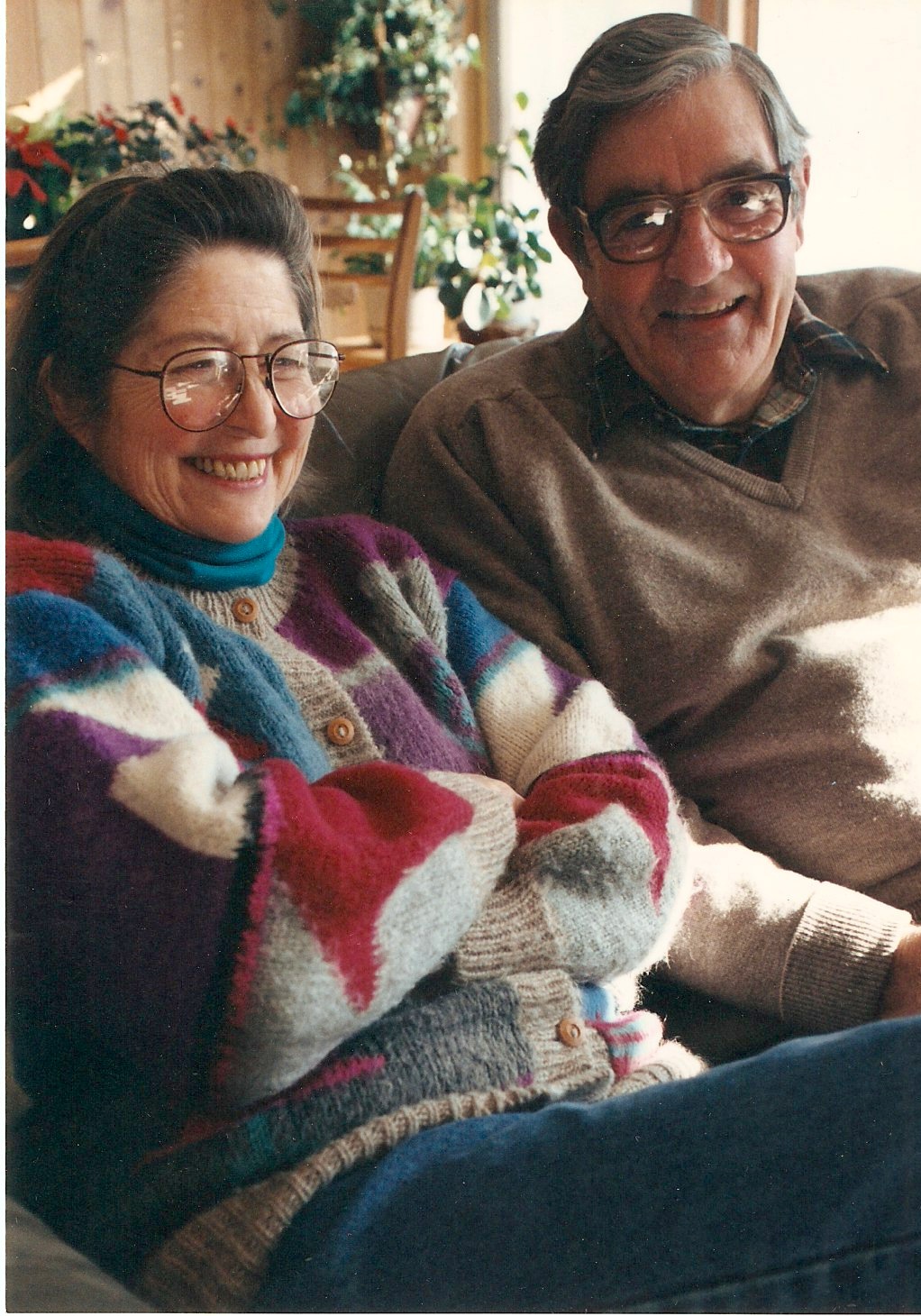
Showing posts with label Clay and Joan Blair. Show all posts

Thursday, September 29, 2011

Part II - CLAY BLAIR WITH ISLAND WRITERS - 1994

Washington Island, Wisconsin -


Note:  This is Part II of a February 1994 presentation Clay Blair gave as guest of the Island Writers group.   He began with a description of the latest book project he and Joan had recently completed. (He thought they had completed the book, but this project eventually became two, large volumes, the second one published shortly before his death in 1998.  For more details, see interview with Joan Blair in the August 7, 2011 blog that followed the seven-part Clay Blair interview).   
   Here, in Part II, Clay recounts his younger years, his entry into journalism, and his early career as a writer.  While some of the material in this presentation covers similar ground with the interview of Feb. 1994, the reader will also find new material and new insights on writing not covered by the interview transcript series.
 - Dick Purinton


PART II - AN ISLAND WRITERS GROUP MEETING AT REC CENTER WITH CLAY BLAIR
I have to tell you that the work we do is a joint endeavor, Joan and I.   We work side by side in the archives.  She will research this line, I’ll research that line, and we bring all of this stuff back here, to write.  And that’s the only drawback, that you have to get two or three railroad cars full of research and bring it back.   But then, the other six years (working on this book) were really wonderful.

I write, Joan edits and puts it in the computer.   The way it stands, a chapter - and there are 20 of them - each chapter is 40-50,000 words, which is really a book.  And so, we did 20 little books.  All chapters, of course, on the same subject.

Our writing is aimed at, you might say, the Book-of-the-Month Club mentality.   We try to deliver that in terms of writing and subject matter and style, in a way that it will be interesting, if not gripping, and in language that will pass muster with the Literary Guild or Book of the Month. In fact, we’ve been lucky to have one main selection as Book of the Month.  We’ve been selected by the Literary Guild, and many other book clubs. 
 
We research and present our material on a level well above PhD or professional historian.  We do these serious things, but we’ve also done all sorts of other things, very short, quick, fast books. We’ve published novels, and non-fiction work, and a whole bunch of other stuff.  

***

Now, I’ll talk a little bit about how I became a writer.

A writer.  I’ve been a writer for almost 50 years. 
 
I’ve known a lot of writers, and they’re all, like, drunks… crazy like I am.   No…they’re really different.  I think a writer – a real writer – there again there are writers, and there are writers … I’m talking about real writers, professional writers now… they’re doing the screen work, for sure - that’s the only general definition I can make.

If you look in the lives of many writers across the USA, you find out they lost their parents.   Hemingway lost his father.  His father was shot when he was 14 years old.   I did a little study one time.  His father shot himself when he was a kid.  You can find this stuff, this adversity.  That’s generally another factor that goes into it:  screw loose;  adversity in childhood. These are all givens, I think.  

And then, a talent.   Talent somehow for writing a sentence.  Talent.  Not a learned talent, just a talent that sort of spews out.   I can’t, I can’t for the life of me begin to tell you how that happens.  
I’ve been through all kinds of theories about this, how a writer translates things into different terms.  That good writers have conflict, have plot.   That the writers with a screw loose from childhood were really playing out a natural plot in disguised form.

But, again, we’re really way out, up on the wall now, and I don’t know how this sets a pattern. 

I do know that in my own case, maybe starting in 8th grade, I was writing essays in English class. Everything just came naturally.  And I read a tremendous amount as a kid.  I was a lone wolf and a lone sheep.  Kept to myself pretty much.  I did not engage in sports in younger years, or hunting, fishing, or any of that.    I just read a lot, and that also is a very important factor in being a writer.

You read, read and read all your life and never stop reading, because that’s how you learn to write.  You absorb that by osmosis in some way.   I mean, you don’t sit down and study somebody’s columns, for that sentence or that word, but if you read and read and read – good stuff - and if you are a writer to start with, then you’ll absorb it.   And it will show and become your own writing - not consciously - because that’s, to my view, that’s the end.   When you’re writing against the show of conscious...if that’s what you’re writing, the effort to write or to copy somebody else - it shows.  And that’s no good.  That doesn’t work. 

I was in the navy in WWII.  I was on a submarine, and the first thing I ever published was related to the submarine.  

After the war we came home to the sub base in New London, Connecticut, to mothball our submarine.   And at the end of that period you have a decommissioning party, for your boat, your crew, and they have a printed menu – you know, turkey, giblets, gravy, rolls.  And they had a lot of blank space on the menu because its not like a funeral here where there is a Psalm to read, verses, a biographical sketch based on this person.  For this souvenir menu I wrote a poem about our ship, and we put it on the back – they put it on the back – and that was my first published thing.
 
That was a hell of a good poem!  (pauses)  No, it was really dull!   

It was a tribute as well, the sadness of this decommissioning trip to Connecticut.  You’d probably look at that and say, “My goodness, he’s probably a war lover.”   I might be.  But you can tell it was my first published effort.
 
****     ****
And then I went home after the war to college at Tulane University.  I entered the School of Architecture because I always thought I would be an architect.   And after I’d been there several months, the dean called me.  I had a very tough time with algebra and trig, which I hadn’t seen in three years, if not four.  I must say, I was not the top student in the classroom.  We took aptitude tests for engineering.
  
And he said, “Mr. Blair, do you have other interests?” 

That was the end of my architecture.   The fact is, I did quite well in the English Department through high school, and so I moved into my writing on the GI Student Loan. 

This thing happened.  I wrote this short story.  Boom!  Right out of the blue.   And so I typed it out and put it in a drawer.   I had no intention of being a writer.  I had a roommate, and he took this story to our college literary magazine, the Tulane magazine, and gave it to the editor who then published it, and I won the prize for the best short story of 1947.   And $25!   This is really true.  And that really impressed me.  Because this was so easy, I thought, Wow! I could do that for a living.   So, then I decided to be a writer.

There were very few places you could go then and be a writer, or study being a writer.   One of them was Columbia University, New York, which had a school of creative study.  They had a writing thing in their curriculum.  You could take play writing, novel writing, short story writing, journalism, poetry…anything. 

And so I wrote short stories, more stories, and sent them out to Columbia, and they accepted me.   And it turns out, there were quite a few other kids in college at the same time doing the same thing (applying to Columbia).   I didn’t even know this.  But when we arrived we were sort of an expatriate southern group, and we had our own little community.   Columbia, and Southern Columbia, I should say.   

We didn’t have any money.  I got a job at Time Magazine as a copy boy.   All the copy boys were either in the PhD programs or were writing "their novel.”  We were all in the same boat then.  And it was the most disorganized, fouled up outfit you’d ever seen.  There were like 30 of us.
 
And, I had some experience in the navy heading up a department, so I fixed this department, and he (Clay's boss at Time) was so impressed with that, for having done it, that he offered me a job to be a trainee correspondent.   They’d teach me how to write and be a reporter.  And although I had not graduated from college yet - I still had a year to go because I couldn’t transfer all my credits from Tulane - and so I had this terrible angst, Gesthemane, and I finally decided I would take the job, even though I hadn’t finished college, hadn’t graduated yet.  And the rest of it is…history.
  
I was in a year’s training, a youth writer who aspires to be a writer.  You talk about a wonderful experience.  All my life I’ve fallen into things like that.  I guess I was, in a way, prepared. 

The bureau chiefs kept moving me around…and all these people were critiquing me week in, week out, month after month.   And it was just fabulous.  So at the end of that time, I’m up in Washington, at Time Magazine, and the day this war broke out - June 25th, 1950, the Korean War broke out - the regular national security correspondent at Time was named Bob Sherry.  He was away writing a picture history of WWII.  It was like a sink-or-swim deal.   And, I swam.   I did all right.
 
The guy who went to write the picture history never came back, and so I was the Pentagon guy for years.  I made the connections in Washington that I used when I began to write books about the military, and to make a long story short, I became a staff writer for Time

I wrote no less than 10,000 words a week, in eight or ten written stories.   And in those days, what you did was, you “over-filed” for Time, and then the writers in New York rewrote it.   If I filed 1000 words, they might boil it down to 200.  So they would completely rewrite your stuff.  And meanwhile, you’re filing at length.  And the cover stories for Time Magazine - they had no rule - but I had to do one cover story about generals and admirals in Korea that was about 25,000 words.  And then their writer in New York would take your 25,000 words and boil it down to 5,000 with no attributions, no name on it, no nothing.   They called it “group journalism.”  We called it “gang journalism.”  

It was a fabulous way to learn to be a writer, but very unsatisfactory in terms of recognition.  So I started writing long pieces, 5,000 words of my own, and I published eight or ten of those, and because of that, and because I liked that so much, I went over to Saturday Evening Post after eight or nine years at Time as a staff writer.  

At the Saturday Evening Post the people were old, they were tired.   Television had come and they were taking advertising from magazines like the Saturday Evening Post, which was carrying Ladies Home Journal, Holiday, House and Home.  They then asked me to be Editor of the Post.   It was a wonderful job, but I didn’t know about all the problems of the corporation.  I went up to Philadelphia and was Assistant Managing Editor, then Managing Editor, got caught up in corporate BS, the trench warfare.   We had a circulation of 7 million a week, and you had to produce 10 or 12 stories, fiction, and covers…an incredible rat race. 

In 1965 I left that, and I had what I call a “brass parachute.”    It was enough to get started on being a freelance writer who wrote books.  I went to Washington, and I needed a typist.   (Looks at Joan in audience.) 

“You want to tell that part?”  

I met Joan, and we talked about Washington Island.  I didn’t know where this place was. I couldn’t conceive of it.  We ran off together, and we had a wonderful life.  We’ve written …how many books? 

Anyway, our lives have been hectic, and scary at times.  We’ve managed, since 1967, to write many books.  Sometimes we’ve had some pretty good luck with very good sellers.  There’ve been very lean times, too.  Feast or famine, unless you hit one big one.   But, it’s a very rewarding life.   We’re very pleased now to see books such as David Halberstam’s new book The Fifties using our books as references for this war. 

End Part II  -  Dick Purinton

Sunday, August 7, 2011

JOAN BLAIR FOLLOW UP INTERVIEW

Joan Blair holding the U-Boat books she 
referred to as "her babies."


WASHINGTON ISLAND,
WISCONSIN -


[Note:  To the recent series of pieces on the Joan and Clay Blair interview, I add this post of a recent, follow-up conversation with Joan to learn about their writing career after our 1994 interview. Clay had alluded to a new contract for another book, which, as it turns out, split the voluminous material into two books.  As Joan said to me, "You can barely pick up one book with one hand.  Imagine if this were all one book!"  
Joan and Clay had continued working on the Hitler U-boat book, to later be published by Random House as two books:  The Hunters 1939-1942, and  The Hunted 1942-1945.
  - DP

Q – I think that doing the transcript of our 1994 interview reopened my eyes as to all the work you did together.  It also really impressed me with the amount of detail.
  
Joan -  Yes, that was Clay’s hallmark.  He went into every single, the most minute, detail about everything.  He used to drive me crazy sometimes!  I’d say, let’s don’t do things to free the world again. 

Q – There are those who write history and do it well, but to tackle  a subject with all of the detail…even if you have all of the information in your lap, which it wasn’t…to assemble that huge project.  How do you make sense of all that?  And from Clay’s quotes, he didn’t know, either.  It’s innate, I guess, is what it is.

Joan -  Most of this was before we had a computer.  In fact, we didn’t get a computer until we had a U-Boat book.   So he would write facts, dates, everything on 3 x 5 cards.

Q – He had given me these (manila file folders with samples of U-boat movements, etc.), and said, “This is the kind of thing..”

Joan -  And then he’d collate all the cards, and then he’d write it out, longhand. 

Q – But even to do that from this, he’d have to know the story, and had an idea where he was going.  So much detail to not get confused or completely befuddled in the process.

Joan – Right.   No he was really a detail (person).  He learned that as a reporter for Time-Life, and Saturday Evening Post.  “Always ask the next question,” he used to say.

Q – And that was also clear in the tapes that he was thinking about other projects, some of which would just pop up.  Or others that made sense out of what he already had.

At the point I had met with you in 1994, you were about to finish the U-boat book.   What took place after that?

Joan – We didn’t actually finish the U-boat book (then).  The second one didn’t come out until 1998, and that was …He did manage to see both books on book store shelves just before he died on a trip to Washington.

Q – What is the difference between the two books?  The titles are similar.

Joan -  The first book is The Hunters, and that’s the first part of the war, from ’39 to ’42, when the U-boats were all over the place, rampaging around, and we hadn’t figured out how to stop them yet.   Then the second book was called the Hunted, ’42 to’45, and that’s when the Allies really got on the offensive.

Q -  So when I spoke with you in ’94, that decision had not been made, or hadn’t officially been made?

Joan – Probably not.  But look at it, how could you make one book out of that?  (Pointing to the two volumes.) 

Q -  They’re enormous!   Do you look back at that and wonder how you did it?

Joan -  Absolutely!  It took so long, we worked on that book for so long, over ten years between the two of them.   We consider it all sort of one.  

Q – Was there anything else (that might have been on the forefront) as this was going to press?   On the horizon?

Joan -  Yes.  In fact, we even had a contract that was on a book about the Americans who helped break the codes and then what they did after the war.   They were inventors who went into computers, all of that, and we had started researching that. 

Q – Kind of related work, but not for the military, right?

Joan -  Right. Not military at all.

Q – If you had a computer in 1994, would it have helped?  Wouldn’t it have been a nightmarish thing?  There was no program that would have helped, other than the typing?

Joan -  Right.  But that helped enormously.  (Before the computer) Clay would make a correction on a page, and I would have to retype the whole thing all over again. 

Q – You had an electric typewriter which had a little capability...

Joan -  A computer saved my life!

Q – If there was any particular book or subject matter that interested you most, would you have preferred that to military history?  Military wasn’t your background, although you had worked for the government.  Was that a natural fit for you?

Joan –  I was just fascinated by any...all of it.  I became interested in the knowledge about submarines, for instance, WWII.   I loved it all, and the research.  The research was really fun.  The interviews, while they were going on, were wonderful.  They we’d go home and I’d have to transcribe all of them.
 
Q – Fascinating characters, people who were at the pinnacle world wide of their careers, their military careers?

Joan – Oh yes, we interviewed some fantastic people, like the military guys, Gen. Westmoreland, Ridgway, Gavin, Ambassador Harriman, and in the Bradley book…and all kinds of people Mrs. Bradley wanted us to interview who had absolutely nothing to do with his life!  But, yes, it was fascinating, it really was.

Q – For most of those interviews you would travel to the homes and accommodate the person you were interviewing? 

Joan -  Yes.

Q -   A tremendous amount of travel and time spent in travel? 

Joan – Yes. 

Q – Anything else you’d care to add?   Was this how you thought you might spend your career?

Joan -  Well, yes, I guess I did.  What Clay did.

Q – If I remember correctly, your mother (Jean Rutledge, who often wrote book reviews for the Island paper) loved books.

Joan -  Oh yes…Mother and Daddy were both avid readers.  So we grew up with books and reading. 

*****
The two additional books that were not listed in the Part VII listing:

Hitler’s U-Boat War:  The Hunters 1939-42, Clay Blair   (Random House, 809 pages)
Hitler’s U-Boat War:  The Hunted 1942-45,  Clay Blair   (Random House, 909 pages)

  -  Dick Purinton

Friday, August 5, 2011

BLAIR INTERVIEW - PART VII

WASHINGTON ISLAND, WISCONSIN -

Note:  This is the last installment of the 1994 interview.  Following is a list of published books by Clay Blair or Clay and Joan Blair, incomplete, but which I hope to update, along with a short piece based on recent conversations with Joan Blair.
 - DP


BLAIR INTERVIEW - 
PART VII  (Feb. 1994)


Q -  Do you have thoughts of any projects beyond this one?  
  
Clay -  But I wouldn’t like to talk about it.   I will tell you that we signed a contract for a new book.  

Q -  I was just curious whether you’re exhausted  after something like this, or if it reenergizes you when you finish a book?   Your not inclined to sit around, given your past record.

Clay -  Its fair to say I’m a Type-A workaholic. 
 
Joan -  Yes!

Clay -  And so you can see, we’re not apt to sit around and enjoy retirement.

Joan -  We can’t even go on vacation! 

Clay -  That’s not true.   Last year we went on vacation!  

Joan -  But we didn’t just sit around.  We had to be doing something. 

Clay – Last year we went down to Florida, and we didn’t do anything.

Joan -  Oh yes we did!  Every single day.  We interviewed people.

Clay -  That’s right, we did.   I can’t help that.

Q – What is your feeling about this book (U-boat book)?

You must feel good about it.  First of all, being done with it, but any thoughts as to how it might be received?    You said you’re pleased, not that it becomes the definitive work on U-boats in Atlantic submarine activities, but that there were interesting things you found out that might change the view point of history?  

Clay -  I think the battle of the Atlantic was an epic part of WWII.  No matter how you slice it, whether U-boats were effective or not.  It was a huge thing without precedent in all history that linked the battle, the number of ships on both sides, the incredible effort at scientific that otherwise went into both sides.   The back-and-forth, weapons, counter weapons, was immense.  

The wrong spin has been put on that battle, and so we’re putting a new spin on it.  It would be my belief and hope that nobody could write about this war again without taking our point of view.  Because it really is the first…what is it Joan?  The first what?   

Joan – Nobody has ever gone through the whole war, patrol by patrol with the U-boats, and looked at the whole thing, the whole war, and come up with reasons why this didn’t work or that didn’t work.  
Most books, it's “Gee whiz, this many U-boats went out and sank all these many ships, and this was how they did it."

Clay -   "Gee whiz!"  Is right.

There are two kinds of journalism I learned in school:  There’s Gee-whiz Journalism, and there’s Aw-shit Journalism.   And this is…Aw-shit!  

That’s the one thing I learned from that journalism professor.   

Now, I’ll give you an example.   I’ve been reading this book by David Halberstam who wrote The Best and the Brightest and a lot of other good books.  He did a book on the 50s.   He’s got a chapter on the Korean War.    And he has relied almost entirely on Ridgway’s Paratroopers for background on Ridgway and The Forgotten War, in his chapter notes where he’s citing sources. 

Q -  Are you looking forward to getting back into something, Joan?  Or are you looking forward to that vacation?

Joan – (Popping popcorn while Clay leaves room.) 

There’s no sense looking forward to a vacation, because there ain’t gonna be one! 
 
Q -  There are only a few minutes left (on tape).  Is there any type (statement) of an overview? 
You’ve done these defense books.  You’re a veteran of WWII.   Many, maybe all, of the subjects have been about WWII that you’ve written about ...

Clay -  The Korean War.

Q – Yes, and even that book had key players from WWII.

Clay – That’s true.

Q -  For the first time we now have a president (Clinton) who was not of that generation.    What sort of differences do you see in the future, a different generation certainly that was involved in WWII than we see today?   Any overall comments?

Clay -  I think when our generation was going off to war, we were definitely afraid that Hitler and Mussolini and Tojo were going to conquer the world.  And there was every expectation that they were going to do that. 

So when we Americans, our generation, got into the war, we thought we were fighting to save the world against a great peril.  We all went charging off like knights.  I call it a crusade.   It had this ‘All or Nothing’ feel about it, and this attitude spilled over into the Cold War.   In other words, our generation thinking, “Well, here we are again, back in another all-or-nothing deal with the communists, and if we don’t do this or do that, they’re going to take us over just like Hitler, Tojo or Mussolini might have.”  

And so our attitudes developed in WWII carried us into the Cold War, our generation, and so we said, in apocalyptic terms, its “either/or.”   You know, either they’re gonna win, or we’re gonna win.  But now, the Soviets have collapsed of their own mismanagement, I think more so than anything we did.   Since they collapsed, we don’t have this all-or-nothing threat.   I don’t see it anywhere.  

So I think the world goes into a whole new era of relations and history that your generation will take over without that all-or-nothing feeling, probably, so that on the one hand its wonderful not to have to face the possibility, real or imagined, that its all-or-nothing.  But then, on the other hand, that was a great organizing principle, this threat, and now it's disappeared, and I see a tendency that everybody seems to be floundering:    What are we doing?   What is the purpose in life?  What is the purpose of our country?  Should we be policing the world?  Bosnia, Somalia…what is it we’re supposed to be doing? 

And I think that fact, plus it’s radically, absolutely changing the complexion of the population of this country…the influx of Latins, Asians, and so forth…who are of a different mindset from, let’s say, the old establishment, and the changes that will ensue from democracy.   It’s going to fragment us further.

Q – Do you see people today of the same stature as Bradley, Ridgeway, or anyone else you want to cite?

 Clay -  No.  George C. Marshall, who was the head of the army in WWII, Eisenhower, Nimitz,  King - head of the Navy in WWII...  people of that stature, maybe its because they had epic jobs to perform, they assumed epic proportions in our mind. 

Q -   Certainly not Schwarzkopf, you wouldn’t put him on the same page as Bradley? (Schwarzkopf had been rumored to be considered for 5-star promotion following the first Gulf War).

Clay -  No, I would not. 
 
And the publicity machines are bigger now, and people achieve instant fame sooner.   Often undeserved.   No, I certainly wouldn’t.  I’d put him (Schwartzkopf) on par with a lot of division commanders in WWII, not army commanders.  
 
The changing democracy, the unsettled role that America should be playing in the world, I think it makes a very unsettling future for you people, your generation.

End - February 1994 Interview 

Addendum:

LIST OF PUBLISHED BOOKS BY CLAY BLAIR; CLAY AND JOAN BLAIR

1.     The Atomic Submarine and Admiral Rickover (Henry Holt, 1954). 
A crusading biography which led to Rickover’s retention in the Navy.
2.     The Hydrogen Bomb, Clay Blair and David Shepley (David McKay, 1954).
The weapon and the policy debate between Teller and Oppenheimer.
3.     Beyond Courage (David McKay, 1955).
Tales of escape and evasion in Korea about Air Force pilots.
4.     Valley of the Shadow, by Major Ward Millar (ghosted by Clay Blair) (David
McKay, 1955).  A single escape and evasion tale told by an Air Force pilot in the Korean War.
5.     Nautilus 90 North, by Commander William R. Anderson and Clay Blair
(World, 1959).   Story of the Nautilus’ voyage beneath the North Pole. 
6.     Diving for Pleasure and Treasure (World, 1960).   Adventure tale of the
Discovery of a Spanish galleon wreck in Yucatan.
7.     Always Another Dawn, by Scott A. Crossfield and Clay Blair (World, 1960).
Autobiography of the first X-15 pilot with a history of all experimental aircraft at Edwards Air Force Base.
8.     The Voyage of the Nina II, by Robert Marx (ghosted by Clay Blair)
(World, 1963).  In the footsteps of Columbus with a replica of the Nina.
9.     The Board Room (E.P. Dutton, 1969).  A novel set in the magazine industry.
10. The Strange Case of James Earl Ray (Bantam, 1969).  Biography of Martin Luther King’s assassin.
11. The Archbishop (World, 1970).  A novel about the winds of change in the Catholic Church.
12. Pentagon Country  (McGraw-Hill, 1971).  A novel about a senior Navy captain
and his anti-war son.
13. Survive!  (Berkley, 1973).   Story of the Uruguayan rugby team that crashed in the Andes.
14.    Silent Victory:  The U.S. Submarine War Against Japan (J.B. Lippencott, 1975).  A definitive work.  A Main Selection of the History, Military and Playboy Book Clubs.
15.   The Search for J.F.K., by Clay and Joan Blair (Berkley, 1976).  A close biography of J.F.K.’s younger years, debunking the myths.
16.   MacArthur (Doubleday, 1977).  A biography.
17. Scuba! By clay and Joan Blair (Bantam, 1977).   An adventure novel set in the Bahamas.
18.    Combat Patrol  (Bantam, 1978).   An action-oriented condensed version of Silent Victory in paperback.
19.     Return from the River Kwai, by Clay and Joan Blair (Simon & Schuster, 1979).   Non-fiction account of what happened to the British and Australian POWs after they built the Burma-Thailand railroad. 
20.    Mission Tokyo Bay, by Clay and Joan Blair (Bantam, 1980).   World War II adventure novel about the submarine war.
21. Swordray’s First Three Patrols, by Clay and Joan Blair. (Bantam, 1980).  World War II adventure novel about the submarine war.
22. A General’s Life, by General of the Army Omar N. Bradley and Clay Blair (Simon & Schuster, 1983).   Bradley’s autobiography, enhanced by independent Blair research.
23. Ridgway’s Paratroopers (Dial, 1985).   A history of the American airborne in World War II.
24. Korea:  The Forgotten War  (times books, 1987).    A definitive work.
     
[Note:  List is current only through 1993]