Wednesday, November 26, 2014

ISLAND ICELANDIC HORSES

Young riders on their Icelandic mounts at a Field Wood
Farm show.  From L to R:
Erika Johnson, Heather Young, Evy Purinton and
Alex Trueblood.  Year unknown.
Washington Island, Wisconsin -

Note:   Last week we received in our mail the Winter 2014/2015 issue of Door County Living.  If you live in Door County and read your copy, I hope your reaction was as positive as mine.  (Copies are available - at no charge - at several county travel information outlets.)

Four separate pieces featured Washington Island.  The first three ran back-to-back for impact.  The four stories were:  “The Icelanders – A Settlement of Singular Significance,” by Stephen R. Grutzmacher;  “A Marvelous Legacy to Wisconsin – Thordarson’s Boathouse,” by Patty Williamson, PH. D.;  “Island Icelandics – 50 Years of Icelandic Horses,” by Richard Purinton; and featured separately, “How Washington Island Got Its Name,” by Jim Lundstrom.  

These features effectively connected Washington Island and its Icelandic heritage in a straightforward presentation of local history and cultural ties.  It was a refreshing change from the promotional journalism that most often appears in such magazines.  Graphics were also well done, using the distinctive Icelandic flag design overlaying Rock, Washington and Detroit Islands, the red, white and blue in constrast against the black and white historical photos shown.

Because of magazine space limitations, my story about Icelandic horses used only a portion of the text and photos I assembled.  For that reason, I’m devoting several blogs on this topic. 

Although I worked from a file of clippings, notes and letters gathered by Mary and Arni Richter, I relied heavily on Laurie Veness to help verify fine points and to fill in gaps.  Laurie, in addition to being a devoted lover of Icelandic horses, also keeps files – both written and in memory - of the Icelandic horses introduced here and their offspring.  

Laurie answered my questions, occasionally with long and detailed answers.   I also needed to take photos, and for this activity she directed me so that I stood in an optimum spot to capture her horses, one of them as it bolted across the pasture.

The Icelandic Horse and Washington Island

Icelandic horses are on Washington Island today, in part, due to a winter’s party held nearly 50 years ago at the home of Arni and Mary Richter.   Whether attendees at this party had previously discussed the notion of owning Icelandic horses isn’t known – there was advanced footwork done to determine source and price – but it appears that agreement on that occasion launched the venture in obtaining Icelandic horses.

Earlier, perhaps in the fall as her college courses got underway, Estelle Richter,  one of the Richter twins, discussed Icelandic horses with a girl in her school dorm.  By chance, this young woman’s father owned Icelandic horses in Maryland.   Samuel Ashelman, Jr. of Ashton, Maryland, had imported 13 non-related mares and one stallion from Iceland in 1960, for the purpose of breeding them and for trail rides.

Pedigree paper believed to be for one of the
original Island Icelandic horses.


Ashelman wrote to Richter on January 3, 1965 –
“Dear Mr. Richter:  My daughter Siri tells me that your daughter wrote asking information about our Icelandic ponies, saying you might be interested in 10 or so. 
“We have about 45 in our herd.  In 1960 I brought in twelve mares and a stallion but we lost three mares.  Out of the original group we have a stallion not related to the original stud and are now just expecting our first foals sired by him.  To date, we have, as a policy, not sold any foals (except for two who got hurt and were not as good as the rest) as I have wanted to build up the herd.   Icelandic ponies have gotten some publicity in the Eastern Sunday newspapers, and I felt they would be a drawing attraction at a summer recreation place we are developing in the mountains of W. Va.  This next summer I plan to run pack camping trips and got a very positive response from some of the outdoor writers who have promised to do feature stories in the major newspapers.
 “I think we are in a position that we could sell some of the foals this Spring.  I would prefer to sell some of last Spring’s foals or some from the year before.  As to prices, I have no idea what would be fair and would like to know what you would expect to pay.  To import would cost about $350 plus $100 quarantine etc. charges, and a lot of trouble and some danger of losing some in shipment.
“We found the ponies a lot of fun, very good disposition, excellent for teen agers and strong enough to carry a full grown adult.  Enclosed is a folder about them.  I can send you some pictures, if you like.  They are easy to train.  Most of our older ones have been ridden but the younger ones would need some working.  Let us know what you are planning to do and what your project is.  I hope we can meet.  Looking forward to hearing from you.” – Sam Ashelman

Richter responded Jan. 14, 1965:
“Dear Mr. Ashelman – Received your letter of Jan. 3rd and was happy to learn about your Icelandic ponies.  A small group on the Island became interested in these ponies last year and we have had considerable correspondence with the Icelandic Pony Club and Registry in Greeley, Colo.
“We are thinking seriously of purchasing ten ponies and build a small herd.  Eventually we would have a riding stable. Washington Island is becoming a very popular tourist center and we feel there would be a good demand for this service.  Washington Island had the first Icelandic settlement in the United States.  Therefore we feel it would be most fitting and interesting to have these ponies.  My grandfather was one of the first Icelanders to migrate to Washington Island.  His name was Arni Gudmundsen.
“My daughter Estelle was quite excited when she learned from your daughter that you were raising these ponies. She has always loved horses and is looking forward to the time when we may raise them too.
“Mrs. Richter and I are planning a trip East some time in Feb. and would like very much to stop by and meet your and see your herd.”
The Island group voted to move ahead, and a deal was made with Ashelman.   On June 23, 1965, Richter sent a check for $2560.00 “for the eight mares (all with foal, I hope). I am sure that the truck driver will find the island O.K. if he has a Wisconsin road map.  Tell him to call me from Sturgeon Bay (my phone number is 40-2).  Does he have insurance covering the horses in route?”

Arni Richter feeding horses.
(about 1966)


After their arrival - the trucking bill was $400.00 - The Door County Advocate Island Correspondent, Sarah Magnusson, wrote a story titled, “Hardy Icelandic Ponies are Thriving on Washington Island”:

“On a zero degree moonlight night in January I glanced out my kitchen window to see a dark blot against the white snow.  On closer inspection it proved to be an Icelandic pony.  I switched on the yard light and discovered that it was red with white in its face.  It was pawing down through the deep snow to get the dead grass. Wandering around day or night seems to be a characteristic of the Icelandic ponies.  Also, they are extremely hardy, and will go into a warm barn to eat, then sleep outdoors in the snow.” 
Sarah described the horses: 
“All were pedigreed, and the original pedigrees passed on to each individual buyer. Most of the ponies have Icelandic names, such as:  Elding (which is red and means flame in Icelandic), Hrefna (black), Naela (star in forhead, red with white feet), Thordur (called Sam), Kari, Bjorn, Groa, Loki (one of the Gods), Trygve, LIff and Ula.  The latter two are Arni’s colts.
“There are now 24 ponies on the Island, and there are several new owners.  Out of seven originals, each mare has had three colts, and all are expecting.  Most of the male ponies are geldings, Sam being the only stallion, and he is not related to any of the mares.  He is owned by Kathy Anderson.
“Icelandic ponies are docile, love people and attention, and are easy to train, say their owners.  Some of the children who now own them have taught them tricks like shaking hands, rolling over, and getting down on their knees.  The ponies become so attached to their young owners that they will stand by the beach while the children go swimming, or will stand by a frozen pond while the children go sliding or skating.”

Children’s book:   Bylur

Evy (Purinton) with Bylur, about 1985.


It was just such friendly and docile characteristics exhibited by her Icelandic horse, Bylur, that our daughter, Evy, described in her book, “Bylur, the Icelandic Horse.”  In the years she grew up with her horse, there were few outdoor activities in which her horse was not a part, including ice cream at the Albatross Drive-In.

Now, many years after losing Bylur to old age, Evy is excited to have Blitzen, another Icelandic, also pure white in color.

Recently, Connie Essig passed along to us at the Island Bayou Press unsold copies of Evy’s book, which was published in 1996.   The illustrations by Shea Ryan capture an idyllic island childhood, with horse and owner engaged in a variety of Island activities.  This book is now listed on my website, alongside books I’ve written. ( See  RichardPurinton.com ) 


Learning about Icelandic horses

In order to learn more about Icelandic horses I contacted Laurie Veness of Field Wood Farm, near West Harbor.  Laurie is a knowledgeable horsewoman who first came upon Icelandics when visiting Washington Island as a teenager, and she admits she was drawn to them.  An absence from them made her realize how great a ride Icelandics were in contrast to quarter horses and other breeds she’d worked with.  From 1971 to the present, then, Veness has owned, trained and bred Icelandics.   Her command of the various Icelandics’ names, lineages, and traits is impressive.

At one time she had as many as 44 Icelandic horses, offering trail rides and lessons.  Our daughter Evy was one of those young Island girls who became infatuated with horses at Field Wood Farm, learning all facets of care, including feeding and the cleaning of stalls, in exchange for the opportunity to ride.  

Star (Stjarna), a 38 year old mare at Field Wood Farm.


Today, Laurie's farm has 14 horses, and the facilities are rather run down and in need of repair.  

A first time visitor who might bring with them a child for the purpose of taking a trail ride, Laurie’s lane, home and barn emit a Ma-and-Pa-Kettle, helter-skelter ambience.  But I found myself attracted to the disarray, anxious see what lay around the next corner.  

The present state of her farm isn’t a reflection on Laurie’s inattentiveness, but rather her physical inability to do the work necessary following two debilitating auto accidents several years ago.  There are days she finds it difficult just getting from house to stable, much less performing the daunting chores necessary to maintain fences, gates and buildings.  I was pleased for that reason to be invited to spend some time with Laurie learning about her horses and Icelandics in general, to see her horses and photograph them.   

Laurie Veness with her companion.


Laurie is a smart, well educated woman, and she knows her subject matter.   She is also bold to tell anyone – including me – her ideas based on her storehouse of knowledge.  But when it comes to horses, at least her Icelandics and their offspring, her knowledge is considerable and quite complete.  

Her interest goes back to her childhood.

“I can never remember not being interested in horses,” Laurie said. “I rode my first Icelandic, Freya, owned by Cathy Newman, who was Pearl Haglund’s granddaughter.”  

But it was absence from the island and from riding Icelandics - including several years at SUNY, where she earned an associate degree in Animal Science, majoring in Horse Science - that deepened Laurie's respect for this breed.

One of the more interesting features I learned from Laurie about Icelandics - besides the fact they have several gaits unique to the breed that provide a smooth, even ride – has to do with their thick, warm coats.  I remembered how thick Bylur’s coat had been, even in summer, and his distinctive flowing mane and tail. 

Laurie described three different coat hairs that grow in to protect the horse from Icelandic weather that often includes wet, blowing snow.  “They have a 4-6 inch winter coat with down underlying it, which is the last to shed.  And there are guard hairs, up to 12 inches long, stiffer and shinier, that shed water.  If you put one of my guys in the barn right now [this was August], you would overheat them.”  
Snow and ice build up on the longer hairs and provide a protective shell for the horse, preserving body heat.  This can be seen most dramatically in the tail, a growth of longer hairs which Laurie described as a “caudal disk.”  With their backs against the freezing wind, their long tail hairs fan out in the breeze, collecting snow and ice and forming a windbreak of sorts.

Although there wasn't wind or snow on
this day, the caudal, or tail, fans out and
encrusts with ice and snow,
protecting the horse from cold winds.


The Icelandic horse - and not a pony, according to Laurie - is considered a purebred developed over centuries in the fields and mountains of Iceland.  At least in modern times, no other horses are permitted to be imported.  And once an Icelandic horse is exported, it may not reenter the island.  This is to keep the breed pure, but also to protect the native horses from disease.  Even riding boots and gear worn outside of Iceland is prohibited, unless such items are brand new and haven’t been used.

Rose, galloping across the field at Field Wood Farm in August.

  
These Icelandic horses are exceedingly sure footed, bred for rocky, volcanic ground that is commonplace in Iceland, and they carry more weight than a typical horse of their size.   An Icelandic can carry the weight of a horse half again as large, and they require less in return, living off sparse Icelandic pastureland and preferring the outdoors. 

Other Current Island owners

Besides Field Wood Farm, Jerry and Mary Ann Meiers own several Icelandic horses – one is a gelding and one a mare, half-brother and sister - as well as other horses of related Scandinavian breeds.  

Mary Ann Meiers of Norse Horse Farm with their Icelandic mare.


The Meiers bought their Icelandics from a farm in Iowa (prices start at around $8,000 each, Jerry said).
From his research, Meiers said that centuries ago, perhaps as early as 900, the Icelandics derived from the Dole horse and the Fjord horse (both are light Norwegian draft horses), and also the Russ or Gotland horse (from the Swedish island of Gotland.)
 
Norwegian horses have the same easy temperament as the Icelandics, Jerry said, although in his stable's pecking order it is the small Icelandic mare that dictates who comes in the barn, and who eats first.

The Meiers keep other animals, too, such as Icelandic sheep, Finnish sheep, and Swedish chickens.  Their intent is to show visitors the variety of Scandinavian livestock available, hence their farm’s name:  Norse Horse Park.   They do not breed their horses, and they do not offer trail rides.  Their farm is meant to be an educational experience.  This year their farm was closed, but they hope to reopen to the public again in 2015. 

-  Dick Purinton


Thursday, November 13, 2014

A REMEMBRANCE


James Gau    (Feb. 5, 1928 - Oct. 28, 2014)


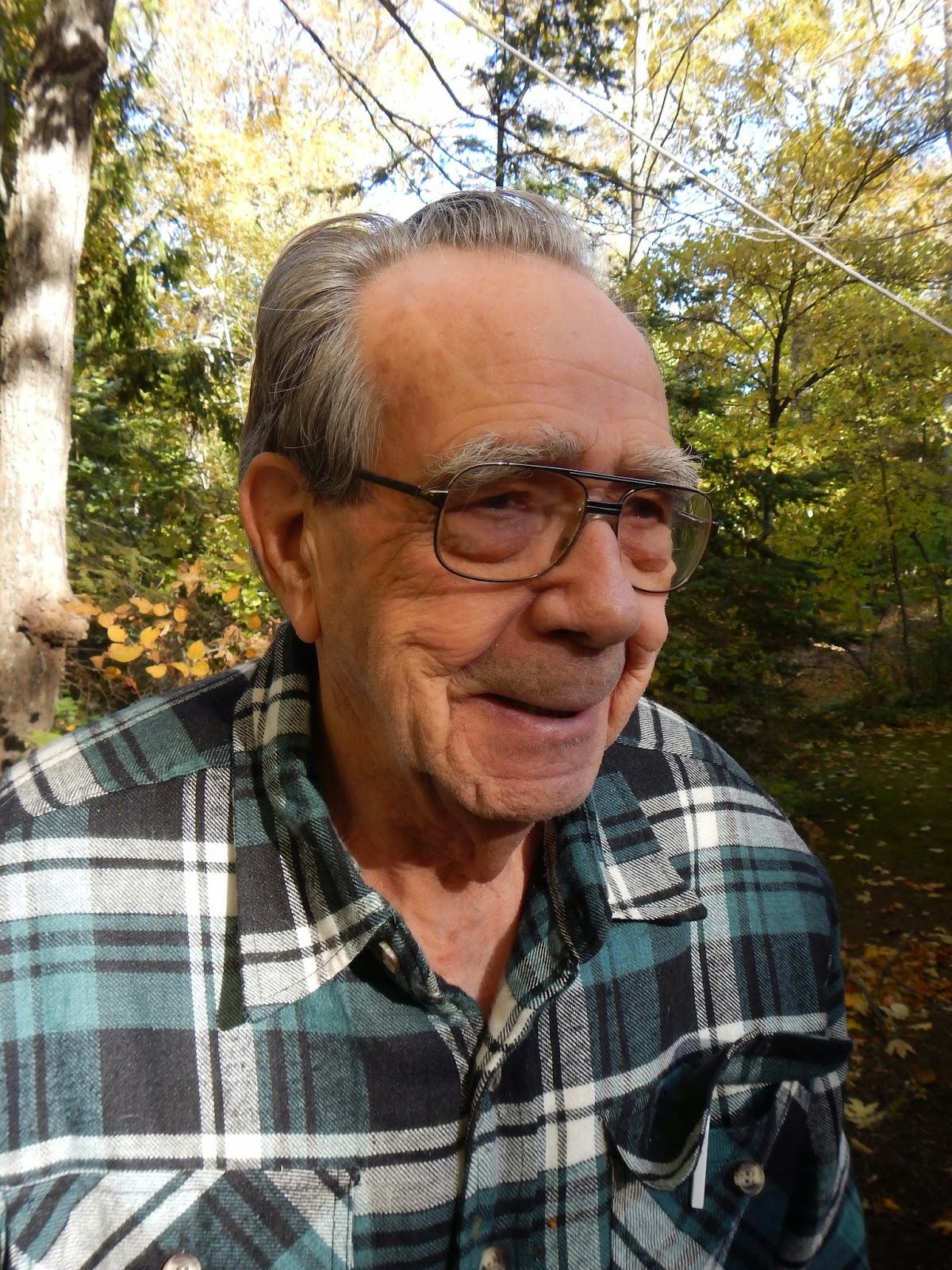
The following story was written in 2013 following an interview with James Gau at his home near the southern shore of Little Lake, where he and his wife, Marilyn, retired after teaching careers.   The impetus behind the story was Jim's participation in an honor flight, but also his known fragile health.   I asked if I could take several photos of Jim, and one then taken outdoors captured Jim smiling -  not that smiling was unusual for Jim.   He often smiled as he exchanged pleasantries at the Island post office, store or Ferry Line package counter.  But mostly, at least as I knew him, Jim's face appeared serious and determined.  

With his illness giving him a defined, short time to live, he moved to his daughter's home in Arkansas where he passed away October 28.  A graveside service will be held on the Island at a later date.  

With the recent Veterans Day in mind, the piece that appeared in a November issue of last year's Island Observer is reprinted below.  

Island Honor Flight Veteran Jim Gau 
       
By Dick Purinton

Island World War II navy veteran Jim Gau participated this past June in a special Honor Flight out of Appleton, Wisconsin.

Specially chartered flights to our nation’s capitol are arranged for veteran guests at no charge. Their day is filled with planned activities designed both to allow them the opportunity to view national monuments firsthand, and also to honor their military service by a showing of thanks.

Born and raised in DeKalb, Ill., Gau was motivated to join the service when he was still a young student. He recalled attending classes at a nearby teacher’s college while still in high school, believing it would help prepare him for the military. He earned sufficient high school credits for an early graduation and then joined up at age 17 under his father’s signature of permission.  His father, also named James, was an army veteran of WWI who tried to re-up when the United States entered WWII, but he was refused because he was too old.

In 1944 Gau attended boot camp in California, but he returned to the Great Lakes Naval Base near Chicago for basic diesel and advanced diesel classes. The knowledge he gained in his rate was so thorough that for a time that he was held back as an instructor at the Great Lakes Naval Training Center, rather than being allowed to transfer into submarines, his desired area of service.

Eventually, Gau served aboard the Pomfert, one of several dozen submarines built by the Manitowoc Shipbuilding Company for the war effort. When the war ended, and in his last month of active duty, Gau was assigned to help decommission ships in Apra Harbor, Guam, and for a time he guarded Japanese POWs.

Looking over momentos from his
Honor Flight trip.


Upon discharge from active duty he pursued a teaching career, but Gau continued in the naval reserve for approximately ten years. Then in 1980, following a career in teaching and school administration, he and his wife, Marilyn, who also taught, moved into their new Island home near Little Lake. They enjoyed many seasons of retirement together, surrounded by nature, before Marilyn passed away in March 2012.

“I had a call one day in April, from someone I didn’t know, who asked if my military service number was 301831. You never forget your service number, “ Gau said. “She told me they were holding a seat for me on an Honor Flight.”

Although he was unable to accept the first suggested flight date, “she kept me on the list.” Gau was then rescheduled for the June Honor Flight.

Gau recalled that morning, when he and the other WWII veterans gathered at the Appleton airport. He had spent the night in a nearby Appleton hotel where approximately 40 other out-of-town veterans also stayed. It was a short night’s sleep with an “early reveille,” he said, before their bus ride to board the 5:30 a. m. flight. 

The sense of welcome for the WWII veterans was already in the air at that early dawn hour, an atmosphere that followed his group throughout the day. When their bus arrived at the Appleton airport, they were greeted by well-wishers, a crowd of young and old that included uniformed Army personnel. They each received an Honor Flight tee-shirt and met their personal flight guardian. Cathy Konen, an Appleton resident, introduced herself to Gau, and she remained by his side throughout the day until their plane returned that evening. The pilot greeted the veterans, welcoming them aboard before taking off, and once in the air, they were served breakfast, then snacks. In all, his plane carried 98 WWII veterans, three of whom were women veterans who had served as military nurses, plus the guardians.

Their arrival in Washington, D. C. later that morning was once again festive and patriotic. A military band played as they were ushered through airport corridors, and East coast greeters lined up to thank them for their service.

“Each time we got on or off the plane, there were crowds of people we didn’t know,” Gau said. “It was heartwarming.” 
Three large buses fitted with wheelchair lifts transported the veterans through the Capitol, circling slowly several monuments before parking near the World War II Memorial. A U. S. Army Drill Team performed precision maneuvers for their appreciative audience. 

Photos from the day’s activities were later assembled by Gau’s guardian as a momento of the flight. On the closing page of Jim Gau’s album was inscribed the following:

      It was an honor and a privilege to be your Guardian on the Old Glory Honor Flight. We had a wonderful day and I’m so happy I got to share it with you. I think we really had a great time!  God Bless - Cathy Konen, honor flight guardian

Before boarding their flight that morning, Gau had learned that Konen’s husband was a cancer patient. He asked if she didn’t need to stay home to assist her husband, instead. 


“He insists that I go, that I do this,” she replied.   Konen and other guardians have flown many times, whenever an honor flight allows them the opportunity to serve veterans.

   -  end - 

Friday, October 17, 2014

NICOLET LEGACY: TIME TO RECONSIDER?


Washington Island, Wisconsin -

When I've read about our early history, whether as a boy or more recently, my fascination with the earliest European explorers was kindled.  A part of that, I think, is because my family occasionally stopped on our way to Green Bay at the roadside memorial to Jean Nicolet along highway 57, near Dykesville.  I imagined Nicolet stepping ashore, his arms aloft, firing his pistols as I had seen in a painting reproduction.

French explorer Nicolet was in 1634 supposedly the first white man to visit Green Bay waters and come ashore, and that statue and painting were strongly etched in my mind.  Dressed in a splendid red robe with what appears to be gold applique, his show of fire power as depicted by the artist caused natives to cower in fear and uncertainty, and listen in awe to his message of greetings.  Nicolet's pistol attention-getter would have preceded the message that these inhabitants were now subjects of New France.  Then Nicolet, or a priest traveling in his company, would very likely have baptized the heathens into membership in the Roman Catholic Church.

Memorial to Nicolet that was erected
along Highway 57 near Red Banks,
near what is now near the town
of Dykesville.

Over the years, a Wisconsin bank, a high school (perhaps more than one), a Wisconsin National Forest, the Rhinelander Technical College, a restaurant and perhaps many, many roads … were named for this explorer as a way of honoring his visit, Wisconsin's earliest European connection.

Never did information contradict this general view of Nicolet's  appearance along the shores of Green Bay…until now.

Ronald J. Mason, Lawrence University, carefully points out corrections to the record in his article "Where Nicolet and the Winnebagoes First Met," published in The Wisconsin Archeologist (2014, 95(1):65-74.  Mason, a Professor Emeritus in Anthropology and a name familiar to Rock Island and Great Lakes anthropology, uses scholarly language and exacting logic, to be expected.  To paraphrase his article here will seem incomplete and lacking in respect for the supporting statements Mason makes.  Mason is most careful to close loopholes in his challenge to the existing notions of Nicolet's journey.

However, condense we must, and using his information we begin with his opening statement, one that sets the stage for a convincing argument:

 The surviving descriptions of Nicolet's 1634 or 1634-1635 exploration west of Lake Huron were not written by the explorer himself, but by the contemporary Jesuit fathers Paul Le Jeune and Barthelemy Vimont in subsequently edited segments in published collections of extracts from the annual reports of the Jesuit mission in Canada.  These substitutes have thereby become the definitive sources on Nicolet's travels.

A number of years passed, according to scholars, between the actual 1634 exploration and the written compilation of that accomplishment, based, it is presumed, on a journal of Nicolet's that might have "later been lost."  What survived may have been "delivered orally or in writing."  Mason cautions about the sources:  "However that many (years) have been, the record of where the explorer actually had gone has survived only indirectly and partially, thus requiring a measure of diffidence not always exercised by scholars appealing to it in their own reconstructions of history."

The descriptions of location that survived, then, "apart from the few snags in translating seventieth-century French" of which Mason gives examples, are a much closer fit with the rapids of Sault Sainte Marie, which is a major river that opens up to "the little lake," possibly today's Whitefish Bay, and then to a "second fresh water sea," most likely Lake Superior.   Information about a such large inland sea would have come from the earlier explorations of Champlain.  Mason writes, such "knowledge doubtless communicated to Nicolet before his departure, of the existence of such a big, even if not yet formally named, lake beyond Sault Ste. Marie…depicted on both the 1616 and 1632 Champlain maps."   Certainly Nicolet would have taken advantage of all prior knowledge before setting out on his journey.

One "snag" that may have thrown off earlier scholars, Mason acknowledges, was the notion that Nicolet met with members of the Menominee and Winnebago tribes.  Formerly scholars believed this would eliminate Lake Superior, but not the shores of Green Bay which was traditionally where scholars believed those people called home.  Mason takes pains to describe the various tribes inhabiting this area, their various native names, and those names given by Nicolet (who was fluent in Algonquin dialect).  It is also possible, Mason thinks, that one named native group could have been confused with another, and also that Nicolet may have repeated names he overheard that were commonly used by those he met to describe "diverse foreign groups" of natives.

Mason also points out hat natives may not have been closely associated with just one geographic area, as we might assign them today, or that this area may have changed over time.   We think of Lake Winnebago today as being the traditional home of the Winnebago people (why else the name?) but naming on a U. S. map shouldn't exclude the possibility that members of this tribe, or the entire tribe for that matter, might have traveled or lived elsewhere, well beyond a location that we may today consider their geographic or tribal boundaries.  Purposeful relocation (or displacement forced by other tribes), or trading opportunities with other tribes, or seeking a more plentiful food supply might also have been real reasons for moving about.

Mason writes:

This does not mean that Lake Superior was the "homeland" of the Winnebagoes and that they did not inhabit other areas instead or as well.  It simply and importantly means that Nicolet met Winnebagoes in 1634 on the shore of Lake Superior and not on Green Bay or Lake Michigan."

A part of his argument Mason bases on his extensive reading and study of the various ethnic cultures of the Great Lakes. He then cites the description of Father Claude Allouez, who wrote "some thirty years after Nicolet, about the cosmopolitan habits he witnessed on Lake Superior":

The lake is, furthermore, the resort of twelve or fifteen distinct nations coming, some from the north, others from the south, and still others from the west;  and they all betake themselves either to the best parts of the shore for fishing, or to the islands, which are scattered in great numbers all over the lake.  These peoples' motives in repairing hither is partly to obtain food by fishing, and partly to transact their petty trading with one another when they meet.

The geography of his travels as described by Nicolet (and compiled perhaps years later by his transcribers) depicted "a great river."   Mason points out that neither the Fox, Menominee or any other Green Bay river meets the true test of a "great river." But, the St. Mary's River that connects Lake Huron with Lake Superior would so qualify.   Had Nicolet found Green Bay's Fox River, its mouth near the present city of Green Bay, Mason believes Nicolet would surely have been informed by natives of the relatively easy route up the Fox, and the short portage to the Wisconsin which flows to the Mississippi River.

Readers may say, "What difference does it make, after all?"

It's unlikely that an institution in northeastern Wisconsin will change its name in light of new scholarship from Nicolet to something else, especially when that name was based on an historic event that for many years has been unassailable.

But, Nicolet's expedition is a record unknowingly embellished through the years by honest people who repeated mistaken assumptions.

Those assumptions have led, among other things, to the erection of a bronze statue and an accompanying historical plaque (as I remember these were made possible, in part, through funding by penny donations from school children).  A consideration by state highway officials to move or raze this monument was challenged by newspaper readers before the highway underwent reconstruction a few years back.  I believe it can still be seen from the highway, if you look carefully as you drive by at 65 mph.

And then there are the historic oil paintings that became popular and lasting records of Nicolet's exploits, great teaching tools to tell "the Wisconsin story." But, what if they depict the wrong geographic location?  One such painting, by Hugo Ballin, hangs in the Governor's Reception Room of the State Capitol in Madison.  A similar painting, in which Nicolet is again displaying his authority with raised pistols on behalf of France, was commissioned in 1904 by then Wisconsin Historical Society President, Robert McCormick, with artist Edwin Deming.

Such well-intended efforts perpetuate the erroneous assumptions made over generations, dramatizing errors made by earlier scholars.  For his research and his boldness, it may be Mason who deserves a monument!

 -  Dick Purinton


Saturday, October 11, 2014

ISLAND TIME BOOKSHOP CHANGES HANDS

Kathleen Dixon, left, will soon turn the keys to her store over to new
owner Deb Wayman.
Washington Island, Wisconsin -

When Island Time Books closes on October 15, Kathleen Dixon will retire from the business she started 11 years ago.  The shop's new owner will be Deb Wayman, who was on hand in the closing days of the 2014 season to meet customers and learn about the business in preparation for next year, when she'll reopen the store Memorial Weekend.

Her customers would liken Dixon's personality to that of a speed reader:  rapid, engaging conversation, seldom dropping in velocity, filled with information; a scanning of authors, books, and events; the trending of reader habits and the book industry - all within a short visit.  But, because of her love of what she does, Kathleen's been a great resource, and for those same reasons, her customer base, both regular and the drop-in visitor, has grown over the years.

Retiring after 30 years as an emergency trauma nurse - much of that time as a member of an ambulance crew - Dixon started a new pursuit as the owner of Island Time Books.  For two years it was located on Main Road across from Karly's, and then for the past nine years in its present location, nestled between the Red Cup and the Island Post Office.  As anyone visits with her knows, her mind is rapid-fire, enthusiastically promoting authors, books, her store, and the Island.

She's always loved books.  "We were readers.  My sisters and I used to walk to the libraries," Dixon remembered, noting the many neighborhood branches of the Chicago Public Library in the city where she grew up.

"Day trippers and others are thrilled to see an independent bookstore, with good coffee next door," she said, "great for browsing on rainy days.  They like the Independent Bookstore list that comes out monthly, with its many new recommendations."

Dixon prides herself in the fact she could recommend books to readers who least expected to find such a wide range of titles in so small a shop - on an island, no less.   She would often special-order books requested by visitors who stayed only a week or two, receiving their requests within two days via UPS.  Many loyal customers, she noted, buy books at the close of the season to read during winter.  Physical books, as opposed to e-books, she noted, are still very much a part of the public's reading habits.

Dixon kept current on new titles and authors, in part, by attending the annual Key West Literary Festival, where many of the nation's leading authors would gather each January.  (Key West was her former winter home, but she's now moved to the Naples area.)  At the Key West Festival, Dixon volunteered for several years at their book sales table, in addition to being a registered participant.  She's a member of the Island Literary Festival committee, involved since its inception.

This winter Dixon and Wayman plan to travel to the American Booksellers Conference in Asheville, North Carolina, where Dixon will introduce Wayman to her industry friends and contacts.

Dixon still plans to visit the island in summer.  "I'll be back," she said.

New owner Deb Wayman and husband Bob, an engineer and production manager, own a summer place along the eastern shore of Washington Island, on Wickman Road.  However, their year around home will continue to be York Center, Illinois.  Their two children, Alan, 23, and Shelby, 20, are enrolled in college.  


-  Dick Purinton

Thursday, October 9, 2014

WHAT'S NEW ON THE WATERFRONT

Shown on the former Hansen / Standard Oil pier are Ferry Line
Vice President Rich Ellefson, Coastal Engineer David Wentland
and Ferry Line President Hoyt Purinton.
Washington Island -

Changes may appear to happen slowly on Washington Island, but they do happen.

The major news in this entry is about a change of hands on the property that was Ray Hansen's, most often referred to as either the Hansen Oil or Standard Oil property.

The pier and the upland property that supported the oil storage and transfer business, so critical to the island these many years, had been cleared of tanks and associated pumps and piping quite a few years ago, when storage was moved to a new Hansen tank facility near East Side Road and Town Line Road.

Except for an old shed containing a few related fuel transfer items, and seasonal boat moorings, the property has been mostly vacant since that time.

As adjacent landowner, and a business dependent upon water frontage and mooring for its vessels, the Ferry Line had expressed interest in purchase of the property, a transaction that was accomplished in the early days of the fall season.

While no long term plans have yet been made, initial efforts will stabilize and repair the pier.   Coastal Engineer David Wentland, of Docks & Marinas, Inc., Green Bay, will offer a plan on how best to repair the pier, work that could be done yet this winter from shore.  Attention will then be turned toward the treatment of upland property, how to best to mesh with adjacent properties, and whether safe public access opportunities, such as pier fishing, can be included and managed.

Historical note:   Hoyt Purinton, great grandson of J. W. Cornell, received the Title papers on the property intended to be purchased September 12, 2014.  This was exactly 104 years - to the day - from the date when John W. Cornell purchased the same land from Bo Anderson and Ole Christiansen.  Cornell, we presume, later sold to Standard Oil, and more recently the title was transferred to Ray Hansen who assumed ownership of the property along with the Standard Oil distributorship he already managed.

Season about to close

This week marks what for all purposes is the last of the "busy" fall tourism weeks, although we anticipate lively traffic yet through the end of the month, especially while fall colors are vibrant.

Our schedule for the ferries to and from Northport cuts back Oct. 20 - from eleven to six trips.  Many island retail shops will soon operate with curtailed hours or days of the week.   The Cherry Train - an air conditioned ride that can be miserably cold on certain fall days - is nearing the end of its 2014 track, soon ready to head for the roundhouse.  And at Jackson Harbor, the Karfi's schedule to Rock Island ends Monday.  Columbus Day is the last day of service.


I took my last turn at the Karfi's wheel Tuesday with Tony Woodruff as my crew.  The time seems to fly each one of those days I've been aboard.   I've enjoyed the full schedule of Rock Island trips - when campers and piles of gear await us on the docks at either end for a quick turn-around - as well as the softer fall schedule, when Tony and I pass the time between trips talking sailboat designs and past cruises with nostalgic regret for the short summer just passed.  (If we were tuned in to the ice boating season, our regret would soon be replaced!)

The fall weather and shorter days make the realism of camping or tramping on Rock Island less appealing to visitors.  It was just yesterday (Wednesday) that high velocity westerly winds and the small handful of Rock Island travelers, led to cancellation of the afternoon's two trips.   But overall, 2014 ferry traffic made it a good tourism season, and we look forward to seeing the next one roll around.

Apple cider at the Farm Museum and the Fall Harvest Festival Dinner at Trinity mark two major events on the island this weekend, paired with outstanding tree color everywhere.   Hardly any leaves have so far fallen, and the tree colors now may be placed in the 40% range, turning much later than many other island autumns.   There are still plenty of great fall days to enjoy.

 -  Dick Purinton

ISLAND LITERARY FESTIVAL 2014 - MULTIPLE SUCCESSES

Marnie Mamminga, author of Return to Wake Robin, talked about
her family's history at their cabin near Hayward, Wisconsin.
She was one of many writers who spoke at the recent
Island Literary Festival.    

Washington Island -

Eleven authors / writers were featured at the recent Washington Island Literary Festival, the second year of the event.   It was a success in several ways.

First, besides drawing writers of considerable acclaim to this event, readers were also attracted, along with aspiring writers interested in learning from veteran writers.   The range in talent and material presented was wide:  poetry, fiction, non-fiction, investigative journalism, personal memoir.   There were plenty of opportunities to meet and speak with individual authors, and to hear them read and comment on their work.  Several workshops were held prior to the main presentations on Friday, October 3, and these were also well received by those who signed up for them.

I attended Max Garland's poetry workshop and learned from his comments and easy manner regarding his own work.  Garland is a professor at UW Eau Claire and also the current Wisconsin Poet Laureate.   Afterward, I followed him to the Island School where he spoke to freshmen and sophomore students about why poetry matters, the forms which it may take, the human need for poetry, and how it provides an important means of self expression.

Although I consider my own skills to align more closely with journalistic writing and reporting (such as I'm doing here) I can't deny the interest and mystery poetry seems to hold as an outlet for expressing ideas either too complex or too difficult for linear writing.   I'd like to think that Garland's school visit will have planted a seed or two that some day - perhaps some decade - will inspire those present to seek their own expression through one of the many shapes and forms loosely identified as poetry.

Presentations during the three-day festival varied from a panel discussion to author readings followed by question and answer, but always there were plenty of opportunities to engage an author backstage on a one-to-one basis.

Guest authors were provided courtesy lodging, and Mary Jo and I were pleased to host Larry Watson and his wife, Susan.   Aside from the fact that Larry's birthday is just one week and one day before mine (I learned we were both born in 1947), Watson's book Montana 1948 remains a favorite book of mine.   I've recently read several of his books in fact, and I enjoy getting inside the lives and minds of his characters on the Montana and North Dakota plains, a spare and tough people with few frills in their lives.   It reminded me, as I read them, of my grandparents and their neighbors farming stony land on Old Stage Road near Sister Bay in the first half of the 20th Century - minus the violence that frequently emerges in Watson's characters.

Adam Schrager, a Madison television news journalist, described in his book Sixteenth Rail the
crime, investigation, capture and prosecution of the Lindberg kidnapper, using
the advanced science to examine the homemade wooden ladder used
by Bruno Hauptmann.    


I particularly enjoyed Adam Schrager's presentation of his book Sixteenth Rail, the story of a meticulous solution to the prosecution of the Lindbergh baby kidnapper by Arthur Koehler, leading wood scientist of his day, who worked at the U. S. Forestry Laboratory in Madison.  Koehler's examination of the kidnapper's ladder came amid tremendous pressure from the public and the press to nail key suspect Bruno Hauptmann.  Schrager's logical and easy-to-read book provides a fascinating look at the rise of exacting science in crime investigation to solve the nation's most publicized crime.

Poet Laureate Max Garland visited with freshman
and sophomore students at school.

Festival venues were varied.  The Farm Museum Barn, the recently reopened Washington Hotel, the Red Barn, the Island Dairy - all were utilized in addition to the TPAC, where main events were held.  At the TPAC, between events blocked for speakers, the Backstage Bookstore featured books for sale with the authors on hand to sign them.

The Literary Festival is far from a strictly "highbrow" weekend.   Events are accessible for anyone who enjoys reading, writing, or who aspires to do more of each.  Next year's festival dates have yet to be set, but several themes are being considered along with possible author names, and we're confident, based on the success of the past two festivals, an exciting slate of writers and poets will again be attracted to Washington Island.

We should also mention that the Literary Festival's goals and efforts are closely joined in spirit with Write On Door County!, an organization that fosters writing at their center near Judville.  Anne Emerson is founder and creative force, and Jerod Santek, Director.  Both Anne and Jerod were participants in this most recent Literary Festival.  Collaboration between these two organizations will help in highlighting writing as a creative force, and in the encouragement of new and aspiring writers.

 -  Dick Purinton

Friday, September 19, 2014

washington island high school class learns about blogs

Students of Washington Island High School American Literature class:
Finn Hagen, Korrina Ervin, Shammond Ervin, Hailey Jorgenson, Elena Waldron,
Bradley Jordan, Alex Johnson, Ben Johnson, Josh Ervin, teacher Mrs. Nehlsen
and classroom aide Karin Baxter.

Washington Island Island High School -


The nine members of teacher Leila Nehlsen's Washington Island High School American Lit class invited me to speak about blogs today.

They've been studying Thoreau, Emerson and the Island's own Jens Jacobsen…about nature, journals, and self expression that can be published, or not, that often speaks to issues others may be interested in, too.

Their field trips and reading focused on personal thoughts and ideals, individualism that represents their own special gifts and talents, yet with the potential for being instructive and universal in their appeal to others.

There is something to be said for hands-on learning that textbooks may not necessarily provide, and certainly nature is one stimulus for that reflection on individualism.

Earlier, students had cut out their silhouette profiles, and these were posted in the hallway paired with quotes, for example Thoreau's "If a man does not keep pace with his companions, perhaps it is because he hears a different drummer.  Let him step to the music which he hears, however measured or far away."

We also spoke about being careful in what we say and how we say it, and the "forever out there" permanence of the web.  With their assistance, I published this blog (with edits later) from their classroom.

 - Dick Purinton

Tuesday, September 16, 2014

AMONG SPIRITS


Three groups of 30+ each listened raptly to eight 
Island voices at Sunday's Cemetery Walk.
Washington Harbor, Island Cemetery -

The third Washington Island Archives Cemetery Walk held Sunday, Sep. 14, brought eight Island personalities from the past back to life before an audience of more than 100.

The Green Bay Packer organization held off Sunday's start time at 3:25 out of respect for this Island resurrection, making it possible for fans to participate in both events.   The September weather was pleasant, the monologue scripts summarizing each life were excellent, and the actors who delivered the messages did so in convincing, entertaining fashion.

The eight Islander profiles chosen, along with their respective actors, are shown in photos below.   In many instances, the likeness of the presenter to the person they portrayed was uncanny.  The many accomplishments of the persons chosen, and their contributions to Island life, absorbed within a two-hour program, was overwhelming.  These were tireless organizers, heads of families, champions of causes, successful in ways that lasted far beyond the grave.  

According to Island Archivist Janet Berggren and her staff of volunteers, over 100 programs were given out to a crowd divided into three groups.  Each circulated the short distance between headstone locations, spending approximately 15 minutes with each spirited actor.  The entire event was completed by 3:00 pm, in time to watch the Green Bay Packers get buried, then miraculously come to life again against the New York Jets.  

Julian Hagen sang his new song, written
especially for the occasion:
"From A Spirit's Point of View"


Archives President Eric Greenfeldt portrayed
his great-grandfather J. W. Cornell (1865-1952).
Research/Script by Eric Greenfeldt.


Jens Hansen portrayed
Christ A. Hansen (1856-1936).  Research/
Script by Charlotte Hansen.
Chuck Sena portrayed Nels Friis (1850-1923).
Research/Script by Connie Sena.
Neil Shadle portrayed Will Jess (1869-1938).
Research/Script by Merrill Lundberg.
Lillie May Shadle portrayed Janet Burgoon (1900-1989).
Research/Script by Kirby Foss.

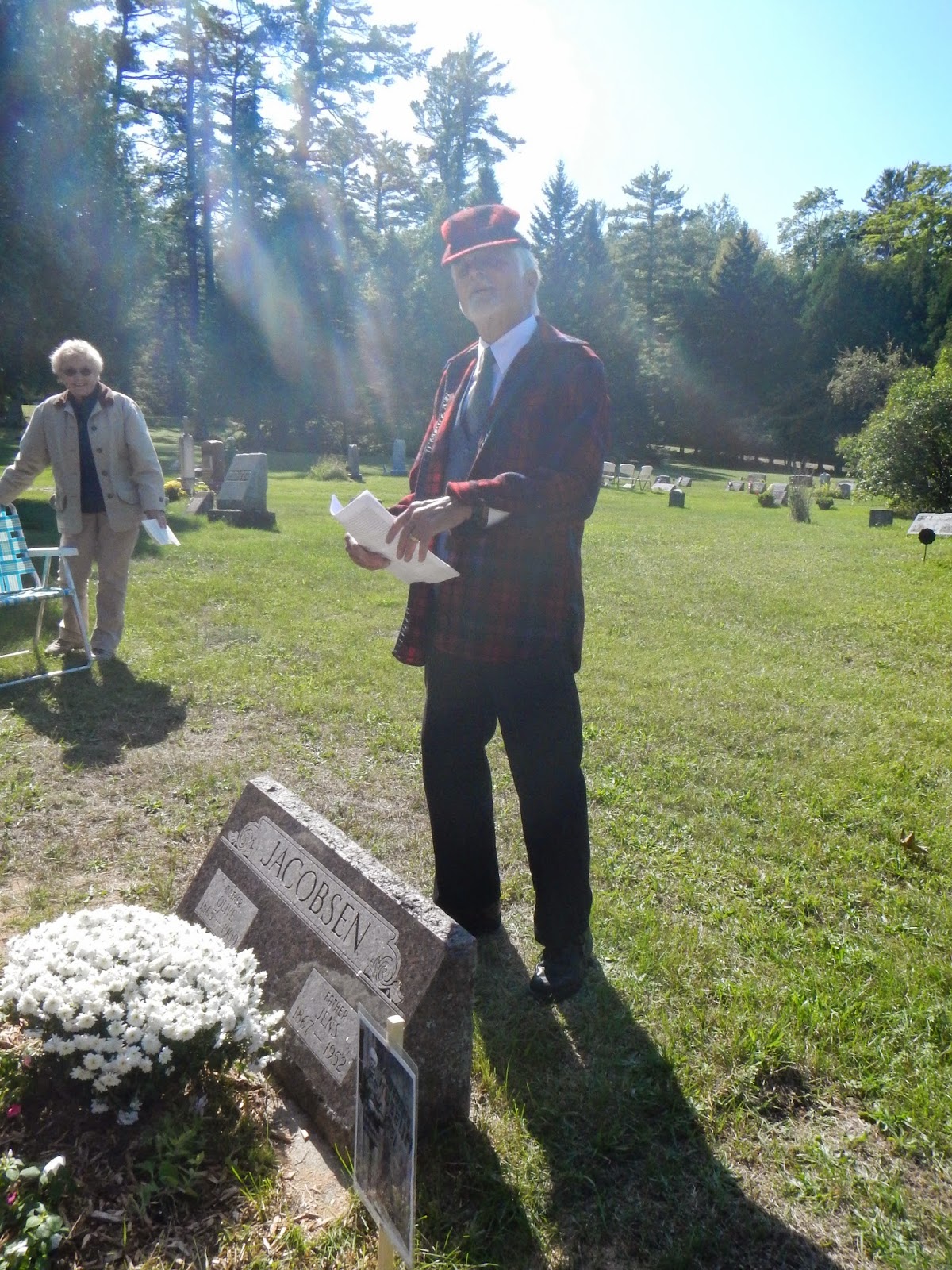
Terry Henkel portrayed Jens
Jacobsen (1867-1952).   Research/Script
by Jewel Lee Grandy.
Joyce Morehouse portrayed Martha
Stelter (1914-2009).  Research/Script by
Jeanie Young.
Tony Woodruff portrayed Tom Nelsen (1871-1960).
Research/Script by Dave Raup and Grace Woodruff.

Saturday, September 13, 2014

SHIFTS IN THE WEATHER

Dark clouds, distinctive rays and backlit vegetation
made for an interesting sunset at the Bayou the
day before our weather became stormy.
Detroit Harbor, Washington Island -

Maybe I've waited too long to publish these photos, because the weather has been in continual flux since they were taken.

First, we experienced warm and humid weather in the high 70 degrees (high 80s in much of the midwest) leading to violent storms and great rainfall amounts. Then starting with Thursday, Sep. 3rd, flooding occurred in areas where flooding is rarely seen, towns such as Baileys Harbor.   Trees were downed, and creeks, rivers and swamps were filled with runoff.  

Dramatic squall line between powerful rain cells
as the stormy mass moved across Detroit
Harbor in the early afternoon. The low pressure
remained to our west and moisture then circulated
from east to west over northern Lake Michigan.   
At our home we experienced power interruptions, frequent during the height of the storm, but never for more than about 20 minutes.   The REA crew stayed on top of downed trees to keep power supplied locally, but the Peninsula experienced wider and longer outages, some for close to 24 hours.

We were in Karly's for a hamburger before the first wave of the storm hit, taking in with us a slicker just in case, because the radar showed a massive storm cell was headed our way.   I had begun working on my french fries when the power went out. The deluge intensified outside, with heavy, tropical-like rains at times.

This pattern continued throughout the night of Sep 3, on and off.  As one large cell passed over, or split and went north and south, another just as large and intense formed inland to the west, taking its place in the sequence.  Around 8:30 pm, with island power temporarily out and an intense squall in progress, Hoyt and Rich were called on to make a special medical emergency trip.  

The Packer game in Seattle that same night wasn't impacted by Wisconsin's weather, but our TV viewing was.  Frequent, but brief, outages had us listening to part of the game on a battery operated radio.  It was a good diversion from a game that in many ways echoed the night's weather:  a relentless pounding.

Patrons supped contentedly at Karly's, unfazed by the
power outage, as heavy rain fell outdoors. Tim stated
the power would be back in 20 minutes - and it was.
This moist air mass began well to the southwest, Oklahoma and Nebraska, through Iowa into Minnesota, Wisconsin and Michigan.  Rather than this large humid air mass being pushed briskly to the east by a cold, high pressure air mass, which is often the case, the winds remained southerly, and we enjoyed a few more days of pleasant, warm summer weather before the pattern seemed to repeat itself.

One week later, Sep. 10, stormy skies reappeared, this time with less rain but more wind - gusts in the 40+ mph range for ten hours or so.  When the cloud cover finally eased a day or two later, we found ourselves in a high pressure system with fall-like temperatures: mid-40s by night, daytime highs in the lower to mid-50s.  

This change provided a good reason to get the pellet stove going and shut down basement humidifiers.  The drying warmth felt good, both the real heat and the psychological warmth a fall fire can bring.

Photo taken by wimpy photographer aboard the Robert Noble.
 I rolled down the window for this one as we headed through the break wall
and into the NW gale.  Temperatures dropped 10 degrees in one hour,
and winds picked up dramatically in late afternoon,
Wednesday, Sep. 10, but all ferry trips were completed.

Yes, fall is firmly in place.  The bow hunt for deer season begins today, and I believe we heard blasts from a goose (or turkey) hunter early this morning.  Several maples now show signs of bright colors, and our fields suddenly seem to have lost their summer green.  Plants are in the latter stages of production.  High bush cranberries are turning a bright red.  

Many great days lie ahead, however, and it's a time of year that many of us prefer to any other: sweater weather.   Still pleasant enough for just about any outdoor activity of your choice, at least during the middle part of the day.

Time to get out and enjoy it!  -  Dick Purinton

Thursday, September 4, 2014

ISLAND LITERARY FESTIVAL COMING UP!

Washington Island -

Today's blog entry is meant to serve as a reminder to anyone who enjoys reading, literature and poetry, and having an enjoyable time meeting others with similar interests - including noted authors and poets!

Registration has been ongoing, but after September 15th the registration price increases from $75 to $90.  You can register online (go to the TPAC website and find the Literary Festival pages), by mail (TPAC, PO Box 36, Wash. Island) or stop in and see Kathleen Dixon at Island Time Books.

I should emphasize that this year the program offers an opportunity for several workshops.  I'm looking forward to the poetry workshop with Max Garland.

The poster above should have a slight yellowish background tint, but for some reason my printer cartridge (even with a new one) came out pinkish.    The photos and information is still clear, however.

I look forward to joining you at the 2nd Island Literary Festival.  Lots of great names, great books, and an enjoyable time awaits.   -  Dick Purinton

Monday, September 1, 2014

MESSING ABOUT IN BOATS

Rigging for a sail on a light air day -  
Michael Kuharski and his canoe trimaran.
Jackson Harbor, Washington Island -

While getting ourselves ready for our first trip on the Karfi a couple of weeks ago, we watched Michael Kuharski of Madison prepare for a sail from Jackson Harbor's launching ramp.

Michael's rig is a one-of-a-kind, which he says was an idea that came about over time, modified through experimentation, and he's never through with tinkering to improve its performance.  The center hull is a Mad River canoe, and he obtained the pods for the outriggers from a company out of Minnesota that made a proa-type sailing boat. From all appearances, these were made to match.

The first time I observed Michael getting his gear in order on the beach was last year.  With his portable drill in hand, I observed from a distance as he fastened the struts together - struts that held the pontoon pods in place.

Like many other onlookers, I'm sure, I expected very shortly to see a show once he nosed into the bay and experienced that first, strong gust of wind.  It was blowing fresh from the NW, and there were 2-3 foot waves with whitecaps.  Michael didn't disappoint me in terms of putting on a show - but it was a clinic, and not a show, as it turned out.  He tacked back and forth to Rock Island effortlessly, multiple times, having great fun in winds I thought would overpower him, a breeze somewhere between 15-20 mph.   He often stood up on the decks, or in his canoe, to balance his craft and to maneuver more easily.  At no time did he ever appear to be "out of control," or was his craft put in a precarious position.  When he got in a tight corner near shore and needed an extra boost to come through the wind to tack, he stroked a few times with his paddle to help bring it around.

His sail has a Sailfish insignia on it, and along with a small foresail, this is sail area aplenty.  He handles it well, as he does his craft, screaming along on reaches with little-to-no wetted surface to slow him down.  The day before I took these photos, he told me that he sailed in winds at least 25 mph, and he had fun doing it.

He spoke of his experimentation in reducing wake by the accidental adjustment of his outrigger pontoon, and centerboard position, partly the happy result of an accident in which one strut broke.  His repairs improved performance.  He's a confident sailor, enjoying what he's built, and I would add that he's also quite fit, scampering about on his craft with the agility of a youngster (I'd guess he's mid-60s).

It shows what fun one can have messing around in a small boat, and in this case, Michael's trimaran is one I would label a "high-performance" craft.  

Nutshell Pram

My Karfi partner and crew many days this summer was Tony Woodruff, a sailor who enjoys recreational sailing about as much as anyone I've known.  He often often rigs his catboat for a sail after work hours, or on his days off.

Last week, as crew member Carl and I prepared for our last trip to Rock Island, Tony (who had that day off) was preparing to launch his home made Nutshell Pram, a Joel White design.  He said that it took him a few years to put together, but the result is a stunning little craft.  Neat as a pin is an apt description of this boat, which Tony proceeded to row out to his mooring and tie off to the stern cleat of his catboat, where he put up sail.

I spent quite a bit of time at an earlier age, when I existed in much smaller dimensions, learning to sail in an Optimist Pram, 7-footers owned by the Sturgeon Bay Yacht Club for the purpose of teaching sailing.   These were rather poor boats to sail, with hard chines, flat bottoms (notorious for leaks along the seams), an inefficient gaff-sprit rigs, outboard rudders and  centerboards that could be quickly adjusted by hand.   Not especially good on the wind, they were still fun when in company of a dozen other boats, all headed for the same mark at about the same time.  Lots of pushing off one another, taking advantage of chances to steal one another's wind, these were tactics employed when we needed to get to the finish line first.

Tony, about to get underway in his Nutshell.
I alternated between that sailing activity and a 19-foot family sailboat, and running around the bay in a 12-foot, wooden Shell Lake motorboat powered by a 7.5 hp Evinrude.

I couldn't have been happier on the water, and I often think I could still be happy playing around in such a small boats…its just that it's much harder to maneuver today in a boat that has a beam of not much more than three feet.

-  Dick Purinton