Monday, March 14, 2011

SECOND CHANCE FOR ISLAND PERFORMING ARTS CENTER

TPAC Building Committee members Jay Ward (L) and John Chapman
review details of conditional State-approved plans.  These men, plus other Board
members, have volunteered hundreds of hours to bring successful resolution
 to a building that has been unusable since late fall of 2009.
(Purinton photo)


 - Main Road, Washington Island, Wisconsin


REPAIRS UNDERWAY AT THE TPAC

A remarkable process is underway at the Wilson and Carol Trueblood Performing Arts Center located south of the school campus on Washington Island’s Main Road.  

After having been closed for fifteen months, solutions to the various physical building problems identified by the State and the TPAC Board are being addressed.  Provisional State plan approvals have been given, contractors were selected, and repairs are now well underway to restore this structure as a useful, vital island facility.

The Trueblood Performing Arts Center (TPAC) had been closed since November of 2009.   At that time, a Wisconsin Department of Commerce inspector red-tagged the structure after water had been observed seeping through the single-block walls and a critical structural design defect had been identified.   Once red tags were posted on entry doors, no one except remediation engineers, contractor representatives, and representatives of the TPAC Building Committee have been allowed inside. 

Several weeks ago, three men from the Oscar J. Boldt Company, headquartered in Appleton, WI, including hands-on supervisor Greg Voss, began the strengthening process for key structural components.  All of Boldt’s work could be accomplished from within the building, despite winter weather, thanks to painstaking engineering and planning.  Because of their ability to work daily inside the building, Boldt's team will complete their phase of repair work by the end of March, after excavating through existing concrete, pouring several new concrete piers, and installing 8" x 8" steel columns that will accept the load from the two roof trusses. 

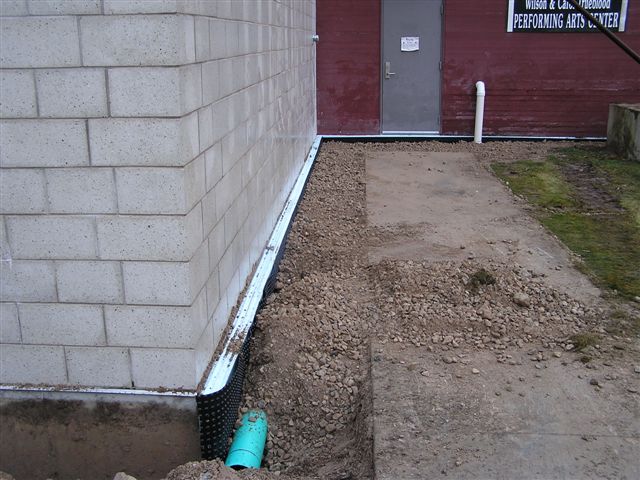
And before Boldt arrived on scene, island contractor Tom Jordan had completed most of Phase I, which consisted of digging away fill material in order to insulate the foundation’s exterior.  New plastic piping was also laid, adjacent to the building’s north and south walls, to divert problematic ground water.  Signs of concentrated roof runoff and ponding was discovered, believed to be a source of moisture discovered within underground heating and air conditioning vent ducts.   These problems have now been addressed, along with improved insulation for air handling components.

Tom Jordan dug a trench in November along south TPAC wall, observed by TPAC Board member Emmet Woods looked on.  Two-inch foam insulation was buried, 24" deep against the foundation and 16" outward, as frost barrier.   Exterior metal bracing will be removed prior to the erection of
foam panels and metal wrap system in April.

(Progress photos by John Chapman)
North TPAC wall with insulation added to foundation, and drain pipe
(green plastic) buried to divert runoff from "saddlebag"

roof that formerly flowed from single, white roof drain pipe
onto a splash board.


The final phase of repairs will begin in early April on the exterior walls as spring weather improves.  Structurally, the blocks and mortar of the exterior walls were determined to be sound through exacting lab "prism" testing.  Capillary passage of moisture through mortar joints, not gaps or obvious openings, had permitted penetration of rainwater through the walls.  All  solutions considered pointed toward waterproofing the exterior of the building's walls.  At the same time, improved insulation will be obtained.

The outer walls will be “wrapped” in 3-inch thick foam panels.  The metal-clad foam panels, in turn, will be covered with unique metal sections of deep-corrugated design.  This outer wrapper will shed water and further eliminate the transfer of air, reducing heat loss.

One further benefit of the new exterior metal covering is an opportunity to improve the building’s exterior visual appearance.  Through the use of darker panels on the top half, and the horizontally textured corrugation that will de-emphasize height, the building should become more attractive.  Current concrete block walls are rated a paltry R-4.  With the new foam panels plus metal barrier, in essence a windproof and waterproof wrapper, an additional R-20 rating will be gained.

Repairs Follow Months of Behind Scenes Negotiations

It was only after mediation brought about an agreed upon settlement at the end of October 2010, and funds (of an amount undisclosed to public) were transferred to a TPAC escrow account, that actual repairs began.   

The TPAC Board, led by Doug Straus (who is also interim administrator for Washington Island Schools), has established an Escrow Subcommittee that will monitor repair costs as they come in.  Members of the TPAC Building Committee worked closely with new engineers and the State of Wisconsin to obtain conditional certification, prior to moving ahead with actual repairs. 

It has been a long road, with much of the activity until now having taken place away from the public's eye, because of uncertainties and the need to remain confidential during negotiations. 

The Board’s goal, as stated by Straus, is to have the facility open for Memorial Weekend.  Confident that date will be met, the TPAC Board has begun adding event dates to its calendar, including such noted events as the Island Forum in June and the Island Music Festival in August.  

Said Straus, “The decision to close the facility was probably one of the most difficult I've seen a group of people have to make.  We all took that seriously, knew it would be damaging, embarassing, knew what the public perception would be.  But we had a commitment to return the building to a quality building."  He later added, referring to the current repair project, "We think we have a good solution to a complex problem.”

This shortened version of events as outlined above hardly does justice to the very complicated problems faced by the TPAC Board, the many physical deficiencies that had become gradually more evident during the life of the six-year-old TPAC building.

But, it took time and expertise to establish what the exact problems were, and as the list of defects grew in both number and complexity, there was never a clear guarantee that affordable solutions might be reasonably found.  Given their limited funds, the non-profit TPAC was hard-pressed to make their case for restitution.  The building’s original contractors seemed reluctant to pay for remedies for problems that might not be entirely theirs, with solutions that could be expensive. 

There are details the public may never be party to, given terms of the eventual settlement, but on the other hand, the general story with its significant volunteer effort is worth publicizing, because the alternative to a satisfactory settlement and a repaired building would likely have been… a major blight on the island landscape and hole in the island community. 

Detail of foam panels shows interlocking joint -
a bead of non-hardening caulk sealant will be added.
Panels are to be installed vertically, with metal clips and long screws
securing panels to hat-channel style grid.
 (Purinton photo)


Mediation success

The original TPAC contracts were written on standard American Institute of Architects (AIA) forms that included the requirement for an aggrieved party to file a claim.   If the claim for redress isn’t settled amicably between parties, the unresolved problem then moves to mediation. 

During mediation, a selected mediator moves between the dissenting parties to gain consensual approvals for a solution, a technique partly dependent upon the skill of the mediator, partly on the willingness of the parties to compromise.   Only when the mediation process fails to produce a satisfactory result does the process move to an arbitration process, whereby one or more arbitrators hear evidence and issue a decision which the parties are bound by the process to accept.

Several good things came about from the TPAC mediation process.  First, all parties and their insurance companies participated in the mediation, rather than requiring the TPAC to deal with each party separately, as would have been the case had the matter gone to arbitration.  This fact simplified the process and it reduced potential TPAC legal fees.  Secondly, the mediation proved successful, in that differences were satisfactorily resolved.  That is, the TPAC was ultimately supported through mediation in its goal to fully restore the structure, using quality repair measures, to an acceptable state of repair and purpose as a year-around facility. 

This last point was key, in that merely accepting any repair “fix” would not do.  The building had proven substandard in so many different ways that glossing over real problems by taking the cheapest or most expedient approach was unacceptable to the TPAC Board.  Fortunately, the TPAC team included an excellent forensic architectural engineer and expert legal representation.  One member of the Building Committee, who is a retired specialist in construction litigation, played a critical role at the final mediation session. 

It should also be stressed that mediation did not allow for “improving” the structure beyond the original designed concept, other than to fix the shortcomings found to be substandard in such a public building.  “Upgrades” would, therefore, not become a part of the agreement.  Walking the fine line to determine how far a solution ought to go, and yet remain essential as a repair, became one more challenge in the negotiating process. 

The TPAC representatives worked hard to demonstrate need for redress, and they were rewarded with a settlement that recognized their efforts.  In actual practice, the two mediators hired to “knock heads” rotated through separate rooms, representing the positions of the several parties.  As the legal costs rose rapidly for each party involved, the necessity of settlement became more clear.  Cost of continuation became the ultimate hammer in bringing reality to each party’s position.

TPAC Building Committee member and attorney Jay Ward also credited the several legal representatives for the parties involved, and their insurance companies, for bringing a high level of ethical professionalism to the negotiations.  He believes that also contributed to a positive process. 

In the settlement there is a “disparagement clause” that obligates TPAC Board members to not speak untruths about the other parties.  TPAC representatives Straus, Ward and Chapman are careful to honor that tenet and see no reason to do otherwise.  Each stressed that they believed in being positive, moving forward, and that disparagement of the negotiating parties – or anyone connected with the TPAC's history, for that matter - wouldn’t serve them well as individuals or serve to improve the TPAC’s future. 

State Approved Repairs  
 
Details surrounding the actual repairs will require more column space.   They’ll be  outlined in a companion piece that will center around “solutions.” 

What can be said here in summation is that those solutions appear to have been extremely well thought through, almost elegant in nature, some of them, and that October’s settlement date allowed sufficient time for the development of engineering, plan details, approvals, and the opportunity to begin those repairs early in 2011. 

What will it take to restore this facility to a position of prominence?  
When economics of the island community are considered, the TPAC facility plays an extremely important role in drawing people to the island, and in providing an island experience to anyone who enters its doors.  A facility that has been vacant for fifteen months has likely reduced the public’s confidence, perpetuating a reputation already bathed in rumors that were based on skimpy or erroneous information regarding its closure.

[In Part II, we’ll describe the various repairs in greater detail, attempt to correct misinformation, and indicate the intended long term results for the TPAC rebirth.]  

-  Dick Purinton


Friday, March 4, 2011

March - On The Water

Gillnet tug Faith, Lyle and Larry Voight peering out the door, in the Door
(March 3 - photo by Joel Gunnlaugsson)


Death's Door and Washington Island - 

We're at the point in winter when we wish it would just go away.  If we could only have an early break-up of ice, with rain and warmer weather to help get rid of the snow.  Well, we're in the midst of an early break-up, it seems, although its still a good month or more before we're likely to enjoy true spring weather.

I noted the ice on the Northport breakwall Tuesday, formerly a thick covering over the stones and entrance lights, had diminshed greatly.  A few cakes of dirty ice floated in the harbor, swept along the lake shore by swells and currents, bobbing among pieces of cleaner, offshore ice.  All were signs of the gradual breakup process taking place in Green Bay.


Ice enroute hasn't been much of a problem this winter for the ferry Arni J. Richter.  But Thursday, thick pieces of broken ice, nearly three feet in thickness, flowed through the Door on a northwest wind, most likely brought down from Big Bay de Noc or the upper shore of Green Bay, formed early, then undisturbed, made thick through January and February's cold.   Such heavy bay ice, except when layered in ridges under pressure of the wind, had been seen for several years in the Door.  

The spacing between these cakes was loose and generous and it was easy for the ferry to keep moving.  But the much lighter hull and shallower draft of the fish tug Faith of Gills Rock, rather than parting the cakes in her way, foundered on top of one piece.  Her rudder was partly out of the water, with not enough propulsion to overcome the buoyancy of the piece beneath the keel.  A pull on a tow line from the Arni J. Richter was enough to settle the suspended tug's hull back down, allowing the Voight brothers to regain forward movement. 

A shift of wind Thursday evening to the southeast then cleared the heaviest ice from the passage, pushing it westward, back into the bay.   A few more wind shifts over the next few weeks, with sunshine and ever warmer temperatures, and these pieces will become progressively smaller, melting or turning into slush.   

This morning at the Potato dock, located outside the entrance to Detroit Harbor, loose ice filled the channel, but it was different ice, not thick, and the Koyen's fish tug See Diver could be seen heading out to lift nets in the lake.  Ice patterns change daily, and on the whole large openings far outweigh the amount of frozen surface as the bay gradually rids itself of ice.  As average winters go, these signs mean early open water and easier navigation.


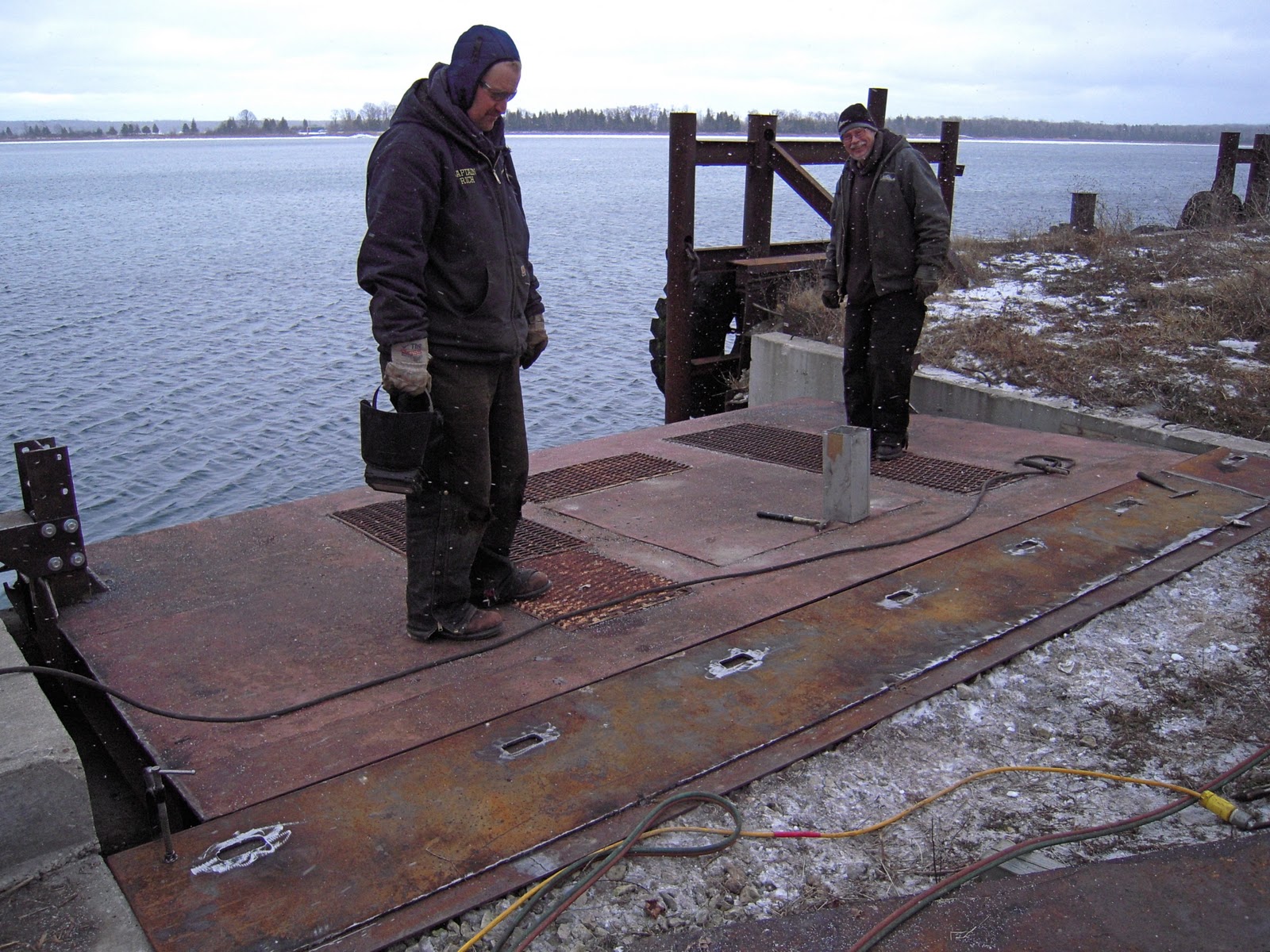
Rich Ellefson and Nathan Andersen worked aboard the dormant Robert Noble setting steel base pedestals for new, aluminum benches.  These benches are being fabricated for us by Hi-Tech in Sturgeon Bay.  The aluminum benches will replace the original wooden-slatted benches from 1979, and customers will hopefully find them more comfortable.  They will also be easier for our crew to maintain.   Part of the impetus for replacement now is our plan to take down to bare metal all paint surfaces on the upper and lower outer decks, replacing the existing layers of older oil-based paint with new, more durable, epoxy coatings.   The grinding and welding associated with installing these new bench foundations will be completed in advance of that paint work.   

-  Dick Purinton


Monday, February 21, 2011

ISLAND WINTER PARTY


Detroit Harbor, Washington Island -

The Winter Festival drew a number of people from off the island, for ice fishing, to see the Island Players version of Our Town, and to enjoy both indoor (chili cook-off, bingo) and outdoor activities.   It was also an opportunity for Islanders to kick up their winter bootheels.

Saturday afternoon a large crowd assembled to celebrate a birthday party (not Lincoln or Washington) on Detroit Harbor and circled around a bonfire with food, drink and camaraderie.   Youngsters bounced, skidded and resisted centrifugal force as a four-wheeler towed them in a large satelite dish, about 8-ft. diameter, encircling the ice party.  The rumble of the metal dish over the hard, sometimes irregular ice surface, could be heard from afar nearly all afternoon, until fireworks and low sun signaled a slowdown to the afternoon's events.

The Island Lions members organized many of the past week's ice fishing activities, as they do each winter, but this party was for Lee Franzen's birthday, and it drew as many as 100 persons, with some 40 cars and pickups parked nearby, plus 4-wheelers and snowmobiles.  

Further out on the harbor,  steadfast ice fishermen tried their luck ice fish in the 20-degree weather.   Large northern pike and perch had been caught throughout the week, with others bobbing after lawyers on the west side.  Saturday's weather was ideal for this social event on the ice, as well as for fishing.

The drama Our Town played Friday evening, a Saturday matinee, and again Saturday evening, with roles filled by local actors with a range of acting experience from first-time to seasoned veterans.  This was an excellent production, theater in-the-round at the Trinity fellowship hall with island townsfolk surrounding the performers.  There were memorable, standout performances.

Ice Access

I couldn't help but think how fortunate it was that the temperature had dropped since last Thursday when accumulated snow melted so rapidly that one fisherman described the swirl of meltwater running down his fishing hole as resembling a "toilet flushing."  The ice returned to a glare surface overnight with Friday's return of high pressure and colder air, and the mucky, rutted shoreline where fishermen entered and exited the ice froze hard over night.  It made the transition from Main Road's blacktop to the harbor ice once again negotiable.   Had temperatures remained above freezing through this weekend's activity, the muddy ruts would have worked even deeper under pickup tires, eventually becoming impassable.  Fresh access routes might have been created further down the beach.

With the Island's annual winter fish derby, plus private social gatherings on the ice as witnessed Saturday afternoon, drawing people of all ages, the importance decent public access to the harbor is underscored.  
At one time, there were many access points at various island shoreline locations, but many of these have now vanished, absorbed as private property, built upon, or otherwise no longer maintained by the Town.

The south end of Main Road remains the most heavily used water access in winter, but it's also a point for viewing in warm weather months.  If the Town has in the past prompted the Department of Natural Resources for permission to add aggregate to this stretch of beach and been refused, this past week and weekend's activities should encourage further attempts at access improvement.

Several loads of coarse stone, approximately 16-ft. wide, might actually reduce traffic impact over the present day "driver's choice."   As an inviting, safe access to Detroit Harbor, it would not only be winter sportsmen who would benefit.  There are occasional loads of materials headed to Detroit Island that are trucked over the ice.  Detroit Island's property owners, who ask for little and receive less direct return for their township taxes, like to occasionally snowmobile, cross country ski, or drive across the ice for a winter weekend retreat at their cabins.  Such access improvement would assist them, too.

While it may not be a given right to drive motorized vehicles across harbor ice, it is important to the island, to our limited winter economy, and for the sport and recreation of its citizens.  We estimate daily usage this winter as 50 vehicles (on the low side), to well over 100 passages from road to beach on a busy Saturday when fishing pressure increases.  We've looked out the window at midnight (and even 3 a.m.) and observed headlights out on the ice (probably not fishing!).   So, we would consider usage of this Main Road access as high on a daily basis, and nearly around the clock.


Low Lake Levels


Adding to the problem of ice access is the wider beach brought on by a very low Lake Michigan.  The current level is within inches of the record low, despite last summer having shown signs of a gradual, two-year rise.  The amount of exposed beach and harbor bottom is considerable.  Shallow areas utilized by bass and other fish for spawning in the early months of summer are exposed.  I walked over frozen mud flats today, routes never possible when water levels were higher.

Already this winter's cover of bay ice has, for all purposes, broken up and is on the move.  The fact is, it had never set up, except in sections of the upper bay.  (The lower bay, south of Chambers Island, was solid, shore to shore, by early January.)  There has been continual shifting of the ice fields with the winds, aided by large lake vessels still sailing to the Escanaba ore docks through early February, then heading south in the bay to Bay Shipbuilding in Sturgeon Bay.   Already, as of this week, several lake freighters already fitted out will resume their regular runs from Escanaba to Indiana's steel harbors.  It is highly upper Green Bay's ice will ever re-freeze this winter.   Lack of an ice cover over upper Green Bay waters also allows evaporation from those same waters, not insignificant over many square miles of surface.   With the snow pack in the Lakes Michigan-Huron watershed currently negligible, we can only hope for more snow accumulation and heavy spring rains to help restore the supply.

At some point as ferry operators, we may become concerned that our dredging projects of 2007-08 may not be sufficient for unrestricted ferry access to landings.                               - Dick Purinton

Tuesday, February 15, 2011

Shoreline Show


Detroit Harbor, Washington Island -


After driving steel pilings along the shore near the former Ship's Rib late Monday, island contractor Tom Jordan tried to drive his Volvo excavator from the ice surface.  But the climb from ice to a rock-filled wooden crib proved too much of an angle for the excavator to negotiate.  Tracks spun, ice buckled, and the machine soon wallowed into the mucky bottom.

That is how Jordan's excavator spent the night, with exhaust pipe and top of the motor slightly above water level.   Help was on the way on the Tuesday morning ferry.  Jordan had contacted Harbor Construction of Baileys Harbor who offered to lend a hand by pulling with their larger machine.   It took nearly an hour and a half of tugging, trying different purchase points before the solution was found that offered enough leverage to lift the tracks from the muck and level the machine.   But still, the partially-submerged machine wouldn't skid or roll up and over the sharp ledge.  The excavator's tracks simply would not turn, not without applied power from the motor.

The morning's activity had proven to be an excellent diversion from ice fishing, from work, or from just about any other island thing going on, and a crowd of onlookers had gathered along shore to see when and if the extraction would work.   About the time a few of the spectators broke for lunch, a better purchase was obtained with one excavator arm chained to the other.

Hoping for a long-shot, Tom checked his excavator's motor fluids to see if it was prudent to start up the machine.  After several bursts of compression followed by puffs of white smoke, the Volvo was running, surprising, considering its submergence in the murky, icy water the previous twelve hours.

The final step went smoothly:  the combined pull from two upland machines, plus power applied to his excavator's tracks, brought Jordan's machine up and over the ledge to solid ground on the shore.

Above:  Started and under its own power, the Volvo crawls toward the beach;
Below:  Tom Jordan expresses thanks to the Harbor Construction crew.


Dick Purinton -

Wednesday, February 9, 2011

PACKERAMA


STAUNTON, ILLINOIS -

What a week this has been!

We drove to St. Louis to attend the 40th Anniversary of the Passenger Vessel Association, spending one extra day in Brookfield, WI shoveling snow from a massive midwest storm.

Our convention coincided with Super Bowl Sunday, and we knew there would be a great deal of excitement surrounding the Packers / Steelers game, including a bit of jousting with friends from Pittsburgh who operate the Gateway Clipper fleet.  Nothing brought more immediate excitement, however, than spotting the Packer Mobile parked alongside the snowbank as we rounded the corner to our St. Louis hotel Thursday afternoon.

The two die-hard Packer fans shown above, Dieter "The Snowman" Sturm, and Mark "The Iceman" Madson had stopped to warm up, with the Arch as their backdrop.   Without knowing a great deal about their car or their trip, we just assumed they were enroute to the Super Bowl in Arlington, Texas.  We had driven through -6 F temperatures near Rockford earlier that day, and temperatures had warmed only slightly by the time we crossed the Mississippi River and drove into St. Louis.  Given the weather forecast then for southern states, we knew these two would not find the going any easier in their convertible as they neared the Cowboys stadium.

But then the traffic light turned green, and with cars lined up behind us we drove around the corner to the Hyatt Hotel.  Later, I kicked myself for not stopping and wishing them well and taking a photo.  Later, in the hotel, we looked them up online and watched several videos they had already posted about their trip on their website...       www.packermobile.com/PackerMobileBlog       ...and we learned more about these two fanatics and their road trip from Lambeau Stadium to the Super Bowl.

A Second Chance-Encounter

Fast forward five days, following many meetings in hotel conference rooms and the Championship Super Bowl win by the Green Bay Packers Sunday evening celebrated in the hotel sports bar.  We began our drive back to Wisconsin at noon Tuesday, Feb. 8.   Less than one hour  from St. Louis on I-55, Mary Jo spotted the Packer Mobile as it exited the off-ramp near the town of Staunton.   Not wanting to miss this second opportunity, we followed close behind, driving several miles west of the interstate to downtown Staunton, where the Packer Mobile stopped opposite the Subway restaurant.


Although the Packer Mobile's occupants had been riding almost continuously in their 1978 Eldorado convertible for over a week, covering the 1300-mile route to Dallas with the aid of warm clothes and flexible heater hoses shoved up their jacket fronts to keep them and their faces from freezing, The Snowman and The Iceman graciously posed with us and talked about their trip.

The Packers organization has a strong fan base, but there aren't more dedicated fans than these two men.  Neither had a ticket for the big game or expected to get one.  They had met only recently at the Chicago Bears / Packers Conference Championship game and they decided to share their similar Packer passions in a way different than most by rallying others around their car and their crazy goal.   It was the thrill and enthusiasm of participating in this momentous sporting spectacle that drove them along through some of the Midwest's most miserable winter weather.   [You will want to follow along by viewing their many video blogs posted along the way.]

As we headed north toward Rockford, IL, late that afternoon, the outside temperature dropped to +4 F, then to +1 F.   Due to an overturned semi carrying ammonia blocking the interstate, we were routed along with hundreds of other vehicles on a long detour through the countryside.   We thought back on our second chance-encounter with the Packer Mobile and wondered if our friends, too, were snagged by this detour?

The Iceman and The Snowman could handle it, we knew, as we inched along between the rural snowbanks and lines of rerouted traffic, slowed by at least 90 minutes over the expected driving time.  It would take more than a back road detour to slow down those two Packer fans.  


  - Dick Purinton

Thursday, January 27, 2011

JANUARY ICE SCENES


WASHINGTON ISLAND, WISCONSIN -

Jim Rose has, once again, sent us a few excellent photos, these showing hard, clear January ice frozen in the absence of snowfall.    Here is the accompanying text Jim sent, followed by two more of his photos, with thanks for giving us permission to use them.  There is nothing quite like being out along the ice shoves in winter, listening to the groans and pops, enjoying the raw beauty of the ice and the bluffs.  This ice is about as clear as you will find, given its thickness, in any winter.  -  DP


    "On Friday evening, the 21st, Steve Waldron and I skied from the Little Lake museum, to the cut to the bay, and then up to Boyers Bluff.  The ice had shoved some, but was incredibly clear.  These pieces are almost a foot thick and you can see Steve's face through it, in the second photo.
And the next day I went over to Rock Island, and did some skiing there.  The ice in front of the boat house was almost like a mirror.  
Could have used a little more snow."     - Jim Rose


Sunday, January 16, 2011

OTHER THAN THE PACKERS...

Washington Island, Wisconsin -

Packer fans can look back at this weekend as a huge success, with a decisive victory over Atlanta on Saturday taking them on to Chicago next Sunday, now surprisingly, only two games away from winning the Super Bowl.

But, locally there were other activities, and one event that we attended at Fiddler's Green was the book launch of Robert Mazibuko's This Side Up, an autobiography of a man who grew up in South Africa, was shaped by the African culture and customs of the day, and who is now a Washington Island resident and an active member of the Baha'i global faith.  Robert told stories, something he is very good at, and answered a few questions before signing books.

The photo is of Robert holding a copy of his new book while posing with his wife, Gretchen.


Sunday Sled Run 


Although the temperature was in the low teens, the snow cover made a perfect blanket for a quiet walk in the woods.   Aidan led the way in a pair of snow shoes, with Magnus in the sled and Mary Jo in harness.   I had a late start, following their tracks around the wooded trail near the barn, catching them on the uphill climb.


We had been without much snow cover for nearly two weeks, and so the new blanket of snow is welcomed, along with the moisture it represents.   Out on the harbor ice we now count 23 ice shanties, most scattered toward the line that runs between the two ears of the rabbit, near Petersen Bay.   Perch have been caught, fairly numerous and some quite large (14 inches was one reported catch) by the ice fishermen.    We walked across the north end of the harbor, circling Snake Island just before sunset, watching the sun drop behind the trees, glinting off the shiny tin of ice shanties.  It was a quiet softness, that last hour before sunset, with the moon already high in the eastern sky.   Even the Packers cannot improve on this!

   -  Dick Purinton


Thursday, January 13, 2011

WINTER WORK


Rich Ellefson (holding welding helmet) and Ken Berggren - Jan. 12

North Breakwall - Northport Harbor, tip of Door Peninsula


WASHINGTON ISLAND, WISCONSIN -    

The ramp shown above has seen many winters when it was a part of the Northport landing for the C.G. Richter.   

Once the Arni J. Richter was built, winter side-landing became officially obsolete, and within a year or two the ramp and foundation beams were pulled out and the dock surface was leveled with concrete.   Because this ramp structure still had potential use as a loading ramp, Rich, Ken and others modified it for insertion in a concrete foundation made for that purpose on the Potato Dock.  New lifting arms were added for possible future adjustments, and in time hydraulic rams (currently in use at Northport) will be installed.   This Potato Dock landing may not see a great deal of activity, but it provides an alternative spot to unload freight or vehicles.     

Just one or two days before this photo was taken, two old Potato Boat doors that were welded together, extremely heavy and not well-suited for adjustment, had been removed from this same site.  Those doors had been cut years ago from the Mackinac Straits ferries used by Ed Anderson, and they've been used in varied locations around our ferry docks when transition was needed to accommodate water levels.   

The current 2011 lake levels, and the Army Corps predictions for the coming summer, indicate we'll be operating in shallower depths than last year.  Already,  stern loading on several of the ferries requires the ramp to touch or rest on the sheeting and concrete when in lowered position.   That is true on the island, and even worse at Northport.  We could use steady rains this spring and summer.    

I took a few photos as I caught up on the work Rich and Ken were doing, and during this time a heavy, dense squall had slid across the Door from the west, obliterating first Door Bluff, then Hedgehog Harbor, and finally, Plum Island.  The first flakes were like detergent, but they grew in size as the breeze-driven snow continued to fall.   Within half an hour the snowfall had subsided, and the low clouds had passed over, heading in the direction of Charlevoix, leaving behind a dusting of snow. 

More Ice Photos

Several postings back I ran a photo of an ice-covered Northport breakwall light.  My photo hardly did justice to the shaping of the spray as it froze under heavy winds.   

Jim Rose then forwarded these excellent shots, and I pass them along to readers, with thanks.   The extent of ice and the angle of formation is about as extreme as I can recall seeing there.   

Melting and evaporation since these photos were taken have altered the scene a bit.    While some ice will stay through the winter, the fact the bay has lots of floating ice will prevent such a formation again this winter (we think).    Part of the interest of a winter scene is that it is always changing.
 -  Dick Purinton     


Friday, December 31, 2010

As The Sun Sets On The Calendar Year...

Above photo and information below are used with thanks to owners of this blog site where additional text and informative, entertaining photos are to be found:     
                                2gringos.blogspot.com:2010_12_01_archive.html.webloc

Washington Island, Wisconsin -

Our foreign reporters in the Caicos have updated their blog site with more information on the C.G. RICHTER, now TREASURE SEEKER.   The red-hulled pirate-like ship was recently towed from protected but shallow harbor to deep water where an ocean-going tug took her astern for a long tow to a repair facility in Puerto Rico.  There, from what we understand, a new rudder will be fabricated and installed while the boat, or at least the stern, is out of water.   The owner's marine insurance company has apparently authorized both this tow and the repairs necessary to get the vessel seaworthy and on its way to the end-destination of St. Thomas, where it will be placed in a charter capacity for cruise ship visitors on shore excursion.    

Given the somewhat difficult trip thus far, we wish the owners better going the rest of the way, and with their venture.  They are now some 14 months since sailing the vessel for the last time from Detroit Harbor, Washington Island as the C.G.RICHTER.

  -  Dick Purinton

Thursday, December 30, 2010

ICE, FISHING AND KITES

WASHINGTON ISLAND, WISCONSIN - 

Ten days ago we had a beautiful, soft snowfall, backlit by a full moon at sunrise.  Extraordinary morning light.  

Today, by contrast, the air temperature is up to 39 F, it is drizzling, and the snow has melted into mush.  True, island roads have mostly cleared of ice, but the unpleasantness of plowed up hunks of lawn sod and the residue left by town sand trucks is exposed, reminder of a long slog into summer.  

Out on the ice this past week, local fishermen had towed their ice shacks out from shore and tried their luck perch fishing.  We had gotten used to watching their activity, from early morning before daylight to late in the evening after dark, as trucks, snowmobiles and four-wheelers came and went.  This morning many of those same shacks have been towed back to the safety of near-shore, where the ice is safe.  Puddles caused by rain and melting snow have created small ponds here and there ten inches deep.  The pulling vehicles created a wake as they negotiated their way back toward the end of Main Road.  

Jeff Andersen, Andrew Rainsford and Jack Rose had just removed an ice shanty, a dark mass appearing out of the fog as they headed toward shore.  Then they contemplated their next move.   The pattern of winter recreation for these fishermen will be adjusted for a few days until temperatures get below freezing and the harbor ice becomes solid and slick once again.   Fishing for perch in Detroit Harbor had been more a testing of the conditions, anyway, they told me, with small perch few and far between.

No Ice Enroute, Yet

On the open water, there has been almost no floating ice seen beyond the island docks, and none at Northport, either, although the breakwall shows off a thick winter coat of ice from the last wind storm.  Ice beards hang at an odd angle from the entrance light structure, stalactites formed in the 40-50 mph freezing gales.


Kite Flying

Late Tuesday afternoon grandson Atlas and I walked out on the  ice-covered snow to fly kites.   

It was 37 degrees,  a raw but yet ideal, steady wind from the SW, and a clear sky.  It was perfect for launching our kites.  After removing a few tangles, Atlas had his kite up and flying, a parachute-style with lots of pull.  I encouraged him to give it more string as it rose higher and higher, while I broke out kite #2 and readied it for flight.  

By the time my kite was airborne, a simple trapezoidal kite that flew almost directly overhead, Atlas had released some 300 feet of string, out to the final knot on the spool.   

I suggested we trade kites so that I could wind a few turns back on the spool as a safety cushion.  That's where we ran into trouble. 
While passing it between our thick gloves, gusts tugged at the kite and the spool lifted off across the snow,  almost like slow motion, it seemed.  A quick sprinter could retrieve it from just beyond where we stood, I thought, and with my encouragement Atlas took after it.  But he slipped on the snow as the spool bounced, then became airborne, heading for the passenger side door of a parked fisherman's truck.   Atlas regained his feet, giving chase, but another gust pulled the spool up and over the truck (rather than snagging on the side mirror, as I had hoped), and all we could do was watch it sail smartly toward Holiday Inn and a large grove of poplar trees.   

This is where our kite came to rest, some twenty feet off the ground, a colorful fixture until the next gale plucks it from the branches, or it becomes shredded material for a squirrel's nest.   

This had been a completely typical kite experience:  tangled tail and string, then a successful launch, a good flight, and, finally, loss of kite in nearby trees.  My only regret, one that marred our experience, was when I muttered "Dammit" as the spool jumped from our gloved grasp.  That would be the only thing I would want returned, if I could.
  -  Dick Purinton      


Thursday, December 23, 2010

IT'S CHRISTMAS TIME

WASHINGTON ISLAND, WISCONSIN -

Christmas is upon us:  a season;  a special day but yet more than just one day;  Christmas rituals;  holiday excitement;  and for many, Christmas rekindles our strongest memories with family members.

I realize this note may not hit the mark for everyone.   Even in the best of family situations there exist  unspoken tensions, goals never met, acts or words we wish we could undo.  But there needs to be a few days of truce from all of the negative, and with Christmas the joy of a special birth provides that opportunity.

Our lives can be infused with pleasure from the unbounded excitement of young children, something holiday pageants and stories have tried to capture time and again.  The lives of young children are pure and innocent and are not yet conflicted.  For them excitement, especially at Christmas time, takes center stage as each day they rise only to be themselves once again.

Here on Washington Island we'll host our children, now grown adults, and our young grandsons.  While we are excited thinking about each of them being in our home, our attentiveness will center around the youngest.

The top photo shows Kirsten and Hoyt's two boys, Aidan (with screwdriver) and Magnus (pliers), attempting to take apart an old compressor.  They've learned "scrapper" habits, that there is value for wire and old metal.   It's a good occupier of their time and they pitch in on any project allowed, expecially because it involves using tools.  In scrapping, they are encouraged to disconnect or break apart an old tool or appliance.  We'll anticipate seeing more of these two boys in the next few days.

Hosting holidays has shifted downward a full generation.  In the bottom photo, I join sisters Martha and Helen with Mom, 93.   This was a gathering held at Martha's home that lasted a few hours on a Saturday  following Thanksgiving.  It's not easy getting everyone together, but it's even harder when health and mobility make such an outing difficult for Great Grandmother.

With gatherings including our eldest participants becoming more rare, memories of the olden days are even more special.

For old, young and the many in between, have a Merry Christmas!  

-  Dick Purinton

Sunday, December 12, 2010

NEW BOOK SOON

Washington Island, Wisconsin -     

BRIDGES ARE STILL NEWS  [Order Form At Foot Of Blog]

This posting announces my new book with an order form enclosed (below) that you can print.   Publication and delivery is anticipated to be the end of this coming week (by Dec. 17th) and order requests will be filled first, prior to distribution to area retail outlets.

In 2009, I was very fortunate to have Words On Water published by Norbert Blei's Cross+Roads Press.  Based on my ferryman's journal of 2007, it was well-received by the public, with reviews that were also very supportive.   During the three years years since writing Words On Water, I've worked on other projects and polished pieces written prior to 2007.  Many of these appeared on this blog, along with other poems and essays.  It is a selection of these pieces, then, with further editing and the inclusion of many photos, that makes up my newest book, Bridges Are Still News.


Putting this book together was more difficult than I had anticipated because of so many different pieces, but it would have been impossible without the help of Amy Jorgenson who composed the pages, had great graphic sense, and made this, in my opinion, a most appealing and readable book.   In one sense, it is literary, both poems and prose.  On the other hand, if you like history, essays or photos, you should not be disappointed.  The inclusion of so many color and B&W photos, over 100, would have been unthinkable 15 or 20 years ago due to production difficulties and cost.

Publishing


Norbert Blei was kind to publish my last book. By his own policy it is something he does only once per aspiring writer in order to give them exposure, and encourage their continuation and success.   His accepting my book for publication was of immense value to me.  But now, if what I write is to see the light of day (beyond these blogs), in what is primarily a limited, local / regional market, the establishment of Island Bayou Press for self-publication seemed to be the only probable course.

While e-books are the coming trend, and many small-run books can be purchased on-line, I think local history and regional literature will continue to be with real books, read and placed on shelves alongside like books from the past.

Here is something I copied from an on-line site which throws a huge element of concern into anyone who considers going this route.  It reads:

 Before traditional self publishing, you may want to make your work available in electronic form, carefully monitoring the response, and then building on it.  If that appears unreasonable, keep in mind the following statistics:


  1.  around 1 million manuscripts are apparently looking for a US publisher
  2.  only 1% of manuscripts will probably be published
  3.  33 percent of high school graduates will never read another book for the rest of their lives
  4.  42 percent of college graduates will never read another book after college
  5.  70 books published do not earn back their advance
  6.  70 percent of books published do not make a profit
  7.  art, literature and poetry together account for only 3.3% of the  US book market


Daunting.  So, to the readers of these blogs and of all regional literature, to the readers of local authors and poets...thanks for your support.

ORDER FORM:

GREAT, STORMY DAY!

WASHINGTON ISLAND, WISCONSIN -

We are connected to a broad section of the upper midwest by this storm system that is slowly passing through.  High winds, over a foot of snow in many places, blocked roads, closed businesses, canceled church services, falling temperatures... a day that makes us feel very much alive, and connected to the rest of the huddled midwesterners!  The shoveling, the plowing and cleaning up will begin once the wind begins to subside.  There are no ferries today, and may not be on Monday, either, since storm force winds, reducing first to gales, will blow through Tuesday night.

This morning the amber flash of the town plow told us it was time to get up.  The howl of the winds made it hard to sleep, anyway.  We made our way downstairs and turned on the outdoor floodlight to watch the fury, impressed with how this blizzard blocked out neighbors lights, except during slight let-ups in the gusting, drifting snow. Washington Island was out far enough in Lake Michigan to escape the heaviest snowfall. We were located on the regional weather radar within that pink band that defined the heavy snowfall to the west and south with sleet over the open lake.   Was it ten, eight or six inches of snow that fell here?  Who knows?  Drifts one to two feet have formed in our driveway, but they are saddled by black patches of bare asphalt.  Hard to tell.

Game boards will be brought out, crock pots filled, cookies baked, and holiday lights trimmed - if they aren't already - and the NFL will have one of its strongest viewing days in the midwest states ever.  If only our power stays on!

Hunting


I had the opportunity to hunt last week in southern Iowa with sons Hoyt and Thor.  Hoyt has traveled to the same territory annually for the past nine years or so to hunt.  I've joined him there one other time.  Thor has not hunted at all for nearly 15 years and never in Iowa.  This outingwas set up several years ago when we applied for Iowa deer tags.  It takes a few years in the queue and the purchase of "preference points" to get an out of state tag for an antlered deer - a buck.  Doe, or antlerless, tags are easier to obtain as an out-of-stater, but at nearly $450 each, they are almost as pricey as the buck permit.  Add in the gas, food, lodging and the accessories ranging from shotgun slugs to handwarmers, not to mention time away from work, and there is a significant commitment.

So, is it worth it?

Yes, it is, when you like spending time with your sons and that time has not been as frequent as you would like.  The hunting becomes an activity around which that time is centered, with fewer interruptions in the flow of conversation.   It is also just being in each other's presence, even when there's no talking, Thor in the back seat doing crosswords, Hoyt listening to the radio, me reading the paper through the miles on the way to the camp.   For all of the above, it was fun, the trip was a success, and we enjoyed the time we had.

Viewed from the narrower aspect of hunting, our trip was also successful. Each of us shot one or more deer.  Hoyt, as unofficial guide, organized our day, told us where to sit and how to approach the terrain for best results.  We brought home approximately 150 pounds of boned venison, and we gave one deer to a party who wanted venison but had no source.   (During the hunting season, so far Hoyt has donated three deer to a food pantry.)   None will go to waste, and all of it will be enjoyed later as either roasts, stews, sausages or ground meat to be used throughout the year.

But, it is the time together that cements us as friends, as well as father-son-son.

A Pirate Ship Sails Into Harbor


In the ongoing story of the former ferry C.G. Richter, now Treasure Seeker owned by Ray Hixon and his family of St. Petersburg, FL, we offer the following photo taken from an internet blog site.  The site is named, "Two Gringos in the Carribean" and only a brief mention and the accompanying photo is made as the author cited the sight of a strange vessel under tow near the Caicos harbor.  Date the photo was taken is also unknown, but is presumed to be around mid-November.   It does show that the old ferry, now pirate ship, is on her way further south, enroute to the new home port of St. Thomas, U.S. Virgin Islands.   The link to that web site is:        http://2gringos.blogspot.com/2010/11/november.html.


I will speculate that it is the draft of the vessel (not mechanical fault) that put her on the towline as she entered port, but we will have to wait for more details to find out.   A rather impressive, pirate ship-like profile, don't you think?     -  Dick Purinton


Thursday, November 25, 2010

THANKSGIVING

Washington Island, Wisconsin -


We had a wonderful dinner, ate too much as is the custom, the grandchildren have gone home and to bed, and the most strenuous activity I can come up with at the moment is typing words on my computer.

Thankful for so many things in our lives, our friends and our family, and the good health to enjoy one another, rest at the top of our basket of plenty.  We're thankful for our customers, too, the many people who from diverse backgrounds travel by ferry for many different reasons. Some are customers only once, while others use our ferry services on a regular basis.  Living in this country where we have a wide range of freedoms is yet another thing we are thankful for - a circumstance not to be taken for granted.

We hope your Thanksgiving was satisfying and memorable, too.


Wednesday morning I  boarded the 7 a.m. ferry.   Thin ice from the late afternoon trip the day before still coated the foredeck.  The season of slippery, ice conditions had begun.

A few vehicles belonging to hunters were on board, headed south with deer on car tops, and in the case of one boat owner, pairs of hooves projected from the cockpit of his craft.  They were taken, maybe, from Rock, Detroit or Plum Island.

The 2010 gun hunt for deer continues through this weekend, then a muzzleloader season and a late bow season follow.  Only the smartest or luckiest deer will still be running free in late January.   But, many of them survive, and as many seem to populate the island forests and meadows the following year.   Their numbers remain steady, from year to year.

We've enjoyed a mild November so far, but that's about to change.   Winds tonight are gusting to 40 mph and higher, with gale force winds forecast to continue through Friday evening along with plummeting temperatures.   Given the drop in temperatures, spray will cause icing on deck, and tomorrow's ferry runs may be challenging.
  -  Dick Purinton

Thursday, November 18, 2010

DONATIONS GIVEN TO ISLAND MEMORIAL MEDICAL FUND, INC.


-Washington Island, Wisconsin

Several articles in the Island Observer and letters soliciting island organizations have drawn a welcomed response in donation dollars for the Island Memorial Medical Fund.

Tuesday, November 16, 2010 Washington Island Lions Club representatives presented two checks to Island Memorial Medical Fund treasurer Leon Shellswick.  In what might be considered a "cornerstone" donation, one check presented included $15,000 to help remodel Dr. Wilson's dental office, and a second check for $2000 will be used for Dr. Filar's eye care office.  Both of these providers have an island practice within the Island Community Center.  Dr. Wilson travels from Sister Bay, and Dr. Filar also has a Sturgeon Bay practice.

The Island Lions were but one of several organizations to respond to the announcement for assistance.  The American Legion Post, the Island Womens Club, the Detroit Harbor Ladies Aid Society, and many individuals also donated toward the dentist office remodeling project and island eye care.   All gifts, whether large or small, are appreciated for their contribution toward the betterment of island health care.  


Island Lion Joel Gunnlaugsson and Lion President Al Stelter present Island Memorial Medical Fund Treasurer Leon Shellswick with a donation as Dr. Tom Wilson (right) looks on.
Joel Gunnlaugsson, who is currently the Lions Club Secretary-Treasurer, recalled conversations he and other Lions had several months ago with Henry Nelson, a longtime Club member who for many years held the post of Treasurer.  Henry had expressed his wish that the Lions consider the Island Memorial Medical Fund project.  Following Henry's passing in the early fall of this year, the Lions Board of Directors, including Will Herschberger, Gunnlaugsson and Stelter, honored Henry's wishes by designating a sum toward island health care.

The Island Lions have undertaken many projects over the years, significant fundraisers which enable them to return dollars to community improvements.  Public support for the various Lions Club projects is, therefore, greatly appreciated by the Lions members.

Among the more visible of the ongoing activities and projects taken on by the Island Lions Club are these:  the annual Fly-In Fishboil at the airport;  Island Fair and Parade;  rental and set-up of Club-owned tents for public and private events; the recycling of aluminum cans at the Island Landfill;  improved School House Beach public facilities;  the Mid-Winter Festival and Fish Derby; and ongoing ball park improvements such as new bleachers and the establishment of a little league field.

While it appears the immediate dental and eye care fund-raising goals are now much closer to being met, the Island Memorial Medical Fund is an ongoing entity.  The Fund's ability to help underwrite island health care improvements exists entirely through annual donations and gifts, and continued support is required.

Inquiries or gifts may be made by mail to:

    Island Memorial Medical Fund, Inc.
   Leon Shellswick, Treas.
   581 Silver Birch Lane, Washington Island, 54246.

   -  Dick Purinton

Wednesday, November 17, 2010

MORE VOYAGEUR PHOTOS


 Voyageur at Bay Ship- 2006 - (Wendell Wilke photo)
Washington Island, Wisconsin -

Karen and Bob Kalal, who have ties with Gills Rock and who fondly remember the days of Washington Island ferry boats landing there years ago, sent along a number of photos.   They show the Voyageur at various stages of remodeling, in what turned out to be a better-looking vessel in many respects, one well-suited, at least, for the tour and excursion business on Chicago's waterfront.  Major changes in appearance can be seen in these progress photos.  Bob took a number of photos "through the fence," as he put it.  Others are attributed to Wendell Wilke and Bob Lund.  Thanks to all who consented to have their photos published here.    -  Dick Purinton

Shown above and below:  Voyageur on blocks at Bay Ship, winter of 2005-06.  (Wilke photo)  A small extension was constructed over the transom (below) for crew access, line handling and emergency egress.  


Scrap heap:  old pilot house and cabin section  (Kalal photo) 

Voyageur at Bay Ship prior to reconstruction.  (Dick Lund photo)


Monday, November 15, 2010

VOYAGEUR - THEN AND NOW


Two photos above show the 1960 vintage ferry Voyageur as a Chicago tour boat (photos courtesy of Shoreline Marine)
Voyageur typically carried 12 autos.  Here she is shown with "tour bus plus six" ................

Detroit Harbor, Washington Island -

The ferry Voyageur was designed by Walter Haertel of Sturgeon Bay, and built by Sturgeon Bay Shipbuilding & Dry Dock in 1960 for Arni Richter and the Washington Island Ferry Line.

This was the first open deck or "flat-top" ferry, as people liked to refer to it, for Washington Island.  With a single ramp that lowered in the bow, for the first time large, long and heavy loads could be transported to Washington Island.  This was a major potential change that lead to dump trucks, gravel crushers and screeners, semis, long trailers and other large highway vehicles reaching the island, in addition to automobiles.  

Until the Voyageur was built, only autos, short trucks, and trailers that could be disconnected and worked across the deck by hand could be transported, given the limited deck space of the C.G. Richter, Griffin, and their wooden-hulled predecessors.

Shortly after the Voyageur came into service, tankers carrying road oil, graders and other large equipment arrived to blacktop island roads, just one example of the change the Voyageur's design brought to island life and commerce.

In October 1960, the Voyageur's first year of service, the Sturgeon Bay bridge was struck by the Swedish freighter, Carlsholm, a blow to the single highway link over the bay.  This incident necessitated emergency measures to keep commerce and at least essential transportation flowing north and south in the county.  Within about six hours after the incident occurred, the Voyageur and C.G. Richter arrived from Washington Island to begin continuous service across the bay.  The two ferries and their island crews ran for several weeks straight, hauling vehicles that lined up on either side of the bay at temporary landings that consisted of piles of gravel, sculpted and adjusted for vehicle loading. 

Nathan Gunnlaugsson was then a young captain,  one of several men who piloted the Voyageur with its finnicky air controls.   Older island pilots preferred to stay with the familiar, ferries and engine controls they had mastered and were comfortable with.  Doug Foss, a licensed Great Lakes ore carrier mate, also operated the Voyageur during that time.  The run from the east to west side of the bay was short, from the Fruit Growers Co-op dock to the opposite side of the bay, frontage where the tug John Purves now is moored.  

Those tricky Westinghouse air controls were, on the one hand, fun to operate because depressing each button with a characteristic hiss that followed took some getting used to.  On the other hand, even experienced operators could be caught short not having made a successful shift.  In such cases, the ferry might react in a totally different manner than anticipated, especially when extra throttle was applied, skewing the ferry toward the landing point.  But when they worked, this ferry's short overall length (65 feet) and smooth underbody made spinning it in a circle within its own length possible, and highly maneuverable.

The original engines were GM 6-72 motors, supposedly WWII surplus engines rebuilt for this commercial application.   However, they broke down repeatedly during those first years, and by 1965, a pair of 4-cylinder 452 Murphy diesels with Twin Disc gears replaced them.  The generator was a single-cylinder Onan that produced 3.5 kw, just enough for lights and compressor and a wall-mounted furnace on the car deck.   Despite numerous mechanical problems with the Murphy motors over the course of its operating life and a characteristic black cloud of smoke from improperly combusted fuel, the Voyageur was still a workhorse ferry through the 1990s.  A classic side profile gave rise to the nickname "shoe."

In 1999, the Voyageur was repowered with new Cummins 855 motors (approx. 350 hp each, which are still working today), and a stern loading ramp was added to make it more versatile for auto traffic.  Although the aft overhead was low (slightly over seven feet to the underside of the upper deck), cars exiting via the stern ramp could, for the first time in the Voyageur's operating history, drive on one end and drive off the other.  Also in that repowering project, old pilot house air controls were scrapped for newer-style Morse cable controls (which also happened to be "old-style," just not as old.)  A new passenger deck extension with box benches for seating and life jacket stowage was created forward of the pilot house.  

The addition of the ferry Washington in 1989 to the fleet relegated the Voyageur to official standby status, for use in only the busiest of times or when one of the first-line ferries was for some reason disabled.  Built when semi-trucks were not much longer than 45 feet in length (the open foredeck was approximately 50  x 30) the Voyageur and even her sister ferries were often inadequate when faced with modern semi trucks 60 feet and longer.  

Once the all-season ferry Arni J. Richter was placed in service in May of 2003, the Voyageur as fourth ferry seldom saw underway time.  A for sale notice went up.  An inquiry came from Shoreline Marine of Chicago, a company that specialized in tours and excursions from the foot of Navy Pier, and after a day of survey from top to bottom, the Callopy family acquired the Voyageur.  

Shoreline Marine moored the Voyageur at Bay Shipbuilding for approximately one year until plans for modification were firmed and approved, and once those changes were made to suit its new location and service, it began its second - and for all appearances successful - life as a passenger tour boat on the Chicago River.  Two recent photos from Shoreline Marine (above) show the handsomely modified Voyageur getting underway, with a low wheelhouse structure for sliding under bridges, and ample deck seating for unobstructed passenger viewing during architectural tours.  A bow thruster was added for maneuvering (and side-stepping small vessel river traffic), and beverage coolers and shelving for stores were created below decks.  A distinctive paint scheme also added to the new design and helped reduce the boxy appearance of the main deck.  

The life of the Voyageur was successfully extended through a sensible, presentable modification.  Former Washington Island ferry passengers can bring back their early memories of travels across the Door, complete with vintage wooden slat benches for seating, by joining a Shoreline Marine Chicago River cruise from Navy Pier.  
Air operated throttle, one for each motor, sat beside a set of   three stainless buttons.  (Forward,  Neutral and Reverse buttons.  It was advisable to throttle down completely, then depress the neutral button prior to changing from forward to reverse, in order to improve the odds of not missing a shift.)

Voyageur shown ferrying screening plant crossing Sturgeon Bay in 1960.
This photo was believed to have been taken by the Door County Advocate's
editor, Chan Harris.
  - Dick Purinton