Friday, February 14, 2014

BACK IN WISCONSIN

Arni J. Richter approaching the island dock,
Thursday, February 13th.
Washington Island, Wisconsin -

The photo shown above was taken 24 hours ago, when 30 mph southwest winds whipped icy snow crystals across the harbor.   Visibility was down to 1/4 mile at times.

We received approximately four inches of new snow yesterday (by my estimation), but it was the cutting wind that made being outdoors unpleasant.  In fact, the temperature was a rather balmy 25 degrees - pleasant by standards of the past several weeks, others reminded me.

AJR maneuvering to back in to the shore ramp.
Captain Erik Foss is at the controls.


Overnight, winds shifted to the NW and the velocity dropped, as will the temperature tonight, expected to dip into the now all-too-familiar minus 5 degree range.

The annual Lions Club Fishing Derby is underway, with this being the final weekend of activity.  Traffic heading onto the ice from the south end of Main Road was light, due to the miserable, white-out conditions.    Water forced up through cracks in the ice near shore made the under layer slushy, but that's firmed up now, and the driving with pickup trucks should be good once again.

There are Valentine's Day activities today, too.   At school, the day started with a pancake breakfast for seniors (defined as 50 and over for the day's purposes), which yours truly joined in.  I was greeted by Finn Hagen, who shook my hand and knew my name, "Mr. Purinton," as I'm often seated near him in church.  It was wonderful to be so recognized.  This was a festive occasion, with some 35 guests in addition to the school children who assisted parents and staff in serving the breakfast in the school commons. Afterward, we followed as the younger grades lead us in singing the Star Spangled Banner.

Our four grandsons were there, too, and their parents who helped serve.  But it was the overall camaraderie of young and old, students, staff, parents and citizen guests, that made this morning special.

We'll see more activities for young and old out on the ice tomorrow, not only fishing, but other activities, too.

 - Dick Purinton


Wednesday, February 5, 2014

NOTES FROM SEDONA


Sedona, Arizona -
This blog is somewhat of an experiment, because in previous years I've not been able to construct text from my iPad.   Now, text seems to work, but so far I haven't been able to access my photos to illustrate and dress up this communication.  (photos shown were added 2.14.14 from my home computer.)

We're in Sedona, Arizona, where we'll complete two weeks of hiking, visiting historical sites, and relaxing, fully conscious of the cold and snow that's smothered the upper Midwest since Jan. 12th, the day we left Washington Island and headed to Houston.   Texas weather was quite pleasant...upper 60s, even low 70s several days...but it really didnt matter much since nearly the entire five days there were spent inside an sir conditioned Hyatt hotel, at the Passenger Vessel Association Maritrends Conference.

What I can pass along that has some bearing for readers is that here in Arizona, we've had very pleasant, and meaningful, visits with two men whose names might be familiar to Washington Islanders.

Monday we drove to Prescott, a drive of some 60 miles from Sedona, to see Goodwin Berquist.   I learned when I called Goodie several days earlier that Nancy, his wife of many years, had passed away Sunday, Jan. 26.   Nancy, many will recall, was the Chair of the Island Music Festival in its early years and she worked closely with Stephen Colburn to coordinate the many details -including performance locations prior to the existence of the TPAC.     I believe Nancy was a regular in the bridge circle that included Mary Richter and Clara Jessen, among others.   Their day to play was Tuesdsy, an all-day affair, more or less, rotating among homes, with each participant bringing their own lunch.

Goodie indicated that Nancy's wish was to have her ashes brought to Washington Island.  

During their years on Washington Island, Goodie, who was Professor Emeritus, Ohio State Speech Department, participated on the Archives Committee.   He was also a member of the Trueblood Theater Committee, as it was then known, during the formative years of the concept that eventually morphed into the Trueblood Performing Arts Center.   He co-authored a number of history books, including one on Milwaukee's founding fathers.   For nine years, I believe he said, early in his teaching career he taught at UW-Milwaukee, before returning to Ohio State where he became a tenured professor.

His interest in the people and activities of Washington Island, and Nancy's, continued through their years in Arizona, partly through letter correspondence, but also through the pages of the Island Observer, of which they continued to subscribe.    In later years, because Nancy's eyesight had failed, Goodie read to Nancy.  

Unfortunately, I'm unable to bring up a photo taken of the three of us on Monday - Goodie, Mary Jo and me.   Our visit over lunch covered many pleasant topics, often with us supplying the answers to Goodie's questions about Washington Island in the present day.   We hope he might be able to visit this summer, as he and Nancy had planned to do last September, before travel for her became impossible.

Island Tour Guide

We called on Bill Krieger last week, and following breakfast together, Bill offered to lead us to several local points of interest.   He guides Road Scholar groups in the Sedona area, and also to the Grand Canyon, which he will do again later this winter.   Bill's island home is adjacent to the Red Cup, in summer months.   We three seemed to share a common interest in history, especially Indian history, but also Washington Island and Rock Island  history.    Bill and  his late wife, Dottie, were docents on Rock Island at the lighthouse before they bought their island home.

We had a most pleasant day touring the national monument at Tuzigoot, an ancient  Indian village near Cottonwood, and the old mining town of Jerome.   But as much as anything, we valued Bill's time visiting with us.

That's our news - if it can be classified as news.   During our time away, several reviews of my book,Thordarson and Rock Island, have been published - Lakeland Boating Feb. issue was one -  and I've been able to monitor my online website successfully for orders, of which there've been several.   All of this is heartening as we head home and my thoughts turn more seriously to another writing project.     -  Dick Purinton

PS - By the time we arrived home, Feb. 12th, following our visit with him in Prescott, two books co-authored by Goodie Berquist were found waiting in our island mail box.  

Thursday, January 9, 2014

MAY I RECOMMEND…?


    So You Want to Own an Oil Tanker

      Captain Donald Kilpela - Harborside Books
      24 Waterfront Landing, P.O. Box 24
      Copper Harbor, MI  49918
      221 pages, with photos
      $15.95 + $2.00 S+H

During winter when outdoor activities become limited in the Upper Midwest and when evening's curtain is drawn earlier than we'd like, reading becomes a way to lose ourselves.

Let me recommend a book to you.

If you enjoy learning about maritime matters, if you have a background in either vessel operations, vessel management, marine insurance or marine regulations, or if you enjoy being entertained reading about another person's plight as he spirals into an abyss while still managing to keep a determined and optimistic outlook, or if you enjoy wit and humor - much of it self-inflicted - then this book is for you.

This book gets complicated.  That is, the story gets ever more complicated, and yet it reads beautifully, easily, with conversations between real people of contrasting backgrounds and wills.  Only a Kilpela would have done these things, you come to believe.  Only Kilpela has the courage - now with hindsight of some 30 years - to tell his story without sparing us awkward and painful truth.

We've had the pleasure of knowing Don and Betty over the years through passenger vessel owner gatherings.  I've always respected their hard work in building and operating their passenger ferry business to Isle Royale from their home port in Copper Harbor, Michigan.  This four-hour run over open Lake Superior, at 60 miles, is one of the longest offshore runs made by any small passenger vessel in the U. S., and they do this in all types of conditions.  Seasickness and discomfort among passengers is a normal part of the trip.  Don keeps a file of humorous - in retrospect - customer letters, and he pulls them out to read every so often at gatherings.   He's had us in tears with laughter.   His humor in relating one near-financial disaster after another as an oil tanker owner struck me in a similar, unexpected way.  I thought also for a moment as I began reading of similarities with Anne Proulx's Shipping News, a fictional account of Newfoundland's maritime community.

Don is a funny man, but he's also seriously insightful and critical of himself and the actions he took some 30 years ago when possessed by a notion to buy an oil tanker in the Caribbean.  With multiple warnings that it was the wrong thing to do, that buying an oil tanker was a very risky proposition, he admits to being overwhelmed by the notion and plunging ahead regardless.  Credit the Finnish honesty in his veins, Kilpela had the stuff to stick it out and make overbearing circumstances work in the best way possible.  Just as remarkably, Don's wife, Betty, and his close family members supported him, and they came to enjoy this unique opportunity to spend a part of their lives in the warm, sunny Caribbean, away from the snowy Keweenaw Peninsula.

Kilpela did bring considerable experience to the tankerman's role, having lectured and written about business management.  He started several small businesses - several of which also failed.  Mostly, he relied on his experience running a successful passenger vessel operation.  The rest he made up for with his waterfront smarts, and propitious timing when his back was pressed against the wall, as it was time and time again.

Descriptive passages and lively dialog makes this book flow from one sentence, paragraph and chapter to another.  The unpredictable turns of events, the manner in which Kilpela frankly relates his blunders as well as successes, kept my interest at a high level.

I would also recommend this book to anyone interested in traveling vicariously to the Caribbean through the pages of his book.  Along the way you'll gain insight into how residents and businessmen manage affairs in these islands colonized by European nations centuries ago.

  - Dick Purinton


Tuesday, January 7, 2014

KEEPING COUNT, KEEPING WARM

Washington Island, Wisconsin -

You're looking across steaming Death's Door in the above photo, with the Door Peninsula headland on the horizon.   It was 5 degrees below zero when this photo was taken, a gain of ten degrees over dawn's temperature.  Out of the frame and to the west of the old Plum Island Coast Guard facility, the Arni J. Richter made its afternoon run to Northport.

The main reason I posted this photo, though, besides showing the steam and ice, is the bird represented by the black dot seen in line with the tip of Door Bluff.   It's a snowy owl sitting on the ice bank, apparently content with its exposure in the 15-20 mph winds.  At first, I was unsure of the dark mass, but after borrowing a pair of binoculars from the ferry office, both Hoyt and I confirmed it was an owl hunkered down, feathers fluffed, occasionally turning its head from side-to-side.

Another reason for posting this "bird" photo is to introduce results of the recent Christmas Bird Count held on Washington Island December 15th.  Birders pooled their sightings for that day, and for the day or two on either side of that date.  Most observations are made in the field, but reports are also submitted from kitchen window yard feeders.  Sandy Peterson made the final tally seen below, along with supporting information.  This annual bird count activity takes place simultaneously throughout Door County, with Washington Island well represented by both experienced and novice birders.  Due to very cold temperatures, high winds, and ice covering the harbors, the birds seen this year were fewer in number and in variety of species than in years past, according to Sandy.

A snowy owl (or perhaps two different owls) are found in this year's count.

Our youngest son, Thor spotted a snowy owl after Christmas as it perched on the rocky point of Susie's Island.  It's likely this same bird has stayed in our area during this whole time.

Note added 01.09.14 -  Following our sighting of this owl, Melody Walsh was able to photograph the bird with a telescopic lens, and it had brownish feathers.  According to Sandy Peterson, this indicates a young bird, perhaps a young female.  Her email comment: "Snowy Owls are desperately trying to survive this winter all over Wisconsin.  Many are young of the year with no experience with winter or civilization - the ones with darker markings."  

More nature observed

Adding to local birding observations are reports of a wolf - and wolf tracks - sighted by several people on Washington Island.   At one point,  it was seen on Detroit Island, and then just Saturday it was spotted by the Arni J. crew from the wheelhouse as they crossed to Northport.  Seen scampering over broken ice, the wolf appeared to be heading toward to the mainland but was stopped by the open water in the Door.  When last observed, it was headed toward Plum Island.  According to Capt. Bill Jorgenson, it looked healthy and "well fed."


Otter hangs around

On New Year's day I tried to get several good shots as the ferry departed the Island docks, and I located myself at the tip of Kap's point, near the Travelift.   Prodigious piles of otter poop decorated the snow and the surrounding ice shelf.   Belly tracks, where it slid along in the fresh snow, were on both the shore and the neighboring, old barge that's moored there.  This is the same area where, a few years ago, similar signs showed that an otter lived in the area.

Carp or other fish pieces are often scattered about on the ice, among the piles of scat.  This animal makes raccoons seem like great housekeepers in comparison.  About the only thing the otter leaves uneaten from a fish are the boniest pieces surrounding the carp head.  The rest is ingested, and it seems rather quickly chewed.  The results scattered on the ice and snow indicate a quick trip through the otter's digestive tract.


Ferry Line mascot

The only close-up bird photo I can contribute today is of a ring-neck pheasant, taken this afternoon.  This fellow has taken to hanging around the terminal building, and, maybe to relieve boredom, he sometimes jumps to the window ledge to peer at Bill Schutz's computer.  By now he might anticipate the handouts, because I've seen him jump from the ground to the wooden deck by the south door and snatch a cookie or piece of bread offered him.  Some days he's accompanied by a hen, but today he "foraged" alone.

Winter's just begun, but already school has been called off two days in a row, this coming on the heels of a two-week holiday.  The upper and lower bay is locked up with ice, and ore boats still operating will have their share of troubles.

With this ice and cold, it will be interesting to see how wildlife continues to adapt.

  -  Dick Purinton      

Tuesday, December 24, 2013

CHRISTMAS EVE UPDATE

Tug Stephan M. Asher is laid up for winter along the south side
of the Ferry Line bulkhead.
Washington Island -

Winter weather has been with us for at least a month, even though officially this season began last Saturday.

At home, we've had time to get settled into a routine of shoveling, getting wood into the woodbox, and cutting new wood for next year.

Each day last week, it seemed, we received more snow. Temperatures were often in the mid-20s, with northeasterly winds, conditions that encouraged the production of lake effect snow.  Those fluffy, light flakes accumulated quickly on the ground, a good seven inches last Sunday alone.  In addition, our part of the state received moisture from a more southerly origin that became snow as it met colder, northerly air masses. An easy 10" of snow on the level now covers the landscape.

Dredging operations wrapped up Monday, December 16, and by late Tuesday the equipment had been set for winter by the Roen crew.  The silt curtain, already torn to shreds by the ice, was extracted from the harbor in pieces. The remains were loaded in the Jordan dump truck, destined for a box at the Town's recycling center.  A few Roen crew members may return during early January for maintenance work on their equipment, but otherwise the operation is shut down until warmer weather returns and ice is gone.   The

View from Ferry Line office window as shredded silt curtain
is disposed of from barge to dump truck.

The Detroit Harbor dredging project has had its share of hiccups, but overall I would say that I've been pleased with the progress made, and I'm hopeful that spring-like weather, along with WDNR permit approvals, will allow for the second half of the project to be completed before the Fourth of July.  As of the date when production stopped, 51% of the estimated total yardage had been dredged.

Bill Engelson forwarded a copy of a news clipping taken from the Door County Democrat, found when he was looking for information about his family's history.  (The Engelsons started Sunset Resort, and prior to that Torger Engelson was a commercial fisherman, first on St. Martin Island, then Washington Island, as I recall.  He noted the cost of the current project.)

I'm guessing this dredging project would have been the first such Detroit Harbor project, and it could have created the short-cut, "false channel," that runs east of the present-day channel.  This would have made entry possible, and safer, for the deeper draft sailing and power vessels that entered Detroit Harbor.  For many years - and perhaps until the later 1920s) there were no piers, or reasons to stop at what we now associate as the Ferry Dock area.  Water traffic went to the Shipyard near Jensenville, to the Ida Bo dock near the foot of Main Road, or to Richter's Point on Detroit Island, which had homes and a number of fish boats.

I wonder what sort of bottom material they encountered, and where they placed the spoils.   Chances are, they weren't hauled far from that location before being dumped.


We have a beautiful winter day going, with plenty of sunshine, in advance of another predicted three inches of snow tonight to dress up the landscape.  Why not?  It's winter.

Have a Merry Christmas!

PS - This is posting #201.   Besides those blogs archived with this site, I previously dumped about 80 blogs in 2010.   The spinning globe on this blog now has registered over 85,666 hits since it was installed several years ago.  Thanks for your continued interest.
 -   Dick Purinton

Monday, December 16, 2013

ICE SEASON BEGINS

Arni J. Richter passing Roen dredge, 8:05 a.m., Dec. 16.  
Washington Island, Wisconsin -

Earlier than anticipated, deep cold temperatures halted the Detroit Harbor dredging project today, and it also marks the beginning of the Arni J. Richter as the ferry of choice for the next several months.

Single-digit temperatures around Wisconsin Sunday, plus ice in the Door passage, means we're not far from seeing the bay tighten up with ice.   Before Sunday noon, when bay ice from the western shore filled in the Door passage, the Eyrarbakki was used for most ferry runs.  We may reach 32 degrees by Christmas Day, but otherwise, its been consistently cold, and snowy.

When this photo was taken last week, several
nights' ice had formed in the channel.  It was later
cleared with a ferry stern wake and northerly wind.
Here, the Eyrarbakki is
pictured underway.    The Washington
and Robert Noble (hidden behind the Washington, to the right)
were drained and winterized prior to the previous,
deep cold snap.


Colder temperatures of teens and single-digits, coupled with strong westerly winds, hampered dredging operations during the past week.   The scow shown being loaded in the photo above was receiving the last of the dredged spoils for this season.  Roen crewmen will begin to lay up their equipment later today, mooring the construction and material barges near the island ferry terminal.  The tug Stephen M. Asher will moor at the south side of the Ferry Line property, where shore power can be obtained.

With ever-decreasing production this past week, and already down to one shift, it was a matter of time before the call was made by Roen and Foth to stand down.

When it was still possible to do so last week, the Roen crew dragged the channel to assure uniform depths, and to determine if any large, upturned stones were missed by the excavator operator.  Errant stones lying above project depth could be struck inadvertently by ferry propellers this winter when transiting the channel.   However, none were found.  In the accompanying photo are stones recently dug from the channel depths.   They will be added to the upland pile of stones previously separated from the more easily trucked spoils.

Blocks of stone three-by-four feet in dimension, like the one above, have been encountered all too frequently. 
Exactly when this project might resume is anyone's guess.  This will be determined in part by the WDNR's allowance for dredging after March 15th -  a date when, the claim is made, fish may begin to spawn.  When the heaviest ice disappears is another factor.   If ice remains well into April, and permit approval is not forthcoming from WDNR to continue in April and May, then the project may stall until late summer or fall.  This, in turn, will have impact in delaying repair of island roads.  Road repairs won't be made until the trucking ends.

An update on the dredging project progress will appear in the next issue of the Island Observer.

Note:   In the most recent Island Observer I carelessly wrote that Foth Construction Manager Ken Aukerman patrolled the trucking route and tossed spilled stones from the pavement into the grassy roadside.  That was incorrect.  Aukerman brings them to the dumping site where he hands them over to Tom Jordan, making the point that truckers should pick up after themselves, or be more careful. 

-  Dick Purinton

Sunday, December 8, 2013

COLD WEATHER, THORDARSON and Annoyances

Steam rose from the lake with single-digit temperatures Friday. 
Detroit Harbor, Washington Island -

Temperatures dipped in to single digits and teens the past several days.  Steam rose from open water.  In the shallower harbor, ice crept outward farther each day, solid now except for a few holes from warm currents, here and there.  This Sunday morning skim ice formed out the channel, a first for this season.  Dredging moves forward, but the project's close-down gets closer as extra-cold temperatures
create more difficulties for dredging and trucking operations.

Channel dredging, Monday, Dec. 2.
Just last Monday, following the Thanksgiving weekend, we experienced a calm, relatively mild day.  Hardly a ripple was seen on the water, and low cloud cover created a green cast to the water as we headed out the channel.   Equipment on the crane barge reflected in the calm surface.  By Thursday, Dec. 5th, with sharply dropping temperatures and gale winds from the WNW, only the first ferry trip of the day was made.  The day's remaining trips were cancelled.

Interview with WPR

I traveled to Green Bay with Mary Jo last week for appointments and shopping, and while in a motel room Thursday afternoon, I phoned in for an interview with the hosts of "Central Time," Wisconsin Public Radio's weekday afternoon time slot.  (Find interview at WPR Archives - Dec. 5th, 3 p.m.)  The 15-minute discussion was to be on "Thordarson and Rock Island," but initial questions posed by the hosts began with a statement that Rock Island was an Icelandic village, and that the buildings there reflected Icelandic architecture.

So, before we got rolling, I interjected with clarifications.  I explained that the buildings incorporated unique design elements, including Mediterranean-style tiled roofs, but they were not "Icelandic" in any way.  It was not Thordarson's intentions to create an "Icelandic village."

True, details are found in the Rock Island boathouse today, most notably on the carved furniture, that give the visitor an impression this building was heavily influenced by its Icelandic owner, Thordarson.  Icelandic wood carver Halldor Einarsson furthered Thordarson's Icelandic interests by carrying out Norse mythological themes in his furniture carvings.  However, the furniture pieces displayed there now were built and carved for use in his Chicago office.  Only later, toward the end-years of his life in 1941, did Thordarson move those furniture pieces to Rock Island.

For anyone who reads my book, trying to straighten out such "myths" about Rock Island was a stated incentive behind my writing efforts.  The best that can be said is that Thordarson, with his Icelandic roots, influenced how he wished his estate to look, based on things seen and read, with perhaps a strong desire to use materials that were as practical and durable as possible.  (Stone walls, concrete sills, cypress window frames, and tile roofs were used in many of his 1920s era buildings.)

I'm more convinced than before, given the initial direction of this recent WPR interview, that the historical signage found on the Rock Island grounds (and on similar signs located on the State Park Dock in Jackson Harbor) may be at fault.  Information provided on those boards - despite all of the useful information they do provide - perpetuates certain errors through statements that incorrectly reflect Rock Island's development under Thordarson.

These may seem like finely-shaved points to talk show hosts, but at some point a corrected version needs to be emphasized.  The reality of what exists is quite interesting and captivating without such embellishment, whether intended or not.  

More musings from the Weed patch

Nikki Weed has gone underground for the time being, at least as far as Washington Island communications are concerned.   But before disappearing, she wrote a short piece for the "Sandlappers" newsletter, for a chapter of BMW car owners.

https://www.bmwcca.org/sites/default/files/newsletters_for_chapters/SANDLAPPERb327396443a0371eda9491e4339cfd07.pdf 

Weed's style can be characterized as lacking in both accuracy and substance.  But, imagination she does have, like when she describe the "long" ferry ride.  (I presume she meant it was too long for her attention span.  Not that the distance (4.5 miles) or time (less than 30 minutes) would be considered long by most standards.

Well, judge for yourself.  I suppose - even though she insinuates rather than identifies - that hers is the red car parked alongside the Island Observer office.  Was Weed double-parked?   Had she consumed too much alcohol before getting behind the wheel for her return trip by ferry?  Did alcohol intake, losing track of time, or combined disfunction cause her to miss that last scheduled ferry?

Armed with good intentions to fellow Beamers, Weed forewarns them about taking ferry boats to small "scenic" islands.  She boldly recycles her observations and opinions in the following piece (the image is a photo of my computer's screen with the offending page shown).

As fellow boatman Don Kilpela commented regarding my blog of last Sunday- and Kiilpela's family DOES operate a long passenger route, to Isle Royale on Lake Superior):
    "BMW magazine?  Haha.  Move along.  Move along."        -  Dick Purinton


Sunday, December 1, 2013

A CALL TO FAIRNESS IN REPRESENTATION!

Washington Island, Wisconsin -

The image above is of a page from the BMW owner's magazine (Roundel - Nov. 2013), of  a column written by Nikki Weed titled, "The 1 Series travels to Devil's Island."

As poorly researched, written and disguised a journalism piece as that is, it is even more surprising that the reputable carmaker BMW's magazine editors would print her submission.

But, we'll let you read it for yourself, as many Islanders already have.  (You may want to go to the Roundel website and print your own copy for easier reading.)

In the interest of fairness, and at least the resemblance of balance, Weed and her editors ought to retract their words with an apology, and perhaps print a selection of some of the comments representing a more realistic (and positive) side of Washington Island, not just the thinly distorted slice presented by Weed.

A well-written, solid response to Ms. Weed was written by youngest son, Thor Purinton, visiting over Thanksgiving.  He "penned" his first draft using an iPhone, while waiting in line for the ferry at Northport.   His comments (Nov. 30, 2013) follow:

Dear Ms. Weed:

I write to you today regarding a column you wrote entitled, "The 1 Series travels to Devil's Island," published in Roundel magazine, November 2013.  What you said in that column about the people of Washington Island, and ferry captains in particular, was insulting and offensive.   I demand - and expect - an apology from you and your editor.  It's unfortunate that you seem to have had a bad experience there, and I do not presume to tell you how to feel.  You are certainly entitled to your opinion, whether or not I find it offensive, but your editor should certainly know better.  "Devils Island" is a pretty thin veil - enough to protect your publication from accusations of libel, perhaps, but transparent to any reader familiar with Door County geography.  There is, after all, only one island in Door County with regular car ferry service, and the list of ferry captains in Door County is a short one.  All of the people on that list I call friend, and two of them are members of my immediate family.  It may surprise you to learn that at least one of them is an accomplished author.   I'll let you use your sharp journalistic skill to figure out who that may be…

It's difficult, as I write this, to avoid attacking you personally, as I did just now.  I apologize for that, and for those quips that may slip through hereafter.  Such is the visceral nature of my reaction to your column.  But let me be clear:  I want to be your friend, Ms. Weed, and in the spirit of friendship I'd like to try to clear up some of the obvious misunderstandings in your piece.  First and foremost, the only ill will you will find on the island is that which you bring with you.  In your column, you adopt a tone of being in some sense better than the locals you encountered.  Now, looking down your nose at every one you meet is hardly the way to make friends, is it?  I think all of us, yourself included, tend to get defensive in perhaps an abrasive way when confronted by a stranger who considers himself - or herself - their better.  That's just human nature.

Since we're already on the subject, I'd like to talk a little more about your tone and your intended audience.  Your tone seems to be that of an urban, upper-middle-class automobile enthusiast who looks down on those in less "civilized" areas, in tougher economic circumstance, or who don't happen to bear a striking resemblance to Ann Coulter.  I'm worried that you, by writing from the perspective of a typically urbane BMW owner out for an adventure among the rustics, are doing a disservice to other BMW owners, many of whom are in actuality well-adjusted adults.  That your editor read and approved the piece before publishing speaks to the contrary, and is a condemnation of his or her diligence.

The other misunderstandings are relatively straightforward. Calling the Island uncivilized is perhaps obvious to someone from an urban area, and let's face it, what most others would call a small town seems big to an islander.  But what exactly were you expecting to find there?  Curbs?   Traffic signals? A Starbucks nestled at the foot of a twenty-story office building?  I would argue that the bedrock of civilization is a sense of community, a cooperative spirit.  These qualities are necessary for a community that relies mainly on tourism for its economic well being in a climate that permits at best a five-month tourist season, and I'm sure you can understand that a column such as yours, even in a reasonably obscure car club newsletter, raises our hackles a bit.

Also worth noting, Old Style is not the libation of choice on the island.  It's probably a close race between Anheuser Busch and Miller products, just like the rest of America, but you may be surprised to learn that Capital Brewery, of Madison, Wisconsin, brews a number of beers exclusively from grain grown on the island.  There is also a line of spirits, under the moniker of "Death's Door,"  distilled near Middleton, Wisconsin, from Island-grown ingredients.  Both beer and spirits are quite tasty, and I invite you to try them at your leisure.   If none can be had where you are, I'd be happy to mail you a sampler.

And now to your jab at ferry captains, your coup de grace as it were.  You begin by saying that you missed the last ferry.  If you like, I'd be happy to explain what a schedule is and how it works, and answer any questions you may have about what time the 5:00 boat actually leaves.  I suspect you may have been a little angry at yourself for missing it.  All of us who call ourselves islanders know how that feels.  It certainly was lucky that there was an extra trip that night, or some innkeeper or there would likely have had to square off against a crafty, fast, multisyllabic speaker armed with such vertiginous and obtuse bits of thrasymachian sophistry as to make Plato himself blush in frustration.

In summation, I am not happy that a self-described "random blonde" came to the place I call home, insulted it and the people with whom I share it, and then went out of her way to insult a captain who was certainly my friend, and may also have been my brother or father.  For that, I require an apology. As you may expect, an island full of American steel is pretty short on subscriptions to Roundel.  I suggest a heartfelt, concise apology be sent to the local paper, the (Washington Island) Observer, at:
   
    Washington Island Observer
    1253 Main Road
    Washington Island, WI  54246
    office@washingtonislandobserver.com

Going forward from there, I'd like to invite you to visit the Island again.   I would relish the opportunity to prove to you how wrong you were, to show you the places and introduce you to the people that make this island so special.  

Very Sincerely Yours, Thor Purinton   
thorpurinton@yahoo.com

PS:  I've taken the liberty of reading the portions of your blog that aren't password protected, in an effort to get a better sense of your background and writing style.  You'll find I am follower number twenty-two.  It occurred to me that your column was maybe a misguided attempt at humor, which to be perfectly honest, is a whole lot more troubling than a simple bad experience or misunderstanding.  Make no mistake, Ms. Weed, to make game of a community in that manner is mean-spirited, and belies a profound insecurity on the part of the author.  So, I wasn't all that surprised to learn that you have had trouble with eating disorders, it being the case that those disorders are often rooted in one's self-image.  Battling that sort of thing takes no small amount of courage, and you have my sympathy and support. But, I promise you, your road to happiness will be much smoother if you can find more positive ways to express yourself.

Cheers - Thor

PSS:
A few observations on the craft of English composition:   You will find that readers take what you have to say more seriously if you can refrain from describing things, and especially yourself, as random.  You will also find that relying less heavily on parenthetical interjections will force you to structure sentences in a way that is clearer and more direct.  It's a habit that's hard to break, I know.   I once went through a phase when I thought that frequent use of semicolons made me sound more intelligent. It certainly did not.  Good, sound, inexpensive advice on the nuts and bolts of writing can be had at many community colleges all across this great nation of ours, and I am confident that you would be pleasantly surprised at how rewarding mentorship in the areas of creative and expository writing and poetry can be.    

-   T

[A "well-done" to youngest son, Thor, who originally learned about the Roundel piece from Facebook connections with Island friends and was inspired to try to balance the record. - Pops]

   -   End  -

Wednesday, November 27, 2013

HALDOR EINARSSON CARVING REDISCOVERED

Gudrun Ingvarsdottir, Icelandic immigrant, 
likeness carved
in one side of sperm whale tooth.
Washington Island -

Several weeks ago, at a meeting of the Washington Island Archives, Archivist Janet Berggren brought to our attention a carving inside a glass case. This item had been passed along from the Island Library, where it had been on display for a number of years.  
No one seemed to immediately know what it was, or its significance, although a hand-lettered label on card stock inside the box said, "To Icelanders of Washington Island from the Icelandic Association of Chicago."
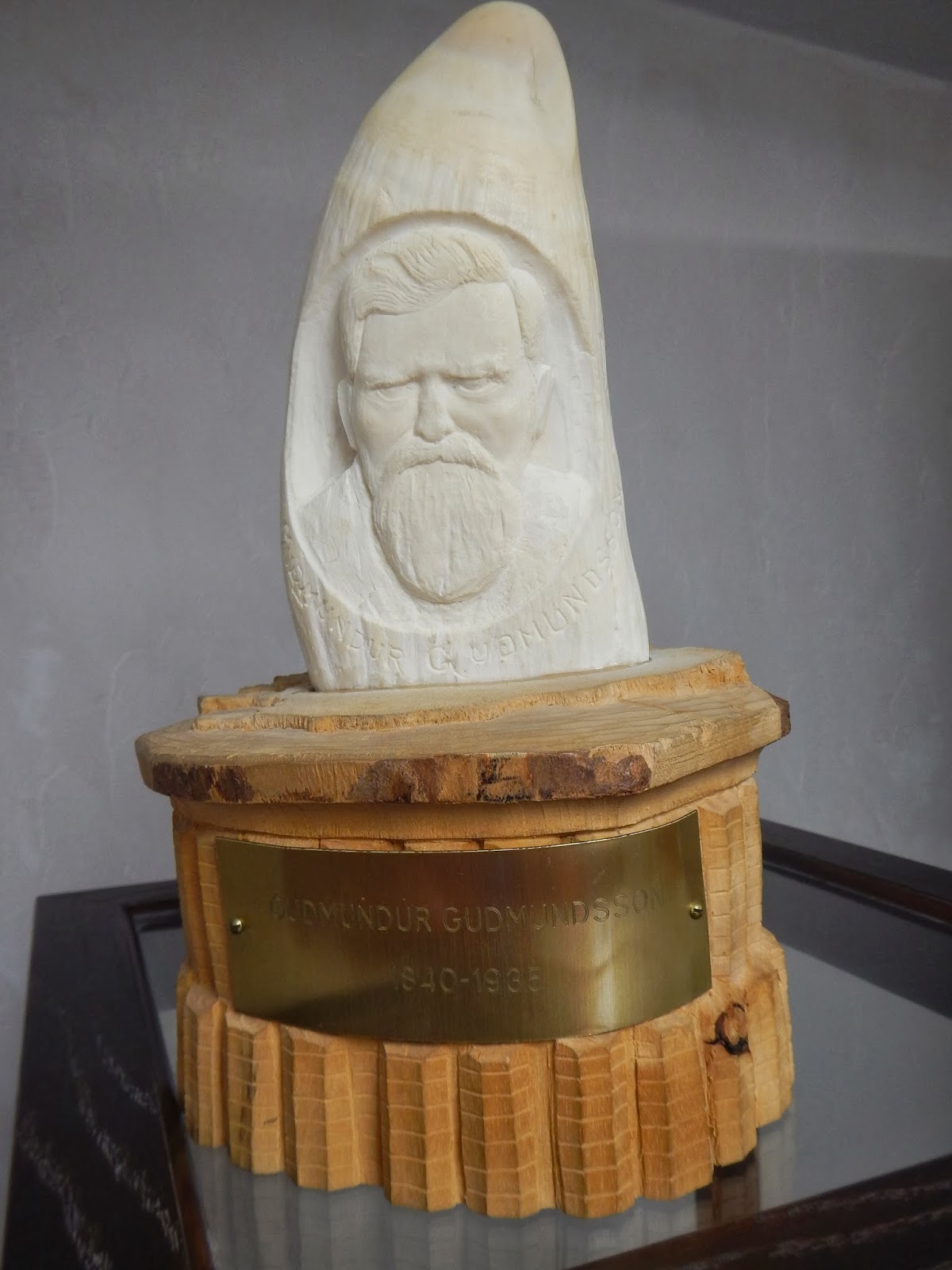
The glass case, approximately 16 inches high by one foot square, held what appeared to be a carved sperm whale tooth, mounted on a wooden base with descriptions of the two carved figures, one on either side, inscribed in brass plates fastened to the wooden base. On one side: Gudmunder Gudmundsson 1840-1938. On the opposing side:  his wife (we assume) Gudrun Ingvarsdottir (1842-1940).
This carving was placed on a piece of what appeared to be a square of dark sheepskin, wool side up, of a very dark brown color, shades of which are found among some Icelandic sheep.
[As I write this, I've strained to see more closely their respective dates of birth and death, and I can hardly believe they both lived to 98 years of age!  That will require additional checking to see if my eyes are correct.] 
Gudmunder Gudmundsson, whose two sons,
Tom and Albert, chose
last names Goodman and Goodmander.
The glass case was secured with a light, brass hasp, but to ensure no one messed with the carving, a hardened padlock was snapped in place.  A key for the lock could not be located.

The following week I brought a hacksaw to the Archives in an attempt to cut through the lock.  No dice.  It took a bolt cutter to do the job.  Once the carving could be examined more closely, it did indeed appear to be a carved sperm whale tooth, with the moniker "Dory" on the underside of the base, along with the date, '70.   "Dory" was also carved into one side of the tooth.
The top of the wooden base on which the tooth was mounted (glued, it appears) showed the relief outline of Iceland, and basalt-like columns were carved vertically into the sides, representative of those volcanic formations found in the landscape of Iceland. 
The carving's date, then, was 1970, the same year the Washington Island Icelandic Immigration Centennial was celebrated, highlighting the arrival of the first Icelanders here.  (That same year, also in  June 1970, the new ferry Eyrarbakki was christened with well water from the Eyrarbakki school yard well.)
Janet searched the Archives Index for related articles, and she found that a Centennial celebration had been planned for June 1970.  A request was made in one news article for the availability of rooms to host guests, and 400+ pounds of whitefish were on order for a fish boil.  Several Icelandic dignitaries were expected to make an appearance, including a man who at the time was the Chicago manager for Icelandic Airlines.  But, no news photo or direct connection was uncovered regarding a carved gift from Iceland. 
Similar signature 
While we were convinced this was given to Washington Island in 1970, perhaps accepted by the then Town Chairman, the carver's identity remained to be determined.  The rather stern looking faces carved in the tooth I believed were similar to those faces, also of the Gudmundssons, that I had seen in a museum in Selfoss, Iceland, when we traveled there with a large group in 1987.  Ted Jessen had brought us to the Halldor Einarsson museum of carvings during that trip, that same man who carved Thordarson's furniture.  I recalled filming Jessen as he held up two carved wooden figures, and their likeness resembled closely those carved in the whale's tooth.  
Einarsson, who immigrated first to Manitoba in 1922, then came to Chicago, had left his Chicago area home for Iceland in 1965 after the death of his wife, in order to spend his last years in his homeland.  He took with him many carved pieces accumulated in his personal collection, and he then funded and established a museum in Selfoss to house them.  Einarsson died in 1977.  With continued good health, he could have in fact carved this commemorative piece, either commissioned, or as his personal gift. 

But, a few days passed before I made the association between Halldor Einarsson and "Dory."  On several of the sketch pages observed in one of Thordarson's notebooks, there appeared the same stylized name, "Dory," with its distinctive tail end of the "Y" extended beneath the other letters.  Dory was Einarsson's nickname, it appeared - or at least the way in which he signed his work.  
In my book, I attributed Thordarson's notebook sketches (dated 1931) to someone who had gained Thordarson's trust, and I suggested it was possibly the work of his oldest son, Dewey, who studied to be an artist.  Whoever it was, he received permission to expand upon Thordarson's creative ideas in those personal pages.  Wood carver Einarsson would have earned such trust, through his successful interpretation of Norse mythology in the furniture carvings he made for Thordarson's Chicago office.  Those pieces were later moved to the Rock Island boathouse.
What has not yet been decided is the ultimate disposition of the encased, carved gift to "Icelanders of Washington Island" that now resides in the Archives.  It is the general mission of the Archives - partly due to space available - to receive and maintain documents and photos, but not to collect and display artifacts.  It would seem that the Town of Washington, as the recipient and owner, ought to prominently display this piece where it can best be seen and appreciated by citizens and visitors (and not relegated to a storage room).  
The value of this piece lies more in its cultural connections, rather than its monetary value, although Icelanders who venerate Einarsson's work might look differently on this artifact. 
- Dick Purinton

Tuesday, November 19, 2013

BOOK REVIEW


A BOOK REVIEW

Washington Island, Wisconsin -

[Note:  Thanks to Norman Gilliland, one of the Island Literary Festival presenters in early October, and a Wisconsin Public Radio producer and host, I'll have the opportunity to be interviewed on Wisconsin Public Radio's "Central Time."  (Sister Bay station is WHDI 91.9 FM) -     3:12 p.m.,  December 5th.   Hope you'll join me there…]

            ***                                     ***

The following review by Charlie Calkins appeared in the November 14 Island Observer:


Thordarson and Rock Island by Richard Purinton 
  
Washington Island, WI:   Island Bayou Press, 2013 (XXVIII and 436 pages).

Dick Purinton has done it again!  With the recent publication of his fourth major book, Thordarson and Rock Island, he has made another significant contribution to the Door County bookshelf.  And it should be noted that this work – consistent with his three previous books – is very much unlike the earlier ones in subject matter.

The title might suggest that Purinton is providing us with a traditional biography of Thordarson, a Chicago electrical industry innovator and Rock Island, Door County, recreational property owner.  Such is not the case.  The author is very careful to be explicit about his intentions:  “What appears in these pages…isn’t a biography…but rather excerpts from Thordarson’s life placed in an understandable sequence, depicted through correspondence, documents and photos.”  (p. IX)   Put another way, Purinton wants his readers to understand the relationship his subject had to this particular place (Rock Island) and the relationships Thordarson had with the many people who tried to help him transform his property into his envisioned dream. Make no mistake.  This is a formidable task.

Purinton relies very heavily on Thordarson’s own correspondence to tell his subject’s story.  The letters alone, however, would not tell much of Thordarson’s transformation of Rock Island.  It was incumbent on the writer to provide the backgrounds and transitions as he generally moves chronologically from one episode to another in Thordarson’s ownership of Rock Island.  Purinton does a masterful job in providing the reader with the background information needed to follow the meaning and understanding of Thordarson’s intent in writing his letters.  The reader comes away believing he / she does understand the flow of ideas, actions, and results.  This is paramount in following Purinton’s purpose.

A glance at the chapter headings suggests, for the most part, standard topics covered in a general chronological order.  “Rock Island Property Purchase,”  “Boathouse Construction,”  “Game Management Escalation,” and “Contemporaries in Door County” are examples.  But what about “A Magnificent Library, A Lifetime of Books”?  What does this have to do with a Rock island recreational property?  Purinton details Thordarson’s lifetime love of the printed word, especially science related books.  Over the years he amassed a spectacular collection of books, which were ultimately housed in his architecturally impressive boathouse.  This fine collection eventually formed the basis for the University of Wisconsin’s rare books collection.  The point here is that the author left little – if anything – out of the story of the man and his island.

This reviewer is impressed by authors who do the required homework (research) necessary to produce a fist-class work.  Clearly, Purinton has done this in all regards.  His bibliography is extensive and impressive.  The accompanying photographs and diagrams with informative captions are to the point and relevant, not fluff added as an afterthought or as a space filler.  In addition, pertinent documents provided help tell the story.

The reader should be forewarned:  This is not a quick nor easy read.   That observation is not intended in any way as a criticism of Purinton’s book.  Instead, it should be considered a compliment, for several reasons.  The book is very complete, and, as a result, very lengthy (436 pages of text).   The pieces of correspondence provided are numerous, many are lengthy, and some are quite detailed.  It takes time to read them and follow them.  Moreover, the author’s discussions necessary for an understanding of them are comprehensive, as are what he calls “notes”, which he uses as explanatory notes rather than formal footnotes.  And, finally, in this regard, there is a great deal of information provided about this very interesting and complex man that deserves pondering, rumination, and reflection.  This takes time for serious readers.  But, it is sure worth the time and effort.


    Charlie Calkins is a retired geography professor, a part-time Door County resident, and an inveterate collector of printed material related to the county.  In his spare time he operates the Badger Bibliophile, a business specializing in buying and selling gently used Wisconsin books and maps.  His wares are sold at several antique malls in the state, including the Old Orchard Antique Center in Egg Harbor.                                              E-mail him at wibooks@yahoo.com

Monday, November 18, 2013

MONDAY MORNING ASSESSMENT

-  Detroit Harbor, Washington Island

Ferry trips are running more or less on schedule this morning, which is better than expected given the gale warnings posted for the upper lake from Sunday evening through most of Monday.   A glance at our Northport webcam showed several trucks lined up to come over for the 9:30 a.m. ferry to the Island.

Two box trucks were also transported on the earlier run, one of them the Mann's Store grocery shipment that comes across each Monday to provision the shelves at our only island grocery.  When weather is questionable and we're in that time of year when there are few trips during the day, Orion Mann is considerate to put their 25-ft. box truck in line early on a Sunday (when the traffic is generally lighter).  Our crew ferries it to Northport where it sits over night.

Then, on Monday morning it's already in place - regardless of weather or other traffic that morning - for the grocery semi that arrives to transfer pallets of goods.  If Orion can't get across, his cousin, Chris Voight, positions the truck to the food semi at the highway's shoulder, and he later drives it loaded down the dock to the waiting ferry.  This routine is usually accomplished for the earliest ferry leaving Northport, so that Island grocery shelves and display cases will restocked and ready for Island shoppers.  Late Monday morning is an optimum time to shop at Mann's grocery, a few hours after their loaded truck comes off the ferry and backs up to the store's loading dock.

Roger Johnson passed away

We'd like to mention the recent death of friend and Gills Rock neighbor Roger Johnson, 77, November 12, 2013.  Roger's wife Gloria, who survives him, for many years worked behind the counter at the Ellison Bay Post Office, and we would see her when we picked up and dropped off Island mail there.  Roger's family is an old Gills Rock commercial fishing family, and he fished in his early years before taking up carpentry.  Oldest son, Rick, is one of the few remaining commercial fishermen left in the northern peninsula, fishing from the tug Freitag Bros.

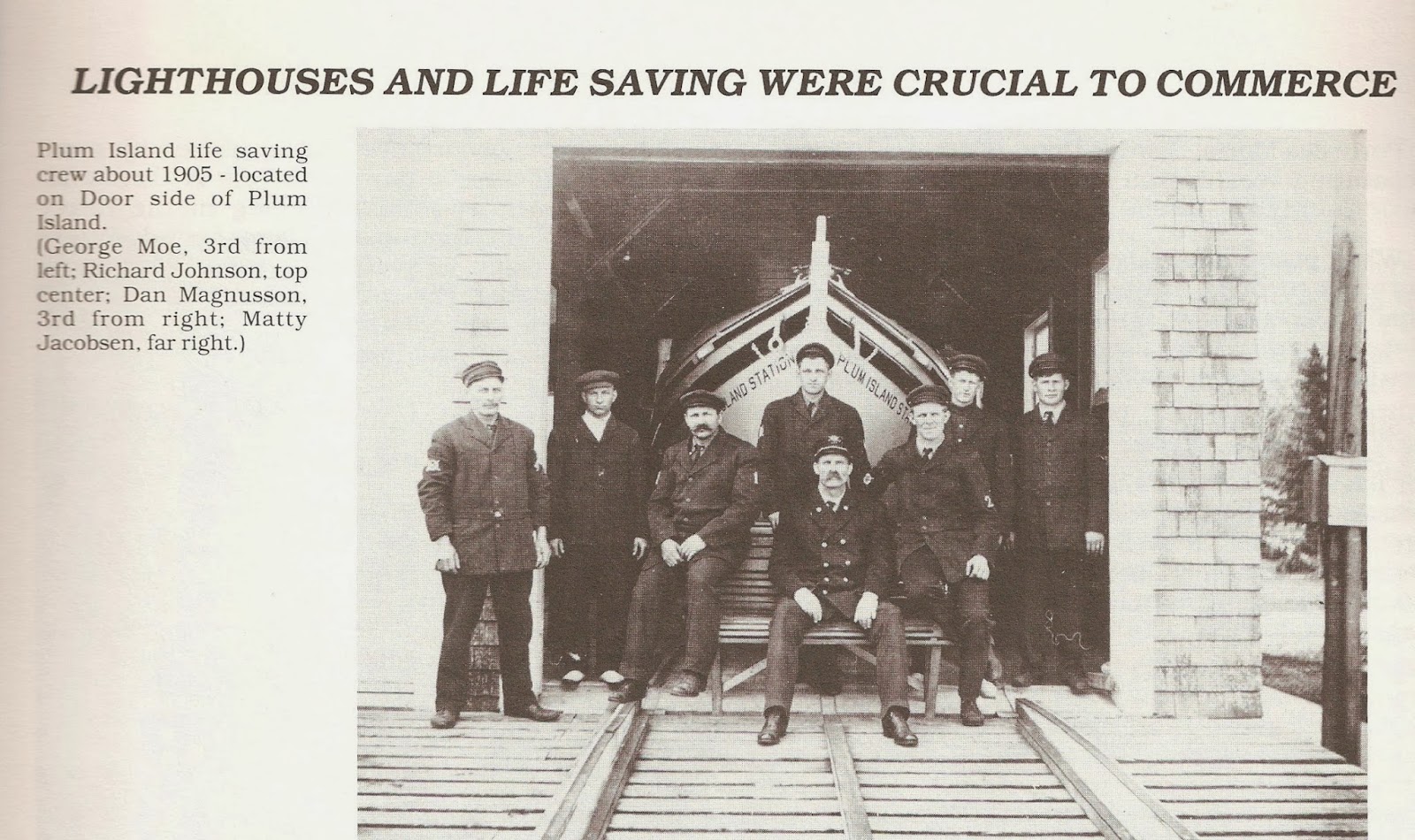
Roger's father, also Richard, served for a time at the Plum Island Life Saving Station, and Roger helped identify many of the men shown in the photo (below) that appeared in Over and Back, published in 1990.

We'll remember Roger also for construction of the Northport Pier Restaurant in 1985/86, and days when we popped into his Gills Rock shop where he worked on projects, adjacent to the ferry landing.  That building was the Johnson family's net shed.

Our sympathies to Roger's family.

 ***

The northwest winds of today, and the SW winds Friday into Saturday, were forecast days in advance.  The strong southerly flow caused a suspension of dredging operations, once again, but crews and truckers were back at it once again this morning, because in Detroit Harbor's channel the northerly winds won't hamper tug and barge maneuvers.  Below are a few more recent photos taken during the past week.

Jim Rose photo taken this morning, Nov. 18.


After a day of wind-caused delay, at 7 a.m. the tug Stephen M. Asher
pushed the dredging rig into position as we passed by,
outbound, on the Eyrarbakki.


While there was a break in the weather, with excellent weather Friday to complete a big pour of
concrete, our ferry crews installed a large diameter steel pipe culvert.  Ken Berggren fabricated the drainage box with grate, and he took the plywood lid off long enough for me to photograph the layout.  The project went along smoothly until a deep concrete wall poured many decades ago was discovered beneath the blacktop, directly in the line the pipe would take.  This required the better part of a day's work to saw, jack-hammer and trench toward the steel bulkhead.

An attempt to eliminate a large puddle on the dock where traffic
lines up, this culvert was installed and concrete
was poured Thursday, Nov. 14.  Roen rig (background) laid up for wind and
installation of a new tug generator.


Friday proved to be our finest day outdoors this past week, and I traveled to Sturgeon Bay and discussed my book, Thordarson and Rock Island, on air with Eddie Allen of WDOR.

Time flies quickly during such interviews, and I wondered afterwards if I highlighted enough important things about Rock Island and Thordarson. Regardless, its over, and I appreciated the opportunity and the one phone call from listener Kay Polster who said she possessed a check made out for $24.00 and signed by Thordarson, to her dad, Hector Floyd Koyen.

Floyd and Gladys Koyen spent at least one - maybe several - winters firing the greenhouse boiler on Rock Island to preserve Thordarson's orchids and his other plants from season-to-season.  I remember Floyd commenting on that task, shaking his head about how futile it all seemed, burning cords of wood in order to keep a glass greenhouse warm throughout the winter.  But, it was gainful employment.  (Floyd was a well-driller and a plumber by trade.)  I believe that check, made out in Thordarson's hand, was from 1941, a time when the Thordarson social and family activities on Rock Island were about to winding down, in comparison with earlier years.

Kay visited with me the following day at the Greco Gallery where I was signed books that afternoon.  She brought Floyd's endorsed, cashed check along.  (Floyd must have asked Thordarson if he could keep it as a souvenir.)  It was good to see so many visitors in the Greco Gallery on Third Avenue, out on a rainy afternoon, a few of whom I hadn't seen in years.

Kay (Koyen) Polster holds check her father
received from C. H. Thordarson.
Added to the recent weeks' activities are two book reviews that I will unashamedly publish here in my next blog!  
    -  Dick Purinton

Thursday, November 14, 2013

WINDS OF NOVEMBER REMEMBERED


Jim Rose took this photo this morning, with Roen work and material
barges moored adjacent to the main ferry pier's
south side.


Washington Island, Wisconsin -

The Roen barge alongside our regular ferry pier tells the story today, the second straight day with no dredging activity due to strong SW winds and seas that make maneuvering barges difficult and dangerous.  We've been able to make our ferry trips in the southerly winds, all right, but the work of unloading spoils has been temporarily halted because of high SW winds.  There is a roll that comes into Detroit Harbor, even sweeping around the end of the Potato Dock

On Monday, this most recent Veterans Day, our ferries made only several of the scheduled trips.  Two boats carried cars and passengers at 2:00 p.m., and that was the day's last run.  After the early trip, the other morning trips were cancelled.

Monday's cancellations were, I believe, the first such scheduled runs cancelled in 2013.  That day, because the winds were from NW, sea conditions in the Detroit Harbor channel remained smooth, despite gusts, and the Roen crews continued dredging.  In fact, we had several days of quite tolerable weather early this week - though cold - during which dredging operations went full-bore.  But then, when a warming trend brought swings in temperatures of twenty or more degrees, the southerly air flow increased to the point dredging operations were halted. 

Hazards of trucking typically don't
include deer, butduring his last run of the evening
several days ago a deer tried clearing Dave Hanlin's truck
hood.    This photo by Jim Rose shows Hanlin's truck
at Northport, awaiting a replacement windshield.
In the marine construction business there is always something to fix on a weather day, and the Roen crew busied themselves with a generator project yesterday.  But as the clock ticks and the season advances, production must continue or else we'll surely be looking at a prolonged dredging project well  into 2014.  That's not in anyone's best interest.  

Following discussions with Roen and Foth, we will likely permit the offloading of spoils at our regular dock until working conditions improve.  With the swinging of mud and stone in buckets, and the movement of trucks, there is an associated mess and mayhem, which we prefer to take place at the Potato Dock, out of the way of ferry traffic.  But we also realize the necessity of keeping this project moving along, so our main ferry pier may become the temporary offload site until winds abate. 

Gordon Lightfoot's lyrics that paid homage to the men of the Edmund Fitzgerald, lost in a Lake Superior storm November 10, 1975, and to Great Lakes sailors in general, brings to mind storms of historical proportions.  There was the Armistice Day blow of Nov. 11, 1940, to which Arni Richter often referred, etched into his memory.  The November 1913 "White Hurricane" was another, which carried vessels into dire straits in local waters over a period of several days:  the Louisiana, Halsted, and Plymouth.   Winds were recorded exceeding 70 mph during that storm.

Joan Hansen reminded me last week that this year was the 100th anniversary of the Louisiana coming ashore in Washington Harbor, its crew managing to safely reach shore in a lifeboat after a night on board, while the hull burned, eventually to the water line.  The Louisiana was light after unloading cargo in Milwaukee, enroute to Apena, Michigan, and had dropped into Washington Harbor for protection from the wind and seas.  When the wind direction shifted, it dragged anchor with seas bringing it progressively closer to the beach.  That was November 8th.

On the 10th of November, with the storm still raging, it was the lumber barge Halsted's turn, and it landed after many hours broadside on a ledge near shore.  Later, in calmer weather, it would be pulled to safety with the help of a dredge and steam tug, to continue its service.  No lives were lost on either the Louisiana or Halstead.  

One account reported the boiler of the Louisiana salvaged in 1920 by the Leathem Smith Company of Sturgeon Bay.  The compound steam engine was also removed later that year, it is believed.  

North of Washington Island, however, the barge Plymouth had been towed into the bay, possibly seeking the lee of St. Martin Island, towed by the tug Martin.   The tug's Capt. McKinnon indicated later that he was towing toward Washington Harbor when he determined the strain of the tow cables was too much. The tug had itself already taken on much water through leaks in its hull and was in danger.  McKinnon feared that both tug and barge might go down together, and so a decision was made to let the barge go.  Shortly after the tow cables were cut, according to an account, the barge sank with seven men still onboard.  Another account had the Plymouth anchored for a time near Gull Island, with the tug, helpless, a distance away.  

McKinnon had apparently tried to turn his tug around in order to save the men in the water, but he was blown away from the site of the wreck.  It is unclear why so many men were onboard the Plymouth, an unpowered vessel, while it was under tow in heavy weather.  The helplessness of the men aboard the unpowered barge was compounded when the cables were cut. Their loss of life was reported November 12th, 1913.

This photo of the Robert Noble taken by Peggy Olson several years ago serves
as a reminder that when one of our ferries behaves like a rowboat or small
runabout, it isn't a good time to be underway.  In this instance, winds
were westerly and crossing the Door itself was the greatest, though brief, challenge.

 Each day's conditions - wind direction, sea state,
air temperature, ice  (if any)  - can impact the decision to operate

or not.


LOUISIANA - Nov. 8, 1913

The other day at the Archives, Kirby Foss asked, had I ever read the accounts of the Louisiana and Halsted in the Wreck Log from the Plum Island Life Saving Station?  He promptly found them for me, and here are the main portion of neat entries, official accounts for the Louisiana, followed two days later by the Halsted, made by Williamson Robinson, Keeper:

Nor Shellswick with team to haul Beach Apparatus to scene of wreck.

At 6:30 a.m. I received a telephone message from Washington Harbor saying that the steam barge Louisiana had dragged her anchor and was on the shore with the crew on board and that they needed our assistance.  The wind was then blowing a gale form the N.W. with blinding snow storms and it was not practicable to take the life boat to Washington Harbor as it would take hours to reach there.  We loaded the gear of the Beach Apparatus into the life boat and took the boat to Detroit Harbor where I had engaged a team to carry us to Washington Harbor.  We left the station at 7:50 a.m.  It took us some time to load the gear and to launch the life boat in the heavy sea.  We arrived at Detroit Harbor at 8:40 a.m. where I learned that the crew was on shore, that the vessel was on fire and that no assistance was needed.  I was informed that three other vessels in Washington Harbor were in danger of dragging ashore.  We continued our trip overland to the scene of the wreck.  The crew of the Louisiana was ashore and nothing could be done to assist the burning vessel but three other vessels were in danger.  We spent the day & night patrolling the shore. 

 From the Wreck Report entry a few days later, Nov. 10th, 1913, of the Halsted, also entered by Williamson Robinson, Keeper:

Nor Shellswick with team to carry gear of beach apparatus.

We arrived at Detroit Harbor at 9:30 a.m. on our way to wreck of Louisiana.  We learned that the Louisiana needed no assistance but that several other vessels were in danger in Washington Harbor.  We continued our trip overland loading gear of Beach Apparatus on a rig I had previous engaged for that purpose.  On arriving at scene of wreck we found that the Sch. Halsted anchored about 3/4 mile from head of Harbor was dragging ashore.  We patrolled the beach all day and night, building fires for signals to the vessel.  We expected the Halsted to come ashore at any time as at times she would drag a considerable distance and then would hold for an hour or more.  At 5 o'clock Monday morning the Halsted dragged within 60 feet of shore.  We shot a line over her and got the whip aboard.  The water is very bold at that point and the Halsted was hard against a shelf of rock.  We were ready to use the breeches buoy when a heavy seas lifted the Halsted upon the shelf.  It was then so close to shore that the men on  board hung a ladder over her port bow and we assisted them to shore.  When daylight broke we used the whip to bring their clothing ashore.  We could render the Halsted no further assistance but we remained at scene of wreck as a small vessel was in danger of dragging in.  At 3 p.m. the wind went down slightly and as the vessel was in no further danger we came to Detroit Harbor intending to return to Station.  As our boat was covered with ice we remained there overnight, removing ice form boat & returning to station at 11 a.m. Tuesday morning.

-  Dick Purinton