Wednesday, November 9, 2011

ROBERT NOBLE - WORK PROGRESS

Second of two CAT C-18 engines with Twin Disc
marine gear, ready to
be lowered through a main deck opening
.
Bay Ship Building, Sturgeon Bay, Wisconsin -

Catching up with some of the photos I took last week of the Robert Noble repowering project, I've posted several of them here.  Since that date, much has been accomplished.

Both engines have been set on engine bed framing and aligned, and by now a hard resin known as Chock-Fast has likely been poured beneath the mounting plates.  Piping of cooling lines has begun.   Keel coolers have been installed, from the underside of the hull.   The new props were mounted on reinstalled shafts and secured with large brass nuts.  Rudders that were slightly enlarged were reattached.  The hull exterior was spot-blasted where needed, and painting over those areas was completed.

As of today, nearly all work has been completed outside the hull.   In the near future, the ferry will be floated from the dry dock.  Then, remaining interior work will be done while moored to the pier.  A solid two-to-three weeks of piping, wiring (including gauge panels in the PH), insulating, painting and dockside testing are necessary before the ferry will be ready for a sea trial.

Rich Ellefson has monitored work there since the ferry went into dry dock, Monday October 17, and has spent long hours on board each day following up on details.  Results, though far from complete, already indicate wise choices in use of the limited engine room space.   Equipment placement, wiring run locations, and essential piping that can avoid traffic areas is considered carefully for later ease of service and maintenance.   Regulation governing small passenger vessel design adds to the volume of valves and wiring, for example, but the engines themselves are more compact than the engines they replaced.

Starting battery banks, separate and distinct for each engine, were shifted to a seldom-used alcove, one example of how sensible redesign can save space in the more frequented walkways.  Main engine exhaust lines, essential to carrying away hot emissions, grew from 6" diameter pipe to 8" pipe, are another challenge because they will hang directly above the shaft alleys, limiting side-to-side movement for service in the engine room.   However, on the port side which is near the engine room entrance, round pipe will be replaced by a flattened, rectangular tube, so that crew members can more easily duck  beneath.  

As more equipment is piped and wired, remaining open spaces will gradually close in, but the intended result is to maintain sufficient room to move and to service the equipment that may be superior to the original layout.

Following are more photos that show progress as of 11/1/11, which was the approximate starting point for putting the engine room back together.    -  Dick Purinton

Rich Ellefson and Bay Ship machinist discuss
cooling water connections.
Engine room, starboard side looking aft:  new waste holding tank
is outboard, at left; bulkhead plating with round access hatch 

to steering room was cut, then flipped 180 degrees and reinstalled to 
avoid new exhaust run.  Exhaust pipe will penetrate 
bulkhead to left of stanchion shown in foreground.
Starboard rudder, foreground, with additional surface 
added to trailing edge, hangs from chain fall, ready
to be reinstalled.  New starboard prop is
already mounted and secured to shaft.

Saturday, November 5, 2011

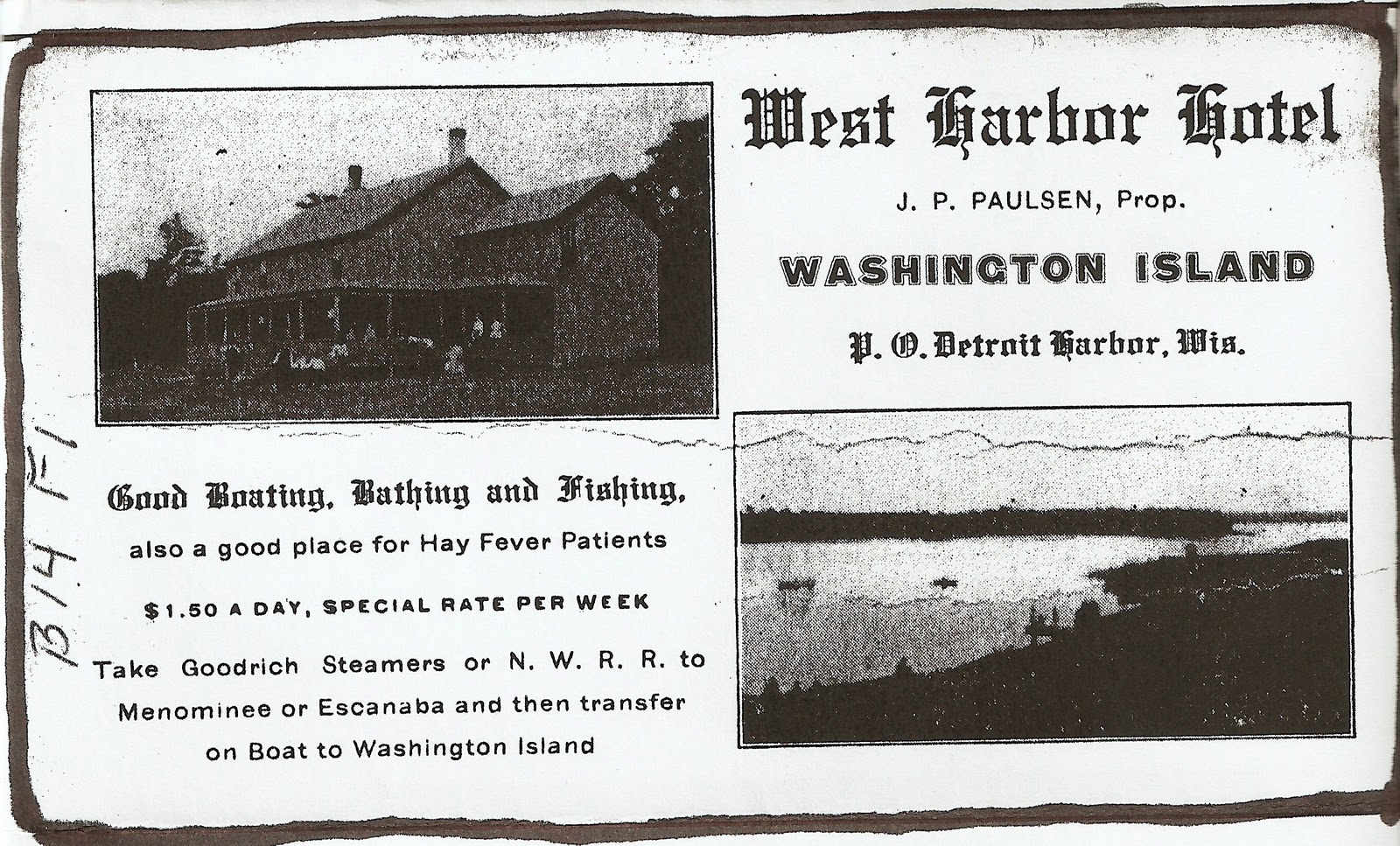
WEST HARBOR SAWMILL, HOTEL

West Harbor Hotel - date unknown, but thought to
be 1900 or shortly thereafter.
Washington Island, Wisconsin -

So many memories accumulate around a piece of property and the people who own, manage and offer hospitality, that it is hard to accept sudden interruption in that flow of history.  We think ... and this is only conjecture, knowing the resilience and resolve of the Gibson family and their close association with their home, property, business and community...that there is more than even chance it will be rebuilt.

But that is a decision that will come after close examination of future plans, including what is possible and practical given today's design and structural codes.  We do know there are a good many people pulling for the Gibsons who still have vivid memories of vacations spent there, playing in the water, tasting the most wonderful chicken dinners, shooting pool or horseshoes (free lessons from the "master"), and visiting with Marianna and the Gibson children, (and before that, with Pearl and Frank.)

My own memories include such arcane blasts from the past as:   our own honeymoon night in room #8 (where else could you get away from wedding revelers?);  playing bunco during the holidays with the American Legion and Auxilary members, and observing a near-fight between hostess Pearl Gibson and other senior bunco fanatics as to which table was the "head" and which one was the "foot;" escorting a frail Florence Bell out the back door to her car one evening during an early December snowfall wearing my leather-soled shoes, departing from a party hosted by Arni and Mary, then slipping and nearly crushing Florence as I fell on top of her;  numerous Ferry Line Christmas parties, most always centered around those delicious meals with games afterward;  knocking on Marianna's kitchen door after driving through West Harbor ice in a pickup truck with Tom Wilson;  and a family Fourth of July in one of the Gibson cabins in 1955, when swimming and flipping over in inner tubes was just about the coolest thing I could imagine.

I understand one or more dining room tables remain relatively untouched from the fire, and maybe even those old dining room chairs, save for smears of watery char, because the intense heat during the balze concentrated upward in the ceiling and attic cavities, not the main floor below.

Our memories are only a very small slice of the nonstop family and community activity that took place for over a century at West Harbor.  I was reminded in checking back that it was in June 2007 when the 60th anniversary of Gibson family presence at the resort was celebrated, an event attended by over 500 people.  And before the Gibsons were the Sorensons, and before them, the Paulsens.


The West Harbor Hotel image (top) is from an Archives post card and we think it was from the Paulsen era, given the squareness and trim of the porch, the look of the windows.   A Paulsen calling card noting special instructions for getting there was also in the archives file for West Harbor.

At some point the Door County Advocate featured an article written by Herb Gibson (date unknown but the HS indicates it may have been Herb's high school history project) about West Harbor Resort.  It was very well done, and given yesterday's events, I'll reprint it here as a refresher on the progression of ownership that took place on that property.

[I would also recommend looking at a video interview with Herb who recounts this history on the Island Chamber web page in story-teller fashion.  With pride, Herb talks conversationally about his family's roots there and those who preceded the Gibsons.]

From the Door County Advocate, by Herbert Gibson, Washington Island HS:


 "My home, West Harbor Resort, has a very interesting history.  It is one of the oldest buildings still standing on the Island.  The main building and the property started out as the headquarters for a lumber camp. After that it was converted into a general store, and then in to a summer resort, which it still is today.
  "About 1860 Frieburg's Lumber Company, one of Wisconsin's leading wood companies of the time, bought a timber contract for removing all the virgin pine from the island.  At that time the island was very sparsely populated, and nearby all  the island was covered by huge virgin pine.
  "The so-called "big pine" of the island which was cut down several years ago was estimated to be about 500 years old and was about five feet in diameter and illustrates the immense size the trees must have been.
  "That particular pine was one of the few survivors of that great lumber boom 100 years ago.  That sawmill was set up at the point of land north of the entrance to West Harbor. 
 "A boarding house for the lumberjacks was constructed from some of the first products of the sawmill, and that building is still standing today although several additions have been added.  A large dock, built out into Green Bay next to the mill, served the ships hauling lumber to all the large cities on the Great Lakes.
  "Traces of that dock can still be found.  The lumber jacks used oxen mostly to haul the logs to the mill.  From dawn until dusk all that could be heard was the ringing of axes and the buzzing of saws. The whole point on which the mill was located became a mass of slabs and sawdust. Even today if you walk on this point the ground is spongy from that sawdust, and if you ever fish in West Harbor, there is seldom a day goes by without hooking into one of the thousands of waterlogged slabs or deadheads that abound in the water.
  "Most of the activity of the mill ceased in the winter.  The lake froze over early and no shipping could get through, also the heavy snows that used to prevail made work in the woods almost impossible in spring.
  "Eventually it became unprofitable to keep the mill running.  All the pine had been cleared off and there was no profit shipping other types of lumber.  Frieburg, still owning the small piece of property on which the mill and boarding house were located, decided to convert the boarding house into a general store.  The upstairs was used for storing 100 pound sacks of flour and feed.  With all this weight continually being stored there, dips in the floor developed, and even today as you walk down the upstairs hall it is like walking over a series of hills.
  "In the store's early days people came from all corners of the island to trade at Frieburg's general store.  They would come for a weekly and sometimes monthly trip in their horse and buggy or horse an sleigh depending on the time of year, and stock up.  But as the population increased, other stores sprang up nearer the centers of population, and began taking the business away from Frieburg's, and it became unprofitable to keep the store running.
 "The store was boarded up and stood empty and deserted for a number of years.  Then, about the year 1900, a fellow by the name of Paulson with the idea of turning the store into a resort bought it from Frieburg. Since that time, it has never shut its door to summer tourists. The only other owners of the resort beside Paulson are Jens Sorenson and Frank Gibson.  Many additions and improvements have been added to make the resort what it is today.  It isn't a fancy or expensive resort, but the people who come there enjoy themselves and a large percent come back every year.  Its purpose is, and has been, to serve the tourist and hopes to go on doing so for many years."


   -  Dick Purinton

Friday, November 4, 2011

UPDATE: WEST HARBOR RESORT FIRE

Island Fire Chief Pete Nehlsen confers with resort owner Herb Gibson
on plan of action following return of equipment to
fire station.  Nehlsen and several men stayed on scene with one
truck as fire watch.
Washington Island, Wisconsin -

By 9 a.m. this Friday morning, nearly all equipment and volunteer fire fighters had been released from the scene.  Fire Chief Peter Nehlsen, one truck, and a few men as fire watch remained.

"It was the smoke alarm that saved us," Herb said.  "Without the alarms, who knows?"    Herb, his wife Marianna, and one daughter, Sara, were sleeping when the smoke alarms sounded, around 4:30 a.m., and he immediately placed the fire call.  With soot on his lips and face, still very much absorbing the impact of events of the early morning, Herb expressed relief that his family was safe.

The building appears to have extensive damage, in particular the easternmost  portion of the building.  This section contained a dining room, game room, large living room area and a staircase leading to upstairs guest rooms.  These spaces were used primarily by resort guests, although the Gibson family welcomed many island visitors who made themselves at home for various club and private functions over the years.  The building's west end, also two stories, had been remodeled within the past ten years and was living quarters for the Gibson family.   From the exterior, it appears to have been spared from direct flame, but it will undoubtedly have smoke and water damage.

How important a role did the Island Fire Department's new ladder truck play in battling the blaze?

"The aerial pumper saved what is left of the building," according to Fire Chief Nehlsen.  "Unequivocally, without it, the rest of the building would be gone."  Heat had blown out window glass in the older section of the resort building.

Perry Jorgenson and Herb
examine damage.
And, from the accounts of several firemen I spoke with, each agreed that the timely arrival of island men and equipment, in particular the aerial truck, were key in knocking down the fire, keeping it from spreading and consuming the entire building.   Nehlsen, who was in the attic pulling down smoldering insulation when I arrived, said the entire attic the length of the building had been on fire at one point, but water directed downward from the aerial pumper stopped the advance in short order.

Nehlsen credited Liberty Grove's firefighters who, wearing Scott air packs, spelled Island firemen when it came to working inside the structure, assisting in extinguishing remaining hot spots, in particular the overhauling, tearing down of interior walls and ceilings.   "That's the dirty work," he said, "the real physical work."  Each LG fireman cycled twice through the structure's interior, he noted, before heading back to the mainland.

Nehsen had already contacted the State Fire Marshall to conduct  a post-fire investigation, routine procedure for such events, he said, and he expected an investigator would arrive later today.

New sheets of OSB were already stacked on the lawn, along with 2 x 4s and tarps, in preparation for closing the building's openings once the fire is out with certainty.   While the early morning  had been calm and frost was everywhere before sunup, southerly winds are anticipated this afternoon.  Island firemen will return around 3 pm to assist in buttoning up the remains of the structure.


-  Dick Purinton  - 11 a.m.

FIRE AT GIBSON'S WEST HARBOR RESORT!

Washington Island Fire Department volunteers responded to fire
at West Harbor Resort, called in at approx. 4:30 this morning.
Washington Island, Wisconsin -
  Gibson's West Harbor Resort, an island landmark wood frame building and one of the oldest commercial structures on the island, experienced a major fire early this morning.   Volunteer firefighters responded quickly, using the newly acquired aerial pumper truck (purchased from neighboring Liberty Grove Fire Dept.) to knock down flames.  Members of the Gibson family, including owners Herb and Marianna, were reported to have safely exited the building shortly after the fire was discovered.

No details of how or where the fire began are yet available, but it appeared as though damage was greatest next to the chimney, the east end of the building.   There are rental rooms on the second floor, and family living quarters in the western end of the building.

By 6 a.m. exterior flames appeared to have been checked, and firemen were about to attack the internal parts of the building to further extinguish burning material.   All units of the Island Fire Department were on scene, including pumper units at the Ferry Dock, where the tankers were being refilled.

Offering to assist, Liberty Grove Fire Chief Chris Hecht sent approximately eight volunteers, led by Liberty Grove Fire Captain, Lee Telfer, across the Door.  They arrived at the Island dock on Jeff Weborg's trap net boat from Gills Rock around 5:45 a.m. and joined Island firefighters at the West Harbor scene.   (Note:  By 7:40 a.m. they were on their way back to Gills Rock via Weborg's trap net boat.)

By the time the 7 a.m. ferry Washington began loading for the first trip leaving the island, water demand had slowed.

The hope is that damage will be confined to the eastern end of the structure, but that may be better determined in the next hour or two with daylight and a better assessment of damage from the interior.

This building, before it became a resort, had at one time housed men working in a West Harbor sawmill operation, prior to 1900.   The property, situated on a beautiful site along the island's western shoreline and also on the small inlet known as West Harbor, has provided rooms, meals, and hospitality to generations of guests for decades.  For over 50 of those most recent years, it has been operated by members of the Gibson family.


  -  Dick Purinton  -  7:40 am

Tuesday, October 25, 2011

SLACK WATER

Algae and scale shading on steel sheets, indicating
annual lake level variations, with highest point
resulting from the 1986-87 modern high. 
Washington Island, Wisconsin -

tide |tÄ«d|nounthe alternate rising and falling of the sea, usually twice in each lunar day at a particular place, due to the attraction of the moon and sun: the changing patterns of the tides | they were driven on by wind and tide.• the water as affected by this: the rising tide covered the wharf.• a powerful surge of feeling or trend of events: he drifted into sleep on a tide of euphoria | we must reverse the growing tide of racism sweeping the country.


Ticket seller Maggie Swanson fielded a challenging question yesterday from a visitor.  His question was:  "Is it high tide right now, or low tide?"

If there are tides on Lake Michigan, they are imperceptible.  However, with mud flats and protruding rocks now beginning to show a bit more each week, our harbors and shorelines do take on an appearance of lake water having ebbed with the tide.   This phenomena is typically observed here in the fall of the year.  Lake Michigan levels have remained below-average since approximately 2001, and for some of those years the levels have been mere inches above the record-lows of 1963-64.  

According to a report received from the International Lake Superior Board of Control, under authority of the International Joint Commission (IJC), the Lake Superior outflow has once again been adjusted, one means of tweaking water levels in lakes Huron and Michigan which, by the Mackinac Straits connection, are at the same levels.  Lake Superior by the end of September was about 11 inches below long-term average, but 2 inches higher than a year ago.  Lakes Michigan-Huron at that same time were about 14 inches below long-term average, 1-inch lower than a year ago, and about 7 inches above chart datum level.

Low water observed on Lakes Michigan-Huron has drawn critics for past engineering and the processes by which water levels are adjusted and maintained.   Yet, from all we've read and heard, including a presentation by the IJC Chairman several summers back, there is nothing as dramatic for impact on lake levels as plentiful precipitation, or on the other hand, evaporation, and absorption into land mass.

We were told that despite the controls at the few man-made valves from these Great Lakes, mother nature is still very much in control, and she will continue to dictate what is normal despite our wishes to the contrary.  Would an "empathy table"and free hugs, such as that employed by Wall Street protestors at New York City's Zuccotti Park, be useful activism for citizens who refuse to believe Army Corps of Engineers (ACE) data and reasoning?   An empathy table would provide temporary mental relief, at least, from what may seem to be overwhelmingly difficult and unfair conditions.

U.S. ACE Great Lakes Update


Monthly our office receives a free report on Great Lakes water levels, which includes a very informative bulletin titled "Great Lakes Update."

According to October's bulletin, the Coordinating Committee on Basic Hydraulic and Hydrology Data was formed in 1953, following extremely high lake levels in 1952.   At that time, agencies in both the U.S. and Canada "recognized that continued independent development of basic data would be illogical...and that early agreement on the hydraulic and hydrologic characteristics of the system was of paramount importance..."    As a result they "...opened negotiations early in 1953 for the purposes of establishing a basis for development and acceptance of identical data by both countries."

The Coordinating Committee, which meets twice a year, is made up of six members  (a chairperson, member and secretary from each country) and represents these agencies:
  *  U.S. Army Corps of Engineers
  *  National Oceanic and Atmospheric Administration
  *   U.S. Geologic Survey
  *   Environment Canada
  *   Natural Resources Canada
  *  Fisheries and Oceans Canada
  *  Canadian Hydrographic Service

There are several important subcommittees (pardon me if your eyes begin to glaze slightly as we review them):

    **   The Vertical Control-Water Levels Subcommittee which established the International Great Lakes Datum (IGLD) in 1955, a base line for all future measurements.   Noted are the "continued effects of crustal movements," new surveying methods, and the deterioration of the "zero reference point gauge location."

   **  The Hydraulics Subcommittee, which documents methods for conducting hydraulic field measurements, reports them, makes maps, comments on measurement techniques and computation methods, water level readings and tables of actual discharges.

   **  The Hydrology Subcommittee "spends a great deal of effort in coordinating forecasted wear levels for the Great Lakes and official water level statistics," which includes discussion of "Monthly mean water levels, outflows, precipitation and net basin supplies..."

The above is but a summary of the activities of the IJC and its subcommittees, a rather impressive range of activities for which the average citizen has little appreciation.  It is something to think about when gazing at the mud flats and wondering, and complaining, "Where has all the water gone?"

We can take comfort in the fact that these impressive-sounding agencies, staffed and supported by many technical experts in their field, put their best effort forward in monitoring and managing our Great Lakes water.  While their activities are tax-payer funded, and they work from a framework of legislation approved by Canada and the U.S., there would seem to me to be little room in such settings for renegades or persons with self-serving motives.  And still, these agencies have come under increasing pressure in recent years from those who aim for the good old days of higher lake levels, and who desire to change the status quo (to what?).

Bring on the "Empathy Table" and free hugs.  We can all use some!
 -  Dick Purinton

Sunday, October 23, 2011

ROBERT NOBLE IN SHIPYARD


Sturgeon Bay, Wisconsin -

The ferry Robert Noble sailed to Bay Shipbuilding in Sturgeon Bay early Sunday morning, October 16, and shortly after arrival crew members began dismantling piping, wiring, and exhaust lines from the engines as they cooled.   The following morning a tug assisted the ferry, "cold iron," into the oldest dry dock in the yard.

This box is made from a ship's hull surrounded by fill on all sides except the seaward end, where the gates are located.  Pumps run 24 hours a day to dewater the box due to a slightly leaky gate system.  It's old, but efficiently sized, and our ferries have used this dry dock almost exclusively during the many yard visits over approximately 70 years.

The reasons for dry docking Robert Noble now are several:  the five-year required Coast Guard hull inspection;  removal of propellers and shafts, check of stern bearings, pintles and pintle bearings;  modification of external cooling loops; paint touch-up as needed.   Of course, there can always be other items, sometimes planned maintenance, other times surprises, which are also expected when there are so many pieces to fit.  Even in freshwater, a hull exterior unseen for five years, can require unforeseen attention while it is on the blocks.

The plans to re-power this ferry by replacing original Cummins K-1150 engines with CAT-18 engines, and new gears, actually starts with the underbody where welded, steel channel loops would no longer provide sufficient cooling capacity, or configuration for the new engines.   Requirements for different water jacket ranges for after-cooler and engine cooling, with separate loops for each transmission, the old channel coolers no longer sufficed.  And, as it turned out, they had accumulated scale from the past 32 years.   It would be simpler and cheaper, for these reasons, to cut them off and install in their place new Fernstrum grid coolers, approximately 4' x 3' copper/nickel grids that readily exchange engine heat with cool lake water.   With the possibility of receiving the new coolers within ten days of order placement, the project both without and within the hull, would proceed apace.

Rich Ellefson had trailered the shafts to Green Bay's Badger Roll machine shop, along with two, new 4-blade propellers, for a close taper fit, and also the transmission tail shafts that would mate against propeller couplings.  These items would be ready within a week to install in the dry dock.

Above the dry dock

If you've ever been fascinated by the pouring of cement into foundation forms at a construction site, or the erection of steel on a multi-story building, or the quick and efficient setting of roof trusses on a home, as bystander you can appreciate the progress made before your eyes, even if you're incapable of personally doing any of it.

I felt that similar sensation at the shipyard Friday morning, the fourth day since work had formally begun, while staring down into rectangular openings in the main deck.   Hoses and wires ran this way and that.  Pieces of jagged, cut steel - now scrap - were jumbled in skip boxes on deck.   Fans, lights, ladders, barrels and other equipment were found in a seeming unorganized fashion.

This is a fairly typical shipyard snapshot, where a dozen or so men would cut, grind, weld, pipe, run new wire, insulate, and finally, paint, over the course of the project.   Each day's activities are coordinated for maximum, consistent progress until the day the new engines are restarted, a sea trial is run with Coast Guard observers on board, and the ferry is given approval for running back to the island.

During these first four yard days, the old engines and gears had been removed.  The engine foundations, boxes of half-an-inch thick steel, were undergoing slight modification to receive the new motors.  Deeper oil pans required cutting down transverse stiffeners inside the engine beds to accept them.  Racor fuel filters would be modified, one set of filters for each new engine.  The same for independent, isolated starting battery banks.  New, engine-driven hydraulic pumps with separate oil reservoirs for each system, will be installed.  A brand-new steel waste tank in gleaming white paint, had been lowered through the convenient deck opening and was resting on frames outboard of the starboard engine location, ready to be secured and connected to piping.

The aft, starboard bulkhead had been cut away, and a new bulkhead would be installed further aft, satisfying a Coast Guard design requirement for stability and balance in event of down-flooding.   

Peering through deck opening at
port engine location


What had seemed like a fairly straight-forward and routine engine replacement, old for new, had become a significant project.  Such projects often grow in like manner.   And yet, given the consistent, daily progress by skilled yard personnel, and the timely arrival of key equipment components from suppliers, this project may stay on or slightly ahead of schedule.

Our goal is to have the ferry home by Thanksgiving, more or less, with additional testing, cleaning, painting, and then winter lay-up, to follow.

 -  Dick Purinton

Sunday, October 9, 2011

GET THEE TO THE SCULLERY

Jacob Ellefson, taking a momentary breather from the sink,
comments on the exceptional red maple out his sink window.
Washington Island, Wisconsin -

The turkey, dressing, mashed potatoes and gravy, squash, pumpkin pie, etc. may have been outstanding as usual - and they were, according to many who stopped by the kitchen to express their appreciation - but the work in the trenches is equally important to a fine meal!

Many of the volunteers ate first, then worked in the kitchen for an hour or two afterwards.  A few worked, then ate at one of five seatings, then worked some more.   It's essential to keeping the Island's traditional Trinity Lutheran Church Fall Harvest Dinner moving along, flowing smoothly, allowing for serving in excess of 500 in an evening.

A running narrative of jokes mixed with fiction and fact flowed from the scraper's corner where Tim Lyons manned a rubber spatula over garbage cans as he received the busser's trays.   John Gay, Pat Hewlett, Dorothy Gay, Charlotte Hansen, Christie Hansen, Joan Hansen, Dan Hansen, Jacob Ellefson, John Davies, Jerry and Marlene Mann, Terry and Linda Henkel, Judy Perry, Joan Zorn, Betty Sperberger, Kirby and Margaret Foss - yours truly on the silverware sink - were among those more or less on duty during the first several kitchen hours.  All activities were managed and coordinated by Barb O'Connell who has a remarkable knack for keeping food and utensils in balance with diners' expectations.


This list does not even begin to mention the many who rotated through kitchen preparations hours earlier, or later, or the dozens of wait staff and greeters, including many teens, and those who worked the door, who handled reservations and money matters.  (A few kitchen photos shown were taken during lulls between serving and clearing tables.)


Frank had just completed a 3-wedding day at the Stavkirke, across the road from Trinity's main church, and sported Maxwell colors on his necktie, along with abbreviated leg wear.  Only an extraordinarily beautiful, warm October day would allow for getting away with such light summer clothing, but this was one of them.  And in the kitchen, an occasional breeze came through opened windows to invigorate the scullery crew.

"How did the weddings go today?" I asked, knowing it was always a bit of stress to coordinate such events, and to do justice to people who may travel great distances for an island, lifetime event.


"Fine, but the first wedding groom called to say he was late, got tied up by traffic in Sister Bay and missed the ferry."  Things managed to get back on track, just the same, with skillful juggling.

The pace of ferry operations Saturday was indicative of the volume of people in Door County for the weekend.  Four crews ran steadily and made 28 round trips - a summertime pace - in approximately a 12-hour period, moving traffic across the Door.

Today, Sunday, looks like it will be a similar snapshot.

  -  Dick Purinton

Saturday, October 8, 2011

LOAD 'N GO

Saturday's ferries - one arriving, one leaving
Washington Island, Wisconsin -

Ideal October weather (upper 60s), light breeze from the SE, and lots of visitors in Door County brought traffic to the Island this morning.   With as many planned Peninsula and Island activities as any time of year, there are many choices to be made, including riding the ferry to Washington Island.

Temperatures were consistently warm, days sunny, and colors brilliant against blue skies all week long, once the high pressure filled in.  The official recorded weather for our area, as delivered to us by NOAA Island Weather Observer John Delwiche from September included the following (all within the last hours of the month as stormy weather passed over the area):
  *    1.08" for a 24-hour precipitation   (an island record for 9/30)
   *   Mid-lake waves measured  23-ft. for night of 9/29 to 9/30
  *    Peak wind gusts recorded at Northport NOAA tower:     64 mph at 9 pm, 9/29  
    (Sister Bay gust were recorded at 69 mph)

The damage from last week's winds caused widespread power outages, both on Washington Island and on the Door Peninsula, where poles that supplied the island were snapped.   The Northport road still shows many of the trees that were cut and shoved aside so that power could be more quickly restored.

Robert Cornell, our Island Electric Cooperative Manager, along with Mary Lynn Andersen, Randy Sorensen and Don Johnson, worked long hours Thursday night into Friday, into Saturday, and again Sunday, to restore island power to all but a few homes.  Those were reached by Monday and Tuesday.  With stand-by Co-op generators available, but downed lines too numerous, it was an impossibility to keep up with the outages as they occurred, which led to one of the longest outages remembered by islanders.

Long delays, ensuing customer frustration, and the desire by non-experts to peg the problems and solutions floated unfounded rumors.   Robert, I believe, answered all the important questions and more in a straight forward manner in a box holder mailed Friday to Island REA customers.  

His 4-page letter which went into considerable detail began with this paragraph:

    "The Washington Island Electric Cooperative would first like to thank all the members for their patience and understanding during the severe storm of September 29 and 30.  We would also like to thank the Town Crew, Officers McGrane and Schultz and members of the Washington Island Fire Department for their assistance.   The amount of damage done to our system was unprecedented at least in the last 10 years and likely significantly longer.  When you are working during a storm and there are trees and branches coming down around you as you work, these folks deserve extra thanks. We would also like to thank all those members who offered help, brought in food, and gave us encouraging comments during the storm."   


Robert's Cooperative Boxholder letter is well worth placing in a file for reading once again some day.   As frustrating as the outages were, and the inconveniences caused by them, in the end few (if any) vehicles or buildings were reported damaged, and most importantly, there were no personal injuries reported either here or on the Peninsula as a direct result of the storm, a rather remarkable fact considering the limbs flying and trees that were wholly uprooted.   Lots to be thankful for, in other words, including the hard work of the power company men in clearing trees and restoring downed power lines.

So, this week has been a tourism "gravy week" in many ways, with beautiful, consistent weather that's brought out visitors to enjoy the outdoors at its finest.


Today and Sunday the Island Farm Museum will have cider pressing, carmel apples (the best!) and wagon rides with Ted Hansen and his pair of Belgians.   Ted had them out exercising in the fields adjacent to the museum barns when we visited Thursday while his wagon was at Dave's Garage getting axles greased in preparation for the weekend.  

Here are a few photos of Ted, brother Ray who stopped by to visit, and his horses.   -  Dick Purinton

Saturday, October 1, 2011

ISLAND POWER


WASHINGTON ISLAND, WISCONSIN -

When the weather looks as fine as it appears in the photo above, we're right with the world.  However, these pleasant looking, low cumulus clouds sailed southward on the tail end of winds that had blown down trees and knocked out electrical power, both on Washington Island and the Door Peninsula.

School House Beach, Friday morning

Forecast with precision, a cold air, high pressure system finally pushed a low to the eastern Great Lakes.  It had been sitting over northern Illinois since last weekend and was the source of much needed rain here, rain clouds that circulated east-to-west in counter clockwise fashion.  We made all scheduled ferry trips Thursday, as winds shifted to the north and velocities increased.  Around 9 pm our house shuddered.  Over the evening, heavy rains and sharp blasts blew down trees and broke power poles on the peninsula.  Our power remained out until 4 am Saturday.   The north end of Washington Island is still without power, from downed trees over power lines, we presume.

Maggie Swanson answers a generator-powered phone
at the Ferry Dock Friday as Bill Schutz looks on.
Power was restored early Saturday morning to
the Island's south customers.


As we, and many others, took the customary drive around the island to see the extent of damage, watch the waves at School House Beach, and commiserate with friends and co-workers about the lack of power, others gathered at either the Danish Mill (which had its own generator) and KK Fiske (gas stoves, and a source of water next door at the REA) for food and information.   Those two places did a great businesses as they were among the very few places still open.

Down at Holiday Inn on Detroit Harbor, where one would normally think it was protected from northerly gusts, the Lions Club tent that had been erected for a wedding there was not only knocked down, it was torn into pieces by the wind.  The wedding celebration, which is taking place as we write, will be held indoors at the Inn.

Anticipating we might not run Friday morning due to the predicted winds, our crews held in until 1 pm, then started making the scheduled trips.   The Northport Terminal building, normally locked, had been left open for those who might arrive to wait for the ferry.  That was, in retrospect, a mistake, because the northern peninsula power outage meant no water pressure for flushing toilets, and no lights in the rest rooms.  These two omissions, however, didn't stop those who needed to use them, or the dozens of cars who were doing the same thing we were on Washington Island:   driving around to inspect storm damage and looking for a place that had open bathrooms!  It might have been a very ugly scene, had it continued without supervision, but Hoyt rode across on Friday's first afternoon ferry.  He intended to cut and remove downed trees in the parking lot and organize freight in the garage, but nearly all of the first two hours were spend flushing toilets with buckets of water hauled from the dock.


Two of Ivan and Micki's "Poopsie's Pots" in Packer green and gold were soon on their way by ferry from the island to stand in for the decommissioned indoor facilities.   And when morning came, daylight and electric lights revealed a surprisingly clean set of rest rooms, thanks to a considerate public.


Attached are several shots taken during Friday.  (The cedar with large burl was taken at People's Park.)

Fall is here!  -  Dick Purinton

PART III - CLAY BLAIR WITH ISLAND WRITERS - 1994

Washington Island, Wisconsin - 
Note:    This is the final installment of a transcribed recording from Feb. 1994, when Clay Blair was a guest of the Island Writers Society.   
   In Part I, Clay spoke about his latest book about German U-boat warfare, and previous books he and Joan collaborated on.  In Part II he described his early years as a journalist and writer.  
  In Part III, below, he responds to questions asked by members of the audience, having to do with writing, and with the topic of submarine warfare.   -  DP


PART III - AN ISLAND WRITERS GROUP MEETING AT REC CENTER WITH CLAY BLAIR


Question:  How do you go about getting an agent?

Clay -  This book, for example (holds up a copy of Silent Victory), was published by Random House.  The way this works, you have a proposal that you type up and send to your agent, after you’ve talked on the phone.   And he may also include ideas before sending it on to a publishing house.  They’re not very many publishing houses left.  They’re all merging, merging and folding divisions, so that at the most there are only about ten major publishers.  

Then he’ll look to see what other books have been published that are similar.  They’ll send it on to maybe six editors, within a house, who may be interested in the subject, or the author.  

We’re lucky in that we’ve had the same editor for four years, and he’s an absolute crackerjack.    He can make commitments without sitting in a committee.  So we’ve published with Simon Schuster, Random House, Lippencott. 

Question:  How does it go from a book to a movie?

Clay -  We’ve had that experience twice in fifteen books.  It’s a wild crap-shoot. 
 
The best thing I can say for writers is that Hollywood has an insatiable demand for material.  I’m not talking about TV, now, but theatrical movies.   And the way Hollywood works, is, a project goes into what is called a “development stage.”   Let’s say for every 1000 development movies, a few get made.   You can get a book option with pretty good option money and have it go into a development stage, at which time a professional screen writer takes your material and begins to fashion it in his own treatment - a screen play which now you have nothing to do with, unless writing a screen play is part of the upfront deal.   We wrote a screenplay for a terrible movie. 

The normal process is that a book comes out - there are 55,000 books published every year… how about that!  - and a tiny few get reviewed.  Still a tinier number get on the “best seller list,” such as the New York Times or the Washington Post.  But it’s really a miniscule number we’re talking about here.  In the whole 55,000, maybe 200 books on the outside, in the whole year. 
  
Normally a book gets on the bestseller list and the lords of Hollywood leap on it.   Every book that becomes a best seller that could possibly be made into a movie - even a book like Everything You Wanted To Know About Sex But Were Afraid to Ask, from 20 years ago, there was an option to make that into a movie.   That’s how books are made… a tiny bit of them are actually made into movies. 
And then, there are movies made that are not released.  That was the case with our two movies. They should never have been released!  

We’ve been with the same agent for 25 years.  Agents have really replaced the image of the old editor with the typewriter, the tweed jacket-type guy who cares about the writer.   An agent goes after the best deal because they get 10% of everything you do.  And they might even like you, as well…but there’s no assurance of that.

There have been some defections recently, I’ve noticed.  Agents die.  Ours died.  It was very difficult trying to deal with him from the grave.   We found a new one, someone in the same firm.  Chief agent dies; little guys move up.   Our big agent died, who was the biggest agent in New York, really.  He dies, and his wife tried to take over the company.  She was a flake.  All three top agents left and went on their own, so we went with them.  You might not follow that editor, but you follow that agent, because he knows where the money is.

Question:  How did the German U-boat compare with the American submarine? 

Clay -  The Americans fought a different kind of submarine war than the Germans.  In each case the objective was the same.  

The German objective was to isolate Britain and starve it out, and shut down all the imports so that you couldn’t build war machines or conduct war.   That was their objective.  Our objective was actually the same.  That is, Japan was not unlike Britain.  Our idea was to draw a noose around Japan, and starve it out.   Both objectives were the same.  

But the submarine war was fought very differently.   Ours was basically a one-boat operation. A boat went out on patrol by itself, and our submarines were big, and quite comfortable, I mean relatively comfortable, and they carried torpedoes and a lot of fuel.  You could go out for two months, two months and a half, then return to your base, Midway or Pearl Harbor, or wherever it might be.   Germans, on the other hand, had little submarines, about ½ to 1/3 the size of ours. They carried 11 torpedoes, half as many, with terrible habitation.  They lived like pigs, no water to shave or shower.  They were all stinking, and when you combine that with the smell of a diesel engine in a tiny little boat…the living was just horrible.   The food had maggots in it.  Just awful.  

And their task, all through the war, was to attack convoys in wolf packs, as we called them, anywhere from ten to 40 U-boats.  They had arrived at this strategy on the grounds that in WWI we had revived the convoy system of old, and there were so many ships and so many escorts that a single U-boat had a very difficult time with a large convoy.  

Our thing worked. We sank just about 1000 Japanese ships.   They didn’t sink many ships, but we did.   We sank about 5 million tons and a bunch of war ships, and we literally shut down war material and food and such. 

We never used the radio.  The Germans used the radio all the time because they were patrolling according to official headquarters ashore, the admiral.  He’s talking to them all along:  “Where are you?  How much fuel do you have?  How many torpedoes have you got?  If you see a convoy, don’t shoot, tail it, and we’ll get more boats in there.”    And so all these messages were going back and forth, but we’re breaking their code, we’re reading all this.  A lot of the time we knew exactly what they were doing.   They were playing with an open hand, like cards in a poker hand.  

And besides that, when a boat got in behind a convoy to tail it, they had to send beeping signals to the other boats.   We invented radar, which was a factor in all this, a high frequency direction finder, called HFDF (huffduff).  These were shore and shipboard high frequency direction finders, so that the minute the Germans sent out a signal that said, “Here I am, guys, home in on me,” we would home in on them using HFDF.   So one of the escorts would peel out and either drive that boat under or sink it.   Driving it under was good enough, because you could turn the convoy 90 degrees, and by the time that guy comes up – and the Germans don’t have radar, so he can see only about five miles – he doesn’t know where everybody’s gone.    Finally the admiral would come in tell them to search a certain way…so all that radio chatter gave us a total look at all their operational directives. 

We did not use the radio.  Only very rarely did we use the radio. 

Question:  What was the reason for withholding the information on the submarine warfare for so many years?  

Clay -  It was a number of things.   The main thing was that during the war…first was that the Poles broke the German Enigma machine, and they gave it to the British.    And then British were breaking the codes, using machines.   The German Enigma was a machine, a machine encoder, and the British developed a machine for decoding.   So after the war – the British had mastered a large store of machine coding and decoding.   They sold these coding machines to everybody in the world, Indians, South Africans, everybody in the Dominion, and then other places as well.   So the British were reading all the codes of all of their surrogate countries, reading all their policy decisions, everything that was going on in these countries, at a time when the Empire was breaking up and any information was quite valuable.  
So they didn’t want us to release information that we had broken the code in WWII because their customers were out there banging away on these things.  That was one reason.  Another reason is, people historically never talk about code breaking.  That’s a state secret of very high standing.   It’s just not done.   We don’t talk about it today, even though we’re breaking everybody’s code all over the world, without a doubt.  

I think its fair to say that all code breakers are secret-type of people.   All of them. We’ve met quite a few of them, and they’re all reluctant to toot their horn, or say anything, really, because they worked so hard, such a mind boggling thing to achieve this little success, or big success as the case may be, and they don’t want to give it away.   Anybody who was in any way ever connected to code breaking took an oath to never disclose anything about it.  A lot of people maintain that to this day.  I had a close personal friend who was a code breaker who died last month, and he would never talk about it.  
 
Advice for becoming a writer?

Clay - If you’re going to be a writer, it takes a special person to withstand a threatening environment.   I instinctively took a route without even knowing it, being aware of doing it.  I found myself in New York, I enrolled in school with writers, and I got a job at Time.  And actually Time magazine was so exciting, and things were going on there.  I started out to be a novelist, but I believe it was Scotty Reston who said, “The 19th century was the age of the novelist.  The 20th century is the age of the journalist.”  And I really went for that, and became involved in Time magazine operations.

We used to say, “You want to get a job as a writer, get a job on a country newspaper, and you’ll learn everything there is to know about a newspaper.”   That’s how all newspaper reporters started out then.  How to approach city hall, fires, and so on…

It’s a place where you learn to write, and write and write, and that’s how you learn how to write.
So without the loose screws and the terrible childhood and all that, I somehow gravitated to the very place I should be, which is in a journalistic, threatening environment.   And progressed from there. 

And so I would say to any would-be writer, go work for a newspaper.   Don’t work for an ad agency, because ad agencies are sleaze, and they deal in illusion, not facts.  Real facts.  Go work for a newspaper.  Go work for a publisher.   Don’t go to university and teach English.  That’s the worst thing that could happen, because it will isolates you into a special group that in most cases lifts you away from life and experiences and puts you away in an ivory tower.  That’s not always true, because there are many who have done very well with academic exposure, but again, I say, they’re all writing the same stuff.  It’s almost interchangeable.  

People say, I want to be a writer.  I say, go to work and get a job where you write all day long.  
(Conversations with the audience became layered as Clay Blair’s presentation to the Island Writers Society came to conclusion, and voices became impossible to track.)     -  End  - Dick Purinton


Thursday, September 29, 2011

Part II - CLAY BLAIR WITH ISLAND WRITERS - 1994

Washington Island, Wisconsin -


Note:  This is Part II of a February 1994 presentation Clay Blair gave as guest of the Island Writers group.   He began with a description of the latest book project he and Joan had recently completed. (He thought they had completed the book, but this project eventually became two, large volumes, the second one published shortly before his death in 1998.  For more details, see interview with Joan Blair in the August 7, 2011 blog that followed the seven-part Clay Blair interview).   
   Here, in Part II, Clay recounts his younger years, his entry into journalism, and his early career as a writer.  While some of the material in this presentation covers similar ground with the interview of Feb. 1994, the reader will also find new material and new insights on writing not covered by the interview transcript series.
 - Dick Purinton


PART II - AN ISLAND WRITERS GROUP MEETING AT REC CENTER WITH CLAY BLAIR
I have to tell you that the work we do is a joint endeavor, Joan and I.   We work side by side in the archives.  She will research this line, I’ll research that line, and we bring all of this stuff back here, to write.  And that’s the only drawback, that you have to get two or three railroad cars full of research and bring it back.   But then, the other six years (working on this book) were really wonderful.

I write, Joan edits and puts it in the computer.   The way it stands, a chapter - and there are 20 of them - each chapter is 40-50,000 words, which is really a book.  And so, we did 20 little books.  All chapters, of course, on the same subject.

Our writing is aimed at, you might say, the Book-of-the-Month Club mentality.   We try to deliver that in terms of writing and subject matter and style, in a way that it will be interesting, if not gripping, and in language that will pass muster with the Literary Guild or Book of the Month. In fact, we’ve been lucky to have one main selection as Book of the Month.  We’ve been selected by the Literary Guild, and many other book clubs. 
 
We research and present our material on a level well above PhD or professional historian.  We do these serious things, but we’ve also done all sorts of other things, very short, quick, fast books. We’ve published novels, and non-fiction work, and a whole bunch of other stuff.  

***

Now, I’ll talk a little bit about how I became a writer.

A writer.  I’ve been a writer for almost 50 years. 
 
I’ve known a lot of writers, and they’re all, like, drunks… crazy like I am.   No…they’re really different.  I think a writer – a real writer – there again there are writers, and there are writers … I’m talking about real writers, professional writers now… they’re doing the screen work, for sure - that’s the only general definition I can make.

If you look in the lives of many writers across the USA, you find out they lost their parents.   Hemingway lost his father.  His father was shot when he was 14 years old.   I did a little study one time.  His father shot himself when he was a kid.  You can find this stuff, this adversity.  That’s generally another factor that goes into it:  screw loose;  adversity in childhood. These are all givens, I think.  

And then, a talent.   Talent somehow for writing a sentence.  Talent.  Not a learned talent, just a talent that sort of spews out.   I can’t, I can’t for the life of me begin to tell you how that happens.  
I’ve been through all kinds of theories about this, how a writer translates things into different terms.  That good writers have conflict, have plot.   That the writers with a screw loose from childhood were really playing out a natural plot in disguised form.

But, again, we’re really way out, up on the wall now, and I don’t know how this sets a pattern. 

I do know that in my own case, maybe starting in 8th grade, I was writing essays in English class. Everything just came naturally.  And I read a tremendous amount as a kid.  I was a lone wolf and a lone sheep.  Kept to myself pretty much.  I did not engage in sports in younger years, or hunting, fishing, or any of that.    I just read a lot, and that also is a very important factor in being a writer.

You read, read and read all your life and never stop reading, because that’s how you learn to write.  You absorb that by osmosis in some way.   I mean, you don’t sit down and study somebody’s columns, for that sentence or that word, but if you read and read and read – good stuff - and if you are a writer to start with, then you’ll absorb it.   And it will show and become your own writing - not consciously - because that’s, to my view, that’s the end.   When you’re writing against the show of conscious...if that’s what you’re writing, the effort to write or to copy somebody else - it shows.  And that’s no good.  That doesn’t work. 

I was in the navy in WWII.  I was on a submarine, and the first thing I ever published was related to the submarine.  

After the war we came home to the sub base in New London, Connecticut, to mothball our submarine.   And at the end of that period you have a decommissioning party, for your boat, your crew, and they have a printed menu – you know, turkey, giblets, gravy, rolls.  And they had a lot of blank space on the menu because its not like a funeral here where there is a Psalm to read, verses, a biographical sketch based on this person.  For this souvenir menu I wrote a poem about our ship, and we put it on the back – they put it on the back – and that was my first published thing.
 
That was a hell of a good poem!  (pauses)  No, it was really dull!   

It was a tribute as well, the sadness of this decommissioning trip to Connecticut.  You’d probably look at that and say, “My goodness, he’s probably a war lover.”   I might be.  But you can tell it was my first published effort.
 
****     ****
And then I went home after the war to college at Tulane University.  I entered the School of Architecture because I always thought I would be an architect.   And after I’d been there several months, the dean called me.  I had a very tough time with algebra and trig, which I hadn’t seen in three years, if not four.  I must say, I was not the top student in the classroom.  We took aptitude tests for engineering.
  
And he said, “Mr. Blair, do you have other interests?” 

That was the end of my architecture.   The fact is, I did quite well in the English Department through high school, and so I moved into my writing on the GI Student Loan. 

This thing happened.  I wrote this short story.  Boom!  Right out of the blue.   And so I typed it out and put it in a drawer.   I had no intention of being a writer.  I had a roommate, and he took this story to our college literary magazine, the Tulane magazine, and gave it to the editor who then published it, and I won the prize for the best short story of 1947.   And $25!   This is really true.  And that really impressed me.  Because this was so easy, I thought, Wow! I could do that for a living.   So, then I decided to be a writer.

There were very few places you could go then and be a writer, or study being a writer.   One of them was Columbia University, New York, which had a school of creative study.  They had a writing thing in their curriculum.  You could take play writing, novel writing, short story writing, journalism, poetry…anything. 

And so I wrote short stories, more stories, and sent them out to Columbia, and they accepted me.   And it turns out, there were quite a few other kids in college at the same time doing the same thing (applying to Columbia).   I didn’t even know this.  But when we arrived we were sort of an expatriate southern group, and we had our own little community.   Columbia, and Southern Columbia, I should say.   

We didn’t have any money.  I got a job at Time Magazine as a copy boy.   All the copy boys were either in the PhD programs or were writing "their novel.”  We were all in the same boat then.  And it was the most disorganized, fouled up outfit you’d ever seen.  There were like 30 of us.
 
And, I had some experience in the navy heading up a department, so I fixed this department, and he (Clay's boss at Time) was so impressed with that, for having done it, that he offered me a job to be a trainee correspondent.   They’d teach me how to write and be a reporter.  And although I had not graduated from college yet - I still had a year to go because I couldn’t transfer all my credits from Tulane - and so I had this terrible angst, Gesthemane, and I finally decided I would take the job, even though I hadn’t finished college, hadn’t graduated yet.  And the rest of it is…history.
  
I was in a year’s training, a youth writer who aspires to be a writer.  You talk about a wonderful experience.  All my life I’ve fallen into things like that.  I guess I was, in a way, prepared. 

The bureau chiefs kept moving me around…and all these people were critiquing me week in, week out, month after month.   And it was just fabulous.  So at the end of that time, I’m up in Washington, at Time Magazine, and the day this war broke out - June 25th, 1950, the Korean War broke out - the regular national security correspondent at Time was named Bob Sherry.  He was away writing a picture history of WWII.  It was like a sink-or-swim deal.   And, I swam.   I did all right.
 
The guy who went to write the picture history never came back, and so I was the Pentagon guy for years.  I made the connections in Washington that I used when I began to write books about the military, and to make a long story short, I became a staff writer for Time

I wrote no less than 10,000 words a week, in eight or ten written stories.   And in those days, what you did was, you “over-filed” for Time, and then the writers in New York rewrote it.   If I filed 1000 words, they might boil it down to 200.  So they would completely rewrite your stuff.  And meanwhile, you’re filing at length.  And the cover stories for Time Magazine - they had no rule - but I had to do one cover story about generals and admirals in Korea that was about 25,000 words.  And then their writer in New York would take your 25,000 words and boil it down to 5,000 with no attributions, no name on it, no nothing.   They called it “group journalism.”  We called it “gang journalism.”  

It was a fabulous way to learn to be a writer, but very unsatisfactory in terms of recognition.  So I started writing long pieces, 5,000 words of my own, and I published eight or ten of those, and because of that, and because I liked that so much, I went over to Saturday Evening Post after eight or nine years at Time as a staff writer.  

At the Saturday Evening Post the people were old, they were tired.   Television had come and they were taking advertising from magazines like the Saturday Evening Post, which was carrying Ladies Home Journal, Holiday, House and Home.  They then asked me to be Editor of the Post.   It was a wonderful job, but I didn’t know about all the problems of the corporation.  I went up to Philadelphia and was Assistant Managing Editor, then Managing Editor, got caught up in corporate BS, the trench warfare.   We had a circulation of 7 million a week, and you had to produce 10 or 12 stories, fiction, and covers…an incredible rat race. 

In 1965 I left that, and I had what I call a “brass parachute.”    It was enough to get started on being a freelance writer who wrote books.  I went to Washington, and I needed a typist.   (Looks at Joan in audience.) 

“You want to tell that part?”  

I met Joan, and we talked about Washington Island.  I didn’t know where this place was. I couldn’t conceive of it.  We ran off together, and we had a wonderful life.  We’ve written …how many books? 

Anyway, our lives have been hectic, and scary at times.  We’ve managed, since 1967, to write many books.  Sometimes we’ve had some pretty good luck with very good sellers.  There’ve been very lean times, too.  Feast or famine, unless you hit one big one.   But, it’s a very rewarding life.   We’re very pleased now to see books such as David Halberstam’s new book The Fifties using our books as references for this war. 

End Part II  -  Dick Purinton