Thursday, July 5, 2012

DREDGING HOPES CONTINUE

Virtually every commodity needed to sustain the 
Washington Island community is transported by ferry, 
in addition to daily carriage of vehicles and passengers.


Detroit Harbor, Washington Island -

Were it not for regular ferry service, island commerce and island living would be much different.  And were it not for a serviceable entrance to and from port, with sufficient depth to permit frequent and safe passage, that lifeline ferry service could be interrupted.

The Town of Washington's recent application for a Wisconsin Dept. of Transportation (WISDOT) Harbor Assistance Program (HAP) grant was turned down, but there are several reasons to remain optimistic, and to redouble efforts in obtaining project approval.  The elements are in place and a base of knowledge has been gathered.  It's a matter of finding the right funding sources, or combinations of support, that will move the project forward.   

Recent discussions by state and federal officials concerning the Town of Washington's application for dredging, at a meeting held in the Rutledge Room of the Island Community Center, Friday, June 22,  recognized the potential calamity that suspended or restricted navigation would cause should the lake level continue to drop.  It was further recognized that at this point there is no imminent danger of ferry service interruption due to depth, they said.  And an increase in channel depth through abundant rain and snow fall could also occur.  But it is just as likely the lake level could drop even further.

The funds that were requested to execute this dredging project, approximately $7.6 million,  exceeded the WISDOT HAP dollars available.  There were five other project applicants after those same dollars, and the available funds were split among three applicants.  One or more applicants had been rejected for a previous application.

The Detroit Harbor project, in order to be accepted, would either need to be scaled back, made less expensive, or applied for in two, separate funding cycles.  A stronger and more conclusive case also needs to be made for getting this work done now, before lake levels drop further.

The possibility of funding with tax revenues from two fiscal years is being reviewed for feasibility. There is extra cost in mobilizing equipment for two separate project contracts.  Doing so could also impact island roads over a longer period of time with heavy truck traffic.

There were questions regarding the Town's project application.  A crisis is not yet at hand, but is there a likelihood a low water crisis could occur in the next year or two?   What do long range lake level predictions tell us?   The general consensus among members of the citizen review was that this was a worthy project.  But in order for this to proceed, further engineering needs to be furnished to arrive at more exact dredge spoil quantities.

Another question asked was, what type of bottom material would be encountered?   Might this channel accumulate silt within a 10 or 20 year period and have to be dredged again soon?   From dredging experiences and from numerous core samples that have already been taken, sediments of rock, clay and muck predominate.  There is no sand or gravel.  There has been no silting since the federal channel was dredged in 1937.   Would the type and quality of dredged material be useful for beach nourishment?  The likely answer to reusing dredge spoils on beaches is no, because they would lack the clean material useful for recreational shorelines.

The question was asked, how can engineering go forward when there is yet no approved state project?  The HAP grant program will fund final engineering, but only after the project has been accepted for grant funds.   The state will not provide engineering funds for projects that may not receive approval for construction.

Keep the project moving

There is greater momentum on the Detroit Harbor dredging project than ever before, with increased knowledge and interest on the part of principals representing state, federal and local agencies and governments.  It seems most useful to keep this project alive, even if that means the Ferry Line offers to help fund the additional engineering.

That is what the Ferry Line recently offered to do.  On July 3rd, the Ferry Line signed a contract with Foth Environmental for a continuation of their professional services, a figure that could approach $13,000, to provide finer project detail.  Through this sponsorship, the Ferry Line as a corporation recognizes that its vessels are a major user of this waterway.  We have long held that the Detroit Harbor federal channel is a highway, with both public benefit and public responsibility.  It is, in the end, the public's burden to maintain an essential channel for navigation.

For those who may still be skeptics, and who think that somehow this project will bestow special privilege or profit to the Washington Island Ferry Line, let us be clear:    there is no profit to be gained in dredging, nor is there profit in damaging vessels due to shallow waters.  Likewise, there will be no profit if ever we are forced to operate at reduced capacity, in an effort to avoid touching bottom.

Additionally, the immediate impact of lower lake levels to WIFL operations will be in late fall, winter and early spring, when lake levels are typically at their annual low, and the presence of ice requires use of our deepest draft vessel, Arni J. Richter.


Sufficient water depth and room to maneuver are the very basics of ferry transportation, and there are many cities, counties and states that have placed dollars on the line to attract or sustain regular ferry service.  Channel improvement is a rightful goal to be supported by all of Washington Island citizens, as well as the State of Wisconsin.

In pursuing all possibilities of action, we can't excuse the federal government, which dredged the channel in the first place and has ultimate responsibility for maintaining the charted depth.  But as a practical matter, the process of obtaining federal funding is difficult and lengthy (2016 or 2017 at the earliest, and then only if fast-tracked and accepted) and competition with other, larger ports for federal dollars is stiff.  Then there is the matter of cost benefit.  In this category Washington Island has difficulty proving that dredging dollars are well spent, that they will bring an effective return over time.

The best argument, it seems, is that without dredging, this community, its citizens and properties, will be up a creek at some point with low water.  When that happens, Washington Island will become a liability to the State.

To further facilitate getting this project done, State Senator Frank Lasee has suggested placing a special bill before the state legislature.  We're pleased to have his support, and Washington Island residents ought to back his efforts, whatever he determines is the most expedient course for funding.
       - Dick Purinton


Friday, June 29, 2012

TIPTOE THROUGH THE PERIWINKLES

Detroit Harbor, Washington Island -

"Richard, can you help me create something that I can mount some shoes on - old wooden clogs - in front of my shop windows?"

The idea shopowner Ruth Gunnerson had was to provide pockets for plants: petunias, periwinkles and such.  (I have no idea what I'm talking about in flower-speak.)

I procrastinated on this project for several weeks until one afternoon, while shopping the metal pile at the Island Exchange, I  came across a thing that had been welded up from old hay rake tines.  These were tines that are about 3/8" diameter rod, hardened, and are bent with a loop in them for spring action in the event of striking a large stone in the field.

There were five such tines goobered together with weld, as if the outcome had been intended for use as an outdoor table base.

These I disassembled, having to cut them in half with a torch as I did so.  Then I rewelded the pieces into approximately 40-inch standards with loops on the top end , and with small washers welded to the loops.  Then, selecting from an ample supply of old wooden clogs saved by Ruth, I chose several with brighter colors to fasten with screws to the washers.  I pushed each finished planter into the ground the other morning and waited for Ruth to do the rest.

Fortunately, the idea seemed to work, and more importantly, Ruth seemed pleased.   Well, that's a cheap birthday gift in advance.  (Our birthdays are nearly the same day in September, as is Mary Dawn, Ruth's sister, and son Hoyt.)   Old shoes, old metal, new use.

Stop by the Kaupstadur to admire her flowers-in-clogs when you are out shopping.

- Dick Purinton

Thursday, June 28, 2012

COMPLETION OF HARBOR AIDS TO NAVIGATION


Detroit Harbor, Washington Island -

Roen Salvage work barge No. 73 entered Detroit Harbor late Wednesday morning, and within approximately 5 hours the crew had set the two aluminum poles atop Aids to Navigation bases #4 and #5.  I had received an email or two asking about the completion of these cylinders just the previous day, and as if prompted by public curiosity, the tug and barge appeared, rounding Door Bluff on a stiff southerly breeze with the two towers on deck.


These towers appeared to be fabricated entirely of welded aluminum, built and installed to fail-proof federal government (U. S. Coast Guard) specifications, with foot pegs and a trap door for access to the light platform.  Each all-alminum platform with rails will hold a battery, solar panel, light and day boards.  These light bases are substantial, bolted to the top of robust - some have used the word "overbuilt"- concrete, steel and rock pedestals.  These massive objects take the place of the former red nun and green can floating buoys that were held on station by chain and concrete sinker.

The Roen tug Charles Asher and the work barge under command of Don Sarter, having finished their work here, then waited until the southerly winds diminished before setting a course in northern Lake Michigan for the Straits of Mackinac, St. Mary's River, and then a long tow across Lake Superior to Duluth.  There, contract work involving dredging and driving pilings awaits in Duluth harbor.

This morning, Thursday, by 10:30 a.m., U. S. Coast Guard Aids to Navigation personnel from Milwaukee's Sector Lake Michigan were on hand to complete activation of the aids.  Green or red day boards were bolted to the railings, solar panels installed, and a corresponding light with battery were added to the circuit, making the aids fully functional.

Arni J. Richter approaches island dock as Coast Guard personnel
complete work on light structure #5.
Mariners are advised to keep both hands on the wheel and reduce speed when approaching these new, immoveable objects!

-  Dick Purinton

Sunday, June 24, 2012

OVERDAHL PHOTOGRAPHY EXHIBIT

Washington Island -

Retired photojournalist Ron Overdahl, Washington Island, will exhibit a sampling of his many photos at the Historic Island Dairy gallery.

The first floor gallery as well as the rest of the newly renovated former "cheese factory" or "Island chalet" (names by which this building has also been known locally over the years) will open to the public Saturday, June 30, from 4 to 7 p.m. Refreshments will be available.

Historic Island Dairy owners, Marsha Williams and Scott Sonoc, have made it possible according to Overdahl, by offering him  their space and encouragement.   For this show, he's selected nearly 100 photos, all but a few in black and white, out of thousands taken during his lifetime.
Overdahl's career as photojournalist, which began as a high school student at Milwaukee's Custer High School, included 37 years with the Milwaukee Journal Sentinel.   Assignments have taken him to a wide variety of events, where subjects he's covered included well-known artists, politicians and sports figures, as well as the citizen-at-large.  His photo selections emphasize the human element.

He is especially proud of those photos that relate an emotion to the viewer based on an activity, its surroundings, and a greater context within local, regional or national affairs.  In all, he has thousands of negatives in boxes and these include photos that have appeared in Time, Life, Sports Illustrated and other leading publications.  Overdahl's work won acclaim for photojournalistic excellence, and he was nominated for a Pulitzer Prize.  He believes this exhibition spans an important era in film photography.  Excepting only one enlargement, all were photographed and also developed by Overdahl,  During his career, he has not been featured in gallery shows, and he's never produced work intended to be framed for sale, which makes this island exhibit extra special.

 Many island residents may recognize Overdahl as a former Town of Washington official, a Lions Club member and a neighbor, but few may realize the breadth of his professional photographic work.  More information on Overdahl, his background and his career, will be available in the forthcoming Island Observer (available June 28th).

Please join in meeting Ron Overdahl and his wife Faith (they met as staff members of their high school year book) at the Historic Island Dairy gallery.  This inaugural exhibit is one well worth seeing.
 -  Dick Purinton

Friday, June 22, 2012

HISTORIC ISLAND DAIRY

Town Line and Range Line Roads, Washington Island, Wisconsin -


The Historic Island Dairy, known to islanders over the years as the “cheese factory” or “Thor’s Chalet,” has been extensively remodeled by Marsha Williams and Scott Sonoc.  An opening public reception will be held from 4 to 7 p.m. Saturday, June 30, with both floors of the building open for viewing. 
  
Their island home is near Little Islands, on Figenschau Bay, and they own and have restored several other island properties, prior to the Historic Island Dairy.   Marsha serves on several corporate boards, and she is semi-retired, and Scott is an architect heading a Chicago architectural firm. 
They bought the former island dairy property because it was central to the island in location, and had at one time reflected the heart of the island's dairy business, with a significant history. 

 According to Marsha, what appealed to her was the fact that the old dairy “was located in the center of the island, and it reflected the beauty of the island.  It was pretty, and it needed some TLC.”

Scott added, “This is what we can do, like ‘planting an apple tree’.  Others might take photos or bake, for example, but this is what we know how to do - in serving the community, the public interest.”  

Complying with state and local permits, the Historic Island Dairy property can host a wide variety of public uses.  Initially, a gallery will occupy the first floor space, open to the public on weekends, or when docents are available.  (A photography exhibit by former Milwaukee Journal Sentinel Photographer Ron Overdahl will be featured this summer.)  The second floor has an open, comfortable space for large gatherings, open to an outer deck with a view to fields in the west.  This building is  fully accessible, and it is the first on the island to have an elevator.
 
Flexibility in the design will allow for creating smaller spaces in the future, such as offices on the lower level.  The building has high-energy efficiency, and it is zoned so that the first floor can be heated independently. But, if a special winter event comes along, the second floor space can be quickly heated.  
There are many pleasant, advanced features to be found in this building.  Overall, this is a beautiful structure with wonderful history, and it will add to Washington Island's interest and diversity. 

As a long term goal, Marsha and Scott hope that Islanders will appreciate and enjoy this building, incorporating it into community life, much as when it was an active Island Dairy.

- Dick Purinton 

OLD CHART BRINGS NEW INSIGHT

This chart was one several purchased on e-Bay by Eric Bonow.


Detroit Harbor, Washington Island -

In the mail the other day was an envelope from Eric Bonow that contained a copy of a chart of Death's Door waters, by the U. S. Navy Hydrographic Office, that was published as a Notice to Mariners in 1895.   Eric had purchased several of these Great Lakes Notice to Mariner charts through eBay.

This mapping effort apparently satisfied requests by maritime interests for more accurate information about Nine Foot Shoals, adjacent to what is now the Waverly Shoals buoy, and the Middle Shoals located midway between Plum and Detroit Islands.  This is referred to locally as the "Middle Ground."

Eric went one better and researched old Door County Advocates to find out more about the two wrecks shown on the Middle Shoals.  His findings are as follows:


Door Co. Advocate, 3/23/1895:  Detroit Harbor Notes. The rocky shoal about half way between Plum and Detroit Islands and marked by a red spar buoy during the months of navigation is made more dangerous since the schooner H. M. Scove went to pieces there.  Her entire bottom is anchored there on the shallowest spot by a lot of cobble stones placed between her frames to stiffen her while sailing.  They now keep the bottom there intact so there is only six feet four inches of water over the bottom with high water, while there would be considerably less with low water or a high sea running.

Door Co. Advocate,  10/3/1919:  MARQUETTE IN TROUBLE
Steamer Brought Here For Removal of Old Schooner Scove Cables Which Were Wrapped Up In Wheel.
   The passenger and freight steamer City of Marquette, owned by W.W. Hill, which has been on the Green Bay run the last couple of years, was towed into port Saturday by the tug Search of Washington Island and docked at the Universal yard for the purpose of having an old shroud cable taken off her wheel.
   The entire top rigging of the old wrecked schooner Scove was wound up in the Marquette's wheel as the steamer lay at the Richter dock at Detroit Harbor.  When the Marquette attempted to swing around the cable was picked up.  Diver Pearl Purdy and assistant Ed. Donovan went to the Island Tuesday of last week to relieve the steamer but the job was too big for Diver Purdy.  There were scores of strands of the cable wrapped about the wheel.  An acetelyne (sic) torch was used to cut the wire away and the job was completed in 55 minutes.  The Marquette left the same day for Detroit Harbor.
   The Scove was wrecked on a reef off Plum Island nearly 30 years ago and when her spars fell several years later fishermen towed the top works  into Detroit Harbor and dropped it near the Richter dock expecting to salvage it at some time.  In recent years it was forgotten and it was thought the ice had taken hold of the old topmast and dragged it off into the bay.

Pearl Purdy was a name I had just become familiar with a day or two earlier, when reading parts of FOUR ISLANDS: A History of Detroit, Rock, St. Martins, and Washington Islands (published in 1984), by former Jackson Harbor resident and island commercial fisherman Raymond E. McDonald.  McDonald recounted an incident involving the steam tug Kate Williams:

"A bad blow came up one day, from the north, and blew very hard that night.  It was too much for the anchor chain and it parted, letting her drift in between Washington Island and Rock Island.  The seas pushed her up quite high on the rocks, and she was soon lying over on her side with not much water under her.
"The tug "Leathem Smith" came up from Sturgeon Bay with a barge and all necessary equipment to release and salvage her.  Although this was a big and powerful tug, they could not release her.  This happened in 1909.  They gave up the attempt but they recovered the steam boiler and the engine and all pumps, etc. that were useful.
"A new tug was built at Sturgeon Bay and all this machinery was used to power it.  They named her the "John Hunsader."
"Pearl Purdy was the diver who was used in the effort to salvage the "Kate Williams."  He was form Sturgeon Bay and quite a young man and of very slight build.  The tug "Leathem Smith" was over 100 feet long - - not a small tug. Hank Tuft was captain.  Ed Weber and Pat Writt were the engineers.  They were all from Sturgeon Bay.  The "Leathem Smith" had living quarters for the whole crew and carried a cook.   She would run up in the mud near McDonald's dock and lay there, no need for an anchor.
"Pearl Purdy had used dynamite on the "Kate Williams" to free some of the shafts, etc.  He would sometimes set off a dynamite cap in the water near the "Leathem Smith" in Jackson Harbor.  This would stun the perch and they would float to the top.  Then they could be gathered in and there was plenty of nice perch for dinner.  One day he made a mistake some place, and instead of perch he blew off three of his fingers.  They brought him into McDonald's, who hitched up the horse to the buggy and rushed him right to the doctor, seven miles away.  The doctor trimmed up the stumps and sewed him up. They did not have much of anything then to kill the pain, but on the way out they stopped in at Mrs. Charlie Johnson's to see if she had some whiskey.  She did and they gave Pearl a generous amount, which no doubt was a great help.
"Pearl Purdy followed shipping for the rest of his life, out of Sturgeon Bay, until one fatal trip on the steamer "Clifton" out of Sturgeon Bay in the fall of 1924, when she foundered in a bad storm on Lake Huron.  The entire crew was lost.  Most of this crew was from Sturgeon Bay."


So, several interesting connections.  But, back to the chart shown at the top of the page.   You might have a hard time reading the fine print, but alongside the dotted line to the north of Pilot Island is this notation (I'm guessing at letters where chart paper is torn):

Track recommended by Lighthouse Keeper for all vessels during strong southerly winds.


The track to the south of Pilot has the note:  General Track


In October of 1892, in the course of three days, three sailing ships wrecked on Pilot Island. The Light Keeper's advisory to sail north of the island in a strong southerly wind may have resulted from that occasion and was subsequently issued as advice to mariners.  From personal experience, I've always been surprised at just how far the lobe of shelf rock extends southward from the island, while to the north it possible to nearly place a bow against the island.

This chart does not show the Plum Island range lights, but that project was in the funding pipeline when this chart was developed.  According to information from Door County lighthouse historian Steve Karges, Congress appropriated funding in 1895, and in August of 1896 a crew of 30 men began work clearing forest in preparation for erection of the range lights and associated U. S. Lighthouse Service buildings.  By May of 1897, the range lights were exhibited for the first time, under the supervision of Martin Knudsen, the same man who was Keeper on Pilot Island during the 1892 incidents, for which he received a commendation.

Our appreciation to Eric Bonow for passing along the Death's Door chart.

-   Dick Purinton


Thursday, June 14, 2012

PIECES

Essar steel mill in Canadian Soo.
Here 'n there -

Tom Wilson, Island dentist, and I went on our second annual U.P. road trip this past weekend, which took us to Sault Ste. Marie, among other places.   Friday evening's rain, much needed in the eastern Upper Peninsula where there have been many wooded acres burned in the past month, gave way to sunshine as we cruised on the upper St. Mary's river in Le Voyageur, a craft operated by Soo Locks Tours that closely resembled our old C. G. Richter.  Not surprising, the Naval Architect was the same Walter Haertel, and the builder for each vessel was Sturgeon Bay Shipbuilding and Dry Dock.

Laker Cason J. Calloway approaches
lock loaded with ore.  Great Lakes Maritime
Academy training vessel follows.


Our weekend tour continued with a drive to the maritime museum at Whitefish Point, then Tequamenon Falls, with time to scoot to Boyne City on the mitten (yes, Michigan has a real mitten shape down-state) and dinner with our youngest son, Thor, at a fantastic Italian restaurant.  This is in the same neighborhood as Hemingway's old haunt of Horton's Bay.

After a night in St. Ignace, we hit the road again for home Sunday morning and stopped briefly in the early afternoon at the Peshtigo Fire Museum.  Over 1200 lives were lost in an evening firestorm, we learned.  I've always wanted to stop at this museum (and did once on my motorcycle, but it had closed) and compare notes with southern Door County's Williamsonville fire of the same date in October 1871.
Williamsonville was a settlement within the Town of Brussels, actually a shingle mill owned by the Williamson brothers.  A much more broad area than the Town of Brussels and parts of southern Door County that were burned on the east side of the Bay, but even more lives and acres were burned in the country surrounding Peshtigo.

We covered a lot of ground in three days, surpassing, by my estimate, the 1200 driving miles we put on during last year's excursion.  Among the memorable sights was Canada's Essar mill.  Somehow, the billowing smoke and piles of raw materials gave me a warm and friendly feeling:  the essence of production with the piles of taconite, coal and limestone, and even more impressive were the enormous piles of slag.  A truck dumped a load of orange, molten slag as we cruised, and exposure to oxygen brought on an eruption of smoke, causing a youngster to point and exclaim to his parents, "Look, a volcano!"  He was right, it had that appearance.

And while that industrial setting may no longer be observed in the U.S. - due to environmental laws and the times, as well as imported steel - there was an endearing quality about this example of heavy industry (with its 4000+ jobs, according to our narrator), and the tangible, finished coils of rolled steel at the end of the pier, waiting to be shipped to customers.

There's a lot to be seen and learned by visiting our Great Lakes waterway neighbors.

May's weather -


Island weather observer John Delwiche dropped off his monthly synopsis for May the other day, and here are a few of the highlights:  
   A record high was recorded of 78 on 05/16, which also happened to be the first 70 degree day in 2012.  I'm not sure if we hit 70 again since then - just kidding - but it has been on the cool side of late.   Our May precipitation total was 1.80".  That figure is less than half the average precipitation of 2.87".   We remain nearly two inches off the precipitation average for the year.

Lake levels, as had been predicted by the Army Corps, fell off slightly rather than continuing to rise, as would be expected up to July, given normal snowmelt and spring rains.

Wisconsin said "No" to Town's application -


We heard via Town Chairman Joel Gunnlaugsson late last Thursday that the Town of Washington's Harbor Assistance Program grant application was NOT selected for approval.   There were other applicants, and we understand that Washington Island did not receive a funding recommendation.  In fact, we were at the bottom of the list.   Where does that leave us, given continued low water and the prospect for perhaps even lower future lake levels?    

We're bound to learn more details during the next week.  A renewed application effort is one possibility.

Eagles eat, too -

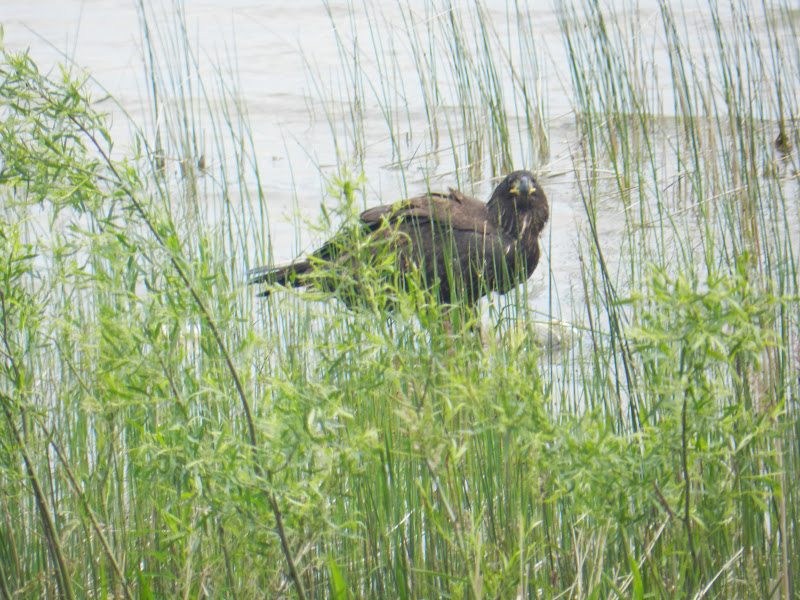
Eagles are seen more frequently along these shores, from Rock Island to Washington, Plum and along the peninsula, to the point where sightings are no longer considered unusual.  However, they're still fun to watch and exciting to see, flying or sitting, and part of this has to do with their size and their habits.

We watched six immature eagles, in varying degrees of white and brownish-black feathers, roosting in one tree last Sunday afternoon.  Below them, at water's edge, were three egrets.  And just beyond the egrets was a pair of white (black-tipped wings) pelicans. Nearby, geese swam with their young.

The resident great blue heron had taken the afternoon off, and he was absent from the scene, but neighbor Connie sees him - or her - often, sometimes with a snake wrapped in its bill.

A rather incredible Detroit Harbor sight, all of these birds seen together.

This noon, while eating lunch at our kitchen table, I looked out the window and watched an eagle doing the same, only with a dead fish, among the grasses near shore.  A seagull and a second eagle waited above to claim the leftovers.

It's never too late to get a good pair of binoculars and enjoy spotting these impressive birds.

-  Dick Purinton


Tuesday, June 5, 2012

DETROIT HARBOR AIDS TO NAVIGATION - contd.

Cylinder base for Detroit Harbor aid #5,  filled with rock to create mass.


Detroit Harbor, Washington Island -  

The second of two steel cylinders was transported to Washington Island Friday afternoon, June 1st, and was lowered over H-piles where buoy #5 had previously been tethered on chain and concrete sinker.  Roen crews began filling each cylinder with stone from their second work barge, and by late Monday, both #4 and #5 cylinders were ready for concrete.

A stationary mixer truck on deck was used to combine gravel, sand and cement, then the product was pumped into the cylinder. (photo below)

Concrete mixer (L) and crew ready to add to cylinder.
Below - Ferry Eyrarbakki shown outbound from the island dock,
alongside Roen's construction barge.


The bulkiness of these new harbor additions will be hard to overlook, even without their 20-foot or so tall light towers, yet to be added.

By Thursday, June 7th, if work on the two cylinder bases is completed, the Roen work barges and crew may depart this location in preparation for their next contract.  The final stage of light pedestal installation will follow later, after shipment of the units is received from the fabricator.

-  Dick Purinton


Thursday, May 31, 2012

Buoys Replaced By Structures

Detroit Harbor -

Two of the floating aids in the Detroit Harbor channel, buoys number 4 and 5, are being replaced by permanent structures.  The new aids to navigation will be solid cylinders of steel, cement and stone, anchored by nine H-piles into bedrock, and topped with a steel pole upon which will be a light, solar panel and battery.

This contract, estimated to be in the half-million dollar range, was bid to the Rock company of Pontiac, Michigan.  Door County marine contractor Roen Salvage, of Sturgeon Bay, is the major sub-contractor.  Other subcontractors include the drilling company that bored the holes for the pilings, and suppliers of the buoy cylinders and light towers.

Two of Roen's work barges are shown in the photo here shortly after they began the project.   Pipes of 14" diameter were set into the bottom a the buoy locations, then used as guides as they were drilled out, down three feet into bedrock.  Nine H-piles per navigation aid were then inserted into the drilled holes inside each pipe, and then epoxied into place using a special grout mixed with sand.   The pipes were removed once the epoxy was set

These permanent aids to navigation had been proposed for several years by the U. S. Coast Guard, but funding wasn't in hand until this fiscal year.   The new aids should eliminate drift from station (something that did occur with the older, floating buoys, especially as ice forced against them).  Batteries, solar panels and bulbs can be accessed easily for servicing by Coast Guard Aids to Navigation team members by small boat.  Formerly, a shallow-draft Coast Guard vessel would cross the lake from its home port in Muskegon to lift the floating aids with an A-frame, and its crew would inspect each chain and sinker.  The buoys would then be repainted, with chain replaced, if needed, before being reset on station.  

The tops of the new 12-ft. diameter cylinders will stand approximately 7 1/2 feet above water level, and  have a nearly 20-ft. mast on top of that.  These will make a strong target on radar scopes, and they will also be more easily seen during nighttime or low visibility by vessel operators.  (One of two cylinders is shown in the photo below as it is lifted from the semi to the Roen work barge, alongside Northport Pier.)


Roen Salvage is the largest and oldest marine contractor in the area.  This company typically bids on  marine construction projects such as dredging, break wall and dock construction around the Great Lakes.  From Detroit Harbor, this rig will prepare to sail to the upper St. Mary's River, where several similar, but larger, navigational aids will be constructed.  When that job is completed, the construction equipment will be towed to Duluth harbor at the western end of Lake Superior for another project that will include dredging of 200,000 cu. yds. and driving pilings for commercial shipping.

Actual work on the Detroit Harbor aids to navigation began Monday, May 24, after the equipment had been mobilized to the island. Work is expected to be completed - barring delays in supply of the light towers - by Friday, June 8th.   The steel cylinders that shape the base of the aids and the light pole assemblies are pre-fab items subbed to another company in the Fox Valley.  Delays in receiving those items could possibly prolong the project's completion.

Shown below is Don Sarter, Construction Supervisor and a 39-year Roen employee, who also operates the tug Stephan M. Asher that tows and positions the work barges.

Not yet known, but to be determined soon, is the fate of the dredging application by the Town of Washington for the Detroit Harbor channel.  This application, submitted earlier this calendar year, is believed to have cleared the citizen's committee that reviews such applications.  If so, it now awaits further review for approval by the WISDOT secretary, and finally, approval and signature must be given by Wisconsin's governor.   If approval is given and funding is released, this would mean a huge improvement for Washington Island, a major dredging operation that will widen and deepen a  navigation channel last touched in 1937!

This project could possibly be undertaken yet this calendar year.  However, approval and funding dollars through a Wisconsin Harbor Assistance Program Grant to the Town of Washington must first receive approval in order for any dollars to be allocated.  There were four or five other Wisconsin commercial port applicants, each with worthy projects competing for those same dollars.

-  Dick Purinton

Tuesday, May 15, 2012

WITH SUMMER COMING ON

Framed by the lightening holes in the main fore and aft structural bulkhead,
Con McDonald and Hoyt Purinton install foam blocks
in the aftermost compartment of the ferry
Robert Noble.


Washington Island, Wisconsin -

Spring at the Detroit Harbor ferry dock typically means painting, cleaning, assembling systems drained over winter, and minor modifications in readiness for daily operations.  This spring has been different in that there were several, major projects to complete.   By mid-May, we're nearly there.

Pete Nikolai and Eric Brodersen
open a mold containing newly
expanded, closed-cell foam block.

Hoyt Purinton with pile of blocks
in workshop.


Robert Noble


This ferry was at Bay Ship for all of November in late 2011 for new engines and gears and new cooling, hydraulic and fire systems. This was extensive work resulting from the replacement of original (1979) Cummins diesels with CAT engines.  The major emphasis was to reduce emissions levels and lower the gallons of fuel consumed per hour of running time.  (So far, fuel consumption is under 7 gallons per hour, per engine, at running speed of 1100 to 1200 rpms.)

Once back in her Detroit Harbor berth, our crew cleaned and repainted the entire Noble engine room.    In late February, as a result of the Coast Guard recalculating vessel stability for the Robert Noble, it was determined that due to a newer formula than that under which it was designed in 1979, additional measures would be needed to conform with required stability.

While there were several options, the one least invasive and least costly involved adding inert, light foam material to the aftermost compartment.  That is what we chose to do, and in the accompanying photos, block production and installation are shown.  The objective is to displace water that might, in an extreme flooding situation, fill the after compartment.

We were fortunate in this project to have new soft patches, removable covers over each main engine. These were installed as a part of the re-power project.  With the starboard hatch removed, eight-foot long blocks could be maneuvered into the after compartment.  Steel flatbars, 1/4" x 3", will be bolted to frames, securing the foam blocks between the frames.  

Starboard, aft void with foam blocks installed.


Robert Noble deck, with hatch over starboard
engine removed.
Washington


The Robert Noble had been used during the first week of May under a provisional Coast Guard certificate, while a warranty repair was in progress on the Washington.  The Washington's starboard engine had a bad rear crankshaft oil seal, the second time this seal had failed in two years, for a two-year old engine. The flywheel housing was determined to be the cause, ever-so-slightly out of round, and a new one was located to replace the original.  (The casting was slightly off from the factory, unusual, but not unheard of, and a new one was located in Germany with identical bolt hole characteristics. It was air-freighted to Green Bay where our engine awaited at the CAT/FABCO shop.)  The repaired engine was then delivered to the island last Thursday morning and lowered in place through the soft patch opening.  It was in running order by late afternoon, and the Washington was immediately placed back on the line.  Crossing our fingers, we believe this ferry is now in top mechanical order for the upcoming season!

Arni J. Richter


During the latter part of February 2009 while routinely inspecting the Arni J. Richter's aft below deck compartment, crew members discovered what proved to be a slight trickle of water.  (This was determined over a period of several weeks, as there can also be tiny leaks under gaskets surrounding deck hatch covers, as well as condensation collected on the shell plating.)  Closer inspection, monitoring of the suspected area, and conference with the Coast Guard Marine Safety Office in Sturgeon Bay led to a determination that several small weld fractures had occurred above the starboard skeg.  The two skegs on the Arni J. are fin-like structures attached to the underside of the hull, through which the propeller shaft protrudes.

Worker prepares skeg for new shell plate, an area of
convergence of multiple planes, and which requires extra care
to avoid shaft log movement during heating, cooling
of welded members.
A crew from Bay Shipbuilding came to the island on an afternoon ferry, bringing with them grinding and welding gear and steel plate, and they spent the next fifteen hours, until early dawn, welding the fractures and installing framing stiffeners.   These repairs were intended to be temporary, only.  In two years, the plate in the area of concern would need to be cropped and repaired to Coast Guard satisfaction.  That is when the next scheduled dry docking exam for the Arni J. came due.  That required hull inspection and repair period took place this spring, during which time the affected areas surrounding both port and starboard skegs were addressed.   Substantial  5 ft. x 5 ft.  x  1" inch plates were inserted above each skeg to better carry the weight and absorb stresses.  New interior framing running both fore and aft and thwartships (side-to-side) was also added.

Because of this work, the Arni J. Richter was in the yard from early April to early May while subject areas were prepared for new plating and framing.  Examination of the existing areas led to various discussions regarding proposals to fix problem areas, and this, too, added to overall time at the yard.

In the end, it can be said that the fractures found in welds were likely a result of several different factors, not just one.   Vibration, plate movement and stresses at various points can be expected in a vessel that runs through ice.  Ice encountered in the Door can be heavy and hard, and there are times underway when it passes continuously between the two skegs, funneled into the blender-like mix as it passes through the propellers.   Had this ferry never operated in winter, it is likely the problems seen would not have developed.

The framing structure in surrounding areas over the skegs, in retrospect, appeared relatively light, given this vessel's mission on a year-in, year-out basis.  There were also signs that a closer fit of plating and higher quality welds may have forestalled or prevented failure.

Interior shell in areas over skegs received extensive,
deep framing to carry stress and reduce plate movement.
During the entire time the Arni J. Richter  was operated, following the  initial recognition of the problem in March 2009, the intermediate measures we adopted under Coast Guard and naval architect direction proved to be prudent and satisfactory.

Now, each of our ferries, upon completion of the foam block project, will be in excellent shape for summer operations.  By mid-June, a ferry may operate 10-12 hours each day, for the next three to four months, before the schedule begins to wind down.

- Dick Purinton

Machinists (man at right) took hourly readings to
determine change in shaft log
alignment. Welders and fitters tailored
their work to minimize movement.


Sunday, May 13, 2012

CREATURES DOMESTIC AND WILD

Washington Island, Wisconsin -

Springtime means renewal, and at the Beneda "farm" there are baby chicks, seven of them.

In time, they'll produce eggs of varied colors, something Evy, and now her boys, will look forward to in the months to come.

Shown are Zander with Nerf gun, Atlas holding his chick, Henny Penny, and Evy with Zander's chick, Penny Henny.  ("Ya, it's confusing," Zander says.)   Cousins Aidan and Magnus also have chicks, which they named Nothing and Goldie Miner.

Keeping chickens is one step in moving from a city environment to the island country side, a learning experience for all of the boys.

Down on the Bayou


When warm weather came along in March, the snapping turtle population buried in the mud of the bayou came to life, much earlier than we've typically seen.

The turtles were sluggish at first, some with a five-inch cake-layer of muck on their backs as they emerged from winter's hibernation.  The turtles warmed themselves each day in the sun, if the sun was out, floating on the water's surface or crawling into the nearby grasses, warming to a point where they might exhibit fairly brisk movement in the latter hours of the day.  When nighttime and cold temperatures came on, they ducked back into the mud, or under the weedy banks where they've created underwater dens.


On the warmest, sunny days, we witnessed males briefly clashing, and males and females in a reproductive attitude.  These creatures have been living in muck, reproducing in mucky water, and perpetuating their species much as they've done for the past three million years.  Reptiles that have not perceptibly changed over such a span of time are to be admired for their ability to survive, and the bayou harbors a sizable population of perhaps several dozen adults that winter in relatively close quarters.


-  Dick Purinton

Saturday, May 12, 2012

NEW LIFE - TILLIE AND TUG

Washington Island -

Although it may seem like old news in today's 24-hour news cycle, the birth of twins April 22 to the Gunnlaugsson family is still big island news.

Shown above is a proud  dad, Joel Gunnlaugsson, with daughter Tillie Ann.  Tug Allen is in the family car behind him with his mom, Krista, and big sister, Greta, age four.  Paternal grandparents are Jeanie and Kirby Gunnlaugsson, who were in Green Bay for the arrival of the twins.

This was already second or third ferry ride for the twins who, besides their initial homecoming, required several health check-ups in their first ten days.  The newborns each weighed over five pounds at birth, and they are healthy and doing well.

The name Tillie is from a relative of Joel's, Aunt Tillie, and Tug is Scandinavian for "strong," a unique name with a likable sound.  It is not hard to imagine Tug with a career on the water.

Joel is a ferry captain, the Town of Washington Chairman and County Board Supervisor for northernmost Door County, in addition to his duties as father of three.  Krista, always smiling, even when running, as she often did along Main Road in recent years, is now fully engaged again as a mom.

Congratulations to the Gunnlaugssons on their new additions.

What's in store for island children and families?

Tug and Tillie join an elite, dwindling group of island youngsters approaching school age - a group that has grown smaller with each recent decade.  An aging population is a hallmark of this community as much as a declining school enrollment.  The cost of education per pupil is already high, with 65-70 students in K through 12, despite the doubled-up classes in each room.   The traditional island model that employs a full-time teaching staff for a handful of children at some point approaches one-on-one tutoring.   Even classes that, for the most part, have already doubled-up for efficiency, have declining numbers of students per teacher.  For that reason, new ways of looking at island education are being considered by the school district and staff.   It has led educators to consider the declining class size as an asset - rather than a disappointing yardstick - for future learning opportunities.

At a recent school board meeting, the sentiment "go forth and multiply" was expressed, in so many words, by an enthusiastic audience member.  But this edict would be a tall order for young, married couples, and maybe, an unfair pressure to place upon them!   Wishing for population increases also presumes there will be employment opportunities and the means required to raise children.

Population, economic health, and job stability are among the key challenges impacting the island community's health looking ahead.  Would diminished educational opportunities discourage those same young families with children who could help to bolster the island's school system?

It is like the old adage, Which comes first, the chicken or the egg?    Increasing family size may enlarge the school, making local education more efficient.  A balanced population could also help the island economy to grow over time, provide young business leaders and the necessary skilled service providers.  However, good jobs and job opportunities, a challenge in any community much less one with sharp seasonal swings in activity, remain elusive for families who might otherwise relocate here if those opportunities were present.

The island community needs to be supportive of the young families we do have by listening to their needs and goals, and by providing resources when possible to encourage and include them as part of the larger island family.
  -  Dick Purinton

Sunday, May 6, 2012

CALLING ALL TURKEYS


Washington Island, Wisconsin -

We're in the middle of the spring turkey hunt, and island hunters have been out prior to sunup, sneaking into field and forest before the birds get down from their tree roosts to set up hunting blinds and decoys, and to get themselves situated for approaching birds.

What else might motivate a hunter to load his gear in an open aluminum boat - a long-barreled shotgun, backpack with decoy and turkey calls and a bicycle - and then motor over to Detroit Island before the sun was up, ride his bicycle a mile or so down the rough dirt road, listening for tom turkeys calling as he rode?  

The hunting on Washington Island has been pretty good, or so the reports seem to indicate, but after several unsuccessful outings near home, Hoyt decided to try Detroit Island.

Shortly after bicycling south, to a point approximately 2/3 of the island's length from the boat landing, and having heard several turkeys, he got off his bicycle and successfully called a tom to within shooting range.

Then, with his bird in hand (approximately 25 pounds), shotgun and backpack filled with gear, he pedaled back to the boat landing and motored home.  He was back on Washington Island by 7:30 a.m., where these photos were taken.  


Hoyt pointed out two middle tail feathers that weren't yet fully developed in pattern, and he guessed his bird was perhaps two years old.  The spur length, half an inch at most, seemed to confirm this.  But as for weight, this bird was a handful to lift, and must not have been an easy partner for riding double.

Turkeys are wary, having excellent eye sight and very sharp instincts, and yet it is hard to refer to them as being smart.  A case in point:  several weeks ago I looked out my window to see a tom turkey challenging its image in the chrome fender of my pickup truck.  This activity went on for over an hour, until dark, with occasional pecking at the bumper and the lifting of his beard in what seemed to be an aggressive, self-promoting manner.  During this time, he left a dozen or more deposits, littering the asphalt at the truck's rear bumper.


-  Dick Purinton    

Friday, April 27, 2012

OLD NOW LIKE NEW

Herb and Marianna Gibson, Hoyt Purinton
Washington Island, Wisconsin -

When fire badly damaged Gibson's West Harbor Resort last November, Hoyt Purinton was one of the firemen inside the building.  His experience crawling around in the smoke came to mind several weeks later when he was scavenging at the Island Exchange (the dump) where he spotted a badly damaged vacuum that had been tossed on the scrap pile.  This unit had a look somewhat similar to one he had seen in the fire that evening, including the badly melted cord and warped plastic parts.

Believing it was the same Gibson vacuum, Hoyt took it home, then called the Kirby vacuum cleaner company in Cleveland to see if their Lifetime Warranty would still apply.  It would, except that the vacuum had actually been registered to Marianna's mother, Bernice Hansen.  However, a paperwork shuffle and an a price to refurbish the vacuum with new parts was agreed to, and in a few months the Kirby Company shipped the like-new unit to the Ferry Line office, but now registered under the Gibson name.  (There was great assistance from the gentleman at Kirby who at one time sailed for Cleveland Cliffs, and he recalled looking toward the island and West Harbor as his ship passed our shores. He then Googled West Harbor, while on the phone with Hoyt, to see what the harbor looked like on the satellite image. The Kirby Company is to be thanked for standing behind their quality product.)

Responding to my request to discuss some ideas, Herb and Marianna came to the Ferry Line office this morning and were reunited with their vacuum.

From the Gibson's description of progress at the Resort, furniture and mattresses are being moved in, with most construction work having been shifted to outdoors.  Their deadline for opening Memorial Day weekend still looks promising, although there is still much work to be done before its ready for customers.

We wish them well and hope the wayward vacuum will help in the reopening process.

[An added note: Bernice Hansen purchased this vacuum after her husband, Art, died, according to Marianna.   Bernice was living at that time in a ranch home on 11th Place in Sturgeon Bay.  When my younger sister, Martha, moved to Sturgeon Bay from Florida two years ago, by coincidence she bought the home formerly owned by Bernice and Art Hansen, where the vacuum would first have been used.]

 -  Dick Purinton

Thursday, April 26, 2012

AUDUBON'S BIRTHDAY


Robin's nest with two eggs at island ferry terminal entry,
observed by Atlas Beneda and Mack Ellefson.


Washington Island, Wisconsin -   

How do eggs hatch if the mother is off the nest for long periods of time?   We're about to find out.  This smoker's kit near the west entry of the ferry terminal may have been a secure place to build a nest, but its location means foot traffic passing nearby approximately ten hours each day.   So far, we've not once observed mother robin.

Today is the birthday of John J. Audubon, and in observing his birthday I reprint here the flyer sent to C. H. Thordarson, collector of books on nature, science and English literature during his lifetime.  Thordarson was solicited as a very active and interested collector for a set of Audubon folios, books that are approximately two feet wide by three feet high.  Engravings were made in Europe that reproduced Audubon's life size renderings of American birds, which were then hand-colored. 

From a prospectus sent to Thordarson by book dealer Walter Hill on Sept. 20, 1913:  

THE GRANDEST WORK EVER PRODUCED ON ORNITHOLOGY
AUDUBON (J.)        BIRDS OF AMERICA.    The Genuine Original Edition, Complete Set, containing 435 superbly coloured plates engraved by W.  H. Lizars or R. Havell &  Son, from drawings by AUDUBON.

4 vols. double elephant folio.  Fine set in contemporary full red morocco, g. e. 1827-1839.        $3250.00

The 435 plates in this Magnificent Work, illustrate 1065 species of birds – all delineated in their natural size and colours.   Cuview expressed the opinion that this work “is the most magnificent monument that art has ever erected in Ornithology.”

Everyone who attempts to describe the plumage of a bird, realizes how inadequate language is to convey a just idea of the richness and peculiar beauty of Nature’s living tints.
Each plate is one of the original copper-plates engraved in London and accurately colored by hand by W. H. Lizars or R. Havell and Son;  their extreme beauty makes them particularly desirable for mural decoration, and their rarity tends to make them exclusive possessions.  

“There has never been a keener eye than Audubon’s” says “Old John” Burroughs, and these plates in their unparalleled beauty, accuracy and spirit, prove it.  They form size 38 x 25 ½.   The plate-mark, or the size of the picture itself, necessarily varies, as the birds are in all cases represented of the size of life.  They must not be confounded with the copies made in 1861 by lithography, which are not in the slightest degree worthy of comparison with originals.

It may be noted that this is an extraordinary opportunity for the buyer and one which may not occur again.
A complete set of the work sold at auction for over $4,000.00

When Thordarson purchased this distinctive set, he added to the many rare and unusual books already in his library.  He collected up to the time of his death, a count that approached 11,000 by 1945.  These books were housed in special book cases, custom built for his collection in his Chicago office.  Later, in 1942, he transferred those cases and his library to his Rock Island boathouse where they remained until 1946. 

One reason for their removal to Rock Island was that Thordarson believed his books would be safer on Rock Island in time of war, should German bombing of Chicago become a threat.  Second, and maybe as practical a reason, was that the Thordarson Electric Manufacturing Company was bought out by the Burgess Company at that time.   His office items and files were moved to the basement of his factory, but the books and carved furniture were moved to Rock Island boathouse, a structure he believed to  be nearly fireproof, for safekeeping his books.

Following Thordarson's death in 1945, the University of Wisconsin entered into an Agreement to Purchase with the Thordarson heirs, and with that agreement in hand, the books were moved to Madison for their protection, complete inventory, and contemplation of how they would be incorporated into the library system.  This move also bought time for gaining additional university support and the arrangement of funding.  

The Thordarson library was ferried from Rock Island to Gills Rock by the Griffin, then by truck to Madison, where it then resided in the crowded old library building, now home of the Wisconsin State Historical Society.  A new university library was built in 1950, and the books were moved into the new building.  Volumes from the Thordarson library, selected books from that library that included the Audubon folios, formed the basis of the university's new rare book collection, kept in a carefully controlled environment.  Other volumes not considered rare were set out on shelves with other library books for borrowing.   

University officials stated at the time of their purchase that the value of the Thordarson collection was in scholarly research, and it was not intended as an investment.   But in fact, the value of his collection, with many individual volumes considered among the finest and rarest examples of early English language books in this country if not in the world, has appreciated considerably.  

Perhaps the most valuable among them are the Audubon folios.  

The entire Thordarson collection was purchased by the University of Wisconsin in 1946 for $170,000, plus a broker's fee of $30,000.   According to an internet auction source, an original Audubon folio set fetched $8,800,000 in 2000, and a single engraving brought $150,000.  By 2011, the auction sale of a "rare double-elephant folio"set had risen to a record $11,500,000 and a single print may now command $200,000.

The dear price of a set of Audubon's books today is supposedly a good thing, in that owners and dealers will be less inclined to sell plates separately, something that had been done in past years.  Also, most copies now reside in institutions, such at the University of Wisconsin rare books collection, where they will presumably remain intact for future centuries.

-  Dick Purinton     

Thursday, April 12, 2012

UNPLEASANT BUSINESS

Washington Island, Wisconsin -


A smile, a pleasant greeting and an upbeat air are considered wonderful traits when you are face-to-face with customers on a daily basis.

No one did this better than Jason Carr.
However, Jason Carr was sentenced today on three felony counts in Door County Circuit Court by Judge Peter Diltz.

Carr pled guilty to three charges of felony theft and in so doing, waved his right to a jury trial.  Carr had earlier paid restitution to the Ferry Line in the amount of $28,000.   As a part of his sentencing, he will spend 30 days in the County Jail, pay a $500 fine plus court costs on each of the counts (numbered 39 in all) and will carry the felonies as a record.  The remaining 36 counts, Class A forgeries, have each been dropped, but they will remain on record as per the plea bargain with the State, as represented by District Attorney Raymond Pelrine.

This is unpleasant business for all concerned.

A complaint against Carr was filed August 25, 2011, following several months' investigation.  The investigation was triggered by Carr's own private conversations in which he admitted theft as a ticket seller over a several-year period.  Until late June of 2011, he had been not only a trusted ticket seller for the Ferry Line, but he was extremely well thought of by fellow employees and customers alike.  It was with concern for Carr as an individual, as well as for the significance of the crimes he had allegedly committed, that charges were brought forward through Sheriff's Department to the Door County District Attorney's office.

During his sentencing, Judge Diltz took time to personally address Carr, stressing not only the seriousness of his crimes, but also the breach of trust with the Island community that had supported him.  Diltz read into the court record the following letter from the Washington Island Ferry Line, Inc., signed by Richard and Hoyt Purinton, company managers and owners.

Because of the nature of the ongoing investigation and then proceedings over the past months, it was not possible, nor was it considered prudent, to publicize Carr's alleged actions.  However, with sentencing now completed, to not inform the public and our customers about this unfortunate turn of events also seems improper.


March 12, 2012

Door County Circuit Court
Judge Peter Diltz
c/o  District Attorney Pelrine


Letter to Jason Carr:
    
Washington Island Ferry Line appreciates your timely restitution for money stolen while you worked for Washington Island Ferry Line as a ticket seller.  We know the penalties under law in sentencing by the Court are not insignificant. 

However, because of your accepted plea agreement, you haven’t had to respond to questions concerning your crimes in court, and for that reason the public has learned little information about your crimes.

You told an investigating officer that you had been stealing for “five or six years.”  If that was the case, then the total stolen by you as an employee is five or six times the amount you’ve returned in restitution.   Apparently, you resumed work each spring during those years with intent to continue stealing money.  You shielded your stealing from others, even as you repeated your crimes, year to year.

Then, shortly after you were officially investigated for stealing, you expressed to several Washington Island friends in conversation, and to others through your Facebook page, words that indicated you were proud of your undetected theft. 

As your former Ferry Line managers, we think your breach of trust is as damaging as the money that was stolen.  Many people – your co-workers, the ferry customers, island neighbors and others – knew and respected you as a pleasant-mannered, smiling employee, often the first island person they came in contact with upon arrival at the ferry dock.  What they didn’t know – and we didn’t realize – was that the money paid to you by them you then put into your own pocket. 

By doing so, repeatedly, you’ve broken a bond of trust among co-workers and customers, and friends.  How will you now turn that around?  How will you help others to understand that you recognize what you did was wrong?   How will you go about regaining trust from a community that has supported you in many ways? 

You now have an opportunity to begin mending the trust that was broken, by an honest statement to the court, by showing the community in which you live that you are sincere in your acknowledgement of what you’ve done, and that you’re determined to restore our trust in you.

Respectfully,


Hoyt and Richard Purinton, for
Washington Island Ferry Line, Inc.


-  End -

Wednesday, April 4, 2012

NEW NEIGHBORS

Chad and Evy Beneda in driveway of their new home.
Washington Island, Wisconsin -

A few weeks ago I posted a blog entry about family moving closer.  This was the first sort of announcement of the potential future sale of our former Main Road home to our daughter, Evy, and Chad Beneda and boys.  They are now 90% moved in, and have enjoyed being on the Island after moving from their former home in Brookfield.  They still own their Brookfield home and it will have it for sale, shortly.

In the meantime, during the week Chad will travel back and forth to sales appointments, much of it by air, as an insurance representative for Liberty Mutual's midwest commercial accounts, and he will also continue to report to his Chicago office for some of those days when not on the road.   But, if his travel connections work well, starting with the ferry on Monday morning, and if he's able to keep up the pace of weekly travel, Chad plans to be home each weekend with his family.

Their two sons, Atlas, 9, and Zander, almost 4, have also begun to acclimate with school projects and more outdoor time as the weather improves.  Atlas happily pedals to the nearby Island Library for books, and south along Main Road to his Gramma's for cookies and entertainment.

Mary Jo with grandsons Zander, Aidan, Atlas and Magnus
on move-in day.


The Beneda's home is the one "across from the log cabin," or "across from the ball park," also known as the "J. W. Cornell home," or the "Maple Grove Inn" where June and Jake Gunnlaugsson rented rooms in the 50s and early 60s.   It was purchased by Carl and Ethel Anderson in 1963 (Carl was a brother to Ed Anderson, Ethel was a daughter of J. W. Cornell), before being transferred to Mary Jo and Richard in 1976.  

We're pleased to see it still in the family, enjoyed again as a year around home by the Benedas.

-  Dick Purinton