Friday, February 15, 2013

NORTHPORT QUEEN PASSED ON

Hedwig - Hedy - Eller in 2009.
Northport, Door County -

When writing the word Northport I almost always describe ferry operations from that location.  Today I'm writing a note of thanks, for having known Hedy Eller, who along with her husband Ernst lived in their retirement home near the head of the Northport dock since the early 1970s.  They were our good neighbors, helpful, supportive and known to many on Washington Island and in the northern Door community.

Hedy was 97 when she passed away Monday, Feb. 11, 2013 at Scandia in Sister Bay.  She had resided there for these last three years or so, and we occasionally stopped by to see her.  In all of our visits she appeared vibrant, upbeat, with her  smile and an infectious laugh.

She always seemed to know what was happening around her.  She had a great faith, and with realism seemed to look forward to what lay ahead.  She was an active parishioner of Stella Maris in Sister Bay, and thanks to good friends who drove her, she was able to attend worship services most Sundays.  She never drove, even after Ernst died, but she had willing friends who transported her when needed.

One mannerism of Hedy's, and perhaps it was a contributing element to her title "Queen of Northport," was the way she seemed to dismiss, with a laugh, events or activities with which she might not be in full agreement.  It was a slight inflection of her voice, a raised eyebrow, a quick look away, but never in disdain.  Perhaps it was a sign of quiet, internal judgement.  That was an endearing feature, and I viewed this as part of her good-humored disposition.

She warmed quickly if the topic of the Church entered conversation, the politics within and the organizational stresses on its leaders. She seemed to understand how their duty in service weighed upon them.   Priests who served Washington Island and Sister Bay communities over the years were invited  to enjoy a meal in her home, upon their return by ferry.

My favorite photo of Hedy and Ernst together was of them posing with a group of C. G. Richter passengers, shortly before they boarded for the trip home.  While awaiting Coast Guard assistance to free the ferry from heavy ice for our trip home (some waited three days, others fewer), Hedy and Ernst opened up their home - kitchen, bathroom and even bedrooms - to strangers expecting to board the ferry and sail home through ice, perhaps an hour's undertaking at best.  That experience revealed the nature of the Ellers' hospitality.  By being open to everyone's needs, they also came to know regular Island travelers, passengers who owned seasonal homes and who waited in line each Friday night for the ferry.

Hedy's body will be buried Monday morning on Washington Island, alongside Ernst's.
Funeral services for Hedy Eller will be held in Sister Bay this Saturday morning.

Upon Ernst's death in 1988, an exception was made to an unwritten rule that, for Island burial one had to be either an Island resident or a property owner.  Ernst was neither, but in his heart he was an Islander, a true neighbor who was sometimes referred to as "Mayor of Northport."  His Queen has joined him.


 - Dick Purinton
        

Friday, February 1, 2013

LP TANKERS, COLD WEATHER

Shore crew waited in wind, cold and drifting snow
as the sun rose over Detroit Island.
Detroit Harbor, Washington Island -

My purpose for driving to the Potato Dock this morning was to photograph the LP tankers that would unload when the special, early morning ferry arrived.  This was a ferry just for tanker trucks carrying the liquid propane fuel.  This was also the first official occasion using this docking point for unloading two semi trucks.  Truckers from Kaukauna's Schuh Transport typically load product the day before so that they can be on the highway no later than 5 a.m., to arrive at Northport before 7:15 a.m.

The ferry trip went smoothly, with little-to-no ice encountered.  The previous day's winds and the blizzard on Wednesday had blown heavy ice from the Door into the lake, but new ice was already forming in near-zero temperatures.  Within two days the passage will be ice covered once again. Heavier, jumbled ice lies to the west of Plum Island.

A primary concern was if the Potato Dock facility would serve its purpose without hitch, the ramp levels, the available dock surface for turning trucks, and so forth.  Everything worked well, as it turned out.  Lined up on shore where the woods began were vehicles and passengers waiting to be directed to the ferry, just as soon as the trucks cleared the causeway.  The two smaller trucks shown at the end of the pier in the top photo were Ferry Line trucks used to transport freight between the Potato Dock and Terminal building - package freight, food products and such.

It generally takes 2-3 hours for the tankers to unload, time enough for the ferry to run its regularly scheduled morning round trip.  Then, after the ferry once more unloads vehicles, passengers and freight, the empty tankers are loaded for another unscheduled run to Northport.  -  Dick Purinton


Joel Gunnlaugsson secured lines.
Crew waiting for ferry:  Rich Ellefson,
Pete Nikolai, Con McDonald.
Propane, most of it used for heating, is stored at the Hansen
LP facility on Town Line Road, and from there it is
distributed to tanks at island customer locations.

Wednesday, January 30, 2013

POTPOURRI

Weather photo, taken early Tuesday afternoon, Jan 29th.
(Purinton photo)
Washington Island, Wisconsin -

After promoting the picture of a mighty, bustling island in winter I open here with a shot of yesterday's Main Road.
Not a single car passed me in the several minutes I stopped to photograph... but there was activity just across the road!  The second shot of this soupy, unusually warm day (40 degrees F) shows Martin Andersen's pasture and cows.  I couldn't help but remember Alvin Cornell's favored adage, "Winter's fog'll freeze a dog" when I saw those animals laying down in the cold slop of the pasture.  Where's their sense, anyway?

Snow Friday, Jan. 25, again Sunday into Monday,
Jan. 27, then rain Tuesday turned it into mush.
Later today, Wednesday, we're expecting
6 to 8 inches of new snow.


The rain-slicked roads yesterday only added to a rather depressing scene, but just take a look at the two photos that follow.  The first was taken by Tyler McGrane from a vantage point on the Potato Dock as the ferry returned from Northport.  This was the morning of the first day's service out of that docking point.  The second photo is of a bright, cheery morning filed with sunlight and human activity.  It was taken by Tim Sweet who traveled to Washington Island Saturday, Jan. 26 for the meeting of Friends of Plum and Pilot Islands, for which he serves as its president.  Tim also took terrific photos of Rock Island later that day, but I think he'll submit them for the FORI website at some point.

If it wasn't still dark outside this morning, I could provide a weather update for you...instead, you can look in on our Ferry Dock Webcams at www.wisferry.com     Enjoy your weather, and your day, wherever you are.
  -  Dick Purinton

Ferry returning, single-digit morning, Monday Jan. 21.
(Tyler McGrane photo)
Cold, crisp morning as ferry approached Island,
Saturday, Jan. 26.  (Tim Sweet photo)

EAGLE SERIES by Paula


Death's Door, near Northport -

The waters of Death's Door are anything but quiet this time of year.  Besides daily changes in ice conditions, eagles are frequently seen in winter, more common in recent years it seems than years ago, along with rafts of ducks.

Last week, during single-digit temperature days, Northport neighbor Paula Hedeen took a series of eagle photos that she kindly shared. She uses a powerful lens with her Nikon camera, and she has patience that is rewarded from time to time with excellent shots from the deck of her home. (You may recall photos of Northern Lights taken by Paula, posted here in early December.)

One series of hers in particular I found  of interest because it shows quite graphically a pair of eagles as they zeroed in on a duck. Then one eagle grabbed it, lifted it from the water and flew to nearby ice that had formed along the shore.

Ducks provide a protein source for these large birds and seem to be as much a part of the eagle's diet as fish this time of year.

At one time, Paula photographed as many as seven eagles within the scope of her lens.  Some were completely white-headed adults, others still had brown head feathers.  Her series gives an excellent opportunity to study their powerful wing action.

This series reminded me of a ferry trip aboard the C. G. Richter many years ago, a gray winter's day when we headed out an ice-filled channel with difficulty.  As we backed up and then rammed ahead, repeating the process time and again, an eagle hovered within 25 yards to our port side in very strong  southerly wind above a ten-foot opening in the ice, waiting for a duck to surface.   Each time it did, the eagle dove, but the duck took air and dove back under.  After approximately ten minutes, during which time the duck tired, the eagle finally grabbed it, then struggled to get airborne with its prize once again. Finally, it sailed cross-wind away from us and over the treetops of Detroit Island.  Our forward progress was almost nil during this time, so we had an excellent vantage point to watch the drama unfold.

There's sometimes a tendency to think that once winter sets in, life will be long and boring, static from one day to the next, sameness all around.  But Paula's photos (and photos I will post in the blog to follow this one) are dramatic, and they help refute that point of view.  If we look around and observe, exciting changes occur daily in lighting, in weather, in observed animal and bird activities, as well as in our own activities that reflect our efforts to adapt, endure, and survive winter in our own way.  The closer we look, the more we see - and the more we see, the more there is to enjoy about winter.  One small observation can make a difference in our day, activity that would be more easily overlooked against summer's busy backdrop.


Thanks to Paula Hedeen once again for these photos.  - Dick Purinton


Monday, January 21, 2013

HAVE AN ICE TIME!

Traffic boarded the Arni J. Richter from
the Potato Dock for the 8 a.m. departure.
Detroit Harbor, Washington Island -

This Monday morning was the first trip of the winter for the Arni J. Richter, and the first official loading at the newly dredged Potato Dock.  Pete Nikolai met traffic waiting to board and worked with components of a new, portable ticketing system.  Crews prepared the decks for possible freezing spray as the engines warmed at the pier.

Pete Nikolai met customers at the upland staging
 area, using a new portable ticketing system.


Traffic included the typical load of autos and passengers, with a pumper unit belong to the Washington Island Volunteer Fire Department being the first truck to load on a scheduled run from that location.  Joel Gunnlaugsson was driving the truck to a facility in the Fox Valley for maintenance.   One standard item not loaded on board due to observance of Dr. Martin Luther King's birthday was the U. S. Mail.

Joel Gunnlaugsson, who also wears hats of
ferry captain and Town Board Chairman, drove the pumper
truck off the island for maintenance,
also on his way to attend a meeting
as a County Board Supervisor.


It was that time of year for beginning a new, anticipated routine.  Morning air temperatures hovered at +2 degrees F with a sharp NW wind.  New ice, some made overnight, the rest blown in from the north, covered approximately 80% of waters between Washington Island and the Door Peninsula.  Steam rose from patches of open water to the east where the bay opens to the lake itself.  After toying with us for the past month, winter seemed finally to settle in.

The Island's two remaining commercial fishermen brought their tugs C & R (Jeff McDonald) and Sea Diver (Kenny Koyen) around the island from Jackson Harbor Saturday, in advance of the predicted cold spell and ice that would lock them in at Jackson.

The Detroit Harbor channel with ice now formed to the entrance buoy and beyond will not be navigable for the ferry Washington.  That ferry, with less draft than the AJR, made all ferry trips in early winter, given the lack of ice during that time.

Crews began the winter layup process immediately after the AJR's departure, starting with the draining of engine room water lines and pumps, necessary before turning off electric heaters.  We're now beyond the middle of January, and given what may be a shortened ice season (no certainty, of course), within a few months a non-ice breaking ferry could once again operate from our main docks near the Island Ferry Terminal.

Until then, crews and passengers will have time to adjust to the new routine of operating from the Potato Dock using the ice breaker Arni J. Richter.

This coming week may prove too cold to accomplish any dredging at Northport, due to icing of the spuds in their wells on his barge, but Mike Kahr had begun work there with his machines.  He switches back and forth between two excavators on board the barge. One is fitted with a breaker point to loosen the bedrock before scooping it up with the second machine's bucket.  When the temperatures rise once again, he will continue deepening the maneuvering area off the end of Northport Pier. Then, if ice allows, he'll return with his barge to Detroit Harbor where more dredging and dock work awaits.

Mike Kahr broke up rock ledge to deepen
waters near the end of Northport Pier.
Photo taken Friday afternoon, Jan. 18.


Monday morning ferry departure from Potato Dock.

Thursday, January 10, 2013

MOVING ON

Dredging and trucking crews with final spoils barge
to unload,  6 a.m. Tuesday Jan. 9th.    

L to R:
Roen crew Jeff Thoney, Greg Viste, Steve Ross, Jim Warrick; Hoyt Purinton (WIFL)
Roen crew Matt Goetz,; drivers Dave Hanlin, Pete Nehlsen, Tom Jordan,
Joel Gunnlaugsson (WIFL, behind); driver Tim Ervin; Rich Ellefson (WIFL);
Don Sarter, Roen Project Supervisor and tug captain.
Detroit Harbor, Washington Island -

The last Roen barge load of dredge spoils was off-loaded early Tuesday morning to complete several weeks' work near the Potato Dock.  Mike Kahr continued digging Tuesday in several hard-to-get spots, but the bulk of the project is complete as of Jan. 10.


Ferry Arni J. Richter brought around to new mooring,
shortly after Roen's barges moved out.


Mariners were greeted by a perfect Thursday morning today, January 10.  With light wind and temperatures already in the middle 30s by 8:30 am, the Roen crew moved their barges and tug to deeper water in preparation for the tow home to Sturgeon Bay.  Before they departed Washington Island, however, they were joined by a deeper draft tug operated by Selvick Towing.  The Jimmy L came to pick up the McMullen & Pitz construction barge that had been in Kap's Marina since early November, constructing a new dock for the Coast Guard station there.

The heavy work on the dock project had been finished.  Final details were being wrapped up, such as wiring and the grouting of gaps between the pre-cast walkway sections.  Workers launched a small boat from the McMullen barge in order to push it toward deeper water near the channel, where Roen's tug waited to take over.  Then, beyond the entrance light the tow was transferred to the Selvick tug.  The Jimmy L began towing toward Door Bluff and Marinette, where the barge would remain for the rest of the winter.

Using a fuel truck and a backhoe as ballast in the bow to lighten the stern, the Arni J. Richter's crew moved that ferry from the inner harbor to the Potato Dock in preparation for anticipated winter operations.  (Lately, we're beginning to wonder if we'll get winter back again!)

While the water near the dock is deep enough, caution must be used because the room to maneuver, especially to the east, will be limited.  The dock will be useable for landings, however, and that was the whole objective since this project began.

-  Dick Purinton

Tuesday, January 8, 2013

ANDERSON POTATO FARMS - WHAT HAPPENED?

Potato boats were island landmarks for a number of years
 after Anderson's farming ended.
They were sold in 1973 as scrap steel.
Detroit Harbor, Washington Island -

The Edward Anderson potato farm on Washington Island grew to become a factor in midwest potato markets and more importantly, a significant contributor to Washington Island's economy.

By 1967 the farm was all but finished.  What caused the decline?  Poor potato markets?  Higher costs of farming?  Over extended borrowing for capital improvements?  Costly operation and maintenance of the potato boats?  Did a successful Chicago business prop up the Island farm, doomed sooner or later for failure?  Or could it have been a combination of many related factors, plus the strong personality of its owner and founder, Ed Anderson?

Records that speak directly to the decline of the potato farm don't seem to be available, and there are few who have enough background to make a calculated judgement.  Even those who were at one time close to the daily farming operations may not have had access to the full range of contributing economic factors.  In the end, we're left with personal accounts plus conjecture.

Physical leftovers

A few visual reminders of the potato farm days dot the Island's landscape:  the white tractor sheds on the land next to the main farm on Detroit Harbor Road; ten-ft. lengths of aluminum irrigation pipe here and there, some now lying beneath Island driveway entrances as culverts; a handful of rusting International Harvester Farmall tractors in the yards of Island residents;  berms and irrigation ponds.  These are the visual clues that remain.

Then there is the old pier called the Potato Dock where the potato boats moored, one of the more obvious physical features left to jog faded memories.  The boats themselves, supposedly made of  high-quality Bessemer steel, were sold for scrap and towed from the Island in 1973 to Canada, and from there to Italy.

The several ponds, and the deep wells that fed them to supply irrigation water for the fields, included  Screwdriver Lake, a pond off Range Line Road borders the Freddie Koyen cedar swamp. Another pond existed north of Bill Jorgenson's log home on Town Line Road.  A third pond is near Lee Bjarnarson's, off Jackson Harbor Road in the northeast sector of the Island.  In addition to these manmade features and the drilled wells that supplied them, the potato farm also drew water from Detroit Harbor through use of a large, engine-driven pump located in the Ed Anderson boathouse along the shore.  (In the 1990s, Brad and Judy Gordon built a home on that shore property; it was later purchased by Rusty Murray.  Coincidentally, today Edgar Anderson and his wife Martine own that property.)

Ideas on the farm's decline

Following one week of marriage and ready to return to San Diego, where I was assigned to a naval destroyer, Mary Jo and I were onboard the Eyrarbakki in early October 1972.  Also onboard, by coincidence, were Ed and Sylvia Anderson.   A conversation with Ed, who introduced himself, soon brought up the topic of his farm, competition in the potato markets, and what he perceived as growing demand nationwide for french fries requiring specialized, larger potatoes.  I was given a quick primer on the farm and what had happened, from Ed's point of view, most of which I no longer remember.  At one point, to punctuate his claims of achieving status as a major figure in potato agriculture, Ed opened the trunk to his Cadillac and pulled out an oversized facsimile of a check made out to him (about 18 inches long) for $1 million.  It had been signed by Secretary of Agriculture Ezra Benson, who served two terms in that capacity under President Dwight Eisenhower.

It was Ed's energy that day plus his eagerness to show this newcomer his marker of prosperity and accomplishment that stuck with me.  Ed's belief in himself may have been symptomatic of both the rise and the fall of his Island potato farm.

Other perspectives

Next door to the tractor sheds on the main farm at Airport and Detroit Harbor roads was the James Hanson home.  Hanson was acknowledged by Anderson in the Rohm & Haas article (referred to in an earlier blog) as being a major contributor to his farm's success.  As the potato farm manager, remembered by his son Jim, a Ferry Line captain, Hanson took great pride in having helped build the farm from scratch.

According to Jim who was young at the time and may remember only the bits overheard from his father, Anderson made his money in the futures markets trading potatoes.  Ed's first wife, Lydia, who died when quite young, was an integral part of that business.  It was profits from Anderson's Chicago potato brokerage operation that enabled his investment in the island farm.  Shortly after Lydia's death, Jim believed, the Chicago brokerage business began to decline.  The Island farm, however, still did well, according to Jim's father.

As potato farm manager, James Hanson's arrangement with Ed was to receive a ten percent commission on farm profits.  But he never actually received his commission.  When the 1965 crop was brought in under Hanson, it yielded a profit of $150,000 according to farm books kept by Hanson.  When no commission was forthcoming, Jim remembered, "Dad put his foot down.  'Ed, either pay up, or I'm out of the farm.' We moved to Sturgeon Bay in January, 1966. Two years later, no more potatoes were planted."

It was James Hanson's knowledge that helped build the farm, his son believes.  Hanson decided which fields to plant, how the crops should rotate, and other daily decisions often made on a large scale to keep production at its peak. "He considered building up the farm as a major accomplishment.  It was a significant blow to him," Jim said of his father's ending farming and leaving their island home. "He had to do that for the welfare of his family."

While the energy and drive of Ed Anderson are what enabled the considerable investment in Island potato farming in the first place, his strong personality may have led to its demise.  According to Jim Hanson, "Ed always felt his potatoes were worth more than anyone else's." There are accounts of Ed holding on to his crop, waiting for the best price.  This in turn led may have led to eventual dumping of unsold, spoiled potatoes.

Another perspective

At the time the potato farm went out of business, Anderson was heavily mortgaged.

Larry Young, who began work on the farm grading potatoes while in high school, soon worked full time.  He assisted Walt Jorgenson by maintaining tractors and other farm equipment.  Toward the end of the farm's existence, pay checks were bouncing, he said.

The old ferry hulls became floating warehouses, stripped of non-essential wiring, piping and machinery, but the boilers still had to function, according to Young. The boats were moored on the island in summer through late October, when the crop came in.  Then, before towing, the boilers had to be fired up and the dynamo operating for shipboard electricity.  The steering and the winches and onboard lighting were dependent on steam produced from coal-fired boilers.  Young believes the potato boats were costly to maintain and to tow back and forth between the Island and Benton Harbor, Michigan.  There in Benton Harbor, through the winter, supervisor Oscar Garcia and other workers processed and packaged the crop at a shore facility.  "The potato boats may have been the back-breaker," Young said.  "And, the cost of fertilizer went through the roof."

Anderson also owned land on Detroit Island, with separate ownership from the potato farm. There, he developed lots for sale.  Walt Jorgenson and Larry Young helped lay out the lots and cut access roads in the off-season.  Many Detroit Island lots were sold to fellow parishioners from Anderson's home church in Oak Park, Illinois.  Some of the original Detroit Island landowner families and their offspring are still regular summer residents there.  As with farm land on Washington Island, Anderson's unsold Detroit Island lots went into receivership in the early 1970s.

The Potato Dock property, roughly 5 acres, was purchased from Chicago's Continental Mortgage by members of the Slenys family of Chicago.  WIth no immediate purpose for the property in mind, they put it on the market after more than ten years, and in 1995 the Ferry Line made an offer that was accepted.  Eldred Ellefson was the island realtor who as a young man worked for Anderson's potato brokerage in Chicago.  While the dock property was on the market, it stood against persistent seas during the high-water cycle of 1986-87.   Portions of the dock were nearly washed through and were impassible to motorized traffic.

Since then, stone protection, stone fill, sheet piling and dredging - at a considerable expense for a dock that sits idle much of the time - were added. That brings us to the present day Potato Dock with its distinction for being, potentially, the only available island ferry landing in the coming months.

-  Dick Purinton


Harbor scene early Saturday morning,
Mike Kahr's barge being positioned
for drilling final core samples. (Purinton)
 
Detroit Harbor, Washington Island -

This is being written Tuesday morning, on what we hope will be the final day of major dredging at the Potato Dock.  There will be more dredging over the next few weeks, but in smaller volumes, as areas around the main ferry landings are brought to useable depths.

A reminder of the Potato Dock dredging project goal:  safe navigation and maneuverability at one island landing for our winter ferry, Arni J. Richter (draft of slightly over 11-ft.,loaded.)  The Detroit Harbor channel is now too shallow to chance regular passage with that ferry, the Ferry Line's only ice breaking vessel.   Other ferries draw less water, and because we've not had ice to contend with yet this winter, we've made daily trips much as before, loading at our regular docks using the ferry Washington. (Eyrarbakki and Robert Noble are currently in winter lay-up.)

Roen's project supervisor and crew chief Don Sarter said, "It's time.  We're ready to head home.  It's been a long season."  Ice hasn't yet set in near Sturgeon Bay heavy enough to cause them difficulties in navigating home, a good thing, and winter maintenance and a return to more normal working hours and home life lies ahead.  The crews work in the outdoors, 10-12 hour days, with two crews alternating shift time since Jan. 2nd in order to gain on the production of dredge spoils.

Mike Kahr arrived in port with his barge Wednesday from Fish Creek, and he provided a work platform for Subsurface Exploration Services, LLC, of Green Bay, with its drill rig and operators, along with a Foth Environmental Engineering representative as observer.  Their objective was to obtain representative core samples along the channel bottom that will reveal what type of material a contractor  might encounter after the channel dredging project is bid.  (We're saying "when,"not "if," with optimism that project funding will be approved, in this case by the State of Wisconsin.)

Core sampling resumed Saturday morning for the final holes (and that's when the above photo was taken) as the Kahr barge with drill rig and workers headed out the channel.   Early morning conditions were perfect for stable drilling outside the harbor entrance light.  The photo below was taken by Jim Rose earlier, on Friday, when the rig worked near lighted aid #5.

Kahr work barge with drill rig.  (Jim Rose photo)
 Regular traffic and logging trucks  continued to be ferried aboard the Washington.  Saturday, with Captain Bill Jorgenson down with the flu and Joel Gunnlaugsson driving dump truck, I had a chance to try the helm on three round trips.

Saturday morning log trucks. (Purinton)
Aside from light ice surrounding island landings, no ice is in sight on the route, getting on in January for such a condition to be observed.  It makes me wonder what ice cover we'll ultimately see over upper Green Bay this winter.

While the lack of ice and extreme cold aided greatly to complete the recent weeks' dredging and trucking tasks, ice cover can supposedly slow evaporation of surface water, at least from that small percentage of the lake typically ice covered each winter.  Aside from the rain, sleet and snowfall of several weeks ago, we've since had a dry spell for precipitation.

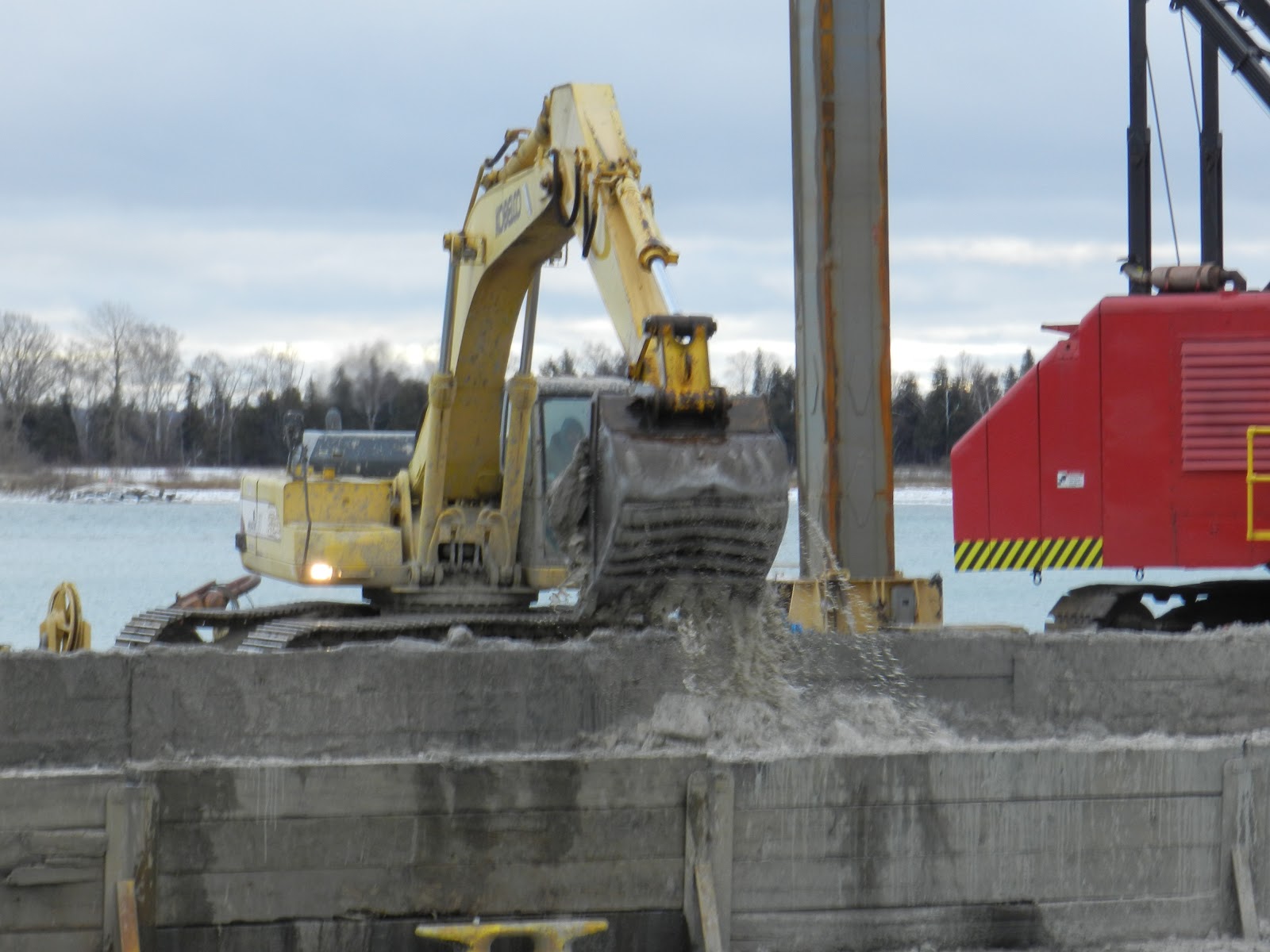
Monday brought very strong SW winds (30+ mph), but both the Kahr and Roen crews kept dredging, two excavators digging from neighboring barges, tucked in the lee of  the Potato Dock to find calm water.  Sunday's production marked what may have been the highest 12-hour volume so far.  It took more than 66 truckloads to empty the barge, given a good daytime production.  The pile of spoils on the barge was being replenished every few hours with the added stones and hardpan from Mike Kahr's barge.

-  Dick Purinton


Thursday, January 3, 2013

DREDGING GAINS WIDER AUDIENCE

WBAY news team at the Potato Dock Thursday morning.
Detroit Harbor, Washington Island -

When news here is slow, we report on those who are reporting on the status of ...

News reporter Bao Vang, WBAY-TV, Channel 2, Green Bay, and her cameraman did a short interview this morning with Hoyt at the Potato Dock about dredging.   The Roen crew had just completed offloading the barge and were in the process of pushing the crane and material barges into position to begin again.  The news story should air on the local-2 news this evening.

Two crews are now working on the barges.  Tom Jordan digs the tougher material with the excavator during the day, which is offloaded before the shift ends, then second shift digs softer material with the crane, and that barge load is trucked first thing in the morning.  Progress is being made, but there are still 3 to 4 days of this routine, estimated, to complete the work.  Temperatures have been in the teens by night, low to mid 20s by day, with a forecast for warming toward the weekend.   That's good news.

Early morning runs to Northport are being made to pick up log trucks (empty), which are ferried from the island later in the morning. That return trip is sandwiched between the two regular runs.  This routine is day-by-day, dependent upon the volume of logs to be exported.  With moderate winds and no ice in the route, ferry travel has been good.

Travelers interested in catching an earlier trip need to contact the Ferry Line office to find out if there will be an extra ferry for the following day, and time of departure.

-  Dick Purinton  


Tuesday, January 1, 2013

DIGGING OUT

It's amazing the
stuff that piles up over time.  I'd
not want to place this burden on
anyone else.
Detroit Harbor, Washington Island -

Happy New Year!

Our blog offices shifted as of late yesterday afternoon from the Ferry Line office to the lower level of our home.

I'm surrounded by file boxes, photos, books and an assortment of other stuff accumulated since that building was completed in June of 1996.  What I'm surrounded by this morning is only part of the total.  Two days ago boxes of documents, copies of regulation and old correspondence I hope not to ever have to revisit were hauled to the trash.

This is the "digging out" I refer to this morning.  It is with pleasure I decide whether to pitch or save.  The harder problem is where to put materials sorted into the save pile.

Hoyt will occupy my former space, and Rich Ellefson will fill the other corner office.  Both men need space in which to work.

There's a time when one's activities becomes paper shuffling and pontificating, and I think I reached that point a year or more ago.  Time to let the younger fellers have at it.  I'll work from home, at least while there's snow on the ground.  There's still a good story behind this truncated working life, but your own story can always be trumped by someone else.  Move on.

A few dredging comments, too

I need to reply to several comments from blog readers.  All comments received are appreciated.  They don't need to reflect the same mindset that I do, opinions formed from my viewpoint alone.

The Potato Dock project is solely the Ferry Line's responsibility.  It's a private dock attached to private property, with associated riparian rights of the adjacent lake bottom.  The State or Federal government, we hope, will have the necessary details in order - the engineering, including core sample data that may be completed later this week, and financing - in order for the Town of Washington to become a grant recipient for channel dredging this summer.  If all that takes place, with permit approvals, then the main channel can be dredged later this year and we'll have a greater depth under the ferry keels once again.  But that won't happen for a good 6-10 months at the very soonest.

Even if/when the channel is deepened, we still have to accomplish additional, private dredging around ferry landings at the island and at north port.  This would be completely separate and apart from the dredging now underway at the Potato Dock, which we hope will provide temporary landing until our main docks and channel depths are improved.  

Regarding trucking and the associated noise, apologies are in order for the inconvenience caused homeowners along the route.  It's only because this is a very necessary project that we're pressed by the elements and time.  In many ways, with fewer cars, bicycles or pedestrians sharing the roads, this is as good a time of year as any for trucking.  If the Ferry Line Board had decided we could get through the winter without dredging at the Potato Dock, we would have gladly waited until spring to see what the new year's water levels might bring.  Such a project would never have been undertaken months back on speculation that it might be some day helpful to have deeper water at that location.

As for the trucking routines, hauling begins when the barge is full of material.  Not to begin hauling spoils immediately is to pay for contractor's time for vessels, equipment and crew without productive benefit.  From my observations so far, the hauling process has been quite clean, that is, relatively little mud or debris dropped en route to the dumping site.

Truck engine noise is another matter.   Yes, the diesels can be an irritation if you live along the trucking route and a truck passes by your house every few minutes over a 4-hour stretch.  To date, however, no trucking began prior to 0630, and no trucks hauled after 2030, and that was on one occasion only.

Thought for the day:   The earth's fragrance can't be enjoyed when your fingers are in your ears.

 - Dick Purinton

Monday, December 31, 2012

AGAIN ??

Seems like the same old story, digging, trucking and muck.  
But each day holds newchallenges.  Current dredge spoil 
totals are now slightly over the half-way mark
objective in terms of volume of spoils, and

not quite half-way in bottom area to be dug.
Detroit Harbor, Washington Island

-  Last Day, 2012  -

By far the largest dredging project yet undertaken by the Ferry Line is the deepening of waters adjacent to the Island Potato Dock.  In the warmer weather of any other season, a successful project conclusion would be assumed as only a matter of time and money.  But with winter coming on, short daylight hours, temperatures sure to drop below the pleasant upper 20s of the past weeks, and equipment and people increasingly under strain, achievement of our goal is still a ways off.

"No, not another blog on dredging," was a comment I received, directed toward the series of reports with similar themes of late.

I can't help myself!  I find the combination of big equipment, the project scale and challenges too intriguing to pass up.  And, that doesn't begin to address the alternatives if the Ferry Line and the Island can't have one, safe ferry landing site come real winter.  Not succeeding is just something none of us can begin to contemplate.  So... its dig and haul, dig and haul, until sufficient material is removed.

"Why is this being done so late in the season?" is one question we've been asked.

The project as it stands on this last day of the year is a culmination of action begun months ago.  First, as water levels were monitored, we hoped the drop would not lead to extremes requiring immediate dredeging.  The cost of such activities was huge enough that we waited until we were sure certain there were no other options besides expenditure for dredging.

The paperwork - the filing of permit applications for state and local approvals that allow a project like this legally go forward began in early October.  That was when falling lake levels sounded serious alarms for the consequences of the coming winter's navigation.  We were fortunate in the permitting process to have had the prompt and full cooperation of regional WDNR administrative and Door County Zoning personnel,  We believe they helped to speed the permitting for this project more than would typically have been the case.  Our permits were received in mid-December, and at that time we had already set a tentative start date for digging.

There was also the verbal lining-up of a marine contractor.  Although we had Mike Kahr on the way, after he completed work at another site in Fish Creek, the scope of this project and the slippage of time brought further concern.  That led to our asking Roen by the middle of December to consider our job once their work in Egg Harbor was completed.  This they agreed to do.   We were fortunate to have the understanding and support from both Roen and Kahr.  Everyone understood that this dredging needed to be done ASAP.   As it happened, we are relying on the equipment of each marine contractor.

Critical in this project, too, is the willingness of Island men who own and drive dump trucks.  They've been willing to operate their trucks, loaded ten yards at a time, for five or six round trips - about 3.5 hours - per material barge load.  They appear at the Potato Dock after an advance phone call from Rich Ellefson.  Rich then works either on shore coordinating the trucking, or he monitors dredging progress and operates a skidster to assist cleaning out corners on the material barge.

Without the help of Pete Nehlsen, Dave Hanlin, David Small, Mike Jorgenson, Tim Ervin, Tom Jordan, Drew Rainsford and Jon Mann, plus one of Mike Kahr's dump trucks driven by Joel Gunnlaugsson (or myself, one day), and Hoyt Purinton supervising the pit dumping activities, the dredged material would soon stockpile on the barge and the entire project would be slowed.  Thanks also to Julian Hagen for consenting to receive spoils at his gravel pit.  Because the Hagen site is close, a truck can make the round trip in 30 minutes or less, when all goes smoothly.

Dave Hanlin, Rich Ellefson, Con McDonald
lent a hand in pulling slack on the hoist cable.


Rigging the cable for the clamshell used for offloading
stopped production Saturday evening for about 30 minutes.
Rich Ellefson, Dave Hanlin and others assisted Roen crew in
refastening the cable.


Tom Jordan drove his dump truck for every off-load, and he's also operated the Kahr excavator.  Saturday, I observed Tom as he climbed down from the excavator following a continuous, five-hour shift of digging.  (The excavator didn't have heat in the cab.)  Cold and stiff-legged, he crossed the barge deck to get behind the wheel of his truck.  Later that evening, while the bucket cable was undergoing repairs,  he laughed and joshed with other drivers, surprisingly fresh and enthusiastic.


View from behind the wheel of a Mack.  I kidded Pete Nehlsen about
"catching up with me," when actually he'd lapped
me earlier on the pit turn-around.   Good drivers can haul, dump, re-do
tailgate "sludge locks" and be positioned for
another load in less than 30 minutes.  It's no space shuttle cabin, with
half-a-dozen buttons and as many procedures for dumping, but I 

barely kept up.   A clutch failure sidelined my truck later, that evening.
Now, with a two-day holiday break coming, Roen's lead man Don Sarter indicated he'll return after New Year's with enough men for two shifts to enable round-the-clock digging.  The Roen crew is just as concerned about finishing the job for the Island as they are to complete their season and get their equipment safely back to homeport in Sturgeon Bay.

So, thanks for indulging me in yet one more report on dredging.  It's critical to the well-being of Washington Island to have this work done.  We could say that the stakes have never been higher.  For that, we're thankful for the willing participation of many hands during the recent days.
  -  Dick Purinton

Sunday, December 30, 2012

WHENCE "POTATO DOCK"?

Edward Anderson in foreground, City of Cheboygan
and City of Munising moored behind him.  Pier was constructed
with two old, iron dry-dock boxes towed from Sturgeon Bay, 
and by dumping tons of fill, some of it coming from old stone fences.


Detroit Harbor, Washington Island -  

While cleaning out books files and other materials yesterday from my office at the Ferry Terminal in preparation for the next tenant, I ran across a folder containing information on the Anderson potato farm. It occurred to me that many readers may not know the history of island potato farming as it related to the Potato Dock, why the dock was built in the first place and how it was used.

The key individual in this story is Ed Anderson, an island boy who became a successful commodities broker in Chicago and knew the potato markets well.  He brought his ideas and energy and resources to Washington Island, where for nearly two decades his potato farming operations provided work for many islanders.

The above photo was published in Rohm & Haas Reporter,  the July-August 1965 issue. (It was copied in an early copy machine, and then scanned into a digital file) and shows Anderson posed with his car ferries in front of the potato dock. 

There were several excellent articles in my file that covered Anderson potato operations.  Besides the Rohm & Haas article, from a house organ magazine published by the fertilizer company, the Door County Advocate (DCA) also published a story (April 26, 1960) with this headline: "Processing of Island's Potato Crop Nearly Done; Ship to Be Remodeled."   
   
   Following are paragraphs reprinted from that DCA article:

  "The last of the 1959 Washington Island potato crop will soon be processed, according to Edward H. Anderson. 
  Anderson, whose big potato boat is named after him, will then take the 259 ft. ship back to the Island for a major facelifting this summer.
  This season's crop amounted to nearly a quarter million bushels of quality Russett Burbank potatoes.     Right now, the market is high, over $5.50 for 100 lb. bags of U. S. No. 1s.   When you figure that a bushel of potatoes weighs 60 lbs. the total crop amounts to 15,000,000 lbs.  Then take 80 percent of that for No. 1a (Idaho gets only 40 percent, according to Anderson) and you come up with 12,000,000 lbs., or 120,000,000 100-lb. bags.  That times $5.50 makes $660,000."
  Of course, that doesn't work out exactly that way, but it does give one an idea of the size of Anderson's operation.
   Not all potatoes are put in 100-lb. bags.  There are also 10's, 25's and 50's.
   Price fluctuates wildly.  A 10 lb. bag on the Chicago market ranges from 43 to 65 cents.
   When this reporter went over to the boat Anderson was in his little cubicle under a stairway ("ladder" for marine purists) talking on the phone to the chief buyer for National Foods.  The two are good friends.
   Anderson said his only problem in selling is to get the customer to try his Wisconsin Russet Burbanks once.  If they do they're convinced.  Idahos have a mighty reputation but they apparently don't stand up in comparison with Island spuds.  The Burbanks are just as good baked and don't disintegrate when boiled.
  Anderson presently owns 550 A. on the Island but intends to expand to 1,000 A.  He'll be putting out a million bags of potatoes annually, going all over the country.
  Pinebrook and Washington Island are the brand names now, but everything will be under the Washington Island label in the future.  And what a label for Door county!  It will have a map of Wisconsin, conspicuously showing Door county and the Island.  Everywhere the potatoes are sold people will see the peninsula.
  The potato boat is a new industry for Sturgeon Bay.  Twenty people work aboard her, washing, bagging and shipping out the cargo.  A cold storage warehouse will be built at the dock, further boosting Sturgeon Bay's economy.
   Orrin Gunnlaugsson is Anderson's manager aboard the boat, and James Hanson manager of the Island farms.
   Washing and bagging is now done on the car deck of the former Michigan auto ferry but this summer's remodeling will change all that.  The work will be done above, where the lounge, galley, etc. are now located. The ship will be closed in out to the rails for added space.  Filled bags will go down and out to trucks by gravity.
   All equipment to handle the potatoes will be completely new.  Now, for example, potatoes have to be hand loaded onto the washing conveyor.
   Anderson, a native Islander, started out in the potato business in 1920, getting a salary of $25 a week in the  South Water St. market in Chicago.   He learned from the bottom up.
  He now buys potatoes in 43 states.  Figuring by carloads his Door county operation is less than 4 percent of the firm's total volume. 
   Yet that 4 percent has 100 percent of Anderson's heart.  This is home, and he loves it. "I'd rather be in Door county in a snowstorm than in Florida a sunny day," he said as he looked out from the bridge of his ship.
  He confided that the ship filled a lifelong dream for him.  "I always wanted to have a boat and now I finally got it, even if it is a barge," he smiled.  (A Roen tug tows the ship.)
  He had an anxious moment with the ship last November when a sudden early cold wave threatened to wipe out $100,000 worth of potatoes.  Leaving the national convention, of which he was chairman, he flew to Door county to supervise protection of the cargo.  Insulating board was placed over the whole upper deck.
   Anderson, by the way, is a veteran air traveler.  He was the 126th person in the country to receive an air credit card.
   The big Island crop and the picturesque ship would not exist but for the vision of Mr. Anderson.  he was told he couldn't grow potatoes on the Island, that the land has been farmed out.  Anderson's reply was to build the soil with the proper mixture of fertilizer and to put in a large irrigation system.  Results this year:  450 bu. per A."   (name of the news writer was not credited in this article)


Another source of information about island potatoes came directly from Anderson himself in an undated, handwritten letter addressed to Mrs. Burgoon. (Janet Burgoon was one of the Washington Island Archives' founders.)

Anderson's letter read:


“Dear Mrs. Burgoon:

From about 1895 until 1932 there were approximately 80 farmers on Washington Island who raised from 2 to 10 acres of potatoes.  The planting & harvesting of this crop was done by hand.  The most difficult was the harvesting.  They were dug using a fork to remove from ground.  At the field they were picked by hand and placed in bags, hauled to a storage, there they remained until put aboard a schooner.   When the schooner arrived the farmers hauled the potatoes (in sacks) to the Booth dock in Washington Harbor West Side.  Sometimes a line up of wagons extended half a mile waiting to be unloaded.

  George O. Mann and the Farmers Union were the principal sales agents for the farmers.  The schooners went to Milwaukee, Kenosha & Chicago, where the potatoes were sold in small lots.    

  Generally the farmers realized from 15 to 35 cents for 60 pounds of potatoes.
This continued until the crop had removed the food elements from the soil, such as nitrogen, phosphate and potash.  When the writer became interested in growing potatoes on W. I.,  I first had the soil analyzed, found it was sorely lacking in phosphate and potash.  I was advised by many farmers not to attempt to grow potatoes, however plants need food, the same as humans.
  
  Testing the soil was then accomplished and found same sorely lacking in phosphate & potash.

  I planted 15-varieties, found the Idaho russets were the best for this soil because it has a very high P.H. around 6 to 8.  This make a scab to form on smooth skinned potatoes, but perfect for russet burbanks.  With the working of the soil to 8 to 10 inches deep proper application of fertilizer, half a ton of 6-24-24 per acre a good spray program to eliminate insects and blight, the average yield per acre was 450 to 500 bu. per acre.  The average yield in 1895 to 1932 was 75 to 125 bu. per acre.  In 1919 when the writer started in the carload potato business in Chicago, there were 100,000 potato farmers in the U. S.  Now in 1974 there are 15,000 left.  The last 20 years except 1973 and 1974 the prices to farmers have been mostly at cost or below cost of production.  This applies to almost all farm commodities.   

  Washington Island has a wonderful soil to grow russett burbank potatoes, but they must bring a price to realize above cost to the producer.
  
 At present cost of labor, fertilizer, insecticides, equipment, taxes, etc. 4.00 per cent is needed to realize cost.  Most all costs to farmers has increased from 100 to 150 % in last 18 months:  a farmer gambles with weather, markets and other conditions.

  At present the writer is studying the feasibility of putting a French Fried processing plant, if producing is to be resumed.
   (signed) Edw. H. Anderson”

And from the Rohm & Haas article, there is more information about the role of those old car ferries:

 "The fleet of "potato boats" is owned and operated by Edward H. Anderson, a Chicago carload potato dealer who is also one of the Midwest's major potato growers.  Mr. Anderson acquired his tow large vessels several years ago when they were made obsolete by the construction of the Mackinac Bridge connecting Michigan's Upper and lower Peninsulas.  He figured the boats would solve one of his biggest problems in connection with producing potatoes on Washington Island:  getting the spuds to market economically and efficiently.
   "Before we got our boats we had to store out potatoes in a warehouse, ship them out in small lots, and then send them by rail and truck to Chicago for final grading and packaging," says Mr. Anderson.  "Once we figured out that we handled each potato 14 times before it reached the customer.  That made for a lot of bruising and a lot of expense."

    The old ferry boats have made a big difference in this marketing system.  They've enabled Anderson to reduce by more than a half the amount of handling his potatoes get and to cut substantially the cost of delivering his crop to customers.

    From the Field into the Ferry

   Here's how this amphibious operation works.  during the fall harvest, wagons of potatoes are brought directly from teh fields to the boats.  Here the tubers are loaded loose into the holds.  The converted ferries have a combined capacity of approximately 200,000 bushels.  This is close to the total crop produced on the Anderson farms, with the exception of seed potatoes, which are stored on the island for next year's planting.
  
   Harvest runs to the end of October, at which time the boats are towed to their winter berths at Benton Harbor.  While the boats are in the harbor, a crew processes the potatoes for the market.  This involves washing, sizing, grading and packaging.  It takes from five to six months to unload the boats.
   
   During this time, the potatoes keep well in their unusual storage area.  The cold waters of Lake Michigan that surround the boats keep temperatures low and prevent the potatoes from deteriorating or sprouting.  When required, propane gas heaters are used to maintain a temperature of about 40 degrees in the holds, and thus avoid any problems with freezing.  Fans circulate fresh air through channels in the floor.
   
   In May, after the last bags of potatoes have been moved out, the Edward H. Anderson and the City of Munising - now referred to as simply "Number 2" - head back to Washington Island.  They're not empty, though.  They carry a cargo of fertilizer, agricultural chemicals and other supplies needed on the island for raising the next crop of potatoes."

    Further along in the article Anderson talked about locating his farm on Washington Island, and of his manger, Jim Hanson.  Hanson's children still have roots here:  daughter Lois (Tim) Jessen has an excellent reputation for her kitchen skills, and a son, Jim, is a Washington Island Ferry Line captain.]

 "By the mid-1930's, Anderson was moving several million bushels of potatoes a year (in the Chicago markets as trader).  About that time he began looking for a summer home where he could spend his slack season.  "I explored the New England states, Michigan, Wisconsin, and Minnesota, and then I came back to Washington Island and found the most beautiful place I'd seen.  It was my old home.  I bought it, dressed it up a little, and we began spending our summers here," says Anderson.

   "I loved it, but I got restless.  The first of June to Labor Day was too long a time to be idle. So then I started buying land.  My first idea was to plant cherry trees. But then I decided I'd better stay with m own business - potatoes.   I was lucky enough to find a man who really knows that crop - Jim Hanson - to run the operation.  We gradually expanded our operation and now we're in the business in a pretty big way. But we still really get a kick out of farming."

    Anderson and Hanson have something in common besides potatoes"  their love of the water and sailing.  During the First World War, Anderson was a wheelsman on an iron ore carrier on the Great Lakes.   Hanson for his part spent 10 years on a freighter and served in the Merchant Marine during the Second World War.  Their diversified experiences serve them in good stead.  Hanson is an expert at growing potatoes.  Anderson - with 45 years experience as a broker - knows every aspect of selling them.  And they both put their seamanship abilities to good use in operating their private flotilla of potato boats.
  
 - the end -           Dick Purinton


Friday, December 28, 2012

FRIDAY MORNING DREDGERY

Detroit Harbor, Washington Island -

Dredging at the Potato Dock resumed early Wednesday morning when the Roen crew returned from Christmas holiday.  Tom Jordan operated the excavator of Mike Kahr's, and brought up heaping buckets of sand, clay from the hardpan area 100-140 ft. east of the dock's face.  A loaded barge was offloaded Wednesday, and again late Thursday, and digging began again after 7 p.m., continuing until a hydraulic hose connection broke on the excavator.

While Rich Ellefson went for repair parts, the crane and clamshell are once more in service.  The material barge is full as of 11 a.m. this Friday morning, and trucking has begun.

Island road conditions are good with most icy patches worn down, some slush here and there. Dump trucks have been making good time on each round trip.  A couple of truck owners have dropped out of rotation due to mechanical concerns, so one of Mike Kahr's trucks was ferried over yesterday.  It's being driven by Joel Gunnlaugsson.  Something like one-quarter to one-third of the estimated volume has now been dredged. A substantial area remains.  

Holiday traffic is arriving for New Year celebrations on the Island.  A log truck and a Veolia waste truck with trailer departed from the Island on earlier ferries.  

Conditions are calm, temperatures have hovered around 24-26 degrees, ideal late December weather for this work in many ways.   Light snow may fall this evening.  

-  Dick Purinton